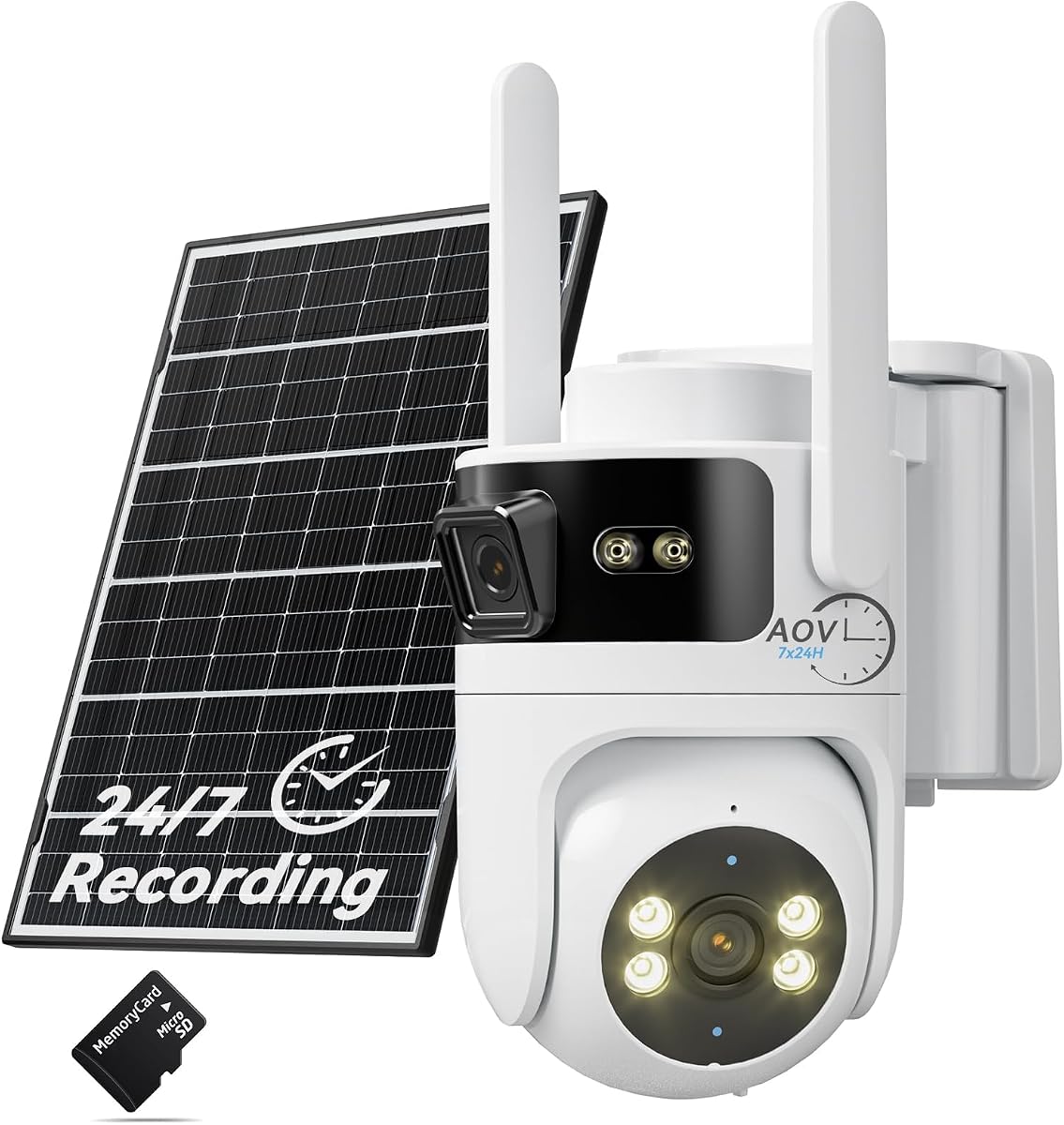
LongPlus Solar AOV
5.0Editor score
Solar 24/7 AOV recording
Dual-band Wi-Fi support
AI alerts and two-way talk
Our Dual Lens Outdoor WiFi Security Cameras guide compares ten models for dual-view coverage, tracking, night vision, solar power, Wi-Fi support, and storage.
Dual lens outdoor WiFi security cameras combine a fixed wide view with a movable pan/tilt or telephoto lens, helping reduce blind spots around driveways, yards, porches, garages, and entrances. The best models also support intelligent detection, useful night imaging, flexible storage, and dependable outdoor connectivity.
We compared all ten cameras by examining lens resolution, viewing range, tracking behavior, night vision, power options, weather resistance, Wi-Fi bands, storage choices, and smart-home integration. The list includes wired, battery-powered, and solar models so readers can compare installation demands as well as surveillance features.
Each review explains the strongest reasons to consider that camera, along with practical limitations to keep in mind. The top picks highlight especially balanced options for budget-conscious, premium, and all-around use. Product availability and prices can change, so confirm current listing details before buying.
5.0Editor score

4.5Editor score
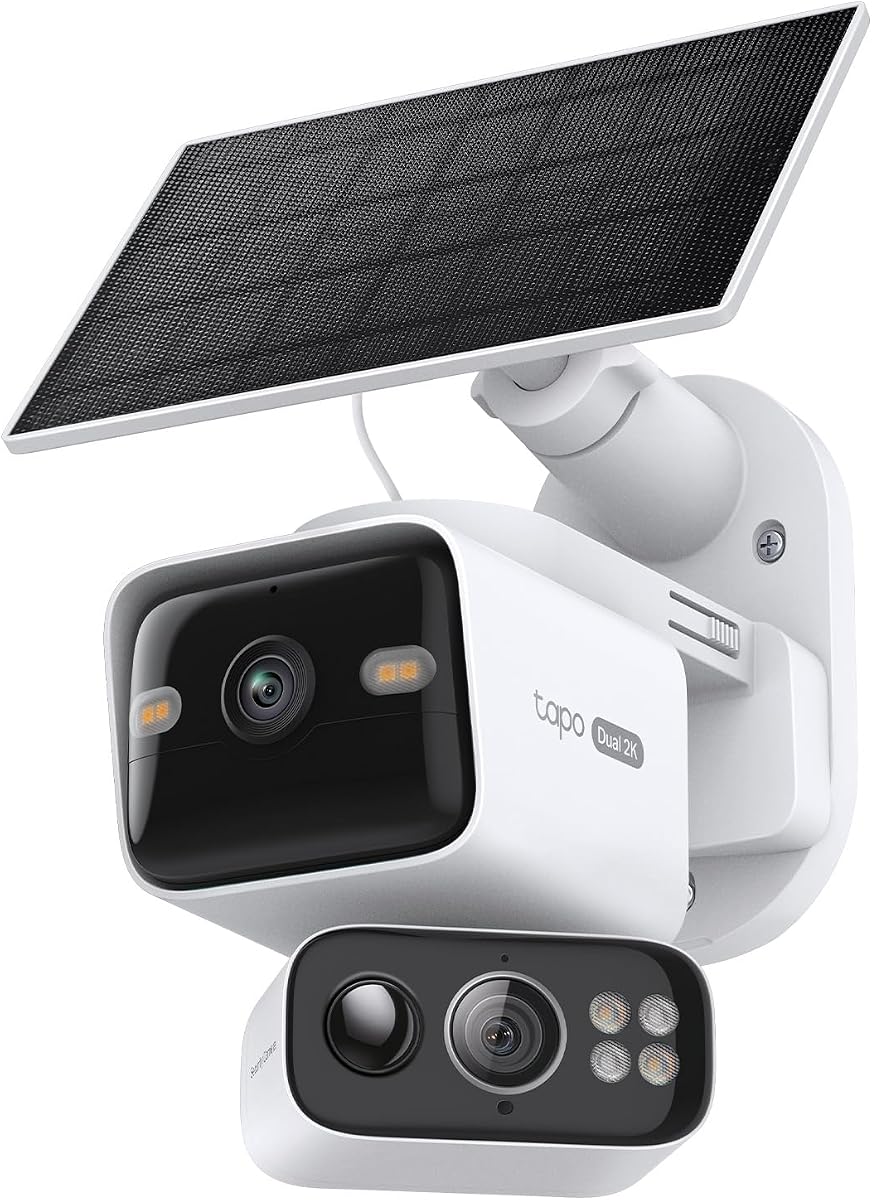
4.4Editor score
The comparison below highlights the defining lens, power, connectivity, imaging, and storage features of each dual lens outdoor WiFi security camera, making it easier to identify the model that best fits a particular property and installation plan.


The Tapo C246D is a wired dual lens outdoor WiFi security camera that combines a fixed 2K wide-angle lens with a separate 2K pan/tilt lens. Its 4.5 rating reflects a well-rounded feature set, including precise zoom, broad pan/tilt coverage, AI-powered alerts, night vision, and flexible storage. It stands out as an adaptable wired option for users who want precise control rather than relying on a single automatic view.
We may earn a commission when you buy through this link, at no additional cost to you.
The fixed lens offers a 125-degree field of view, while the movable lens adds a 6mm telephoto perspective and can pan 360 degrees horizontally and 152 degrees vertically. Because the lenses can be positioned independently, the camera can maintain a broad reference view while the second lens follows important activity. Tapo also supports one-tap smart focus, letting users select an area in the wide live view and have the pan/tilt lens center and zoom toward it.
AI detection can distinguish people, pets, vehicles, and baby cries, with selectable notification categories for fewer irrelevant alerts. The fixed lens can cue the pan/tilt lens to track detected motion, while privacy and detection zones help direct recording and attention toward relevant areas. Recordings can remain on a microSD card up to 512GB, sold separately, or use Tapo Care cloud storage. Night viewing options include infrared, full color with spotlights, and an automatic mode.
The main tradeoff is installation. Because this is a wired camera, it needs a dependable power connection and suitable placement, although that also removes battery-management concerns. It supports only 2.4GHz Wi-Fi. Overall, it is an excellent choice for a homeowner who values lens independence, app controls, useful detection categories, and local recording in a thoughtfully wired installation.
Its combination of a broad fixed perspective and a separately controlled telephoto lens makes it especially effective for entrances, driveways, and other spaces where both context and detail matter. Users should prioritize stable Wi-Fi reception and a weather-protected power route during installation.
The fixed wide-angle lens preserves a consistent view of a key area, while the pan/tilt lens can investigate movement or zoom into smaller details. This dual arrangement gives users context that a standard digital zoom often cannot reproduce as clearly.
Selectable AI detection categories and privacy zones make alerts more useful, while support for microSD cards and optional cloud service gives users more control over where recordings are kept.
We may earn a commission when you buy through this link, at no additional cost to you.
The LongPlus AOV is a solar-powered dual lens outdoor WiFi security camera designed for properties without an easy electrical connection. It has a 5.0 rating and combines two 2K lenses with 24/7 AOV recording, an 8-watt solar panel, and an 8,800mAh rechargeable battery. The result is a flexible option for garages, yards, farms, and remote entrances.
We may earn a commission when you buy through this link, at no additional cost to you.
Its fixed lens can watch a defined area such as a garage while the pan/tilt lens scans 350 degrees horizontally and 91 degrees vertically. AOV recording is designed to conserve energy by operating at a lower frame rate in static conditions and increasing activity when a person or car is detected. The listed power-saving approach is approximately 90%, and the battery can support about one month of 24/7 recording without sunlight.
Connectivity is a meaningful strength because the camera supports both 2.4GHz and 5GHz Wi-Fi. It automatically selects a suitable band, giving users a choice between longer range and faster local performance. Human detection can activate an audio and strobe alarm, and the built-in microphone and speaker support two-way communication through the app. Four LED lights and four infrared lights provide day-and-night viewing for both lenses.
Potential drawbacks include the limited value of the included battery under prolonged poor sunlight and the fact that the package contains one camera rather than a multi-camera set. Storage options include a built-in 32GB SD card, support for cards up to 512GB, and a stated cloud trial for new accounts. For users seeking solar independence and continuous recording without running power cable, these limitations are reasonable trade-offs.
This camera is a particularly compelling option for a remote gate, farm building, parking area, or wide yard where wiring would be inconvenient. Buyers should position the solar panel where it receives meaningful direct sunlight and confirm that their chosen network band remains stable at the installation site.
Solar charging and a substantial rechargeable battery remove the need for a nearby outlet. AOV recording is especially useful for users who want more continuous monitoring than a conventional motion-activated battery camera may provide.
The combination of human detection, an audio and strobe alarm, and two-way talk allows users not only to monitor activity but also respond through the app or attempt to discourage unwanted visitors.
We may earn a commission when you buy through this link, at no additional cost to you.
The Hiseeu 2Pack is a bundle of two wireless dual lens outdoor WiFi security cameras, giving users a practical way to monitor two separate areas. Its 4.2 rating reflects a useful combination of fixed-lens context, PTZ movement, human tracking, extended-range Wi-Fi, three night vision modes, and IP66 weather resistance.
We may earn a commission when you buy through this link, at no additional cost to you.
Each camera pairs a fixed lens with a movable PTZ lens, allowing a stationary view of one area while the second lens follows people. A sensitive PIR sensor supports notification delivery through the Eseecloud app. The system also supports manual device sharing, which can help family members view relevant activity without giving every user unrestricted control.
The listed Wi-Fi Pro connectivity reaches up to 60 feet, with 2.4GHz support for longer range and 5GHz support for faster transfer. Outdoor durability is rated IP66, and built-in LED lights provide color night vision and a light-alarm function. Users can select infrared, full-color night vision, or intelligent color adjustment depending on the scene and their preferred balance of clarity and visibility.
The main limitation is that the supplied information does not state the camera's exact resolution, so buyers cannot compare its fine-detail capability directly with models that list 2K, 3MP, 4MP, or 6MP output. A two-camera bundle may also be unnecessary for a small property. Even so, it offers one of the clearest advantages of dual lens design: automatic movement tracking while preserving a fixed reference view.
This pack is best for buyers who want to monitor two exterior zones and value linked human tracking. It may suit a home with a front approach and a backyard, two driveway corners, or separate buildings. Placement should prioritize strong Wi-Fi coverage and clear sightlines for both lens modules.
The two-camera configuration can cover separate outdoor zones without requiring users to choose a single camera location for both a fixed reference view and an entire property.
The PTZ lens follows detected people while the top fixed camera maintains its wider orientation. Selectable sharing controls add convenience for households or small businesses that need more than one person to monitor footage.
We may earn a commission when you buy through this link, at no additional cost to you.
The EVERSECU 6MP is a wired dual lens outdoor WiFi security camera built around detail, flexible PTZ movement, and broad integration support. Its 4.4 rating is supported by 6MP output, a wide-angle lens paired with a 4X telephoto lens, 360-degree-style pan and tilt coverage, color night vision, two-way audio, and human-detection tracking.
We may earn a commission when you buy through this link, at no additional cost to you.
When the bullet screen is selected, the dome lens adjusts and rotates toward a target. The two perspectives can be displayed concurrently on one screen, allowing users to retain a broad view while using the telephoto lens for identification details. The camera reaches 355 degrees of horizontal rotation and 90 degrees vertically, and the listed clear imaging range extends up to 30 feet.
Night performance is supported by 12 built-in lights, with full-color or infrared viewing stated to reach 60 feet. Three night vision modes offer flexibility for changing conditions. AI human detection is designed to reduce false alerts caused by leaves and insects, after which the camera can track a person and send a mobile notification. If the target leaves the camera's range, it returns to its preset guard position.
Its most notable technical benefit is RTSP support. After setting a password in the O-KAM app, users can access the stated RTSP address and integrate the camera with applications such as Blue Iris, iSPY, ZoneMinder, Security Spy, VLC, and compatible NVRs. Alexa compatibility and a two-way audio system add further versatility. As a wired unit, it requires a stable power source and careful cable routing.
This camera is a strong fit for technically inclined users who want both high-resolution recording and third-party software access. It is less convenient for a simple wireless-only setup, but the combination of telephoto detail, tracking, night illumination, and RTSP makes it a flexible choice for a fixed surveillance location.
A 6MP platform and separate 4X telephoto lens help users inspect smaller subjects, while simultaneous wide and zoomed screens preserve environmental context during an investigation.
RTSP access can connect the camera to compatible NVR and surveillance software, making this a practical option for users who already maintain a broader smart-home or video-monitoring ecosystem.
We may earn a commission when you buy through this link, at no additional cost to you.
The TKENPRO Solar is a wireless dual lens outdoor WiFi security camera designed for flexible placement around a porch, driveway, yard, or garage. Its 4.2 rating reflects useful 2K imaging, broad 360-degree pan and tilt coverage, solar charging, PIR detection, two-way communication, and support for both local memory and cloud storage.
We may earn a commission when you buy through this link, at no additional cost to you.
One fixed lens maintains a view of a critical area while the rotating lens sweeps 355 degrees horizontally and 110 degrees vertically. The stated aim is to reduce distortion and blind spots while preserving a broad field. A white spotlight and infrared LED array provide color imagery and conventional night vision, making it possible to select a lighting approach based on the scene.
Solar power and a rechargeable battery remove the need for routine battery removal or a power cable. Its IP65 rating is designed for rain, snow, and other outdoor conditions. PIR sensing and AI detection are included to reduce false alerts, while two-way talk allows users to communicate with visitors through the app. Recorded video can be stored on a memory card up to 256GB, sold separately, or in cloud storage.
The important limitation is network compatibility. This model uses 2.4GHz Wi-Fi only, which may actually help it maintain range in some outdoor positions, but it cannot take advantage of a 5GHz-only network. It also includes neither a memory card nor the premium cloud tiers. Users who need Ethernet, 5GHz support, or the broadest professional integrations may need to consider another option.
This camera suits buyers seeking a straightforward wireless installation and a broad movable view without running cable. It is particularly appropriate where a fixed sunlit location can support the included solar panel. Solid short-range Wi-Fi coverage and regular firmware maintenance remain important for reliable alerts and live viewing.
The solar panel and rechargeable battery allow placement without a nearby outlet. Users should select an orientation that captures dependable sunlight while keeping the camera within a usable Wi-Fi signal.
A spotlight supports full-color imagery, while infrared illumination provides a more discreet alternative. The combination is useful for both identifying activity and maintaining coverage after dark.
We may earn a commission when you buy through this link, at no additional cost to you.
The Tapo C645D KIT is a premium solar dual lens outdoor WiFi security camera combining a fixed 165-degree ultra-wide lens with a 2K pan/tilt telephoto lens. Its 4.4 rating reflects a capable and flexible system with independent lens control, synchronized tracking, dual-band Wi-Fi, a 10,000mAh battery, and subscription-free recording.
We may earn a commission when you buy through this link, at no additional cost to you.
The broad fixed lens establishes a panoramic reference view, while the second lens can pan 360 degrees horizontally and provide sharp zoomed detail. When enabled in the Tapo app, motion detected by the fixed lens can direct the pan/tilt lens to follow the subject. This synchronized approach is valuable in broad outdoor spaces where one fixed perspective alone cannot provide enough detail.
Power is handled by solar charging and a large backup battery. The stated charging guidance is that one hour of direct sunlight can support a full day of use, while the battery can last up to four months on one charge during cloudy conditions. Solar charging requires temperatures above 32°F. The camera supports both 5GHz and 2.4GHz Wi-Fi, with the shorter-range band offering faster connections and the longer-range band better suited to distant placements.
AI detection identifies people, vehicles, and pets without requiring a subscription for those core detection features. Full-color night vision uses spotlights, while infrared mode provides a more discreet, power-efficient alternative. The kit is also listed as a USA Today Top Pick at CES 2026, and Tapo states that the device reflects its participation in the CISA Secure-by-Design pledge.
Its main limitations relate to configuration and environmental conditions. It is a premium kit rather than the simplest single-camera installation, and solar performance depends on adequate direct sunlight and temperatures above the stated charging threshold. For users who want premium lenses, sophisticated detection, local recording, and flexible connectivity without ongoing subscription requirements, however, the feature balance is exceptionally strong.
The 165-degree fixed lens captures an unusually broad area, while the separate pan/tilt telephoto lens can concentrate on a person, vehicle, or other subject. Independent control helps balance awareness and detail.
Solar charging and a 10,000mAh battery reduce dependence on wired power, while dual-band Wi-Fi gives users more choices when balancing speed, range, and network conditions.
We may earn a commission when you buy through this link, at no additional cost to you.
The ICSEE 2X3MP is a wired dual lens outdoor WiFi security camera with two 3MP lenses, human detection, automatic tracking, and broad compatibility with common surveillance platforms. Its 3.8 rating is the lowest in this comparison, but the feature set includes useful details such as 5X digital zoom, color night vision, two-way audio, and ONVIF support.
We may earn a commission when you buy through this link, at no additional cost to you.
The upper fixed lens supplies a stable broad view, while the lower PTZ lens can follow detected people and return to a default point when the subject leaves. Users can touch a location in the fixed view and the PTZ lens will move toward it and lock there. Dual-band 2.4GHz and 5GHz Wi-Fi support gives the camera more network flexibility than many 2.4GHz-only alternatives.
Recording can be handled through a built-in SD card slot supporting up to 128GB and stated 24/7 recording, with encrypted secure cloud storage also available. Built-in floodlights and full-color night vision improve visibility in dark conditions, while 5X digital zoom allows more flexible framing. Two-way audio supports communication through the ICsee app, and notifications are sent when motion is detected.
Compatibility is a major strength. The camera is listed as working with ONVIF NVRs and software such as Blue Iris, iSpy, Tiny Cam, and IPCam Viewer, as well as QNAP and Synology platforms. Its limitations are the need for an outlet and a relatively low rating that may reflect mixed experiences. The two 3MP sensors also do not match the higher stated resolution of the 6MP alternatives for fine-detail work.
This is a practical selection for a budget-conscious buyer who already uses ONVIF-compatible equipment or wants to connect a camera to third-party software. It is less suited to someone prioritizing a simple battery or solar setup, but for a fixed location with reliable power and network access, its combination of tracking, zoom, and interoperability is considerable.
ONVIF support and compatibility with major NVR platforms make this camera easier to incorporate into an existing surveillance system. Users can retain familiar software instead of remaining confined to a single mobile ecosystem.
Touching a location in the fixed image directs the movable lens to that point. Human detection and tracking add an automated layer, while 5X digital zoom helps users refine the view manually.
We may earn a commission when you buy through this link, at no additional cost to you.
The LongPlus Wi-Fi 6 is a solar dual lens outdoor WiFi security camera focused on continuous AOV recording and flexible wireless connectivity. Its 5.0 rating is shared for the highest rating in this roundup, while the feature set includes dual 2K lenses, Wi-Fi 6, an 8-watt solar panel, and an 8,800mAh rechargeable battery.
We may earn a commission when you buy through this link, at no additional cost to you.
A fixed lens watches a priority area while the pan/tilt lens scans 350 degrees horizontally and 90 degrees vertically. AOV technology records at 15 frames per second when a person or car triggers activity and at an adjustable 1 frame per second in static environments. The stated design reduces power consumption by approximately 90% and can maintain about one month of 24/7 recording without sunlight.
The camera supports 2.4GHz and 5GHz Wi-Fi, and the product information identifies Wi-Fi 6 connectivity. Humanoid detection can trigger an audio and strobe-light alarm, while a built-in microphone and speaker support real-time two-way communication. Both lenses provide 2K daytime and nighttime imagery, supported by four LED lights and four infrared lights for color or infrared viewing.
Compared with the closely related LongPlus AOV model, this listing emphasizes Wi-Fi 6 and has a slightly different vertical pan/tilt figure. As with any solar device, long-term reliability depends on the installation's solar exposure, seasonal weather, and battery condition. The camera also has no stated premium subscription requirement for its core functions, which is important for continuous-recording users.
Buyers looking for an all-season, always-oriented outdoor camera should find this model especially interesting. It suits remote properties, farm structures, gates, and wide driveways where a low-power continuous mode is more valuable than a short burst of high-frame-rate footage.
The camera preserves continuous orientation while varying its frame rate according to activity. That makes it more suitable than a purely motion-triggered design for users who want a reliable record of unattended areas.
Support for both Wi-Fi bands allows users to favor longer 2.4GHz range or faster 5GHz performance. The listed Wi-Fi 6 capability may also improve efficiency in compatible networks and crowded wireless environments.
We may earn a commission when you buy through this link, at no additional cost to you.
The ICSEE 6MP is a dual lens outdoor WiFi security camera that combines two 3MP sensors, simultaneous screens, human tracking, and both wireless and Ethernet connectivity. Its 4.3 rating makes it a well-rounded option for users who want flexible networking, detailed 3K-class imagery, and strong outdoor night viewing.
We may earn a commission when you buy through this link, at no additional cost to you.
The fixed and PTZ lenses provide a broad field of view and can be displayed together in the iCSee app. A white lamp and infrared lamp offer three night modes: full color, infrared, and intelligent vision. The listed best night-vision distance reaches 65 feet, making the camera useful for yards, driveways, gates, and other areas where distance matters.
Human detection identifies people and can display a person's trajectory while automatically tracking movement. The app can send real-time alarms and capture images or video of detected activity. A built-in microphone and speaker enable two-way conversation, and access sharing lets family members, friends, or security personnel view the system with appropriate permissions.
The networking choice is particularly notable. Users can connect over Wi-Fi for a simpler setup or use the stated Ethernet option for a more stable wired connection. Recording supports 24/7 capture, a microSD card up to 128GB, or cloud storage. Alexa compatibility provides voice-control integration. The primary limitations are the need for power and the lower 128GB local-storage ceiling compared with some alternatives.
This camera is a strong middle-ground option for buyers who value detailed dual views and connection flexibility. It is particularly attractive where a wired network run is possible but full Ethernet-only installation is unnecessary. Home users, small businesses, and property managers can benefit from the combination of tracking, night illumination, and multi-user access.
Showing both the fixed and PTZ views together helps users understand where activity occurred and then inspect the relevant direction. It also reduces the need to switch screens while an incident is unfolding.
Users can begin with Wi-Fi or choose Ethernet for a steadier path. This flexibility makes the camera easier to adapt to different properties, including locations where a network cable is available but not required.
We may earn a commission when you buy through this link, at no additional cost to you.
The SEHMUA 2-Pack is a bundle of two solar dual lens outdoor WiFi security cameras, each showing two live views at once in the Ubox app. Its 4.2 rating reflects an attractive combination of 2K and 4MP image detail, PIR detection, color night vision, solar power, and custom controls for different monitored areas.
We may earn a commission when you buy through this link, at no additional cost to you.
One fixed lens can remain focused on a garage or front door while the PTZ lens turns toward the yard or street. Each camera uses dual 2K/4MP lenses, with infrared and spotlight support for full-color night imagery when motion occurs. That combination is particularly useful for checking late deliveries, identifying activity near an entrance, or watching pets after dark.
PIR motion detection includes human filtering to send relevant alerts and record event clips. If the fixed lens detects activity near a garage, the user can redirect the PTZ lens toward the yard while receiving a notification. Two-way talk helps users greet visitors or provide delivery instructions. Custom detection zones, schedules, and sensitivity settings make it possible to tailor the cameras to front doors, driveways, or small-business entrances.
Each camera includes a rechargeable battery and 6-watt solar panel, reducing the need for frequent removal and charging. IP65 weather protection is intended for rain, dust, heat, and cold. The app supports sharing with up to four users, allowing several family members or staff members to view live footage. The important limitation is that the cameras operate on 2.4GHz Wi-Fi only.
This bundle is a good match for users who want more than one exterior monitoring point without running power cables. Each unit needs a workable solar location and adequate short-range wireless reception, so the two-camera set is best suited to properties with two viable installation points. For those conditions, it delivers broad coverage with considerable flexibility.
Two cameras can cover separate homes, buildings, gates, or sides of a property. Within each unit, simultaneous fixed and PTZ views help users monitor both a specific point and a wider surrounding area.
The 6-watt panels and rechargeable batteries reduce charging interruptions, while custom zones, schedules, and sensitivity controls help keep alerts relevant. Shared access also makes the pair suitable for family or small-business monitoring.
We may earn a commission when you buy through this link, at no additional cost to you.
A good dual lens outdoor camera should balance wide-area awareness, detailed zoom, reliable tracking, outdoor power, and dependable connectivity. Comparing those elements against the actual coverage and placement of your property is more useful than focusing on one headline specification.
A dual lens design works best when the two views have clearly defined roles. The fixed lens should cover a stable reference area, such as a front door, garage, or gate, while the pan/tilt lens covers a broader yard or follows moving subjects. Look at the stated mechanical pan and tilt ranges, but also consider the fixed lens field of view. Some listings offer horizontal rotation approaching 360 degrees, while vertical ranges differ considerably. A wider movement range can reduce the need to reposition the camera manually, although the body must still be mounted in a location with a clear line of sight.
Choose a camera whose fixed and movable lenses cover different but complementary areas. Placing both in nearly the same direction wastes the benefit of dual lenses and can leave gaps elsewhere.
Dual 2K, dual 3MP, 4MP, and 6MP configurations all provide useful outdoor detail, but they are not equal. A fixed lens with a broader field of view establishes context, while a telephoto or digitally zoomed lens helps distinguish smaller objects. The stated 4X or 5X zoom capabilities of some models add flexibility, although digital zoom can reduce clarity compared with optical detail. Consider the viewing distance, lighting conditions, and the size of the subjects you expect to identify rather than relying only on the largest available pixel figure.
Prioritize a balanced dual-resolution system if fine details matter, but verify that the fixed lens is not sacrificing too much resolution. The best results come from a clear subject, controlled lighting, and viewing distances within the camera's intended range.
Solar outdoor cameras are ideal where running electrical cable would be difficult. Look for an included panel, rechargeable battery capacity, and realistic guidance about operation during cloudy periods. Some cameras emphasize continuous AOV recording, while others are optimized around motion-triggered events. Direct sunlight, panel orientation, seasonal temperature, and nearby obstructions all affect runtime. A larger battery and efficient recording mode can improve resilience, but no solar camera completely removes the need to consider battery condition and local weather.
For an exposed yard or gate, solar power usually offers greater placement freedom than a wired camera. For a sheltered entrance with nearby power, a wired model may be simpler and more consistent.
Outdoor cameras must operate after dark, and dual lenses place different demands on illumination. Infrared produces a conventional monochrome view with minimal visible disturbance, while a spotlight can create a color image that is easier to interpret. Intelligent modes can switch between the two. Listed night ranges range from about 60 feet to 65 feet on several models, but actual clarity depends on reflective surfaces, weather, lens placement, and ambient light. Wider scenes benefit from even illumination, whereas a telephoto lens can capture more useful detail from a greater distance.
Choose infrared for discreet monitoring or color for easier identification. If the camera covers a road-facing area, check whether bright lighting could affect neighbors or distract drivers.
Human detection can reduce the number of irrelevant alerts caused by animals, foliage, insects, or moving shadows. Some cameras also identify vehicles and pets, which is useful for driveways and yards. Tracking generally works by using motion detected in one view to guide the movable lens toward the subject. Users should still adjust sensitivity, establish restricted zones, and understand that tracking quality depends on the subject remaining visible. Notifications are most helpful when categories are selected rather than every possible movement triggering an alert.
Prioritize models that let you choose detection types and configure zones. This prevents a powerful tracking system from becoming a source of unnecessary notifications.
The listed models support either 2.4GHz only or both 2.4GHz and 5GHz. The 2.4GHz band generally provides better outdoor range and is less congested, while 5GHz can offer faster performance at shorter distances. Some products mention Wi-Fi 6, which can improve efficiency in compatible environments. A dual-band camera is more flexible, but the strongest signal at the intended mounting point still matters more than the label. Thick walls, metal objects, closed garages, and long property distances can all reduce signal quality. Ethernet support on select models provides an alternative for locations with a stable wired network.
Use a phone near the proposed mounting position to check signal strength before drilling. For solar cameras, the panel location and camera position should remain close enough for a reliable connection.
Local microSD storage is attractive for users who want routine recording without an ongoing cloud subscription. Capacity limits range from 128GB on several models to as high as 512GB on others, and memory cards are sometimes not included. Cloud services can add remote access or longer retention, but their cost and availability change. For more established monitoring systems, RTSP and ONVIF compatibility can connect a camera to an NVR or third-party application. Alexa support provides another way to view live video, though it does not replace careful account and network configuration.
Decide whether local storage, cloud retention, or third-party integration matters most. Check the current app requirements, card limits, and subscription details before finalizing a purchase.
Begin by mapping the area before mounting the camera. Identify a fixed subject such as a door, bin, garage, or gate for the wide lens, then choose the direction the pan/tilt lens should cover. Check Wi-Fi reception at the exact mounting point, especially if the camera will use solar power. Confirm that the location provides a suitable view, unobstructed sunlight for a panel, and manageable cable routing for a wired unit.
Install the camera according to its listed weather-resistance rating and the manufacturer's guidance. Use appropriate wall anchors and weather seals, keep the lens glass clean, and avoid directing the sun or a strong light source directly into the lens. Connect it to the app, update the firmware, set the time zone, create detection and privacy zones, and select the relevant AI categories. Test live viewing, tracking, two-way audio, night illumination, recording, and alert notifications before relying on the camera unattended.
For ongoing care, periodically inspect the mount for looseness, clean dust or water from the lens, and verify that the solar panel remains unobstructed. Review the battery condition on solar models and replace or recharge the battery according to the manual. Review stored footage and account permissions periodically, remove access for former household members or employees, and keep the app and firmware current. If live footage becomes unreliable, test the network before changing camera settings.
A dual lens camera can maintain a broad, fixed view while a second lens pans, tilts, zooms, or follows a subject. This often provides more useful context than a single camera that must move its entire field of view. It can also reduce blind spots when both lenses are positioned thoughtfully.
They can be better when continuous wide-area awareness and detailed tracking are both important. A fixed lens preserves context that would otherwise be lost when a single PTZ lens moves. However, a high-resolution single lens may still be sufficient for a small, fixed area and may provide a simpler installation.
Several models in this roundup support local microSD recording, including models designed for 24/7 capture. Capacity and continuous-operation support vary, and some cameras are better optimized for motion-triggered recording. Cloud retention may still be optional, but it is not required for basic local monitoring on every listed model.
The 2.4GHz band generally travels farther and is often more suitable for outdoor placements. The 5GHz band can provide faster performance where the camera is closer to the router. Dual-band models give users more flexibility, while 2.4GHz-only models may still be the simplest option where long range matters.
The amount depends on the panel, battery capacity, recording mode, and local weather. One listed Tapo model states that one hour of direct sunlight can provide a full day of use, while the LongPlus models describe approximately one month of AOV recording without sunlight after charging. Users should still prioritize a clear, unobstructed panel orientation and check performance through the seasons.
Solar and battery models can operate without a nearby outlet, provided the panel receives adequate sunlight and the battery is maintained. Wired options such as the Tapo C246D and EVERSECU require a power connection. Choosing a wired model may be worthwhile when a reliable cable route already exists.
Some models support RTSP, ONVIF, Alexa, or third-party applications. The ICSEE 2X3MP is listed as compatible with ONVIF NVRs and several software platforms, while the EVERSECU supports RTSP and is compatible with numerous third-party systems. Other cameras may provide app-only control or smart-home display support.
A fixed wide lens can monitor the driveway entrance while the pan/tilt lens scans the wider yard or follows a vehicle. Solar or wired power depends on the property, and strong Wi-Fi reception is important if alerts and live viewing need to remain responsive. AI vehicle detection, if available on the selected model, can further reduce irrelevant activity alerts.
The Tapo C246D is the most balanced wired choice, combining independently positioned 2K lenses, detailed AI detection, synchronized tracking, and flexible local or cloud storage. The LongPlus AOV stands out as the budget-oriented solar pick for continuous recording, while the Tapo C645D KIT offers a more premium combination of ultra-wide coverage, telephoto detail, dual-band Wi-Fi, and large battery capacity.
Prioritize the factors that affect your property most: view the fixed and movable lens placement together, confirm adequate Wi-Fi at the installation point, and choose power based on access to wiring and sunlight. Night vision, tracking, recording method, and smart-home compatibility should follow the way you intend to use the camera rather than a single specification.
Before purchasing, verify the current product listing, included accessories, app compatibility, memory-card requirements, and any storage service details. Prices and promotions change, as do firmware features and network requirements, so checking the latest listing can prevent an avoidable mismatch between the camera and your installation plan.