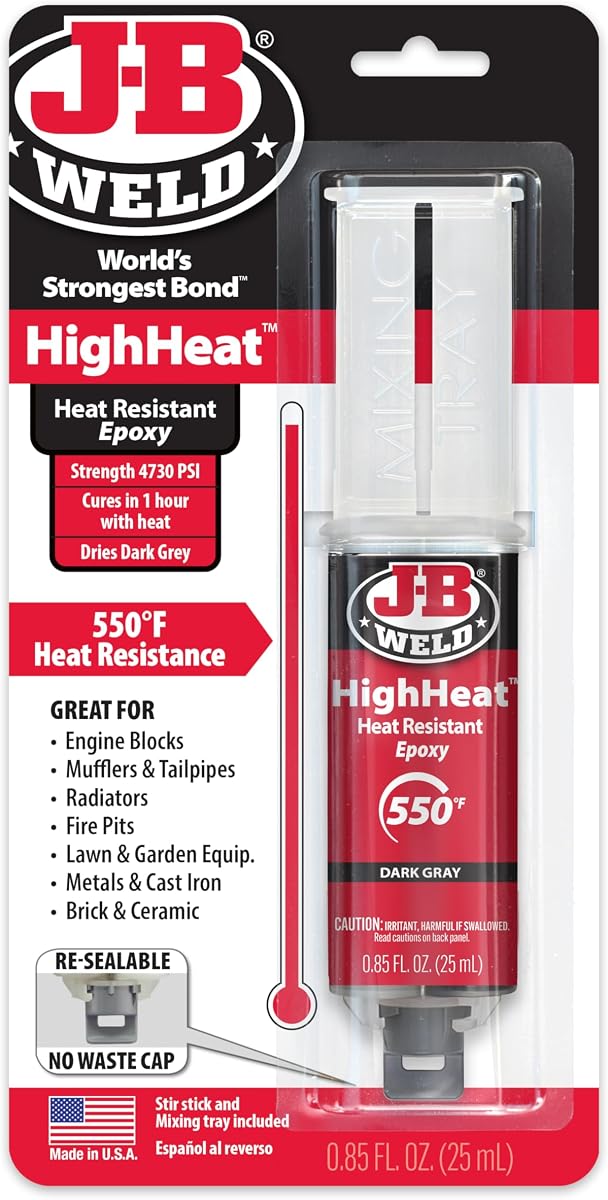
J-B Weld High Heat Epoxy Syringe, Dark Grey
4.6Editor score
4730 PSI stated bond strength
Two-part epoxy cures permanently
Handles heat, fuel, chemicals
Heat Resistant Adhesive guide comparing ten options for temperature tolerance, curing time, sealing strength, ease of use, and compatibility with demanding
Heat Resistant Adhesive is formulated to bond, seal, or repair materials exposed to elevated temperatures, making it useful for appliances, grills, fireplaces, ovens, exhaust components, and industrial equipment. The right product must tolerate heat without weakening, while also adhering effectively to the surfaces involved.
This guide compares ten heat-resistant bonding and sealing products based on stated temperature limits, curing requirements, mechanical strength, flexibility, chemical resistance, application method, and compatible materials. It includes general-purpose silicones, two-part epoxies, metallic repair compounds, and a refractory sodium silicate solution.
Each review explains the product's strongest use case, practical limitations, and ideal project. Ratings and specifications reflect the supplied product information, while prices and availability can change, so readers should confirm current listing details before making a purchase.
4.6Editor score

4.6Editor score

4.2Editor score
The table below compares all ten products by their stated heat tolerance, curing behavior, bonding or sealing function, and most suitable applications, making it easier to identify the right product for a specific repair.


This 3.53-ounce silicone sealant combines a stated operating range of -50°C to 550°C with a 4.6 rating, making it a strong general-purpose option for heat-exposed household repairs. Its most appealing qualities are rapid surface drying, flexible cured rubber, and a formulation intended to prevent heat, moisture, and smoke from leaking through gaps.
We may earn a commission when you buy through this link, at no additional cost to you.
The adhesive is particularly relevant around ovens, fireplaces, microwaves, induction cooktops, and grills. A pointed nozzle helps place material accurately in seams or damaged areas, while the stated 3–5 minute surface-drying time can make a repair feel comparatively immediate. Once fully cured, the seal is described as elastic and capable of tolerating vibration, thermal expansion, and contraction without cracking.
Its practical limitation is that surface dryness is not the same as complete cure. The listed full curing period is 2–4 hours, so the repaired component should not be returned to service immediately if an uninterrupted bond is important. Users must also ensure that the surfaces are compatible and properly prepared, because no adhesive can compensate for contamination or an unsuitable substrate.
This is a compelling choice for household sealing tasks that require flexibility and a broad temperature range. It suits DIY users who need to address small gaps around compatible hot appliances, heating equipment, or cooking surfaces without mixing a multi-part epoxy. For repairs that demand a rigid, drillable, or immediately structural bond, a different product category may be more appropriate.
The cured silicone is described as remaining elastic and resisting cracks under vibration and thermal expansion or contraction. That flexibility makes it especially useful for seams and gaskets that repeatedly warm, cool, or move slightly during operation.
A pointed nozzle makes controlled placement easier, and the stated 3–5 minute surface-drying time helps speed routine repairs. Full curing still takes 2–4 hours, allowing the material to develop its final sealing performance before heat exposure.
We may earn a commission when you buy through this link, at no additional cost to you.
J-B Weld High Heat Epoxy is a two-part structural adhesive with a 4.6 rating and a stated heat resistance of up to 550°F. Unlike flexible silicone, its primary appeal is a rigid permanent bond, including a listed strength of 4730 PSI. It is positioned for heat-resistant repairs where a durable joint matters more than easy flexibility.
We may earn a commission when you buy through this link, at no additional cost to you.
The resin and hardener are mixed at a 1:1 ratio, which keeps the process straightforward while still requiring careful measurement. At room temperature, the product sets in one hour and cures in 24 hours. Heat can accelerate curing, with the supplied information stating that the epoxy can cure in one hour at 250°F, though controlled heating should be considered in relation to the workpiece and safety requirements.
Chemical and fuel resistance broadens its usefulness beyond a simple household seam. This makes it relevant for components exposed to oils, fuels, or demanding mechanical conditions. The trade-off is that epoxy creates a hard bond rather than a flexible gasket, so it may not tolerate movement as gracefully as RTV silicone. It also demands more curing time than products described as surface-dry within minutes.
For budget-conscious DIY users seeking strong bonding in a heat-exposed repair, this is one of the most compelling options in the guide. It is best suited to compatible rigid parts and carefully prepared joints. Users should follow the mixing instructions precisely and allow the stated curing period when performance depends on the bond reaching full strength.
The listed 4730 PSI strength and permanent two-part bond distinguish this epoxy from flexible sealants. It is better suited to joining compatible rigid components than maintaining a movable gasket or filling a seam that must flex repeatedly.
The epoxy sets in one hour at room temperature and fully cures in 24 hours, while the supplied information notes that heat can shorten curing. Users should account for the entire curing process before placing a repaired part under sustained load.
We may earn a commission when you buy through this link, at no additional cost to you.
Rutland's black high-temperature silicone sealant carries a 4.6 rating and is rated to withstand up to 500°F. It forms a tough, flexible seal and is listed for clean surfaces including glass, metal, plastics, fiberglass, wood, brick, and stone. That broad material compatibility makes it useful when a project involves more than one substrate.
We may earn a commission when you buy through this link, at no additional cost to you.
The product's listed applications include sealing fireplace inserts, applying ceramic tiles to a fireplace surround, repairing solar panels, and installing heat shielding behind a stove. These examples show its value in heat management and general maintenance rather than a single narrow application. The black finish may also be preferable where a discreet repair line is desired around a dark appliance or fixture.
Compared with more specialized automotive or industrial products, this sealant offers a straightforward general-purpose proposition. Its 500°F rating is ample for many household heating and cooking applications, though it does not match the stated upper limits of several high-temperature silicones in this guide. Buyers should also allow the material to cure according to its own instructions before exposing it to heat.
This Rutland sealant is a solid choice for fireplace-adjacent sealing, heat shielding, or general household repairs on compatible surfaces. It is particularly attractive when a black, flexible bond is needed and several different materials may be involved. Projects requiring extreme-temperature ratings should verify whether its 500°F limit provides enough margin.
The listed substrate range includes metal, glass, plastics, fiberglass, wood, brick, and stone. This makes the sealant a practical option for household projects that combine different surfaces instead of requiring a product narrowly dedicated to one material.
Sealing fireplace inserts, attaching ceramic tiles to a fireplace surround, and placing heat shielding behind stoves are among the stated uses. These applications highlight its value in areas where heat management and dependable adhesion must work together.
We may earn a commission when you buy through this link, at no additional cost to you.
This 3.53-ounce high-temperature silicone adhesive has a 4.4 rating and a stated range of -50°C to 650°C, giving it the highest listed upper temperature among the flexible silicones in this roundup. It is designed to retain adhesion, flexibility, and sealing performance in high-temperature environments.
We may earn a commission when you buy through this link, at no additional cost to you.
The formulation is described as waterproof, moisture-proof, and weather resistant. Once cured, it remains elastic and is intended to withstand vibration, thermal expansion, and contraction without cracking. Its sealing function is especially relevant to gaps through which heat, moisture, or smoke could otherwise move, making it relevant to ovens, fireplaces, microwaves, induction cooktops, and grills.
Its main drawback is the 24-hour full curing period. The surface may dry in 10–15 minutes, but that should not be confused with complete curing. Users who need to return an appliance or heating component to service quickly may find the wait inconvenient. The 4.4 rating also trails the 4.6 ratings assigned to several alternatives, although rating alone does not tell the entire story.
This adhesive is best for compatible sealing and gap-filling applications where the stated 650°C range provides meaningful thermal margin. It is less attractive for urgent repairs or projects requiring a rigid structural bond. As with any sealant, surface preparation and full curing are essential to achieving the intended result.
The stated 650°C upper limit provides more thermal margin than several household-oriented alternatives. That makes the adhesive worth considering where a seam may experience concentrated heat, provided the chosen surfaces and application are compatible.
Waterproof and moisture-proof performance makes the silicone relevant to kitchens, grills, and exterior heat-exposed areas. Its flexibility also helps it resist cracking when materials expand and contract differently over time.
We may earn a commission when you buy through this link, at no additional cost to you.
This 100ml sealant is designed for heat-exposed gaps on compatible ovens, microwaves, induction cooktops, range hoods, ceramic glass, metal panels, and glass panels. Its stated operating range is -60°C to 300°C, or -76°F to 572°F, and it carries a 4.2 rating. The defining feature is its white-to-translucent appearance.
We may earn a commission when you buy through this link, at no additional cost to you.
Applying white makes it easier to see coverage and confirm placement, which is useful in narrow seams and visible repair areas. Once cured, the material becomes semi-translucent for a less conspicuous finish. A precision nozzle directs the sealant into difficult gaps, while the included scraper helps spread and smooth it for more even coverage.
The main limitation is its 300°C upper temperature. That is lower than the stated limits of several silicone alternatives, so it may not be the correct choice for unusually hot surfaces or concentrated heat zones. Its 4.2 rating also places it below the more highly rated products in the guide, although specialized appearance and included application tools can still make it useful.
This sealant is a good option for visible appliance seams that need a neat repair and moderate heat resistance. The white-to-translucent cure provides helpful visual feedback during application. Buyers should test a small area, confirm surface compatibility, and follow the instructions for full curing before operating the repaired appliance.
The white uncured appearance makes coverage easier to inspect than with a transparent or dark sealant. This helps users identify missed sections before the material cures to its semi-translucent finish.
The pointed nozzle and included scraper support controlled placement and smoothing. Those accessories are particularly helpful around glass panels, ceramic surfaces, metal edges, and other locations where neat application matters.
We may earn a commission when you buy through this link, at no additional cost to you.
J-B Weld ExtremeHeat is a metallic repair paste formulated for iron, steel, and other metal components exposed to temperatures up to 1000°F. Its 4.2 rating does not lead this roundup, but the exceptional stated heat tolerance and metal-specific performance make it the premium choice for severe, high-heat applications.
We may earn a commission when you buy through this link, at no additional cost to you.
The compound is described as nonflammable and free of solvents or volatile organic compounds. Once fully cured, it creates a permanent bond that can be drilled, machined, or sanded. That machinability is important because it allows a repaired component to be restored into a mechanically finished form rather than remaining an uncured filler.
The stated repair applications include exhaust manifolds, pipe connections, mufflers, catalytic converters, outdoor grills, fire boxes, gas and commercial furnaces, and water heaters. These are demanding environments, and the product's specialized formulation makes it less broadly applicable than household silicone. Surface type and repair scale should therefore be considered before choosing it.
This paste is best suited to metal repairs in severe heat environments where maximum stated temperature tolerance and post-cure machining matter. It is less appropriate for sealing delicate appliance seams or bonding small flexible components. Users should follow its curing instructions and verify compatibility with the specific metal and repair conditions.
A 1000°F stated limit and a metal-focused formula distinguish this paste from general household silicones. It is best considered when repairing iron or steel components exposed to sustained, severe heat.
The ability to drill, machine, or sand the fully cured compound gives it an advantage for mechanical restoration. This lets users shape and finish the repaired area as part of a broader mechanical repair process.
We may earn a commission when you buy through this link, at no additional cost to you.
J-B Weld's red high-temperature RTV silicone has a 4.7 rating, the highest customer rating among the ten products supplied. It is designed for mechanical assemblies that encounter higher temperatures, with a stated continuous rating up to 550°F and intermittent rating up to 650°F. The clear distinction between those two conditions is useful for realistic gasket selection.
We may earn a commission when you buy through this link, at no additional cost to you.
As an RTV silicone, it cures through exposure to moisture in the air and forms a tough, waterproof seal. The cured material is described as resistant to shrinking, cracking, and weathering, making it more relevant to gasketing than a simple crack filler. Listed applications include oil pans, exhaust manifolds, water pumps, timing covers, differential covers, drive housings, and oven doors.
The product does have some practical constraints. Its red color is conspicuous and may not blend into an appliance or finished surface. It is also a sealant and gasket maker rather than a rigid structural adhesive, so it is not intended to replace a load-bearing epoxy joint in the same way. Surface preparation and curing conditions remain important.
This RTV sealant is a particularly strong option for mechanical gaskets and flexible heat-resistant seals. Its high rating, continuous and intermittent temperature specifications, and broad repair list make it more specialized and versatile than a basic household sealant. It is best for compatible mechanical assemblies where a durable, flexible seal is required.
The separate 550°F continuous and 650°F intermittent ratings help users match performance to actual service conditions. A short burst of heat is treated differently from sustained exposure, making the specification more informative than a single maximum figure.
The listed uses span oil pans, exhaust manifolds, water pumps, timing covers, differential covers, and drive housings. This mechanical focus makes the sealant appropriate for users who need a flexible, weather-resistant gasket rather than a rigid bonded joint.
We may earn a commission when you buy through this link, at no additional cost to you.
Rutland's clear high-temperature RTV silicone carries a 4.6 rating and a stated temperature limit of 500°F. Its defining advantage is a clear cured appearance combined with resistance to gasoline, oil, coolant, and transmission fluid. Those traits make it especially interesting for automotive and mechanical gasket projects where the seal must tolerate chemical exposure.
We may earn a commission when you buy through this link, at no additional cost to you.
The product is described as a liquid gasket maker for transmission pans, water pump housings, and differential covers, with broader uses including exhaust and valve-cover applications. It bonds to metal, aluminum, and composite surfaces, according to the supplied information. The cured seal is intended to remain flexible and resist cracking or shrinking as the assembly experiences heat and mechanical stresses.
As with any RTV, the application is more suitable for gasket-style joints than rigid structural assembly. The 500°F rating also leaves less thermal margin than the 650°F continuous limit of the J-B Weld red RTV or the higher temperature ratings of the metallic and sodium silicate options. The clear finish is advantageous for visible areas but may make incomplete coverage harder to notice.
This sealant is best for discreet mechanical repairs involving compatible surfaces and common automotive fluids. Its combination of clarity, flexibility, and chemical resistance distinguishes it from general-purpose black sealant. Users should follow the instructions for surface preparation and curing and confirm that the repair falls within the stated temperature and chemical limits.
Gasoline, oil, coolant, and transmission fluid resistance makes the clear RTV more purpose-built for demanding mechanical assemblies. It offers a more relevant chemical profile than a general sealant selected only for appearance or ease of application.
The transparent cured appearance can be useful where a colored bead would interrupt the appearance of a component. Care should still be taken during application because transparent material may offer less visual feedback while the joint is being formed.
We may earn a commission when you buy through this link, at no additional cost to you.
This sodium silicate solution, also known as water glass or liquid glass, is the most extreme-temperature product in the guide. The supplied information states that its dried solid form can withstand temperatures up to 2000°F. It is water-based, colorless, and supplied as a 40% grade N solution with a viscosity similar to maple syrup.
We may earn a commission when you buy through this link, at no additional cost to you.
Its primary role is bonding ceramic fiber blanket, boards, and other refractory materials. It is also used in pottery, ceramics, concrete sealing, automotive repair, and fire protection. These applications show that it is fundamentally a specialized high-temperature bonding solution rather than a consumer-oriented gap-filling silicone, which is an important distinction for buyers.
The main trade-off is versatility. Liquid sodium silicate does not provide the same flexible rubber-like behavior or simple nozzle application associated with modern household silicones. Its suitability depends heavily on the refractory materials involved, the geometry of the repair, and the proper drying or curing process. Users should follow the instructions for the specific project.
This product is the leading option for specialized ceramic and refractory work where extreme heat tolerance is the central requirement. It can also serve concrete sealing and pottery applications. For ordinary appliance seams, a flexible silicone or RTV gasket maker will usually be easier to apply and more forgiving, while this solution is best reserved for applications that genuinely benefit from its refractory bonding characteristics.
Bonding ceramic fiber blanket, boards, and other refractory materials is the product's most relevant use. Its high dried-heat tolerance makes it suited to insulation and heat-management work in demanding environments.
The water-based liquid has a maple-syrup-like viscosity and dries to a clear solid. This process differs from ready-to-use flexible silicones, so users should understand the required application and curing method before selecting it for a project.
We may earn a commission when you buy through this link, at no additional cost to you.
This 100ml clear oven heat resistant glue has a 4.6 rating and a stated heat tolerance of 570°F. It is designed for high-temperature electrical equipment and is also listed for induction cookers, microwave ovens, barbecue grills, ovens, and hardware glass panels. Its 100ml format and pointed nozzle focus on controlled repairs in visible areas.
We may earn a commission when you buy through this link, at no additional cost to you.
The adhesive is waterproof and moisture-proof, and the supplied information states that it can cure at low temperatures within a -60°C to 300°C range. It is also described as fast-curing, with a five-minute tack-dry time and a complete cure in six to eight hours. The distinction matters because a tack-dry surface should not be treated as fully cured.
Compared with the larger general-purpose silicones in the guide, this product offers a clear finish, a smaller container, and a relatively efficient full-cure time. Its limitation is that it remains a flexible sealant rather than a rigid or machinable repair compound. It also has less stated thermal headroom than the 650°C silicone and the metallic or sodium silicate products.
This glue is best suited to discreet appliance and equipment sealing where controlled placement, a clear appearance, and moderate-to-high heat resistance are priorities. It is particularly practical for small gaps and edge repairs. Buyers should allow the full curing period before operating the equipment and confirm compatibility with the material being sealed.
The stated five-minute tack-dry time helps the material remain manageable during initial placement. Full curing still takes six to eight hours, so this speed should not be confused with immediate service readiness.
A clear finish and pointed nozzle suit controlled application around appliance seams, glass panels, and hardware. The product's listed uses cover several common cooking and heating environments where moisture resistance also matters.
We may earn a commission when you buy through this link, at no additional cost to you.
Choosing heat resistant adhesive requires matching the product's chemistry and temperature rating to the material, joint design, exposure level, and service needs of the repair. A larger temperature number alone does not guarantee the right bond.
Begin by distinguishing continuous exposure from short or intermittent heat. The J-B Weld red RTV explicitly lists 550°F for continuous service and 650°F for intermittent use, while several products provide only one upper limit. Continuous heat requires more thermal margin than a brief spike during cooking, firing, or a warm-up cycle. Also consider the temperature of the substrate, the joint's ability to shed heat, and whether the adhesive sits directly in a flame or beside a hot component.
Silicone and RTV products create flexible seals that tolerate movement, thermal expansion, and contraction. Two-part epoxy creates a rigid permanent bond and offers a stated 4730 PSI strength in the J-B Weld High Heat option. Metallic paste is intended for iron and steel repairs that may later be drilled or machined, while sodium silicate is a liquid bonding solution for refractory materials. Match the chemistry to whether the joint must remain flexible, carry a load, withstand fuel, or function as insulation.
The surfaces being joined matter as much as the temperature. Rutland's black sealant lists adhesion to glass, metal, plastics, fiberglass, wood, brick, and stone. The clear RTV lists metal, aluminum, and composite surfaces, while several appliance silicones focus on metal, glass, and ceramic. Adhesives often perform differently on plastics, coated metals, porous materials, and surfaces with oils or release agents, so compatibility should be verified before purchase.
Cure time determines how soon a repaired part can safely return to service. Surface drying may occur in three, five, ten, or fifteen minutes, depending on the silicone, but those figures do not represent full cure. The listed full curing periods range from two to four hours to a full day. J-B Weld High Heat sets in one hour and cures in 24 hours, while its accelerated cure can take one hour at 250°F. Plan around complete cure whenever the repair carries load or heat.
Heat resistance alone does not protect a seal from gasoline, oil, coolant, transmission fluid, smoke, or moisture. The J-B Weld High Heat epoxy is described as chemical and fuel resistant, while the clear Rutland RTV specifically resists gasoline, oil, coolant, and transmission fluid. General-purpose silicones often emphasize waterproofing and moisture resistance. For automotive, exhaust, barbecue, or industrial work, the fluids surrounding the joint should be included in the selection process.
Materials expand and contract when heated, and bonded joints can fail if the adhesive cannot flex with them. Multiple silicones in the guide remain elastic after curing and are described as resisting cracking under vibration and thermal expansion or contraction. A flexible RTV is generally more appropriate for gaskets, seams, and covers. Rigid epoxy or metallic compounds are better where the joint needs structural strength, machining, or dimensional stability and the surrounding materials do not require significant movement.
A pointed nozzle improves control in narrow seams and hard-to-reach areas, while a scraper helps spread and smooth visible repairs. The 100ml white-to-translucent sealant provides visible placement feedback and a neat cured appearance. J-B Weld ExtremeHeat can be drilled, machined, or sanded after curing, which is valuable when a repair must be finished mechanically. Consider whether appearance, precise placement, smoothing, or subsequent machining matters most in the completed project.
Heat-resistant products still require sensible handling and appropriate curing conditions. The ExtremeHeat metallic compound is specifically described as nonflammable and free of solvents or volatile organic compounds, while other products may involve chemicals or heat-accelerated curing. Review instructions, maintain ventilation where advised, avoid exposing uncured adhesive to incompatible conditions, and use suitable protective equipment for the project. A heat rating also does not remove the need to disconnect equipment or allow hot components to cool safely.
Start by identifying the joint and verifying that the adhesive is compatible with both surfaces. Disconnect or shut down equipment when appropriate, allow hot components to cool, and remove loose material, grease, dust, moisture, and contaminants. Silicones generally need clean, dry substrates, while epoxy requires accurate resin-to-hardener mixing. Concrete, porous, coated, and composite materials may have different preparation requirements, so follow the product instructions rather than assuming one preparation method applies to every material.
Apply only the amount needed for the repair. Use a pointed nozzle or applicator to place silicone accurately in the seam, mix two-part epoxy thoroughly at the stated 1:1 ratio for the J-B Weld High Heat product, and spread sodium silicate consistently onto compatible refractory surfaces. Scrape excess material away before curing, while keeping the joint in the position required for a strong bond. For visible silicone repairs, smoothing the bead can improve both coverage and appearance.
Allow the product to cure for its full stated period before heat exposure, mechanical loading, moisture, or chemical contact. Tack-dry surfaces are not necessarily fully cured, and accelerated heat curing should be used only when the instructions and workpiece permit it. After curing, inspect the joint for gaps, cracking, or incomplete coverage. Replace loose sealant rather than layering it over a failed cure, and store containers tightly closed in a suitable location away from unsuitable temperature extremes.
Heat resistant adhesive generally emphasizes bonding two components together, often with structural strength, while a sealant is designed primarily to close gaps and prevent heat, moisture, smoke, or fluids from passing through a joint. Silicone and RTV products often function as both, but their flexibility and application method differ from rigid epoxy and metallic repair compounds. Choose based on whether the project primarily needs a load-bearing bond or a flexible, fluid-resistant seal.
Several products in this guide are explicitly listed for ovens, microwaves, induction cooktops, or range hoods. However, the manufacturer should confirm that the specific model is suitable for the material and the temperature being encountered. Cure the adhesive completely before operating the appliance, and never assume a surface-dry seal is ready for sustained heat.
Silicone is usually better when flexibility, weather resistance, and the ability to accommodate thermal expansion are important. Epoxy is generally more appropriate for rigid structural bonds where high strength and permanence are desired. The choice also depends on substrate compatibility, chemical exposure, application temperature, and the shape of the joint.
The listed products have different limits, ranging from 300°C to 650°C for the flexible silicones, while the sodium silicate product states a dried tolerance up to 2000°F. One product separately lists 550°F continuous and 650°F intermittent performance. Check the product-specific specification and compare it with the actual operating temperature of the repaired component.
J-B Weld ExtremeHeat is specifically described as drillable, machinable, and sandable when fully cured. Most flexible silicones are not intended for machining and should remain as finished seals. Even with a machinable compound, complete curing is necessary before working the material with tools.
Cure times differ substantially among the listed products. Some silicones dry at the surface within minutes but require several hours to cure fully, while J-B Weld High Heat sets in one hour and cures in 24 hours. Follow the instructions for the exact product and allow the complete curing period before applying heat, load, water, or chemicals.
Sodium silicate is primarily listed for ceramic fiber blanket, boards, other refractories, ceramics, concrete sealing, and fire-protection work. A flexible appliance silicone or RTV sealant is generally easier to apply and better suited to narrow seams, vibration, and movement around common household equipment. Use sodium silicate when the project specifically involves compatible refractory materials.
Surfaces should generally be clean, dry, and free from grease, dust, loose particles, and other contamination, although exact preparation varies by material and adhesive chemistry. Porous surfaces may require different preparation from glass, metal, or ceramics. Follow the manufacturer instructions, test a small inconspicuous area when compatibility is uncertain, and do not rely on the adhesive to bridge an unstable or damaged substrate.
The High Temp Silicone Sealant stands out as the best all-around choice for flexible household sealing, combining a broad stated temperature range with rapid surface drying and strong application convenience. J-B Weld High Heat Epoxy is a practical budget pick for rigid repairs requiring a permanent bond, while J-B Weld ExtremeHeat provides specialized high-temperature metal repair capability.
Prioritize the actual demands of the project before comparing temperature numbers. A flexible RTV is better for moving gaskets and weather-exposed seams; epoxy is better for rigid structural joints; metallic paste suits severe metal damage; and sodium silicate belongs in refractory work. Also consider substrate compatibility, chemical exposure, curing time, appearance, and whether the joint will be machined after hardening.
Ratings and specifications provide a useful starting point, but the listing's current details should be confirmed before ordering. Prices, availability, packaging, and manufacturer information may change, and the most suitable product is ultimately the one that matches the materials, heat level, movement, and service expectations of the repair.