
COMSOON 3.5mm AUX Receiver
4.5Editor score
Bluetooth 5.0 audio streaming
3.5mm AUX output connection
Up to 16 hours operation
Built-in microphone for calls
Dual-device pairing support
Bluetooth Transmitters for Motorcycles range from compact helmet units designed for solo riders to vehicle-mounted receivers that connect an existing audio system. The right choice depends on whether you want navigation prompts, music, hands-free calls, passenger communication, or a multi-rider intercom network.
This guide compares ten products based on Bluetooth version, wireless range, audio connections, microphone capability, battery life, water resistance, installation needs, and rider-to-rider features. It includes purpose-built helmet intercoms, universal audio receivers, FM transmitters, and adapters designed for selected touring motorcycles.
Each pick reveals what it is best suited for, from an easy solo-rider upgrade to a more advanced group communication system. Product configurations, ratings, and availability can change, so verify the current listing, connector layout, and motorcycle compatibility before purchasing.
4.5Editor score

4.4Editor score

4.1Editor score
As an Amazon Associate we earn from qualifying purchases.
The comparison below separates purpose-built helmet communication systems from motorcycle audio receivers and FM transmitters, making it easier to match connection needs, range, power requirements, and weather resistance to your riding setup.


The Sena FreeWire Wireless Bluetooth Honda Goldwing Adapter is a purpose-built communication solution for riders whose motorcycles already have compatible infotainment equipment. Its 4.1 rating reflects a specialized product with meaningful integration features rather than a universal plug-and-play adapter. The appeal lies in connecting the motorcycle's existing audio, navigation, and CB functions without requiring a generic car-style transmitter.
We may earn a commission when you buy through this link, at no additional cost to you.
Its standout capabilities include wireless connection to a bike's infotainment system and GPS, CB radio communication, and the ability to use an additional FreeWire unit for passenger conversation. The product also supports Bluetooth 4.1 wireless audio streaming, a 3.5mm AUX port, and Audio Boost. A stated seven hours of talk time provides a useful operating window for touring days, while its listed dimensions make installation relatively compact.
The principal trade-off is specialization. This is not a universal motorcycle transmitter that can be casually connected to any stereo or helmet, and the product title specifically identifies the Honda Goldwing application. It also belongs to an older Bluetooth 4.1 platform rather than offering the newest wireless standard. Buyers who need advanced group intercoms, a broad device ecosystem, or a current phone-centered setup may find a purpose-built helmet system more suitable.
This FreeWire is most appropriate for a Goldwing owner who wants integrated navigation prompts, music, CB functions, and optional passenger communication. Installation should be approached as a motorcycle-specific installation rather than a casual accessory. Confirm that the motorcycle's audio configuration and connectors match the system's requirements before buying, then allow the unit to be mounted where its controls remain accessible without interfering with steering or storage.
The main benefit is integration. Instead of relying only on a phone speaker, the adapter can bring wireless audio into the motorcycle's infotainment and GPS environment, creating a more native touring experience.
CB radio support and compatibility with an additional FreeWire extend the system beyond personal audio, making it useful for passengers who want a direct conversation rather than sharing music through an external intercom.
We may earn a commission when you buy through this link, at no additional cost to you.
The DS18 BTC-Five Universal Wireless Bluetooth 5.3 Audio Receiver offers one of the strongest combinations of range, environmental protection, and installation flexibility in this guide. Its 4.4 rating reflects a well-rounded receiver that can stream from phones and other Bluetooth-enabled devices while feeding audio into an existing motorcycle, powersports, or marine sound system.
We may earn a commission when you buy through this link, at no additional cost to you.
Bluetooth 5.3 supports stable streaming across a stated range of up to 130 feet, giving riders enough flexibility to place the receiver within the motorcycle rather than directly beside their phone. Its IP66 waterproof rating is especially relevant for exposed installations. Audio quality is supported by a 3.3V RCA pre-output and a 96dB signal-to-noise ratio, while remote-out capability can activate an external amplifier without complicated control wiring.
The device is not as immediately approachable as a self-contained helmet headset. It is designed to become part of a larger audio installation, so cable routing, power, grounding, signal connections, and amplifier compatibility matter. It also does not provide helmet microphones or a rider-to-rider intercom network. Those limitations are reasonable for someone upgrading a stereo, but riders seeking ready-made communication should choose a helmet system instead.
The DS18 BTC-Five is an excellent general-purpose receiver for a motorcycle with an existing or planned audio system, particularly where weather exposure and wire placement require a rugged component. It is equally suited to boats, ATVs, and other outdoor vehicles. Choose it when you need flexible RCA integration and extended wireless range; choose a helmet intercom instead when the goal is hands-free group conversation.
An IP66 housing makes the receiver better suited to exposed motorcycle compartments than a basic indoor-style adapter. Protection against water and dust supports use around changing weather, splashes, trail environments, and general powersports conditions.
The RCA pre-output and 96dB signal-to-noise ratio support a cleaner path to an amplifier or DSP. Remote turn-on control adds another layer of convenience by helping the external audio system respond automatically.
We may earn a commission when you buy through this link, at no additional cost to you.
The 2026 Upgrade Pro Bluetooth 6.0 Transmitter Receiver is a compact 2-in-1 adapter designed to work in opposite directions. In transmitter mode, it sends an AUX or RCA source to wireless headphones; in receiver mode, it brings Bluetooth audio from a phone, tablet, or computer into a wired audio system. Its 4.5 rating makes it one of the strongest-rated options in the roundup.
We may earn a commission when you buy through this link, at no additional cost to you.
One particularly useful motorcycle application is temporary phone-to-helmet or phone-to-stereo audio without replacing an existing system. Auto-pairing starts the adapter at power-on, while system memory supports rapid reconnection with familiar headphones and other Bluetooth equipment. Its 20-plus-hour battery life, one-and-a-half-hour USB-C charging claim, and ability to operate while charging suit extended riding days and multi-stop trips.
Its versatility has boundaries. The manufacturer explicitly excludes live music, instruments, karaoke, 2.4GHz synchronization devices, and Bluetooth hearing aids. That makes it unsuitable for some specialized applications, but those limitations do not materially affect conventional motorcycle music, navigation, or podcast use. The two-listener sharing function is another useful extra, allowing two headphone sets to receive audio in transmitter mode.
This adapter is best for riders who want a portable bridge between different audio sources and do not need a permanently mounted motorcycle system. It is also attractive for testing whether Bluetooth audio would improve an existing setup before committing to wiring. For fixed installations with higher weather exposure, the DS18 receiver may be the more robust choice, while group communication calls for a dedicated helmet intercom.
The two-in-one design prevents the need to carry separate transmitter and receiver units. That flexibility is useful when switching between sending a wired source to earphones and receiving phone audio through a motorcycle stereo.
Power-on auto-pairing and stored-device reconnection reduce setup time at the curb. USB-C charging and use-while-charging further support riders who begin a journey without fully replenishing the battery.
We may earn a commission when you buy through this link, at no additional cost to you.
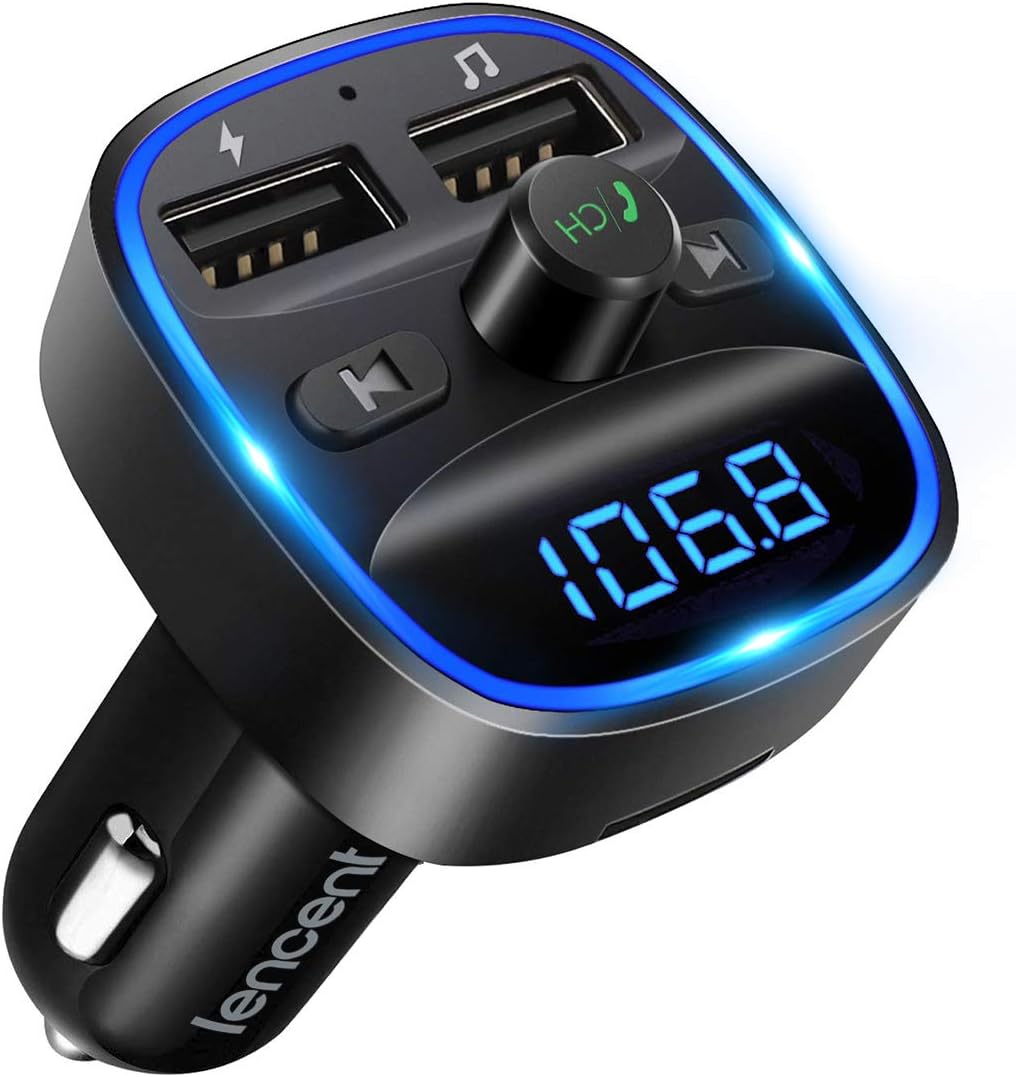
The LENCENT T25 is a multifunction FM transmitter that can serve as a connected audio hub for a motorcycle with a suitable 12-volt power socket. Its 4.5 rating highlights a useful combination of Bluetooth streaming, hands-free calling, voice navigation, USB media playback, and charging. It is more closely associated with cars, so compatibility and mounting require careful consideration on a bike.
We may earn a commission when you buy through this link, at no additional cost to you.
Music can come from Bluetooth, a USB flash drive, or a microSD card, with support for several common file formats. CVC noise and wind suppression is designed to improve call and navigation audio. The built-in FM transmission covers 88.1MHz to 107.9MHz, allowing the signal to reach the motorcycle's original stereo without a direct AUX connection. A display also reports the connected vehicle's battery voltage.
Two USB ports support simultaneous charging, while built-in over-current, over-voltage, temperature, and short-circuit protection improves confidence during use. The trade-offs are installation-dependent. A motorcycle may lack a conveniently accessible cigarette-lighter socket, and adding one can require wiring changes. FM transmission can also introduce noise in some areas, so a wired connection generally offers better fidelity when the stereo supports it.
The T25 is most useful for riders whose motorcycle has a protected 12-volt socket and an FM-capable stereo. It is especially attractive when phone storage, hands-free navigation, and charging are priorities. Riders with modern audio systems should favor an AUX or RCA receiver for a cleaner digital connection, while group riders should choose a helmet intercom because this unit does not provide rider-to-rider communication.
Bluetooth, USB flash drives, and microSD cards make the transmitter useful when a rider wants more than phone streaming. Local media can reduce dependence on mobile data during long tours.
The battery-voltage display gives riders a quick electrical status check, while dual USB ports provide convenient charging for a phone and a second device without adding separate accessories.
We may earn a commission when you buy through this link, at no additional cost to you.
The DS18 BTC-Five Bluetooth 5.3 Audio Receiver for Car, Marine & Powersports is a fixed-installation receiver explicitly positioned for motorcycles, ATVs, UTVs, boats, and other outdoor vehicles. Its 4.1 rating reflects a specialized but practical approach: adding Bluetooth to an existing sound system instead of relying on a conventional automotive adapter.
We may earn a commission when you buy through this link, at no additional cost to you.
The receiver uses Bluetooth 5.3 and promises stable low-latency streaming across a range of up to 130 feet or more. A 3.3V RCA pre-output and 96dB signal-to-noise ratio feed audio into an amplifier, DSP, or vehicle stereo. Its IP66 housing provides water and dust resistance, making it better aligned with exposed powersports installations than an unsecured indoor-style receiver.
Installation is a central part of the experience. The package includes RCA cables, power wiring, an inline fuse, and a remote turn-on lead. Automatic reconnection helps after the motorcycle's power is cycled, while the compact housing is intended to fit tighter spaces. The trade-off is that the product does not supply helmet speakers, microphones, or an intercom experience; it is an audio receiver within a larger system.
This DS18 is an attractive choice for riders who already have a capable motorcycle stereo and want wireless phone music and navigation. The included wiring and weather-resistant construction make it especially relevant to touring, marine, and off-road applications. Riders who only want a self-contained helmet unit can find a simpler solution elsewhere, while serious group riders should add a purpose-built intercom system.
The IP66 enclosure and included fuse and remote turn-on lead show that this model is intended to become part of a working vehicle installation. Its compact construction can help locate it in protected spaces without taking up excessive room.
A direct RCA pre-output path avoids the tuning and interference sometimes associated with FM transmission. That makes the receiver attractive when the motorcycle's amplifier or DSP can accept a conventional low-level audio signal.
We may earn a commission when you buy through this link, at no additional cost to you.
The Fodsports M1S Pro 2000m is designed for riders who see motorcycle communication as a group activity rather than merely a way to connect a phone to a helmet. Its 4.3 rating reflects a capable system with music sharing, hands-free operation, navigation support, and intercom functionality for as many as ten riders when used with the stated V3.0 group configuration.
We may earn a commission when you buy through this link, at no additional cost to you.
Bluetooth 5.0 provides the underlying connection, while the advertised intercom range reaches up to 2000 meters under unobstructed conditions. That is far more useful for a group on open roads than a short-range accessory connection. The FODSPORTS Connect app, seven-language voice prompts, and Siri voice-command support expand the control experience. A universal pairing mode allows communication with compatible helmet intercoms from other brands.
Audio performance relies on full-range membrane drivers, while a CSR chip helps reduce ambient wind and engine noise. The removable metal clip and dual-microphone arrangement support a helmet-mounted installation. A 900mAh battery provides up to one week of standby and 20 hours of working time. The key limitation is that range depends on clear conditions, and group communication still requires compatible hardware, correct pairing, and consistent settings.
This M1S Pro is best for touring clubs, group rides, and riders who want conversation, music, GPS prompts, and calls in one helmet system. It is more complex than a solo headset, so riders traveling alone may prefer a simpler unit. Regardless of group size, check the manual and installation requirements before purchase, especially if mixing brands or expecting communication in heavily built-up areas.
A ten-rider full-duplex group intercom is the defining feature, allowing the system to serve as a shared communications platform. The extended open-range capability supports conversations when riders are spread along a road.
Music sharing allows riders to listen to the same audio, while GPS support and hands-free calling turn the headset into a central control point. Voice prompts and app access help reduce the need to handle controls while riding.
We may earn a commission when you buy through this link, at no additional cost to you.
The JX06se is explicitly a single-rider helmet headset rather than an intercom, which makes its purpose unusually clear. It connects a smartphone to a helmet for music, GPS prompts, and hands-free calls. Its 4.0 rating places it among the more highly rated solo options, particularly for riders who value a modern chipset, quick mounting, and visible status features.
We may earn a commission when you buy through this link, at no additional cost to you.
Bluetooth 5.4 is designed to provide stable connectivity, lower latency, and stronger interference resistance in dense environments. Custom-tuned drivers and multi-layer noise cancellation support clearer music and navigation through wind and engine noise. A built-in FM tuner adds news, traffic information, and radio music without requiring a phone connection, while natural English voice prompts announce status and an exact battery percentage.
The magnetic mounting base is a meaningful convenience improvement over constantly manipulating a traditional clamp. Customizable RGB lights add visibility during night rides, although color settings should be chosen with local regulations and visibility in mind. The 1000mAh battery and lab-certified IP67 protection support extended solo trips and wet conditions. The limitation is equally important: it cannot connect directly with another rider for conversation.
The JX06se is a strong recommendation for commuters, solo touring riders, and anyone who wants phone audio without installing a larger multi-rider system. Choose it when music, calls, GPS prompts, FM radio, and convenient helmet mounting matter more than intercom networking. Group riders should select a product built for rider-to-rider communication or confirm that an external intercom solution meets their needs.
The quick-release magnetic base makes it easier to remove and reinstall the headset without repeatedly aligning a clamp. That convenience is especially helpful when the helmet is removed frequently at stops or destinations.
Bluetooth audio and the built-in FM tuner give riders two content paths. The radio can deliver traffic updates and music without a phone, while smartphone connectivity remains available for navigation and calls.
We may earn a commission when you buy through this link, at no additional cost to you.
The Nulaxy KM18 combines Bluetooth 5.4, FM transmission, and a visible information display in a vehicle-style adapter. Its 4.4 rating reflects a feature-rich design aimed at drivers who want easier access to call status, music information, FM channels, and battery-voltage readings. Motorcycle use is possible where a suitable 12-volt socket is available.
We may earn a commission when you buy through this link, at no additional cost to you.
The 1.44-inch LCD gives the product an advantage over simple LED-only transmitters because it can present more information at a glance. A rotatable gooseneck allows the display to face the rider at a comfortable angle. Bluetooth 5.4 supports faster, more stable connections, while noise cancellation helps reduce road noise in calls and streaming audio.
Audio can reach the original stereo through FM, while TF card and AUX cable playback provide additional options. Hands-free controls support answering, rejecting, ending, and recalling calls, and voice-navigation broadcasts can reduce the temptation to look at a phone. As with other FM-based products, reception quality can vary, and the need to power it from a cigarette-lighter socket may require an accessory on a motorcycle.
The KM18 is most useful for a bike with an accessible 12-volt socket, an older stereo without Bluetooth, and a preference for a clear display. Its 12V-to-24V range also suits many trucks and larger vehicles. Riders seeking cleaner sound and a permanent installation should consider an AUX or RCA receiver, while communication-focused riders should choose a helmet intercom.
The LCD centralizes information that would otherwise require navigating a phone. Call status, FM channels, music information, and battery voltage are all presented in a format intended for quick glances.
FM transmission, TF card playback, and AUX input give the adapter several ways to reach the stereo. Bluetooth 5.4 and broad device compatibility make it adaptable to common phones and media players.
We may earn a commission when you buy through this link, at no additional cost to you.
The Sena FreeWire Bluetooth CB and Audio Adapter for Harley Davidson is designed to connect a compatible Harley-Davidson motorcycle's infotainment system, GPS, and CB radio. Its 4.0 rating reflects a focused solution for riders seeking integrated motorcycle communication rather than a general-purpose audio adapter.
We may earn a commission when you buy through this link, at no additional cost to you.
Wireless audio streaming and CB radio support form the core of the device's appeal. An additional FreeWire can be added for direct passenger communication, which is useful on long rides where riders want conversation without relying on the motorcycle's original intercom. The stated seven-hour talk time supports extended touring use, and firmware upgradeability offers some flexibility as the system evolves.
The product's narrow scope is its main trade-off. It is not a universal Bluetooth receiver for arbitrary stereos, nor is it a conventional helmet-mounted headset with a large group-intercom network. Its Bluetooth 4.1 platform is also less recent than options using 5.3 or 5.4. Most importantly, electrical and connector compatibility with the target motorcycle must be established before purchase.
This FreeWire is a sensible specialized purchase for a compatible Harley-Davidson owner who wants the motorcycle's infotainment, GPS, CB radio, and passenger communication integrated into one system. Verify the exact model-year requirements and installation details in the current product listing. Riders seeking broader compatibility or modern group communication should consider a universal receiver or a current helmet intercom instead.
Connecting to infotainment and GPS systems lets the adapter act as a bridge between the rider's devices and the motorcycle's original speakers. This can create a cleaner ride than relying on a small phone speaker.
Support for an additional FreeWire creates a direct passenger communication option, while CB radio support adds a feature that generic Bluetooth receivers often lack. Together they make the system more relevant to multi-rider touring.
We may earn a commission when you buy through this link, at no additional cost to you.
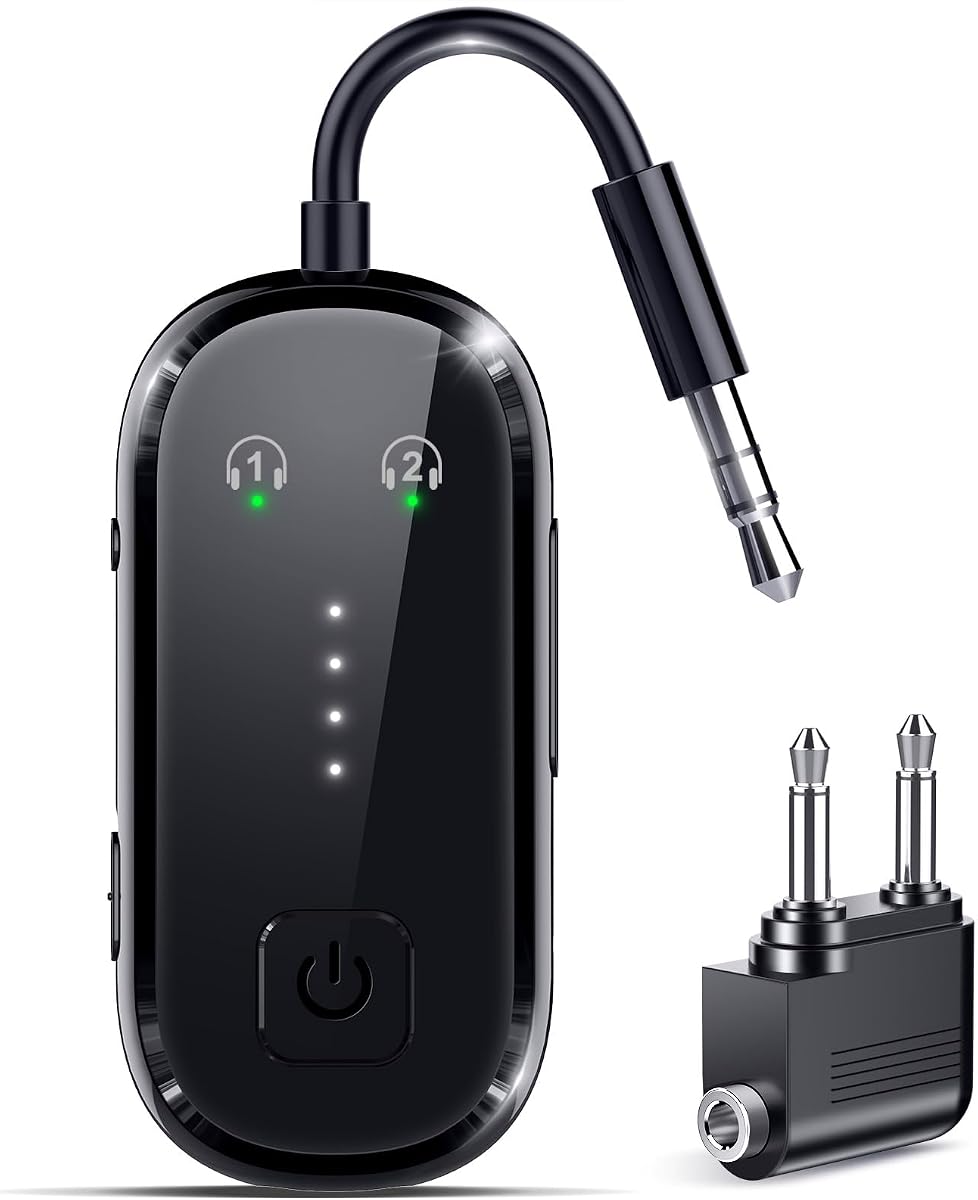
The COMSOON Bluetooth Receiver for Car is a straightforward way to add wireless phone audio to a motorcycle, home stereo, set of speakers, or wired headphones with a 3.5mm jack. Its 4.5 rating is among the strongest in this guide and reflects a simple product that covers the essential functions without the complexity of a full installation kit.
We may earn a commission when you buy through this link, at no additional cost to you.
Bluetooth 5.0 provides stable connection, fast transmission, and a broad usable signal range. Once paired with a phone, the receiver sends audio through its 3.5mm output. A built-in microphone enables hands-free calls, and CVC8.0 noise cancellation with DSP processing helps reduce echo and distracting background sound such as wind, traffic, or crowds.
Battery life reaches up to 16 hours for calls or music, and a full recharge takes about 2.5 hours using the included Type-C cable. Operation while charging provides flexibility for longer trips. Dual-device pairing allows two phones to remain connected, and the receiver automatically reconnects to previously paired devices when they return within range. It cannot pair with Bluetooth headphones; its purpose is converting a wired output into wireless reception.
The COMSOON is best for a rider whose helmet or motorcycle audio system has a 3.5mm input, particularly when simple installation and dual-phone convenience matter. Its lack of a stated IP rating means it should be mounted away from direct rain and spray. For a permanently exposed motorcycle installation, a rugged receiver with power wiring and a higher water-resistance rating is the safer choice.
The 3.5mm output means the receiver can work with many already-installed sound systems without a specialized wiring harness. A phone can pair and stream audio without adding a new stereo.
Up to 16 hours of operation covers many full riding days, while use-while-charging helps prevent an interruption on longer tours. Automatic reconnection also reduces the need to repeat pairing.
We may earn a commission when you buy through this link, at no additional cost to you.
A useful purchase starts with the communication task you need, followed by a careful check of power, connector, and helmet compatibility. The best motorcycle Bluetooth solution is not necessarily the one with the most features; it is the one that integrates cleanly with your bike and riding routine.
Decide whether you need phone-to-helmet audio, rider-to-rider conversation, passenger communication, CB radio access, or a way to add Bluetooth to an existing stereo. Solo headsets are streamlined for calls, music, and GPS, while intercoms support group conversations. Vehicle receivers focus on connecting a phone to an amplifier or original audio system, and motorcycle-specific adapters may integrate native infotainment and radio functions.
Check whether the product uses a 3.5mm jack, RCA output, FM transmission, USB connection, or native motorcycle wiring. A 3.5mm receiver is simple but may not match modern weather-resistant helmet connections. RCA receivers suit amplifiers and DSPs, while FM transmitters can connect to older stereos without a direct audio input. Native motorcycle adapters require exact model and connector compatibility.
Range figures should be interpreted in context. A phone-to-receiver connection only needs enough distance to place the unit securely inside the motorcycle. Intercom range matters more when riders spread out along a road, but the stated maximum may depend on clear, unobstructed conditions. Obstacles, hills, traffic density, and antenna placement can all influence real performance.
Motorcycle electronics may encounter rain, spray, mud, dust, and changing temperatures. An IP66-rated receiver is designed for rugged powersports use, while an IP67 headset offers strong protection for helmet-mounted equipment. Products without a stated rating may work reliably when kept in a protected compartment but should not be treated as weatherproof. The enclosure rating matters more than the marketing label.
Battery life should cover a typical riding day with room for navigation, calls, and music. Look for a stated working time, standby time, charging method, and whether operation during charging is supported. Helmet systems commonly use rechargeable integrated batteries, while powered receivers draw from the motorcycle and do not depend on the rider remembering to charge them.
Clear communication depends on microphone placement, echo cancellation, and the reduction of wind and engine noise. A speaker-only receiver cannot provide calls or intercom conversation unless it also includes a suitable microphone. Helmet intercoms should place microphones near the mouth and keep speaker modules positioned for intelligibility without excessive helmet pressure.
Group intercoms can support several riders in one communication set, with app configuration, voice prompts, and firmware updates improving setup and control. Check whether the stated group size requires an upgrade, whether other brands are compatible, and whether universal pairing is genuinely important. Solo riders generally gain little from paying for large-network features they cannot use.
A feature-rich device is only useful if it can be mounted safely and operated without distracting the rider. Helmet systems require compatible ear pockets, secure speaker placement, and an accessible control module. Vehicle receivers require power, ground, fuse, signal wiring, and room for the enclosure. Magnetic mounts and app-based setup can simplify installation, while display-based units must be readable from the riding position.
Begin by confirming the power source, audio connection, and mounting location before connecting the device to your motorcycle. For helmet systems, install the speakers and microphone where they do not obstruct the helmet's retention, padding, or visor operation. For powered receivers, use the proper wiring, fuse, ground, and remote turn-on lead, and place the enclosure where it is protected from direct impact and standing water.
Charge a battery-powered unit fully before the first trip, then pair it with the intended phone while the motorcycle is stationary. Complete any intercom pairing between riders before departure, select a clear communication channel, and confirm that navigation prompts, calls, and music play correctly. Test every control, including volume, microphone behavior, automatic reconnection, and the method used to switch between devices.
Before each ride, check attachment security, cable strain, connector engagement, and visible damage. Clean removable speaker pads or ear-pocket adapters according to the manufacturer instructions, and keep charging ports and covers free of mud and moisture. After riding, disconnect any exposed charging leads, dry the unit, and store it in a dry location. Update firmware or app settings when needed, but complete updates only while the motorcycle is parked.
A transmitter sends audio from a wired source to Bluetooth headphones or speakers, while a receiver takes audio from a Bluetooth phone and sends it to a wired motorcycle audio system. Some compact 2-in-1 adapters perform both functions. Check the TX and RX labels carefully, because a motorcycle installation often needs the receiver function unless the goal is to send a wired source to wireless earbuds.
It may work if the motorcycle has a compatible 12-volt socket and an FM-capable stereo, but physical vibration, weather exposure, and limited mounting space can make a car adapter less suitable. A purpose-built motorcycle receiver with secure wiring and water resistance is generally better for permanent use. Always compare the connector size and available socket before purchase.
A receiver is sufficient if the motorcycle already has speakers and all you want is phone music, navigation prompts, and possibly calls through an external microphone. A helmet intercom is better for private rider-to-rider conversation, passenger communication, and group rides. Some intercoms also handle music, calls, and GPS, so choose the device based on your highest-priority communication need.
That depends on the speaker system's input. FM transmitters can send audio to an FM-capable radio, AUX or RCA receivers can feed a 3.5mm or low-level input, and native adapters integrate with supported motorcycles. Inspect the audio system's connections and confirm whether it has Bluetooth already before choosing a transmitter.
A stated IP rating gives a better basis for comparison than vague weather-resistant language. IP66 receivers suit exposed powersports installations, while IP67 helmet systems are designed for demanding outdoor conditions. Even rated products benefit from secure placement and intact seals, and an accessory without a stated rating should be kept away from direct rain and spray.
Phone-to-helmet and phone-to-receiver connections generally need only enough range for the signal to travel inside the motorcycle. Group intercoms benefit from a much longer stated range, but maximum figures often assume open, unobstructed conditions. For urban traffic or crowded group rides, prioritize stable pairing and clear audio over the largest advertised distance.
Some receivers, including the COMSOON model in this guide, support dual-device pairing. That allows two phones to remain connected and makes it easier to take calls from one device while streaming from the other. Confirm whether the product switches audio automatically or requires a button press, as that behavior varies between models.
Use the supplied wiring and inline fuse, secure the enclosure away from moving parts, protect connectors from road spray, and avoid locations where water can pool. Check the mount frequently because vibration can loosen hardware. For a permanent setup, weather-resistant receivers with a rated enclosure are generally preferable to unprotected car-style adapters.
The DS18 BTC-Five Universal Receiver stands out for its flexible integration, extended range, and rugged housing, while the COMSOON 3.5mm receiver offers the simplest path to adding phone audio to an existing system. The Sena FreeWire Honda Goldwing Adapter earns the premium position for riders who want dedicated integration with native motorcycle infotainment, GPS, CB radio, and passenger communication.
For group riding, prioritize a dedicated intercom and verify its rider capacity, range conditions, pairing process, and brand compatibility. For solo touring, focus on helmet installation, microphone quality, noise reduction, battery life, and weather protection. For a permanent motorcycle audio upgrade, choose a receiver with the correct power and RCA connections rather than relying on FM transmission when a direct wired path is available.
Ratings, firmware, product configurations, and availability can change over time, and motorcycle compatibility can vary by model year and factory audio equipment. Check the current listing, included accessories, dimensions, connector layout, and installation instructions before purchasing. Compare the complete system rather than selecting only on Bluetooth version or maximum advertised range.