
iSpring RO500AK
4.6Editor score
High-capacity 500 GPD flow
Tankless space-saving design
Automatic filter reminders
Residential reverse osmosis systems compared for filtration, capacity, installation, maintenance, tank storage, and overall household drinking water needs.
Residential reverse osmosis systems provide a dedicated supply of purified drinking and cooking water at the kitchen sink. A strong model should combine meaningful contaminant reduction, practical daily capacity, easy filter servicing, sound certification, and a faucet design that suits the household.
This guide compares ten products using the supplied specifications, certifications, rated capacity, filtration features, installation requirements, maintenance details, and design considerations. It covers conventional under-sink systems, pump-equipped and tankless models, a compact countertop unit, and a storage-tank accessory.
Each review explains the product's strongest benefits, possible limitations, and ideal household fit. Product configurations change often, so readers should verify current availability, dimensions, included components, certifications, and replacement schedules before purchasing.
4.6Editor score
4.6Editor score

4.4Editor score
The comparison covers filtration design, rated capacity, certification, installation style, and maintenance features, while identifying the one product that is a storage-tank accessory rather than a complete filtration system.


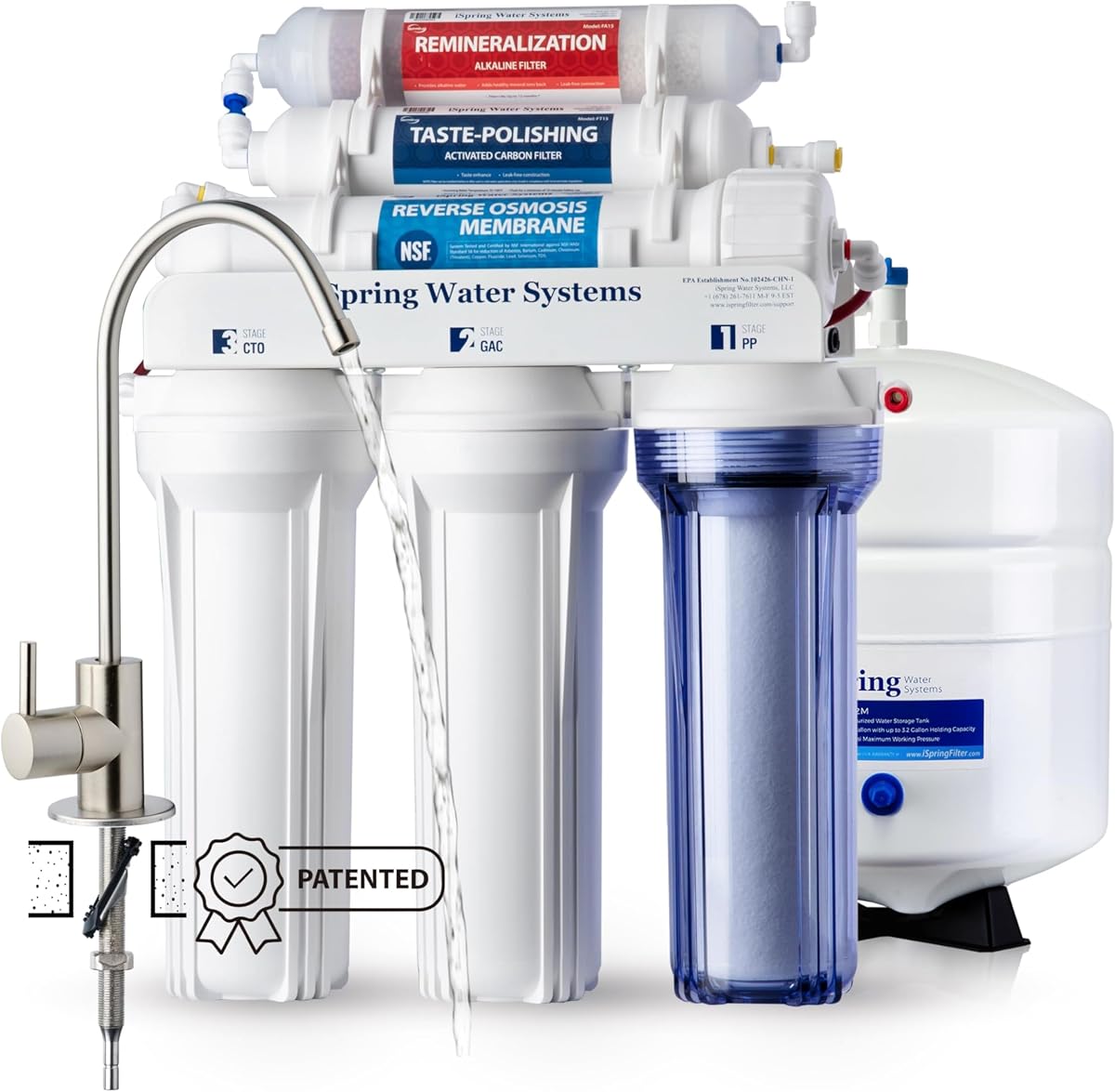
The iSpring RCC7AK-BN combines a 75 GPD rated capacity, six-stage filtration layout, and alkaline remineralization in a conventional under-sink package. Its 4.6 rating reflects a strong balance of purification performance, practical installation features, and straightforward maintenance, making it one of the most versatile options in this guide.
We may earn a commission when you buy through this link, at no additional cost to you.
One of the system's most meaningful distinctions is its certification to NSF/ANSI 58 for the entire filtration system rather than only selected components. The supplied specifications list broad reduction capabilities for TDS, PFAS, chlorine, asbestos, barium, cadmium, chromium, copper, fluoride, lead, selenium, and more than 1,000 other contaminants. A natural mineral AK stage is intended to restore minerals and support a more balanced pH and taste.
Installation and upkeep are handled thoughtfully. The patented top-mounted fastener allows the connection to be tightened entirely from above the sink, avoiding the need to reach beneath the cabinet to secure the nut. The transparent first-stage housing allows users to see accumulated sediment and judge when service is needed. Replacement filter sets are offered on 6-month, 1-year, 2-year, and 3-year schedules.
This is a good fit for households seeking a conventional RO system with mineral restoration, visible filter monitoring, and broad contaminant reduction. It does not include the electric pump found in the RCC7P-AK, so homes with weak incoming pressure may need to confirm that ordinary plumbing pressure is sufficient.
Overall, the RCC7AK-BN is the strongest all-around recommendation for shoppers who want proven certification, balanced drinking water, a well-considered faucet design, and flexible filter replacement options without moving to a tankless premium configuration.
NSF/ANSI 58 certification covering the complete system gives buyers a clearer basis for comparison than certification limited to individual components. The stated reduction percentages for lead, fluoride, PFAS, TDS, asbestos, and numerous heavy metals make this a well-documented option for households seeking broad filtration.
The top-mounted fastener reduces one common under-sink installation frustration, while the transparent housing makes sediment inspection straightforward. Clearly identified replacement sets and technical support help simplify ongoing ownership.
We may earn a commission when you buy through this link, at no additional cost to you.
The iSpring RCC7AK-UV expands the familiar six-stage approach with a seven-stage configuration and an LED UV stage. Its 4.6 rating, alkaline mineral stage, layered cartridge construction, and flow-activated purification make it a premium choice for buyers who want an additional treatment layer beyond conventional RO.
We may earn a commission when you buy through this link, at no additional cost to you.
The UV stage activates when water flows and uses a mercury-free, maintenance-free LED design. The product information also emphasizes individually layered cartridges rather than compressed composite filters, allowing the full volume of media in each stage to remain visible. Together, the mineral and UV stages are intended to improve both purification coverage and the overall drinking experience.
Certification is a central selling point. The complete system is certified to NSF/ANSI 58 and 372, and the stated performance includes 97.9% TDS reduction, 98.9% lead reduction, 97.4% fluoride reduction, and greater than 99.7% asbestos reduction. It also addresses barium, cadmium, chromium, copper, and selenium.
There are trade-offs. Adding UV protection and a seventh stage increases the system's complexity, and buyers who do not specifically value that additional layer may find a simpler design easier to understand and maintain. The product also uses conventional under-sink installation rather than a tankless layout.
Households seeking a thorough, layered treatment configuration should give the RCC7AK-UV serious consideration. It is especially appealing when whole-system certification, visible media, alkaline water, and an integrated UV stage are priorities rather than optional extras.
The UV stage turns on only while water is moving through the system, avoiding unnecessary continuous operation. Its mercury-free, maintenance-free design adds purification without requiring lamp replacement as part of routine filter service.
Visible, full-volume media in each cartridge makes the internal treatment sequence easier to inspect and understand. The natural mineral stage adds a flavor-focused benefit after RO filtration.
We may earn a commission when you buy through this link, at no additional cost to you.
The APEC Water ROES-50 is a conventional 50 GPD under-sink RO system built around five filtration stages. Its 4.5 rating and straightforward package make it appealing to households that want a complete installation kit, a storage tank, and a dedicated faucet without paying for more specialized features.
We may earn a commission when you buy through this link, at no additional cost to you.
The stated filtration performance is designed to address arsenic, chlorine, lead, fluoride, heavy metals, PFAS, microplastics, and more than 1,000 impurities. Large-capacity filters are intended to remain effective longer than smaller all-in-one cartridges, while quick-connect fittings and color-coded tubing help organize installation and future servicing.
The package includes a Filter-Max-ES50 filter set, brushed nickel faucet, water tank, installation kit, and instructions. That completeness helps buyers understand what they will need before installation. Replacement is generally recommended at 6- to 24-month intervals depending on incoming water quality.
The main limitation is rated output. A 50 GPD system is less suited to large households, frequent cooking with purified water, or multiple simultaneous users than 75, 90, or 500 GPD alternatives. It also lacks an electric booster pump, which may matter where household pressure is inconsistent.
For a couple, smaller household, or secondary drinking-water source, the ROES-50 offers a manageable combination of filtration, included components, and simple maintenance. It is a sensible pick when uncomplicated ownership matters more than maximum flow.
The included filter set, brushed nickel faucet, tank, installation kit, and instructions create a more self-contained package. This reduces the need to source separate accessories before setting up the system.
The design targets common household concerns including chlorine, heavy metals, fluoride, arsenic, PFAS, and sediment. Its 50 GPD output is best matched to moderate daily use.
We may earn a commission when you buy through this link, at no additional cost to you.
The iSpring RCC7P-AK is the highest-rated product in this guide at 4.7. Its 75 GPD system combines a six-stage layout, alkaline remineralization, and an electric booster pump, targeting homes where low water pressure could otherwise reduce RO performance.
We may earn a commission when you buy through this link, at no additional cost to you.
The booster pump is the defining feature. It is designed to maintain consistent filtration efficiency in homes with low pressure while also reducing wastewater. The system states that it can reduce up to 99% of more than 1,000 contaminants, including lead, chlorine, fluoride, arsenic, PFAS, asbestos, calcium, and sodium.
Mineral restoration is another advantage for households that dislike the flat taste sometimes associated with standard RO water. A sixth stage is intended to restore essential minerals and balance alkalinity, while the transparent first-stage housing lets users monitor sediment accumulation without dismantling the system.
The tradeoff is electrical dependence. A power adapter is included for 100-240V, 50/60Hz use, but the installation must include access to a suitable outlet. The pump and additional connections also make initial setup more involved than a basic power-free RO configuration.
This model is a strong recommendation for households with marginal incoming pressure or users who want the extra assurance of pump-assisted operation. Buyers with strong plumbing pressure and a preference for minimal electrical components may be better served by a simpler 75 GPD system.
The electric pump is intended to support consistent flow when household water pressure is not ideal. It can also improve the efficiency of the overall filtration process while limiting drainage waste.
The final mineral stage is designed to restore beneficial elements and improve taste. Meanwhile, the clear pre-filter housing makes cartridge condition easier to check at a glance.
We may earn a commission when you buy through this link, at no additional cost to you.
The iSpring RCC7-BN delivers a 75 GPD, five-stage reverse osmosis system without requiring electricity. Its 4.6 rating reflects a proven conventional design, NSF/ANSI 58 certification, a lead-free faucet, and a straightforward configuration suited to many homes.
We may earn a commission when you buy through this link, at no additional cost to you.
The system states that it reduces up to 99% of more than 1,000 contaminants, including PFAS, chlorine, fluoride, lead, arsenic, asbestos, calcium, and sodium. TDS reduction is listed at 80-90%, and a fine GAC filter provides final polishing. The membrane is described as filtering contaminants down to 0.0001 microns.
Installation convenience is a major strength. The system requires no power source and is designed to fit under most kitchen sinks. A check valve helps prevent backflow, the housing uses impact-resistant AS material, and the transparent first stage supports quick filter inspections. The included faucet and food-grade tubing are also intended to support reliable everyday use.
Those wanting mineral-enriched or alkaline water may prefer one of the AK models, while homes with weak pressure may need a pump-equipped alternative. The five-stage layout is otherwise less complicated and easier to maintain than premium multi-stage configurations.
The RCC7-BN remains a strong selection for users who value established certification, practical capacity, and uncomplicated installation without electrical requirements. It is especially suitable for households that prioritize dependable purified drinking water over specialty treatment features.
Eliminating the power requirement simplifies installation and allows operation without a nearby outlet. The included check valve is intended to help prevent backflow, while the impact-resistant housing adds durability.
Fine GAC media provides a final polishing stage after the RO process. The system is positioned for drinking water, ice, tea, coffee, cooking, and formula preparation, with a lead-free faucet included.
We may earn a commission when you buy through this link, at no additional cost to you.
The iSpring RCC7AK-BLK combines a 75 GPD rated capacity with six-stage filtration, alkaline remineralization, and a distinctive black faucet. Its 4.6 rating makes it a polished choice for households that want certified RO performance and a more coordinated kitchen appearance.
We may earn a commission when you buy through this link, at no additional cost to you.
The product information lists reduction of up to 99% for more than 1,000 contaminants, including sediment, vinyl chloride, chlorine, fluoride, lead, arsenic, PFAS, asbestos, calcium, and sodium. As a complete NSF/ANSI 58-certified system, it also provides specific figures for TDS, lead, fluoride, asbestos, barium, cadmium, chromium, copper, and selenium.
The AK stage restores minerals and alkalinity after membrane filtration to support a fresher taste. Three pre-filters protect the RO membrane, which is described as filtering down to 0.0001 microns, and a fine GAC stage adds final polishing. The transparent housing makes early-stage condition easy to inspect.
The included black faucet distinguishes the package from brushed-nickel alternatives, but the product still needs adequate cabinet space and does not include a booster pump. The supplied guidance specifically asks buyers to check under-sink dimensions before purchasing.
This is a good match for buyers who prioritize full-system certification, alkaline water, and visual design. It combines most of the core benefits found in the RCC7AK-BN while offering a different faucet finish and a newer product identity.
The black faucet gives the sink area a modern appearance while delivering dedicated reverse osmosis water. It is a practical reason to prefer this package over a functionally similar brushed-nickel model.
Full-system NSF/ANSI 58 certification and detailed contaminant figures provide measurable performance information. Pre-filters protect the membrane, while final GAC media polish the finished water.
We may earn a commission when you buy through this link, at no additional cost to you.
The APEC Water RO-90 is a 90 GPD under-sink system designed for households wanting more daily output than a 50 or 75 GPD unit. Its 4.5 rating reflects a well-established five-stage design, high-capacity filters, and convenient connection system.
We may earn a commission when you buy through this link, at no additional cost to you.
The stated filtration goal is removal of nearly all impurities, including arsenic, chlorine, lead, fluoride, heavy metals, bacteria, virus, and more than 1,000 contaminants. WQA Gold Seal certification is highlighted, while large-capacity cartridges are intended to resist clogging and extend time between changes.
Installation emphasizes secure, simple connections. JG quick-connect fittings do not require additional lock clips, and the package includes a lead-free chrome faucet and food-grade tubing. The system can support drinking, cooking, and general purified-water needs without the complexity of powered tankless equipment.
Its 90 GPD output is less suitable for heavy whole-home demand than a 500 GPD model, and the absence of an alkaline stage means it does not explicitly add minerals back after RO. The listed maximum feed-water pressure of 85 psi should also be considered where household plumbing operates above that level.
APEC buyers looking for strong capacity, certified filtration, and easy servicing will find the RO-90 compelling. It is a balanced middle ground between compact 50 GPD systems and high-output tankless models.
A rated 90 GPD output provides more purified water than standard 50 GPD systems. It is a useful middle ground for larger families that want more flow without moving to a high-capacity tankless installation.
The fittings are designed to create a secure seal without extra clips or complicated tools. Color-coded systems and food-grade tubing support an organized installation and dependable connections.
We may earn a commission when you buy through this link, at no additional cost to you.
The DREO 7-in-1 Countertop RO is a compact alternative for people who cannot or do not want to install an under-sink system. Its 4.4 rating reflects appealing smart features, including real-time TDS monitoring, automatic pitcher filling, and a self-cleaning function.
We may earn a commission when you buy through this link, at no additional cost to you.
The system uses a seven-in-one filtration design and is described as removing 99.9% of possible contaminants, including PFOA, PFOS, chlorine, and fluoride. It was tested by SGS against NSF/ANSI 58 standards, offering a clear basis for comparing its performance with certified residential systems.
Convenience is central to the design. One display checks both raw and purified water TDS, while alerts help guide timely filter replacement. An auto-fill sensor refills the pitcher hands-free, and the system automatically flushes internal tubing to support continued purity.
Its intended scale is limited. A 3-liter tank and 1.1-liter pitcher are positioned for one or two people, and countertop placement means it does not provide the continuous high flow of an under-sink unit. It also cannot serve multiple fixtures or supply a large household's cooking and drinking demand.
The DREO is a compelling choice for an apartment, office, bedroom, rental, or secondary drinking source. It delivers a modern countertop experience for users who prioritize compact placement and smart maintenance prompts over high-volume output.
Simultaneous raw and purified water readings make it easier to see what the system is removing. Filter reminders reduce the need to estimate cartridge condition purely from taste or visible symptoms.
Automatic tube flushing and hands-free pitcher refilling reduce routine interaction. The slim 14.51 by 6.73 by 13.35-inch footprint also makes placement flexible outside the kitchen sink area.
We may earn a commission when you buy through this link, at no additional cost to you.
The iSpring RO500AK is a 500 GPD tankless reverse osmosis system built for high daily output and efficient under-sink use. Its 4.6 rating and advanced feature set make it the premium choice in this guide for households wanting substantial flow without a conventional storage tank.
We may earn a commission when you buy through this link, at no additional cost to you.
The system is certified to NSF/ANSI 58 for TDS reduction, and its 0.0001-micron membrane is described as removing up to 99% of lead, PFAS, chromium, radium, fluoride, arsenic, chlorine, and other contaminants. An alkaline remineralization filter adds minerals and is designed to enhance flavor.
At up to 0.4 GPM, the unit is intended for drinking, cooking, and filling pitchers, with a 2:1 pure-to-drain ratio that is substantially more efficient than many traditional RO arrangements. It also includes automatic flushing after 24 hours of non-use and front-panel lights with a buzzer for filter-change alerts.
The tankless chassis measures 16.13 by 5.13 by 16.25 inches and is designed to save considerable cabinet space while reducing the potential for secondary contamination in a stored water chamber. Quick-connect compatibility for 1/2-inch and 3/8-inch connections helps simplify installation.
The trade-off is electricity. Tankless operation requires an outlet, and flow can still depend on incoming pressure and tankless design constraints. Nevertheless, the RO500AK offers the best combination of capacity, space efficiency, maintenance guidance, and mineral restoration for high-use households.
The 500 GPD rating and 0.4 GPM maximum flow support frequent drinking and cooking use. Eliminating a storage tank also frees cabinet space and avoids maintaining a large pressure vessel.
The two-to-one pure-to-drain ratio reduces discarded water compared with conventional systems. Automatic flushing and audible filter alerts make preventive maintenance more systematic.
We may earn a commission when you buy through this link, at no additional cost to you.
The iSpring T55M is a 5.5-gallon pre-pressurized storage tank for compatible reverse osmosis systems. With a 4.6 rating, it is a useful accessory for households that want more stored purified water, but it should not be confused with a complete filtration system.
We may earn a commission when you buy through this link, at no additional cost to you.
The tank is made from a food-grade butyl diaphragm with post-cure procedures intended to provide a tasteless and odorless water chamber. It includes a stainless steel 1/4-inch NPT valve thread and a ball valve, giving owners the components needed to integrate it into a properly designed RO installation.
Installation flexibility is a key feature because the tank discharges effectively in either vertical or horizontal positions. This makes it easier to fit within crowded under-sink spaces or in a separate utility area, subject to the compatible system's installation requirements.
The tank is pre-pressurized between 7 and 10 psi for common use. Because pressure and tank condition affect flow, existing users may need to check or adjust the air pressure when installing or replacing their storage vessel.
This product is best for owners of a compatible tank-based RO system who need additional storage, a replacement vessel, or more flexible placement. New buyers seeking full contaminant reduction, a membrane, pre-filters, a faucet, and complete filtration should choose one of the systems rather than this accessory.
A 5.5-gallon vessel gives compatible systems additional reserve between membrane production and household use. The result is less waiting when several glasses or a cooking container are needed at once.
The tank can discharge in vertical or horizontal positions, making it adaptable to different cabinet layouts. Its food-grade butyl diaphragm is designed for a tasteless and odorless water chamber.
We may earn a commission when you buy through this link, at no additional cost to you.
The right residential RO system depends on household size, available cabinet space, incoming water pressure, desired flow, and whether alkaline minerals, UV treatment, or a countertop format are important.
Rated capacity indicates the approximate volume a system can produce in a day under its test conditions, not necessarily the amount delivered in real time. A 50 GPD unit generally fits one or two people with moderate usage, while a 75 GPD model is more versatile for a family. The 90 GPD option offers additional margin, and the 500 GPD tankless system is intended for heavy drinking and cooking demand. Capacity should be considered alongside recovery rate, storage tank size, and actual household routines.
Choose a capacity that comfortably exceeds normal daily consumption rather than matching it exactly. Account for guests, water used for cooking, and simultaneous faucet use.
Look for a system with credible, clearly stated contaminant reduction figures and certification that covers the complete assembly when the product claims whole-system certification. NSF/ANSI 58, NSF/ANSI 372, WQA certification, and SGS testing against NSF/ANSI 58 can provide useful comparison points. The included list should address contaminants relevant to the household, such as lead, fluoride, arsenic, PFAS, chlorine, sediment, and TDS.
Treat marketing percentages as product-specific claims and compare them directly. Certification scope matters because component certification does not necessarily certify the assembled system's performance.
Standard RO removes dissolved minerals along with contaminants, and some consumers prefer the resulting taste. An alkaline remineralization stage is designed to add selected minerals back and support a more balanced pH, which can improve smoothness and palatability. Models designated with AK in the product name include this feature, while the plain five-stage APEC and iSpring RCC7-BN systems do not.
Choose remineralization if improved flavor is a priority. It is not a substitute for certification, so the treatment sequence and contaminant claims should still guide the decision.
Traditional RO systems need room for the membrane housings, tubing, faucet, and often a pressure tank. The T55M is a 5.5-gallon tank accessory for compatible systems, while the RO500AK uses a tankless configuration to reduce cabinet space. Before purchasing, measure the available width, depth, and height beneath the sink and leave working room for filter changes. The DREO countertop model avoids cabinet installation entirely.
Tankless models conserve space but require electricity. Conventional tank systems avoid that electrical requirement but use more cabinet space and need periodic pressure checks.
RO membranes require adequate incoming pressure to operate effectively. A standard system is appropriate where household pressure is consistently sufficient, while a booster pump can help maintain flow and efficiency in low-pressure conditions. The iSpring RCC7P-AK includes an electric pump and a 100-240V, 50/60Hz adapter. Tankless models can also be sensitive to pressure because they lack a conventional storage buffer.
Check the plumbing before choosing a pump-equipped design, and review any stated maximum feed pressure for non-pumped models. Pump support is helpful, not a substitute for sound plumbing.
Every RO system requires periodic cartridge and membrane replacement, and a clear monitoring method makes ownership easier. Transparent first-stage housings let users see sediment accumulation, while electronic TDS displays and audible filter reminders provide more active guidance. Replacement intervals depend on incoming water quality, usage, and cartridge type; the APEC ROES-50 guidance ranges from 6 to 24 months, while named iSpring filter sets are assigned different service schedules.
Prioritize a system with visible components, understandable replacement options, and available support. Confirm that replacement cartridges are sold separately and match the exact system.
Quick-connect fittings, color-coded tubing, and top-mounted fasteners can reduce installation difficulty, but adequate space and a suitable shutoff and drain connection are still required. The APEC systems include tanks and installation components, while several iSpring models use the patented top-mounted faucet design. The DREO is a countertop appliance and avoids permanent sink plumbing. Electric pump and tankless models require an outlet near the installation area.
Review the manual, included parts, and local plumbing restrictions before ordering. DIY installation is possible for many systems, but complex tubing or unfamiliar connections may call for a plumber.
A dedicated faucet makes purified water easy to identify and use for drinking, ice, tea, coffee, cooking, and formula preparation. Brushed nickel offers a traditional look, while the RCC7AK-BLK includes a modern black faucet. Consider handle movement, clearance around the sink, and whether the design coordinates with existing fixtures. Top-mounted fastening can make the initial connection easier than working directly beneath the sink.
Choose a faucet based on both appearance and usability. A dedicated drinking-water faucet is especially valuable in households where confusion between tap water and purified water would be inconvenient.
Begin by confirming the system matches the incoming plumbing, available space, and required power. Follow the included manual for mounting, tubing, faucet, drain-line, and tank connections, shut off the supply during installation, and check every connection for leaks before restoring flow. For tankless or pump-equipped models, connect the correct adapter only in a dry location.
Run the system as directed after installation and flush away the initial water. Use the dedicated faucet for drinking and food preparation, while leaving untreated tap water for washing produce and other tasks. Clean the first-stage housing when sediment becomes visible, and replace cartridges according to the specified schedule and local incoming-water conditions. Tank users should also verify tank pressure when flow becomes weak.
Good long-term care also involves monitoring the system rather than waiting for obvious taste changes. Use available TDS displays, change reminders, and visible housings as prompts, but follow the manufacturer's maintenance guidance when readings and conditions differ. Keep replacement parts compatible with the exact model, avoid unnecessary filter substitutions, and contact technical support when leaks, unusual noise, persistent pressure loss, or unexpected water quality changes occur.
A tank-based system stores purified water in a pressurized vessel, which provides a useful reserve and can reduce reliance on immediate membrane production. A tankless system produces water on demand and saves cabinet space, but it generally requires electricity and depends more heavily on incoming pressure. Tankless models are attractive when space is tight or daily demand is high.
A 50 GPD system generally suits one or two people with moderate consumption. A 75 or 90 GPD model offers more flexibility for a typical family or frequent cooking. A 500 GPD system is intended for substantially higher demand. Actual delivery can vary with pressure, membrane condition, and how much water is drawn simultaneously.
An alkaline stage is generally added after the primary filtration process to restore selected minerals and improve taste. It does not replace the membrane or pre-filters. Buyers should evaluate the complete treatment sequence, certification, and stated contaminant reduction rather than assuming a higher pH changes the core filtration performance.
No. The APEC ROES-50 and APEC RO-90 are traditional tank-based systems, while the iSpring RO500AK is tankless. The iSpring T55M is not a complete RO system; it is a 5.5-gallon storage tank accessory for a compatible tank-based setup. Countertop models may include a smaller removable water vessel as part of their design.
Replacement timing depends on cartridge type, incoming water quality, and usage. The APEC ROES-50 guidance specifies 6- to 24-month intervals, while the iSpring products use several filter sets with different stated service periods. Visible sediment, filter reminders, reduced flow, and TDS readings can help identify when attention is needed, but the manual should govern replacement.
Many models are designed for DIY installation with quick-connect fittings, color-coded tubing, and clear instructions. The top-mounted faucet fastener on several iSpring models improves access during setup. However, leaks, unfamiliar plumbing, electrical requirements, and local code considerations can make professional installation worthwhile.
A UV stage adds another form of treatment after water passes through the primary filtration stages. In the iSpring RCC7AK-UV, the mercury-free LED UV stage activates only when water flows. It is designed to provide an additional layer of protection without a conventional replaceable UV lamp, although it makes the system more complex than a standard five-stage model.
Reserve enough room for the filter housings, tubing, faucet hardware, drain connection, and any storage tank, plus room to remove cartridges. Exact dimensions vary by model, so measure the cabinet and inspect the product's installation diagram. Tankless systems generally need less space, while a 5.5-gallon tank requires a larger designated area.
The iSpring RCC7AK-BN is the most balanced conventional choice, combining 75 GPD output, complete NSF/ANSI 58 certification, alkaline remineralization, and installation-friendly features. The iSpring RO500AK stands out for households seeking high flow and a tankless design, while the DREO countertop system offers the most accessible format for one or two users.
Prioritize certification scope, contaminant performance, daily output, and realistic installation constraints before considering decorative or specialty features. Pump-equipped systems can suit low-pressure homes, alkaline stages can improve taste, and tankless architecture can save space. The APEC ROES-50 and RO-90 remain practical options for households that prefer conventional five-stage systems with included components.
Finally, check current product configuration, dimensions, included parts, certification information, and replacement-filter availability before purchasing. Configuration and availability can change over time, and the most suitable residential reverse osmosis system ultimately depends on the household's pressure, space, usage, and maintenance preferences.
