
Aquarium Clean Light 3W Mini
4.2Editor score
Compact 3W mini design
254nm UV disinfection
Test card and temperature strip
Aquarium UV Light buying guide comparing ten options for wattage, tank size, timers, shielding, installation, and algae-control needs for home aquariums.
Aquarium UV light can be a valuable tool for reducing green water, suspended algae, odors, and certain microorganisms, but choosing the right model requires more than comparing wattage. Tank volume, water flow, lamp placement, safety shielding, timer controls, and freshwater or saltwater compatibility all influence the results a user can reasonably expect.
This guide compares ten aquarium UV lights using the specifications and stated features provided for each product. The list covers compact units for small tanks, filter-mounted models, higher-wattage clarifiers for larger aquariums, and submersible lights designed for ponds, pools, cold plunges, and other water features.
Each review explains the intended use, installation considerations, distinctive features, and practical trade-offs of the selected model. The recommendations also show why a light designed for a small planted aquarium may not be suitable for a large pond. Prices and availability can change, so check the current listing and overall aquarium setup before purchasing.
4.2Editor score

4.1Editor score
4.1Editor score
The comparison below places each aquarium UV light according to its intended tank size, power, mounting approach, and user controls, making it easier to identify the model that fits a particular water system.




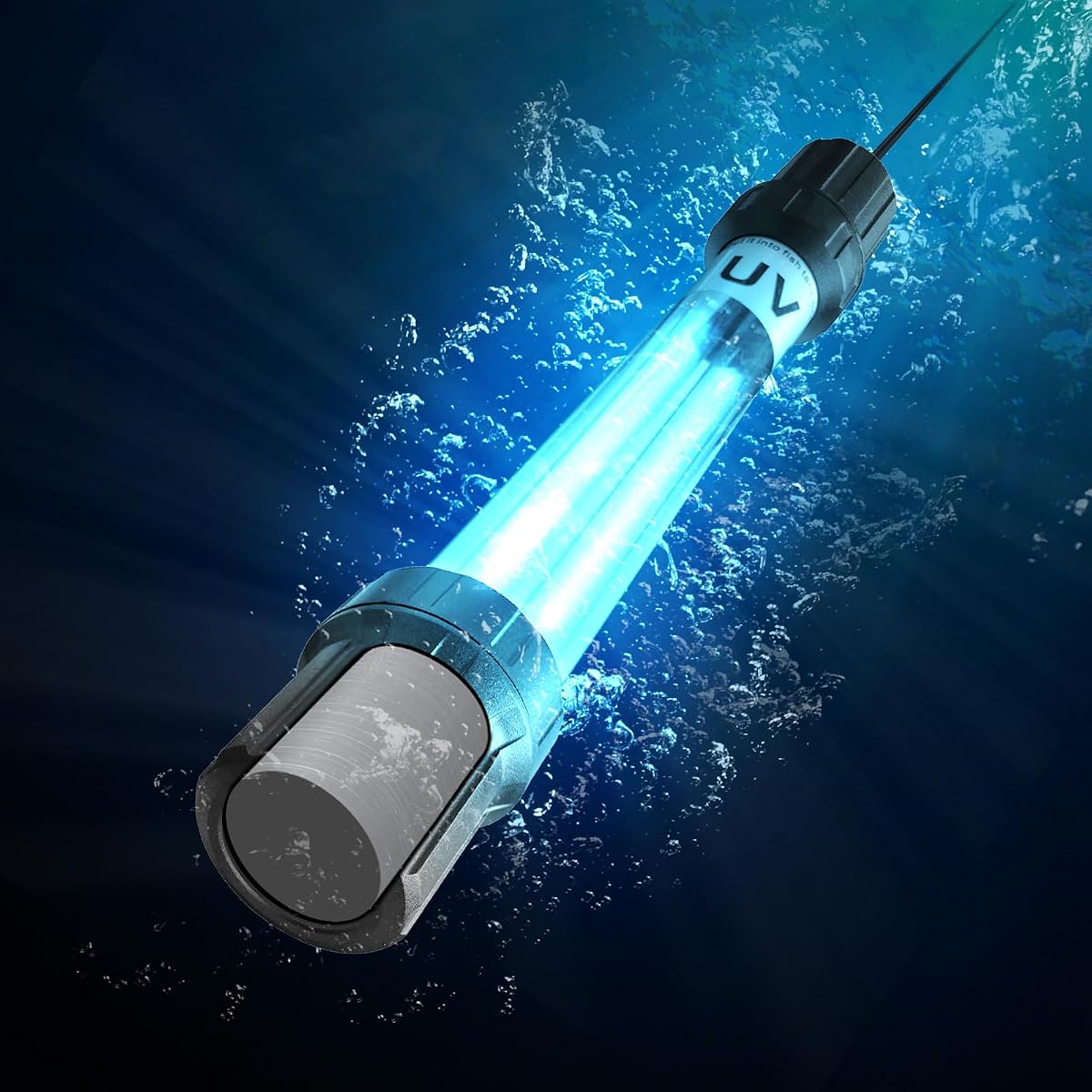
The Aquarium Clean Light 3W Mini is a compact, submersible UV unit intended to help clear green water in aquariums, ponds, pools, and indoor water features. It carries a 4.2 rating and stands out for its small format, simple button control, and inclusion of a UV test card and aquarium temperature strip. The lamp uses silica glass and a stated 254nm wavelength.
We may earn a commission when you buy through this link, at no additional cost to you.
Its most appealing feature is the combination of size and useful accessories. Because the housing is small, it can be tucked behind a filter component, positioned near a circulation point, or separated from fish with an opaque plate. The included test card gives buyers a way to check visible UV output, while the temperature strip adds a way to monitor the aquarium conditions during use. The manufacturer suggests operating the 3W mini for three to four hours every two to four days.
The main limitation is that this is a very small lamp without a built-in timer, so it is most appropriate for modest tanks and aquarists who are comfortable controlling the cycle manually. Its listing also makes an important distinction: the light can address green coloration in the water but cannot remove black precipitate attached to rocks or the tank. The glass tube should be handled carefully, and the controller and plug must remain away from water.
This is a sensible budget-oriented choice for a small aquarium experiencing green water, especially if a filtration compartment can conceal it. It is less convincing for a large display aquarium because there is no stated gallon rating and no automated schedule. Buy it as a supplementary clarifier rather than as a replacement for filtration, water changes, nutrient control, or general aquarium maintenance.
The UV test card and temperature strip make this entry more practical for beginners. They also help distinguish UV output from the visible glow and provide a quick indication of the water temperature while the lamp is being used.
Place the unit where water can pass through it, preferably near filter flow. The product description recommends using it in the filter or behind an opaque barrier so fish are not exposed to direct UV light.
We may earn a commission when you buy through this link, at no additional cost to you.
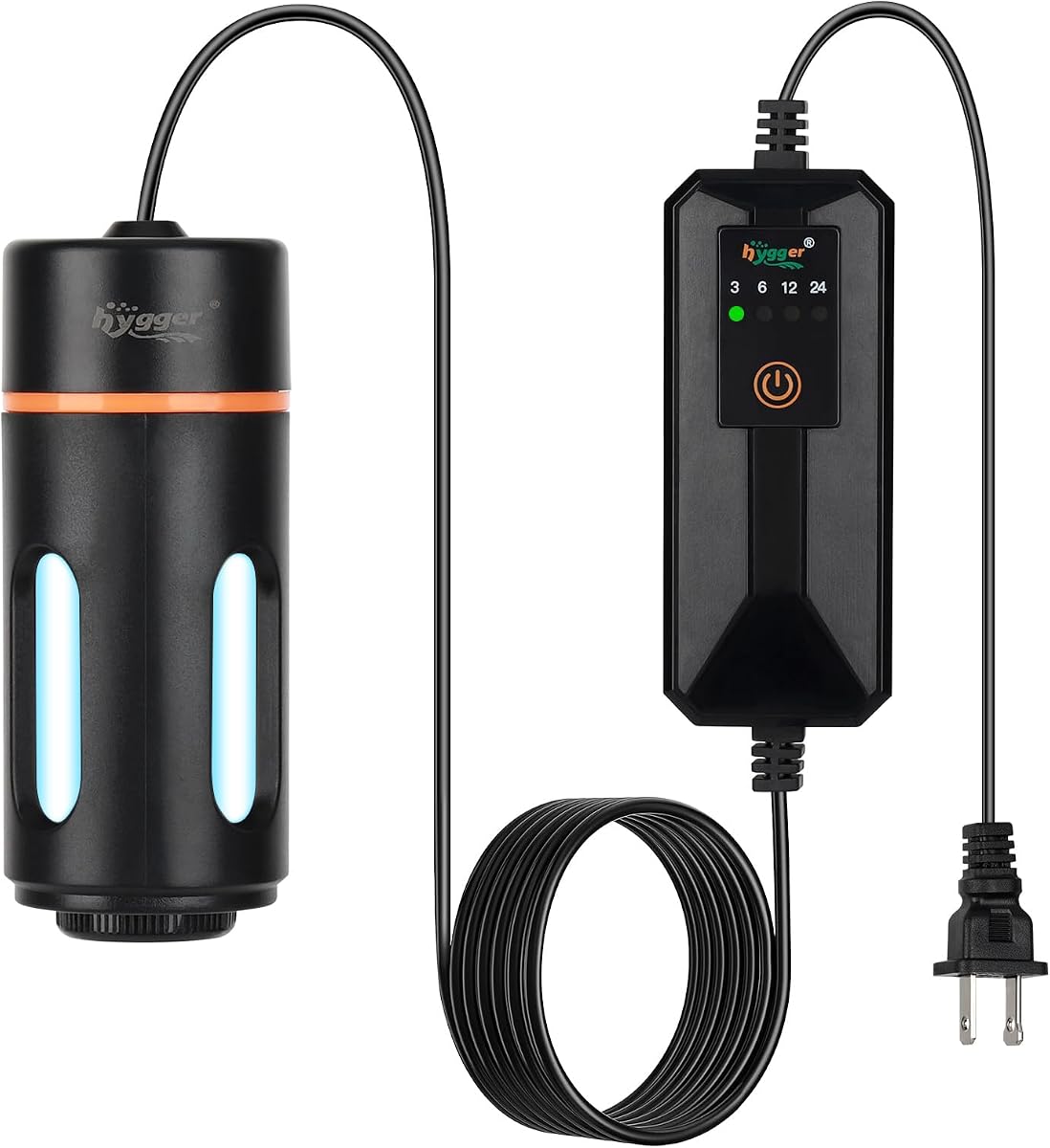
The hygger 3W U-V Light is designed for fish tanks and turtle tanks between two and 15 gallons. Its 4.4 rating is the highest among the products in this guide, and the defining feature is the built-in controller with four timer choices: 4H, 8H, 12H, and 24H. A memory function allows the selected schedule to repeat after a power interruption.
We may earn a commission when you buy through this link, at no additional cost to you.
This model offers a more automated experience than other compact 3W lights. It can run continuously for three to five days during a severe green-water event and then move to a four-hour daily maintenance cycle. The sealed protective cover directs most of the emission from the back, helping reduce accidental eye exposure when the light side is placed near the tank wall or bottom. The compact body is also easier to conceal than many exposed-tube alternatives.
The stated performance still depends heavily on circulation. The lamp works best in moving water, near filter output, or with a wave pump, and the product listing does not indicate that a pump is included. Direct UV exposure of people, fish, reptiles, and plants should be avoided. As with other UV clarifiers, it is a targeted tool for green water and clarity rather than a substitute for routine filtration and water changes.
This is an attractive choice for a small aquarium, betta setup, or turtle habitat where automatic scheduling is important. It is also one of the stronger options for users who want more control than a simple push-button model. For tanks larger than 15 gallons, move up to a higher-output unit with a more appropriate capacity rating.
The timer presets simplify a repeated treatment routine, while memory restores the previous setting after an outage. The 24H option is useful during intensive green-water periods, although shorter cycles are more appropriate for routine maintenance.
With a stated range of two to 15 gallons, the unit is best matched to compact tanks and turtle habitats. The housing is designed to fit tight spaces without requiring a large external assembly.
We may earn a commission when you buy through this link, at no additional cost to you.
The Internal Green Water Killer combines a 5W aquarium UV lamp with a built-in five-watt water pump and is rated for tanks up to 75 gallons. It has a 4.2 rating and is designed for both freshwater and saltwater systems. The selling point is simplicity: one internal assembly supplies circulation while exposing passing water to UV treatment.
We may earn a commission when you buy through this link, at no additional cost to you.
Combining the pump and light can make installation more approachable because the owner does not need to arrange a separate circulation device specifically for the UV unit. Its stated goal is to turn green water clear in three to seven days, making it relevant to aquariums experiencing suspended algae or cloudy green coloration. The integrated circulation helps water pass through the treatment area rather than leaving the lamp sitting in still water.
The product information is comparatively brief, so buyers should expect a straightforward unit without the detailed timer presets and shielding modes offered by several hygger models. No timer is mentioned, and the actual treatment schedule will depend on the aquarium, filtration, and algae load. It also needs appropriate placement within the tank, with fish protected from direct exposure.
This is a good match for aquarists who want a single UV-and-pump assembly for a tank up to 75 gallons. It is less suitable for users who require precise scheduling, multiple mounting options, or a high degree of flexibility. Always consider where the UV light sits within the circulation path and use an opaque barrier or filter arrangement when necessary.
The built-in pump removes the need for a dedicated circulation accessory and helps move water through the UV section. This integrated design can simplify setups in which every piece of equipment competes for limited space.
The stated capacity reaches 75 gallons, which distinguishes it from most of the 3W compact units. Actual results still depend on water volume, flow rate, water clarity, and the severity of the algae problem.
We may earn a commission when you buy through this link, at no additional cost to you.
The hygger 11W U-V Light is a higher-output model intended for freshwater and saltwater tanks from 60 to 180 gallons. It has a 4.1 rating and combines a 254nm lamp, four timer settings, a memory function, and a 360-degree protective shield. Two operating modes allow the light to be used in different aquarium arrangements.
We may earn a commission when you buy through this link, at no additional cost to you.
The Healthy Mode closes the shield for direct placement in the aquarium, while High Efficiency Mode opens it for use in a filter chamber where broader algae treatment is wanted. The timer provides 3H, 6H, 12H, and 24H options, making it possible to run intensive treatment during an outbreak and switch to a shorter daily maintenance cycle. Two suction cups and a user manual are included.
A notable trade-off is that continuous 24-hour operation can shorten the bulb's lifespan, according to the listing. The protective design also depends on proper configuration: the cover should remain closed when fish may swim near the lamp in direct-tank mode. Its size and power may be excessive for a small aquarium, so the stated capacity should guide the purchase rather than the lamp's headline wattage alone.
This is the most versatile recommendation for a moderately large home aquarium because it combines timer control, flexible shielding, and a broad stated capacity. It is particularly useful for owners who want to move between a direct installation and a filter-based arrangement. Choose it when the aquarium is large enough to benefit from 11W output and when a timer is important for establishing a repeatable maintenance schedule.
Keeping the shield closed helps limit direct exposure when the unit is placed in the tank. Opening it inside a filter chamber is intended to improve algae treatment by allowing the lamp to work across a wider area of the unit.
The 24H setting is intended for a three-to-seven-day algae outbreak period, while three hours per day is recommended for ongoing maintenance. Avoiding unnecessary continuous operation helps preserve expected bulb longevity.
We may earn a commission when you buy through this link, at no additional cost to you.
The hygger 5W U-V Light fills the gap between compact 3W units and larger 11W models. It is intended for 13- to 40-gallon freshwater and saltwater tanks, carries a 4.1 rating, and uses a 254nm UV treatment lamp. Its 360-degree shield and timer are the primary features for aquarists who want more control from a moderately sized unit.
We may earn a commission when you buy through this link, at no additional cost to you.
The controller provides 3H, 6H, 12H, and 24H timer modes and remembers the last selection. In Healthy Mode, the shield is closed for direct aquarium placement. High Efficiency Mode opens the shield and is intended for a filter tank, where the lamp can treat more of the water passing through the compartment. The product includes the UV light, two suction cups, and a manual.
Its most significant purchasing consideration is that compatible replacement bulbs are sold separately and use the HG245 model. That adds a potential future accessory requirement, although it also means a failed lamp need not require replacing the entire assembly. As with the larger hygger model, prolonged 24-hour operation may shorten bulb life, and the shield must be used according to the installation mode.
This is a balanced recommendation for tanks in the middle of the list. It offers a useful tank-capacity range, automated scheduling, and enough power to avoid the limitations of the smallest lights without requiring the space associated with an 11W model. It is particularly appropriate when a compact filter chamber can house the lamp with the shield open.
Daily cycles can be programmed in three, six, 12, or 24-hour increments. The memory function retains the chosen schedule after a power interruption, reducing the need to reset the controller.
The replacement lamp is identified as the HG245 model and is sold separately. Checking bulb availability before purchase can be helpful for owners who want a straightforward long-term maintenance plan.
We may earn a commission when you buy through this link, at no additional cost to you.
The 18W Aquarium UV Light is built for large systems, with a stated range of 100 to 1,000 gallons and applications including koi ponds, pools, spas, cold plunges, and large fish tanks. It has a 4.1 rating and uses a dual-tube design, thick protective end covers, high-transparency quartz glass, and a weighted gravity block. A 17-foot power cable adds installation flexibility.
We may earn a commission when you buy through this link, at no additional cost to you.
The upgraded packaging is designed to reduce tube breakage, while the weighted base allows the unit to stand underwater and provide broad treatment around the tubes. The listing states that the dual-tube configuration improves operating stability, and the 254nm UV-C light is presented as a means of addressing algae, odors, and unwanted microorganisms. A detailed installation video and a one-year warranty are also provided.
This is a substantial piece of equipment, so it is not the logical choice for a small display tank. The product listing also advises keeping electrical components away from the unit and isolating the light from fish with an opaque barrier or by placing it in a pond or aquarium filter. The stated bulb lifespan is 8,000 hours, though actual longevity depends on use and operating conditions.
Choose this model for a large pond, pool, spa, cold plunge, or substantial aquarium that needs more treatment capacity than a compact household unit can provide. Its combination of dual tubes, weighted construction, long cable, and broad stated capacity makes it a strong high-output option for users with room to install it correctly.
The stated 100-to-1,000-gallon range is much broader than that of household aquarium lights. Actual performance still depends on flow, turbidity, and whether the unit is placed in a filter where water can pass through the UV tubes.
The gravity block helps the lamp remain upright and can stand independently underwater. Double sealing and thickened end covers support reliable submersion, although care is still required around power connections.
We may earn a commission when you buy through this link, at no additional cost to you.
The FishTankLight 11W is an aquarium algae-control light intended for freshwater and saltwater tanks between 55 and 150 gallons. Its 4.0 rating reflects a straightforward design centered on a silica glass UV tube, a stated 254nm wavelength, and filter-oriented installation. It does not describe the timer or multi-position shielding features found on some competing models.
We may earn a commission when you buy through this link, at no additional cost to you.
The product information recommends placing the lamp in a filter or behind an opaque plate to prevent direct UV light from reaching fish. That is a particularly important installation point for this model because it is intended to treat algae in a moderately large aquarium without subjecting aquatic life to direct irradiation. Its silica glass tube is described as offering good UV transmission for water cleaning.
The suggested operating pattern is three to four hours every two to five days, which is manageable for an aquarist with a routine maintenance schedule. However, no built-in timer is mentioned, so users will need an external timer if they want the lamp to operate unattended. The instructions also advise measuring the aquarium and filter before purchase because the physical dimensions must be compatible.
This is a practical choice for owners of a medium-to-large aquarium who want a dedicated UV lamp and can provide filter placement or opaque separation. It may appeal to buyers who prefer a simpler device without multiple modes. The trade-off is less automation and fewer stated mounting protections than on the more feature-rich 11W and 5W hygger products.
The listing specifically recommends comparing the aquarium and filter dimensions before buying. A lamp that does not fit securely in the intended chamber may not receive consistent flow or may be difficult to conceal.
The recommended three-to-four-hour cycle every two to five days is considerably less demanding than continuous operation. An external plug-in timer can add consistency if the aquarium is unattended during part of the day.
We may earn a commission when you buy through this link, at no additional cost to you.
The Qualirey 11W UV Light is a submersible UV-C lamp with a timer, protective hood, and quartz tube construction. It has a 4.2 rating and is marketed for fish tanks, ponds, sumps, and swimming pools. The product description emphasizes safe installation, including complete immersion before connecting power and keeping the plug and power supply away from water.
We may earn a commission when you buy through this link, at no additional cost to you.
Its timer provides a useful level of scheduling, and the included hood helps reduce accidental illumination of eyes and skin. The listing recommends roughly two hours per use and advises against continuous irradiation beyond six hours. When algae or poor water quality is substantial, continuous treatment for around three days may produce more noticeable results. The quartz tube is described as having high ultraviolet transmission and resistance to damage.
The safety guidance is notably strict: the lamp should not be placed in the same water as fish without effective separation, and direct irradiation of people, animals, and plants is prohibited. That makes the hood and correct placement essential rather than optional accessories. It is also worth noting that the listing advises contacting support if the tube is damaged during transport, reflecting the care needed with a submerged quartz component.
This is a useful option for pond, sump, and pool applications where the lamp can be isolated from aquatic life. It may also work well in a filter chamber, provided water flow is sufficient. The combination of timer, hood, and clear operating guidance makes it approachable, although strict separation requirements reduce its flexibility for direct display-tank installation.
Scheduled two-hour sessions fit a regular maintenance routine, while the stated three-day intensive period can be used when algae is especially troublesome. The recommendation against long, unattended runs reduces unnecessary bulb exposure.
The lamp should be fully submerged before power is connected. The plug, controller, and power supply must remain dry and should never be placed in a humid location near the water.
We may earn a commission when you buy through this link, at no additional cost to you.
The Compact 3W U-V Light is a small aquarium clarifier for freshwater and saltwater tanks from three to 20 gallons. It has a 4.0 rating and distinguishes itself through a one-to-24-hour timer with one-hour increments, a daily memory function, status indicators, and a protective shielding housing. Its listed dimensions are 4.5 by 1.0 by 0.8 inches.
We may earn a commission when you buy through this link, at no additional cost to you.
The timer offers finer control than the preset schedules on many competing 3W models. A controller display, indicator lights, and a visible lamp window allow the owner to check operating status without removing the unit. In Health Mode the shield closes for safer direct placement in the tank, while Efficient Mode opens it to expand coverage; the latter requires the light to be out of sight of people and fish.
A pump is not included, so water circulation must come from the aquarium's existing filtration or another suitable movement device. The listing recommends installation near the filter outlet for better performance. Although the lamp is compact, it is still a treatment tool rather than a complete circulation system, and users should not expect it to overcome poor water movement or severe nutrient problems without supporting maintenance.
This is a strong option for small aquariums where a fine-grained timer and easy status monitoring are priorities. The compact dimensions make it easy to conceal, while the 3-to-20-gallon range offers more flexibility than many miniature models. It is less suitable for medium or large tanks or for setups lacking reliable circulation.
Adjustable one-hour intervals allow the user to match treatment time closely to the aquarium's routine. The memory function retains the schedule after a power outage, so the unit can resume the selected cycle.
Because no pump is included, the aquarium filter should provide enough movement to carry water past the UV window. Positioning the light near the filter outlet improves its usefulness in a compact setup.
We may earn a commission when you buy through this link, at no additional cost to you.
The 20W Submersible Water Clarifier is the highest-capacity model in this guide, with a stated range of 200 to 2,000 gallons. It has a 4.2 rating and uses an upgraded dual-tube 254nm UV-C system. Applications include ponds, pools, cold plunge tubs, spas, hot tubs, and large fish tanks, with a 17-foot cable for flexible placement.
We may earn a commission when you buy through this link, at no additional cost to you.
A weighted gravity block keeps the unit upright underwater, and double sealing with thick protective covers supports reliable submersion. The quartz glass is intended to maximize UV penetration, while the dual-tube arrangement is presented as a way to maintain consistent output. The listing states a lamp life of 8,000 hours and includes a one-year warranty, along with an EPA establishment number.
This model is clearly designed for substantial water systems rather than ordinary household aquariums. For fish tanks, the listing explicitly instructs users not to expose fish to the UV-C light and recommends placing the unit behind the filter where water is flowing. The quartz tubes should be handled carefully, and direct contact with the operating unit should be avoided because of electrical safety concerns.
Choose this clarifier for a large pond, pool, spa, cold plunge, or very large aquarium where the stated 20W output and long installation cable are appropriate. It is the least suitable option for a small display tank, but it offers the broadest capacity and most substantial construction among the products reviewed.
The stated 200-to-2,000-gallon range makes the unit appropriate for large installations where a household aquarium clarifier would be underpowered. The actual result still depends on flow and the amount of material that must be treated.
The paired UV-C tubes are designed to provide more stable output than a single-tube arrangement. Upgraded packaging is intended to protect the tubes during shipping, while the weighted base helps maintain consistent underwater positioning.
We may earn a commission when you buy through this link, at no additional cost to you.
The right aquarium UV light depends on the volume and type of water system, the severity of the algae problem, available flow, and how safely the lamp can be hidden. These factors help narrow the field before comparing individual models.
Start with the volume of water that needs treatment and whether the UV light will serve a fish tank, turtle habitat, pond, pool, spa, sump, or cold plunge. The products in this guide range from compact units intended for tanks as small as two gallons to dual-tube clarifiers stated for systems as large as 2,000 gallons. A larger light is not automatically better in a small aquarium, and a small model may be unable to process enough water in a large system. Use the listed capacity as the starting point, then consider flow and water clarity as equally important.
Choose a model whose stated range comfortably matches the actual system rather than the maximum possible system. For very large installations, verify the physical filter or pond dimensions and ensure the unit can remain submerged and stable.
Wattage offers a basic indication of the lamp's potential output, but it is not a standalone measure of performance. Tube design, quartz construction, shielding, water flow, transparency, and the amount of UV light reaching the water all influence the result. The compact selections use 3W lamps, several midrange models use 5W or 11W, and the large-system products use dual 18W or 20W configurations. A dual-tube system may be advantageous when a large volume of water must pass through the treatment area.
Match power to system scale and avoid paying for a lamp that is physically too large for the available filter space. The most important technical requirement is that water flows consistently through the UV zone.
UV light works on organisms and particles that pass through the illuminated area, so stagnant placement is ineffective. Several products explicitly perform best near filter output, inside a filter chamber, or with a wave pump. Others are designed as internal units with a built-in pump, while a few require the aquarium's existing circulation to do the work. Before buying, identify exactly where the lamp will go and whether it can remain unobstructed as water passes through.
Prefer a location that combines steady flow with protection from direct viewing. If the lamp is mounted in open water, a shield or opaque barrier may be needed to keep ultraviolet light away from fish, people, and plants.
Direct ultraviolet exposure can harm people and aquatic life, so shielding is a critical feature rather than a cosmetic addition. Some models use a sealed or rear-facing cover, while others provide a 360-degree shield that can be closed for tank placement and opened inside a filter chamber. Additional hoods may be included for extra separation. The correct mode matters: a unit configured for direct aquarium use should not be switched to an open treatment mode unless fish and people are fully isolated from the lamp.
Verify that the protective components are easy to position and remain secure during normal filter operation. If the lamp cannot be hidden from sight or separated from fish, choose a different installation method or product.
A timer makes a UV treatment routine easier to maintain and can prevent accidental continuous operation. Available controls range from a simple button-controlled 3W model to presets of 3H, 6H, 12H, and 24H, as well as a fine-adjustable one-to-24-hour timer. Memory functions preserve a selected schedule after a power interruption. For a severe green-water event, a longer or continuous setting may be recommended temporarily, while routine maintenance usually calls for shorter daily operation.
Choose the timer that best matches how consistently the aquarium is monitored. Automatic scheduling is helpful for maintenance, but continuous 24-hour use can shorten bulb life and is not appropriate for every system.
Most products listed here are intended for freshwater and saltwater aquariums, while several also support ponds, pools, sumps, spas, and cold plunges. The chemical needs and circulation requirements of a display aquarium can differ substantially from those of a pond or pool, so a general water-use label should not be treated as a guarantee of identical performance. Confirm both water compatibility and intended application in the product documentation.
For mixed installations, select the model specifically approved for the relevant use. UV may complement filtration and maintenance, but it does not replace biological filtration, water changes, nutrient control, or appropriate pond and pool care.
A UV light operating underwater must have dependable seals and a stable position. Large models often use weighted gravity blocks so the unit stands upright and treats water around multiple sides. Compact units may be held with suction cups or hidden in a filter. Quartz tubes offer high UV transmission but require careful handling, while glass and silica housings can also be vulnerable to impact. Review the included installation guidance and compare the product dimensions with the available filter or tank space.
Pay particular attention to the power connection, controller placement, and instructions for removing the unit before maintenance. Good sealing and stable mounting matter more than a small difference in headline wattage.
Consider how the lamp will be cleaned, stored, and replaced. Some products specify a compatible replacement bulb, while others do not provide bulb availability information in the supplied listing. A stated operating life can help estimate replacement timing, but actual life varies with run time and conditions. Cleaning away accumulated debris and mineral deposits helps maintain consistent transmission, and a timer with memory supports an orderly maintenance schedule.
Check replacement availability and confirm the correct model before purchasing a unit that uses a proprietary bulb. Also retain the installation guidance, because incorrect reassembly can compromise seals and performance.
Begin by measuring the aquarium or water system and confirming that the lamp's dimensions, capacity range, and installation method suit the available space. Read the manual, identify the timer or controller, and decide whether the unit will be placed in a filter chamber, behind an opaque barrier, near a filter outlet, or in another location approved by the manufacturer. For a new installation, confirm that the tank's existing filter and circulation can move enough water through the UV area.
Install the lamp with all electrical connections and the power supply completely dry. Submersible models should be positioned in the water before power is applied, while aquarium installations should use the supplied shield or hood in the prescribed closed position. If the lamp is installed in open water, keep it hidden from fish and prevent direct human exposure. Confirm that the unit is stable and that the cable cannot be pinched, pulled, or exposed to a splash.
Set an appropriate initial schedule according to the manual. During a severe green-water or algae outbreak, some products support a temporary extended run, but avoid continuous 24-hour operation unless the instructions specifically recommend it. Once the water clears, move to a shorter maintenance schedule. Periodically inspect the glass or quartz tube, rinse or clean it as directed, confirm that the unit is still positioned correctly, and replace the lamp or tube when performance declines or the rated service life is reached.
A UV light can help reduce green water by targeting suspended algae and microorganisms that pass through the illuminated water. Results depend on lamp output, circulation, tank size, and the severity of the bloom. A UV unit is most effective when water moves through it, and it should complement rather than replace filtration, water changes, and nutrient management.
Some products are designed for direct placement when their protective shield is closed, while others are intended only for a filter chamber or behind an opaque barrier. Follow the instructions for the exact model. Direct UV exposure can harm fish, reptiles, plants, and people, so never defeat or omit the protective housing.
The appropriate schedule varies by product and the severity of the problem. Several models suggest several hours per day for routine maintenance and a temporary continuous cycle during a serious outbreak. Because extended operation can shorten bulb life and may increase safety concerns, follow the product-specific schedule rather than assuming that longer is always better.
No. A UV clarifier is an additional treatment tool, not a complete replacement for mechanical filtration, biological filtration, or regular water maintenance. It can reduce certain algae, microorganisms, and odors as water passes through the lamp, but the aquarium still needs appropriate filtration, water changes, stocking management, and nutrient control.
Several products in this guide are explicitly listed for ponds, pools, spas, sumps, and cold plunges. Their stated capacities range much higher than those of small aquarium models. Confirm the application, flow requirements, electrical safety guidance, and local water-treatment rules before using any UV unit in a shared or public water feature.
The treatment effect depends on organisms and particles passing through the UV-treated area. Slow or stagnant water can leave much of the aquarium untreated, even when the lamp is operating correctly. Position the light near filter flow, install it inside a suitable filter chamber, or add a wave pump when the design does not include its own circulation.
Disconnect the power and remove the unit from the water before cleaning. Follow the manual's instructions and avoid abrasive materials that could scratch the glass or quartz tube. Rinse away algae and mineral deposits carefully, inspect the seals, let the housing dry as required, and reinstall it only after all components are secure.
Ultraviolet light can harm aquatic organisms when they are exposed directly, which is why shielded or filter-mounted installation is emphasized throughout this guide. The products are intended to help clarify water, not to illuminate the aquarium as a general-purpose light. Use the supplied shields, barriers, and operating modes, and never look directly into an active UV lamp.
The best aquarium UV light for one setup may be poorly suited to another. The 3W mini offers a compact, budget-friendly option for small tanks, the hygger 3W adds dependable timer presets, and the integrated Internal Green Water Killer combines UV treatment with a pump. The 5W and 11W hygger models provide stronger timer and shielding options, while the 18W and 20W dual-tube units target large ponds, pools, spas, and substantial aquariums.
Prioritize correct scale, reliable water flow, and safe placement over headline claims alone. Measure the filter or pond area, confirm the stated capacity, determine whether the lamp includes a timer and protective shield, and make sure every exposed aquatic organism is isolated from direct UV light. A correctly installed unit in a well-circulated system is more likely to deliver useful clarification than an oversized or poorly positioned lamp.
Finally, check current prices, availability, warranty terms, and replacement-lamp details before purchasing, because these can change over time. Pair the UV light with dependable filtration, appropriate water changes, and responsible nutrient control, and review the included instructions before every installation or cleaning.