
Sntieecr STEM Electric Circuit Motor Kit
4.2Editor score
Motors, switches, bulbs, and leads
Multiple propeller configurations
Straightforward circuit-building activities
Discover the best Electricity Learning Kits for kids, teens, and students, with a practical comparison of projects, components, guidance, and age suitability.
Electricity learning kits turn abstract ideas about current, circuits, batteries, and magnetism into practical experiments that children can build and investigate. A strong set balances accessible components, clear instructions, safe connections, and enough variety to encourage repeated discovery rather than one-time play.
This guide compares ten kits by examining their stated project range, included materials, learning guidance, age positioning, and suitability for home, classroom, or STEM enrichment. The list includes introductory circuit sets, comprehensive electricity and magnetism bundles, motor-building kits, and specialized battery projects, with ratings shown as supplied.
Each review highlights what distinguishes its selected kit, including hands-on coverage, component organization, and potential limitations. Ratings reflect the supplied product information rather than personal testing, and product details can change over time. Prices also vary by seller and promotion, so readers should confirm current availability and cost before purchasing.
4.2Editor score

4.7Editor score

4.5Editor score
The table below compares all ten kits by their principal learning focus, project range, guidance, and intended audience. It is a quick way to identify the most comprehensive set, a focused introductory option, or a specialized kit for batteries, motors, circuits, and electromagnetism.



The EUDAX School Physics Labs kit is a broad, school-oriented exploration of electricity and magnetism, with a supplied rating of 4.5. Its most notable feature is the combination of 56 electricity items and 21 magnetism items, allowing learners to move beyond a single circuit demonstration into a wider range of physical investigations.
We may earn a commission when you buy through this link, at no additional cost to you.
The manual covers projects including series and parallel circuits, a fruit battery, an unknown-resistor exercise using Ohm's law, the Oersted experiment, an electromagnet, an investigation of Ampere's force, an electric bell, and a hand-crank generator. This mix connects circuit construction with measurement and electromagnetic effects, making the set useful for students who have already learned basic circuit terminology.
The trade-offs are worth noting. Three AA batteries are needed but not included, and the bundle is focused more heavily on electricity than on magnetism. Because it is designed for grades 9 through 11, younger children may need adult guidance, while experienced younger learners could still use selected projects with supervision.
This is a strong choice for high-school physics, home-school study, or a classroom lab that needs both circuit-building and magnetism activities in one package. It offers a more substantial learning arc than a simple starter set while remaining more focused than a general circuit kit built around entertainment-oriented projects.
The project sequence introduces familiar circuit configurations before moving into measurement and magnetic phenomena. That structure helps learners connect electrical current, magnetic fields, electromagnets, and force rather than treating each activity as an isolated construction.
The included storage bag and broad component count make the kit easier to manage as a reusable learning center. A teacher can present experiments in groups while students retain access to the same range of parts and repair tools.
We may earn a commission when you buy through this link, at no additional cost to you.
This STEM Electric Circuit Kit is designed for children ages 8 and older who are beginning to explore electrical engineering. With a 4.5 supplied rating, its strongest qualities are approachable organization, a guided circuit book, and eight clearly framed experiments that include both conventional circuits and energy-producing projects.
We may earn a commission when you buy through this link, at no additional cost to you.
The stated activities include series and parallel circuits, saltwater power generation, a fruit battery, and several ways to light a bulb. Splitting the components into seven packs can help learners follow a more manageable sequence, and the book is intended to provide easy-to-follow instructions while encouraging problem-solving, creativity, and exploration.
Its scope is narrower than larger systems with dozens or more than 100 activities. That limitation is not necessarily a drawback for younger children, who may benefit from a smaller set of well-defined challenges. Batteries are also required but not included, so the kit will not be ready for use immediately after opening.
The kit suits families, beginning STEM learners, science-fair preparation, and teachers seeking a concise set of guided projects. It offers a more structured introduction than a loose collection of components, but households wanting extensive experimentation should consider a larger or more specialized bundle.
A guide and limited number of activities can reduce the overwhelm that sometimes accompanies a large parts bin. Children can learn how a circuit closes, compare configurations, and observe results before moving to more open-ended challenges.
Fruit and saltwater activities extend the learning beyond batteries. They invite children to compare how different source materials behave and begin connecting chemical processes with electrical energy.
We may earn a commission when you buy through this link, at no additional cost to you.
The National Geographic Circuit Kit for Kids stands out for breadth, offering more than 120 electrical projects and activities. Its supplied rating of 4.7 is the highest among the ten products, and the combination of illustrated instructions, video guidance, and tool-free connections gives it a strong balance of accessibility and variety.
We may earn a commission when you buy through this link, at no additional cost to you.
Possible projects extend well beyond conventional circuit diagrams, including keyboard mode, a light show, a flying copter, and a voice-amplifying sound system. This range makes the kit appealing for children who enjoy building visible or audible results and for families seeking a long sequence of activities rather than a small collection of lessons.
Its greatest possible drawback is focus. A very large number of projects can be intimidating to younger children or learners who prefer a clear learning path. The stated emphasis is on exploration and creativity, so adults may need to help beginners select suitable projects and connect them to formal electrical concepts.
This is a strong choice for sustained home STEM activity, creative circuit play, and gift giving for an inquisitive child. It offers exceptional stated variety and convenient connections, making it one of the most engaging options for learners who want to build repeatedly rather than complete only a handful of prescribed experiments.
With more than 120 stated projects, children can move from simple constructions to more elaborate creations. The scale supports both structured lessons and self-directed challenges, making it useful for long-term use.
Illustrated directions and QR-linked video instructions let learners choose between visual references. Video demonstrations can be especially helpful when a connection sequence or component operation is difficult to understand from text alone.
We may earn a commission when you buy through this link, at no additional cost to you.
The Mysterystone Science Experiment kit provides more than 50 do-it-yourself electricity and magnetism activities, supported by as many as 55 components. Its supplied rating is 4.4, and the set is especially appealing for students who want to understand why an experiment works as well as how to assemble it.
We may earn a commission when you buy through this link, at no additional cost to you.
The manual is described as clearly illustrated and explanatory, covering the experiments themselves while guiding students to discover, think, explore, and learn. Distinctive components include a light-controlled LED, a magnetic switch, and a module for Joule's first law, which can help distinguish the set from kits containing only standard bulbs, wires, and switches.
A large collection can create a learning curve, especially for children not yet comfortable with circuit diagrams. The product information uses approximate wording for its item and experiment totals, so buyers should not treat those figures as guaranteeing a fixed number of unique outcomes. Adult facilitation may also be helpful for some concepts.
This kit is well suited to older elementary students, middle-school learners, and parents seeking an open-ended physics lab. It combines a reusable parts system with explanatory guidance, making it a practical choice when the goal is sustained investigation rather than one or two demonstration circuits.
The stated emphasis on explaining why each activity works makes this more than a construction set. That approach can help learners form hypotheses, change variables, and relate observations to familiar physics ideas.
Every component has a fixed place in a solid case. Organized storage reduces setup friction and makes the kit practical to bring to a classroom, club, or shared family learning space.
We may earn a commission when you buy through this link, at no additional cost to you.
The Sntieecr STEM Electric Circuit Motor Kit is a compact, focused choice for children who want to build working motor-driven projects. It has a supplied rating of 4.2 and includes two motors, five crocodile clip leads, bulbs, holders, rocker switches, a buzzer, battery holders, and propellers with three or four vanes.
We may earn a commission when you buy through this link, at no additional cost to you.
Its approachable collection of familiar parts makes it suitable for introductory science, technology, engineering, and design activities. The different propeller options offer visible ways to compare how a rotating component changes a completed circuit, while the switches and buzzer introduce simple control and signaling features.
The stated safety guidance is important. Use is recommended at 1.5 to 3 volts, and at 3 volts the operating time should be limited to three minutes because the circuit can heat after prolonged use. It also includes a small-parts warning for children under three and advises adult supervision and proper connection before power is switched on.
This is a good choice for a budget-conscious family seeking a straightforward motor kit for a school project or introductory STEM session. It is less versatile than comprehensive electricity-and-magnetism systems, but its focused contents can make it easier for a young learner to understand and use.
Motorized propellers provide an immediate result after a circuit is assembled. That visible outcome can motivate children to troubleshoot connections and experiment with switches, power, and rotating components.
The kit is narrow in topic but rich in standard circuit pieces. Learners can practice following a connection sequence, operating switches, and understanding how a complete path activates a load.
We may earn a commission when you buy through this link, at no additional cost to you.
The Teenii Electricity and Magnetism Kit combines a 50-piece collection with 18 hands-on experiments and a 40-page full-color manual. Its supplied rating is 4.4 reflects a solid, balanced package aimed at children ages 8 and older, families, and learners interested in both circuits and electromagnetic concepts.
We may earn a commission when you buy through this link, at no additional cost to you.
The component list is notably complete. It includes an ammeter and voltmeter, bulbs, switches, battery holders, resistors, a potentiometer, copper and zinc electrodes, bar and horseshoe magnets, a compass, solenoid, electric motor, fan blade, hand crank, and stand. These parts support stated activities such as a fruit battery, electric bell, hand-crank generator, and double-rail module.
The main limitation is breadth relative to kits advertising more than 50 or over 100 projects. Eighteen structured experiments may be more manageable, but the set offers less raw variety. Because it includes small scientific components and requires correct assembly, younger users should receive suitable supervision.
This is an attractive all-around option for parent-child science, school enrichment, and birthday or holiday STEM gifts. The manual, measurement tools, and varied components provide a more complete learning experience than a bare parts set without reaching the size of the largest project libraries.
The ammeter, voltmeter, resistors, and potentiometer allow learners to move beyond simply seeing a bulb illuminate. These components introduce comparison, adjustment, and a more quantitative relationship between electrical behavior and circuit design.
Batteries, fruit electrodes, magnets, a compass, and a solenoid make it possible to connect several foundational themes. That variety is valuable for families seeking one kit to support several related units.
We may earn a commission when you buy through this link, at no additional cost to you.
The Physics Labs Basic Electricity Discovery Kit is a substantial option for junior- and senior-high-school students. It carries a supplied rating of 4.5 and combines 55 electricity items with 22 magnetism items, creating one of the most component-rich sets in this comparison.
We may earn a commission when you buy through this link, at no additional cost to you.
Its manual covers the content, operating steps, and equipment required for each experiment, with an emphasis on discovery rather than simple assembly. Stated projects include series and parallel circuits, a fruit battery, measuring an unknown resistor using Ohm's law, the Oersted experiment, an electromagnet, an investigation of Ampere's force, an electric bell, and a hand-crank generator.
Specialized pieces such as a sensitive ammeter, magnetically controlled switch, and Joule's first-law module add value for students working beyond elementary circuit construction. At the same time, the complexity and larger parts count may make the kit less inviting to young children. Three AA batteries must be supplied separately.
This is a strong choice for advanced home-school study, high-school physics labs, and motivated learners seeking a reusable laboratory-style collection. Its organization, detailed guidance, and breadth distinguish it from simpler introductory kits and make it our premium selection for serious guided exploration.
A sensitive ammeter and dedicated experiment modules allow students to work with more precise or focused activities. These additions are particularly relevant when the objective is to connect classroom physics with observable experiments.
The double-layer case and fixed positions for components support regular use and transport. Teachers can organize materials once, while students can access and return parts without searching through loose pieces.
We may earn a commission when you buy through this link, at no additional cost to you.
The EUDAX Basic Circuit Kit is a focused introduction to electricity for students in grades 7 through 9. Its supplied rating of 4.6 is notably strong, and its defining features are clear English instructions, series and parallel circuit building, and a compact plastic storage box.
We may earn a commission when you buy through this link, at no additional cost to you.
The kit is intended to help students consolidate textbook knowledge of current and basic electrical rules. Simple circuits provide a useful foundation for understanding paths, switches, bulbs, and configuration differences, while the hands-on format supports practical reasoning, creativity, and awareness of electricity.
Its scope is intentionally basic compared with the large electricity-and-magnetism bundles. Two AA batteries are not included, so users must add them before beginning. The basic package also offers less opportunity for advanced measurement, motors, or extensive magnetic experiments than the larger EUDAX options.
This is an excellent fit for first-time circuit learners, middle-school science projects, summer camps, science clubs, homeschool unit studies, and teachers seeking a straightforward teaching aid. It succeeds by keeping the initial experience understandable while providing enough flexibility to build several types of basic circuits.
By concentrating on series and parallel arrangements, the kit gives learners a manageable foundation. Children can master basic connection logic before attempting larger and more advanced electrical experiments.
The stated applications include science fairs, camps, clubs, hands-on centers, and homeschool study. Its modest size and organized case make it adaptable for shared instruction as well as individual practice.
We may earn a commission when you buy through this link, at no additional cost to you.
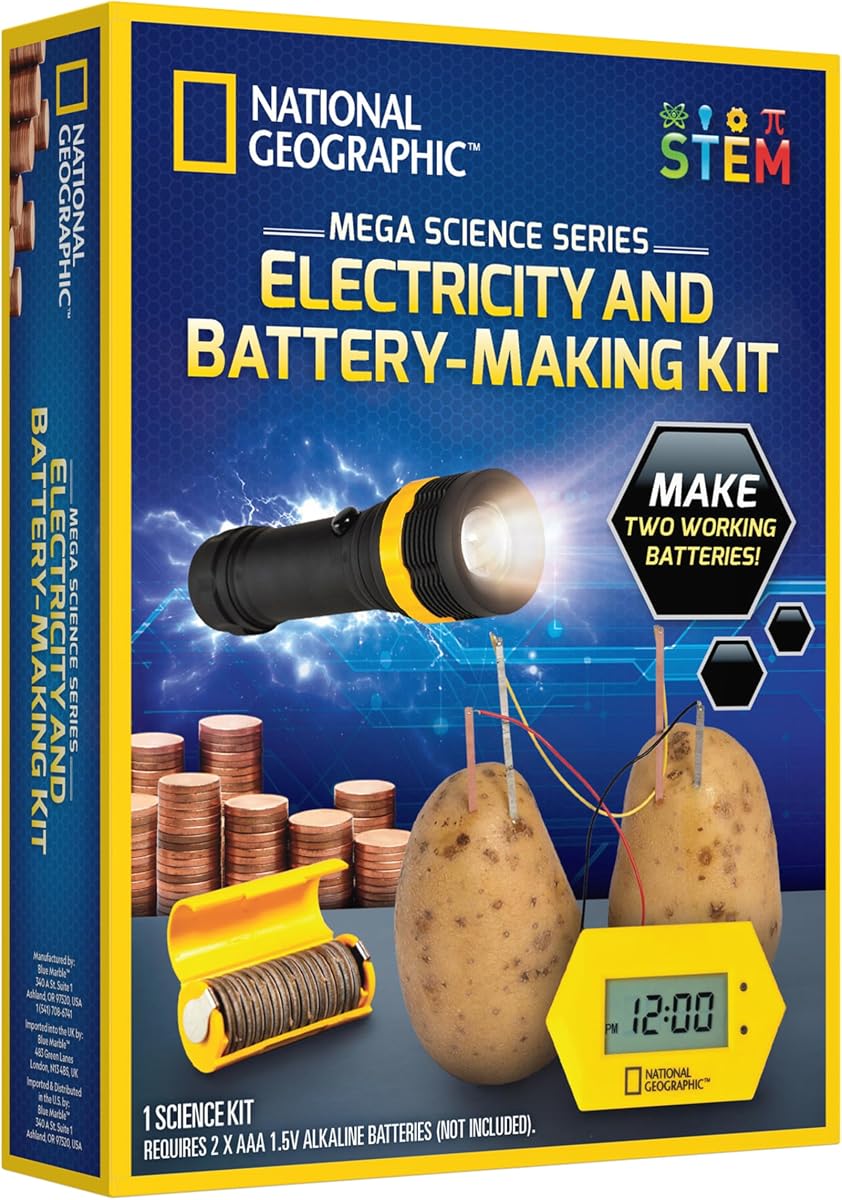
The National Geographic Battery Making Science Kit is built around two clearly defined projects rather than a large general-purpose parts library. With a supplied rating of 4.5, it offers a focused way for children to study how batteries and electrical circuits work.
We may earn a commission when you buy through this link, at no additional cost to you.
The first activity uses two potatoes to build a DIY potato clock with a voltmeter, while the second creates a coin-powered flashlight. Together, these projects let learners make a battery, complete a circuit, observe a working device, and consider why the constructions function.
The main limitation is scale. With only two stated STEM projects, it does not offer the sustained experimentation possible with comprehensive circuit kits. Two potatoes are also required, and the learning is concentrated around batteries rather than a broad treatment of switches, motors, resistance, or magnetism.
This kit is well suited to a child with a specific curiosity about batteries, a compact science gift, or a focused classroom activity. It works particularly well when a parent or teacher wants to guide a short, memorable project and then explain the scientific principles in greater depth.
Using familiar materials such as potatoes makes battery science tangible. Learners can relate a visible food source to a less familiar electrical output and inspect the result with the included voltmeter.
A clock and a flashlight give learners concrete goals instead of an open-ended pile of parts. Completing each project provides a satisfying endpoint and a clear object for discussing electrical energy.
We may earn a commission when you buy through this link, at no additional cost to you.
The EUDAX Upgrade Circuit Kit is a versatile middle option for teachers and students in grades 7 through 11. Its supplied rating is 4.4, and it combines basic electrical components with projects that extend into switching, electromagnets, mechanical movement, and renewable-energy demonstrations.
We may earn a commission when you buy through this link, at no additional cost to you.
The manual supports projects including a simple circuit, series and parallel circuits, a stair double-switch circuit, an electromagnet, a hand-crank generator, a wind-powered car, an illuminated LED, and a traffic-light arrangement. Switches, wires, bulbs, and LEDs are included, while the transparent box makes unused components visible and easy to locate.
This set is less extensive than the EUDAX School Physics Labs and Physics Labs Discovery kits, which provide many more items and dedicated magnetism modules. Two AA batteries are not included, and the traffic-light and stair-switch projects may require more careful sequencing than a single basic circuit.
The upgrade kit suits teachers who need an approachable but expandable classroom set, as well as students moving from basic circuits toward applied projects. It works particularly well for grades-based lessons, weekend STEM activities, and learning centers that need several recognizable circuit applications in a manageable box.
The named activities move from foundational circuits to practical applications. Stair switches, traffic lights, electromagnets, and hand-crank projects can anchor lessons about control, energy conversion, and everyday electrical systems.
A clear container helps users see what is included and return parts after a session. This is useful in a classroom where learners may complete different projects at the same time and components need to remain easy to inventory.
We may earn a commission when you buy through this link, at no additional cost to you.
The right electricity learning kit depends on the learner’s age, the depth of the curriculum, and the kinds of activities that will sustain interest. Consider component count, project guidance, safety provisions, organization, and how easily the kit supports both structured lessons and independent experimentation.
Choose a level that challenges without making assembly feel inaccessible. Look for simple introductory sets for first-time builders and comprehensive laboratory kits for students ready to compare configurations and interpret results.
Prioritize quality and range over a headline number. A well-explained set of 20 activities may be more educational than a much larger catalog with limited guidance.
Choose guides that explain concepts as well as assembly. Observation prompts, expected outcomes, and troubleshooting notes can transform a kit from a toy into a repeatable learning resource.
Favor a balanced set of power sources, controls, sensors, and outputs. Diverse components create more opportunities to ask questions, change conditions, and test original ideas.
Pick storage that matches your setting. Organized packaging is essential for frequent shared use but less important for a single child working at a table.
Always follow the included safety instructions and use adult supervision when age recommendations call for it. Check connections before energizing a circuit and never improvise around warnings.
Match the kit's scale to the learning program. Small sets suit one-time activities, while durable, organized systems reward repeated classroom or family use.
Confirm required power sources before ordering and keep spare compatible batteries available. Never combine battery types or use batteries in ways the manufacturer has not approved.
Begin by sorting the components according to the manual's project list and checking that every required part is present. Read the full experiment before connecting anything, especially when the activity involves switches, motors, magnets, or multiple battery holders. An adult should explain the purpose of the project, identify the power source, and outline the safety rules before a child begins.
Build circuits with the power disconnected, following the connection sequence rather than improvising around the diagram. Test each stage when the instructions permit, record what happens, and compare the result with the expected outcome. If a component does not work, check polarity, seating, and wire connections before replacing anything. Use a troubleshooting guide to turn an incorrect result into a lesson about the circuit.
After each session, switch off and disconnect the power, remove used batteries if the manual recommends it, and return components to their assigned positions. Store the kit in a dry place, inspect wires and connectors for visible damage, and keep small magnetic or electrical parts away from young children. Follow the stated voltage and operating-time limits, and replace damaged components before the kit is used again.
The EUDAX Basic Circuit Kit is a strong option for children who are beginning with series and parallel circuits because it uses simple components and includes English assembly instructions. Adult supervision is still appropriate for young learners. The STEM Electric Circuit Kit is another beginner-friendly option, with eight guided experiments and a detailed circuit book for ages 8 and older.
The National Geographic Circuit Kit for Kids lists more than 120 electrical projects and activities, making it the broadest selection by stated count. It also offers illustrated instructions, video guidance, and snap-together components. Buyers should still check the included materials to confirm that the available projects align with their preferred type of learning.
No, and many kits require batteries that must be purchased separately. The EUDAX School Physics Labs and Physics Labs Discovery kits call for three AA batteries, while the EUDAX Basic and Upgrade Circuit kits call for two. The STEM Electric Circuit Kit also requires AA batteries that are not included. Always check the product listing and manual for exact power requirements.
Several options explicitly combine electricity and magnetism. The EUDAX School Physics Labs and Physics Labs Discovery kits include substantial component groups for both topics, while the Teenii set includes magnets, a compass, and a solenoid. The National Geographic Circuit Kit focuses more broadly on electrical projects and does not state equivalent magnetism coverage in its supplied description.
Yes, and sets with durable cases, fixed component positions, and structured manuals are especially convenient for shared use. The Mysterystone, EUDAX School Physics Labs, and Physics Labs Discovery kits are particularly well organized. Teachers should still review safety guidance, establish age-appropriate supervision, and create a process for inventorying and returning parts after each session.
A basic kit generally provides standard parts for simple series, parallel, switch, and light experiments. A comprehensive kit adds measurement tools, specialized modules, motors, magnets, power sources, and numerous project options. The EUDAX Basic Circuit Kit is focused on introductory configurations, whereas the larger EUDAX and Teenii sets support more advanced investigations.
They are designed for educational experimentation, but children still need age-appropriate supervision and must follow the included instructions. Pay particular attention to small-part warnings, correct battery types, voltage limits, and whether motors or other components are intended for short operating periods. Never bypass a safety instruction or test a damaged wire or component.
The Circuit Kit for Kids states that no additional tools are needed, and its components use snap-together connections. The Battery Making Science Kit requires two potatoes for the potato-clock project. In both cases, the relevant general instructions and learning guide are included, though checking the full product listing before beginning is recommended.
The strongest general option is the National Geographic Circuit Kit for Kids, whose supplied rating of 4.7, extensive stated project count, video guidance, and tool-free connections make it an engaging choice for varied exploration. The EUDAX School Physics Labs kit is especially well suited to high-school study, while the Physics Labs Discovery Kit stands out as the premium option for students ready for more detailed electricity and magnetism experiments.
For younger or budget-conscious learners, the Sntieecr STEM Electric Circuit Motor Kit offers a focused set of familiar electrical parts and rotating components. The EUDAX Basic Circuit Kit is another approachable choice for first-time builders, whereas the National Geographic Battery Kit delivers a concise, memorable experience centered on two specific projects. Prioritize age fit, component relevance, and guidance quality over the largest advertised project count.
Ratings, component availability, instructional details, and promotions can change, so buyers should verify the current listing before ordering. Product prices also fluctuate, and batteries or everyday project materials may need to be obtained separately. Checking current details helps ensure that the selected kit matches the learner, setting, and available time.