
Sky-Watcher Heritage 130mm Tabletop Dobsonian
4.5Editor score
Fully assembled tabletop design
130mm parabolic primary mirror
Two eyepieces included
Starpointer finder included
Dobsonian telescopes earn attention by combining a large Newtonian reflector with a simple, stable altazimuth base. The result is an approachable instrument that can reveal lunar detail, planetary features, and selected deep-sky objects. A well-chosen Dob balances aperture, portability, accessories, and straightforward operation.
This guide compares ten featured telescopes using their supplied specifications, customer ratings, optical designs, mounting systems, and included features. The list covers compact tabletop models, portable traditional Dobs, an app-guided telescope, an electronic GoTo Dobsonian, and one computerized Schmidt-Cassegrain included as an alternative for observers who value automation.
Each review explains the telescope's strongest qualities, practical limitations, and ideal audience. Aperture remains the central consideration, but collimation stability, base construction, eyepiece support, and how much setup a user wants can be just as important. Product availability, configurations, and prices can change, so verify current listings before buying.
4.5Editor score

4.4Editor score

4.3Editor score
As an Amazon Associate we earn from qualifying purchases.
The comparison covers aperture, optical design, mounting approach, portability, and guidance features. Although nine entries are Dobsonian or Dobsonian-style instruments, the final product is a computerized Schmidt-Cassegrain included as a distinct alternative for buyers prioritizing automated pointing.




The Celestron StarSense Explorer 10" App-Enabled Dobsonian Telescope combines a substantial 254mm Newtonian reflector with one of the most approachable pointing systems in this guide. Its customer rating of 4.4 reflects a generally favorable balance of optical capability, guided navigation, and a conventional manual altazimuth base. It is the strongest all-around choice for observers who want more aperture than a tabletop model without moving to a fully computerized equatorial telescope.
We may earn a commission when you buy through this link, at no additional cost to you.
The defining feature is the StarSense Explorer app. It analyzes star patterns in the phone's camera view, determines where the telescope is pointing, and presents arrows for locating celestial targets. It also generates a curated list of planets, nebulae, galaxies, and clusters based on the user's location and observing time. This does not make the mount automatic, but it substantially reduces the learning curve associated with manually sweeping across a dark sky.
Optically, the 10-inch reflector can reveal the Moon's craters, Jupiter's changing disk, Saturn's rings, and brighter deep-sky favorites such as the Orion Nebula and Andromeda Galaxy. The telescope uses a stable manual altazimuth base, so there are no motors to complicate setup or produce tracking errors. The trade-off is bulk: this is a full-size instrument rather than a compact tabletop Dob, and the supplied information does not specify an included collection of eyepieces.
This model is best for beginners who want guided target selection, families sharing one telescope, and observers ready to move beyond the smallest tabletop Dobs. It also suits anyone who values large aperture but does not want to learn motor alignment procedures. Those who need a lightweight, battery-free instrument for remote observing should consider a smaller Heritage or StarSense tabletop model instead.
StarSense turns the smartphone into a celestial pointer rather than an automatic slew system. You still move the Dob manually, but the app's arrows and bullseye target reduce the effort required to place an object in the eyepiece.
The 254mm reflector is the key reason to move up from a compact model. With steady seeing and appropriate eyepieces, its larger light-gathering ability can make smaller lunar features and brighter deep-sky objects easier to appreciate.
We may earn a commission when you buy through this link, at no additional cost to you.
The Sky-Watcher Heritage 150 Tabletop Dobsonian Telescope delivers a 150mm aperture in a relatively compact format, making it a practical entry into visual observing. It carries a 4.2 rating and stands out for its collapsible tube, fast f/5 optics, and straightforward tabletop construction. Rather than trying to automate the experience, it concentrates on giving beginners a real telescope that can be set up without a complicated assembly process.
We may earn a commission when you buy through this link, at no additional cost to you.
Its parabolic primary mirror has a 750mm focal length, producing a wide, bright field that can be pleasant for sweeping across the Milky Way. The telescope is intended for viewing the Moon, planets, and numerous brighter deep-sky objects. A fast focal ratio also makes it less sensitive to some off-axis aberrations than a longer optical system, although actual performance still depends on collimation and observing conditions.
Portability is one of the Heritage 150's most persuasive features. The optical tube collapses while retaining collimation, reducing the amount of space needed for storage or transport. Rubber feet under the tabletop base help minimize vibration, while the simple altazimuth design keeps the observing process intuitive. The limitation is the 1.25-inch helical focuser, which offers less fine adjustment than a larger focuser and may be less satisfying when observing smaller objects at high magnification.
Choose this Heritage model if you want a capable tabletop telescope without app guidance or motorized GoTo. It is particularly useful for casual observers, students, and anyone with limited storage space. People seeking a wider selection of accessories or a larger light-gathering surface can compare it with the 130mm Heritage, while the Celestron StarSense 10" offers substantially more aperture for observers willing to transport a larger instrument.
The tube's collapsible structure separates the optical assembly from the base when storage space is limited. Because the design is intended to retain collimation after collapsing, the telescope remains practical for repeated tabletop sessions.
The f/5 focal ratio and 750mm focal length favor broad views of the Moon, open clusters, and star fields. It is a particularly natural configuration for users who want to explore rather than spend every session chasing a single tiny target.
We may earn a commission when you buy through this link, at no additional cost to you.
The Celestron StarSense Explorer 114AZ brings app-assisted finding to a compact tabletop telescope. Its 4.4 rating reflects the appeal of a product that combines a familiar Newtonian optical system with smartphone sky recognition. At 114mm, it cannot match the light-gathering ability of a 10-inch Dob, but it offers an approachable combination of portability, guided navigation, and celestial features.
We may earn a commission when you buy through this link, at no additional cost to you.
After docking a phone and launching the StarSense Explorer app, a user follows on-screen arrows to locate stars, planets, nebulae, and other objects. The app also creates a nightly list based on location and time. This makes it especially helpful for first-time observers who know the names of bright targets but may struggle to align a finder scope or telescope manually.
The 114mm reflector uses high-reflectivity coatings and is presented as suitable for the Moon, Jupiter, Saturn, the Orion Nebula, and the Andromeda Galaxy. Its manual altazimuth tabletop base keeps the controls intuitive, while the compact format suits apartments, balconies with suitable conditions, classrooms, and travel. The app's green bullseye offers confirmation when a target is ready to view, but the base does not automatically track it across the sky.
This is a strong match for users who prioritize guided setup over maximum aperture. It may not reveal as much faint detail as the Celestron 10-inch or the larger Heritage models, yet it can still provide rewarding planetary and lunar observations. It is less appropriate for an experienced visual observer whose priority is reaching the limits of deep-sky detail, but it remains one of the most approachable choices in the category.
StarSense identifies the sky pattern in the phone's view, turns it into position information, and guides the user toward selected targets. That makes it a practical bridge between a conventional telescope and a fully computerized GoTo system.
The 114mm aperture is large enough for meaningful Moon and planet views while fitting a tabletop role. It works best for users who value setup assistance and easy placement over collecting the smallest astronomical details.
We may earn a commission when you buy through this link, at no additional cost to you.
The Sky-Watcher Heritage 130mm Tabletop Dobsonian is an easy first telescope because it arrives as a complete, integrated package with the optical tube and base combined. Its 4.5 rating is the highest among the supplied customer ratings in this guide. For a new observer, the inclusion of two eyepieces and a starpointer finder removes several common sources of early frustration.
We may earn a commission when you buy through this link, at no additional cost to you.
The telescope uses more than 5 inches of aperture and combines that optical capacity with a collapsible design. The base and tube form one portable unit, making the instrument easy to move from a room to a table or suitable outdoor observing location. It is fully assembled and has no assembly required, so users can begin familiarizing themselves with alignment and pointing rather than assembling a complex frame.
Included accessories include 10mm and 25mm 1.25-inch eyepieces and a starpointer finder scope. The 25mm eyepiece offers a relatively broad starting view, while the 10mm provides more magnification for lunar and planetary detail. As with any small Dob, the limits become clearer when an observer seeks very faint galaxies, small planetary nebulae, or tiny double stars.
The Heritage 130mm is a strong recommendation for beginners, children under supervision, and anyone wanting an uncomplicated telescope for occasional visual sessions. It is less suitable for a dedicated observer who already owns standard 1.25-inch eyepieces and wants a larger, more capable instrument. In that situation, the Heritage 150mm or a 200mm traditional Dob offers more room to grow.
The supplied eyepieces and finder provide a usable observing kit straight from the box. That makes it easier for newcomers to learn changing magnification, centering objects, and comparing wide and narrow fields.
Combining the tube and base creates a compact package with fewer separate pieces to manage. It is particularly attractive for users who want a telescope that can be carried between rooms or stored without dedicating substantial space.
We may earn a commission when you buy through this link, at no additional cost to you.
The Sky-Watcher Classic 200 Dobsonian is a full-size, traditional telescope designed around a 200mm parabolic primary mirror. Its 3.9 rating is the lowest listed in this group, but the specification still represents a capable visual instrument for observers who prioritize aperture and direct manual control. It is especially suitable for dedicated beginners who are ready to learn star hopping and telescope handling.
We may earn a commission when you buy through this link, at no additional cost to you.
The solid tube provides a conventional form that some observers may prefer over a collapsible or tablet-first design. Fully multi-coated borosilicate primary and secondary mirrors are listed at 94% reflectivity, and the telescope has a maximum focal length of 1200mm. That longer focal length supports narrower fields and greater magnification than the compact models in this guide, making the instrument useful for lunar and planetary work.
The supplied package is notably complete. It includes a 2-inch Crayford-style focuser with a 1.25-inch adapter, 25mm and 10mm super-wide-angle eyepieces, and a 9×50 straight-through finder. Patented tension-control handles assist with accurate movement, while Teflon bearings promote smooth azimuth rotation. The trade-off is portability: the assembled telescope weighs 45 pounds, including a 20-pound tube and 25-pound base.
Choose the Classic 200 when observing capability takes priority over compact storage or guided navigation. It offers a clear upgrade path in aperture and maximum magnification compared with the Heritage tabletop models. However, the size and weight make it less appealing for frequent travel, and buyers who want easier pointing may prefer the app-guided Celestron 10-inch or GoTo-equipped Virtuoso GTI.
The 200mm mirror provides a materially larger light-gathering surface than the 130mm and 150mm tabletop Dobs. Under steady skies, that additional aperture can help reveal subtle lunar relief, planetary detail, and a deeper selection of fuzzy deep-sky objects.
There are no powered motors or alignment routines in the base. Patented handles and Teflon bearings make the telescope straightforward to move while preserving the direct, tactile experience for which conventional Dobs are known.
We may earn a commission when you buy through this link, at no additional cost to you.
The Celestron StarSense Explorer LT 114AZ is a smartphone-guided Newtonian designed to bridge entry-level optical performance and beginner-friendly navigation. Its 4.1 rating reflects a practical design that gives users guided sky tours without introducing a fully computerized motor mount. It is an attractive option for anyone who prefers a standard optical tube and conventional altitude-azimuth head over a tabletop Dobsonian base.
We may earn a commission when you buy through this link, at no additional cost to you.
The StarSense app performs the same broad role as it does on Celestron's larger Dobsonian offering. It recognizes the star field through the phone, indicates where the telescope is pointing, and provides on-screen arrows for reaching targets. It also proposes a curated selection of planets, nebulae, galaxies, and clusters based on the current time and observing location.
The base offers manual movement with an altitude slow-motion adjustment controlled by a sliding rod. This can help make fine corrections while keeping both hands close to the telescope. The 114mm reflector has high-reflectivity coatings and is intended to show the Moon, Jupiter, Saturn, the Orion Nebula, and Andromeda Galaxy. Because the aperture is modest, faint targets will be less visually rewarding than through a 200mm Dob.
Buy this model if app guidance and a traditional Newtonian are your priorities but a full 10-inch aperture feels excessive. It may also appeal to observers who want the process of learning the sky rather than relying entirely on automatic positioning. Remember that it is not a standard Dobsonian telescope, even though it shares the guided Newtonian experience and belongs in a comparison of accessible visual instruments.
The sliding-rod slow-motion control allows small altitude adjustments without requiring a motorized system. It offers useful control when fine-centering a target, although the telescope still needs to be moved manually in azimuth.
The app identifies a target and explains where to point, but it does not take over the telescope. That balance can help beginners find objects more easily while still learning how the sky changes as the instrument moves.
We may earn a commission when you buy through this link, at no additional cost to you.
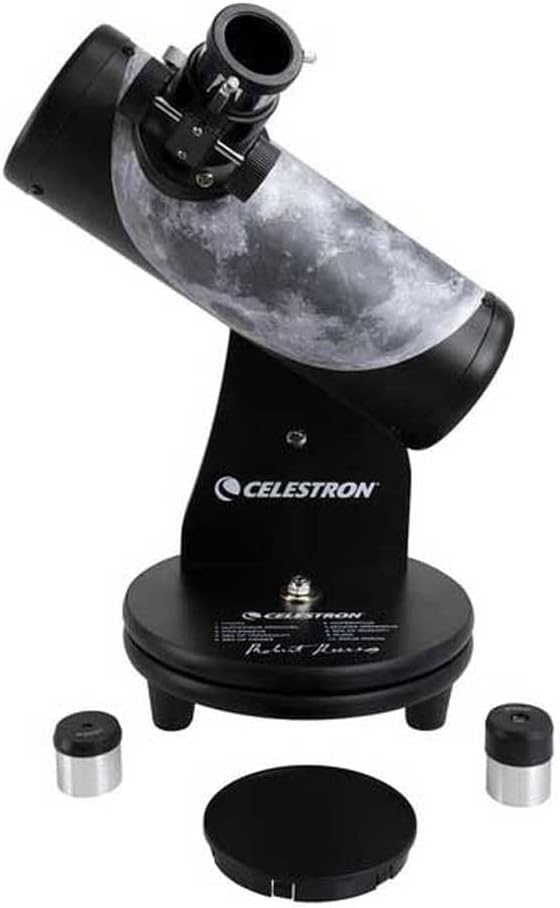
The Celestron FirstScope Signature Series Moon Tabletop Dobsonian Telescope is positioned as a simple, compact entry into visual astronomy. Its 4.3 customer rating indicates a generally well-received product, and the tabletop format makes it suitable for smaller homes, quick observations, and buyers who want an uncomplicated introduction to Newtonian telescopes.
We may earn a commission when you buy through this link, at no additional cost to you.
The supplied information highlights the product's Moon-focused identity, Celestron's support, and a two-year US warranty. It does not provide a detailed aperture, focal length, focuser specification, or accessory list, so those details should be verified on the current product listing. The absence of app guidance is also important: this is a traditional manual instrument rather than a guided or computerized platform.
Its main advantage is uncomplicated operation. Tabletop Dobs tend to be intuitive because the observer moves the tube horizontally and vertically while keeping a modest viewing angle. A small instrument can be more forgiving on an unsteady surface, although the same movements that make it accessible can limit how much fine detail appears at higher magnification.
This FirstScope makes sense for a child, casual Moon observer, or first-time telescope buyer who values a traditional design and established support. It is less suitable for someone seeking a large collection of included eyepieces, app-guided finding, or the ability to resolve dim deep-sky objects. For more transparent purchasing decisions and a better-defined accessory package, the Heritage 130mm may be easier to evaluate from its supplied specifications.
The FirstScope focuses on the fundamental experience of looking through a Newtonian reflector and moving it by hand. That simplicity can be educational, allowing a new observer to learn the relationship between direction, altitude, and the apparent movement of the sky.
The included two-year US warranty and access to Celestron's US-based support add reassurance for a first optical purchase. It is a meaningful advantage for buyers who value help with setup and maintenance questions after the sale.
We may earn a commission when you buy through this link, at no additional cost to you.
The Sky-Watcher Flextube 200 combines the light-gathering capacity of an 8-inch-class Dobsonian with a collapsible tube designed to improve portability. Its 4.0 rating reflects a telescope that offers substantial capability while remaining easier to transport than many traditional full-size Dobsonians. The solid-tube Classic 200 emphasizes tradition, whereas the Flextube focuses on a more compact stored footprint.
We may earn a commission when you buy through this link, at no additional cost to you.
Its unique strut design allows the optical tube to collapse while retaining collimation. Fully multi-coated borosilicate mirrors are listed at 94% reflectivity, and the telescope includes a 2-inch Crayford-style focuser with a 1.25-inch adapter. The supplied accessory package also includes 25mm and 10mm super-wide-angle eyepieces and an 8×50 right-angle finder scope.
The 200mm primary mirror gives this model a clear optical advantage over the 114mm, 130mm, and 150mm instruments. It can collect substantially more light, making it more rewarding for lunar detail, planets, and brighter deep-sky objects. Patented tension-control handles help with accurate movement, and Teflon bearings provide smooth azimuth travel without a powered drive system.
Portability remains relative rather than absolute. The assembled telescope weighs 40 pounds, including a 24-pound tube and 26-pound base, so two people may be needed for some moves. The collapsing tube can reduce storage requirements, but the total load remains significant. This is an excellent choice for observers who need large aperture and can manage the weight, particularly if they want fewer accessories to buy separately.
The collapsible strut structure preserves the optical performance of a full-length tube while reducing the space it occupies. It is a useful compromise for home observatories, closets, and transport cases where a solid 8-inch tube would be inconvenient.
The Crayford-style focuser, adapter, two eyepieces, and right-angle finder provide the core accessories needed to begin observing. That makes the package especially convenient for users who want to concentrate on the telescope rather than immediately build an accessory inventory.
We may earn a commission when you buy through this link, at no additional cost to you.
The Sky-Watcher Virtuoso GTI 150P is the feature-rich premium entry in this guide, joining a 150mm aperture and collapsible tabletop format with built-in Wi-Fi and GoTo control. Its 4.3 rating reflects a favorable reception for users who want electronic pointing without paying for a large traditional Dobsonian base. It is a particularly interesting option for observers who want both automation and manual control.
We may earn a commission when you buy through this link, at no additional cost to you.
The 150mm primary mirror produces bright views and is paired with fast f/5 optics and a 750mm focal length. That combination is suited to the Moon, planets, galaxies, and nebulae, with a wide-field character that complements the instrument's portable design. The collapsible tube also helps address the usual storage challenge associated with tabletop telescopes.
Through the SynScan Pro app, the telescope can perform GoTo functions over built-in Wi-Fi. Patented Freedom Find technology uses dual encoders to preserve alignment information, allowing manual movement without beginning the alignment process again. This is valuable in real observing conditions because a target can drift out of view and be recovered without repeating every setup step.
This telescope is best for an enthusiast who wants motorized target selection in a manageable tabletop package. It is less appropriate for someone who values simplicity above all else, since the electronics introduce setup, power, and alignment considerations. Compared with the app-guided but manual Celestron StarSense models, the Virtuoso offers more automation; compared with the Celestron 10-inch, it sacrifices aperture for portability.
The dual encoders preserve the mount's positional awareness after a manual move. That means the user can make a fine adjustment, locate a target by hand, and still use the electronic pointing system afterward.
The 150mm aperture is large enough for satisfying lunar and planetary work, while the collapsible body preserves a manageable footprint. Built-in Wi-Fi avoids requiring a separate conventional hand controller for the primary app-based workflow.
We may earn a commission when you buy through this link, at no additional cost to you.
The Celestron NexStar 8SE is a computerized Schmidt-Cassegrain rather than a Dobsonian, so it represents a distinct alternative instead of a direct match for the category. Its 4.3 rating and extensive feature set make it relevant to readers comparing Dobs with telescopes that automate object location. The defining advantage is a fully computerized GoTo mount that can slew to and track targets automatically.
We may earn a commission when you buy through this link, at no additional cost to you.
Its 8-inch aperture is capable of showing fine lunar details, Jupiter's cloud bands, galaxies, and globular clusters within a relatively compact optical design. The NexStar+ hand control provides access to a database of more than 40,000 objects. SkyAlign technology asks the user to center three bright stars or planets, after which the system calculates position and aligns the mount without requiring the observer to know their names.
This telescope suits observers who prioritize automatic tracking, a large catalog, and a guided experience over the low-maintenance simplicity of a manual Dobsonian. Because it tracks objects, it also allows extended viewing without the continual manual corrections required by a standard altazimuth Dob. The trade-off is added complexity: users must understand the mount, perform an alignment procedure, maintain power, and navigate a more involved control system.
Consider the NexStar 8SE if the goal is a fully guided telescope that can be upgraded with Celestron accessories and used for both visual observing and conventional astronomical workflows. It is not the appropriate choice for someone specifically seeking the simple, mechanical character of a Dobsonian. The Celestron StarSense 10" offers a less automated middle ground, while the Virtuoso GTI 150P provides GoTo functionality in a more compact tabletop format.
The computerized mount handles both movement to a selected target and continued tracking. Compared with a manual Dob, that reduces the need to keep correcting the telescope and makes longer observations more convenient.
More than 40,000 catalogued objects give the NexStar 8SE a strong starting point for exploring. The SkyAlign routine also lowers the barrier to setup by using recognizable bright stars or planets rather than demanding exact coordinates.
We may earn a commission when you buy through this link, at no additional cost to you.
Choosing a Dobsonian means balancing aperture with portability, convenience, and the amount of electronic guidance you want. The following factors explain the practical differences that matter most once a telescope is outside under real observing conditions.
Aperture is the diameter of the primary mirror and the most important optical specification for a visual Dobsonian. A larger mirror gathers more light, usually making faint nebulae, galaxies, clusters, planetary details, and lunar relief easier to see. The models in this guide range from compact 114mm and 130mm instruments to 150mm, 200mm, and 254mm apertures. The jump is not merely physical size: it affects how much useful detail can be seen and how many targets remain rewarding under imperfect skies.
Choose aperture according to your targets and portability limits. A tabletop model is convenient for the Moon, bright planets, and introductory deep-sky observing, while an 8-inch or 10-inch Dob can reveal a substantially deeper set of objects. Always consider whether the telescope can be moved and set up comfortably where you intend to use it.
Focal length determines how strongly a telescope magnifies and how wide a field it can show. A short focal length paired with a large aperture creates a wide, image-like view that works well for sweeping star fields and large clusters. A longer focal length produces narrower fields and greater theoretical magnification, which can be valuable for smaller lunar and planetary details. Actual magnification also depends on the eyepiece focal length.
Match the optical ratio to your observing style. Fast, wide-field Dobs are engaging for visual exploration, while longer systems can feel more precise when examining compact targets. Eyepiece quality and atmospheric seeing remain important, so a longer focal length should not automatically be treated as superior for every observer.
Tabletop Dobs prioritize compact storage and quick setup. They are easy to carry, often arrive largely assembled, and work well on a suitable table or stand. Full-size Dobs offer larger apertures and more stable viewing positions but can be heavier and occupy more storage space. Collapsible tubes and fold-down bases narrow the difference, making some large-aperture models more manageable without turning them into lightweight travel scopes.
Select a tabletop model if convenience and frequent casual observing matter most. Choose a full-size or collapsible traditional Dob if aperture, magnification range, and a deeper observing challenge justify the additional bulk. Check the listed assembled weight before planning how the telescope will be moved.
A conventional Dobsonian moves by hand. It has little electronic complexity and usually requires no alignment beyond checking the finder and collimation. App-guided models use smartphone sky recognition to identify the telescope's orientation and provide arrows toward targets. A GoTo Dob adds motorized movement and can point automatically after alignment. A computerized Schmidt-Cassegrain goes further by slewing to and tracking catalogued objects.
Manual operation rewards users who enjoy learning the sky. App guidance reduces frustration for complete beginners, while GoTo is convenient for shared observing and quick target changes. Consider both convenience and the need for power, alignment procedures, app compatibility, and ongoing maintenance before choosing electronic assistance.
Newtonian reflectors require their mirrors to remain properly aligned, especially as viewing angle and temperature change. Tabletop instruments and collapsible designs can be sensitive to movement, vibration, and accidental bumps. A stable base, a scope that does not flex under hand pressure, and a repeatable observing position can make a noticeable difference in image quality.
Look for parabolic primary mirrors, rigid tube construction, smooth bearings, and designs that preserve collimation when collapsed. Check the telescope regularly, especially after transport, and allow it to acclimate before performing a precise collimation check. For beginners, learning the process early is safer and more satisfying than waiting for poor alignment to spoil a session.
The focuser determines how precisely you can bring an object into sharp view. A 1.25-inch helical focuser is simple and adequate for smaller tabletop instruments, while a 2-inch Crayford-style focuser with an adapter offers more adjustment range and better support for demanding visual observing. Eyepiece magnification and field of view should be considered together; a large aperture with narrow eyepieces can reveal detail, but only when the telescope is steady and the atmosphere is calm.
Check whether eyepieces and a finder are included. The Heritage 130mm, Classic 200, and Flextube 200 have clearly specified accessory bundles. The other listings do not provide equivalent accessory details, so buyers should verify what is in the current package before comparing overall value.
Portability includes more than total weight. Consider the telescope's disassembled dimensions, whether the tube collapses, whether the base folds, and whether it fits your vehicle. The FirstScope and Heritage models are especially compact, while the Virtuoso GTI 150P combines a collapsible tube with electronic features. The 200mm Dobs provide much larger apertures but are substantially heavier, even when their tubes can be compressed.
Think about where the instrument will live between sessions. A telescope that is difficult to retrieve often gets used less often. For apartment observers, a tabletop model is usually the most practical. For owners of larger homes or vehicles, a high-aperture Dob may be worth the added weight if deep-sky observing is a central goal.
A finder helps locate targets, but it is not a substitute for learning how the telescope moves. Traditional star pointers are simple and low profile, straight-through finders provide a conventional view, and right-angle finders can be easier for some users. App-guided systems add another method by using the phone's camera and star-pattern recognition. The best choice depends on comfort with technology and whether several people will share the telescope.
For a first manual Dob, a simple finder is enough. If target finding has been your main hesitation, an app-guided model may prevent frustration. If you want the shortest path from choosing a target to viewing it, a motorized GoTo system is the logical choice, provided you are comfortable with alignment and power management.
Choose a dark, open observing site and set the telescope on a stable surface at a comfortable height. Avoid placing it beside roads, directly under trees, or where wind and vibration are likely. Let a transported telescope acclimate to the outdoor temperature before checking focus or collimation. Begin with the lowest-power eyepiece, point near a bright target, and adjust the focuser only after the image is roughly centered.
For a manual Dob, move the tube slowly in small increments while watching the finder or using an app-guided target. Keep both eyes open when possible so the observer can use peripheral vision to find a centered object. For GoTo models, complete the required alignment and confirm that the selected coordinates correspond to the current date, time, and location. Make small corrections rather than repeatedly making large movements.
Caring for a Dob is mostly about protecting the optics and keeping the mechanics clean. Use a blower or soft brush to remove loose dust, and use lens-cleaning material only when necessary on the primary mirror. Do not scrub a coated mirror aggressively. Keep the telescope dry, protect it from impacts, check the focuser and finder for looseness, and have the collimation checked periodically. After observing, cover the aperture and return the instrument to a safe storage position.
No, although a larger primary mirror gathers more light and can reveal more detail. A large Dob is only better if its size and weight suit your observing site and you are comfortable handling it. A well-chosen tabletop model can be more useful for frequent Moon and planet viewing than a heavier telescope that is difficult to set up.
A 6-inch Dob can show the Moon's craters and larger surface features, the phases of Venus, cloud bands on Jupiter, and Saturn's rings under suitable conditions. It can also reveal brighter nebulae, open clusters, some galaxies, and planetary nebulae. Faint targets remain challenging, so aperture should be balanced against atmospheric conditions and observing expectations.
A properly assembled and transported telescope may appear adequately aligned, but a collimation check is wise before detailed observing. Newtonian mirrors can shift during shipping, when the tube is extended or collapsed, or after an impact. Even a modest adjustment can improve sharpness and contrast across the field of view.
It usually is for beginners because the app can identify the telescope's position and direct the user toward a chosen object. The telescope still moves manually, so the observer learns the sky rather than relying on automatic tracking. App guidance does add setup steps and requires a compatible smartphone with a clear view of the stars.
They can be, provided the buyer is comfortable with electronics, alignment, and power requirements. GoTo reduces the effort of finding objects and can be especially helpful for families or observers with limited time. A manual model is simpler and less expensive, while app guidance offers a middle ground between full automation and learning to navigate by eye.
Remove the optical tube from its base, lock or secure the moving parts, and protect the primary mirror and secondary mirror from contact. Use a padded case or wrap, protect the finder and focuser, and carry the base and tube separately when their weight makes combined handling awkward. Avoid leaving a telescope loosely assembled in a vehicle.
They can show planets better because they gather more light and may support higher useful magnification, making subtle belts, spots, and ring details easier to see. Atmospheric seeing remains crucial, though, and a smaller scope may provide steadier views on nights when larger apertures are disturbed by turbulence. Eyepiece quality and magnification also influence the result.
Choose a 150mm model for a balance of portability, convenience, and useful aperture. A 200mm Dob offers a major light-gathering upgrade for dedicated visual observing but is heavier and larger. The 10-inch option pushes performance further, particularly for faint deep-sky objects, while demanding more space, transport effort, and patience during setup.
The Celestron StarSense Explorer 10" is the strongest overall choice because its large reflector combines meaningful visual capability with app-assisted pointing. The Sky-Watcher Heritage 130mm is the strongest budget and beginner option, while the Heritage 150mm provides a more capable compact design. The Heritage 130mm arrives with eyepieces and a finder, making it particularly complete for a first purchase.
Prioritize aperture when deep-sky detail is your main interest, and prioritize portability when you want frequent casual use from a convenient location. Traditional Dobs offer reliable mechanical simplicity, app-guided models reduce the learning curve, and the Virtuoso GTI 150P adds motorized GoTo without requiring a full-size base. The NexStar 8SE belongs on the shortlist only for buyers who want a computerized Schmidt-Cassegrain rather than a true Dobsonian.
Before ordering, confirm the current package contents, dimensions, weight, warranty terms, and available accessories on the product listing. Prices, promotions, and configurations can change, so compare the final cost only after verifying that each telescope includes the optics, mount, finder, and eyepieces needed for your intended observing style.
