
La Crosse 911-65557-INT
4.6Editor score
Checks common household battery types
Shows voltage and strength levels
Uses a simple sliding tray
This Lithium Ion Battery Tester guide compares ten automotive and household models for battery chemistry, voltage, diagnostics, accuracy, safety, and ease of
A lithium ion battery tester can reveal the voltage, capacity, internal resistance, and charging condition of a battery, helping identify weak cells before they interrupt essential equipment. The most useful model depends on whether you are diagnosing a vehicle, checking 18650 cells, or sorting household batteries, as these tools support different chemistries and voltage ranges.
This guide compares ten battery testers across supported battery types, measurement functions, display design, safety protection, portability, and diagnostic depth. It includes general-purpose automotive models for 12V and 24V systems, dedicated 18650 capacity testers, and compact checkers for consumer batteries so buyers can identify a device suited to their actual testing needs.
Each product review highlights the standout functions, practical advantages, and important limitations of the corresponding model. Ratings reflect the supplied customer feedback, while specifications are based on the available product information. Prices and availability can change, so compare the current listing, included accessories, and battery compatibility before making a final purchase.
4.6Editor score

4.5Editor score

4.5Editor score
This side-by-side comparison shows the different purposes served by each tester, from automotive battery and alternator diagnostics to 18650 capacity analysis and quick household battery checks.


The ANCEL BT410 is a broad automotive diagnostic tool that supports both 12V and 24V systems, conventional lead-acid batteries, and lithium-ion batteries. Its 4.5 rating reflects generally favorable customer feedback, while its combination of battery health, cranking, and charging-system analysis makes it one of the most versatile products in this guide.
We may earn a commission when you buy through this link, at no additional cost to you.
The tester reports state of health, state of charge, voltage, internal resistance, cranking performance, charging-system behavior, and ripple-related information. A 2.4-inch color TFT display with adjustable contrast and day-night modes should remain readable in garages and outdoor work areas. It supports eight languages and takes power directly from the battery being tested, eliminating the need for separate internal batteries or an external supply.
Its strongest feature is the combination of compatibility and vehicle-level diagnostics. The stated testing accuracy exceeds 99.9%, the supported CCA range is 100–2000, and long 800mm cables help reach awkward terminals. Short-circuit and reverse-polarity protection add useful safeguards, although correct battery-type and rating selection remains essential for meaningful results.
The BT410 is a strong recommendation for a technician, fleet owner, RV user, or serious DIYer who wants more than a simple voltage display. Choose it when one tool must handle automotive batteries, cranking systems, and charging systems across multiple vehicle classes. Users seeking only a quick household battery check will probably find it more complex than necessary.
Supporting 12V and 24V systems, lead-acid chemistries, and lithium-ion batteries gives the BT410 unusual flexibility. It is particularly useful for households or workshops that operate cars, trucks, motorcycles, boats, and recreational vehicles.
State of health, state of charge, internal resistance, cranking voltage, and charging performance provide a more useful overview than voltage alone. The shareable QR report is also convenient for maintaining records or sharing results with a professional.
We may earn a commission when you buy through this link, at no additional cost to you.
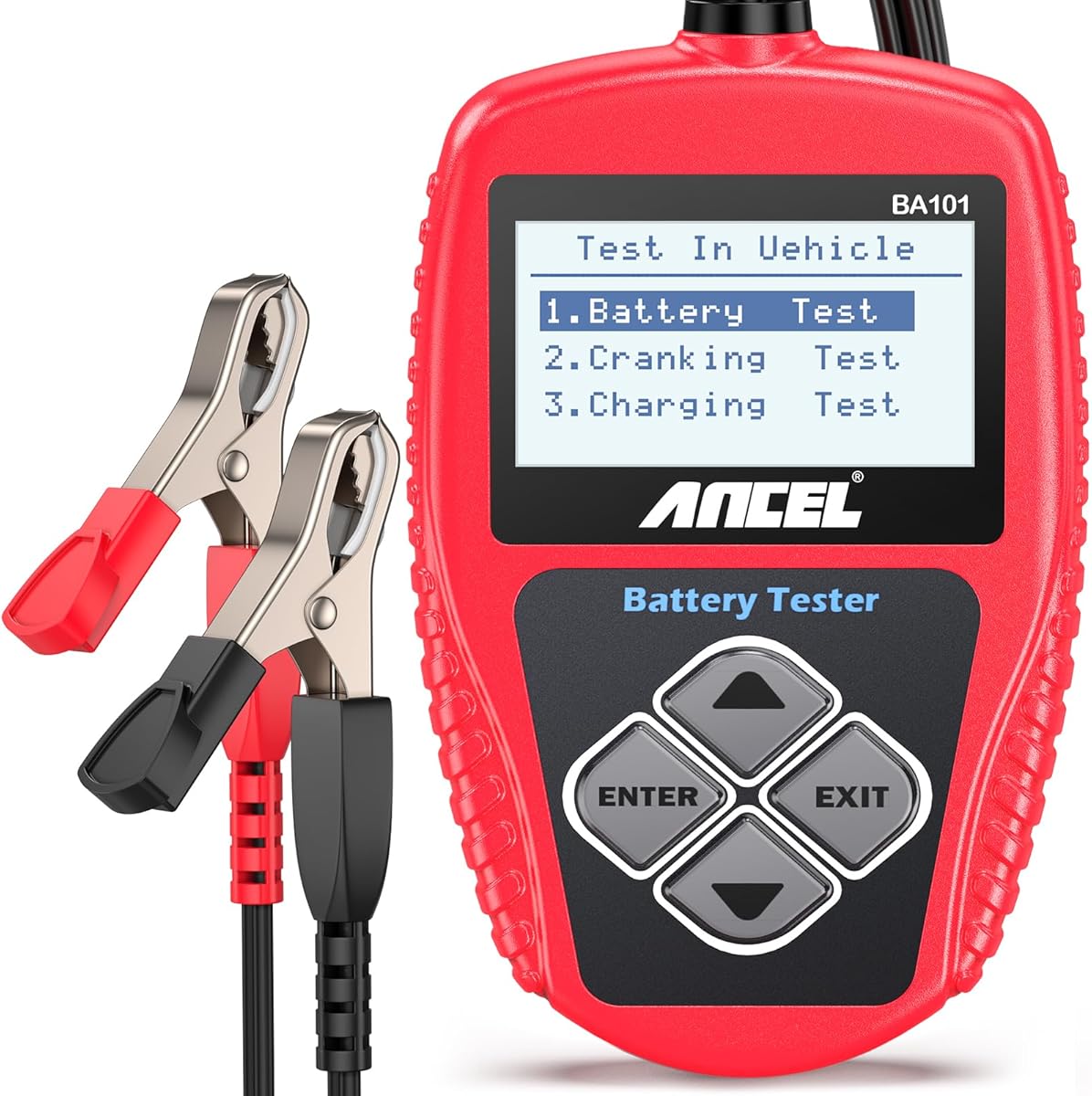
The ANCEL BA101 is a straightforward 12V automotive battery tester designed for lead-acid applications, with a 4.5 customer rating. It provides state of health, state of charge, voltage, current, CCA, cranking results, and charging-system readings, making it useful for diagnosing common starting and electrical-system complaints.
We may earn a commission when you buy through this link, at no additional cost to you.
Its menu-driven design accommodates many international battery standards, including JIS, EN, DIN, SAE, BCI, GB, CA, MCA, and IEC. Flooded, AGM, GEL, and EFB batteries are supported across a 100–2000 CCA range. The adjustable-contrast monochrome display and white backlight improve visibility, while copper crocodile clips support dependable terminal connections.
The main limitation is chemistry compatibility. Despite the broad usefulness of this model for conventional vehicle batteries, it is explicitly not designed for lithium batteries, 6V or 8V batteries, 24V systems, or motorcycle batteries below 30Ah. The stated measurement accuracy of over 99.9% is also best understood alongside the need to enter the correct battery type, rating, and temperature.
The BA101 is a sensible choice for owners of 12V lead-acid vehicles who want meaningful battery and alternator diagnostics in an uncomplicated format. It suits routine maintenance, pre-trip checks, and troubleshooting slow starts. Buyers with lithium-ion vehicle batteries should choose one of the explicitly compatible models instead.
The range of supported rating standards helps technicians avoid rough estimates when configuring a test. Selecting the correct standard, capacity, and temperature is still necessary for the clearest interpretation of the readings.
Because the BA101 draws power from the connected vehicle battery, users do not need to charge an internal battery before testing. That simplifies routine diagnostics and reduces the chance of arriving at a vehicle with an uncharged tester.
We may earn a commission when you buy through this link, at no additional cost to you.
The DWEII 18650 Capacity Tester is a specialized four-channel module for assessing individual 18650 lithium-ion cells, with a 4.3 rating. Unlike basic voltage checkers, it can measure capacity, internal resistance, voltage, current, and power, making it more relevant for comparing used cells or identifying unexpectedly weak examples.
We may earn a commission when you buy through this link, at no additional cost to you.
Its 1.77-inch LCD presents internal resistance, capacity, voltage, current, and battery level simultaneously. The capacity range extends from zero to 99,999mAh, and the 10W discharge load gives the device a defined role in controlled cell assessment. A Type-C port, automatic charge-and-discharge operation, and a claimed measurement error of about 10 percent are the principal specifications to consider.
This tester is not a general automotive diagnostic tool and should not be judged as one. Its narrow 18650 orientation, module-style design, and approximate error rate make it more appropriate for hobbyists, builders, and technicians working with removable cylindrical cells. The seller also indicates that a manual is available through its DWEII storefront support listing.
This is a compelling choice when the central question is whether an 18650 cell retains its expected capacity rather than merely whether it has voltage. It is less suitable for pack owners who need terminal voltage only or for users seeking starter-battery and alternator diagnostics. For that narrower purpose, the four-channel capacity-focused design is a meaningful advantage.
A cell can show acceptable voltage while no longer delivering its rated capacity. This tester adds charge-discharge and internal-resistance measurements, giving users a more complete view of cell condition.
Four-channel support allows multiple cells to be assessed in one session. The simultaneous LCD readout reduces the need to move between individual readings while comparing battery performance.
We may earn a commission when you buy through this link, at no additional cost to you.
The ANCEL BT310 combines broad battery compatibility with stored test history, a feature that makes it particularly useful for monitoring gradual deterioration. It holds a 4.5 rating and supports 12V and 24V systems, 100–2000 CCA, and batteries from 30Ah to 220Ah across Flooded, AGM, GEL, EFB, and lithium-ion types.
We may earn a commission when you buy through this link, at no additional cost to you.
Its readings cover state of health, state of charge, voltage, current, CCA, and internal resistance. Results are translated into five outcomes: good battery, good-recharge, charge and retest, replace battery, and bad cell-replace. A 128-by-64 backlit LCD with adjustable contrast presents the information, while the Review Data function recalls battery, cranking, and charging reports for comparison.
The BT310 also includes protection against reverse polarity, short circuits, overvoltage, and excessive temperature. Its 800mm cable and reinforced silicone case support regular workshop use. As with other accurate automotive testing, the user must select the correct type and rating, and the tester draws its operating power from the battery under test.
Choose the BT310 if you want to establish a history rather than rely on isolated readings. It is well matched to owners of multiple vehicles, maintenance-conscious users, and shops that repeatedly test batteries. The stored reports make it easier to see whether a result reflects a recent change or a longer decline in performance.
Repeated test reports can expose gradual changes that may be difficult to notice during a single inspection. Comparing battery, cranking, and charging results provides a more useful long-term picture of vehicle electrical health.
Five plain-language outcomes translate technical measurements into next steps. This makes the BT310 approachable for DIY users while retaining the measurements needed by more experienced vehicle owners.
We may earn a commission when you buy through this link, at no additional cost to you.
The TOPDON BT100 is a compact 12V lead-acid automotive tester with a 4.6 rating, placing it among the highest-rated products in this group. It is designed for owners who want battery, cranking, and charging checks without carrying a larger workshop instrument.
We may earn a commission when you buy through this link, at no additional cost to you.
State of health, state of charge, voltage, current, rating, and related analytical information are available through its menu system. Compatibility covers regular flooded, AGM flat-plate, AGM spiral, EFB, and GEL batteries in the 100–2000 CCA range. Three-color LEDs communicate results quickly, while premium copper clamps feature reverse-polarity prevention and spark-proof construction.
The tester powers on only after it is properly attached, following a passive approach that avoids the need to recharge a built-in battery. Its small enclosure can fit in a glove box or center console, making it convenient for road-trip checks or emergency troubleshooting. It supports a wide range of vehicles, including cars, motorcycles, trucks, RVs, boats, lawnmowers, and golf carts.
The BT100 is a good choice for conventional 12V lead-acid vehicle owners seeking a portable, easy-to-read tool. It does not advertise lithium-ion battery support, so buyers with those batteries should look elsewhere. Within its intended category, its compact format, straightforward controls, and full set of basic automotive diagnostics make it a practical choice.
Three LED colors allow the primary result to be recognized quickly. The menu adds deeper information when needed, without forcing every user to interpret dense technical displays.
The compact enclosure is designed to remain in a glove box or center console. Since the tester activates from the connected battery, it also avoids routine charging preparation.
We may earn a commission when you buy through this link, at no additional cost to you.
The RC Cellmeter 7 is a compact battery checker for LiPo, LiFe, Li-ion, NiMH, and NiCd packs, and its 4.7 rating is the highest among the ten listed products. It is especially useful for RC packs and other multi-cell assemblies where individual cell balance can be as important as total pack voltage.
We may earn a commission when you buy through this link, at no additional cost to you.
The display includes individual cell voltages, total voltage, the lowest and highest cell voltage, the difference between them, and an estimated remaining-capacity percentage. It supports two through seven lithium cells or four through seven NiCd and NiMH cells. The straightforward readings make imbalance visible without requiring a full workshop diagnostic system.
This is primarily a voltage-based condition checker, not a full-capacity laboratory analyzer. It does not perform the detailed automatic charge-discharge process offered by the dedicated 18650 capacity tester. Buyers should also note that the product does not include a battery, and the supported pack arrangements must be respected.
The RC Cellmeter 7 is an excellent lightweight option for checking balanced cells in compatible multi-cell packs. Its high supplied rating, simple operation, and broad chemistry support make it attractive for RC hobbyists. It is less appropriate for automotive cranking analysis or rigorous capacity grading of loose 18650 cells.
The highest-cell, lowest-cell, and difference readings make imbalance easy to identify. This is especially valuable for packs used in RC equipment, where a weak individual cell can limit performance or create uneven stress.
Support for LiPo, LiFe, Li-ion, NiMH, and NiCd packs lets one compact meter serve several battery families. The broad chemistry range provides flexibility without adding automotive load-testing complexity.
We may earn a commission when you buy through this link, at no additional cost to you.
The FOXWELL BT705 is a guided 12V and 24V automotive tester with a 4.5 rating. It combines battery-health analysis with cranking and charging-output tests, giving users a practical way to distinguish between a weak battery, starting-system fault, and charging-system problem.
We may earn a commission when you buy through this link, at no additional cost to you.
The 2.8-inch screen uses step-by-step prompts and summarizes results as good, recharge, or replace. Supported measurements include CCA, voltage, internal resistance, state of health, cranking voltage and time, and charging output. The 100–2000 CCA range works with Flooded, AGM, GEL, and EFB batteries across cars, pickups, trucks, RVs, boats, and commercial vehicles.
Its 5.9-foot cable is long enough to reach a battery while the operator sits in the driver's seat, making cranking tests practical without assistance. A protective housing, durable clamps, and an included hard case support repeated use and organized storage. It is a substantial kit, although the product information does not advertise lithium battery compatibility.
The BT705 is a strong choice for users who need more than a pocket meter but prefer guided prompts over a dense professional display. It is well suited to garages, repair shops, and multi-vehicle households. Lithium-powered vehicle applications require a model explicitly designed for that chemistry.
Step-by-step prompts guide users through each test, while plain-language result categories make the outcome easier to interpret. Technical measurements remain available for users who need more detail.
The extended cable allows the tester to remain visible from the driver's seat during cranking. This is a practical advantage over shorter leads that force a second person to observe the readings.
We may earn a commission when you buy through this link, at no additional cost to you.
The FOXWELL BT705Plus is the upgraded version of the BT705, featuring a more powerful processor, refined algorithms, and results stated to arrive up to 30 percent faster. Its 4.5 rating and high-contrast 2.8-inch color LCD position it as the premium selection in this automotive-focused group.
We may earn a commission when you buy through this link, at no additional cost to you.
Battery, cranking, and charging tests can be performed in any sequence. Measurements include state of health, state of charge, CCA, cranking voltage and time, charging voltage, and ripple. The upgraded model is designed to maintain useful accuracy even with low-voltage or nearly dead batteries, provided the user selects the correct settings and obtains secure terminal contact.
Five 2.8-foot cables extend from the unit, enabling the operator to view the screen from the driver's seat during vehicle tests. High-conductivity clamps, a storage box, and a professional physical package support repeated workshop use. Compatibility covers Flooded, AGM, Spiral, and GEL batteries for 12V health testing, plus 12V and 24V cranking and charging checks.
The BT705Plus is the most fitting choice for mechanics, fleets, and advanced DIY users who want fast tests, detailed measurements, and a color display. It does not support lithium batteries, and it is not a charger or OBD2 code scanner. The extra capability and package justify premium positioning for users who regularly diagnose vehicles.
The upgraded processor and refined algorithms can deliver results up to 30 percent faster. Faster operation is valuable during fleet inspections or repeated troubleshooting where test throughput matters.
The 2.8-inch color LCD presents a large number of measurements clearly at a glance. Color helps separate results during cranking and charging tests, when users need to identify changing values quickly.
We may earn a commission when you buy through this link, at no additional cost to you.
The Dlyfull DB1 is a portable digital checker for the broad assortment of batteries found in homes, offices, and small electronic devices. Its 4.5 rating is supported by a feature set that covers many common battery sizes and several popular chemistries without requiring a complex diagnostic menu.
We may earn a commission when you buy through this link, at no additional cost to you.
The tester supports 1.2V NiMH or NiCD, 1.5V alkaline, 3.0V lithium, and 3.7V Li-ion cells. Compatible formats include AAA, AA, C, SC, D, N, button cells, CR123A, CR2032, LR44, and 18650. The LCD indicates whether voltage is good, weak, or poor, giving casual users an immediately understandable result.
Operation is based on a one-touch button. A brief press powers the unit and cycles through battery types, a double press controls the buzzer, and a long press turns it off. A magnetic slider holds the battery securely, while a rechargeable design and USB-C input provide up to 15 hours of operation per full charge.
The DB1 is ideal for quickly sorting batteries before installation or identifying likely dead cells in a household collection. It is not a substitute for an automotive load tester or a dedicated 18650 capacity analyzer. Its advantage lies in portability, broad format support, and immediate good-weak-poor feedback.
Many homes contain alkaline, rechargeable, lithium, and button-cell products in different formats. The DB1 consolidates these checks into one small, rechargeable unit rather than requiring separate readers.
The magnetic battery slot holds the cell firmly as the slider makes contact. This reduces the chance that a small battery will move or fall out during a quick test.
We may earn a commission when you buy through this link, at no additional cost to you.
The La Crosse 911-65557-INT is a straightforward digital tester for rechargeable and alkaline household batteries, with a 4.6 rating. It is built around a simple question: how much useful voltage remains in a cell? That makes it a practical companion for flashlights, remotes, clocks, toys, and similar devices.
We may earn a commission when you buy through this link, at no additional cost to you.
It supports AAA, AA, C, D, N, 9V, and lithium-ion button cells. The operating process has three steps: select the appropriate voltage range, pull out the orange tray and insert the battery with correct polarity, then close the tray to establish contact. An LED displays the voltage and strength level in a form that is easy to interpret.
Voltage selection depends on chemistry. The 1.5V range suits alkaline AA, AAA, C, D, and N batteries; 1.2V is intended for rechargeable versions; and 3V is for lithium button cells. Separate touch contacts on the left side accommodate 9V batteries. There is no automatic capacity or internal-resistance grading.
This tester is a good budget-oriented choice for users who only need a dependable household battery check. It cannot handle 18650 lithium-ion cells and should not be considered an automotive diagnostic tool. For its narrow role, though, the uncomplicated process, broad common-battery support, and clear output are meaningful strengths.
The three-step procedure is approachable enough for occasional users. Selecting a voltage, placing the battery in the tray, and reading the result takes little instruction.
A quick voltage and strength reading helps identify weak cells before they cause intermittent device behavior. It is especially convenient for people who keep mixed rechargeable and alkaline batteries in a drawer.
We may earn a commission when you buy through this link, at no additional cost to you.
The right tester depends first on the battery format and chemistry you need to check, followed by the depth of diagnostic information, safety features, display quality, and intended environment.
Lithium-ion is not a universal battery category. Some automotive tools explicitly support lithium-ion packs, several accept only conventional Flooded, AGM, GEL, and EFB lead-acid batteries, and the dedicated 18650 module is designed for removable cylindrical cells. The RC Cellmeter 7 supports several pack chemistries, while the La Crosse and Dlyfull products are intended primarily for household cells. Check the exact battery types before considering voltage range or display features.
Automotive users should distinguish between 12V and 24V systems, while household batteries may require a 1.2V, 1.5V, 3.0V, 3.7V, or 9V selection. Multi-cell hobby packs introduce another constraint: the RC Cellmeter 7 supports two through seven lithium cells or four through seven NiMH and NiCd cells. The 18650 module expects cells within its 5V detection limit, so incompatible voltages should not be connected.
A voltage checker is fast and useful for sorting cells, but it cannot reveal every aspect of battery health. A capacity tester performs charge-discharge evaluation to estimate stored energy and may also report internal resistance. The DWEII module is the most focused capacity option here, while the RC Cellmeter 7 emphasizes cell voltage and imbalance. Determine whether you need an everyday quick check or a more rigorous performance assessment.
Automotive battery health, cranking, and charging tests answer different questions. State of health and state of charge describe the battery, cranking voltage and time reveal starting performance, and charging output or ripple relate to the alternator and electrical system. Models such as the ANCEL BT410, BT310, TOPDON BT100, and FOXWELL BT705 family cover several of these functions, making them more useful than a single-purpose cell checker for vehicle work.
Display quality depends on the environment. A color TFT or LCD is easier to scan when a test involves several changing readings, while a backlit monochrome screen can remain perfectly adequate for routine results. The TOPDON BT100 uses color-coded LEDs, and the La Crosse unit uses a simple LED strength display. Consider readability, language support, and whether the interface provides plain conclusions or only raw values.
Automotive testers can encounter reversed clamps, short circuits, excess voltage, overcurrent, and elevated temperatures. The ANCEL models include multi-direction protection, while TOPDON highlights reverse-polarity prevention and spark-proof clamps. Long reinforced cables improve access but should be routed carefully around moving engine components. For smaller cells, a secure magnetic slot or tray helps prevent accidental contact loss.
A tester kept in a vehicle should be compact and should not depend on remembering to charge an internal battery. The ANCEL BA101 and BT310 draw power from the vehicle battery, and the TOPDON BT100 follows a passive approach. The FOXWELL units include carrying cases for organized professional storage. The Dlyfull and La Crosse products prioritize compact household use and should never be treated as substitutes for high-current vehicle load testing.
Before testing, identify the battery chemistry, nominal voltage, rated capacity, CCA or other rating standard, and polarity. Clean the terminals if accessible, inspect them for damage, and verify that the tester supports the exact battery type. For an automotive model, turn off accessories, close the doors, and follow the prompt to select the correct rating and temperature before attaching the clamps.
Connect the positive clamp to the positive terminal and the negative clamp to the negative terminal for a basic battery check. Never place the clamps across both terminals of one battery, as that creates a direct short. For a vehicle cranking test, position the tester where its screen remains visible, start the engine according to the device instructions, and record the displayed cranking voltage and time. Complete the charging test while following the manufacturer sequence.
Afterward, remove the negative and positive clamps, disconnect accessories, and store the tester in a dry place away from extreme heat, moisture, and conductive metal. For 18650 capacity testing, use only compatible cells and the proper channel, observe the charge-discharge limits, and never cover the module while it is operating. Clean the contacts with a dry cloth and address corrosion or loose clamps before the next test.
Only if the model explicitly supports automotive lithium-ion batteries. The ANCEL BT410 and BT310 list lithium-ion compatibility, whereas several other automotive testers support only lead-acid chemistries. Household and 18650 testers are designed for different applications and should not be treated as vehicle load-test replacements.
A tester measures condition, voltage, capacity, resistance, or vehicle-system performance. A charger is intended to restore charge to a battery. The BT705Plus explicitly does not charge batteries, and most diagnostic tools in this guide are designed to assess rather than recharge.
The tester compares measured performance with the battery's rated specifications. Selecting the wrong chemistry, CCA, standard, capacity, or temperature can make a healthy battery appear weak or a weak battery appear acceptable. Always use the label information and the tester's instructions when configuring the device.
No. An 18650 cell is a small cylindrical lithium-ion cell, while automotive testers are designed for vehicle batteries and their starting or charging systems. The dedicated DWEII module is more appropriate because it measures 18650 capacity, internal resistance, and related values through a controlled charge-discharge process.
State of health estimates how much of a battery's original performance remains compared with its rated condition. It should be considered alongside state of charge, voltage, internal resistance, and cranking or charging results. A single reading is less informative than repeated tests using the same settings and connection points.
No. Household checkers such as the La Crosse 911-65557-INT and Dlyfull DB1 are designed for small cells and cannot perform automotive load or charging-system diagnostics. Automotive batteries also present much higher current and electrical-system demands, making a dedicated vehicle tester necessary.
Use the same battery type, rating, temperature setting, connection point, and test condition each time. The BT310 includes a Review Data function for retrieving previous battery, cranking, and charging reports. Consistent conditions make gradual changes easier to identify and reduce misleading differences caused by setup.
Not always. A depleted battery, recent vehicle use, temperature, connection quality, and an underlying charging-system problem can affect readings. Review the complete test results, perform a consistent retest, and consider professional diagnosis before replacing a battery based on one number alone.
The ANCEL BT410 is the strongest all-around choice because it combines 12V and 24V coverage, explicit lithium and lead-acid support, battery and vehicle-system diagnostics, a color screen, and protective safeguards. For simple household testing, the La Crosse 911-65557-INT provides an approachable budget option, while the FOXWELL BT705Plus serves users who want premium processing, color displays, and detailed vehicle diagnostics.
Prioritize exact chemistry and voltage compatibility before considering any other feature. 18650 owners should look for capacity and internal-resistance measurements, RC pack users should prioritize multi-cell imbalance readings, and vehicle owners should choose among battery-health, cranking, and charging tests. Display quality, stored history, cable length, and protective features should support the way you plan to use the device.
Ratings and product specifications provide a useful starting point, but they do not replace checking the current listing, package contents, warranty details, and compatibility notes. Prices and availability can change, and the most suitable tester is ultimately the one that safely measures the batteries you actually own.