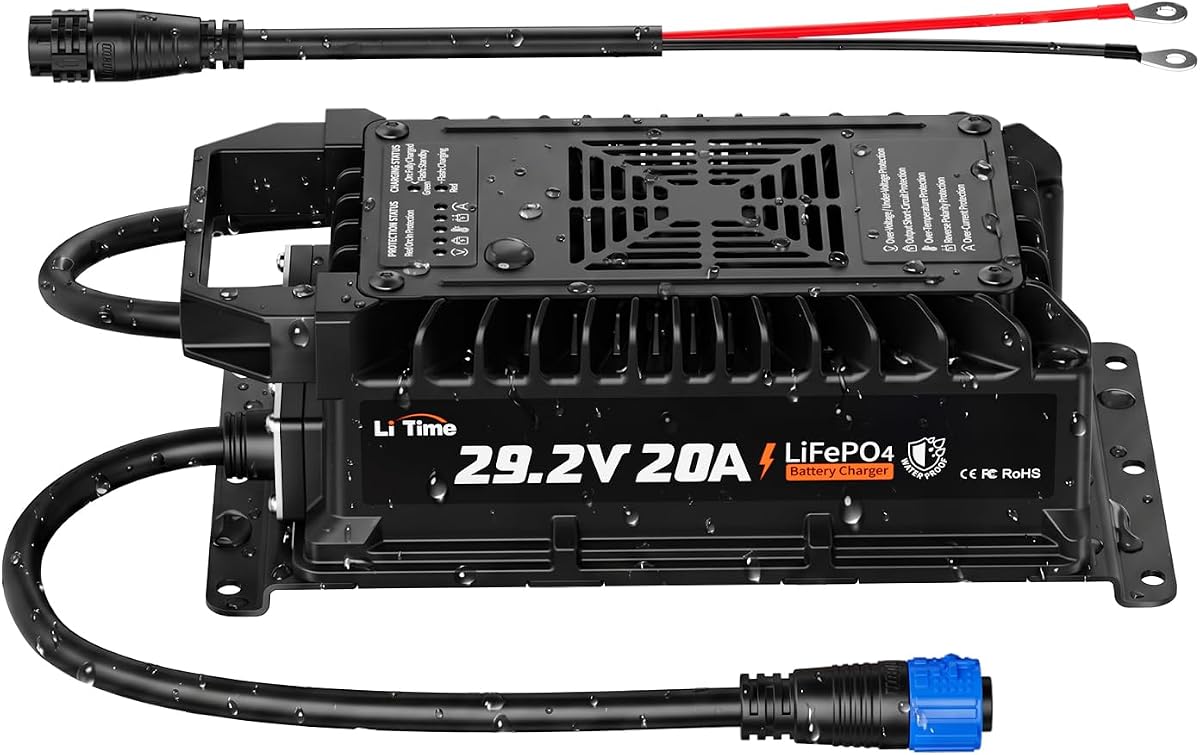
LiTime 20A Waterproof Charger
4.0Editor score
20A intelligent charging current
IP67 outdoor protection
Monitoring status indicators
Bracket and cable included
Our 24V Lithium Battery Charger guide compares 10 models for charging speed, safety, waterproofing, connections, battery activation, and daily use.
A 24V lithium battery charger is built around more than a matching voltage label. Chemistry, amperage, activation behavior, connection style, environmental protection, and battery-management compatibility all influence whether a charger can restore capacity safely and conveniently in real-world conditions.
This guide compares ten 24V lithium battery chargers using their listed charging output, current, safety systems, connection options, environmental ratings, indicators, and intended applications. It includes compact indoor models, high-output chargers, waterproof units, and options designed for deeply discharged batteries.
Each review explains who the product is best suited for and where it falls short, while the top picks highlight strong overall performance, practical value, and premium outdoor construction. Product details and availability can change, so readers should verify the current specifications before buying.
4.0Editor score

4.5Editor score

4.5Editor score
The table below compares all ten chargers by maximum charging current, charging architecture, physical protection, connection choices, and the features most relevant to battery owners.



The first-ranked charger in this comparison is a compact 29.2V, 10A unit designed for 24V or 25.6V lithium batteries, including LiFePO4 packs rated from 30Ah to 150Ah. Its listed 4.6 rating reflects broad buyer satisfaction, while the combination of a two-stage process, LED indicator, and Anderson connector makes it particularly approachable for RV, boat, and general deep-cycle applications.
We may earn a commission when you buy through this link, at no additional cost to you.
The core charging process moves from constant current to constant voltage, allowing the charger to deliver a strong initial charge before reducing output as the battery approaches full capacity. According to the product information, a compatible 50Ah battery can be fully charged in about five hours, while a 100Ah battery can be replenished in about ten hours. These figures make the unit considerably more useful than a low-current trickle charger when a battery needs a meaningful recovery.
Safety provisions include protection against overcharging, overheating, and short circuits. Those protections matter because a charger is only as valuable as its behavior when voltage, current, or wiring conditions go wrong. The principal compromise is that the listing does not describe the enclosure as waterproof, so it should not be treated as a marine-grade unit even though it can be used with compatible batteries found in boats and similar applications.
This is a strong selection for owners who want a manageable charger without paying for the highest available output. The Anderson connector is especially helpful for installations that already use that connection style, and the stated 30Ah-to-150Ah capacity range provides useful flexibility. My recommendation is to choose this charger for dry, protected installations, moderate charging urgency, and a preference for simple controls and a compact footprint.
Constant-current charging handles the main replenishment stage, while constant-voltage charging reduces stress as capacity approaches its limit. The stated five-hour recovery for a compatible 50Ah pack supports faster turnaround than a typical low-output charger.
The Anderson connector provides a secure, purpose-built option for compatible battery setups. Buyers should still verify the terminal orientation, cable length, and matching connector configuration before ordering.
We may earn a commission when you buy through this link, at no additional cost to you.
This LiTime charger combines a listed 4.6 rating with a 29.2V, 20A output for 24V and 25.6V lithium batteries. It is designed for users who want more current than a 10A model without moving to the largest 30A options. Its control circuit uses resonant soft-switching technology, while the aluminum housing and cooling fan help manage heat during sustained charging.
We may earn a commission when you buy through this link, at no additional cost to you.
The automatic sequence covers pre-charge, constant current, and constant voltage stages. Pre-charge is especially important for deeply discharged packs because it allows the charger to establish a safe operating level before applying the main current. Zero-volt activation can also wake a battery whose management system has entered cut-off after a prolonged discharge, making the product useful for storage batteries that may otherwise appear unable to accept a charge.
Six protections are listed for short circuit, overcurrent, reverse polarity, overvoltage, undervoltage, and excessive temperature. LEDs provide charging-status feedback, and the included customer support and two-year quality warranty add reassurance for a product intended to be installed rather than carried around. Nevertheless, this model is explicitly not waterproof, so it should remain in a dry location even when the battery belongs to a boat or other outdoor system.
The product is a strong fit for garages, workshops, storage rooms, and protected RV installations. Buyers need to account for the stated installation footprint of 14 by 4 inches and ensure that the fan has unrestricted airflow. It is a sensible selection for someone prioritizing controlled charging, robust protections, and useful zero-volt recovery rather than waterproof housing or the highest possible current.
The progression from pre-charge through constant current and constant voltage gives the battery a more controlled charging profile. LED indicators help users see where the process stands without repeatedly checking the battery itself.
Zero-volt activation can restore a lithium battery that has slept after BMS cut-off. It cannot revive a physically damaged or irreparably aged battery, so a failed wake-up attempt should not be interpreted as permission to keep using an unsafe pack.
We may earn a commission when you buy through this link, at no additional cost to you.
This 30A, IP67-rated charger is the strongest all-around option in the group for users who regularly charge large lithium batteries in demanding environments. Its listed 4.5 rating is backed by a broad feature set: 29.2V output, three-stage charging, zero-volt activation, temperature compensation, extensive fault protection, and a durable aluminum-alloy housing designed for RV, marine, trolling-motor, and off-grid use.
We may earn a commission when you buy through this link, at no additional cost to you.
The product information states that a 24V 150Ah LiFePO4 battery can be fully charged in five hours. That rapid result is especially relevant to large power banks, where lower-current chargers can leave the system underprepared for the next outing. The charger automatically shifts from pre-charge to constant current and then constant voltage, reducing current near full capacity and powering down when charging is complete.
Its built-in temperature sensor adjusts charging voltage to ambient conditions, while the cooling fan and vortex-style enclosure support heat dissipation. Protection functions cover overvoltage, overcurrent, overheating, short circuits, reverse connection, overcharging, and timing-related faults. These features are particularly valuable in a wet or mobile environment where a charging cable can be moved, exposed, or connected in less-than-ideal conditions.
Connection flexibility is another major strength. Buyers can use an SB-50 Anderson plug, M8 terminals, or alligator clips, allowing the charger to suit batteries with different connector arrangements. This is the pick for serious RV, boat, or off-grid users who want high output and outdoor protection in one unit. As with any high-current charger, proper ventilation, correct polarity, and a sound battery are essential.
A 30A maximum output materially shortens charging time for large LiFePO4 installations. The stated five-hour charge for a compatible 150Ah battery makes the charger particularly attractive to users who recharge substantial capacity between outings.
The IP67 enclosure, aluminum-alloy body, cooling fan, and temperature sensor make this a stronger outdoor choice than a basic indoor charger. IP67 protection also requires sensible cable placement and does not mean the unit can be submerged.
We may earn a commission when you buy through this link, at no additional cost to you.
This charger delivers the same headline maximum current as the leading outdoor model but presents a simpler, chemistry-focused proposition. It is expressly built for 24V LiFePO4 batteries and is not compatible with lead-acid, AGM, or other chemistries. That specificity is beneficial for owners who know their battery type and want to reduce the risk of applying an incorrect charging profile.
We may earn a commission when you buy through this link, at no additional cost to you.
The charging system combines a 29.2V output, 30A current, soft start, and an intelligent control chip. Soft start can reduce abrupt input demands at the beginning of a charging session, while the chip is described as managing output intelligently to support long-term battery health. The product information does not provide the same level of detail about indicator behavior or connector selection as the top-ranked units, so installation planning may require additional care.
Protections include overcurrent, overvoltage, and short-circuit handling, with soft start providing another layer of control. CE, FCC, and RoHS certifications are listed, giving users evidence of formal compliance, although certification alone does not determine suitability for every installation. The stated operating range of -13°F to 104°F is useful for garages, vehicles, and variable environments where conventional chargers may have more restrictive limits.
The listed applications include power packs used with lawn mowers, motorcycles, cars, RVs, and boats, making it a flexible choice for property owners with several 24V LiFePO4 systems. No waterproof rating is provided, so it should be kept away from direct weather exposure. Overall, this is an attractive option for someone who prioritizes maximum charging current and clear LiFePO4 compatibility over elaborate status displays or extensive connector choices.
Restricting compatibility to 24V LiFePO4 batteries is a safety-oriented choice. Buyers should not attempt to use it with lead-acid or AGM packs merely because their nominal voltage appears similar.
The stated 30A output and broad operating range suit mobile and mixed-use charging needs. The lack of a published waterproof rating means it is best reserved for a protected garage, vehicle interior, or similarly dry location.
We may earn a commission when you buy through this link, at no additional cost to you.
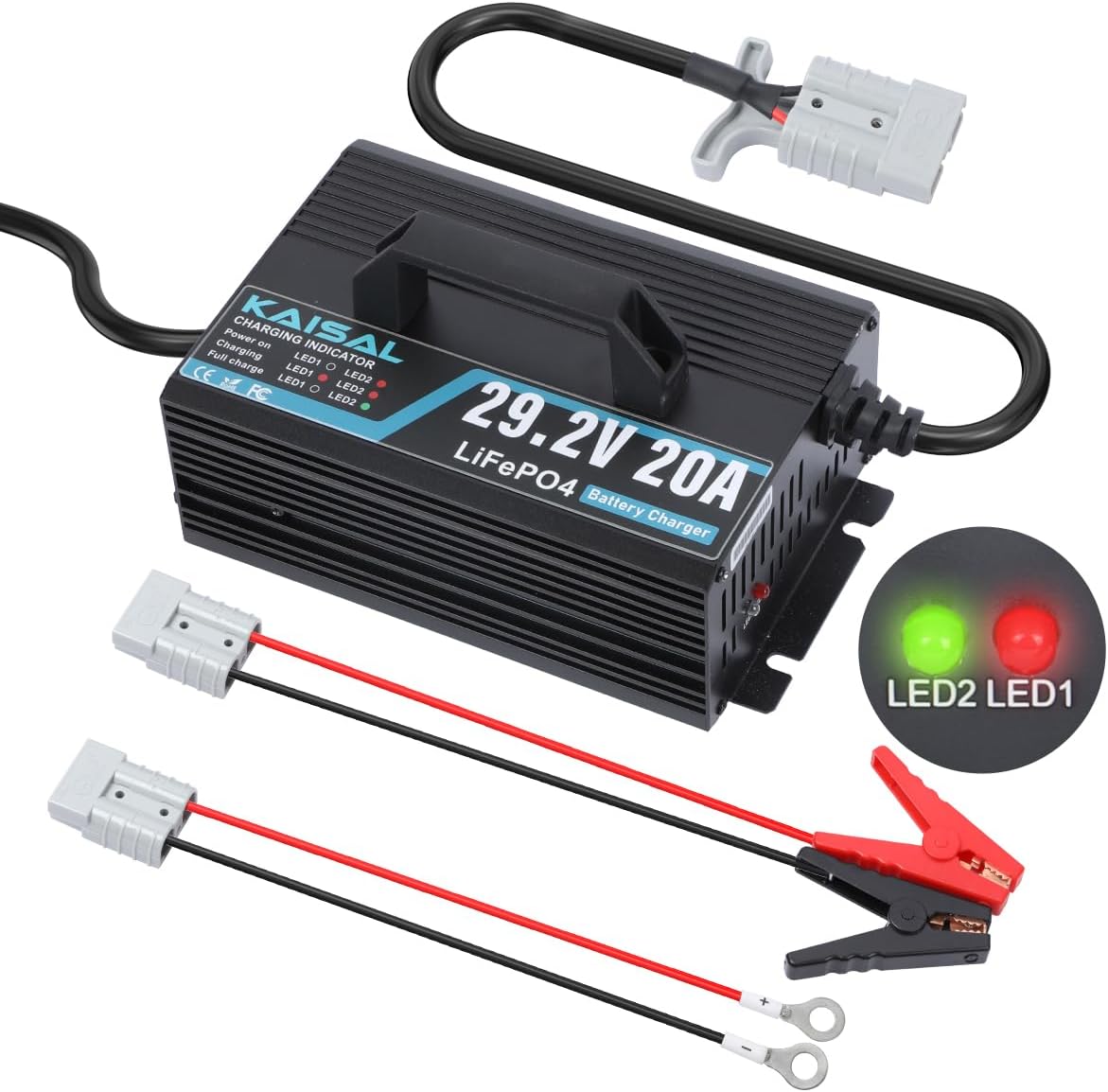
This KAISAL charger balances high current with environmental protection, offering 29.2V and 20A output for 24V or 25.6V LiFePO4 batteries. Its 4.5 rating and broad list of protections make it a well-rounded option for RVs, boats, solar systems, trucks, trolling motors, yachts, energy storage, and off-grid power systems.
We may earn a commission when you buy through this link, at no additional cost to you.
Its smart charging sequence covers pre-charge, constant current, and constant voltage, with automatic output reduction near full capacity. The listed efficiency reaches 94%, and a compatible 100Ah battery is said to charge fully in five hours. The sealed die-cast aluminum case carries an IP67 rating, while the attached cable is listed as IP68, offering stronger protection around a connection that may be exposed to splashing or damp conditions.
A three-color indicator provides unusually clear operational feedback. Green denotes standby or zero-volt wake-up mode, flashing red indicates normal charging, flashing yellow marks the small-current stage near full capacity, and steady green confirms completion. Eight protection functions are listed, including overvoltage, overcurrent, overheating, no-load, short circuit, reverse connection, overcharge, and timing protection. A 15-hour automatic stop helps prevent an unattended session from continuing indefinitely.
The M8 terminals can remain attached to a compatible battery, while alligator clips suit batteries with protruding pole lugs. A 9.5-foot cable improves placement flexibility, and the four-pound claimed weight makes the unit easier to move than many larger chassis. This charger is a strong middle ground for outdoor users who want 20A performance, detailed monitoring, and fewer installation compromises than a compact indoor model.
The three-color display makes it easier to distinguish normal charging, the reduced-current taper, and completion. That visibility is helpful for both attended garage use and periodically monitored installations.
The sealed aluminum body and protected cable suit damp outdoor environments, while the cooling fan supports stable operation. As with all electrical equipment, the charger should still be positioned where ventilation and drainage are adequate.
We may earn a commission when you buy through this link, at no additional cost to you.
This LiTime model is the premium recommendation because it combines 20A output, an IP67 enclosure, wide-range 100-240V AC input, and installation hardware in a single package. Its listed 4.0 rating is the lowest in the group, but the product itself addresses a specific need: buyers who want a LiTime charger for marine, RV, solar, cabin, or permanent outdoor installations.
We may earn a commission when you buy through this link, at no additional cost to you.
The three-stage intelligent process begins with pre-charge, moves into constant current, and finishes with constant voltage. Zero-volt activation is included to recover batteries that entered BMS cut-off after over-discharge. The aluminum housing, cooling fan, and rugged design are intended to sustain performance in wet and harsh environments, and the wide input range can be convenient for users who travel between different AC supply systems.
The indicators do more than show basic charging progress. They also display fault conditions for short circuit, reverse polarity, overcurrent, overvoltage, and undervoltage, which can make troubleshooting faster and reduce repeated cable handling. Protection systems cover excessive temperature, short circuit, overcurrent, reverse polarity, and both over- and undervoltage, providing a comprehensive response to common installation errors.
The package includes a waterproof adapter cable, OT M8 terminal cable, AC power cord, manual, and mounting bracket. A carrying handle supports portable deployment, while the bracket allows a more permanent installation. The listed cable measurements are 1200 millimeters for both AC and DC runs, with a shorter M8 adapter section for terminal spacing flexibility. This is the premium pick for buyers who prioritize a complete installation kit, outdoor protection, and clear diagnostic feedback.
The integrated handle makes temporary use straightforward, while the mounting bracket supports a fixed installation. That combination is useful for owners who move between a garage, cabin, boat, or other location rather than using one permanent base.
Separate protection indicators can show why charging stopped instead of presenting every interruption as an unexplained failure. Owners should still investigate the underlying wiring, polarity, connector, or battery condition before restarting.
We may earn a commission when you buy through this link, at no additional cost to you.
This 20A charger stands out for offering SB-50 Anderson, M8 terminal, and alligator-clip connections in one package. It is designed for 24V and 25.6V LiFePO4 batteries and carries a 4.4 rating. The three-method approach gives it broad compatibility with RV, marine, solar, truck, trolling-motor, energy-storage, and off-grid batteries without requiring an additional permanent cable.
We may earn a commission when you buy through this link, at no additional cost to you.
Charging follows the familiar three-stage sequence: pre-charge, constant current, and constant voltage. The CPU reduces current as the battery nears capacity and shuts the unit down at completion. The listing claims up to 90% efficiency and states that a compatible 100Ah battery can be charged in five hours. A zero-volt wake-up mode is included for batteries that have gone into BMS-protected sleep after a long period without charging.
Eight protections cover overvoltage, overcurrent, overheating, no-load operation, short circuits, reverse connection, overcharging, and excessive charging time. If the fault is corrected, the charger can resume automatically. A 15-hour cutoff adds another safeguard, while the two-color LED arrangement shows standby or wake-up status, normal charging, reduced-current charging, and full completion through differing light combinations.
The enclosure is an aluminum-alloy shell with an eddy-current cooling fan, and the charger weighs a stated four pounds. A nine-foot cable helps users position the unit without immediately reaching for an extension. The absence of a published waterproof rating is the main limitation for exposed marine use, but its connector flexibility, manageable size, and strong 20A output make it an excellent general-purpose 24V LiFePO4 charger.
The Anderson, M8, and clip options are highly useful for owners with different battery brands or terminal arrangements. The appropriate connection should always be selected with correct polarity and suitable current capacity.
Automatic shutdown helps protect a battery and charger when a fault occurs, while automatic resumption after correction improves convenience. Repeated faults still require inspection rather than repeated restarts.
We may earn a commission when you buy through this link, at no additional cost to you.
The 4A XLR charger is a specialized alternative for users whose 24V lithium equipment uses a three-pin male XLR connector. Its listed 4.5 rating indicates positive reception, and the simple proposition—100-240V AC input, 29.4V output, and a maximum current of 4 amps—makes it easy to understand once connector compatibility has been confirmed.
We may earn a commission when you buy through this link, at no additional cost to you.
Compared with the 20A and 30A models in this guide, its lower current means it is best suited to smaller packs or situations where a compact charger matters more than rapid recovery. The product information specifically claims that it charges faster than lower-output 29.4V alternatives, but it should not be confused with the high-current charging capability offered by larger LiFePO4 chargers.
Its ABS shell is described as drop-resistant and heat resistant, and a built-in fan provides active cooling. Automatic shutdown occurs when charging is complete. Multilevel protection is listed for overcharge, overvoltage, overheating, excessive charging time, and short circuits, covering the main risks associated with unattended use.
The LED feedback is easy to interpret: green indicates connection to AC power, alternating red and green indicates that the battery is charging, and steady green indicates full charge. This unit makes the most sense for a specific XLR-equipped setup, compact workshop, or portable project. Buyers should not choose it merely because the nominal voltage matches; the physical connector, battery chemistry, and lower amperage are equally important.
The three-pin male XLR is the defining compatibility point. Users should compare the charger's plug with the battery input and confirm the complete wiring arrangement before use.
The green and alternating-light pattern provides a quick overview of power, charging, and completion. It is a more straightforward interface than the multi-color diagnostics offered by several larger chargers.
We may earn a commission when you buy through this link, at no additional cost to you.
This 10A charger combines an IP67 aluminum-alloy enclosure with a relatively compact 2.8-pound listed weight, making it a value-focused outdoor option. Its 4.5 rating is among the strongest in the comparison, and the specification sheet is thorough enough to appeal to RV, camper, truck, solar, marine, yacht, trolling-motor, and off-grid battery owners.
We may earn a commission when you buy through this link, at no additional cost to you.
The charger provides 29.2V and 10A output for 24V or 25.6V LiFePO4 batteries. Its three-stage process covers pre-charge, constant current, and constant voltage, and the listing states that a compatible 50Ah battery can be fully charged in approximately five hours. Zero-volt activation is also available for batteries that entered normal BMS cut-off after prolonged neglect, with a clear warning that faulty or deeply aged batteries may require repair or replacement.
M8 ring terminals and alligator clips cover the two most common temporary and semi-permanent connection needs. The aluminum-alloy case, eddy-current cooling system, and temperature adjustment help maintain stable charging. The stated operating range of -22°F to 149°F is broad, while charging noise is listed below 50 decibels, making the unit potentially less disruptive in a garage, cabin, or occupied workshop than a louder alternative.
Seven protections cover overheating, reverse polarity, overvoltage, overcurrent, short circuit, no-load operation, and excessive charging time. The latter triggers an automatic stop after 15 hours. A three-color indicator communicates different charge stages, and mounting holes simplify wall or vehicle installation. This is the budget recommendation for buyers who want outdoor protection and smart charging without paying for a 20A or 30A output.
The 2.8-pound listed weight, handle, mounting holes, and IP67 housing make the charger easy to deploy or install. Small size does not eliminate the need for airflow around the cooling system.
A stated five-hour charge for a compatible 50Ah battery offers useful performance for small-to-medium packs. Larger batteries will take longer, making this a better fit for owners who do not need the rapid turnaround of a 30A unit.
We may earn a commission when you buy through this link, at no additional cost to you.
This LiTime model offers a 29.2V, 20A charger with a 4.5 rating, focusing on controlled charging for 24V and 25.6V lithium batteries. It shares several characteristics with the other LiTime AC-DC unit, including resonant control technology, a three-stage sequence, six protections, LED monitoring, and an aluminum-alloy shell with a cooling fan.
We may earn a commission when you buy through this link, at no additional cost to you.
Zero-volt activation is a defining feature. It can revive a battery whose BMS shut down after deep discharge and is also presented as a means of fully charging LiFePO4 to 100% capacity rather than stopping around the 90% level associated with a non-LiFePO4 charger. That statement should be understood within the product's intended chemistry and operating conditions, not as a reason to ignore the battery manufacturer's instructions.
The automatic sequence begins with pre-charge, continues through constant current, and concludes with constant voltage. Safety features cover short circuits, overcurrent, reverse polarity, overvoltage, undervoltage, and excessive temperature. Real-time LEDs make status easier to monitor, and the product information includes a two-year quality warranty plus technical and customer support.
The most important limitation is explicit: this charger is not waterproof and is not intended for exposed marine environments. It is best used in a garage, workshop, storage area, or other protected location, even if the battery itself is installed on a boat. Its 20A output and Anderson connection make it a good choice for compatible lithium systems that require dependable fast charging and a secure purpose-built plug.
Pre-charge, constant-current, and constant-voltage stages provide a structured path toward full capacity. The aluminum housing and cooling fan are designed to control heat while keeping the unit portable.
This charger is explicitly for dry locations. It can service a marine battery when both are protected, but exposing the charger itself to weather would undermine its safety and reliability.
We may earn a commission when you buy through this link, at no additional cost to you.
The right charger depends on battery chemistry, pack size, charging environment, connector arrangement, and the amount of current your system needs. Use the following factors to narrow the field before comparing final specifications.
A charger labeled for 24V lithium is not automatically correct for every battery sold under that nominal voltage. Most products in this guide specifically target 24V or 25.6V LiFePO4 packs and use a charging voltage around 29.2V, while one also states compatibility with generic lithium batteries. The battery label and manufacturer manual should identify the chemistry, nominal voltage, recommended charge voltage, and maximum charge current. Do not assume a lead-acid, AGM, NMC, or other chemistry can safely use a LiFePO4-specific profile. A nominal voltage match alone does not prove compatibility, and using the wrong chemistry profile can cause poor charging, excessive heat, or battery damage.
The maximum amperage tells you how quickly a charger can potentially replenish a battery, but the battery's permitted charge rate remains the controlling limit. A 30A charger may be excellent for a large 100Ah or 150Ah pack, while it can be inappropriate for a smaller battery unless that battery explicitly supports the current. The stated charging times also depend on test assumptions and may not account for every loss, taper stage, or battery condition. Compare the charger's maximum output with the battery's recommended continuous charge current, and use the lower limit. For occasional top-ups, a 4A or 10A charger may be enough; for large packs that need quick turnaround, a 20A or 30A model may be more appropriate.
A basic two-stage charger uses constant current and then constant voltage, while the more advanced units in this group add a pre-charge stage. Pre-charge is valuable for deeply discharged batteries because it conditions the pack before full current is applied. The constant-current phase performs most of the energy transfer, and constant voltage safely tapers the current as the battery reaches full capacity. Automatic shutdown is another important feature because it prevents the charger from continuing indefinitely after the battery reaches the target state. Buyers should also look for a timing cutoff, particularly if charging may occur unattended. More stages are not automatically better, but a well-described sequence makes it easier to understand how the charger is responding to the battery.
Zero-volt activation, sometimes called wake-up or recovery mode, is intended for lithium batteries that have entered BMS cut-off after sitting unused at a very low charge level. It is a useful feature for seasonal boats, RVs, solar systems, and stored backup banks. It does not create capacity in a damaged battery, and it cannot safely reverse severe degradation, internal faults, or unsafe voltage conditions. Product descriptions are appropriately explicit on this point. Activation should be used only with a compatible charger and should be followed by normal observation of the battery. If the pack remains cold, swollen, damaged, or unable to hold charge, it needs professional assessment rather than repeated wake-up attempts.
The difference between a basic indoor charger and an IP67-rated outdoor model can be decisive for boats, campers, solar installations, and exposed work areas. An IP67 enclosure is designed to resist dust and temporary water exposure, but it does not make the charger submersible or immune to standing water, blocked vents, damaged seals, or poor cable routing. Temperature also matters because battery charging generates heat and cold can affect performance. Several products in this guide include temperature sensing or a broad operating range. For permanent installations, consider a bracket, mounting holes, cable length, and service clearance in addition to the waterproof rating. Never use a non-waterproof charger outdoors simply because the battery itself is weather resistant.
Connector compatibility is an easy detail to overlook. Options in this guide include Anderson plugs, M8 ring terminals, alligator clips, and a three-pin male XLR. M8 terminals are useful for semi-permanent installations because they can remain connected to the battery, while clips are convenient for temporary charging. Anderson connectors provide a secure dedicated interface but require a matching socket and correct orientation. A longer cable can improve placement flexibility, although extension arrangements should not compromise current capacity or introduce unsafe joints. Measure the distance from the AC outlet to the battery, inspect the connector style, and confirm polarity before purchase. The best charger is inconvenient to use if its cable cannot reach or its plug does not fit.
Useful protection systems cover overcharge, overvoltage, undervoltage, overcurrent, reverse polarity, overheating, short circuit, no-load operation, and excessive charging time. No charger is made perfect by having a long feature list, so understand what happens when a fault occurs. The best behavior is a controlled stop, clear status indication, and no continued delivery of unsafe current. A timing limit adds useful defense for unattended charging. Protective claims should be considered alongside construction, thermal management, certification, and correct use. Certification marks such as CE, FCC, ETL, and RoHS are referenced for some products, providing useful regulatory information, but they do not replace sound installation practices or a healthy battery.
Status indicators range from a simple green light to multi-color displays that distinguish standby, normal charging, reduced current, completion, and specific faults. More detailed feedback can make a fixed installation easier to manage, especially if the charger is mounted where the battery is not immediately visible. Warranty and service terms are also relevant because chargers are often installed for years rather than used briefly. LiTime lists a two-year quality warranty on its non-waterproof models, while the KAISAL and RALBIL products list three-year service and replacement policies under their stated conditions. Buyers should retain proof of purchase and review the warranty terms, especially when using an outdoor unit in a salt-laden or high-moisture environment.
Before connecting the charger, confirm that the battery is a compatible 24V or 25.6V lithium chemistry and inspect the battery for swelling, leakage, corrosion, physical impact, or damaged leads. Use the correct connector and verify polarity. Place the charger on a stable, ventilated surface with its cooling fan or vents unobstructed, and keep any non-waterproof model inside a dry location.
Connect the charger to the battery before applying AC power, following the manufacturer's sequence. Watch the indicator and allow pre-charge or wake-up mode to complete if applicable. Do not repeatedly interrupt a healthy charging session, use the charger if its cable or connector is damaged, or extend the setup with unsafe temporary joints. If a protection fault appears, disconnect AC power, inspect polarity and connections, and confirm that the battery itself is healthy before resuming.
Remove the charger when the display indicates full charge, even if a timing function would eventually stop it. Wipe the enclosure and connectors dry, inspect cables for abrasion, and store the unit in a clean, ventilated place. For fixed outdoor installations, periodically check mounting hardware, seals, and cable routing, and have the battery serviced if it becomes unusually hot, swells, leaks, or repeatedly trips protection.
Usually, no. These chargers are designed primarily for 24V or 25.6V lithium batteries, and many are explicitly limited to LiFePO4 chemistry. Lead-acid and AGM batteries require different voltage and charging profiles, so use a charger specifically approved for that chemistry. A nominal 24V label is not enough to establish compatibility.
A 25.6V LiFePO4 battery is commonly described in the market as a 24V battery because its nominal voltage is 25.6V. Its full-charge charging voltage is higher, which explains why the chargers in this guide commonly use a 29.2V output. Always check the battery label and follow its specified charging profile.
No. A 30A charger can restore a large compatible battery faster, but it may exceed the safe charge rate of a smaller pack. Output should never exceed the battery manufacturer's recommended current and any system-specific limits. For small batteries, 4A or 10A may be more appropriate, while large RV, marine, or solar banks may benefit from 20A or 30A.
Zero-volt activation is intended to wake a lithium battery whose BMS has cut output after a prolonged deep discharge. It does not repair physical damage, correct a defective BMS, or restore lost capacity. A battery that cannot wake normally may be aged or faulty and should be inspected or replaced.
Only chargers with suitable environmental protection should be considered for exposed marine installations. The IP67 LiTime model and several other listed units are designed for outdoor or marine-oriented use, while the non-waterproof LiTime models are explicitly not suitable there. Secure all connections and keep chargers above standing water regardless of their rating.
The time depends on battery capacity, charger current, initial state of charge, and the charging profile. Product descriptions give examples such as roughly five hours for a compatible 50Ah pack with a 10A charger and roughly five hours for a compatible 100Ah pack with a 20A charger. Actual times vary, and a full charge includes a reduced-current constant-voltage stage.
It depends on the charger's monitoring and safety features and the battery manufacturer's instructions. Chargers with automatic shutdown, charge-state tapering, fault protection, and timing cutoffs are better suited to unattended sessions than basic chargers. Even then, periodic monitoring is wise, and damaged wiring or batteries should never be left unattended.
A typical sequence shows standby or activation, red flashing during normal charging, yellow or another reduced-current indication near full capacity, and green when fully charged. Exact meanings vary among products, so consult the indicator section of the manual. Some premium models also use dedicated lights for reverse polarity, overcurrent, overvoltage, and other faults.
The 30A IP67 model is the strongest all-around choice for large LiFePO4 systems, outdoor charging, rapid replenishment, and flexible connections. The 20A LiTime waterproof unit stands out as a premium permanent or portable installation, while the 10A IP67 model delivers the most practical value-oriented combination for users who do not need maximum current.
Prioritize confirmed battery chemistry, a safe charge current, accurate connection compatibility, and environmental protection before comparing other features. Indoor users may benefit from the advanced protections and diagnostics of the non-waterproof LiTime chargers, while RV, marine, and solar owners should give careful attention to enclosure ratings, cable routing, ventilation, and zero-volt recovery.
Charging times, product pages, and prices can change, so check the latest specifications, connector drawings, warranty terms, and current cost before purchasing. The right charger should fit both the battery and the place where charging happens, making safe installation just as important as the headline amperage.
