
SWANLAKE Dual-Ended Test Leads
4.7Editor score
One-thousand-volt insulation rating
Up to fifteen-ampere capacity
Three-and-a-half-foot flexible cables
Our electrical clips for wires guide compares 10 options for grip, wire gauge, length, insulation, and durability, helping you choose the right test lead or
Electrical clips for wires come in several practical forms, including test leads, battery charging clamps, bare soldering clips, and adhesive cable holders. The right choice depends on whether you need temporary electrical connections, a strong grip on small components, or organized routing for cords and permanent wiring.
We compared all ten products by examining clip construction, wire gauge, lead length, insulation, jaw strength, intended applications, and the number of pieces included. The list covers complete test-lead sets, assortments of individual clamps, and adhesive wire-management clips, giving beginners and experienced technicians options for different workspaces.
Each review explains the standout features, practical limitations, and best use case for its product, followed by a side-by-side comparison. Ratings and product details reflect the supplied information, while prices and availability can change, so check the current listing before making a final purchasing decision.
4.7Editor score

4.7Editor score

4.6Editor score
The table below compares the included products by their most important practical attributes, including construction, cable gauge, lead length, insulation, and common use. Although nine products are electrical test or charging clips, the final adhesive option serves a distinctly different cable-management role.


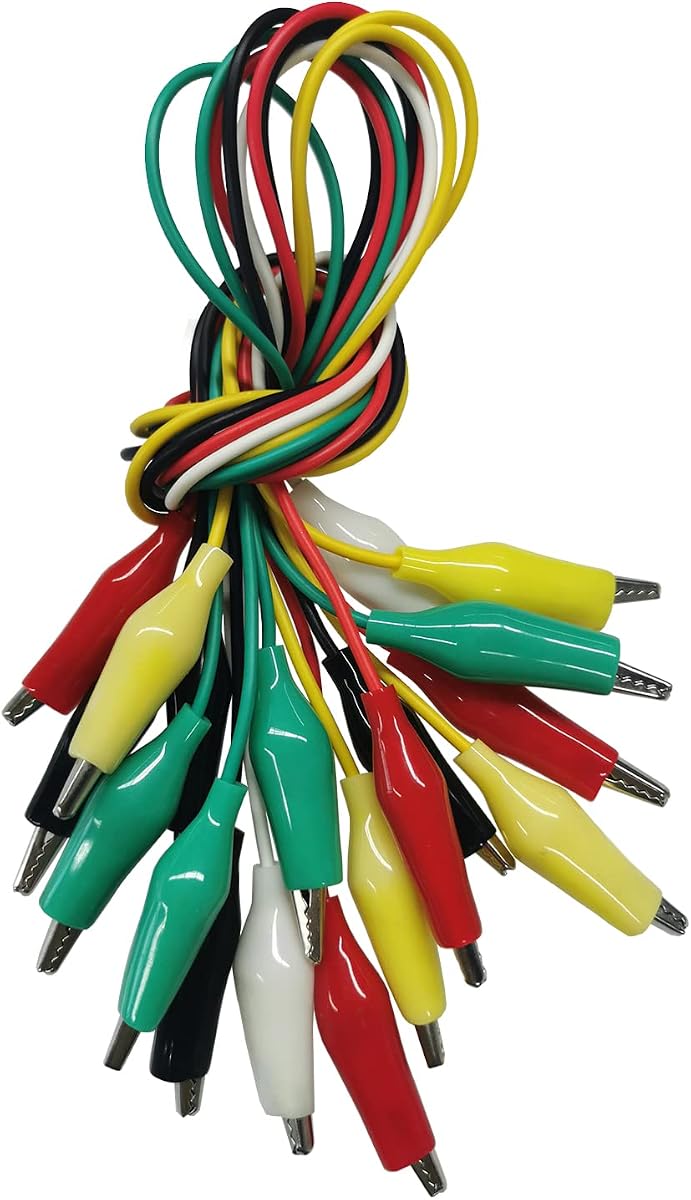


The WG-026 10-Piece Test Lead Set earns a 4.7 rating and stands out as the most balanced choice for general-purpose electrical testing. It combines ten flexible, color-coded leads with sturdy nickel-plated steel alligator clips, giving users enough equipment for bench work, breadboarding, troubleshooting, and routine electronics projects without a complicated assortment.
We may earn a commission when you buy through this link, at no additional cost to you.
Each 22 AWG copper lead measures 20.5 inches, including a 1.6-inch clip, so the set offers useful reach for connecting to components, probes, and terminals. The two leads each in red, black, yellow, green, and white simplify circuit identification. Nickel plating and corrosion resistance support long-term use, while PVC insulation and vinyl-coated jaws improve handling around energized components.
The clips are securely soldered and stamped to their wires, addressing a common weakness of inexpensive detachable leads. This construction should provide more consistent electrical continuity and reduce the chance of a connection being lost through repeated movement. The stated applications include laboratories, schools, home workshops, and industrial environments, making the set suitably versatile for education and light professional work.
Its main limitation is that 22 AWG wire and relatively short leads are intended for light testing rather than heavy-current charging. Users needing long reach, high-current capacity, or a large collection of bare clamps will need one of the more specialized sets. Even so, the combination of color coding, durable clips, and five matching pairs makes this an excellent general-purpose recommendation for students, hobbyists, and technicians.
The five-color organization reduces confusion when several connections are active. Matching two leads of each color also makes it straightforward to build paired test circuits, check continuity, or keep positive and negative paths visually distinct.
Soldering and stamping the clips to the wires creates a more permanent connection than loose, interchangeable accessories. That makes the set useful when a test point must remain attached while the operator changes probes or adjusts the circuit.
We may earn a commission when you buy through this link, at no additional cost to you.
This 50-piece micro alligator clip set carries a 4.7 rating and offers an impressive amount of hardware in a compact package. It includes 25 red and 25 black clips, making it a practical foundation for a home lab, technician's tool bag, or frequently used collection of temporary electrical connections.
We may earn a commission when you buy through this link, at no additional cost to you.
The clips are built from conductive metal with spring mechanisms designed to grip wires, battery terminals, and other contact points firmly. Plastic insulating sleeves add a layer of protection during everyday handling, while the compact 2.13-inch format allows access to smaller terminals and cramped work areas. Their stated uses include laboratory work, car maintenance, charging, and battery applications.
Unlike complete test-lead kits, this package supplies the clips themselves rather than long preattached cables. That gives users flexibility to attach clips to custom wire lengths or incorporate them into a breadboard, fixture, or temporary harness. However, it also means the buyer must already have suitable wire, a crimping or soldering method, and any connector hardware required for the intended project.
This set is best for users who need many inexpensive auxiliary clamps rather than a small number of ready-made meter leads. It can also complement a more specialized test-lead set by providing spare jaws for custom builds. The restricted red-and-black color scheme limits circuit-identification options, but the high count, compact size, and secure spring grip make this a versatile workshop consumable.
Fifty clips provide enough material for multiple fixtures, battery leads, and temporary test arrangements. Technicians can keep a full collection in a drawer without repeatedly borrowing clips from another project.
At just over two inches, these micro clips are more maneuverable than full-size battery clamps. That makes them suitable for narrow terminal blocks, small battery contacts, and densely populated circuit boards.
We may earn a commission when you buy through this link, at no additional cost to you.
The Nilight 60-piece assortment receives a 4.5 rating and stands out for offering an unusually broad selection of clip formats. It combines charging clamps, general-purpose alligator clips, and miniature clips in one set, allowing users to select the appropriate jaw size for batteries, small components, and general wire-holding tasks.
We may earn a commission when you buy through this link, at no additional cost to you.
The package includes two 30-amp charging clips, two 15-amp charging clips, eight 5-amp charging clips, twelve 2-inch alligator clips, sixteen 1-3/4-inch alligator clips, and twenty mini alligator clips. That range makes the assortment especially useful for technicians who regularly handle several current levels or need to match clip size to a cramped contact.
Metal construction is designed for electrical conductivity and durability, while rust and corrosion resistance help preserve performance over time. Insulated PVC jackets, including thicker red and black sleeves on the larger charging clips, improve handling and make polarity easier to identify. The smaller clips can also function as adjustable helping-hands clamps during gluing or soldering.
Because current capacity changes across the assortment, users should select clips based on the task rather than treating every piece as interchangeable. The large number of sizes may also be more than a casual buyer needs. Even so, it is a strong option for workshops and service kits seeking one collection to cover several common clamp sizes and moderate current requirements.
Having 2-inch, 1-3/4-inch, and mini clips in the same set reduces the need to purchase separate accessories for large battery terminals and small circuit points. The varied jaw profiles also make it easier to match the physical shape of a test point.
The red and black insulation gives charging clips an immediate visual distinction. Thickened sleeves around the larger handles also provide a safer and more comfortable grip during routine battery and circuit work.
We may earn a commission when you buy through this link, at no additional cost to you.
The WMYCONGCONG 22-piece kit has a 4.6 rating and is built for small electrical testing and electronics tinkering. It supplies 22 small metal alligator clips in red and black, giving users a moderate collection of individually usable clamps without the bulk of a larger charging assortment.
We may earn a commission when you buy through this link, at no additional cost to you.
Each clip measures 52 by 10 millimeters, and the listed current rating is below five amps. The metal jaws have a smooth nickel-plated finish designed to support conductivity without needlessly damaging the wire surface. A firm spring produces a solid bite, while the plastic sleeve provides insulation and a safer handhold.
These clips can be used for home electronics, automotive projects, circuit testing, and as small supporting clamps for a DIY soldering helping-hands device. The absence of long leads gives buyers freedom to determine their own cable length, which can be helpful for custom temporary connections and compact bench arrangements.
The key trade-off is its limited current capacity, which makes it unsuitable for demanding battery charging or high-load work. The red-and-black selection also provides less polarity distinction than a multicolor set. For students, hobbyists, and technicians working on low-current electronics, however, the firm grip and smooth jaws make this a practical choice.
The nickel-plated surface is intended to create a steady contact without roughing or nicking the conductor. This is particularly helpful when a clip remains attached to a relatively delicate jumper or component lead.
The stated limit below five amps gives users a clear limit for safe project planning. Larger battery clamps or purpose-rated test leads are more appropriate when current demands increase.
We may earn a commission when you buy through this link, at no additional cost to you.
This ten-piece, five-color test-lead set carries a 4.3 rating and focuses on adaptable temporary connections. Its detachable alligator clips can attach to terminals, component leads, battery contacts, or probes, making it a useful bridge between a multimeter and the circuit under examination.
We may earn a commission when you buy through this link, at no additional cost to you.
The supplied information describes 10 alligator-clip leads in five colors, with an overall length of about 21.7 inches and clips approximately 1.3 inches long. The broader jaw is intended to resist slipping off a contact. Five leads include testing probes with good conductivity, while PVC-covered cables provide insulation and flexibility during routine experiments.
The detachable arrangement is particularly useful when different tasks demand different connection methods. A technician can move from a probe tip to an alligator clip without replacing the entire lead, and the larger terminal can hold onto a small wire more securely than a narrow probe. The stated uses include circuit connections, multimeter work, motor testing, appliance testing, prototyping, and temporary power connections.
The metal clip terminals must remain within their voltage limits, and users should not treat the PVC covering as unlimited protection. The set also has the lowest rating in this group, although that does not negate its useful detachable design. It is best suited to electronics experiments, prototyping, and temporary testing where flexible connection methods matter more than high-current capability.
The removable clip arrangement allows one lead system to work with probes, terminal posts, and component leads. That versatility is valuable when a single circuit exposes different contact styles.
The approximately 35-millimeter clip size creates a wider gripping area than miniature alternatives. A broader jaw is less likely to slide from a small terminal during movement.
We may earn a commission when you buy through this link, at no additional cost to you.
The SWANLAKE dual-ended test leads receive a 4.7 rating and are the strongest choice for users who need clearly specified voltage and current capabilities. Each lead is 3.5 feet, or approximately one meter, long, giving it more reach than the shorter laboratory-style test sets in this guide.
We may earn a commission when you buy through this link, at no additional cost to you.
The alligator clips are made from copper for conductivity, while the thick insulated cables are listed to handle up to 15 amps and measurements up to 1,000 volts. These figures make the leads more suitable for general electrical testing than the low-current clip assortments, provided the connected circuit remains within those limits and proper test procedures are followed.
Dual-ended construction allows each cable to connect between two test points without a separate probe at one end. That can create a hands-free connection across a battery, circuit board, or remote terminal. The long flexible insulation is also designed to help prevent accidental shorting and to withstand regular use in a busy toolkit.
Only two leads are included, so buyers needing several color-coded channels will need another set. Voltage and current ratings must still be respected, and insulated cable does not authorize use in every environment. Within its stated envelope, however, this is the most premium-specified option for general-purpose electrical measurement and compact bench work.
Stating a 1,000-volt limit and 15-ampere capacity gives buyers information they can compare with their equipment and planned circuits. Those figures are more useful than a generic durability claim when selecting a lead for a defined test.
A clip at each end lets the lead bridge two points directly. Once secured, the user can operate a meter or examine another part of the circuit without maintaining pressure on either terminal.
We may earn a commission when you buy through this link, at no additional cost to you.
The EDGELEC 12-piece set earns a 4.5 rating and is well suited to breadboarding, prototyping, and troubleshooting where color organization and reliable wire construction matter. The package includes 12 alligator-clip leads distributed across six colors, providing more leads and greater color granularity than many five-color sets.
We may earn a commission when you buy through this link, at no additional cost to you.
Its UL1015 18 AWG tinned copper wire is paired with PVC insulation and nickel-plated steel clips. The clips are soldered and stamped to the wires, which should improve mechanical strength and make the set appropriate for repeated temporary connections. Non-slip rubber sleeves cover the jaws, providing insulation and a positive handhold.
Each clip measures 1.77 inches and has a stated maximum opening width of 0.67 inches. That relatively wide opening can accommodate larger terminal tabs or component leads than a miniature clip. The total lead-and-clip length is 23.5 inches, or 60 centimeters, offering enough reach for common bench arrangements without excessive cable.
No specific current or voltage limit appears in the supplied specifications, so users should not infer suitability for high-current charging. The 18 AWG wire is heavier than the light-gauge leads in several competing sets, which is helpful for general electronics work but does not replace purpose-rated equipment. This is a strong option for organized prototyping and educational benches.
Twelve leads across six colors make it easier to separate power, ground, signal, and temporary sensing paths. The additional color options also reduce confusion when several jumpers occupy the same breadboard.
The 18 AWG tinned copper construction provides a heavier and more durable lead than very thin alternatives. Tinning also helps the conductor resist corrosion during repeated storage and use.
We may earn a commission when you buy through this link, at no additional cost to you.
The four-group double-ended test-lead set has a 4.4 rating and prioritizes reach and versatile connection points. Each of the four one-meter groups has alligator clips at both ends, allowing long temporary links between circuit points without needing a separate probe on either side.
We may earn a commission when you buy through this link, at no additional cost to you.
The nickel-plated steel clips use strong springs to maintain a secure connection. Their insulated sleeves can slide to adjust the amount of exposed metal, giving the user some control over the protected jaw area. PVC wire insulation and surface plating are intended to prevent conductor crossings and accidental shorts while the test remains connected.
The one-meter length is helpful when working around larger equipment, wall-mounted electronics, vehicle components, or a circuit board positioned away from the meter. Red and black grouping also supports basic positive-and-negative identification, even though the limited palette is less useful for complex multi-signal circuits.
The main drawback is that only two colors are included, so a large breadboard with several paths may become difficult to trace. There is also no stated current or voltage rating. For basic experiments, circuit-board troubleshooting, prototyping, and general temporary connections, the set remains a practical option with particularly useful cable length.
One-meter cables can reach from a meter to a distant battery, panel, or test fixture. That reduces the need to repeatedly move a bulky instrument while troubleshooting a connection.
Sliding insulated sleeves let the user vary how much of the metal jaw remains covered. This is useful when different contact points require different amounts of exposed gripping area.
We may earn a commission when you buy through this link, at no additional cost to you.
This 50-piece small alligator clip set receives a 4.6 rating and offers a large quantity in a compact, budget-conscious format. It includes 25 red and 25 black clamps, giving users enough pieces to build several temporary connections or maintain a broad collection of spares.
We may earn a commission when you buy through this link, at no additional cost to you.
The metal clips use a strong spring mechanism to hold wires, battery terminals, and test leads. Plastic insulating sleeves help limit accidental contact during handling, while the 2.18-inch size keeps the clips easy to store and maneuver. Their compact dimensions are particularly useful in laboratory work, car repair, and home electrical projects where full-size clamps may be cumbersome.
The clips are not presented as complete test leads because no long cable or probe is included. Users can attach them to custom leads, breadboard jumpers, or charging wires according to the project's requirements. That flexibility is useful for technicians who already work with wire and connectors, although beginners may prefer a ready-made lead set.
The set's only notable constraints are the two-color selection and the absence of stated voltage or current ratings. Users should not treat these general-purpose clamps as appropriate for every charging or mains-related task without confirming suitability. For creating temporary electrical connections, holding small battery contacts, or expanding a toolkit, the high count and compact spring-loaded design are especially valuable.
A large assortment helps when several test points must be connected at once or when clips are frequently lost or damaged. Having matching red and black pieces also simplifies basic polarity assignments.
The plastic covers reduce exposed metal around the gripping mechanism. They are a sensible handling aid during low-voltage work, although users should still follow appropriate electrical safety procedures.
We may earn a commission when you buy through this link, at no additional cost to you.
The KGROTE 100-piece cable clip set has a 4.4 rating and serves a different purpose from the electrical test clamps in this guide. These adhesive wire holders secure cables against flat surfaces rather than creating an electrical connection, making them useful for organizing Ethernet, USB, HDMI, television, and extension cords.
We may earn a commission when you buy through this link, at no additional cost to you.
Made from clear PC plastic with adhesive backing, the clips measure 16 by 15 by 8 millimeters. Their transparent appearance keeps them visually unobtrusive on a desk, wall, vehicle interior, or entertainment setup. One hundred pieces provide enough coverage for extensive cable routing, multiple workstations, or decorative lighting installations.
Installation requires no screws or tools. Users clean the surface, remove the protective film, position the clip, and press firmly for ten seconds; the supplied instructions indicate waiting two hours before maximum adhesion. Suitable surfaces include tables, metal, walls, plastic, glass, and wood, provided they are flat, dry, and free of dirt, dust, grease, or wax.
These holders are not substitutes for electrical test leads, soldering clips, or battery clamps, and they do not establish a reliable electrical connection. Their purpose is physical retention and organization. Buyers should also understand that adhesive performance varies with surface texture and cleanliness. For tidy, low-visibility routing without permanent drilling, however, the large quantity and simple installation are compelling.
The clips can be mounted directly to a clean, flat surface, which is helpful in rental spaces or finished interiors. They can also be repositioned when cable routing needs to change.
The transparent body blends into many backgrounds and does not compete visually with the cable. This makes the holders suitable for visible workspaces where bulky colored fasteners would be distracting.
We may earn a commission when you buy through this link, at no additional cost to you.
The best electrical clip depends on the job: test leads, charging clamps, soldering helpers, and adhesive holders solve different problems. Consider connection type, current and voltage requirements, reach, insulation, and the number of pieces before choosing.
Match the product to the task rather than treating every crocodile-style clip as interchangeable.
Never infer a safe operating limit from appearance, jaw size, or the word premium.
A wider jaw grips securely but may not fit around a small component lead.
Prioritize solid jaws, sound springs, and documented conductor construction.
Treat insulation as one layer of protection, not permission to exceed ratings.
Choose enough reach for the test point without adding unnecessary cable clutter.
Choose quantity and assortment to match repeat tasks, not merely the largest set.
Surface preparation is essential for dependable adhesive cable retention.
Before using a test lead or clamp, inspect the cable, insulation, spring, jaw, and soldered connection. Confirm that the clip is compatible with the conductor and the intended current or voltage. For a multimeter test, power down the circuit where appropriate, connect the lead, set the meter to the correct function and range, and then restore or apply power as required by the test procedure.
Attach a clip only to an exposed, clean contact point unless the product instructions specify another method. Squeeze the spring gently, position the jaws around the terminal, and release so the metal-to-metal contact is deliberate. Avoid forcing the jaw onto oversized parts, and do not use a clip as a substitute for a purpose-rated connector when substantial current or environmental exposure is expected.
After use, disconnect power before removing clips, wipe away dirt and flux with an appropriate cleaner, and inspect for corrosion or damaged insulation. Store loose clips in a dry organizer and avoid tangling attached leads. For adhesive holders, clean the old mounting area before attaching a replacement and allow the new clip the recommended curing time. Retire any lead with exposed copper, damaged insulation, a weak spring, or a loose connection.
Electrical clips for wires create temporary electrical connections or hold wires during assembly and testing. Common uses include multimeter testing, breadboard connections, battery charging, prototyping, troubleshooting, and supporting a workpiece during soldering. Adhesive cable clips have a different purpose: they organize and retain cords without carrying an electrical current.
No. Only use clips or leads whose product documentation explicitly covers the required voltage and current category. In this guide, the SWANLAKE leads are stated to support measurements up to 1,000 volts and up to 15 amps, but even that rating does not replace appropriate training, PPE, equipment inspection, and safe work procedures.
Choose a complete test-lead set for immediate multimeter or bench use because the cable and clips are already joined. Choose loose clips when you want to create custom leads, repair harnesses, or build several project-specific connections. Loose clips require suitable wire and a dependable way to secure the conductor to the metal jaw.
Wire compatibility depends on the jaw size and construction rather than a single universal gauge. The WG-026 set uses 22 AWG wire, while the EDGELEC set uses UL1015 18 AWG tinned copper wire. Loose clips can potentially accept several conductor sizes, but users should confirm fit, current demand, and attachment method before applying a load.
Color helps users identify conductors and maintain consistent polarity or signal paths. Red and black are sufficient for simple positive-and-negative assignments, while five or six colors are more helpful on a crowded breadboard or in a multi-circuit test. Color does not improve conductivity or establish safety, so it should support organization rather than replace proper ratings and inspection.
Only if the manufacturer rates them for the battery, charger, wire size, and current involved. The Nilight assortment includes clips with stated 5-, 15-, and 30-amp charging categories, but the smaller alligator clips within that set may be intended for lower-current or noncharging tasks. Check the individual clip rating and the charger's requirements before connecting it.
Clean both the terminal and the inside of the jaw, position the clip squarely on a compatible contact, and allow the spring to close fully. A wider jaw is more stable on a small terminal than a narrow probe, while excessively large or mismatched jaws may not fit. For critical testing, support the lead so cable movement does not pull against the connection.
No. The KGROTE 100-piece set is designed to route and retain cables mechanically; it is not a conductive terminal or a substitute for an alligator clip. Use an electrically rated connector when a circuit must be completed, and reserve adhesive holders for keeping already-terminated cords organized against a suitable surface.
The WG-026 10-Piece Test Lead Set is the strongest all-around recommendation because it combines clear color coding, flexible 22 AWG copper leads, securely soldered nickel-plated clips, and a useful 20.5-inch length. It covers many common laboratory, school, workshop, and electronics-testing tasks without requiring users to assemble their own leads.
The SWANLAKE dual-ended leads are the premium choice for anyone who values explicit voltage and current figures, longer reach, and direct point-to-point connections. For a large inventory of loose clamps, either 50-piece micro clip set offers abundant, compact accessories. Buyers focused on a broad size range should consider the Nilight assortment, while those organizing finished cords should look to the adhesive KGROTE holders.
Prioritize the product that matches the actual connection, then verify wire gauge, jaw size, insulation, and documented electrical limits. Product details and availability can change, and current listing prices should be checked before ordering. Buying the right clip type for the job will produce a safer, more organized, and more reliable result than choosing by quantity alone.