
Coffee Maker Cleaner & Descaler Tablets
4.4Editor score
Twenty-four tablets included
Monthly cleaning coverage
Works with major machine types
Simple reservoir cleaning method
Best descaling machine for coffee makers options for 2026, comparing liquids, powders, and tablets by compatibility, ease of use, cleaning power, and value.
A descaling machine for coffee makers is essential when mineral deposits begin restricting water flow, heating performance, and flavor. The right product should fit your brewer, suit your cleaning routine, and remove limescale without leaving unwanted odors or residues. Liquids, powders, and tablets each offer distinct handling and convenience advantages.
This guide compares ten descaling solutions using the supplied product information. We consider machine compatibility, formulation, ease of use, available cleaning cycles, packaging format, user rating, and maintenance coverage. The list includes liquid concentrates, dissolving powders, and individually wrapped or boxed tablets for automatic, manual, pod, drip, and espresso machines.
Each review explains the strongest reasons to consider that option, along with practical trade-offs. The top selections demonstrate how a broad-compatibility liquid, a tablet-based routine, and a manufacturer-branded descaler can serve different needs. Product features and availability can change, so readers should verify current details and current prices before purchasing.
4.4Editor score

4.4Editor score

4.7Editor score
The comparison below places all ten descaling options side by side, highlighting their format, use coverage, machine compatibility, and maintenance approach. It is designed to help readers identify a product that fits both their brewer and preferred cleaning routine without overlooking capacity or rinsing requirements.



The IMPRESA Coffee Machine Descaler is a two-pack liquid solution designed to clean and rinse residue, oil, limescale, and mineral buildup from coffee makers. It carries a 4.4 rating, making it one of the strongest all-around choices in this comparison. Its standout quality is versatility: the two eight-ounce bottles provide enough solution for four descaling sessions, with each session using half a bottle.
We may earn a commission when you buy through this link, at no additional cost to you.
The product is made in the USA and is described as a highly effective cleaning solution that helps preserve the machine by removing deposits that can contribute to corrosion. Its compatibility list includes Breville, Nespresso, De'Longhi, Hamilton Beach, Braun, Bunn, Cuisinart, Tassimo, Krups, Saeco, and other single-use, espresso, and conventional machines. It is also suitable for kettles and electric water heaters, which adds flexibility for households maintaining several water-heating appliances.
The main practical consideration is that this is a measured liquid product rather than a disposable tablet. Users must determine the correct dosage, add it to the reservoir, and allow the machine to complete the cleaning process. Although the container may occupy more storage space than a tablet box or powder packet, its multi-use formula can make routine maintenance more convenient for owners of several compatible appliances.
This is the strongest general recommendation for readers who want one liquid solution that can serve many machines. Four cleaning sessions and a recommended cleaning interval of every three to four months make it particularly relevant for regular household upkeep. Buyers should always consult their machine's manual and the product directions to confirm the proper procedure before starting a cycle.
The broad compatibility list is the central benefit of this pick. It covers automatic, manual, pod, capsule, cup, filter, commercial, cappuccino, espresso, and other common water-heating equipment, reducing the need to maintain separate cleaning products for different household appliances.
Each bottle is designed to deliver two cleaning sessions, so a four-ounce dose provides a repeatable method for breaking down scale and oil. A visible measuring container and consistent routine can make it easier to keep descaling on schedule rather than waiting for a warning light or noticeable flow problem.
We may earn a commission when you buy through this link, at no additional cost to you.
ACTIVE offers a 32-ounce bottle that is formulated for eight cleaning sessions, giving it substantial capacity for households that regularly maintain a coffee maker. The product has a 4.4 rating and uses a citric acid formula made in the USA. It is positioned as both a descaling and cleaning solution for limescale, calcium, and other residue.
We may earn a commission when you buy through this link, at no additional cost to you.
Compatibility is a major strength. The product is listed for Nespresso pod and K-cup brewers, multi-cup drip makers, semi-automatic machines, and super-automatic espresso systems. Named compatible brands include Keurig Mini, Vertuo, Philips, Gaggia, Moccamaster, Hamilton Beach, Mr. Coffee, Bunn, De'Longhi, Braun, Smeg, Oxo, Saeco, Lavazza, Ninja, and others.
The directions are unusually practical for a general-purpose cleaner. Users add four ounces to the reservoir, fill to the fill line with clean water, and run the appropriate cycle. Single-cup machines require two large-cup brew cycles with the dirty water discarded between them, while multi-cup machines use one large brew cycle. The reservoir and other areas are then rinsed, followed by one or two additional clean-water cycles.
This is a good fit for owners who prefer a larger supply and want detailed procedural guidance. The trade-off is that the bottle takes up more space than a compact tablet package, and the recommended process involves several rinses. Those extra steps are useful for removing residue, but they do make the process longer than a simple one-tablet routine.
The eight-use format is useful for households that own more than one compatible brewer or want a long-lasting maintenance supply. Keeping a substantial reserve visible in the utility area can also make it easier to plan descale sessions around the machine's normal cleaning schedule.
Separate instructions for single-cup and multi-cup machines reduce guesswork during cleaning. The emphasis on a large-cup setting, disposal between cycles, reservoir cleaning, and additional fresh-water rinsing reflects a thorough approach to removing both descaler and coffee oils.
We may earn a commission when you buy through this link, at no additional cost to you.
This 24-count tablet package provides a straightforward alternative to liquid or powdered descalers. It is designed for monthly cleaning for up to a year, making the format convenient for users who prefer a predictable, repeatable routine. The product has a 4.4 rating and combines descaling with cleaning in a single tablet.
We may earn a commission when you buy through this link, at no additional cost to you.
The tablets are described as helping break down hard-water scale, calcium deposits, limescale, oils, and residue. The listed compatibility covers single-serve, pod, espresso, and drip coffee makers, including Keurig, Nespresso, Miele, Vertuo, Breville, Ninja, Philips, Moccamaster, Cuisinart, Oxo, DeLonghi, and KitchenAid.
Use involves placing one tablet in the water reservoir, filling the reservoir with clean water, and running a brew cycle. One or two additional cycles with fresh water are recommended for rinsing. This is less complicated than measuring a liquid or portioning powder, although users still need enough time for the tablet to dissolve and for the machine to complete the necessary cycles.
The option is best for readers who want simple storage, a visible tablet count, and a monthly schedule. Its 4.4 rating reflects a well-rounded proposition, though buyers should still verify that their specific machine permits a brew cycle for cleaning. It is particularly appealing for households that dislike handling concentrated liquids or loose powder.
A single preformed tablet removes the need to estimate a liquid dose or divide powdered product. The approach is familiar to many coffee-machine users and makes it easier to keep each cleaning session consistent.
The 24-count supply supports a monthly schedule for up to a year. That makes the tablets a practical choice for users who would rather maintain a predictable calendar than estimate how much solution remains in a bottle.
We may earn a commission when you buy through this link, at no additional cost to you.
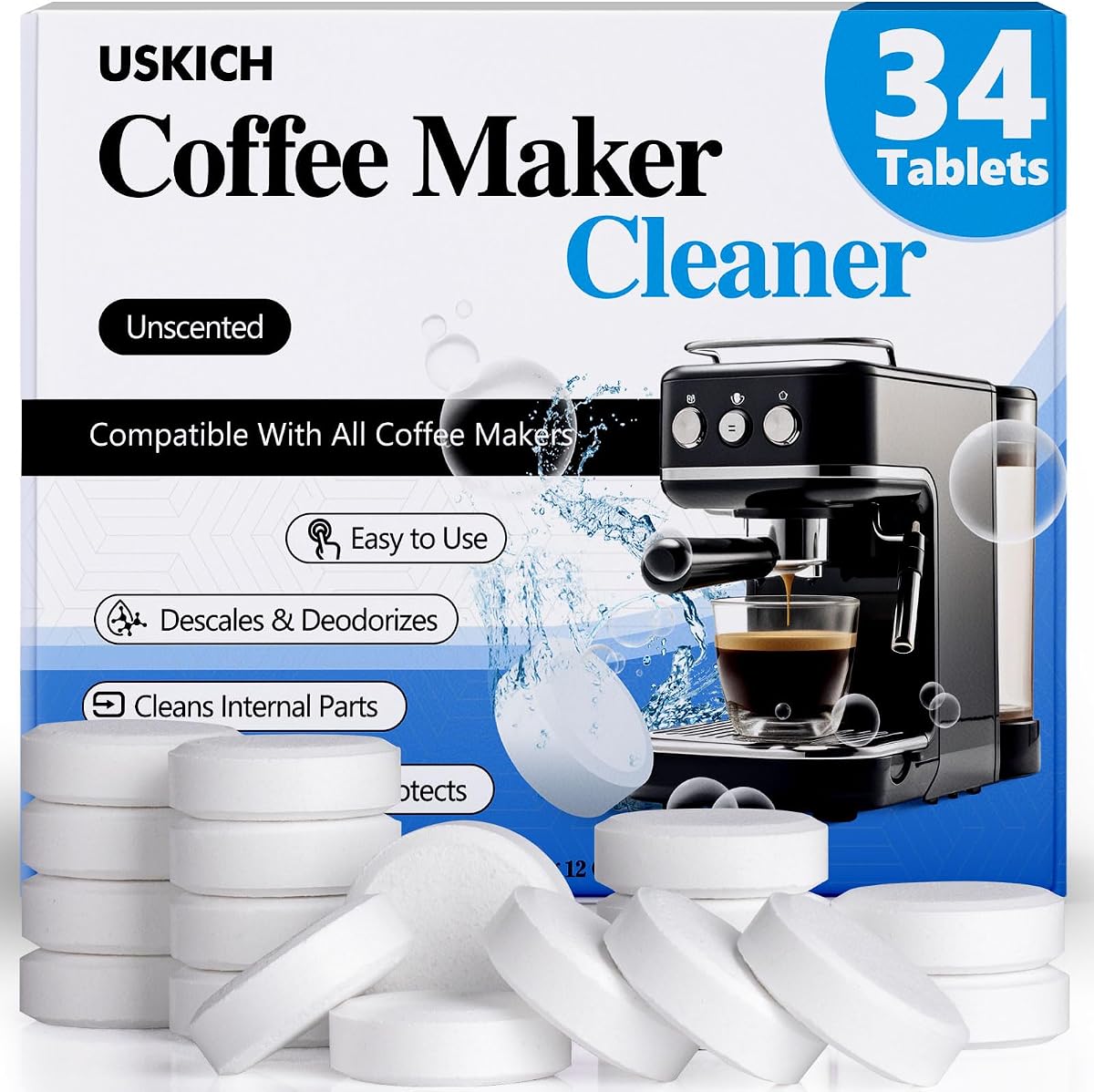
USKICH offers a large 34-tablet package that can represent two years or more of routine cleaning. Its 4.4 rating and substantial count make it appealing for people who want to stock up on a low-fuss maintenance product. Each tablet is designed to address hard-water buildup, calcium, limescale, grime, and oils inside the coffee maker.
We may earn a commission when you buy through this link, at no additional cost to you.
The listed ingredients are PEG 6000, sodium carbonate, citric acid anhydrous, sulfamic acid, and starch. The product is described as a gentle formula, although users with sensitive equipment should still follow manufacturer guidance and avoid using it in ways not permitted by their machine's manual.
Cleaning is direct: drop one tablet into the machine, run the brewing or cleaning cycle, discard the treated water, and then run another cycle with fresh water. The brand lists compatibility with Breville, Keurig, Nespresso Vertuo, Philips, Urnex, Moccamaster, Afresh, Cuisinart, Oxo, De'Longhi, Zojirushi, Verismo, KitchenAid, and other brands.
The standout advantage is the combination of count and compact tablet format. A large package can reduce the need for frequent replenishment, while tablets avoid spilled powder and the dosing uncertainty associated with loose products. The main drawback is that the exact number of maintenance sessions depends on the user's routine, so the stated two-year coverage is a potential rather than a fixed outcome.
With 34 tablets, the package is well suited to households that descale on a regular monthly or similar schedule. The larger count also makes the product less dependent on frequent repurchasing, although the actual number of sessions depends on the user's machine and water conditions.
Tablets contain loose powder in a solid form, avoiding the spill risk of an open powder package. They still need time to dissolve in the reservoir, so users should begin with a full reservoir and allow the tablet to work before starting the rinse cycle.
We may earn a commission when you buy through this link, at no additional cost to you.
Essential Values is a concentrated citric acid descaler for coffee makers, espresso machines, and single-serve brewers. It has a 4.5 rating, placing it among the most highly rated products in this guide. The two-pack includes two eight-ounce bottles and provides four total uses, with each bottle intended for two sessions.
We may earn a commission when you buy through this link, at no additional cost to you.
Its formula is described as odourless, powerful, and capable of penetrating mineral, limescale, and oil deposits. The packaging is made from recyclable PET, adding an environmental consideration to the purchase. Compatibility includes Keurig, Nespresso, Cuisinart, Ninja, Breville, Bunn, and other home coffee equipment.
The process is simple in concept: pour the solution into the water tank and run the machine as directed. The simplicity depends on following the relevant machine instructions because cycle selection and water volume can vary by brewer. Users should not assume that every model should be run for the same number of cycles.
This is a strong option for readers who want a measured liquid with a clear ingredient focus and a moderate four-session supply. The 4.5 rating and absence of a strong vinegar odour make it appealing for routine maintenance, while the multi-brand compatibility provides confidence for mixed-equipment households. It is not the longest-lasting liquid supply in the list, but it is balanced and thoughtfully packaged.
Citric acid is used to help dissolve mineral and limescale deposits inside water-contact components. The formula also targets accumulated oils, which can affect the internal condition of a machine and the character of brewed coffee.
The absence of a strong vinegar odour is valuable in a compact kitchen, where lingering smells can be distracting. The bottle is described as recyclable, offering another point of consideration for environmentally conscious buyers.
We may earn a commission when you buy through this link, at no additional cost to you.
Descaling Powder Solution is a four-use powdered product for Keurig 1.0 and 2.0 machines, home coffee makers, espresso machines, superautomatics, kettles, and garment steamers. Its 4.6 rating is among the strongest in the comparison. It is positioned as an activated scale remover that dissolves quickly in warm water.
We may earn a commission when you buy through this link, at no additional cost to you.
Compatibility is broad, extending beyond Keurig to Nespresso, Breville, Jura, De'Longhi, and other drip and espresso systems. The product also extends to unrelated water-heating appliances, which gives it potential value for users who want one descaler for several devices.
Its key differentiator is the powder format. Powder can be easier to store in small quantities and may be preferred by users who do not want to pour a measured liquid. The trade-off is that the formula must be portioned correctly and dissolved in warm water before it reaches the machine's reservoir.
This product is a good fit for buyers who want an odourless option and value the versatility of a powder. It is also attractive for people maintaining kettles or garment steamers in addition to coffee equipment. The four-use supply is shorter than several bottle-based products, but the focused format and high rating make it a compelling alternative in this list.
The formula is designed to dissolve in warm water, which helps prepare it for the machine's internal water path. Portioning accurately remains important, and the product directions should determine the correct amount for the specific appliance and cycle.
Compatibility with kettles and garment steamers extends the product's potential reach. A single scale-removal format can therefore serve several household appliances that depend on heated water.
We may earn a commission when you buy through this link, at no additional cost to you.
Universal Descaling Solution is a compact liquid cleaner offering two uses, with four ounces required per session. It carries a 4.4 rating and is formulated for single-serve, automatic, and manual coffee makers, including Keurig, Nespresso, De'Longhi, Breville, Ninja, and Hamilton Beach models.
We may earn a commission when you buy through this link, at no additional cost to you.
The product focuses on removing bitter mineral buildup and calcium deposits from heating elements. Its purpose is directly tied to brewing performance, because scale can interfere with water flow and heating. It is also presented as a way to address recurring descale prompts and reduce the potential for clogs and mechanical problems caused by hard water.
An odourless, residue-free rinse formula distinguishes it from traditional vinegar methods. That matters for users who dislike a lingering acidic smell or want to move from descaling back to normal brewing quickly. As with any cleaner, the machine's own instructions should determine which cycle or setting to use.
The short supply is the primary trade-off. Two uses may suit someone testing a new descaler or maintaining one compact brewer occasionally, while frequent users may prefer a larger bottle. Within that limitation, the product delivers a focused proposition: concentrated cleaning, multiple machine types, and an odourless rinse.
Avoiding a strong vinegar aftertaste or smell is a meaningful benefit for households that brew immediately after maintenance. The described easy-rinse formula is designed to support that preference, provided users complete the recommended fresh-water cycles.
Calcium and mineral deposits can restrict the water path and interfere with heating elements. Removing those deposits is intended to help the brewer return to more consistent flow and temperature, although actual results depend on the machine's condition and the user's adherence to the cleaning process.
We may earn a commission when you buy through this link, at no additional cost to you.
De'Longhi EcoDecalk is the highest-rated product in this guide at 4.7. It is a 16.90-ounce descaler formulated with plant-based lactic acid and presented as a safe, effective way to remove limescale and mineral deposits. Its manufacturer heritage in espresso equipment gives the product a clear identity within a category dominated by generic cleaning solutions.
We may earn a commission when you buy through this link, at no additional cost to you.
Although it comes from De'Longhi, the solution is described as compatible with other brands and models, including Breville, Ninja, Philips, and others. The company recommends a hundred-millilitre dose for each descaling process, making the measurement simple and repeatable. Its purpose is to support consistent brewing speed and ideal cup temperature while reducing bitter off-flavours caused by mineral buildup.
The 15-month supply is based on an average household descale frequency of approximately every three months. Actual consumption will vary with water hardness, usage, and the number of machines maintained. The fast-acting, plant-based acid formula is the central technical feature, while the brand's espresso-machine experience supports buyer confidence.
This is the premium selection for readers who value a manufacturer-branded descaler, a high user rating, and a formula positioned as both effective and plant-based. It is a particularly logical choice for De'Longhi owners, although the stated cross-brand compatibility makes it useful more broadly. Follow the instructions for the specific machine, especially when determining cycle sequence and rinse requirements.
The formula uses plant-based lactic acid at a concentration designed to work quickly against limescale and mineral deposits. This gives the product a distinct formulation story compared with conventional vinegar or citric-acid descalers.
Coming from a company focused on espresso machines, EcoDecalk is positioned around brewing speed, temperature consistency, crema, and flavour preservation. It also states compatibility with several non-De'Longhi brands, expanding its relevance to mixed coffee-equipment households.
We may earn a commission when you buy through this link, at no additional cost to you.
The Tillbrook Keurig Coffee Machine Compatible Descaler provides a 16-ounce bottle with four cleaning sessions. It has a 4.4 rating and is described as an all-natural solution for removing hard-water buildup, oils, and residue. The product is made in the USA and is intended for use every three to four months.
We may earn a commission when you buy through this link, at no additional cost to you.
Its compatibility is extensive, covering Keurig, Breville, Nespresso, De'Longhi, espresso machines, K-cup brewers, Hamilton Beach, Braun, Bunn, Vertuo, Gaggia, Smeg, Ninja, Philips, Cuisinart, Oxo, Tassimo, Krups, and Saeco. It is also suitable for automatic, manual, pod, capsule, cup, filter, commercial, and cappuccino machines, as well as kettles and tea makers.
The directed routine uses a four-ounce dose, followed by filling the reservoir and running the machine. Users are instructed to repeat with clean water two more times for a thorough cleanse. That requirement makes the process more involved, but it reflects the product's focus on removing both scale and residue without leaving cleaning solution behind.
This option makes sense for a household with several different brewing appliances or for a Keurig owner who values broad compatibility. The four-use bottle is also positioned as a one-year supply based on regular maintenance. Buyers should choose machines compatible with their brewer's cleaning cycle and follow both the machine and product instructions.
The compatibility list spans pod, capsule, drip, espresso, manual, automatic, commercial, and cappuccino equipment. Buyers with several water-heating appliances may be able to consolidate their scale-removal supplies around a single liquid formula.
The recommended method includes the cleaning cycle and two fresh-water cycles. That extra rinsing is intended to remove residue thoroughly, which can be especially useful for machines that accumulate coffee oils as well as mineral scale.
We may earn a commission when you buy through this link, at no additional cost to you.
Coffee Maker Cleaner Tablets provides 25 individually wrapped tablets intended to support routine cleaning for up to a year. It has a 4.4 rating and works as both a descaler and cleaner, targeting limescale, mineral buildup, and coffee-oil residue during the cleaning cycle.
We may earn a commission when you buy through this link, at no additional cost to you.
Compatibility includes Keurig, Nespresso, Ninja, Breville, De'Longhi, drip brewers, pod machines, and espresso makers. The individual wrapping helps keep unused tablets sealed and makes it easy to take only the number needed for the next maintenance session, which is especially convenient in a humid kitchen or a compact storage area.
The process is uncomplicated: place one tablet into a full water reservoir, allow it to dissolve, run a brew cycle, and complete the recommended rinsing procedure. Because the machine must run water through its internal path, the method depends on the brewer having a suitable brew or cleaning cycle.
This product is well suited to users who prefer individually portioned maintenance supplies and want both scale and oil removal in one step. The 25-tablet count offers a strong balance of storage convenience and routine coverage. It ranks last in this guide only because the comparison includes several longer-lasting liquid and tablet options, not because it lacks meaningful features.
Each sealed tablet is ready to use, eliminating liquid measurement and loose powder. Individually wrapped units also remain separated, which supports convenient storage and helps protect tablets that will not be used immediately.
The formula is described as dissolving both mineral deposits and coffee oils. Combining the two cleaning tasks in one cycle can simplify maintenance, although thorough rinsing remains important for machines that repeatedly heat water.
We may earn a commission when you buy through this link, at no additional cost to you.
Choosing a descaler involves balancing brewer compatibility, active ingredient, cleaning format, rinsing requirements, and the frequency at which you want to perform maintenance. The best product is one your machine can use safely and that you will be comfortable using consistently.
Start with the brewer manual rather than relying only on broad words such as universal or compatible. Look for the maker's approved cleaning method and confirm whether the machine has a dedicated descaling cycle, whether a brew cycle can be used, and whether capsules, pods, standard filter baskets, or the water reservoir require separate attention. A descaler that is ideal for a drip machine may not be appropriate for every espresso, super-automatic, kettle, or garment steamer. Several options in this guide explicitly cover multiple machine categories, including Keurig, Nespresso, Breville, De'Longhi, Ninja, Hamilton Beach, Cuisinart, Philips, and others, but brand and model names can still vary in how they perform a cleaning cycle.
Liquid concentrates are easy to measure and can serve several appliances, but they require storage in a bottle and may need careful dosing. Powders can dissolve readily in warm water and may be more flexible for kettles or garment steamers, although portioning and mixing must be handled carefully. Tablets provide a premeasured, low-mess option with strong shelf organization, but users must allow enough time for the tablet to dissolve before the machine draws water through. A brewer with a warm-water or rinse cycle may suit powder particularly well, while a simple drop-and-brew routine may favour tablets. Liquids are often attractive when one product needs to service several machine types.
The active ingredient helps determine how a descaler approaches mineral deposits. Citric acid appears in several products in this comparison and is widely used for scale removal. The De'Longhi option instead uses plant-based lactic acid, while one tablet product lists citric acid anhydrous and sulfamic acid among its ingredients. Formula wording such as all-natural should not be treated as permission to skip dilution, rinsing, or compatibility checks. Compare the product's intended use with your machine's guidance, and pay attention to claims about limescale, calcium, oils, and residue because each describes a slightly different cleaning objective.
Every descaling process should end with clean water, and some products call for more than one additional rinse. Products that target coffee oils as well as scale may benefit from thorough flushing because oils can remain in the reservoir, tubing, brew basket, and other internal areas. Check the recommended number of cycles, and pay particular attention when using a pod or single-cup machine that may not rinse the entire path in one run. Allow enough time for tablets to dissolve and for liquid concentrate to mix evenly. Completing every rinse is more important than trying to save a few minutes, since leftover cleaning solution can affect the next brewing cycle.
The number of uses is more useful than the package size alone. Four-use liquids may suit one brewer maintained on a strict quarterly schedule, while eight-use bottles can be more practical for multiple machines or less frequent purchases. Tablet counts are best evaluated against a monthly routine: a 24-count package can cover up to a year, while larger counts may extend beyond that if the machine is cleaned consistently. Remember that a manufacturer-provided estimate assumes a certain frequency. Hard water, heavy use, and multiple appliances can shorten that timeline, while a carefully maintained single brewer may use a smaller supply for longer.
Storage needs vary significantly. A large liquid bottle is easy to use but requires an upright, leak-conscious place away from children and food-preparation areas. Powder should be kept sealed and dry to prevent clumping or accidental spills. Tablets are often the most compact and organized option, particularly when individually wrapped, but they still need a dry storage area. Consider how you will measure a liquid, whether your reservoir accepts the recommended water volume, and whether the packaging is easy to handle with wet hands. Good storage makes a descaling routine more likely to be completed consistently rather than postponed.
Directions should state the dose, water level, cleaning cycle, number of rinses, and any machine-specific precautions. The ACTIVE product provides separate guidance for single-cup and multi-cup machines, which is useful because their cleaning paths differ. Other products instruct users to add solution to the reservoir, run the machine, discard the water, and rinse again. Clear instructions do not replace the machine manual, but they can make the process easier to understand. Look for a product that explains what to do if the machine has a descale indicator or requires repeated activation during cleaning.
A useful descaler should address scale buildup that can interfere with flow and heating while also addressing residue that affects the internal condition of the machine. Many products in this guide make that connection explicitly, linking routine descaling to more consistent water temperature, reduced off-flavours, and potentially longer component life. A higher rating can help indicate general user satisfaction, but it cannot guarantee the same result in every water system. Proper use, regular timing, and complete rinsing are essential. The goal is not merely to silence a warning light; it is to remove deposits before they restrict performance or contribute to corrosion.
Begin by reading both the coffee maker manual and the descaler instructions. Remove or empty the water reservoir, discard old water, and check whether the brewer includes a dedicated descaling cycle. If it does not, confirm that a brew cycle can be used for cleaning. For tablets, fill the reservoir with clean water and allow the tablet to dissolve fully. For liquid solutions, measure the specified amount before adding it to the reservoir, then fill with water to the required level. For powder, dissolve the measured amount in warm water before pouring it into the reservoir. Never improvise a dose when the machine instructions specify one.
Run the cleaning cycle recommended for the machine. Single-cup and pod brewers may require more than one large-cup cycle because a small brew does not move enough water through every internal passage. Multi-cup drip machines may need one large brew cycle, while espresso or super-automatic machines may have their own sequence. Do not drink the cleaning water. After the treated cycle, empty the reservoir and inspect areas such as the brew basket or capsule holder for loose residue if the instructions advise it. Wipe or rinse removable parts only when the manufacturer permits it, since some materials are not suitable for immersion.
Finish with the specified number of fresh-water cycles. This final rinsing stage removes remaining descaler and loosened residue, and it is particularly important after using a formula intended to clean coffee oils. Once the machine is rinsed, refill the reservoir with fresh water and run a normal beverage if the directions call for it. Keep the brewer dry when it is not in use, empty the reservoir after the day, and continue to follow the manufacturer's guidance on filter replacement and routine cleaning. If a descale light returns sooner than expected, review water hardness, usage frequency, and whether the full cleaning and rinse sequence was completed.
Many manufacturers recommend descaling every three to four months, although usage and water hardness can change the interval. Hard-water areas, frequent brewing, or multiple daily cups may require more regular maintenance. Follow the machine maker's schedule when it differs from the product guidance. Descaling should be performed when the scale alert appears, brewing slows, or the coffee develops an unusual taste.
Neither format is inherently better for every situation. Tablets are premeasured, compact, and easy to store, while liquids offer flexible dosing and can serve several compatible appliances. Powder is useful when warm water is available for dissolving. The best choice depends on your machine's approved cleaning method, storage space, and how consistently you want to complete the rinsing process.
Many descaling solutions in this guide state compatibility with several major brands, including Keurig, Nespresso, Breville, and De'Longhi. Even so, you should check the exact model in your machine manual and read the descaler directions before use. Compatibility does not mean every model uses the same cycle, dose, or number of rinse cycles.
The cleaning cycle loosens scale, oils, and other residue but may leave some material in the reservoir, tubing, brew basket, or heating path. Fresh-water cycles carry that material out of the machine. Following the specified rinse count is especially important when using a cleaner that targets coffee oils, because lingering solution or residue can affect the next cup.
Descaling can improve taste by removing mineral deposits that interfere with water flow and heating and by cleaning the internal brewing path. A machine that cannot reach its intended temperature or distribute water properly may produce bitter, weak, or otherwise unusual coffee. Results vary with the level of buildup, and a clean descaler cannot compensate for a separate bean, roast, or brewing problem.
Vinegar is a common household alternative, but it may leave a strong odour, require repeated rinsing, and be unsuitable for certain components or machine manufacturers' instructions. Several products in this comparison specifically promote odourless or residue-free alternatives. Using a purpose-formulated descaler while following the brewer's manual is generally the more controlled approach.
First confirm that every required cleaning and fresh-water cycle was completed. Check the reservoir, filter, brew basket, and other accessible areas for trapped residue, and verify that the correct cleaning mode was used. If the message remains, consult the machine manual for a reset or sensor procedure, as some indicators require an additional acknowledgement after maintenance.
It is safe when the descaler is explicitly compatible with the espresso machine and used according to both sets of instructions. Some machines use a dedicated descale cycle, while others require several brew or rinse cycles. Do not use an acidic household substitute unless the manufacturer permits it, and never leave cleaning solution in the machine after completing the prescribed rinses.
The IMPRESA two-pack stands out as the most well-rounded option because it combines four cleaning sessions with an unusually broad list of compatible machines and appliances. Coffee Maker Cleaner & Descaler Tablets offer an organized, easy-to-store alternative for people who prefer premeasured monthly maintenance, while De'Longhi EcoDecalk is the premium pick for its high rating, manufacturer-backed positioning, plant-based lactic acid formula, and extensive household supply.
The most important buying priorities are compatibility with the exact machine, a format you can store and handle conveniently, and a routine you can realistically maintain. Follow the product's dosage instructions, use the correct machine cycle, and complete every fresh-water rinse. A larger supply is useful for multiple appliances, but the best descaler is ultimately the one you understand well and use consistently.
Features, machine guidance, ratings, and current prices can change over time, so readers should verify the latest information on the linked product page before purchasing. Comparing the product's stated compatibility with the coffee maker manual is the final safeguard against choosing a cleaner that is not suitable for the appliance or the user's preferred maintenance routine.