
EP 6 Ft Heavy Duty Appliance Extension Cord
4.8Editor score
ETL-listed 14 AWG construction
Space-saving flat three-prong plug
Fifteen-amp, 1875-watt capacity
Discover the best refrigerator extension cord options by comparing length, wire gauge, grounded plugs, safety certifications, space-saving designs, and
A refrigerator extension cord must do more than bridge the gap between an appliance and an outlet. It needs adequate wire gauge, a grounded three-prong connection, dependable insulation, and enough length for the cord to be routed without creating a trip hazard. The right model can also sit neatly behind a refrigerator in a tight alcove.
This guide compares ten refrigerator extension cords across important criteria such as conductor size, length, plug design, electrical rating, certification, flexibility, and resistance to moisture, abrasion, and sunlight. The list includes compact options for close wall connections, longer cords for distant outlets, and heavy-duty models for refrigerators, laundry equipment, and other major appliances.
Each pick reveals how a particular cord fits common household and workshop situations, while the comparison table makes the technical differences easier to scan. Product details, ratings, and availability can change over time, so readers should verify the current listing and the appliance manufacturer's electrical requirements before purchasing.
4.8Editor score

4.8Editor score

4.8Editor score
The following comparison organizes all ten cords by their most useful differences, including reach, wire size, grounding, certification, and low-profile plug construction. Every option is designed for 125-volt, 15-amp service, but their lengths and physical features suit different installation needs.




This six-foot heavy-duty appliance extension cord is a strong all-around choice when a refrigerator sits only a modest distance from its wall outlet. Its 4.8 rating reflects a favorable customer history, and the product's most convincing attributes are its 14-gauge construction, three-prong grounding, UL listing, and angled flat plug. Those details make it more purpose-built for major appliances than a lightweight household extension cord.
We may earn a commission when you buy through this link, at no additional cost to you.
The 14-gauge conductors are rated for 15 amps, 125 volts, and as much as 1875 watts, giving the cord substantially more capacity than thinner general-purpose wires. Heavy-duty vinyl insulation adds protection and flexibility, while the angle plug allows the connector to remain flush against a wall. That geometry is especially useful behind refrigerators, washers, dryers, and other equipment positioned close to cabinetry.
The main limitation is reach. A six-foot cord works well when the outlet is nearby, but it offers less routing flexibility than the 10-, 15-, or 25-foot alternatives in this list. Users should also avoid assuming that the stated wattage rating means every connected device will draw the maximum; actual load depends on the refrigerator's compressor, the cord condition, ambient conditions, and local electrical requirements.
This is a strong recommendation for compact kitchen layouts, laundry rooms, and appliance nooks where minimizing excess cable is important. Buyers seeking maximum reach can move up to a longer model, while those who want the shortest option can consider the three-foot cord. For a typical refrigerator installation at a close outlet, however, this model offers the most balanced combination of capacity, certification, and compactness.
The right-angle plug is especially valuable behind refrigerators and other tightly positioned appliances. It reduces the gap created by a projecting connector, helping the appliance sit closer to the wall without forcing the plug sideways.
Its 14-gauge wire and 1875-watt capacity are better aligned with refrigerators and other major appliances than thinner cords. The three-prong configuration also maintains a grounding path when the appliance connector permits it.
We may earn a commission when you buy through this link, at no additional cost to you.
The EP six-foot appliance extension cord combines a useful balance of capacity, space-saving construction, and straightforward utility. Its 4.8 rating indicates strong customer reception, while its ETL listing, 14 AWG wire, and 1875-watt capacity make it suitable for refrigerators, washers, dryers, and air conditioners. The flat three-prong plug is the feature that gives it a practical edge in crowded rooms.
We may earn a commission when you buy through this link, at no additional cost to you.
The cord is described as flexible, with a durable vinyl jacket that resists moisture, abrasion, and sunlight. Reinforced insulation and a robust overall construction add confidence for routine appliance use. Its length is short enough to minimize tangled excess cable, yet long enough to provide meaningful placement flexibility around an outlet. This makes it a sensible middle ground between the three-foot and ten-foot choices.
As with any extension cord, resistance to moisture is not the same as permission to leave it submerged, exposed to severe weather, or in a continuously damp location. The rating should never be exceeded, and the refrigerator should be connected directly to a properly grounded wall receptacle whenever one is available. Six feet may also prove too short for a relocated outlet or an alcove with an unusual layout.
This cord is best for buyers seeking a dependable everyday refrigerator extension without paying for unnecessary length. Its combination of ETL certification, heavy gauge, grounded flat plug, and flexible jacket makes it the strongest budget-oriented pick in the group. It also has enough capacity for other major household appliances, making it a versatile addition to a utility room or kitchen.
A flat three-prong plug takes up less space than a bulky projecting connector, allowing furniture and appliances to remain close to the wall. It is particularly helpful in narrow kitchen and laundry layouts.
The flexible vinyl covering is designed to tolerate bending, abrasion, sunlight, and moisture exposure during normal use. That flexibility also makes the six-foot cord easier to fold, route, and store.
We may earn a commission when you buy through this link, at no additional cost to you.
The Vockjour ten-foot extension cord offers a useful amount of reach without moving into the much longer 15- and 25-foot options. It carries a 4.8 rating and is built around 14 AWG, three-conductor construction, a low-profile flat plug, and a 15-amp, 125-volt capacity. For a refrigerator placed a little farther from its outlet, those features provide more placement freedom than a three- or six-foot cord.
We may earn a commission when you buy through this link, at no additional cost to you.
Pure copper wire cores and a durable PVC jacket are standout construction details. The listed attributes also include reduced voltage drop, efficient power delivery, and protection against wear. A useful compatibility feature is the female connector's ability to accept both three-prong and two-prong plugs, although users should still connect the cord through the most appropriate grounded path available.
Ten feet can be too much for a close outlet, and excess cable should be coiled rather than left in a walking path. The white jacket may be visually noticeable in a dark utility area, and the low-profile plug should not be confused with a right-angle design in every installation. It also remains subject to the stated 1875-watt limit.
This is a well-rounded choice for medium-distance refrigerator connections, home offices, and general appliance use. The combination of copper conductors, flexible construction, ETL certification, and a useful length makes it a strong alternative when six feet is too short but fifteen feet would create unnecessary slack.
Ten feet provides enough reach to reposition a refrigerator or connect equipment around a room's edge. The extra distance is most valuable when the nearest outlet is partially obstructed or slightly off-center.
The female end supports both three-prong and two-prong plugs, making the cord useful for varied household equipment. Grounded three-prong appliances should still use the available grounding connection whenever possible.
We may earn a commission when you buy through this link, at no additional cost to you.
This fifteen-foot appliance extension cord is a strong premium pick for installations where the wall outlet is a substantial distance from the refrigerator. It has a 4.8 rating, a 14 AWG conductor, a 15-amp rating, and 1875 watts of capacity. The useful distinction is not a new electrical rating but the combination of substantial reach with thoughtful handling features.
We may earn a commission when you buy through this link, at no additional cost to you.
A 90-degree angle plug allows the connector to sit flush against the wall, improving access behind bookshelves, desks, furniture, and large appliances. Grip grooves on the female end are a practical addition because appliance plugs can be difficult to remove, especially when positioned in a tight space. The heavy-duty vinyl is described as soft, flexible, and easy to fold, which makes a longer cord less cumbersome.
The primary tradeoff is cable management. A fifteen-foot cord may be ideal for a distant outlet but excessive for an adjacent one, so excess length must be secured carefully. Users should never use the flexibility of this cord to create a taut connection or route it across an unattended walkway. Its 1875-watt limit also governs any additional connected equipment.
This model is recommended for kitchens, laundry rooms, workshops, and homes where the outlet location cannot be changed easily. Compared with the six-foot choices, it provides much more routing freedom; compared with the twenty-five-foot model, it is easier to control. That balance makes it a particularly versatile premium selection for refrigerator extension use.
The longer length solves routing problems when an outlet is behind an appliance, around a room corner, or farther from the refrigerator than a short cord can accommodate. It offers flexibility without reaching the extreme length of the 25-foot option.
Textured grooves make the female connector easier to grasp and disconnect. This is especially useful for heavy appliances and installations where hand access to the plug is limited.
We may earn a commission when you buy through this link, at no additional cost to you.
The EP fifteen-foot model gives refrigerator owners more freedom to work around awkward outlet positions. It has a 4.8 rating, ETL listing, 14-gauge wire, and a 15-amp, 125-volt capacity rated to 1875 watts. Its flat three-prong plug is designed to sit closely against the wall, an important advantage behind full-size appliances.
We may earn a commission when you buy through this link, at no additional cost to you.
The flexible vinyl covering is built to resist moisture, abrasion, and sunlight, while reinforced insulation supports long-term durability. Its length can be valuable in a kitchen with a distant outlet, a laundry room with a centrally placed receptacle, or a workshop where equipment must reach an outlet around shelving. The white finish may blend well with light-colored walls and cabinetry.
As with other long cords, the greatest practical risk comes from poor routing. Excess length should be secured along a wall or behind the appliance rather than left in a walkway. The cord should also be inspected regularly and replaced if the jacket, plug, or conductor shows damage. Its stated capacity is a limit, not a target.
This is a good recommendation for users who need more reach than a ten-foot model but prefer the reinforced construction and white appearance of this EP option. It is versatile enough for refrigerators, washers, dryers, and air conditioners, provided the connected load remains within the listed electrical rating.
Reinforced insulation adds a useful layer of mechanical protection around a cord that may be repeatedly bent, routed behind an appliance, or handled during cleaning. It supports dependable use without changing the basic electrical rating.
Fifteen feet can make a refrigerator connection possible when moving the appliance is impractical. Route the cable along the wall and behind the appliance to keep the added length controlled.
We may earn a commission when you buy through this link, at no additional cost to you.
The Elecan four-foot cord is built for the situation where a refrigerator outlet is only slightly out of reach. Its 4.8 rating is supported by a focused set of features: 14 AWG construction, three-prong grounding, a low-profile flat plug, and ETL certification. The short length is intentional, helping users minimize excess cable in close quarters.
We may earn a commission when you buy through this link, at no additional cost to you.
Compared with thinner 16 AWG cords, the 14-gauge conductors are better suited to larger current demands. The stated capacity is 15 amps, 125 volts, and 1875 watts, with the manufacturer explicitly reminding users not to exceed that limit. A high-temperature-resistant design and heavy-duty vinyl insulation add practical protection for household, garage, and professional environments.
Four feet leaves little room for repositioning the refrigerator or navigating a deep cabinet cavity. Buyers should measure the intended path before ordering, including the depth required behind the appliance and the position of the wall outlet. Moisture resistance should not be interpreted as permission for prolonged wet-weather exposure, and the product's warranty is relevant only within its stated terms.
For a nearby outlet and a tight installation, this is a focused and useful model. It is less suitable for distant outlets, but its short length reduces excess-cable clutter. The low-profile grounded design, heavy gauge, and certification make it a sensible compact pick for refrigerator nooks and other major-appliance spaces.
At four feet, the cord provides just enough additional reach for many close installations without creating a large coil. That makes it useful when tidiness is as important as appliance access.
The flat three-prong plug and cable help the refrigerator sit nearer the wall. The grounded configuration is also preferable for major appliances whenever the refrigerator's plug accommodates it.
We may earn a commission when you buy through this link, at no additional cost to you.
This blue six-foot cord stands out because it uses 12 AWG conductors rather than the more common 14 AWG wire found across most of the list. With a 4.8 rating, ETL listing, 15-amp capacity, and a right-angle flat plug, it is a compelling option for buyers who prioritize conductor thickness, easy identification, and compact routing.
We may earn a commission when you buy through this link, at no additional cost to you.
The product includes caution tape intended to mark where the extension cord is located, which can help reduce tripping or accidental contact in busy areas. Its blue molded plug provides visual identification in low light, while the SPT-3 flat three-core cable allows it to run behind refrigerators, desks, and kitchen furniture. The plug is described as approximately 0.94 inches at its thickest point.
The tradeoff is size and weight. A 12-gauge cable is thicker than a 14-gauge model, so it may be less convenient for folding or carrying even over only six feet. The stated 15-amp and 1875-watt rating should still be respected, and high-temperature resistance does not make the cord immune to damage. Warning tape is useful only when it is placed where someone can actually see it.
This cord is well suited to kitchens, garages, workshops, and high-traffic areas where visibility and robust construction matter. It is especially attractive for a refrigerator installation near a wall or floor edge because of the right-angle plug. Buyers seeking the absolute lightest or most compact six-foot option may prefer a conventional 14-gauge model instead.
The 12-gauge wire is thicker than 14-gauge alternatives and is intended for high-power appliances and tools. It can be a reassuring choice for a refrigerator with a demanding compressor load.
The blue plug and included caution tape make the cord easier to identify. These features are especially helpful in garages, workshops, kitchens, and other areas where cables may cross routine traffic paths.
We may earn a commission when you buy through this link, at no additional cost to you.
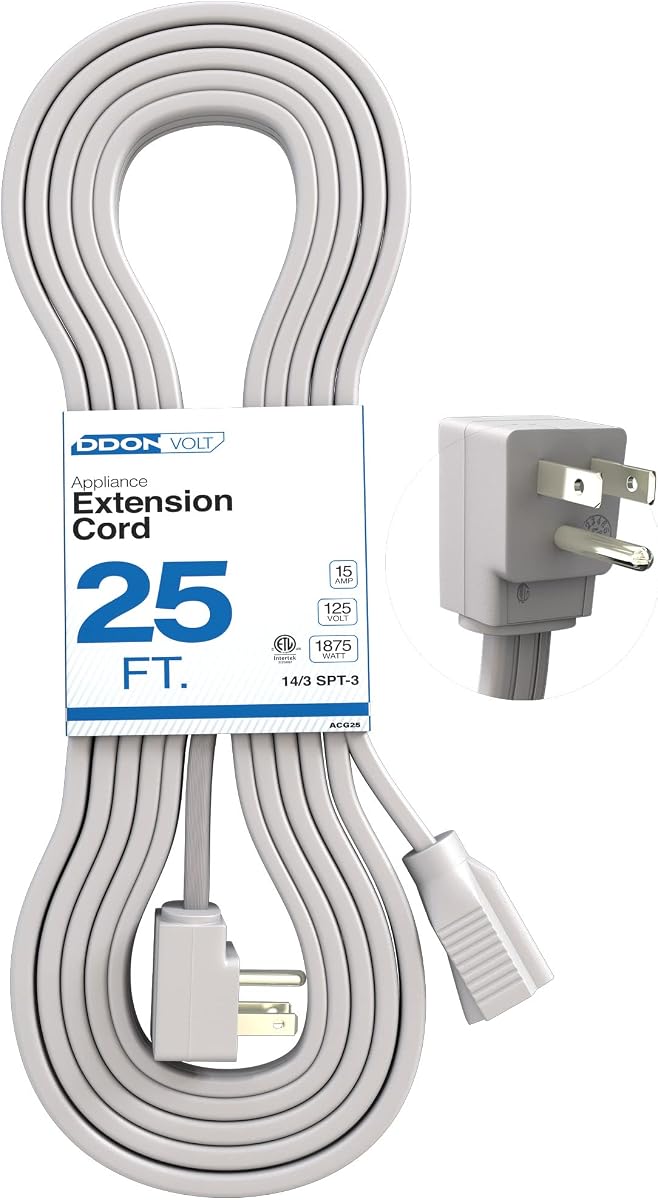
The 25-foot appliance extension cord is the reach-focused option in this comparison. It has a 4.8 rating, 14 AWG wire, a 15-amp rating, and 1875 watts of capacity, but its defining characteristic is distance. It suits installations where the refrigerator's outlet is far away, the appliance cannot be moved, or the cord must reach around several obstacles.
We may earn a commission when you buy through this link, at no additional cost to you.
Like the related 15-foot model, it uses a 90-degree angle plug that remains close to the wall. Grip grooves on the female connector make the appliance plug easier to grasp, while the heavy-duty vinyl is described as durable, resilient, soft, and flexible. Those handling details help offset the practical inconvenience of carrying a long extension cord.
A twenty-five-foot cord requires the most disciplined routing. It should be secured along walls, under appropriate cable covers, or behind fixed furniture rather than stretched across a doorway or walking area. Long runs also make it harder to keep excess length organized. The cord remains limited to 1875 watts, and the manufacturer's allowance to link other extension devices should never be treated as permission to exceed that aggregate limit.
This is the best choice when distance is the primary obstacle and there is no practical way to relocate the outlet. It can also serve larger equipment positioned in workshops or utility spaces. For most standard refrigerator installations, however, the 15-foot model is easier to manage, while shorter cords are preferable when the outlet is close.
Twenty-five feet provides exceptional placement flexibility when an outlet is distant or obstructed. It can spare users from moving a heavy refrigerator or changing an inconvenient outlet position.
The right-angle wall plug and grooved female connector address two common installation problems. They reduce wall protrusion and make heavy plugs easier to remove in confined spaces.
We may earn a commission when you buy through this link, at no additional cost to you.
The HUANCHAIN six-foot black extension cord combines heavy-duty specifications with a flexible, space-saving form. It has a 4.8 rating, ETL listing, 14 AWG conductors, and a 15-amp, 125-volt capacity of 1875 watts. Its SJTW construction and stated resistance to water, corrosion, temperature, and aging make it versatile for home and office environments.
We may earn a commission when you buy through this link, at no additional cost to you.
A particularly useful detail is the reinforced strain relief at the plug end, which the manufacturer says passed 65,000 angle-bending tests. The cable's flat three-prong plug is designed to reduce the gap between the connector and wall, allowing sofas, desks, cabinets, nightstands, and similar furniture to sit closer without damaging the plug.
The listing describes the cord as suitable for indoor and outdoor use, but buyers should still protect it from standing water, severe weather, physical damage, and improper extension connections. The stated 1875-watt capacity is the maximum, while the overload test and high-voltage test are manufacturer claims rather than a reason to exceed the published rating. Six feet may also be too short for some room layouts.
This model is a good selection for compact installations and users who value flexible handling and strain relief. The black color can be less conspicuous than white or blue in a dark utility space, while the six-foot length keeps extra cable manageable. It also has enough capacity for refrigerators and other major household appliances.
The extended strain-relief design helps protect the connection where bending usually occurs. That is valuable when the plug is plugged and unplugged repeatedly or routed tightly behind furniture.
SJTW vinyl provides a flexible jacket with stated resistance to moisture, corrosion, high temperatures, and aging. It remains best protected from standing water and extreme outdoor exposure.
We may earn a commission when you buy through this link, at no additional cost to you.
The EP three-foot cord is the most compact option here and works best when the refrigerator is positioned only inches or a few feet from an outlet. It has a 4.8 rating, 14-gauge wire, a three-prong flat plug, and a 15-amp, 125-volt capacity. Its purpose is simple: provide a short, sturdy connection without adding a large amount of loose cable.
We may earn a commission when you buy through this link, at no additional cost to you.
ETL listing, reinforced insulation, and a flexible vinyl jacket support the heavy-duty positioning. The jacket is described as resistant to moisture, abrasion, and sunlight, while the flat plug helps the appliance sit closer to the wall. These features make the cord viable for refrigerators, washers, dryers, air conditioners, and other large household appliances.
Three feet is the principal limitation. A deep refrigerator cabinet, baseboard, thick flooring, or a slightly offset outlet can consume most or all of that distance. Users should measure the actual path and include the room needed to bend and connect the plugs. As with every model here, the stated capacity must not be exceeded.
This cord is best for compact, close-range installations where minimizing excess cable is more important than flexibility. The black finish is unobtrusive and the short length is easy to manage. If the outlet is farther away, stepping up to a six- or ten-foot model will usually produce a less frustrating installation.
A three-foot length is useful when a wall outlet is very close to the refrigerator. It reduces the excess cable that can collect behind the appliance, making cleaning and appliance movement easier.
Despite its short length, the cord retains 14-gauge wire, a grounded three-prong plug, ETL listing, and reinforced insulation. The key consideration is fit, not reduced electrical capacity.
We may earn a commission when you buy through this link, at no additional cost to you.
Choosing a refrigerator extension cord starts with the appliance's electrical needs, the distance to the outlet, and the available installation space. The following factors help narrow the field without overlooking important safety details.
A refrigerator is a major appliance, and its compressor can require considerably more current than small electronics. Look for a cord with 14 AWG or thicker conductors, a 15-amp rating, 125-volt compatibility, and a stated capacity of 1875 watts. These specifications provide a much better match for refrigerators than lightweight 16-gauge household cords, especially when the compressor cycles on after the appliance has been sitting idle.
Do not measure only the straight-line distance from the outlet to the refrigerator. Include the space behind the appliance, baseboard clearance, outlet location, plug bend, and the route around a wall or cabinet. Add enough slack to connect without strain, but choose the shortest practical length that completes the route. Three and four feet suit very close installations, six and ten feet provide moderate flexibility, and 15 or 25 feet address distant outlets.
A three-prong extension cord is the preferred choice for a grounded refrigerator because it maintains the grounding path where the appliance and receptacle permit it. The female end should accept the refrigerator's three-prong plug securely, and the male plug should fit the wall outlet without forcing or altering the angle. Never bend a plug's prongs, remove its grounding pin, or use an adapter that leaves the outlet ungrounded.
A flat or right-angle male plug is valuable in kitchens and laundry rooms where the refrigerator sits close to the wall. It reduces the space taken up by the connector and can prevent the cord from being pushed sideways. Buyers should still confirm that the plug fits the outlet and that the refrigerator's power cable can bend naturally into the available clearance. A low-profile plug is useful, but it should never be forced.
UL or ETL listing provides useful evidence that the cord has been evaluated by an independent safety organization. In this list, several models carry ETL listing and the top-ranked option is UL listed. Certification does not eliminate the need for proper use, but it is a meaningful differentiator when comparing otherwise similar appliance cords. Inspect the cord for damage and discontinue use if the jacket, conductors, or plug show faults.
A flexible vinyl jacket is easier to route, fold, and position behind an appliance. Heavy-duty or SJTW-style jackets are also described as resistant to moisture, abrasion, sunlight, corrosion, and aging. These qualities help in garages, workshops, kitchens, and laundry rooms, although no jacket makes a cord immune to standing water, crushing, chemicals, or severe weather. Route the cord where it will not be pinched or walked over.
Long cords and darker colors can disappear behind furniture or walls, creating trip risks. A blue cord, caution tape, or a darker jacket can improve visibility depending on the room. Secure excess length along walls, behind furniture, or under a suitable cable cover, and never leave it across a doorway, stairway, or primary walking route. Good cable management is as important as selecting the correct electrical rating.
Some listed products allow connection to another cord, power strip, or surge protector, but that permission does not increase the original cord's capacity. The combined load must remain within the lowest applicable limit, and voltage drop can become problematic with long or undersized connections. For a refrigerator, a single properly rated cord connected directly to a grounded wall receptacle is generally easier to manage than a chain of components.
Before connecting the cord, confirm that the refrigerator's plug fits the extension's female connector and that the male plug fits the wall receptacle without force. Confirm that the cord's voltage, amperage, and wattage ratings cover the appliance's requirements. Connect the refrigerator to the extension cord while it is unplugged, then plug the extension cord into a grounded wall outlet.
Route the cable where it will not be pinched beneath the refrigerator, pulled by the appliance door, exposed to moisture, or crossed by furniture wheels. Keep plugs and receptacles dry, avoid tightly coiling a cord while it is carrying a heavy load, and do not use the cord as a handle for moving the refrigerator. The refrigerator should remain upright and have adequate ventilation for heat dissipation.
Inspect the cord periodically for cuts, cracks, discoloration, soft spots, exposed conductors, loose prongs, or heat damage. Unplug it if any of these signs appear, and replace a damaged cord rather than repairing its insulation. Store the cord loosely in a dry location when it is not in use, and never overload the connection or daisy-chain additional devices beyond the manufacturer's stated limits.
A 14 AWG extension cord is a common practical choice for a refrigerator because it is rated for 15 amps and up to 1875 watts on a 125-volt circuit. A 12 AWG model offers an additional conductor-size margin. Always confirm that the refrigerator's manufacturer permits an extension cord and that the cord's listed rating is not exceeded.
A properly rated, undamaged cord can provide a safe temporary connection when no suitable outlet is available, but it is generally better to install a properly located grounded receptacle. A refrigerator compressor runs for long periods, and permanent use deserves an outlet positioned for safe connection and proper cord management. Check local electrical requirements before modifying a receptacle.
The best length is the shortest one that reaches the outlet without strain. Measure behind the appliance and around baseboards or cabinets, then add enough slack for both plugs to sit naturally. Three- or four-foot cords work for close outlets, while 10- to 25-foot models suit more distant arrangements.
Some extension cords have female connectors that accept either two- or three-prong plugs, including the Vockjour model in this guide. Even then, use the appropriate grounding path whenever the refrigerator and wall outlet support it. A three-prong cord cannot be safely grounded into a standard two-slot receptacle by simply forcing it into the opening.
The 1875-watt figure is the cord's maximum listed capacity at 125 volts and 15 amps. It is not an instruction to run a refrigerator and other appliances at that total load. Connect only equipment whose combined demand falls within the cord and circuit limits, and never exceed the rating stated in the product listing.
A flat or right-angle male plug can be better in a tight installation because it reduces the gap between the outlet and the wall. It is especially useful behind refrigerators and furniture positioned close to baseboards. The plug must still fit properly and should not require excessive bending or force.
No. Running an extension cord under a rug can expose it to compression, heat buildup, damage, and hidden trip hazards. Route it along a wall, behind the refrigerator when there is sufficient clearance, or through an appropriate cable cover. Keep the cord away from moisture and moving appliance parts.
Disconnect the cord and inspect the appliance load, plug connections, and cord route. A cord that becomes unexpectedly hot may be overloaded, partially disconnected, damaged, or incompatible with the appliance. Do not continue using it until the cause is resolved, and replace it if the jacket, plug, or conductor shows damage.
The EP six-foot cord stands out as the best budget pick because it combines 14-gauge capacity, ETL listing, a flat grounded plug, and a flexible weather-resistant jacket. The UL-listed six-foot option earns the editor's choice for its particularly compact angle plug and strong major-appliance specifications, while the 15-foot gray cord is the premium selection for buyers who value reach and easy-grip handling.
Prioritize electrical capacity, grounding, certification, and a length that matches the actual installation. Measure the route, account for the refrigerator's plug and ventilation clearance, and secure any excess cable away from walking areas. A thicker 12-gauge model may be appealing for high-load appliances, but a properly routed 14-gauge cord is the more common heavy-duty choice in this comparison.
Before ordering, verify the current product listing, rating information, dimensions, and instructions because product details and availability can change. The manufacturer's current guidance and the appliance's electrical requirements should always take priority over a general buying guide.