
80pcs 8 Types PCB Proto Board Kit
4.8Editor score
Eighty boards across eight types
SOP and TSSOP coverage
Six TQFP pin-count options
Pre-tinned plated holes
Discover the best SMD to Dip Adapters for prototyping, with 10 expert picks compared across package types, pin counts, board quality, and practical usability.
SMD to Dip adapters make it possible to mount surface-mount components on a breadboard, perfboard, or standard 2.54 mm prototype grid. A good adapter should match the component package, maintain accurate pin spacing, provide dependable solder joints, and remain easy to handle. The right choice depends heavily on the packages and quantities in your workshop.
This guide compares ten adapter products using their listed package coverage, board construction, pin layouts, included accessories, compatibility, and suitability for common prototyping tasks. It covers broad multi-package kits, focused SOIC-8 boards, passive-component breakouts, SOT23 alternatives, and larger TQFP and QFN options without implying that every board suits every component.
Each review explains the standout features, practical limitations, and best-fit projects for the product. Ratings reflect the supplied customer feedback, while technical details come from the listed product information. Product listings and availability can change, so confirm the package dimensions, footprint, and included pieces before making a final selection.
4.8Editor score

4.8Editor score

5.0Editor score
The comparison below highlights each adapter set's package focus, included quantity, board format, and practical prototyping role, helping you narrow the field before reviewing the detailed recommendations.




This is the most versatile broad-coverage kit in the roundup, combining 51 adapter boards across 12 package types with 40 2.54 mm male headers. Its 4.8 rating reflects a favorable customer response, while the listed range covers SOP packages, small passives, SOT devices, and selected TQFP and QFN formats. It is a strong choice for a mixed electronics workspace.
We may earn a commission when you buy through this link, at no additional cost to you.
The package list includes SOP8, SOT23, SOP10, SOP14, SOP16, SOP20, SOP24, SOP28, 0402, 0603, 0805, SOT89 or SOT223, TQFP100, QFN32, and QFN44 or QFN48 layouts. Double-sided FR4 construction gives the boards a substantial feel, and the stated neat edge processing is helpful for both soldering and repeated handling. Including loose headers also makes the set more convenient than adapters alone.
The main limitation is that a broad list can create false confidence. Buyers still need to compare the exact body dimensions, pin pitch, and lead geometry of their components with the relevant board. Not every package in a similarly named family is represented, and the larger TQFP and QFN options are selective rather than comprehensive. The quantity of each type is also lower than in kits focused on a single footprint.
This kit is best for students, educators, repair technicians, and hobbyists who routinely encounter several surface-mount formats. It avoids the need to search for a separate adapter whenever a project uses a different SOP, SOT, or small passive package. For those willing to verify dimensions before soldering, it offers the most balanced combination of coverage, quantity, and included accessories.
The selection lets a single bench handle small passives, common SOT devices, several SOP pin counts, and selected high-pin-count packages. That variety is more useful than a large quantity of one narrow adapter when project requirements are unpredictable.
The included 2.54 mm male headers can be fitted to the adapter boards and used to connect the assembly to a breadboard or perforated board. This reduces the need to source compatible headers separately before the first prototype.
We may earn a commission when you buy through this link, at no additional cost to you.
This option is a broad 12-type adapter kit containing 60 boards, making it the largest stated board count among the general-purpose sets in the comparison. Its 4.2 rating places it behind the stronger-rated kits, but the supplied information identifies it as a double-sided FR4 collection for building, debugging, and maintaining circuits.
We may earn a commission when you buy through this link, at no additional cost to you.
A major strength is the combination of package breadth and quantity. That makes the kit appealing for classroom labs, student experiments, and hobby projects where several groups may need adapters at the same time. The double-sided construction and stated ease of soldering also make it more flexible than a single-sided carrier, while the headers support repeatable connections to standard prototyping equipment.
The principal concern is transparency. The supplied listing identifies 12 types and 60 boards but does not provide the same explicit package-by-package breakdown as the leading kit. That makes package verification especially important. Its 4.2 rating is still favorable, but buyers with exact footprint requirements may prefer a product whose supported formats are listed more clearly.
Choose this kit when you want quantity and variety for education or repeated prototyping rather than one carefully defined specialty format. It should work well for users who can inspect the board markings and confirm compatibility. For a workshop where a single unfamiliar package must be supported immediately, the more explicitly documented alternatives may provide greater purchasing confidence.
Sixty boards provide more inventory for classroom, workshop, or group use. The larger quantity makes it possible to prepare multiple circuits without constantly reusing the same adapter.
Double-sided FR4 construction gives the adapter a more substantial structure and can make routing or connections easier when additional wiring is needed. The stated repeatable soldering quality also supports ongoing prototyping.
We may earn a commission when you buy through this link, at no additional cost to you.
This focused kit contains ten adapters for narrow SOIC-8 or SOP8 devices. It is not a general-purpose collection, but that specialization makes it easy to understand and useful for anyone who routinely works with eight-pin surface-mount logic, memory, communications, or interface chips. Its 4.8 rating is among the strongest in the roundup.
We may earn a commission when you buy through this link, at no additional cost to you.
Each board is listed at 1 by 0.7 centimeters and uses a 2.54 mm mounting pitch. That spacing allows direct insertion into a compatible breadboard or PCB, eliminating the need to invent temporary wiring arrangements for each eight-pin device. Ten matching boards are also convenient for comparative testing, repeated builds, or keeping several identical projects in progress.
The clear drawback is limited scope. A buyer working with SOIC-8 components alone will appreciate the simplicity, but the set will not help with larger SOP packages, QFN devices, SOT packages, or tiny passive components. The supplied information also does not state that separate headers are included, so headers may need to be sourced separately depending on the exact board configuration.
This is a compelling choice for a technician or advanced hobbyist who has a confirmed need for narrow eight-pin adapters. Measure the component body and compare it with the board before ordering, because SOIC packages vary in width and pin geometry. For that specific use case, the straightforward layout and strong feedback make it a focused, practical pick.
A single supported footprint keeps the kit uncomplicated. Each device can be soldered directly to a dedicated carrier and then transferred to a standard prototyping layout.
Having ten matching adapters allows multiple SOIC-8 devices or prototype iterations to be assembled without sharing a carrier. This is particularly useful when testing pin-compatible alternatives.
We may earn a commission when you buy through this link, at no additional cost to you.
This kit is notable for providing 80 boards across eight types, with ten pieces of each format. It covers SOP, SSOP, and TSSOP packages with 8, 10, 14, 16, 20, 24, or 28 pins, plus TQFP packages with 32, 44, 48, 64, 84, or 100 pins. Its 4.8 rating combines customer approval with unusually broad inventory.
We may earn a commission when you buy through this link, at no additional cost to you.
The listed construction details support hands-on prototyping. The boards are described as thick, double sided, and made to FR-4 class, with pre-tinned plated holes. Those features can reduce the friction associated with surface-mount assembly while providing enough material for repeated soldering. The assortment also includes both smaller logic packages and larger TQFP devices.
Its value depends on whether those categories match your work. QFN packages are not listed, and the selection does not include the 0402, 0603, 0805, SOT23, or SOT223 formats found in some competing kits. Separate headers are also not specified in the supplied data. Buyers should therefore consider the package list before assuming this is a universal adapter collection.
This is a strong choice for electronics courses, service benches, and makers who consume many SOP, SSOP, TSSOP, or TQFP adapters. The 10-piece quantity per type is useful for teaching, temporary installations, and repeated prototypes. As a high-volume, clearly documented assortment, it serves as a practical alternative to larger kits whose exact contents are less transparent.
The balanced ten-piece distribution is valuable for busy workspaces. It supports multiple simultaneous builds without dedicating the entire inventory to a single footprint.
The stated pre-tinned plated holes are designed to make components easier to solder. Combined with the double-sided FR-4 construction, this supports both initial assembly and later rework.
We may earn a commission when you buy through this link, at no additional cost to you.
This adapter set is built for three of the most common tiny passive packages: 0402, 0603, and 0805. Fifty boards are included, and their listed 20.32 by 10.16 millimeter size makes them practical for mounting resistors, capacitors, and similar two-terminal parts on a standard breadboard. The product carries a 4.8 rating.
We may earn a commission when you buy through this link, at no additional cost to you.
The benefit is especially practical for circuits that contain several small passives. Soldering components directly to a conventional perfboard can be awkward because the parts are tiny and easily misplaced. These carriers provide defined locations and a 2.54 mm interface, making each component easier to handle and connect during testing.
This is a specialized product, not a general SMD-to-DIP kit. It does not cover IC packages such as SOP, SOIC, TSSOP, SOT23, TQFP, or QFN. Also, the passive designation refers to the component types the layout is designed to accept; users should still verify the physical size markings on the parts and board before soldering.
Choose this set for analog experiments, RC networks, LED circuits, power-conditioning prototypes, and other projects built around small two-terminal components. Fifty matching boards are particularly useful for educational benches or repeated testing. For anyone working primarily with small passives, it offers a more focused and less cluttered solution than a broad mixed-format kit.
Holding a 0402 or 0603 component while soldering directly to perfboard can be difficult. A dedicated carrier gives the part a stable landing area and a defined connection pattern.
Covering 0402, 0603, and 0805 components means a single prototype can use several frequently encountered passive sizes. This reduces the need to move parts between improvised holders during a build.
We may earn a commission when you buy through this link, at no additional cost to you.
This three-pin adapter set earns the highest listed rating in the comparison at 5.0. Its defining feature is a double-sided board with two usable footprint options: a front-side 1.9 mm foot spacing for SOT23-3 or TO-236AB and a back-side 1.2 mm foot spacing for SOT-323, SC-70, SC70-3, or SOT-323T. Twenty boards are included.
We may earn a commission when you buy through this link, at no additional cost to you.
Supporting two small transistor packages on one carrier gives the product unusual flexibility for such a specialized design. Instead of maintaining separate inventory for each footprint, a user can select the side that matches the component. The three-pin SIP-style interface also makes the board convenient for small logic, voltage regulators, sensors, and transistor-level circuits.
The tradeoff is that this remains a narrow three-pin solution. It does not handle SOIC, TSSOP, larger SOT packages, TQFP, QFN, or passive-component work. The board markings and measurements should be checked carefully, especially for devices that share a nominal SOT label but differ in lead spacing or body dimensions.
This set is ideal for a compact repair or prototyping bench that regularly handles SOT23-3 and SOT-323 devices. The dual-sided design, quantity, and top listed rating give it a strong overall feature set. For those who work with these exact packages, it may deliver more focused utility than a much larger kit containing formats that will never be used.
The front and back footprints let the same board serve several closely related three-pin devices. This is particularly useful when a project mixes SOT23-3 and SOT-323 components.
Converting a small transistor or regulator to a three-pin layout makes it much easier to use on a breadboard. The result is easier to connect, reposition, and inspect during testing.
We may earn a commission when you buy through this link, at no additional cost to you.
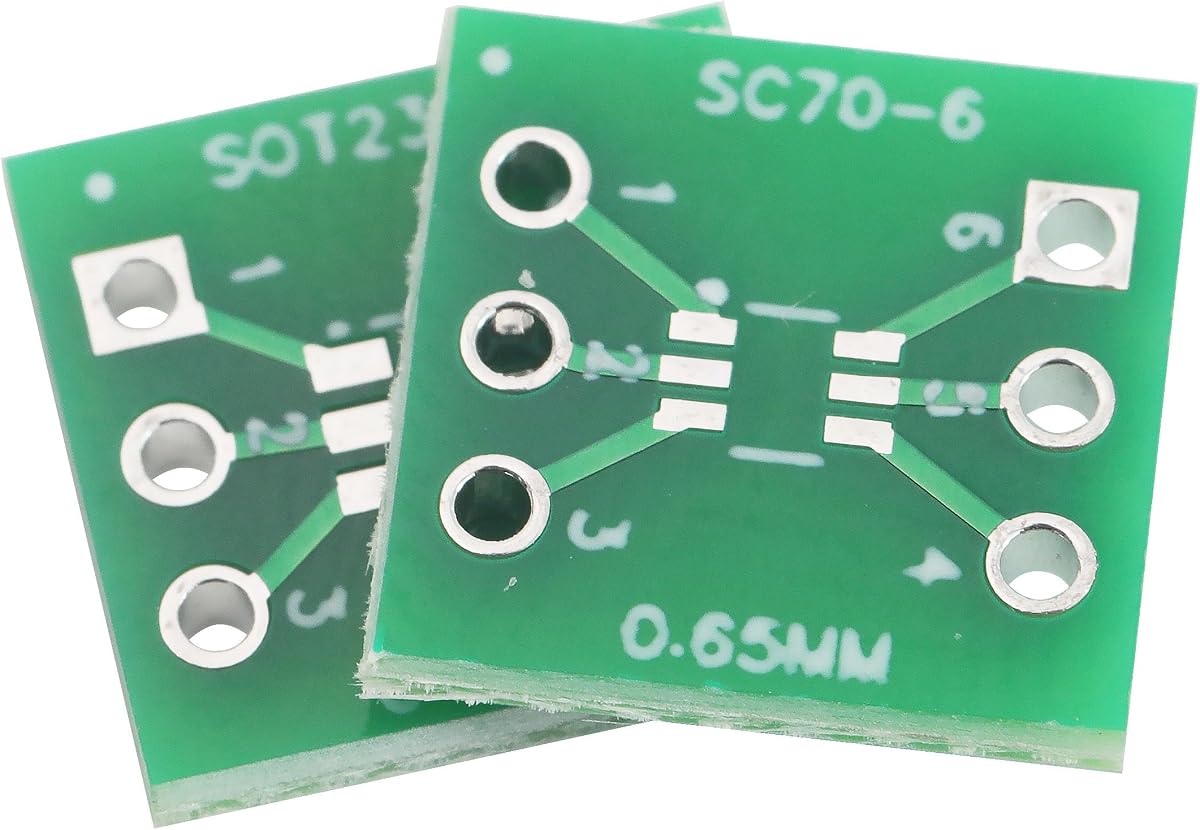
This set converts SOT23-6 and SC70-6 components to a DIP-style layout. Twenty boards are provided, and the 2.54 mm spacing allows them to plug into a standard breadboard or compatible prototyping board. The listed 4.7 rating indicates favorable feedback while remaining slightly below the highest-rated options.
We may earn a commission when you buy through this link, at no additional cost to you.
Six-pin SOT packages are common in compact transistor arrays, sensors, communication circuits, and small analog or mixed-signal devices. Mounting them on a dedicated adapter makes them much easier to connect than placing them directly on a perfboard. The inclusion of both SOT23-6 and SC70-6 support broadens the usefulness for users who encounter either format.
As a focused kit, it does not cover SOP, SOIC, TSSOP, larger SOT devices, TQFP, QFN, or small passives. The listed board size of 10.3 by 10.7 millimeters should be compared with the intended circuit arrangement, especially when space is tight. The product data also does not explicitly mention included headers, so check the package contents and plan to source them if required.
This is a good match for compact sensor prototypes, small logic boards, and repairs involving six-pin SOT devices. It provides a straightforward path from surface-mount assembly to familiar breadboard wiring. Choose it when its two package types match your needs; otherwise, a multi-format set will offer more flexibility for an unpredictable workload.
A DIP-style footprint separates the component from the breadboard, making jump wires easier to attach. That makes temporary testing and circuit changes much less cumbersome.
Twenty boards provide enough stock for repeated sensor or small-logic prototypes. The common 2.54 mm interface also allows each assembly to move between standard breadboard layouts.
We may earn a commission when you buy through this link, at no additional cost to you.
This 12-type kit contains 51 adapter boards and 40 2.54 mm pin headers. Its stated package selection includes SOP8 through SOP28, 0402, 0603, 0805, SOT89, SOT223, TQFP100, QFN32, and QFN44 or QFN48. The 4.6 rating places it among the well-regarded general-purpose options, although not quite at the top of the list.
We may earn a commission when you buy through this link, at no additional cost to you.
The explicit format breakdown is one of its main advantages. Buyers can identify likely projects before ordering, while the FR4 boards and included headers provide a more complete starting point. The listing also emphasizes that the boards are easy to solder and can be soldered repeatedly, which suits iterative circuit development rather than only one-time repairs.
The package selection has boundaries. It does not provide the more extensive SOP, SSOP, and TSSOP coverage offered by another set, and its QFN choices are limited to 32 and 44 or 48. The total of 51 boards is adequate for a broad personal collection, but some competing kits offer more boards or more units of each supported type.
This product is a solid all-purpose choice for users who want common SOP, SOT, passive, and selected high-pin-count support in one kit. It is particularly useful when included headers and clearly documented formats are priorities. Check component drawings rather than relying only on package names, since similarly labeled packages can have different dimensions.
The 40 loose headers make it possible to fit adapters for immediate breadboard use. That turns the package into a more complete prototyping kit rather than a collection of bare carriers.
The listed SOP, SOT, passive, TQFP, and QFN sizes give a clear idea of the kit's scope. This is helpful for users who want a general collection but only need one or two of the formats.
We may earn a commission when you buy through this link, at no additional cost to you.
This seven-type collection provides 35 double-sided adapter boards for SOP, SSOP, TSSOP, and MSOP devices. The listed formats include SOP8, MSOP10, SOP14, SOP16, SOP20, SOP24, and SOP28. Its 3.8 rating is the lowest in this roundup, although the core package selection remains relevant for common integrated circuits.
We may earn a commission when you buy through this link, at no additional cost to you.
The benefit is the combination of several small-IC families in a relatively compact assortment. SOP devices cover many conventional logic and analog parts, while MSOP and related packages are useful for more compact circuits. Double-sided boards offer a practical base for testing, and 35 units provide a reasonable amount of stock for an individual workbench.
The lower rating indicates that customer experiences are less favorable than those of the leading products, so buyers should examine the listing feedback for details relevant to their own use. The product data also provides less precision than some alternatives because it does not clearly enumerate the SSOP, TSSOP, and MSOP pin counts. Dimension checks are particularly important for compact packages.
This kit is best for a hobbyist or technician who has a defined need for small SOIC-family logic and wants some format flexibility. It may be less attractive for educational or service environments that require consistent quality across every board. For those situations, a highly rated kit with clearer package coverage and stronger customer feedback would be the safer choice.
Converting small IC packages to DIP spacing lets users use familiar jumper-wire techniques. This can be especially helpful when a finished circuit needs frequent inspection or modification.
The assortment includes several common SOP pin counts along with MSOP support. That makes it more versatile than a single-format adapter while remaining smaller and more focused than the largest kits.
We may earn a commission when you buy through this link, at no additional cost to you.
This set contains 50 double-sided boards that convert SOT23 or SOT23-3 components to a SIP3 layout with 2.54 mm pin spacing. The listed use of one side for SOT23 with a 0.95 mm pin pitch makes the design clear, and its 4.9 rating is the second-highest customer score in the comparison.
We may earn a commission when you buy through this link, at no additional cost to you.
Fifty matching carriers are useful for transistor circuits, regulators, small sensors, and other three-pin SOT devices. Because each board can plug into a standard breadboard or PCB, a surface-mount part can be tested using ordinary 2.54 mm connections. The double-sided construction may also provide useful routing options around the device.
The limitation is that this is a single-purpose format. It does not address SOT-323, SOT-223, SOIC, TSSOP, larger SOT packages, QFN, TQFP, or tiny passive parts. The package content is listed as 50 converter boards, with no separate headers explicitly mentioned, so users should verify what is included before assembly.
This is an excellent choice for a repair bench that repeatedly handles SOT23 parts or for a maker who wants a generous supply of identical three-pin carriers. The large quantity, straightforward purpose, and strong rating make it more compelling than a mixed kit when SOT23 is the only footprint you need. Exact measurements should still be confirmed before soldering.
Fifty identical adapters support numerous prototypes, repair fixtures, or classroom builds. The uniform format also means there is no need to sort different board types before use.
The 2.54 mm mounting pitch lets each converted component fit standard breadboards and prototyping layouts. This keeps temporary test wiring familiar and easy to change.
We may earn a commission when you buy through this link, at no additional cost to you.
The right adapter depends on exact package geometry, circuit size, and how often you plan to prototype. These factors are more important than the number of pieces alone.
Package names such as SOIC, SOP, SOT23, and QFN describe families rather than a single universal footprint. Before buying, inspect the component's manufacturer markings, body width, lead pitch, lead span, and pin numbering. Compare those dimensions with the adapter drawing or product photographs. A nominal package name can still cover several incompatible dimensions, particularly within compact SOT, TSSOP, MSOP, and QFN families.
An adapter must expose the correct number of pins and preserve their electrical order. For eight-pin logic, choose an SOIC-8 or SOP8 layout with verified width. For larger integrated circuits, count the leads and verify whether the body is gull-wing, no-lead, or another configuration. Adapters for similar pin counts may still differ in pitch, body width, or pin-one location, so pin count alone is not enough to guarantee compatibility.
Double-sided FR4 boards are generally easier to handle and more durable than lightweight single-sided carriers. The listed kits vary: some emphasize double-sided construction, pre-tinned holes, or neatly processed edges, while focused adapters may provide less detail about their construction. A sturdy board is valuable when it must withstand repeated soldering, plugging into a breadboard, or being moved between test setups.
Many prototyping boards and breadboards use a 2.54 mm grid, but an adapter still needs the correct row spacing and pin alignment. Some kits include male headers, while others list only bare converter boards. Determine whether headers are already fitted or must be soldered separately. If headers are included, check their quantity and whether the kit provides enough for the number of boards you intend to assemble.
A large quantity is valuable for teaching, maintenance, and repeated prototypes, but formats with only one or two pieces per type may run out quickly. Focused 50-piece sets are ideal when you use one package daily, while broad multi-type kits distribute their inventory across several footprints. Estimate how many examples of each package you are likely to assemble during a project or term and choose accordingly.
The dimensions of an adapter influence circuit layout as much as its pin count. Small boards such as 10.3 by 10.7 millimeters suit dense experiments, while a larger 20.32 by 10.16 millimeter passive carrier occupies more breadboard space. Account for jumper-wire access, neighboring components, and the room needed to solder the original SMD package without disturbing adjacent parts.
Features such as pre-tinned plated holes and smooth edge processing can make assembly easier, especially for beginners. A correctly sized pad layout is equally important because a part that is difficult to align can be damaged before it is soldered. Look for clear silkscreen or markings that identify the footprint and pin-one location, and avoid forcing a component into a board that does not visibly match its outline.
A breakout board that is soldered permanently may be more convenient for a finished prototype, while a breadboard-compatible carrier is better for temporary experiments and signal testing. Determine whether you need to move components frequently, exchange equivalent parts, or connect measurement equipment. The supplied product information repeatedly identifies debugging, maintenance, signal import, and signal export as intended uses for these adapters.
Begin by identifying the exact component package and checking it against the adapter's footprint. Confirm body dimensions, lead pitch, pin-one position, and pin count before applying heat. Clean the component leads and the adapter pads, then place the part so every lead aligns with its intended pad. Hold it in position with tweezers or by securing the board, and inspect from multiple angles before soldering.
Solder one lead or corner first to establish alignment. Recheck the fit before completing the remaining joints, because a small rotation can cause trouble when moving to a larger package. Use a suitable soldering temperature and avoid dragging a hot iron across adjacent pads. Once the joints are complete, inspect for bridges, incomplete wetting, or solder splashes, and test the adapter on a breadboard before connecting it to the rest of the circuit.
For ongoing care, keep the boards away from moisture and conductive debris, and protect the edges from bending. Clean flux residue only with a method suitable for electronics, and disconnect power before changing components. If the adapter will be reused, inspect the solder joints and header connections for looseness. Store the unused boards in an anti-static container and label the package type or project with permanent marker so the correct carrier can be selected quickly.
An SMD to Dip adapter provides a familiar pin grid for a surface-mount component. It lets you solder a small SMD package onto a carrier and then connect that carrier to a solderless breadboard, perfboard, or another 2.54 mm prototyping layout. This is especially useful for testing, maintenance, teaching, and signal troubleshooting.
No. The component and adapter must share the same footprint, pin count, pitch, and physical outline. Even devices with similar names can differ in body width or lead spacing. Check the manufacturer drawing or package dimensions before soldering, and confirm the adapter's pin-one orientation to avoid connecting the circuit incorrectly.
The terms describe the same measurement: 0.1 inch equals 2.54 millimeters. Most standard solderless breadboards and many prototype boards use this grid, which is why adapters with 2.54 mm mounting pitch are broadly useful. The component's own lead pitch may be much smaller, so both scales can appear in the same product description.
A header can generally be used if its pin count matches the adapter's total lead count and its physical spacing aligns with the board's holes. A 40-pin header can provide individual pins for several smaller adapters, or it may be broken into the required sections. A larger header may be unnecessary for a single eight-pin or three-pin carrier.
That depends on the product. Some kits explicitly include loose 2.54 mm male headers for assembly, while other listings describe only converter boards and do not clearly state that headers are included. Inspect the package contents and image, and purchase compatible headers if the carrier has bare holes rather than installed pins.
They can often be reused if the component is removed carefully and the pads, holes, and header joints remain intact. Applying too much heat can damage the board or pad, while pulling forcefully can lift a pad. Heating each joint individually and desoldering the pins with suitable tools usually gives the best chance of preserving the carrier.
A standard through-hole-style adapter may not be appropriate for packages that are designed for bottom-side soldering or have substantial thermal pads. Check whether the carrier supports the package's termination method and whether additional thermal connections are required. For exposed-pad devices, specialized adapters or dedicated breakout boards are usually more appropriate.
Double-sided construction can provide greater strength, more routing options, and a more durable carrier, but it does not automatically guarantee better compatibility. Pin count, footprint, pad alignment, and header arrangement remain the decisive factors. Choose a double-sided board when it is well suited to the package, but do not rely on board construction as a substitute for checking dimensions.
The 51PCS 12 Types kit is the strongest all-around recommendation because it combines broad package coverage, double-sided FR4 boards, included headers, and a strong 4.8 rating. The 80-piece eight-type kit stands out for inventory volume and clearly listed SOP, SSOP, TSSOP, and TQFP options, while the dual-sided SOT23-3 and SOT-323 set is the most focused premium recommendation for compact three-pin devices.
Prioritize exact footprint compatibility before considering quantity or set size. Measure the package, confirm the pin count and pitch, check pin-one orientation, and determine whether your circuit needs a breadboard interface, a permanent board connection, or both. Specialty adapters for small passives, SOIC-8 logic, or SOT packages can be more useful than a large mixed kit when they precisely match the work.
Product listings, included accessories, and availability can change, so review the current package contents and technical diagrams before ordering. Once the correct footprint is confirmed, choose the adapter that offers the most useful construction for your prototyping style and keep a few compatible board types on hand for future repairs and experiments.