
2 Way Crossover with Panel
5.0Editor score
Supports 300W maximum power
Works with 4–8 ohm speakers
Includes preinstalled junction box
Offers screw and banana connections
Explore 2 Way Speaker Crossovers compared for power handling, impedance, slope, frequency range, installation, and overall value.
A 2 Way Speaker Crossover divides an audio signal between two speaker types, typically sending lower frequencies to a woofer and higher frequencies to a tweeter or midrange driver. A well-matched crossover can reduce distortion, improve tonal balance, and extend the useful operating range of each speaker in a car, home theater, or multi-speaker installation.
The products in this guide were compared using the specifications and construction details supplied for each model. We considered power handling, speaker impedance, crossover slope, selectable frequency points, protection features, terminal design, installation requirements, and suitability for common car and home-audio systems.
Each review highlights the defining features, practical strengths, and potential trade-offs of one crossover. The list includes budget, midrange, and specialist options for both experienced installers and first-time builders, while Amazon prices and availability can change over time.
5.0Editor score

4.6Editor score

4.8Editor score
This side-by-side comparison shows the key differences among the ten crossovers, including their power ratings, compatible speaker impedances, filter characteristics, connection methods, and intended applications.


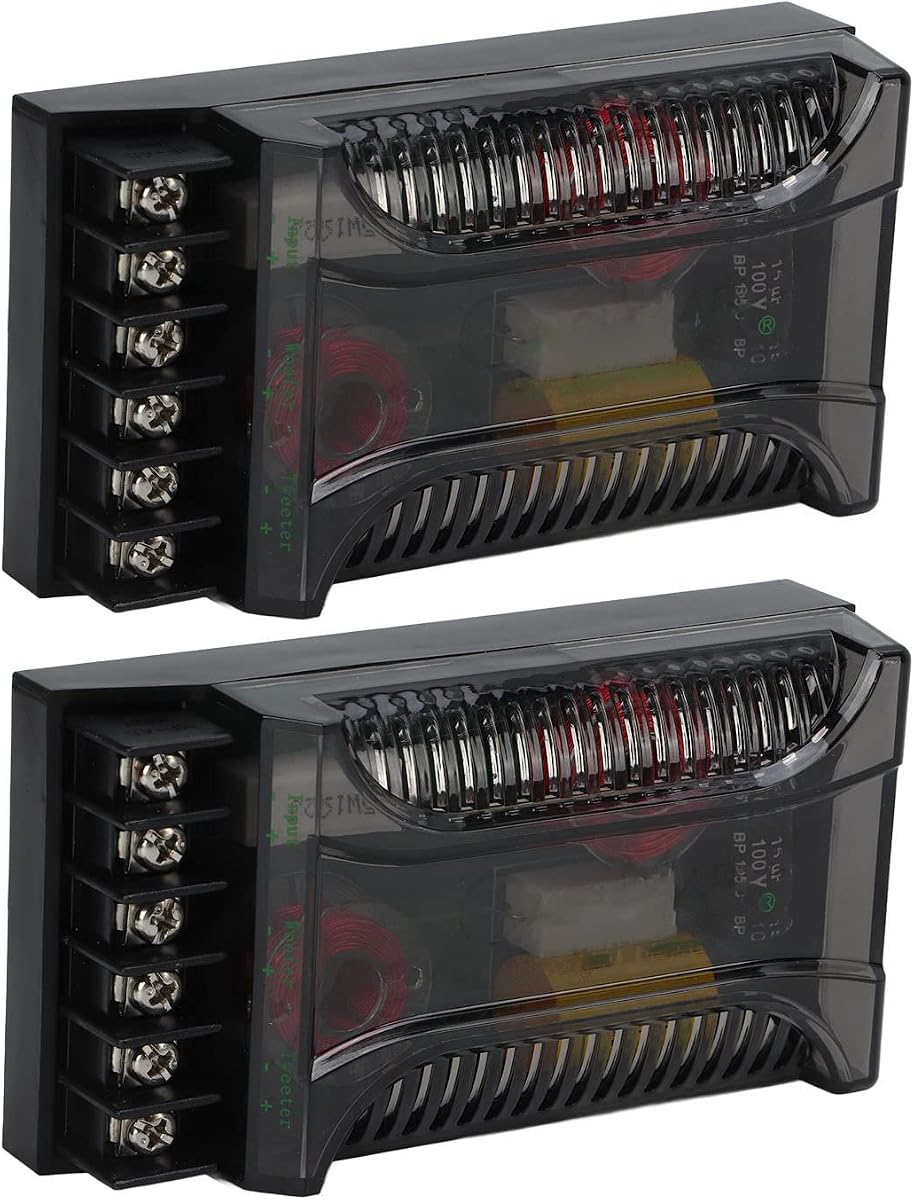


The DS18 PRO-CFX is a two-pack of passive two-way crossovers designed for car audio installations. It carries a 4.6 rating and stands out for its stated 300-watt RMS capability, which makes it a credible choice for a driver-and-tweeter or driver-and-midrange arrangement. The pair also allows an installer to use the same crossover design on both sides of a vehicle.
We may earn a commission when you buy through this link, at no additional cost to you.
Its strongest selling point is efficient amplifier use. The PRO-CFX divides the frequencies intended for two different speaker types, allowing both to work from one amplifier channel rather than requiring separate amplification. This can simplify wiring and preserve amplifier capacity. Its compact dimensions of 6.3 by 3.5 by 1.5 inches also make placement easier in crowded vehicle doors, trunks, and under-seat areas.
The main limitation is that the supplied information presents this as a specialized car-audio product. Its stated features do not mention selectable crossover points, specific impedance ranges, or separate terminal arrangements, so installers should confirm compatibility before cutting wires. It is also a fixed-design passive crossover rather than a finely adjustable system, which may not suit an experimenter who wants to alter the transition extensively.
This is the strongest general recommendation in the list for a straightforward two-speaker car installation using one amplifier channel. It is particularly attractive to buyers who want a matched pair, compact dimensions, and a higher power figure than many budget alternatives. Confirm the crossover point and speaker impedance requirements, then provide the terminal connections with the correct polarity.
The PRO-CFX is built around the idea that one amplifier channel can feed two drivers whose frequency responsibilities have been separated. That simplifies the layout while directing low and high frequencies to the speakers best suited to reproduce them.
Two crossovers are included, and the stated 6.3-by-3.5-by-1.5-inch size is practical for compact vehicle installations. Multiple mounting options help make the finished system easier to service.
We may earn a commission when you buy through this link, at no additional cost to you.
This 2 Way Crossover with Panel has a 5.0 rating and is positioned as an accessible option for installers who want straightforward frequency division. It supports speakers from 4 to 8 ohms and handles up to 300 watts, covering a broad range of common DIY speaker projects without presenting an oversized power-handling specification.
We may earn a commission when you buy through this link, at no additional cost to you.
The preinstalled junction box is the feature that most directly improves the installation process. Instead of requiring a separate enclosure and extensive external wiring, the crossover can mount directly to the speaker exterior. Its Ohmic screw terminals provide secure connections, while banana plug ports allow quick plug-and-play hookups. Audio-grade capacitors are also specified to reduce loss at the upper end of the frequency range.
A notable limitation is that the supplied data does not identify the nominal crossover frequency or filter slope. Those details matter when matching a crossover to a particular driver, especially if the tweeter or midrange has its own roll-off. The 300-watt maximum is also a ceiling rather than a continuous-power specification, so it should not be treated as permission to drive the crossover beyond normal limits.
This crossover is a strong pick for a first DIY build, a simple home-audio speaker pair, or a compact car system where fast installation matters. Its combination of a top rating, integrated enclosure, and two connection styles gives it broad practical appeal. Confirm the crossover point and impedance before wiring, and avoid exceeding the stated power limit.
The preinstalled junction box reduces the need for a separate project box and complicated interconnects. It is a useful approach for a clean, accessible installation that can be revisited later.
Screw-down Ohmic terminals suit permanent hookups, while banana plug ports support quick connection and removal. Having both options makes the unit adaptable to different speaker layouts and working styles.
We may earn a commission when you buy through this link, at no additional cost to you.
The Dayton Audio XO2W-2.5K is a purpose-designed passive crossover with a 2,500 Hz transition point and a 4.8 rating. Its use of 12 dB per octave Linkwitz-Riley alignment gives it a technically credible foundation for separating a woofer from a high-frequency driver while maintaining a smooth transition between them.
We may earn a commission when you buy through this link, at no additional cost to you.
Linkwitz-Riley alignment is valuable because it is commonly used to create a natural transition and reduce the phase issues that can arise with simpler filter networks. The crossover uses 18-gauge inductors to keep direct-current resistance low, which helps minimize power loss and heat. Its low-pass section can accommodate either 4-ohm or 8-ohm woofers, adding flexibility when building a speaker.
The main constraint is its fixed 2,500 Hz crossover point. That is useful for a correctly selected driver combination but not ideal when a tweeter has a substantially different crossover requirement. The supplied information also does not state a maximum power rating, so buyers should compare it with their amplifier and speaker choices rather than assume it is suitable for every high-output installation.
This is the best pick for builders who value a clearly defined crossover design, established filter alignment, and broad woofer compatibility. It is particularly appropriate for a conventional two-way system in which the designer has already selected drivers around the 2,500 Hz transition. For adjustable or very high-power applications, the alternatives offer more explicit handling or tuning information.
The 12 dB per octave Linkwitz-Riley network is the defining technical feature. It provides a thoughtfully designed phase relationship between the low- and high-frequency sections for a conventional passive two-way speaker.
The 18-gauge inductors are intended to minimize DC resistance. Lower resistance can reduce unwanted loss and heat, making the crossover a sensible choice for straightforward passive speaker projects.
We may earn a commission when you buy through this link, at no additional cost to you.
The 300 Watts 2 Way Crossover CRX-203 is a two-pack of passive car-audio crossovers with a 4.5 rating. It is designed to divide a signal between midrange or high-frequency speakers and a woofer, making it relevant to installers who want one enclosure to cover more than one common speaker arrangement.
We may earn a commission when you buy through this link, at no additional cost to you.
Its most useful specifications are the broad stated frequency ranges. The tweeter section covers approximately 3.39 to 20kHz, while the woofer section covers 20Hz to 4.3kHz. Gold-plated screw terminals offer a secure connection surface, and the use of high-grade polymer capacitors provides a solid foundation for the filtering network. The stated handling is 150 watts RMS and 300 watts peak per unit.
Those broad ranges are also the main installation consideration. The product information does not identify a single nominal crossover frequency, selectable setting, or compatible speaker impedance, which means a builder should verify the actual configuration before installation. It would be unwise to infer exact performance limits from the marketing title alone when detailed electrical specifications are not provided.
This crossover is a practical choice for a two-channel car-audio upgrade where a matched pair is useful and broad driver coverage is wanted. The two-pack format makes it easier to maintain consistent filtering on both sides, while screw terminals suit permanent installations. It is less suitable for a builder who requires a confirmed impedance range, precise user-selectable crossover point, or documented filter slope.
The listed tweeter and woofer ranges cover the main areas expected in a passive car speaker setup. This makes the model flexible for common mid-high and woofer combinations, subject to confirming the final configuration.
A two-pack provides a consistent starting point for left and right channels. Gold-plated screw terminals are also well suited to fixed wiring in a vehicle where vibration and secure electrical contact are important.
We may earn a commission when you buy through this link, at no additional cost to you.
This 450W Adjustable Crossover is a two-pack of passive speaker dividers with a 4.5 rating. Its most impressive supplied specification is the 450-watt handling figure, which places it above the other products in this guide for buyers whose priority is a higher stated power ceiling.
We may earn a commission when you buy through this link, at no additional cost to you.
The crossover offers a selectable division point of 2,850 or 2,900Hz. Low frequencies pass through a second-order 12 dB network, while high frequencies use a third-order 18 dB network for phase compensation and cleaner separation. A polypropylene coupling capacitor is specified for the tweeter circuit, and the design also includes a capacitor plus a self-recovering fuse to help protect the high-frequency section during demanding operation.
Because the low- and high-pass sections use different slopes, the design is not a conventional symmetrical crossover. That can be advantageous for some driver combinations, but it should be evaluated carefully rather than treated as a generic feature. The two-position switch is also less flexible than a continuously variable control, and the supplied data does not explain precisely how the switch changes component values.
This is a strong choice for an ambitious car or home-audio build where the stated 450-watt capability and selectable division point are the priorities. It is particularly suitable for installers who understand passive filter design or are following a validated speaker design. The self-recovering protection adds reassurance, but users should still observe correct polarity and amplifier limitations.
The 450-watt specification gives this model the highest stated handling in the list. It may suit higher-output installations, although the actual amplifier, speakers, and thermal environment should all be considered.
The 2,850 and 2,900 Hz settings let an installer select between two close transition points. That can make it easier to accommodate drivers designed for slightly different crossover regions without adding another external control.
We may earn a commission when you buy through this link, at no additional cost to you.
The Dayton Audio XO2W-3K is a 3,000 Hz passive two-way crossover with a 4.8 rating. It gives designers a higher transition point than the 2,500 Hz XO2W-2.5K, which can be useful when a selected midrange or tweeter is intended to take over the upper spectrum at approximately 3kHz.
We may earn a commission when you buy through this link, at no additional cost to you.
Construction details are among the model's strengths. Its 18-gauge inductors are chosen to keep DC resistance low, while all components are glued or fastened down to reduce buzzing and vibration. A high-quality blue printed circuit board and a rigid back plate add structural support, which is especially relevant in a car or an enclosure that may experience movement.
The low-pass side can operate with 4- or 8-ohm woofers, providing useful flexibility. The fixed 3,000 Hz point is the primary limitation for buyers whose drivers are designed around a different crossover region. As with the other Dayton board in the list, the supplied data does not provide a continuous or RMS power figure, so the crossover should be paired with conservative amplifier settings and appropriate drivers.
This model is a compelling option for a compact, purpose-built speaker that has been designed around a 3kHz transition. It is also attractive for car installations where vibration resistance and minimal board buzz are priorities. For a system that needs broad adjustment, a model with selectable settings will be more accommodating, while this board rewards a builder who values a clearly specified, tidy design.
Fastening or gluing the components helps prevent movement-induced buzz. Combined with the rigid back plate, this construction is especially appealing in vehicle cabinets and other mobile installations.
A 3,000 Hz crossover can suit a midrange driver that needs additional upper-midrange support before handing off to a tweeter. It is most appropriate when that driver pairing is known in advance.
We may earn a commission when you buy through this link, at no additional cost to you.
The 400W Adjustable Speaker Crossover is a two-pack that gives DIY builders an adjustable route to separating bass and treble. Its 4.0 rating is the lowest among the listed products, but the unit remains appealing for entry-level builds because the listing combines a stated 400-watt rating, two units, and user-accessible frequency adjustment.
We may earn a commission when you buy through this link, at no additional cost to you.
The product is described as a treble and bass distributor with controls that allow the installer to tune the sound after installation. Its inductors use anaerobic copper winding and pure copper wire, and the circuit can be used with 2.1-style satellite speakers and automotive loudspeakers. That flexibility makes it relevant to a car stereo, a small home system, or a desktop-style speaker project.
The specification is less complete than that of the higher-rated alternatives. The supplied information does not state a precise crossover frequency, impedance range, filter slope, or terminal configuration. As a result, the unit is best suited to experimentation and accessible builds rather than a strictly engineered installation where exact values are essential.
This crossover makes sense for a builder who wants hands-on tuning and two units for a stereo pair. It can be especially useful in a 2.1 arrangement where a small satellite needs its high frequencies separated from a separate bass driver. Buyers should verify all electrical details before connecting expensive speakers and should treat the controls as a starting point for careful listening rather than a substitute for correct driver matching.
The adjustable treble and bass controls allow the installer to respond to real-world placement and room or cabin effects. They are useful for a modest system where a fixed design has not yet been dialed in.
Two independent units support balanced left and right wiring, while the described 2.1 compatibility broadens the range of practical speaker arrangements. The design is approachable for a first custom-build project.
We may earn a commission when you buy through this link, at no additional cost to you.
This 250W 4–12 Ohm Divider is a two-pack of passive speaker crossovers with a 4.2 rating. Its broad 4-to-12-ohm compatibility is the defining feature, making it useful for projects involving several common driver impedances rather than limiting the design to typical 4- or 8-ohm combinations.
We may earn a commission when you buy through this link, at no additional cost to you.
The crossover provides a switchable 2,750 or 2,800 Hz division point. Its low-pass side uses a second-order 12 dB network, and the high-pass side uses a third-order 18 dB network for phase compensation and clean separation. The tweeter circuit employs a polypropylene audio capacitor, while the low-pass inductor uses 1.0mm copper-clad aluminum wire rated for elevated temperatures. Solderless terminal blocks make the wiring process more approachable.
The tradeoff is a stated handling figure of 250 watts, which is lower than several alternatives in the guide. That may be perfectly adequate for many car and home systems, but it is not the strongest choice for a particularly powerful setup. The use of copper-clad aluminum in the low-pass inductor also differs from models that use pure copper wire, although the supplied information does not establish a practical disadvantage for normal use.
This model is well suited to an accessible custom speaker project in which a wide impedance range and simple terminal connections matter most. It is especially helpful for a two-channel build because two units are included. Confirm the chosen crossover setting and observe the stated power limit, while taking advantage of the solderless blocks to make the installation faster and more serviceable.
The broad impedance range is unusually useful among the products reviewed. It offers flexibility when using different driver types or assembling a two-way system from separately sourced speaker components.
Solderless terminal blocks remove the need to attach permanent wire connections during assembly. They also make it easier to inspect, replace, or reconfigure the crossover later.
We may earn a commission when you buy through this link, at no additional cost to you.
The 250W 4–12 Ohm Crossover is a two-pack with a 4.3 rating and a similarly balanced feature set for entry-level and intermediate passive speaker projects. It supports nominal 4-ohm through 12-ohm speakers, which gives builders room to work with a wider range of drivers than a model limited to 4 or 8 ohms.
We may earn a commission when you buy through this link, at no additional cost to you.
Its switchable 2,750 and 2,800 Hz division points provide a small but meaningful tuning choice. The low-pass side uses a second-order 12 dB slope, while the high-pass side uses a third-order 18 dB slope for phase compensation. A high-temperature-resistant copper-clad aluminum inductor is used on the low side, and a polypropylene audio capacitor handles the high-frequency section. Solderless terminal blocks support straightforward assembly.
The 250-watt handling figure is the main reason to consider alternatives when a system will be driven harder. A stated maximum is not the same as an amplifier recommendation, and crossover power ratings should not be treated as permission to increase amplifier output continuously. The two-position switch is also less granular than a continuously adjustable crossover, although it is more flexible than a completely fixed network.
This is a sensible pick for a two-speaker build that needs broad impedance support and a modest amount of crossover-point selection. The two included units make left-right construction consistent, and the terminal blocks are helpful for inexperienced builders. It is best suited to a controlled, moderate-output system with drivers already selected to work around the 2,750 or 2,800 Hz transition.
A switch between 2,750 and 2,800 Hz offers limited but practical adaptation. It is useful when a midrange or tweeter's recommended range sits near one of those two values.
Compatibility with 4- through 12-ohm drivers reduces one common source of installation uncertainty. It can simplify speaker selection when both the low- and high-frequency drivers come from different manufacturers.
We may earn a commission when you buy through this link, at no additional cost to you.
The Universal Heat-Dissipation Crossover is a 300-watt passive crossover with a 4.5 rating, designed primarily for car-audio upgrades. Its housing and connection approach emphasize practical installation, while the stated handling makes it relevant to a wide range of conventional vehicle speaker configurations.
We may earn a commission when you buy through this link, at no additional cost to you.
The high-gloss, double-layer ABS housing is designed to dissipate heat and provide a durable exterior. A bass inductor and magnet are included to support the low-frequency section, and the solderless socket connection is intended to make setup straightforward. The product description also mentions an overcurrent safety feature, adding a layer of protection for the connected equipment during demanding operation.
The main limitation is the lack of technical detail in the supplied information. No crossover frequency, filter slope, impedance range, or exact terminal layout is stated, so compatibility must be confirmed from the product packaging or manufacturer documentation before installation. The practical enclosure and connector are helpful, but they cannot substitute for verified electrical specifications.
This crossover is a good practical option for a car-audio builder who values a straightforward hookup and a housing intended to manage heat. It is especially relevant as a replacement or upgrade in an existing passive system. Match the crossover to the system voltage and speaker configuration, observe the stated power limit, and confirm the filter values before finalizing the installation.
The double-layer housing is intended to dissipate heat during operation. That focus makes the crossover relevant to vehicle environments where enclosure temperature and long operating periods deserve attention.
The solderless socket and straightforward connection process make this approachable for an existing car installation. It can help separate low and high frequencies without introducing an active electronic crossover.
We may earn a commission when you buy through this link, at no additional cost to you.
A useful crossover must fit the selected drivers, amplifier, and cabinet while meeting the builder’s installation needs. The following factors help narrow the options before making a purchase.
Impedance compatibility begins with confirming whether each driver is rated for 4, 8, or another nominal impedance. Some products in this guide support 4-ohm speakers, others accept 4- through 8-ohm drivers, and two models extend to 12 ohms. A wide range offers convenience, but the installer should also verify the impedance of the high- and low-frequency sections rather than assuming that a range printed on the box applies identically to every output. The passive network must also be electrically compatible with the amplifier’s minimum load. When the documentation is unclear, consult the manufacturer or a qualified installer before connecting valuable drivers.
Power ratings indicate how much electrical demand a crossover can accommodate under stated conditions, but RMS, peak, and maximum figures are not interchangeable. The DS18 PRO-CFX and the two 300-watt models list strong handling figures, while one adjustable option claims 450 watts and another claims 400 watts. The Dayton models do not provide a stated power figure in the supplied information. Match the crossover to the amplifier output at the connected speaker impedance, keep headroom in mind, and avoid using a peak rating as a continuous operating target. Proper gain settings, undistorted signals, and correct impedance are as important as the crossover label.
The crossover point should align with the manufacturer’s recommendations for the selected woofer, midrange, and tweeter. The options here range from a fixed 2,500 or 3,000 Hz to switchable points around 2,750, 2,800, 2,850, and 2,900 Hz. Some listings also provide broader high- and low-frequency ranges rather than one nominal transition. A crossover frequency that is too high can ask a midrange to reproduce frequencies it cannot handle cleanly, while one that is too low may give a tweeter unwanted midrange energy. Use the driver specifications as the primary guide and listen for clear, balanced transitions after installation.
Slope describes how quickly each filter attenuates frequencies outside its assigned range. Several products use a 12 dB per octave low-pass section and an 18 dB per octave high-pass section, while the Dayton XO2W-2.5K uses 12 dB per octave Linkwitz-Riley alignment. A steeper high-pass slope can reduce the amount of low-frequency energy reaching a sensitive tweeter, while a well-aligned network can support a smooth transition. Asymmetric slopes are not automatically superior, but they can be useful in carefully chosen designs. Builders should avoid combining arbitrary crossovers and drivers without checking electrical behavior and listening for phase or balance problems.
Protection features can add useful safeguards, but they should complement correct system design. The 450-watt adjustable model includes a capacitor and self-recovering fuse, while the junction-box model describes overload and short-circuit protection. The heat-dissipation model includes an overcurrent feature. These measures may help limit damage under unfavorable conditions, yet they do not make an improperly configured crossover safe. Use appropriately fused amplifier feeds, observe polarity, and make sure the crossover and speakers are installed within their stated limits.
The installation environment can be as important as the filter design. The junction-box crossover has a preinstalled enclosure, while the DS18 PRO-CFX offers a compact 6.3-by-3.5-by-1.5-inch body for vehicle placement. Other products use screw terminals, banana ports, or solderless blocks. Consider where the crossover will be mounted, whether the enclosure can dissipate heat, whether maintenance access is necessary, and how the wires will reach each driver. In a car, secure mounting and vibration resistance help prevent buzz; at home, keeping the crossover close to the speakers can reduce unnecessary cable length.
A stereo installation usually needs two crossovers so the left and right channels receive matching filtering. Six products in this guide are sold in pairs, while the remaining models are individual units. Purchasing a pair can also simplify procurement and ensure consistent construction. If only one is needed for a monoblock or single-speaker project, the single-unit format may be more practical. Always check the package quantity before ordering, as product titles for the two-packs may not make the contents immediately obvious to every shopper.
A product with more listed features is not always easier to use. The best-documented options specify their crossover points, filter slopes, impedance ranges, and component construction. Others emphasize a high maximum rating, integrated enclosure, or protection while providing less detail about the actual network. For a straightforward project, precise published specifications are especially valuable. For an experimental build, accessible controls may be more useful, but those controls still need to be supported by correct wiring and suitable drivers. Read the complete listing and compare the electrical data rather than relying on the product title alone.
Begin by identifying the amplifier channel that will feed the woofer and the high-frequency driver, then disconnect power. Connect the amplifier output to the crossover input with correct polarity, and route the low-pass output to the woofer and high-pass output to the tweeter or midrange. Follow the manufacturer’s terminal labels rather than assuming every model uses the same arrangement. Tighten screw connections, confirm that paired channels have matching crossover settings, and check that no exposed conductor can contact the enclosure.
Set the crossover position before applying substantial amplifier power. Start with a low, clean gain setting and a familiar track containing vocals, bass, cymbals, and sustained high notes. Listen for a smooth handoff rather than a point where one driver seems to disappear. If the system is in a car, account for reflections from windows and hard interior surfaces; in a room, account for placement, furniture, and room boundaries. Make only small adjustments, allowing time to evaluate each change.
Keep the crossover dry, ventilated, and firmly mounted. Avoid placing it where it can be struck by tools, exposed to standing water, or subjected to crushing pressure. Inspect terminals periodically for looseness, corrosion, discoloration, or heat damage, particularly in a car where temperature and vibration vary. Never exceed the documented power or impedance limits, and if a driver sounds strained, disconnects unexpectedly, or the crossover becomes unusually hot, reduce amplifier output and inspect the system.
A two-way crossover divides an audio signal into low- and high-frequency sections. It sends lower frequencies to a woofer and higher frequencies to a tweeter or midrange driver. This lets each speaker operate in a more suitable range, which can improve clarity, reduce distortion, and create a more balanced sound. Passive models do this without requiring external power, while their component values determine the crossover point and slope.
Yes, passive two-way crossovers are widely used in car-audio systems. The DS18 PRO-CFX, CRX-203, adjustable divider, and heat-dissipation crossover are all described with car-audio applications. Match the crossover to the speaker impedance, amplifier output, and available mounting space. Secure it away from water and excessive heat, and use the correct input and output polarity.
Choose the frequency recommended for both the woofer and the high-frequency driver. The reviewed fixed options include 2,500 and 3,000 Hz, while several others offer positions around 2,750 to 2,900 Hz. A tweeter with a high natural roll-off may tolerate a lower crossover, while a midrange may need to hand off sooner. If the manufacturers specify different values, use a validated design or seek installation help.
Neither is universally better. A passive crossover is simple, requires no power supply, and can sit close to the speakers, but its performance is fixed by its component values. An active crossover offers more control and can accommodate different amplifier channels, but it requires power, more connections, and careful gain matching. For a straightforward DIY system, a well-matched passive crossover is often the simplest approach.
The crossover should handle the amplifier power that reaches it under normal operating conditions, with some headroom. Compare the product's RMS, peak, or maximum claim with the amplifier output at the connected impedance. Do not treat a 300- or 450-watt maximum as a target operating level. Set gain correctly, avoid clipping, and follow all manufacturer limits.
The amplifier connects to the crossover input, and the low-pass output connects to the woofer while the high-pass output connects to the tweeter or midrange. Maintain the same positive or negative convention from the amplifier through the crossover to each driver. Terminal labels vary, so read the included diagram and do not rely solely on wire color. Disconnect power before wiring and check connections before increasing gain.
It depends on the crossover's design. Some products support only 4-ohm or only 8-ohm woofers, while others accept 4 through 8 ohms, and the two widest-range options support 4 through 12 ohms. Even when a crossover is compatible with both, the high- and low-frequency sections must be connected to their intended drivers. Check the wiring diagram and impedance requirements for the exact model.
Buzz can come from loose terminals, a reversed connection, vibration, or a mismatched filter configuration. Start by powering down and checking every screw, wire, and polarity connection. Make sure the crossover is firmly mounted and that its components are not vibrating. For balance issues, verify the crossover settings on both channels and confirm that the correct driver is connected to each labeled output.
The best budget option is the 2 Way Crossover with Panel because its integrated junction box, dual connection options, overload protection, and 300-watt maximum make it unusually practical for accessible builds. The DS18 PRO-CFX is the strongest all-around recommendation for car audio, especially when one amplifier channel must serve two drivers. The Dayton Audio XO2W-2.5K stands out for defined Linkwitz-Riley filtering and broad woofer impedance support.
Prioritize verified compatibility over marketing labels. Confirm the crossover frequency, filter slope, power expectations, and speaker impedance, then choose a mounting style that suits the cabinet or vehicle. A crossover with a slightly lower handling figure can be more appropriate than a higher-rated model if the electrical design and driver pairing are better matched. Clear documentation, secure connections, and proper amplifier settings remain essential regardless of model.
Finally, check the current Amazon listing, package contents, seller information, and availability before ordering. Product prices and configurations can change, and the supplied data reflects the information available for this guide. Comparing the current specifications with the selected speakers and amplifier ensures that the crossover improves the system rather than becoming a limiting or mismatched component.