
MT-92H Light Meter
4.6Editor score
Up to 200,000 lux range
Split sensor architecture
Switchable backlit display
Temperature measurement support
Our Analog Light Meter guide compares 10 analog and digital models, highlighting accuracy, metering modes, displays, accessories, and ideal photography uses.
An analog light meter remains a practical tool for photographers, cinematographers, and lighting technicians who value direct exposure readings without menus or batteries. The best unit combines dependable accuracy, a readable scale, useful metering modes, and accessories that suit both studio and location work. Although modern digital meters offer added functions, the right choice depends on workflow, display preferences, and budget.
We compared all 10 products using the supplied specifications, focusing on measurement range, light-metering capabilities, display design, included accessories, power requirements, and intended applications. The list includes traditional analog exposure meters as well as digital illuminance meters and a compact digital exposure meter, since all can help users evaluate light in photography, filmmaking, inspections, or set design.
Each review explains what the product does best, where it is less suitable, and who should consider it. The top selections represent a dependable all-around choice, a budget-conscious instrument, and an enthusiast-oriented premium model. Product availability and pricing can change, so check the current listing and specifications before making a final purchase.
4.6Editor score

4.8Editor score
5.0Editor score
This side-by-side overview highlights the main differences in meter type, measurement range, display style, power source, and exposure features. It also shows where versatile digital instruments complement the straightforward appeal of dedicated analog exposure meters.


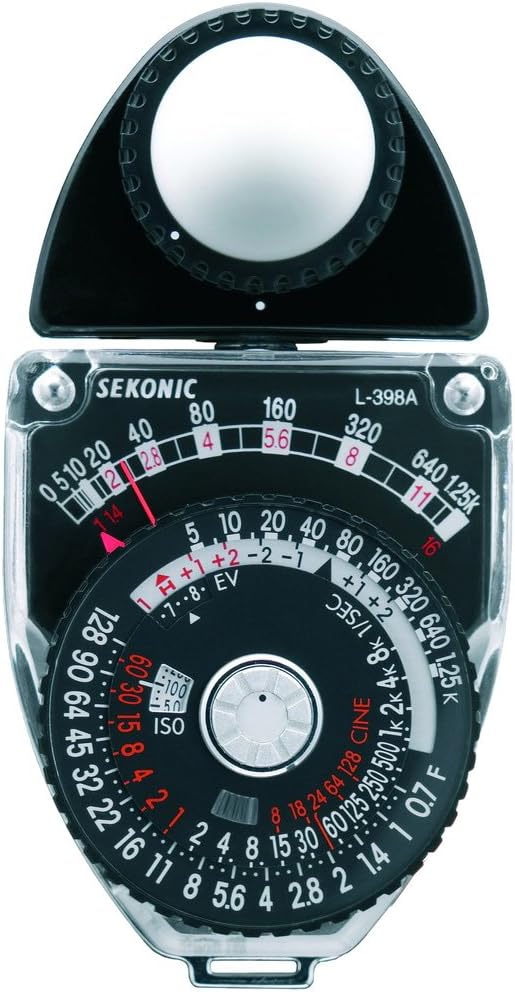


The Sekonic L-398A Studio Deluxe III combines a traditional analog exposure scale with a complete set of accessories, earning it a 4.6 rating and the position of the strongest general-purpose analog choice. It can take incident and reflected ambient readings, while the full dial makes shutter speed and aperture combinations immediately visible.
We may earn a commission when you buy through this link, at no additional cost to you.
Its battery-free amorphous photocell is one of the most appealing features for location work. A meter that does not depend on a battery eliminates a common failure point and allows the unit to be used without checking power. The swivel head also makes it easier to move between the lighting source, subject, camera position, and reflective surfaces without constantly changing your grip.
The included lumisphere, lumidisc, lumigrid, high slide, strap, soft case, and manual make this more versatile than a basic analog meter. The lumidisc supports selective reflected-light readings, while the high slide can assist with narrow or specialized measurement situations. The tradeoff is that an analog scale cannot provide the numerical history, quick mode switching, or illuminated digital details found on electronic models.
This is an excellent choice for photographers and cinematographers who enjoy the deliberate process of reading a mechanical exposure scale and want dependable operation away from mains power. It is less attractive for users who require digital photography and flash-metering modes, but for ambient studio and location exposure work, it offers an unusually complete and coherent package.
The integrated amorphous photosensor derives its operating power from ambient light, so the meter can be ready whenever the scene is bright enough to measure. That simplicity is valuable on sets where batteries may be shared, misplaced, or depleted.
The supplied adapters support broad dome readings, selective reflected-light checks, and more specialized applications. This accessory breadth lets the meter move between general exposure work and detailed lighting evaluation.
We may earn a commission when you buy through this link, at no additional cost to you.
This handheld digital illuminance meter has a 4.4 rating and offers a straightforward way to quantify light in studios, offices, factories, homes, and set-design environments. Its four-digit color LCD provides a practical alternative to an analog needle, while the measurement range extends to 200,000 lux.
We may earn a commission when you buy through this link, at no additional cost to you.
It measures both luminosity and ambient temperature, adding information that can be useful when checking an environment rather than calculating a precise camera exposure. MIN/MAX readings and data hold help users observe changes over time, and the low-battery indication reduces the chance of mistaking a failing power source for a change in lighting.
The specified accuracy is plus or minus 3 percent of reading plus eight digits below 10,000 lux and plus or minus 4 percent of reading plus ten digits above 10,000 lux. As with any illuminance meter, results should be interpreted alongside the sensor specification, the light source, and the surface being measured. Unlike a photography-specific exposure meter, it does not list flash-measurement timing.
Choose it for general illumination surveys, indoor testing, educational work, or a simple digital lux meter that can also report temperature. Photographers wanting direct aperture and shutter guidance should look to a dedicated exposure meter instead.
The combination of lux and temperature readings supports facility checks, set planning, offices, factories, and home lighting assessments. That makes the meter more broadly useful than a model built only around camera exposure scales.
The color LCD, held readings, and minimum/maximum modes make it easier to document changing conditions. Automatic power-off also helps conserve power during intermittent use.
We may earn a commission when you buy through this link, at no additional cost to you.
This listing for the Sekonic L-398A Studio Deluxe III has a 4.4 rating and emphasizes compact, straightforward ambient-light metering. It supports both incident and reflected readings, includes a 180-degree lumisphere, and uses a swivel head that allows users to check light levels while moving around a set.
We may earn a commission when you buy through this link, at no additional cost to you.
The battery-free design is especially convenient for cinematographers and photographers who do not want to manage electronics in the field. Its case, strap, lumidisc, lumigrid, and high slide provide a more complete kit than many simple analog meters, while the compact body should be easier to carry between locations.
The main limitation is that this is an analog ambient meter rather than a full digital photographic meter. It does not list flash timing, dedicated photo or video modes, or illuminated electronic readouts. The exposure dial also requires the user to interpret the needle and match the result to camera settings.
It is a strong match for users who want a mechanical meter for ambient scene work and appreciate a complete accessory package. Choose a digital exposure model if electronic flash measurement, cine-specific settings, or a backlit screen is essential.
The swivel head supports the type of meter movement described as walking the set, allowing readings to be taken from several positions without constantly rotating the entire instrument.
The bundled case, strap, lumidisc, lumigrid, and high slide cover protection, carrying, and different measurement approaches, reducing the need to source accessories separately.
We may earn a commission when you buy through this link, at no additional cost to you.
The MT-92H combines a 4.6 rating with a useful set of digital features, making it an appealing budget option for users who want more than a simple analog needle. It measures from 0 to 200,000 lux, offers 0.1-lux resolution, and refreshes readings every 0.5 seconds.
We may earn a commission when you buy through this link, at no additional cost to you.
Its split-sensor design separates the sensing probe from the main body, which can improve positioning flexibility during measurements. Users can switch between lux and foot-candle units, while temperature can be displayed in Celsius or Fahrenheit across a stated range of 14 to 140 degrees Fahrenheit.
The switchable, glare-resistant backlight is valuable in both dark locations and direct sunlight. Its stated dimensions of 125 by 56 by 30 millimeters and weight of 188 grams support easy carrying. The compromise is that it needs three AAA batteries and is designed around illuminance rather than camera-specific exposure values.
This is a strong choice for set design, plant-light checks, general lighting surveys, or anyone who values fast digital updates. Photography users should pair its measurements with a camera or separate exposure calculator when exact shutter and aperture settings are required.
A 0.5-second refresh rate is useful when light levels change quickly, such as around a practical lamp, a moving subject, or an adjustable fixture. The display can update without the delay associated with some basic meters.
The split-sensor format keeps the measuring element separate from the display housing. This makes it easier to position the sensitive area while keeping readings visible in the main unit.
We may earn a commission when you buy through this link, at no additional cost to you.
The Dr.meter Digital Illuminance Light Meter has a 4.5 rating and focuses on fast, readable measurements across a 0-to-200,000-lux range. Its response speed of two readings per second makes it suitable for changing light conditions and everyday illumination checks.
We may earn a commission when you buy through this link, at no additional cost to you.
The most specialized feature is peak recording, which locks and displays the highest light pulse detected. That makes the meter potentially useful for brief high-intensity sources, including lightning, laser beams, and other transient events. FC/LUX conversion broadens its use for growers, inspectors, and users working with either measurement convention.
A low-battery alert helps prevent interrupted work, although the meter requires a 9V battery. It does not list exposure calculations, flash timing, incident metering accessories, or a backlit screen, so it is not a direct substitute for a photographer’s exposure meter. It is better understood as a general-purpose digital lux instrument.
Choose it when fast response and peak detection matter more than camera-specific exposure guidance. It also serves well for measuring daylight, indoor illumination, or plant-growing conditions where a numerical lux reading is the primary goal.
Peak recording is the defining feature for transient sources. Instead of relying only on the instantaneous display, the meter can preserve the highest detected pulse for later reference.
The 200,000-lux range and simple unit conversion accommodate outdoor sunlight, indoor rooms, workspaces, and plant-light assessments. This broadens the instrument beyond camera use.
We may earn a commission when you buy through this link, at no additional cost to you.
The Extech LT300 has a 4.3 rating and offers a remote-sensor format for inspections where the measurement point is difficult or inconvenient to reach. It supports lux and foot-candle readings up to 40,000 lux, with peak and relative modes for comparing light levels.
We may earn a commission when you buy through this link, at no additional cost to you.
Its cosine- and color-corrected sensor is designed to reflect the way light arrives at a surface. The large backlit LCD supports one-handed use, while data hold, minimum/maximum functions, and zero adjustment support more deliberate measurements and comparisons.
A protective sensor cover and portable construction suit facilities, studios, laboratories, and outdoor inspection work. Its 40,000-lux ceiling is lower than the 200,000-lux maximum offered by several budget models, so it may not cover extremely bright conditions. It also lacks photographic flash timing and camera exposure calculation.
This meter is most appropriate for technicians, facility managers, and lighting users who need remote placement and comparison features. It is a practical complement to a camera meter rather than a replacement for one.
The remote sensor can be placed above a fixture, inside an enclosure, or close to a work surface while the display remains in the operator’s hand. This separation makes awkward measurement positions more practical.
Relative mode, zero adjustment, and peak tracking help users establish a reference and compare conditions. These functions are useful for identifying uneven lighting or changes across a space.
We may earn a commission when you buy through this link, at no additional cost to you.
The Gossen Luna Pro SBC is a dedicated ambient and flash exposure meter with a 3.7 rating, the lowest among the listed products. Its central appeal is a digital EV readout paired with setting rings that let users see shutter-speed and f-stop combinations at a glance.
We may earn a commission when you buy through this link, at no additional cost to you.
The meter can work in incident or reflected-light modes, covering the two main methods of environmental exposure measurement. Its dedicated design and setting-ring interface offer a more camera-specific experience than a general illuminance meter while retaining the immediate, mechanical quality of an analog instrument.
A clock with alarm, timer, and temperature display adds functions that are unusual for a light meter and may appeal to users who want more than exposure measurement. On the other hand, the supplied product information is concise, and the lower rating suggests that some buyers may have found reasons to prefer alternatives.
Consider the Luna Pro SBC if you specifically want a traditional exposure-meter workflow with a digital EV center and flash capability. Verify accessory compatibility, current availability, and all operating details on the listing before purchase, particularly if precise workflows depend on a particular film or digital exposure scale.
The digital EV reading provides a precise center value, while the surrounding setting rings translate that value into usable camera combinations. It combines numerical clarity with a mechanical dial layout.
The integrated clock, alarm, timer, and temperature readout add convenience for set work and travel. These functions are not essential to exposure measurement but distinguish the meter from basic handheld lux meters.
We may earn a commission when you buy through this link, at no additional cost to you.
The Fluke 941 Light Meter carries a 4.8 rating, the highest among the digital illuminance meters in this list, and the Fluke name makes it immediately recognizable as a specialist measurement instrument. It is well suited to users who want a dependable professional tool for evaluating light in practical environments.
We may earn a commission when you buy through this link, at no additional cost to you.
Its digital format allows readings to be read directly without interpreting a needle, and a backlit display supports use in dim locations. The compact, portable construction makes the meter suitable for moving between work areas, while its general illuminance focus gives it value for studio planning, facility checks, and light-level assessment.
The available product information is intentionally limited, listing the brand and model more than it lists technical ranges or supported modes. That means a buyer should check the current manufacturer documentation or packaging for exact accuracy, range, battery requirements, and included accessories. It is also not explicitly identified as a camera exposure or flash meter.
The Fluke 941 is an excellent choice for a professional who values a recognized specialist brand and straightforward digital illumination readings. Choose it for inspection and lighting work; choose a photography-specific model if aperture, shutter, ISO, or flash timing must be controlled directly.
A backlit screen and portable format make the meter practical in offices, studios, and inspection environments. Digital values can be read quickly during repeated measurements.
Fluke is established in professional test and measurement equipment. The brand is especially relevant to users who want a familiar professional instrument rather than a general-purpose consumer gadget.
We may earn a commission when you buy through this link, at no additional cost to you.
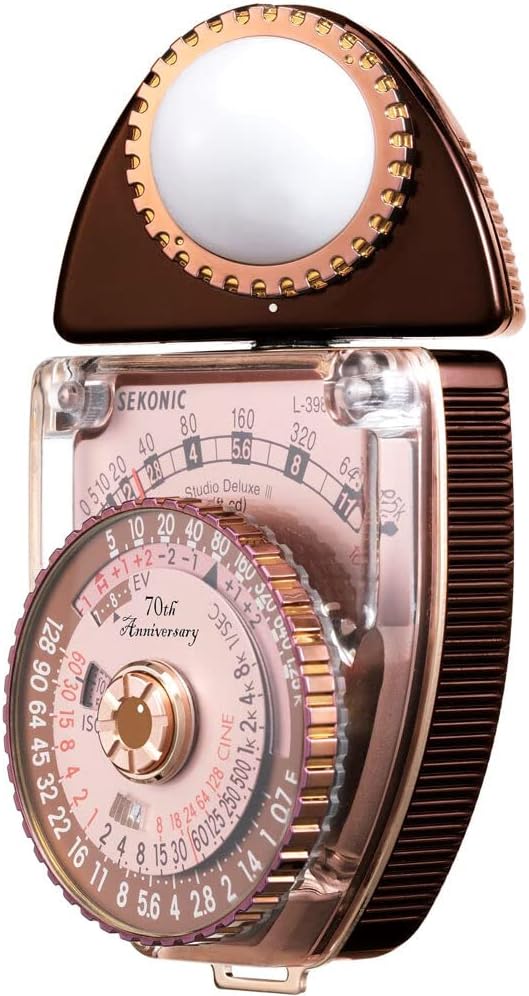
The Sekonic Studio Deluxe III 70th Anniversary has a 5.0 rating, making it the highest-rated product in the group. This commemorative version of the classic analog meter is aimed at photographers who value traditional exposure scales, instant visual interpretation, and the character of a physical instrument.
We may earn a commission when you buy through this link, at no additional cost to you.
Its defining feature is an instant reading of the full range of aperture and shutter combinations. Rather than navigating menus or calculating a matching setting after entering a measurement, the user reads the relationships directly from the dial. That immediacy is the central reason some photographers continue to prefer analog meters.
The anniversary designation also makes it attractive as a collectible or as a premium addition to a camera kit. Its limitations reflect the deliberate design: it is not a digital exposure meter, and the supplied product information does not list flash timing, screen functions, sensor details, or the full accessory package. Current contents should therefore be confirmed before purchase.
For a dedicated analog enthusiast, this model is the premium pick in the roundup. It combines a perfect listed rating with the timeless appeal of instant, glanceable exposure guidance, while users seeking video-specific digital modes should choose a newer electronic meter.
The analog scale shows the relationship among aperture, shutter speed, and available light at once. This is faster for experienced users than stepping through digital menus.
The 70th Anniversary edition gives the traditional meter a distinctive identity. It can serve as a working tool for ambient exposure checks while also complementing a vintage or premium camera setup.
We may earn a commission when you buy through this link, at no additional cost to you.
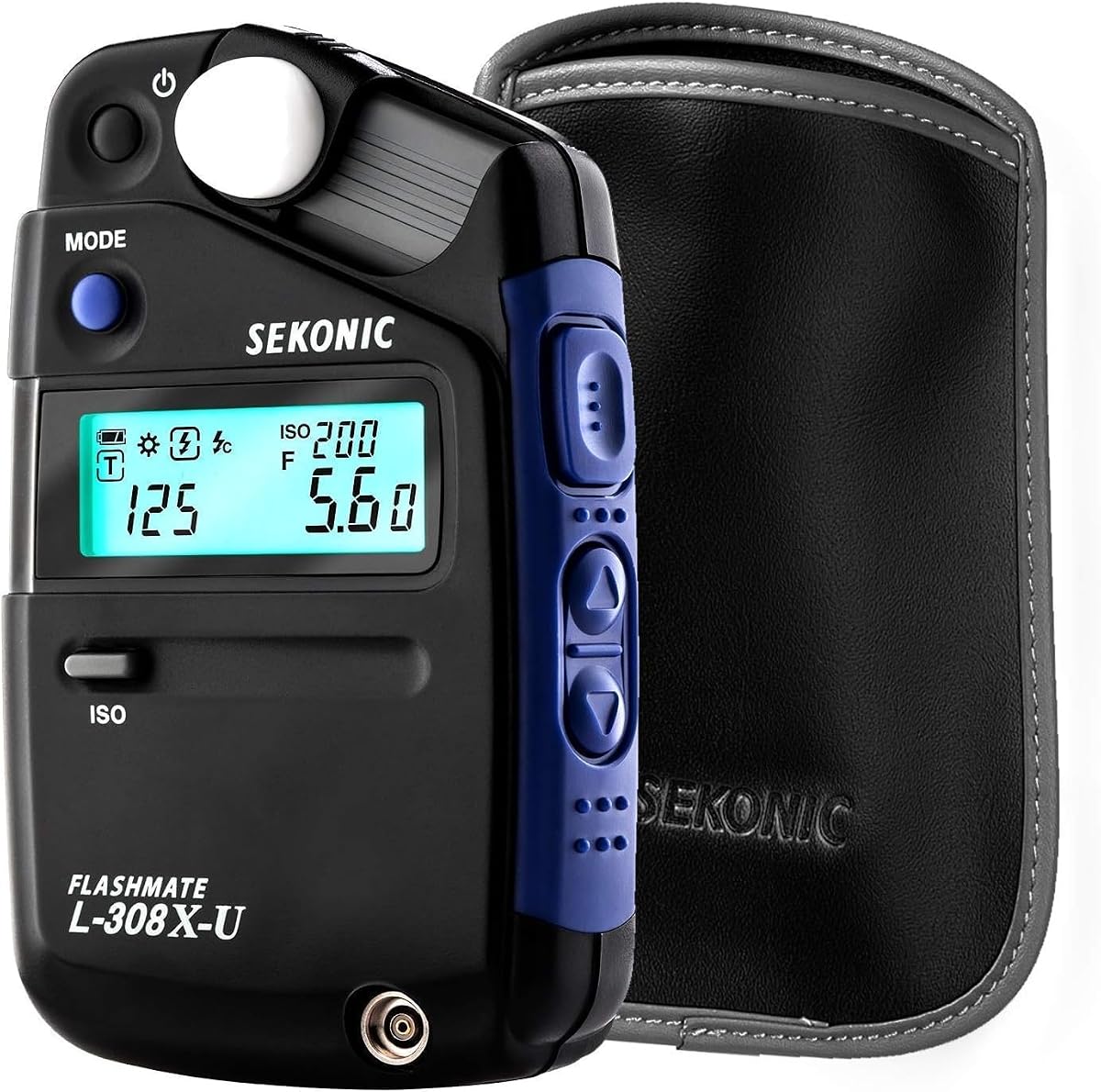
The Sekonic L-308X-U Flashmate has a 4.7 rating and is the most camera-specific digital model in the list. It supports incident and reflected exposure readings, electronic flash measurement, and dedicated photo, cine, and HD Cine modes in a compact pocket-sized body.
We may earn a commission when you buy through this link, at no additional cost to you.
Its exposure guidance reaches one-tenth-of-a-stop precision, making it appropriate for photographers and videographers who want finer control than a basic analog scale may provide. At ISO 100, the listed ambient EV range is 0 to 19.9, while flash readings cover f/1.0 to f/90.9 with flash shutter speeds from 1 second to 1/500 second.
Photo mode supports shutter- or aperture-priority-style display along with ambient and corded or cordless flash functions. Cine mode is designed around cinema cameras, useful frame rates, and shutter angles, while HD Cine mode targets DSLR and mirrorless video workflows. The LCD automatically activates its backlight, and the meter also measures illuminance.
This is the best choice for someone who searched for an analog meter but actually needs a versatile digital exposure tool. It is less satisfying for users seeking a purely mechanical, battery-free experience, but it offers broad functionality in a smaller package than many professional meters.
Photo, Cine, and HD Cine modes tailor the display to different capture workflows. This makes the meter relevant to still photographers, mirrorless videographers, and cinema-camera users without requiring a separate device for each discipline.
Tenth-stop readings and a broad ambient range support precise adjustments under varied lighting. Cord and cordless flash options broaden its usefulness for studio and location shoots.
We may earn a commission when you buy through this link, at no additional cost to you.
The best light meter depends on whether you need traditional exposure guidance, general lux measurement, or a camera-specific digital tool. Consider measurement method, range, display, accessories, power, portability, and the kind of lighting work you expect to perform.
An analog meter offers a direct view of aperture, shutter speed, and light relationships without electronic menus. It is often mechanically simple and easy to read at a glance, although there is no numerical history or illuminated display. A digital meter provides exact values, can record maximum readings, and may include specialized photo, flash, or cinema modes. Users who enjoy deliberate analog workflows may prefer a Sekonic L-398A, while those who need video settings and flash timing may favor the L-308X-U.
Incident metering places the sensor toward the light source and is useful for determining the illumination falling on a subject. Reflected metering points the sensor toward the subject or a surface and is often helpful when matching exposure to what the camera sees. The Sekonic L-398A supports both methods, while the L-308X-U also provides incident and reflected exposure measurement. General illuminance meters are primarily useful for evaluating light levels rather than directly calculating camera exposure.
Maximum range determines whether the instrument can handle bright sunlight, theatrical fixtures, or close-range sources. Several digital models reach 200,000 lux, while the Extech LT300 reaches 40,000 lux. Resolution is equally important when measuring subtle changes. The MT-92H lists 0.1-lux resolution, which is useful for close comparisons, while analog meters communicate changes through a needle rather than a numerical resolution figure.
A photographic exposure meter may support incident and reflected light, flash timing, shutter speed, aperture, and ISO. Video-oriented meters can add frame rates, shutter angles, and HD Cine settings. The Sekonic L-308X-U includes Photo, Cine, and HD Cine modes and supports ambient and electronic flash readings. If you only need to compare room brightness, plant light, or set-design illumination, these extra modes may be unnecessary.
Battery-free analog meters remove charging and battery management from the workflow, making them dependable for location work. Digital meters provide more numerical information but require batteries and may need regular checks before a shoot. Portability also matters: the MT-92H weighs 188 grams and measures 125 by 56 by 30 millimeters, while the L-308X-U is designed to fit in a pocket. Consider how the instrument will be carried and whether electronics are already part of your kit.
An analog dial remains visible in many conditions and does not require power, but fine readings may be harder to record precisely. Digital displays can use backlighting, data hold, minimum and maximum modes, and glare-resistant construction. The MT-92H and Fluke 941 are especially useful in changing ambient conditions, while the Extech offers a large backlit screen and one-handed operation. Select a display style that can be read quickly without interrupting the lighting setup.
A domed diffuser can standardize broad incident readings, while a disc or grid can support more selective reflected measurements. A high slide can help isolate a narrower area. The Sekonic L-398A listings include lumispheres, lumidisics, lumigrids, and high slides, along with a case and strap. Digital models may not need the same collection of adapters, but remote sensors and protective covers can expand their usefulness in professional inspections.
A studio meter should be easy to handle around delicate equipment and adapt to various mounting positions. A field meter benefits from a protective case, secure strap, and compact form. Inspection users should also consider sensor covers and remote placement. The 70th Anniversary Sekonic is styled for enthusiasts and collectors, while the Extech, Fluke, and MT-92H lean toward professional or technical measurement workflows.
Begin by identifying whether you need an incident, reflected, ambient, or flash reading. For incident light, point the covered sensor toward the source or subject position. For reflected light, aim the sensor toward the area you want to expose and ensure the appropriate diffuser or grid is installed. If the meter supports multiple units, select the unit required by your workflow before taking a reading.
Allow the meter and sensor to acclimate near the measurement area, especially when moving between very warm and very cool environments. Take several readings from slightly different positions to identify changes in falloff, shadows, and reflected color. For video, monitor the scene over time because fixtures, camera movement, and automatic exposure changes can alter the light level.
Store the meter in its case or a dry protective pouch and keep adapters clean and dry. Replace batteries before important sessions if the model uses them, and avoid leaving electronic units in extreme heat or moisture. Clean the sensor gently according to the manufacturer’s instructions, since residue and fingerprints can alter readings. For analog instruments, store them away from magnetic fields and strong impact, and verify the needle returns to its zero point before each use.
An analog meter is often better for photographers who prefer an immediate view of aperture and shutter relationships without navigating menus. A digital meter is usually more flexible for exact numerical readings, flash measurement, recording maximum values, and specialized video modes. The better choice depends on workflow rather than one format being universally more accurate.
Incident metering measures light arriving from the direction of the source and estimates the illumination on a subject. Reflected metering measures light bouncing from the subject or another surface toward the sensor. Incident readings are often useful for controlling illumination, while reflected readings can help match exposure to the scene as the camera sees it.
A light meter becomes especially useful when automatic exposure is inconsistent or when you work in rapidly changing, highly controlled, or deliberately unusual light. It is also valuable for comparing lamps, matching settings across a set, and understanding differences between subject positions. Modern cameras are capable, but a meter adds direct control and helps verify what the camera is doing.
Battery-free meters remove battery depletion and charging from the process, which is a major advantage in the field. Their photosensor derives power from the ambient light being measured, so they still require enough light to operate normally. For very dark scenes, users should test the meter under expected conditions before relying on it.
A lux meter can help compare lighting levels, check plant-growing conditions, and evaluate rooms or set illumination. It may not automatically translate a reading into the correct camera exposure because ISO, camera calibration, meter geometry, and light distribution also matter. Photography-specific exposure meters are more convenient when direct aperture and shutter guidance is the priority.
Important features include an appropriate measurement range, useful accuracy and resolution, a readable backlit display, data hold, and minimum/maximum functions. Photo and video users should also look for incident and reflected modes, flash timing, and camera-specific exposure scales. Remote sensor placement can be valuable for fixtures and confined spaces.
Some analog models do, while others are limited to ambient exposure readings. The supplied L-398A listings specifically describe incident and reflected ambient measurement, and the Gossen Luna Pro SBC is identified as an ambient and flash meter. Confirm the product description and included accessories before assuming a model supports electronic flash timing.
Check the meter against a stable reference source or a carefully controlled setup with known illumination before relying on critical measurements. Keep the sensor and diffuser clean, avoid abrupt temperature changes, and repeat readings at multiple positions. If readings appear inconsistent, verify that the correct diffuser and measurement mode are being used before suspecting the instrument.
The Sekonic L-398A Studio Deluxe III is the strongest general analog choice because it combines battery-free operation, incident and reflected metering, a swivel head, and a full accessory kit. For a versatile digital instrument, the Fluke 941 stands out for its professional format and strong rating, while the MT-92H provides a budget-friendly way to obtain fast, detailed lux readings.
Your priorities should determine the selection. Choose an analog dial if you value immediate exposure relationships and traditional camera workflow. Choose a digital exposure meter if you need flash timing, exact values, or photo and video modes. Choose a general illuminance meter for facility work, set design, plants, or broad lighting comparisons, and confirm sensor range and accessories before purchasing.
Ratings and product details can change, and availability may also vary. Review the current listing for included components, power requirements, measurement specifications, and warranty information before buying. Above all, choose the instrument that matches how you work, because the most useful meter is the one you can trust and operate confidently when the light changes.