
Renogy Rover 20A
4.4Editor score
Built-in Bluetooth monitoring
Automatic 12V/24V detection
Up to 99% tracking efficiency
Four-stage lead-acid charging
Our Bluetooth Mppt Solar Charge Controller guide compares ten MPPT options for app control, charging capacity, battery support, monitoring, and easier
A Bluetooth MPPT solar charge controller combines efficient maximum power point tracking with app-based monitoring, remote settings, and clearer system visibility. It is especially useful for off-grid installations where battery condition, charging stages, and energy production need to be checked without repeatedly visiting the controller.
This guide compares ten controllers on charging voltage and current, supported battery types, Bluetooth implementation, display functions, load control, expansion options, and protective features. The list includes compact systems for vans and cabins as well as higher-capacity models for larger renewable-energy installations.
Each review explains the product's most useful capabilities, practical limitations, and ideal installation environment. Ratings and product details reflect the supplied marketplace information, while current availability, bundle contents, and pricing can change, so verify the latest listing before buying.
4.4Editor score

4.7Editor score

4.8Editor score
The comparison below highlights each controller's core electrical ratings, connectivity, monitoring features, and system flexibility, making it easier to match a model to a particular solar installation.


The Victron Energy SmartSolar MPPT Solar Charge Controller 75V, 15A, 12/24V is a compact choice for small off-grid systems that still benefit from sophisticated app control. Its 4.7 rating places it among the strongest-rated products in this guide. The 15-amp rating makes it particularly relevant to a modest solar array feeding a 12- or 24-volt battery bank, while the 75-volt maximum input provides some flexibility for series-connected panels.
We may earn a commission when you buy through this link, at no additional cost to you.
Bluetooth connectivity is handled through the VictronConnect app, which provides real-time system data and a 30-day performance history. Users can configure battery presets, alter operating settings, update firmware, and establish alarms without relying on a computer or a separate display. The controller also includes an intelligent load output whose disconnect voltage can be configured, allowing supported loads to be protected when battery voltage becomes too low.
Its MPPT tracking and intelligent charge algorithms are designed to maximize harvested solar energy, including when part of an array is shaded. Multiple SmartSolar controllers can synchronize so that they move through charging stages together, which is valuable when an installation grows or when power is distributed among multiple controllers. The result is a compact controller with more system-level flexibility than its output rating alone might suggest.
The main limitation is capacity. A 15-amp controller cannot serve a large array or rapidly recharge a deeply discharged battery bank, so buyers should calculate expected output rather than selecting it only for its compact size. The 75-volt input ceiling also offers less room for series configurations than the 100-volt alternatives in this comparison. These constraints are acceptable for appropriately sized systems but important for larger projects.
This is a strong pick for a van, small cabin, modest boat installation, or other compact renewable-energy system where Bluetooth visibility and dependable charge-stage control matter more than maximum current. Users should confirm their panel configuration, battery chemistry, and load requirements before installation. For those needs, it delivers a polished combination of MPPT efficiency, remote monitoring, and compact electrical capacity.
VictronConnect turns the controller into a live system dashboard, with real-time information and 30 days of performance history available through the app. Firmware updates, battery presets, alarms, and operating settings can also be managed from a phone.
The 15-amp rating suits smaller installations where controller size and heat management matter. Its 75-volt input still allows several compatible panels to be configured together, subject to the array's open-circuit voltage and the controller's other limits.
We may earn a commission when you buy through this link, at no additional cost to you.
The Victron Energy SmartSolar MPPT Solar Charge Controller 100V, 50A, 12/24V is built for installations that need meaningful charging current without giving up app-based control. Its 4.6 rating indicates strong customer reception, and the 50-amp output places it near the upper end of the controllers featured here. The 100-volt maximum PV input also provides a practical balance for larger 12- and 24-volt arrays.
We may earn a commission when you buy through this link, at no additional cost to you.
VictronConnect gives installers and system owners a clear view of real-time data, 30-day history, battery presets, alarms, and firmware. That remote access is useful for installations distributed across a property or monitored from a different location. Intelligent load output can also disconnect connected devices at a user-selected battery-voltage threshold, reducing the risk of deeply discharging the battery bank.
MPPT tracking and intelligent charge algorithms help the controller extract more usable energy from changing sunlight and partially shaded panels. For systems that eventually outgrow one controller, synchronized charging allows multiple SmartSolar units to behave as a coordinated system, switching through charging stages together. This scalability is a major advantage for installers who may need to expand capacity later.
Its 50-amp rating means proper system matching is essential. A relatively small panel set cannot take full advantage of the controller, while an oversized array must remain within the 100-volt input limit and suit the connected battery bank. A larger controller can also create more heat to manage, and a physically substantial installation may be less attractive inside a compact van or cabin.
The model is well suited to larger cabins, boats, mobile solar systems, and dedicated off-grid installations where 50 amps of charging potential and remote diagnostics justify the added capacity. Buyers should compare the controller against their actual array output rather than simply selecting the highest current rating. When the electrical design is sound, its app experience and expansion support make it a particularly complete package.
A 50-amp output is meaningful for larger 12- or 24-volt banks, particularly when solar production is substantial and rapid replenishment is valuable. It is most effective when the connected array can consistently deliver enough power to keep the controller active.
Battery presets, alarms, firmware, and live performance data can be handled through VictronConnect. This is particularly helpful for off-grid systems where a quick app check can answer whether a battery is charging normally or a load has been disconnected.
We may earn a commission when you buy through this link, at no additional cost to you.
The Renogy MPPT Solar Charge Controller with Bluetooth & LCD, 100V 20A 12V/24V is a modern, compact option for mobile and residential systems that need both local and remote visibility. Its 4.4 rating reflects a favorable balance of features and customer satisfaction. The second-generation Rover 2 is reported to be 53% smaller than the earlier generation, making it easier to fit in an RV, van, camper, boat, or cabin.
We may earn a commission when you buy through this link, at no additional cost to you.
Bluetooth monitoring is built directly into the controller, so users can view charging status, voltage, and current in the Renogy app without buying a separate communication module. The LCD offers an immediate local view, while an RS485 port supports wired integration. Real-time tracking, battery preset selection, and smartphone monitoring help reduce the need to travel to the equipment compartment for routine checks.
The controller accepts solar arrays with up to 100 volts of open-circuit voltage and is listed for 300 watts on a 12-volt system or 600 watts on a 24-volt system. Its MPPT algorithm has a stated 99% tracking efficiency and is intended to maintain the array's optimum power point, including under partial shade. The thermal design is also said to sustain full 20-amp output up to 113°F.
Battery compatibility is broad, covering lithium, AGM, gel, flooded deep-cycle, and user-defined profiles. Protection against overcharge, short circuits, reverse polarity, and excessive temperature helps reduce installation risk. Multiple Rover 2 units can be linked in parallel as power requirements increase, giving users a practical path for scaling a system without replacing the original controller.
The tradeoff is that a 20-amp controller is not intended to be the central component of a very large array. Its output, despite the 100-volt input allowance, remains the central constraint. For a correctly sized system, however, the combination of a small footprint, integrated Bluetooth, LCD, high tracking efficiency, and broad battery support makes this one of the most practical options in the roundup.
The reported 53% size reduction is meaningful in campers, boats, and equipment cabinets where every inch matters. It provides a 20-amp MPPT controller without requiring the footprint of a larger traditional enclosure.
Integrated Bluetooth allows the Renogy app to display live charging information and lets users select battery presets. The LCD remains useful when the phone is unavailable, while RS485 provides a path to wired system integration.
We may earn a commission when you buy through this link, at no additional cost to you.
The Victron Energy SmartSolar MPPT 100V 30 amp 12/24-Volt Solar Charge Controller (Bluetooth) offers an effective middle ground between compact and high-current MPPT options. Its 4.7 rating is tied for the highest among the listed products, giving this model a strong reputation in the comparison. Thirty amps is versatile enough for many medium-sized 12- and 24-volt solar systems without approaching the demands of a 60-amp controller.
We may earn a commission when you buy through this link, at no additional cost to you.
The Bluetooth connection supports the VictronConnect app, which provides live system information and 30 days of performance history. Users can adjust battery presets, change settings, install firmware updates, and configure alarms. The app makes remote diagnostics practical, while the controller's intelligent load output adds a useful protection layer by disconnecting loads when the battery reaches a selected low-voltage threshold.
The controller's MPPT system uses rapid optimum power point tracking and intelligent charging algorithms to extract maximum output from changing solar conditions. Partial shade is specifically addressed as a condition the tracking system can handle. Multiple units can synchronize, coordinating their charge stages for better system-wide optimization and a logical path toward future expansion.
This product is most compelling for installers who want meaningful current without moving to a large 40- or 60-amp unit. It can serve a capable midrange array and offers enough flexibility for a growing system. On the other hand, 30 amps will be unnecessarily large for a very small setup, and the 12/24-volt scope does not cover 36- or 48-volt battery banks.
The final recommendation is straightforward: choose it when its capacity closely matches the planned array and battery bank, and when app-based control, coordinated expansion, and dependable MPPT performance are priorities. It is a particularly balanced selection for a growing off-grid system that needs more capability than a 15- or 20-amp controller but does not require a high-current model.
The 30-amp rating supports medium-sized systems while remaining easier to match than a 50- or 60-amp controller. It is a sensible target for arrays and battery banks that need meaningful daily charging without excessive capacity.
When more power is required, additional SmartSolar controllers can synchronize and move through charging stages together. That coordinated behavior makes the product attractive for systems designed with future expansion in mind.
We may earn a commission when you buy through this link, at no additional cost to you.
The Dyness MPPT Solar Charge Controller with Bluetooth APP Control 40A 12V/24V has the highest marketplace rating in this roundup at 4.8. Its 40-amp output, integrated Bluetooth module, LCD, and extended app history create a feature-rich package for larger 12- and 24-volt off-grid systems. It supports solar arrays up to 600 watts at 12 volts or 1,200 watts at 24 volts, with PV input remaining below 100 volts.
We may earn a commission when you buy through this link, at no additional cost to you.
The mobile app provides a deeper operational record than most alternatives, allowing users to review up to 300 days of system history from an iOS or Android device. Solar, battery, and load information can be monitored in real time, charging settings can be adjusted, and DC loads can be managed from the phone. This history can help owners identify recurring changes in production or battery behavior over time.
Dyness combines multiple MPPT algorithms to adapt to changing weather and temperature conditions. The controller supports lithium, AGM or sealed, gel, flooded, and user-defined battery types. It automatically recognizes supported 12- and 24-volt lead-acid systems, although the lithium battery voltage must be selected manually. That distinction is important for installers working with lithium banks because the automatic setting should not be relied upon for every battery type.
Protection features cover battery overcharge and over-discharge, PV overvoltage, controller overheating, load overload and short circuit, and reverse polarity at panel and battery connections. The local interface consists of an LCD and LED indicators, while light-control, timer, and manual modes provide flexible operation for the rated 20-amp DC load output. RS485 Modbus communication and optional dual-controller parallel charging are also included.
The product's main drawback is the need to match its considerable output with a suitable array and load design. A smaller system will not benefit from the full 40-amp rating, and lithium setup requires attention to the manual voltage selection. For owners who value detailed remote records, broad load control, and a generous current rating, however, this is an excellent premium selection.
Access to up to 300 days of operating history helps distinguish a temporary cloudy day from a recurring charging or battery issue. Owners can compare solar production, battery status, and load behavior across a much longer period.
A rated 20-amp DC load output can operate in light-control, timer, or manual mode, giving it more utility than a basic solar controller. Optional parallel charging allows two matching controllers to be combined for increased charging capacity.
We may earn a commission when you buy through this link, at no additional cost to you.
The Renogy Rover MPPT Solar Charge Controller with Bluetooth 20A 12V/24V is an established midrange option that combines phone-based visibility with local display information. Its 4.4 rating places it among the better-reviewed products here. The die-cast aluminum enclosure supports heat dissipation, while Renogy's MPPT technology is stated to reach up to 99% tracking efficiency and 98% peak conversion efficiency.
We may earn a commission when you buy through this link, at no additional cost to you.
The controller automatically detects 12- and 24-volt system voltages for non-lithium battery types. Its LCD and multiple LED indicators display solar charging and battery operating information, customizable parameters, and error codes. This combination is useful during installation because a technician can verify operating state at the controller, while Bluetooth provides remote access when the system is installed in a less accessible location.
The self-diagnostic system assesses and protects against reverse polarity, battery overcharging, battery over-discharging, overload, short circuits, and reverse current. Four-stage charging is provided for lead-acid batteries through bulk, absorption, float, and equalization stages. Lithium systems use two-stage bulk and absorption charging, along with a lithium reactivation function. These profiles make the controller relevant to common battery types in mobile and stationary off-grid systems.
Optional load terminals allow supported DC appliances to run directly from the controller. Users can monitor consumption or configure timer controls, adding a level of control that many basic PWM alternatives cannot offer. The 20-amp charging rating is the primary limitation, especially for a large array or a battery bank that needs substantial recovery power after poor weather.
This Rover remains a compelling selection when buyers want established MPPT behavior, built-in Bluetooth, local diagnostics, and load control in a moderate-capacity package. Buyers should confirm the current package contents and app compatibility because variants and production changes can affect accessories. For a correctly sized 20-amp system, the feature set is well balanced and easy to justify.
The LCD and LED indicators provide an immediate view of charging status, operating parameters, and error codes. Bluetooth adds convenience when the controller is mounted in a cabinet, van, or other location that is inconvenient to inspect regularly.
Four-stage lead-acid charging and two-stage lithium charging give the controller more flexibility than a one-size-fits-all design. Lithium reactivation further broadens its usefulness for compatible battery installations.
We may earn a commission when you buy through this link, at no additional cost to you.
The Victron Energy SmartSolar MPPT Solar Charge Controller 100V, 20A, 48V is distinctive because it combines a relatively compact 20-amp rating with support for a 48-volt battery system. That makes it an interesting option for installations where higher bank voltage reduces current requirements. Its 4.4 rating reflects a well-regarded model that retains the app-oriented SmartSolar feature set.
We may earn a commission when you buy through this link, at no additional cost to you.
VictronConnect provides live data, 30-day performance history, battery presets, configuration changes, firmware updates, and alarms. Users can therefore inspect the system remotely and adjust its behavior without navigating a physical menu. The intelligent load output supports a configurable disconnect voltage, helping protect connected loads and the battery bank when voltage falls below the selected threshold.
MPPT tracking and intelligent charge algorithms are intended to maximize usable solar energy even under partial shade. Multiple SmartSolar units can synchronize so that they change charge stages together, coordinating system-wide energy optimization. This scalability is especially relevant to a 48-volt installation, where adequate array output can require careful planning and where several smaller controllers may be easier to distribute than one very large unit.
The main limitation is the 20-amp rating. On a 48-volt bank, that output may be suitable for a modest array but not for rapid charging of a large battery bank. The 100-volt maximum input also constrains how many high-voltage panels can be placed in series, so a proposed array must be checked against both the controller and the panels' temperature-adjusted voltage limits.
This model makes the most sense for a compact 48-volt system that prioritizes app control, reliable MPPT behavior, and coordinated expansion over maximum charging current. Installers should pair it with a properly sized solar array and compatible battery chemistry. Subject to those electrical constraints, it is a refined and flexible option for smaller professional or advanced DIY installations.
A 48-volt bank can carry substantial power with less current than an equivalent 12-volt system, which may simplify wiring and reduce conductor demands. The controller still needs enough array output to use its 20-amp charging capability effectively.
The model retains VictronConnect configuration, performance history, firmware updates, alarms, load control, and synchronized operation. It suits installers who want advanced management without moving to a substantially higher-current controller.
We may earn a commission when you buy through this link, at no additional cost to you.
The LiTime 12V/24V 30A MPPT Solar Charge Controller Bluetooth, LCD Display combines a 30-amp rating with both app access and a local screen. Its 4.4 rating indicates solid customer reception, while the 12- and 24-volt support covers many common off-grid battery systems. It is especially relevant to users who want useful controls without moving to a 40- or 60-amp controller.
We may earn a commission when you buy through this link, at no additional cost to you.
Its built-in Bluetooth module removes the need to purchase a separate Bluetooth accessory for remote control and usage display. The LCD provides system operating information and four menu buttons, while LED indicators show the states of the solar array, battery, loads, and controller. This combination makes the unit practical for both quick field checks and routine phone-based monitoring.
The MPPT system is stated to provide at least 99% tracking efficiency and up to 98% peak conversion efficiency. A die-cast aluminum housing promotes heat dissipation, which is particularly useful in a high-current device that needs to maintain stable output. Supplied copper wire connectors are intended to increase contact area and improve current transfer between the wiring and MPPT components.
LiFePO4 is supported with a dedicated charging mode, while sealed and gel lead-acid batteries can be configured through parameter adjustments. The controller also includes protection against reverse connection, overpower, overvoltage, short circuits, and excessive temperature. These safeguards make careful battery matching and correct wiring especially important when the controller is installed in a mobile or unattended system.
The key tradeoff is that the supplied information emphasizes LiFePO4 and common lead-acid types rather than describing the same broad menu found on some competitors. There is also no stated length for app history. Despite those limitations, the 30-amp capacity, integrated connectivity, local controls, and thermal design make this a well-balanced option for medium-sized systems.
The LCD and four physical buttons provide direct access to system information, while Bluetooth supplies remote visibility. Users do not need a separate communication dongle to begin monitoring through the app.
The die-cast aluminum enclosure is designed to dissipate heat effectively and reduce power loss. Good thermal management is particularly valuable when sustained charging causes the controller to operate near its rated output.
We may earn a commission when you buy through this link, at no additional cost to you.
The HQST 60A MPPT Charge Controller, 12V/24V/36V/48V Auto, with Bluetooth & LCD is aimed at substantial off-grid systems requiring high current and broad battery-bank voltage support. Its 4.3 rating is the lowest among the controllers listed, but the technical feature set remains impressive. Automatic system-voltage recognition covers 12-, 24-, 36-, and 48-volt installations.
We may earn a commission when you buy through this link, at no additional cost to you.
The controller supports LiFePO4 and AGM, gel, and flooded lead-acid batteries, using optimized profiles for the selected chemistry. A stated peak conversion efficiency of 98.7% supports strong solar harvesting. The built-in LCD and Bluetooth app provide system monitoring and parameter adjustment, while the app can preserve up to 300 days of historical performance data for longer-term analysis.
Temperature protection is a notable strength. Low-temperature charging and discharging protection can prevent charging below 32°F and discharging below 5°F for LiFePO4 systems, and that protection can be enabled or disabled according to the installation. The controller can also activate sleeping lithium batteries protected by a BMS, which is useful when a battery has entered a protected low-power state.
Expansion is possible by connecting two identical controllers in parallel with a dedicated cable sold separately. Both units must use the same battery voltage, and the stated support extends to a pair of 60-amp controllers. A built-in fan activates under high load or above 113°F, while the metal housing supports heat dissipation. Protections include overcharge, overvoltage, overcurrent, overheating, and reverse polarity.
Its main limitation is that a 60-amp controller demands a correspondingly capable solar array and robust wiring; using it with a small array simply adds capacity the panels cannot feed. Bluetooth range is also stated as up to 33 feet in an unobstructed environment, so remote access may be limited inside metal enclosures. For a properly designed larger system, though, its voltage flexibility, thermal controls, and expansion support are strong advantages.
Automatic recognition across 12, 24, 36, and 48 volts makes the controller attractive for installers working with varied projects. Battery-specific profiles support both lithium and several established lead-acid chemistries.
Configurable low-temperature protection helps protect LiFePO4 batteries in cold conditions, while BMS activation support can help recover compatible sleeping batteries. These are important features for off-grid systems exposed to seasonal temperature extremes.
We may earn a commission when you buy through this link, at no additional cost to you.
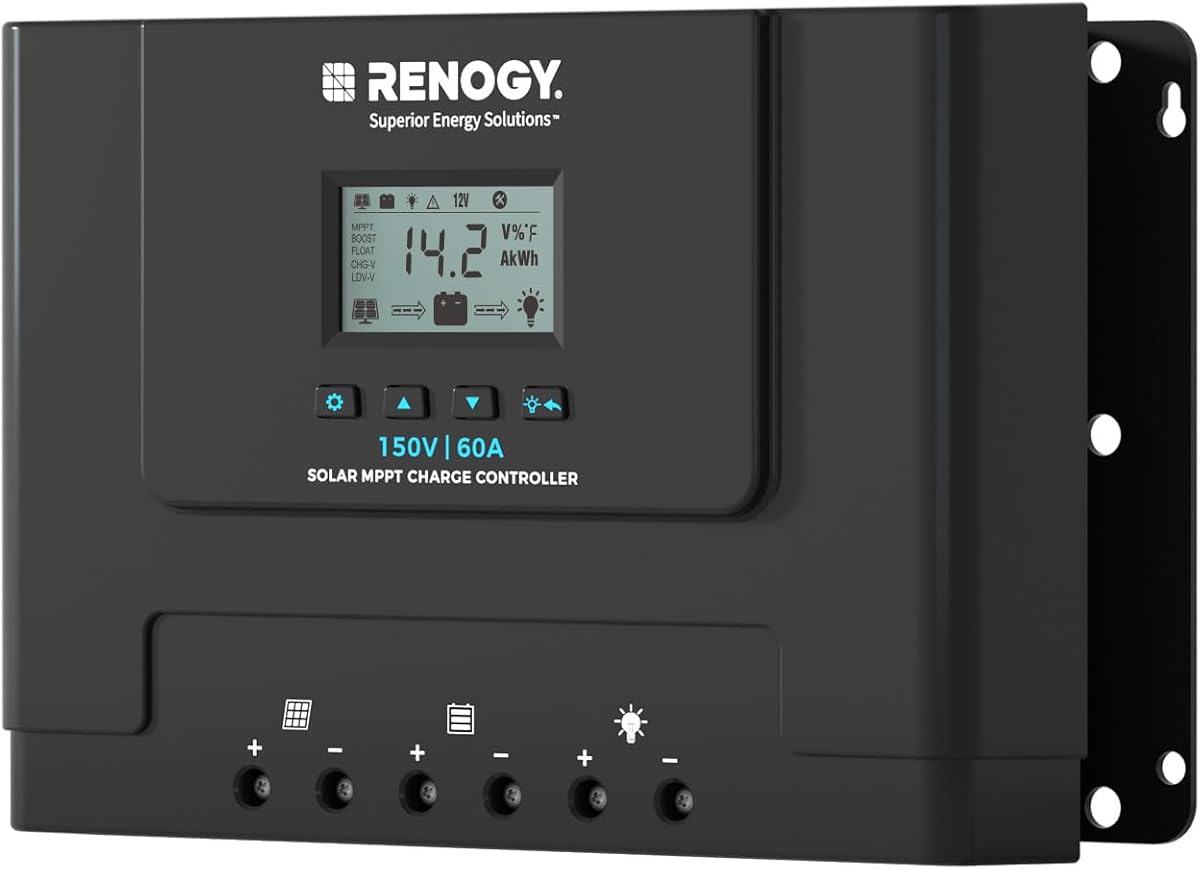
The Renogy 60A MPPT Solar Charge Controller 12V/24V/36V/48V Auto, 150V Maximum Solar Input, for Gel Sealed Flooded and Lithium Battery, Rover Lite 60A is designed for large solar arrays and high-capacity battery banks. Its 4.4 rating reflects positive customer reception, while the 150-volt maximum input gives installers more freedom to connect panels in series than most competing 60-amp models.
We may earn a commission when you buy through this link, at no additional cost to you.
The supplied information states that it can connect as many as six Renogy 200-watt monocrystalline solar panels in series. The higher input voltage can reduce wiring complexity compared with a lower-voltage parallel installation. It also supports 12-, 24-, 36-, and 48-volt systems and works with gel, sealed, flooded, and lithium batteries, making it relevant to a wide range of professionally planned arrays.
Thermal performance is another important feature. The controller is described as capable of full-load operation from -31°F to 113°F. Low-temperature protection safeguards lithium batteries, while a self-cooling design supports efficiency in high heat. The LCD, user-friendly buttons, and clearly labeled ports simplify on-device operation, and the product carries FCC, RoHS, and CE certifications along with a two-year warranty.
The crucial caveat is that this is not a controller with built-in Bluetooth. It is compatible only with the separate Renogy BT2 Bluetooth module, which is sold separately. Buyers who require immediate app monitoring must purchase that accessory and confirm the complete package contents. This distinction matters because several other products in the guide integrate Bluetooth directly into the controller.
For a large array, a long series string, or a high-capacity 48-volt system, the Rover Lite 60A offers excellent electrical headroom and flexible voltage support. It is less attractive for small systems, and its Bluetooth requirement adds a step that should be planned before installation. With the appropriate module and correctly sized solar and battery equipment, it is a capable high-capacity choice.
A higher maximum solar input allows compatible panels to be placed in series, potentially reducing the amount of parallel wiring required. Every series string must still be checked against the controller's voltage limit under the site's worst-case conditions.
The Rover Lite 60A does not include integrated Bluetooth. It requires the separately sold Renogy BT2 Bluetooth module, so users who want smartphone monitoring should include that accessory in the installation budget and verify package contents before ordering.
We may earn a commission when you buy through this link, at no additional cost to you.
The right controller depends on electrical compatibility, expected array output, battery chemistry, monitoring needs, and the physical environment. Review the following factors before choosing a model or beginning installation.
For most mobile systems, a 15- to 30-amp controller is sufficient; larger installations may justify 40 or 60 amps. Match the final choice to both the array and the battery bank's realistic charging demand rather than relying on a single marketing number.
Calculate the coldest-location open-circuit voltage first, then confirm that it remains within the controller limit with an appropriate margin. This check is essential for every installation, especially those involving long series strings.
Confirm nominal voltage, chemistry, and required charge stages before purchase. Incorrect battery configuration can reduce charging performance, trigger protection functions, or damage connected equipment.
List the app features you actually need and verify whether Bluetooth is built in. If remote monitoring is important, confirm compatibility, connection range, and whether a separate accessory must be purchased.
Choose a model with a display and controls that match the installation. Remote apps improve monitoring, but local visibility is still valuable for setup, troubleshooting, and systems in hard-to-reach locations.
Compare the protection list with the risks posed by your battery chemistry and location. More safeguards are useful, but correct wiring, fusing, ventilation, and battery selection remain the foundation of a safe installation.
Allow the manufacturer-recommended ventilation space and avoid enclosing the controller in a sealed, heat-retaining compartment. Check current draw, enclosure size, and expected ambient temperature before finalizing the installation.
Confirm expansion limits and required accessories before installation. A planned expansion path is more useful than nominal support that does not match the intended battery voltage or communication setup.
Begin by confirming the battery bank's nominal voltage and chemistry, then configure the controller with the correct charge profile before connecting solar panels or loads. Review the maximum PV input voltage and calculate the array's worst-case open-circuit voltage. Connect the battery and equipment in the order specified by the manual, observing polarity, fusing, grounding, and torque requirements for every terminal.
After wiring is complete, power up the controller and verify that the display and app show the correct battery voltage, operating status, and charge mode. Connect the Bluetooth function, select the appropriate battery preset, and confirm any low-temperature, load-disconnect, and parallel-operation settings. When adding a second controller, use the required communication or parallel cable and ensure both units are configured for the same battery voltage.
For routine care, inspect the display, app data, and error indicators periodically. Keep the enclosure dry, vents unobstructed, and terminals clean and secure. Review historical production and battery trends, update firmware when appropriate, and investigate unexpected load disconnections, abnormal voltage, reduced charging, or repeated error codes rather than assuming a temporary weather effect.
Bluetooth is not required for charging, but it makes the system easier to monitor and configure remotely. It can display real-time solar, battery, and load data, preserve performance history, and allow settings to be changed from a phone. Some controllers include Bluetooth, while others require a separate communication module, so check the package contents before ordering.
The amperage rating indicates the controller's maximum charging current toward the battery bank. A 20-amp model is appropriate for a smaller array and battery system, while a 60-amp model can handle much larger arrays and recover deeply discharged banks more quickly. A higher rating only helps when the solar array and wiring can support it.
First calculate the solar array's open-circuit voltage, including all panels connected in series. Then increase that figure for the lowest expected ambient temperature to account for rising panel voltage. The resulting value must remain safely below the controller's maximum PV input rating, with additional margin applied according to the installation guidance.
Yes, provided the combined configuration remains within the controller's maximum current and input-voltage limits. Panels may be connected in series or parallel as their ratings permit, but the array's open-circuit voltage and expected output must both be checked. Incorrect series configuration can create a serious overvoltage hazard.
Many controllers support both, but only when the correct battery chemistry and charge profile are selected. Lead-acid and lithium batteries require different voltage and charging behavior, and some models detect 12- or 24-volt lead-acid systems automatically while requiring manual lithium voltage selection. Always follow the battery manufacturer's recommended settings.
Tracking efficiency describes how effectively the controller identifies the solar array's maximum power point and adapts as conditions change. High tracking efficiency helps preserve available energy when irradiance, temperature, or shading alters the panel output. Actual system results also depend on panel quality, wiring, orientation, weather, and correct charge configuration.
Several models support parallel operation, but compatibility is essential. Controllers should generally be the same model or an explicitly supported combination, use the same battery voltage, and have compatible settings. Some parallel functions require a dedicated cable sold separately, and each controller's array and battery wiring must still meet its own ratings.
Battery voltage naturally changes with state of charge, charging stage, temperature, and recent load. A lower reading after heavy use is not automatically a fault, and a higher reading during absorption may be normal. Check error codes, compare the reading with the local display, and verify that the correct battery chemistry and voltage were selected before assuming the controller has failed.
The Renogy Rover 20A stands out as a value-oriented option with established MPPT performance, Bluetooth monitoring, local diagnostics, and load control. The Victron SmartSolar 30A is the strongest all-around choice for a medium-sized system, offering a 4.7 rating, balanced output, extensive app configuration, and coordinated expansion. The Dyness 40A takes the premium position with a 4.8 rating, 300-day history, integrated app control, flexible load modes, and parallel support.
Prioritize electrical compatibility over connectivity alone. Select a controller whose battery voltage, current rating, and maximum PV input match the planned array, then confirm the required charge profile and protections. Built-in Bluetooth is more convenient than a separate module, but the depth of app history, load controls, firmware support, and expansion features differs across the products and should influence the final decision.
Finally, verify the current listing, package contents, accessories, and technical documentation before purchasing. Product configurations and compatible accessories can change, and market prices fluctuate over time. Checking the latest details helps ensure that the selected controller, communications module, panels, and battery bank form a safe and properly sized system.