
Mcbazel Surecom SF401 Plus
4.1Editor score
27MHz–3000MHz frequency coverage
CTCSS and DCS decoding
TCXO timing stability
Two-way radio testing focus
Frequency Counter for Ham Radio buyer’s guide comparing 10 portable, spectrum analyzer, GPSDO, and module models for accurate RF testing and calibration at
A frequency counter for ham radio can help identify operating frequencies, examine transmitters, tune receiving equipment, and verify oscillators with greater confidence. The most useful model is not always the most advanced one; range, accuracy, signal handling, display quality, and practical controls must match the signals and equipment you routinely work with.
The products compared here cover portable two-way-radio counters, a compact spectrum analyzer, bare circuit-board modules, and a GPS-disciplined precision instrument. We evaluated the supplied specifications for frequency coverage, timing accuracy, decoding functions, power options, connectivity, portability, and suitability for amateur-radio service work.
Each review explains the most useful capabilities, important limitations, and the kind of operator who may benefit from that design. Ratings and product details can change over time, while prices and availability fluctuate frequently, so readers should confirm the current listing and accessories before purchasing.
4.1Editor score

4.4Editor score

5.0Editor score
This side-by-side comparison highlights the major differences in frequency range, measurement capability, decoding, portability, and reference stability. It includes dedicated radio-service counters, an analyzer, simple modules, and a precision GPSDO-based instrument so buyers can identify the right category before examining the details.


The Mcbazel Surecom SF401 Plus is a portable counter intended primarily for checking continuous-carrier transmissions from two-way radios. It covers 27MHz through 3000MHz, includes CTCSS and DCS decoding, and has a 4.1 rating. Its most appealing combination is broad radio-service coverage in a relatively simple handheld format.
We may earn a commission when you buy through this link, at no additional cost to you.
The supplied specifications highlight selectable ranges, a signal-strength indicator, and an easy four-button control scheme. Temperature compensation comes from a TCXO, with stated accuracy varying from approximately ±2ppm to ±4ppm over a temperature range of -45°C to 65°C. The package includes separate 144/430MHz and 400–470MHz antennas, an AC adapter, a USB cable, and a manual.
This is not a wideband spectrum analyzer, so operators should not expect to inspect complex emissions or identify unknown activity across a broad span. Its intended job is to count the frequency of a continuous carrier. The included radio antennas and focus on walkie-talkie signals make it more relevant to amateur-radio repeater, simplex, and two-way-radio work than to advanced laboratory analysis.
It is a sensible choice for an operator who wants a portable, dedicated counter with broad VHF and UHF coverage without moving into analyzer or precision-reference territory. Verify that the supplied antennas suit the bands and devices being tested, read the input limitations, and compare it with the FC-2800M when lower-range measurements or different band coverage matter.
The 27MHz–3000MHz span covers a large portion of the VHF and UHF radio spectrum commonly encountered by amateur operators and service technicians. Selectable ranges help narrow the instrument to relevant bands, while the signal-strength indication provides context beyond the numeric frequency alone.
CTCSS and DCS decoding is valuable when confirming which tone or digital squelch code a radio is using. The TCXO-based time base is also a meaningful improvement over a simple uncompensated oscillator when measurements must remain reasonably stable as ambient temperature changes.
We may earn a commission when you buy through this link, at no additional cost to you.
The Surecom SF401 Plus is another dedicated 27MHz–3000MHz portable counter, and its 4.3 rating is slightly higher than that of the closely related first-ranked model. It targets continuous-carrier signals from two-way radios and combines frequency measurement, signal-strength indication, and CTCSS/DCS decoding.
We may earn a commission when you buy through this link, at no additional cost to you.
Its straightforward control layout is appropriate for technicians who need to identify a transmitter frequency quickly rather than navigate a complex menu. Selectable ranges cover most of the frequencies used by common two-way radios, and the compact enclosure makes the unit suitable for field work, benches, or radio-maintenance tool kits.
The principal limitation is its narrow operating concept. It is designed around continuous-wave radio signals and is explicitly not suitable for wide bandwidth analysis. Operators who need to examine modulation, spectral occupancy, or multiple signals in a broad span should consider the TinySA or a more analytical instrument instead.
For a user seeking a portable counter dedicated to everyday two-way-radio checks, this model offers an attractive balance of coverage, useful decoding, and simple operation. It is particularly appropriate for amateur-radio users who maintain conventional or DMR-related equipment and need a straightforward way to confirm operating frequencies.
When a radio is transmitting, this counter is designed to provide its operating frequency directly. The signal-strength indicator adds useful context, allowing the operator to compare readings as transmit power, antenna placement, or distance changes.
The small body and four-button interface reduce the learning curve for technicians who may use the meter only occasionally. A dedicated counter of this type can be more convenient for a quick frequency check than a general-purpose analyzer with many display modes and controls.
We may earn a commission when you buy through this link, at no additional cost to you.
The FC-2800M combines a 4.4 rating with a versatile range arrangement: one operating range covers 2MHz–200MHz, while the other covers 27MHz–2800MHz. It is designed for VHF, UHF, CB, amateur-radio, and DMR continuous-carrier measurements, with CTCSS and DCS decoding included.
We may earn a commission when you buy through this link, at no additional cost to you.
A low-PPM crystal time base supports more precise frequency readings, which is useful when checking radios against programmed channels or expected repeater frequencies. The four-button layout keeps operation approachable, and the compact body should be easy to deploy on a workbench, at a station, or during a portable maintenance call.
The product remains a frequency counter rather than a spectrum analyzer. It is best suited to measuring an active carrier and reading the associated tone or code. It cannot replace a wideband analyzer when the operator needs to visualize a crowded band, assess occupied bandwidth, or investigate unexpected emissions.
This is the most balanced choice in the list for a ham-radio operator who wants broad utility without the complexity of the TinyGTC or the analysis features of the TinySA. Its flexible ranges, decoding, favorable rating, low-PPM reference, and stated two-year warranty make it an especially practical all-around radio-service instrument.
The lower range reaches down to 2MHz, while the upper range extends to 2800MHz. This arrangement supports different portions of the radio spectrum without forcing the instrument to cover everything in one undivided band, although users must select the appropriate range.
The low-PPM crystal reference is a key feature for operators checking programmed channels. Combined with CTCSS and DCS decoding, it helps confirm both the carrier frequency and the squelch function expected from a compatible two-way radio.
We may earn a commission when you buy through this link, at no additional cost to you.
The Portable TinySA Spectrum Analyzer is fundamentally different from the dedicated counters in this roundup. Instead of displaying only a measured frequency, it provides a visual representation of RF energy across selectable spans. Its 4.4 rating reflects a flexible approach to field and bench analysis.
We may earn a commission when you buy through this link, at no additional cost to you.
The instrument covers 100kHz to 960MHz through dual analysis ranges: 0.1–350MHz and 240–960MHz. Users can select resolution bandwidth from 2.6kHz to 640kHz, view as many as 290 scan points on the 2.8-inch color touchscreen, and connect to Windows or Linux systems for remote measurements and command access.
A built-in signal generator provides a 0.1–350MHz sine-wave output and a 240–960MHz square-wave output. An internal calibration source supports self-testing and low-input calibration. These additions make the device more than a simple counter, although it should not be confused with the 40ps resolution of a high-precision GPSDO timer.
The TinySA is best for ham operators who want to locate signals, inspect relative activity, test antenna-related behavior, and perform general RF troubleshooting. It is less appropriate when the sole requirement is a direct numeric frequency check or when signals above 960MHz need to be measured. Its visual output also demands more RF familiarity.
A spectrum view reveals more than a single counter reading. Operators can compare signal levels, identify nearby activity, and examine how a source appears across a selected span, making the TinySA useful for exploratory station work and troubleshooting.
The internal calibration source adds confidence during setup, while the built-in generator can support basic RF tests. These functions make the analyzer a more complete bench companion without requiring a separate instrument for every preliminary troubleshooting task.
We may earn a commission when you buy through this link, at no additional cost to you.
The Portable UHF/VHF Counter is built for operators who need a small, uncomplicated instrument for common amateur-radio handheld and mobile frequencies. It measures VHF from 136–174MHz and UHF from 400–470MHz, includes CTCSS and DCS decoding, and carries a 4.1 rating.
We may earn a commission when you buy through this link, at no additional cost to you.
Its one-button control is exceptionally simple. A long press turns the unit on or off, while a normal press advances to the next test after the frequency appears on the display. A 9V battery and included antenna support portable operation, and the enclosure measures only 9 by 5.5 by 2cm.
The important trade-off is its restricted coverage. It is not a general counter for the HF bands, and it cannot cover higher UHF frequencies such as those used by many 70cm amateur-radio repeaters. The stated one-meter measurement range also means it should be used with the radio at an appropriate close distance rather than treated as a remote receiver.
This meter is best for quick checks of compatible VHF or UHF handhelds, inexpensive two-way radios, and similar equipment. Operators who work across several bands or need a carrier in the upper UHF range should select a broader model. For its narrower purpose, however, the simple controls and compact size are practical advantages.
The control scheme is easy to remember: long press for power and short press to continue testing. That simplicity makes the meter useful for technicians who want to carry a dedicated checker without navigating menus or configuring complicated measurement profiles.
The two ranges correspond to many common handheld-radio frequencies. An included antenna and 9V battery make the unit convenient for bench or field checks, provided the target transmission falls within the stated VHF or UHF windows.
We may earn a commission when you buy through this link, at no additional cost to you.
The Anysecu SF-103 is a portable 2MHz–2.8GHz counter designed for two-way-radio maintenance, frequency testing, and signal-strength checks. Its 4.2 rating reflects a broadly useful design for technicians and wireless enthusiasts who need coverage beyond the common VHF and UHF repeater bands.
We may earn a commission when you buy through this link, at no additional cost to you.
Selectable ranges let the operator concentrate on the relevant portion of the spectrum, and the signal-strength indicator provides more context than a lone frequency number. The four-button layout is simple enough for routine use, while the stated DMR support makes it relevant to users maintaining digital mobile-radio equipment.
Like the other dedicated portable counters, it is intended to count continuous-carrier signals rather than provide a broad spectral display. It therefore cannot answer the same questions as the TinySA, such as the exact shape of a modulated signal or the occupancy of a wider frequency span.
The SF-103 is a strong option for a service-oriented amateur-radio operator who works on equipment across much of the 2MHz–2.8GHz range. It may be particularly attractive for users who want a portable instrument with signal-strength and tone-related radio functions. The lack of a detailed temperature-accuracy specification in the supplied information should be considered for precision work.
The combination of broad frequency coverage and a signal-strength indicator is useful when checking radios under different conditions. A technician can confirm the operating frequency and observe how the signal indication responds as the radio or antenna position changes.
The stated DMR support extends the instrument beyond basic carrier checks for users who maintain digital two-way equipment. It remains a specialized counter, so more advanced modulation or spectrum analysis is outside its stated purpose.
We may earn a commission when you buy through this link, at no additional cost to you.
The Mcbazel Surecom SF-103 combines 2MHz–2.8GHz coverage with a TCXO-based reference and a stated accuracy of approximately ±2ppm to ±4ppm from -45°C to 65°C. Its 4.3 rating makes it one of the stronger dedicated portable counters in this comparison, particularly for users who value timing stability.
We may earn a commission when you buy through this link, at no additional cost to you.
The frequency span includes the 2m amateur-radio area along with VHF and UHF bands, giving technicians a single instrument for many conventional radio checks. A signal-strength indicator, DMR support, and battery-level display add useful context without turning the device into a complicated analyzer.
Input handling deserves careful attention. The supplied information sets a maximum direct input of 5Vp-p and warns against connecting directly to a radio antenna output because doing so could damage the counter. Those restrictions make it essential to use an appropriate attenuator or coupling arrangement and to follow the included guidance.
This model fits operators who want a stable, portable frequency counter for bench and field service. It is more clearly documented in the supplied specifications than some alternatives regarding timing behavior, although it remains limited compared with the TinyGTC in precision, analysis, and reference control. Always observe the stated input limits.
The TCXO reference helps maintain measurement consistency across changing ambient conditions. For operators checking a radio on a cold morning or in a warm workshop, this is more relevant than a basic uncompensated oscillator that may drift as temperature changes.
The explicit maximum-input and antenna-output warnings are positive aspects of the documentation, even though they limit casual connection methods. A technician should use the correct antenna and interface rather than attempting to maximize signal level at the input.
We may earn a commission when you buy through this link, at no additional cost to you.
The Acxico 1–500MHz module is a compact frequency-counter board intended for ham-radio builders and electronics projects. It covers 1MHz through 500MHz, uses a digital 0.08-inch LCD, and is constructed from PCB and FR4. Its 3.1 rating reflects the trade-offs of a simple, project-oriented instrument.
We may earn a commission when you buy through this link, at no additional cost to you.
The module provides a direct numerical display without the bulk of a handheld enclosure. That makes it potentially appealing to builders who want to embed frequency monitoring in a custom project, experiment with RF measurement, or add a dedicated counter to an existing station setup.
The specification notes that accuracy can only be adjusted to the second digit after the decimal point, which places a clear limit on precision. The small display may also be difficult to read without close viewing. Unlike the completed portable instruments, the module does not present the same ready-to-carry enclosure or accessory ecosystem.
The Acxico module is best for an experimenter who values a DIY counter board more than polished portability or laboratory-grade reference stability. It should not be selected for precision calibration without additional verification. A finished instrument such as the FC-2800M or SF-103 is the safer choice for routine radio maintenance.
Because the counter is supplied as a module, it can be incorporated into a larger educational or diagnostic setup. Operators can use the display to observe a changing carrier while building or testing oscillators, receivers, and transmitter stages.
The stated adjustment limit is important when setting expectations. Users should treat the displayed value as a practical counter reading rather than a precision laboratory reference, especially if the circuit is built for calibration or frequency-comparison work.
We may earn a commission when you buy through this link, at no additional cost to you.
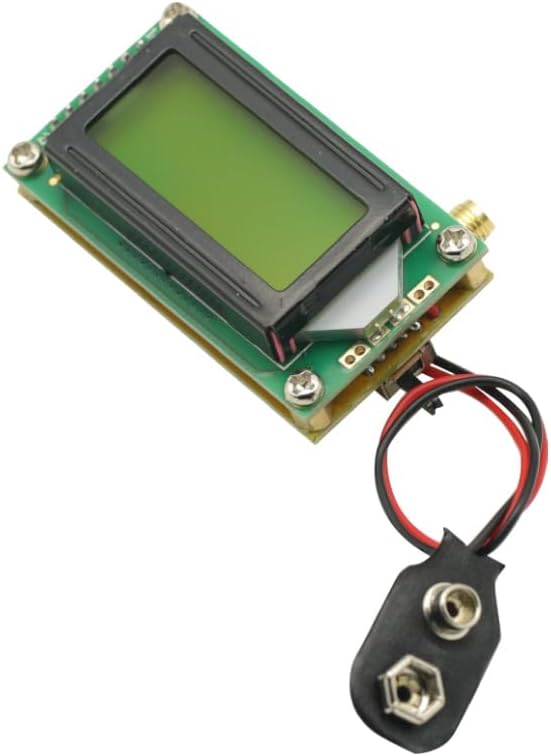
The 1–500MHz Frequency Counter Meter Board is the simplest DIY-oriented product in the roundup. It combines a 1MHz–500MHz frequency counter with an LCD display on a single board, and its 3.6 rating places it above the bare Acxico module but below the finished portable instruments.
We may earn a commission when you buy through this link, at no additional cost to you.
Low power consumption is one of the board's clearest stated benefits. That characteristic can be useful in a compact operating setup, a demonstration project, or a custom station monitor where a dedicated handheld enclosure would be unnecessary. The integrated display provides immediate frequency feedback.
The supplied specification is limited, however, and does not provide a detailed timing-accuracy figure, input rating, decoding capability, or accessory list. Those omissions make it difficult to compare the board confidently with precision devices on factors beyond range and display. Buyers must also consider the work involved in supplying power, connecting an appropriate RF input, and handling an exposed board.
This product makes the most sense for hobby builders who want a straightforward counter module for a ham-radio kit or experimental setup. For dependable field service or a ready-to-use instrument, a completed counter with documented accuracy, antennas, and controls is more convenient. A serious purchase should begin by confirming the board's complete specifications.
The integrated LCD and 1–500MHz coverage provide enough functionality for basic frequency observation without purchasing a full portable meter. It can serve as the foundation for a learning bench or a dedicated display within a larger project.
Because the supplied information is brief, builders should confirm power requirements, input limitations, display behavior, and available documentation before committing to installation. Those details are especially important when the board will be connected near active RF equipment.
We may earn a commission when you buy through this link, at no additional cost to you.
The AURSINC TinyGTC is a high-precision, dual-channel frequency counter and timer with an integrated GPS-disciplined oscillator. Its 5.0 rating and 40ps resolution place it at the opposite end of the roundup from the simple counter boards, offering exceptional capability for calibration, SDR reference verification, and advanced RF work.
We may earn a commission when you buy through this link, at no additional cost to you.
Channel A supports gapless interpolated reciprocal counting from 0.1Hz to 7GHz, while Channel B covers 0.1Hz to 350MHz. The two independent channels can measure frequency, phase, count, and time intervals with stated accuracy up to 5e-12 per second. The integrated GPSDO uses a premium TCXO and is specified to achieve approximately 1e-10 ADEV at short averaging intervals from 1 to 100 seconds.
This is far more than a simple numeric meter. The 4-inch touchscreen and backup jog wheel support bench or field operation, while a rechargeable 4000mAh battery permits handheld use. On-device tools include real-time charting, histograms, ADEV, FFT, and FM deviation analysis, with USB logging, SD-card storage, SCPI remote control, and compatibility with TimeLab and professional analysis software.
The TinyGTC is ideal for advanced amateur-radio builders, calibration-minded operators, and users who need to verify SDR boards, signal generators, oscillators, and radio references. It also supports an external 10MHz reference input. Its complexity and premium-oriented design may be excessive for someone who only wants to confirm a handheld radio's frequency, but for its intended precision work, the feature set is exceptionally complete.
The integrated GPSDO is the defining feature. By locking to a GPS reference, the instrument can maintain excellent long-term stability while also supporting an external 10MHz input for calibration tasks involving SDRs, generators, and radio equipment.
Two independent high-resolution channels support more complex measurements than a conventional single-channel counter. Real-time charts, ADEV, FFT, histograms, FM deviation analysis, and data export turn the unit into a portable analysis platform for serious RF work.
The rechargeable battery, touchscreen, and jog wheel provide multiple ways to operate the device. A complete accessory kit includes an active GPS antenna, USB cable, two 30cm coax cables, and an SMA tee, reducing the need to source every basic connection before starting.
We may earn a commission when you buy through this link, at no additional cost to you.
The right frequency counter depends on the bands you use, the accuracy you need, and whether you want a numeric reading or a broader view of RF activity. The following factors help separate simple radio-service tools from spectrum analyzers, DIY modules, and precision timing instruments.
Start with the frequencies your equipment actually uses. Dedicated two-way-radio counters commonly cover VHF and UHF, while some models extend down into the 2m amateur-radio area or upward into higher UHF bands. The TinySA adds visual analysis from 100kHz to 960MHz, and the TinyGTC extends one channel to 7GHz. A nominally wide range is useful only if it includes the band where the signal is present and the instrument's input and antenna arrangement are appropriate for that band.
Accuracy determines how confidently you can compare a transmitter with its programmed channel or nominal frequency. TCXO-based counters improve stability over basic oscillators, low-PPM references offer another useful step, and a GPSDO provides long-term traceability for demanding calibration work. A large displayed number does not necessarily mean laboratory-grade accuracy, so consider the documented time base and environmental qualifications rather than relying on decimal places alone.
A frequency counter answers the question of what frequency a continuous carrier is using. A spectrum analyzer adds a visual view of amplitude across a range of frequencies, helping users identify nearby signals, inspect occupied spans, and troubleshoot RF conditions. If your work requires only a direct channel check, a counter is simpler and more focused. If you routinely investigate interference, tune antennas, or explore a band, the TinySA offers substantially more useful context.
CTCSS and DCS decoding identifies the continuous-tone or digital squelch code carried by a two-way transmission. Several dedicated counters include these functions, which helps an operator verify both carrier frequency and squelch behavior. This is especially relevant for DMR-capable equipment and commercial or amateur systems using coded squelch. It is not a substitute for decoding every modulation format, however, so radio-specific requirements should be checked before purchase.
A counter's input section must be protected from excessive transmitter output. The Mcbazel Surecom SF-103 states a maximum direct input of 5Vp-p and specifically warns against direct antenna-output connection. Similar caution applies to other models, even when they include an antenna. Use the supplied or appropriate antenna, attenuators, and a controlled test setup rather than assuming a strong nearby transmission can safely enter the input.
A bench instrument and a field tool have different practical requirements. Small handheld units with four-button controls are easy to deploy for radio maintenance, while the single-button meter offers even less complexity. The TinySA and TinyGTC use larger touchscreens and rechargeable batteries, making them more capable but less minimalist. Consider battery type, included power accessories, readability, and how often the instrument will be carried rather than focusing only on dimensions.
Advanced instruments add value when their outputs support a real workflow. The TinySA provides USB control under Windows or Linux, while the TinyGTC supports charting, ADEV, FFT, FM deviation analysis, USB logging, SD-card storage, and SCPI remote control. These features help with repeatable measurements, long-running tests, and integration with analysis software. They are unnecessary for a single transmitter check but compelling for calibration, homebrew development, and professional troubleshooting.
An antenna for the intended band, suitable cables, power supply, and clear operating documentation can determine whether a counter is useful on arrival. The SF401 Plus package includes two radio antennas, an AC adapter, a USB cable, and a manual. The FC-2800M includes a stated two-year warranty, while the TinyGTC ships with an active GPS antenna and RF interconnects. Confirm what is included and how the manufacturer supports the product before ordering.
Before measuring, read the manual and identify the counter's input limits, supported bands, required power, and recommended antenna. Inspect the connector and cable for damage, install the correct accessory, and allow the instrument to stabilize according to its instructions. For temperature-sensitive precision work, give the TCXO or GPS-referenced device time to reach a stable state before relying on the display.
Place the radio and counter in a configuration that produces a safe, usable input signal. Do not connect the counter directly to an antenna output unless the manufacturer expressly permits it. For portable two-way-radio meters, hold the radio or position the antenna within the specified close measurement distance. For the TinySA, choose an appropriate resolution bandwidth and span so the signal is visible without unnecessary spectral overload.
Record the displayed frequency, signal level, and any decoded CTCSS or DCS information, then compare those results with the channel plan or expected values. Clean the enclosure or board with a dry, soft cloth, keep moisture away from openings, and store cables without sharp bends. Protect bare modules from static and physical stress, and avoid charging or operating any device outside the manufacturer's environmental and power guidance.
It is used to measure the operating frequency of a transmitting device, helping technicians confirm programmed channels, repeater frequencies, and oscillator behavior. Some models also show signal strength and decode CTCSS or DCS squelch codes. For advanced interference work, a spectrum analyzer provides a more complete view of the surrounding RF activity.
It depends on the model. The FC-2800M, Anysecu SF-103, and Mcbazel Surecom SF-103 include low-frequency coverage down to 2MHz, while the two SF401 Plus models begin at 27MHz. The Acxico and generic counter boards begin at 1MHz. Check the exact input range, antenna requirements, and any operating restrictions before testing an HF transmitter.
Neither is universally better. A dedicated counter is faster and simpler when the only goal is to read a carrier frequency, while a spectrum analyzer is more useful for locating signals, comparing levels, and examining a range of frequencies. The TinySA provides a visual display, whereas most of the dedicated counters in this guide show a direct numeric result.
CTCSS uses continuous subaudible tones, while DCS uses digital squelch codes to control receiver opening. A counter with decoding can confirm the code associated with a transmission as well as its carrier frequency. This is useful for testing compatible amateur, commercial, and DMR-capable two-way radios.
Usually not. For routine channel checks and radio service, a TCXO or low-PPM counter is generally practical. A GPSDO becomes valuable when measuring oscillator stability, calibrating references, verifying SDR timing, or performing long-duration measurements where a traceable and highly stable reference is important.
Do not assume that connection is safe. Some models, including the Mcbazel Surecom SF-103, state a maximum direct input and warn against direct connection to a radio antenna output. Use the correct antenna, attenuation, or coupling method specified by the manufacturer. Excessive input can damage the counter or create inaccurate readings.
The compact one-button UHF/VHF meter is among the simplest to carry and operate, with a small body and 9V battery. The SF401 Plus models are also portable, while the TinySA and TinyGTC offer more displays and features in exchange for greater size and complexity. Choose based on how much analysis the field task actually requires.
They can be useful in a project, but they are not equivalent to a finished test instrument. The boards in this guide cover 1–500MHz and provide an LCD, yet the supplied information gives less detail about accuracy, input handling, and accessories. Confirm the specifications and provide suitable power and RF connections before installing one near valuable equipment.
The FC-2800M stands out as the most versatile dedicated radio counter in this group, combining dual ranges, a low-PPM time base, CTCSS and DCS decoding, and a 4.4 rating. The Mcbazel Surecom SF401 Plus is a practical portable alternative with broad 27MHz–3000MHz coverage, while the AURSINC TinyGTC represents the premium path for GPS-referenced precision, dual-channel measurement, and advanced analysis.
Prioritize the job before the specifications. Choose a dedicated counter for quick carrier and squelch-code checks, a spectrum analyzer for visual exploration of RF activity, a bare board for a custom project, and a GPSDO-based timer for calibration or reference work. Also match the range to the bands, confirm the input limitations, and consider the included antennas and power accessories.
Ratings, product details, prices, and availability can change, so check the current listing before ordering. Confirm the exact model, current specifications, accessories, return terms, and manufacturer support. With those checks completed, the right instrument can make everyday radio troubleshooting faster, more accurate, and considerably more informative.