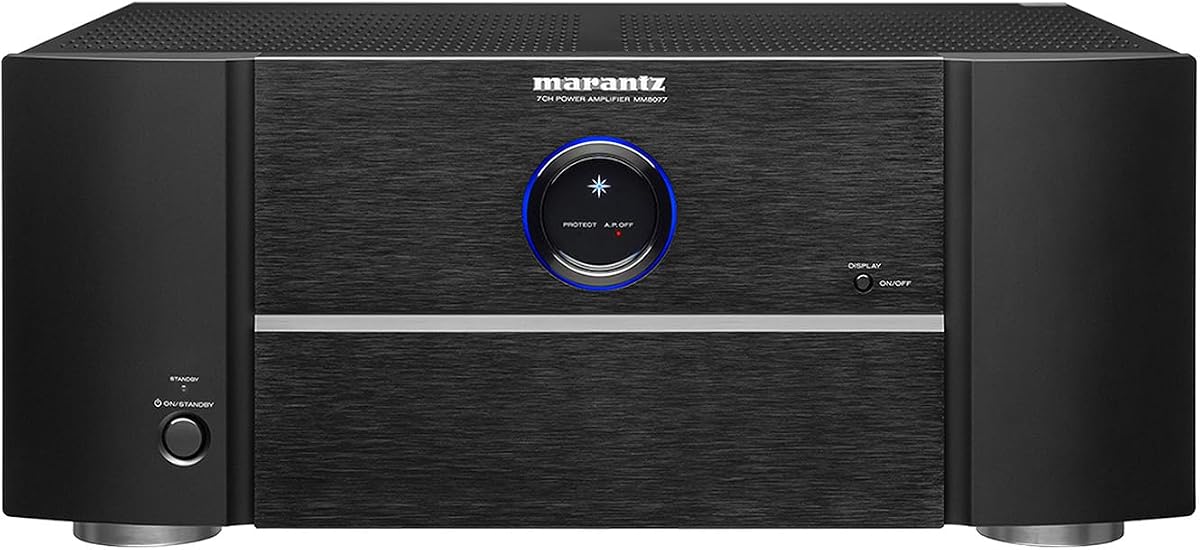
Marantz MM8077
4.1Editor score
Seven-channel home theater design
Balanced XLR and RCA inputs
Uniform multi-channel architecture
Discover the best 7 Channel Amp for Car and Home Audio, comparing power, channel flexibility, controls, protection, and installation fit for modern systems.
Seven-channel amplifiers offer an efficient way to power a complete car or home theater system without filling the installation area with separate units. The right model should provide clean output, flexible channel routing, effective filtering, dependable protection, and controls suited to its intended environment.
This guide compares ten amplifiers using the supplied specifications, including channel configuration, output capability, input options, crossover controls, monitoring features, and physical design. It also includes versatile multi-channel models that can be reconfigured for compact or conventional speaker layouts.
Each review identifies the strongest use case, important compromises, and the features most likely to matter during installation. Product availability, configuration options, and market conditions can change, so readers should verify current specifications and prices before making a final purchasing decision.
4.1Editor score
5.0Editor score
5.0Editor score
The comparison below highlights channel flexibility, power configurations, filtering and remote-control capabilities, and the environments each amplifier is designed to serve.


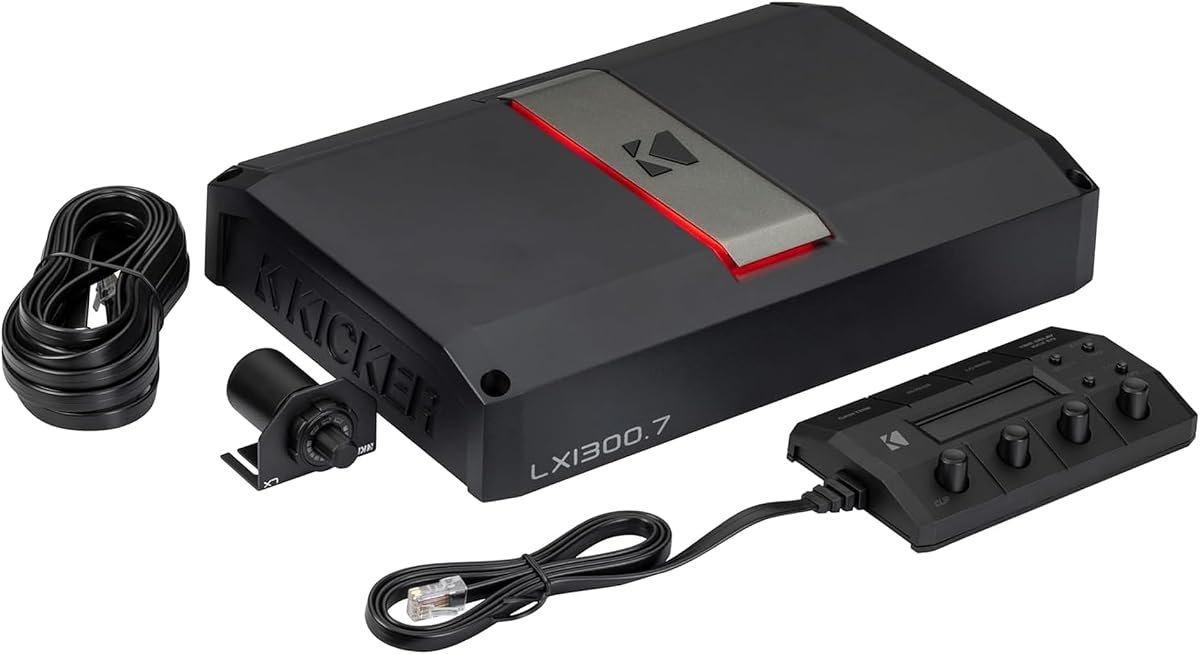
The Kicker LX1300.7 is the most complete dedicated seven-channel amplifier in this guide, combining four full-range channels, two additional full-range channels, and a high-output subwoofer section. Its 5.0 rating reflects a strong overall proposition, while the supplied specifications distinguish it through real-time monitoring, remote bass control, and extensive channel flexibility.
We may earn a commission when you buy through this link, at no additional cost to you.
The amplifier can deliver 150 watts across four channels at two ohms, 65 watts across two channels at two ohms, and 700 watts into a subwoofer at one ohm. This arrangement suits a sophisticated vehicle installation in which front and rear speakers, additional tweeters or midrange drivers, and one or more subwoofers need centralized amplification.
The included LX Control Center monitors battery voltage, amplifier temperature, and protection status while providing access to gain and crossover adjustments. The LX Remote Control adds convenient bass-level changes from the driver area, and SHOCwave2.0 is intended to restore low-frequency impact lost during processing. Class-D efficiency, FIT+ noise rejection, signal acceptance up to 40 volts, and an RGB-accented reversible panel further distinguish the unit.
The main compromise is complexity. A seven-channel amplifier with multiple adjustment and monitoring functions is less approachable than a simpler fixed-layout unit, and its substantial power capability makes careful electrical planning essential. Despite those considerations, it is the strongest recommendation for a comprehensive car system because it combines the required channel count, output flexibility, diagnostics, and everyday remote conveniences in one enclosure.
Keeping multiple speaker groups on one amplifier reduces the need to coordinate several separate units. The LX Control Center places important voltage, temperature, protection, gain, and crossover information in one place, making it easier to identify installation or system issues.
The dedicated 700-watt channel provides the foundation for a serious car-audio subwoofer section. Pairing it with the included remote gives the driver convenient level adjustment while the Class-D design controls heat and electrical consumption.
We may earn a commission when you buy through this link, at no additional cost to you.
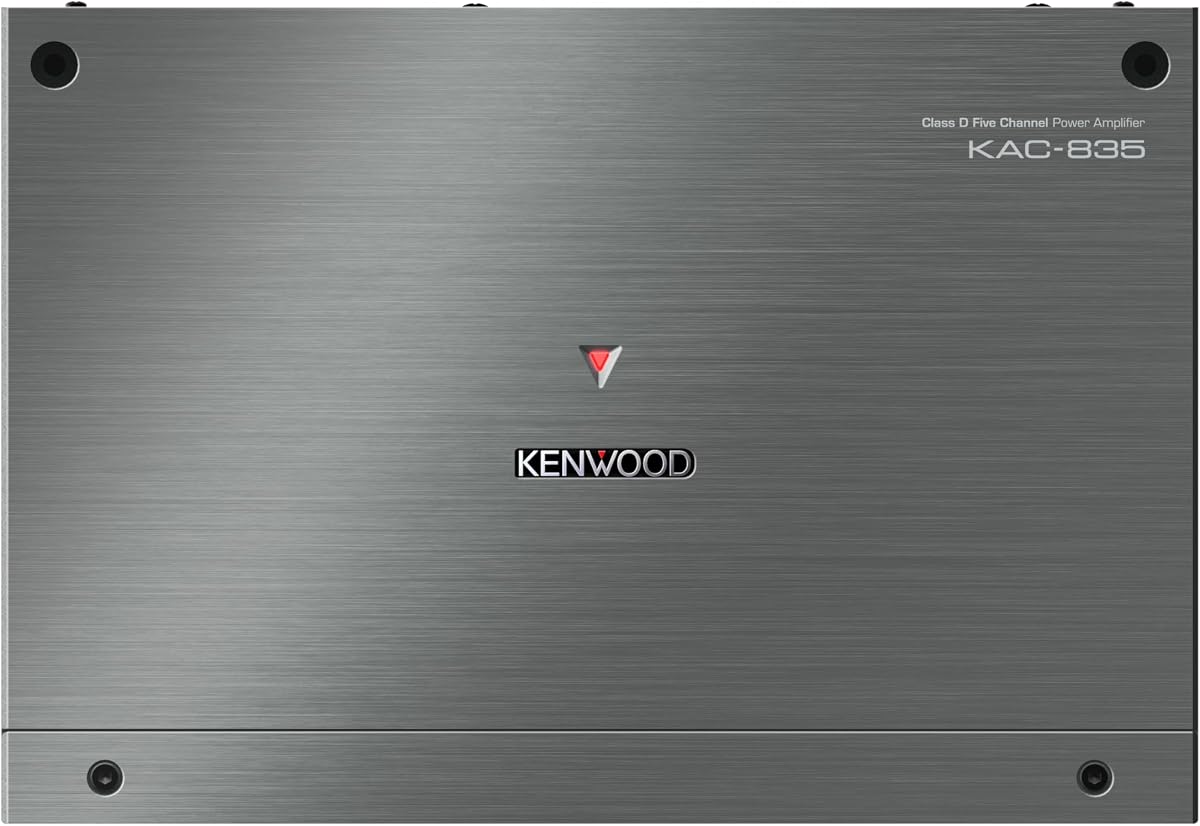
The KENWOOD KAC-835 is an approachable five-channel amplifier that brings together four full-range channels and one dedicated subwoofer channel. Its 5.0 rating and extensive supplied feature list make it a strong budget-oriented choice for standard car audio layouts, particularly where an all-in-one amplifier is more practical than a large seven-channel installation.
We may earn a commission when you buy through this link, at no additional cost to you.
Published configurations include 75 watts by four at four ohms, 50 watts by four plus 300 watts at four ohms, and 75 watts by four plus 500 watts at two ohms. These figures allow installers to compare common speaker impedances and decide how much power each section can supply, although the advertised maximum power should not be mistaken for continuous output in every configuration.
Adjustable high- and low-pass filters, a subsonic filter, and individual gain controls provide the basic tools needed to divide frequencies correctly. The included wired remote makes subwoofer-level changes convenient from the driver's seat. High-resolution audio certification, Class-D efficiency, and relatively low heat production also make the amplifier attractive for extended listening sessions.
This is not a literal seven-channel amplifier, so buyers needing separate amplification for seven zones or a larger home-theater layout will need another option. Even so, it covers the most common five-speaker-plus-subwoofer arrangement efficiently. It is the best budget recommendation for readers who value straightforward controls, useful remote access, and a consolidated amplifier without premium-tier complexity.
The KAC-835 can power four full-range speakers and a subwoofer in one enclosure. That arrangement minimizes installation bulk and provides a cleaner starting point for common front-and-rear car systems.
Adjustable high-pass, low-pass, and subsonic controls help keep low frequencies away from small speakers and protect a subwoofer from unsuitable frequencies. Gain controls then support more accurate matching to the connected equipment.
We may earn a commission when you buy through this link, at no additional cost to you.
The Outlaw Model 7000x is a true seven-channel high-current amplifier intended for installers who value balanced connectivity and disciplined signal isolation. Its 4.7 rating reflects a strong technical proposition, with seven continuous 130-watt channels and both XLR and RCA inputs.
We may earn a commission when you buy through this link, at no additional cost to you.
Balanced XLR connections can help maintain a cleaner signal in professional installations, while the differential-sensing RCA circuit is designed to reject input hum. Each channel receives independent power-supply rectification, improving isolation between channels and reducing the chance that one section will adversely influence another.
Separate output-protection relays are included for every channel. In the event of a short circuit or excessive DC offset, the relevant relay can disengage that speaker from the amplifier. The modular audio-channel architecture maintains isolation from input through output, which is valuable in complex installations where channel interaction could complicate troubleshooting.
The unit lacks the conspicuous app-based DSP interface and remote bass controller found with some newer competitors. Instead, it focuses on electrical architecture, balanced connectivity, and protection. It is best suited to a carefully planned professional car or home installation where each channel has a defined role and reliable isolation matters more than consumer-oriented controls.
XLR inputs are particularly useful in installations with longer signal paths or substantial electrical noise. RCA users still receive a differential-sensing input stage designed to reject hum rather than relying on an unbalanced arrangement.
Independent output relays allow a problematic channel to disconnect without requiring the entire amplifier to stop operating. That granularity can simplify diagnosis and protect the remaining connected speakers.
We may earn a commission when you buy through this link, at no additional cost to you.
The DOWN4SOUND JP77 combines a seven-channel format with a headline 3000-watt RMS designation and a white-gloss enclosure intended to stand out visually. Because no customer rating was supplied for this product, its evaluation here depends on the supplied technical description rather than a measured popularity or satisfaction score.
We may earn a commission when you buy through this link, at no additional cost to you.
Its standout feature is the dedicated 2000 watts RMS at one ohm, giving the amplifier considerable potential in the subwoofer channel. Bandpassable crossover controls and included high-quality RCA cables support a conventional multi-zone installation with straightforward source connections and flexible frequency allocation.
The white finish makes the JP77 visually distinctive in a vehicle installation, where exposed amplifier placement is common. Its construction is also described as intended for daily use, with an emphasis on consistent performance rather than a limited-showpiece role.
The supplied information does not describe input formats, control interfaces, protection circuitry, thermal behavior, or exact dimensions. Those omissions make careful verification especially important before installation. The JP77 is most attractive to buyers seeking substantial bass capability, seven-channel coverage, and a visible centerpiece, but they should confirm the remaining technical details with the seller.
The 2000-watt RMS figure at one ohm gives the JP77 a clear identity in bass-oriented vehicle systems. Users should still match that capability to their subwoofer's impedance and power-handling specifications.
The glossy white enclosure stands apart from conventional black amplifier cases. It is especially appealing where the amp remains visible under a trunk liner or within an open-access installation.
We may earn a commission when you buy through this link, at no additional cost to you.
The OSD Audio Nero HTA7200 is built primarily for home theater installations that need seven actively powered channels. It delivers 210 watts per channel at four ohms or 145 watts at eight ohms with all channels driven, while its 4.6 rating reflects a favorable balance of performance and user appeal.
We may earn a commission when you buy through this link, at no additional cost to you.
Class-AB topology prioritizes sonic character and linear output over the efficiency associated with some digital designs. The amplifier's quoted signal-to-noise performance reaches 110 dB at full power and 105 dB at one watt, supporting clean quiet passages and adequate dynamic range for movie soundtracks and music.
Every channel accepts balanced XLR or unbalanced RCA connections, making the amplifier adaptable to processors and conventional home theater equipment. A 12-volt trigger provides remote power control, and individual LEDs indicate on, standby, or protection status for each channel. The stated five-year warranty also adds useful coverage for a fixed home installation.
Its primary limitation is that it is clearly designed for home theater rather than automotive use. No vehicle-specific remote wiring, compact dimensions, or low-voltage monitoring features are supplied. For a dedicated media room, however, the combination of seven driven channels, flexible inputs, trigger control, and channel-status monitoring makes it a compelling integrated solution.
All seven channels can operate simultaneously, making the HTA7200 suitable for a complete surround-sound layout. Its eight-ohm rating also helps it work with many common home theater speaker configurations.
Balanced inputs, a 12-volt trigger, and per-channel status LEDs make the amplifier easier to integrate with a central processor. These features are especially useful in a rack or dedicated equipment cabinet.
We may earn a commission when you buy through this link, at no additional cost to you.
The Marantz MM8077 is a premium seven-channel home theater amplifier built around uniform output stages and high-current power delivery. Its 4.1 rating is the lowest numerical customer score in the group, but that figure does not erase the specification-driven strengths of a design created for demanding fixed installations.
We may earn a commission when you buy through this link, at no additional cost to you.
Each channel is rated at 150 watts into eight ohms and 180 watts into six ohms. Identical topology across all seven channels supports consistent tonal behavior, which matters when the same program material passes through front, surround, and rear theater zones. Marantz also highlights its current-feedback approach for high slew rate and broad operating bandwidth.
A high-current toroidal transformer provides substantial headroom for dynamic peaks, while reference-grade power-supply capacitors and high-current discrete transistors support consistent behavior. Each channel offers XLR and RCA inputs, adding flexibility with different processors and source components.
Auto-standby, remote power control, a copper-plated chassis, and gold-plated speaker terminals complete a premium feature set. The trade-off is size, heat considerations associated with Class-AB operation, and a substantial financial commitment. It is best recommended for a dedicated home theater where seven uniform channels, robust power supply design, and refined integration matter most.
Identical output circuitry across every channel promotes uniform performance. That consistency is valuable when dialogue, music, and effects move between different speaker positions during a film.
The toroidal transformer and large energy-storage components support current delivery beyond a modest home-theater application. This architecture is intended to preserve clean output during demanding transients rather than merely providing continuous background power.
We may earn a commission when you buy through this link, at no additional cost to you.
The AudioControl D-6.1200 is the most processing-focused amplifier in the guide. It can operate as a six-, five-, four-, or three-channel unit, and its 4.6 rating reflects a strong combination of flexible configuration, comprehensive digital signal processing, and practical factory-system integration.
We may earn a commission when you buy through this link, at no additional cost to you.
Its output configurations include six channels at 125 watts into four ohms, six channels at 200 watts into two ohms, and three bridged channels at 400 watts into four ohms. The dedicated DSP can route outputs from multiple input combinations and add filters, equalization, and crossover functions as required.
The DM Smart App provides access to processing controls through an interface designed for vehicle installation work. The amplifier includes eight speaker-level inputs, six balanced RCA analog preamp inputs, two assignable preamp outputs, and input/output RTAs that help installers identify and combine factory signals.
Automatic bass roll-off correction addresses low-frequency loss introduced by factory head-unit processing, while built-in diagnostics help identify faults. Thirty-band graphic EQ and ten-band parametric EQ per output channel provide fine-grained tuning control. Although it tops out at six channels, it is a compelling choice for installers who value signal processing and broad source compatibility over a literal seven-channel count.
Changing the amplifier between six-, five-, four-, and three-channel modes lets installers work around speaker count, subwoofer requirements, and available space. This makes one enclosure useful across several system layouts.
Speaker-level inputs, balanced RCA inputs, assignable outputs, and RTAs provide several paths for capturing and combining signals. Automatic bass correction can also address a common limitation of factory head units.
We may earn a commission when you buy through this link, at no additional cost to you.
The Pioneer GM-A6704 is a conventional four-channel car amplifier rather than a seven-channel model. Its 4.4 rating makes it a useful inclusion because it shows how a simpler, widely understood design can serve a smaller speaker layout with fewer controls and no dedicated subwoofer section.
We may earn a commission when you buy through this link, at no additional cost to you.
The amplifier supplies 60 watts RMS per channel at four ohms and can operate in bridged mode for 190 watts RMS across two channels. Its Class-AB design balances output character and power use while avoiding the excessive heat sometimes associated with less efficient architectures.
Variable high- and low-pass filters give installers basic frequency allocation, allowing tweeters to receive high-pass signals and larger door speakers to receive low-pass signals when necessary. Pioneer emphasizes minimized crossover distortion to preserve the integrity of the source signal.
The missing subwoofer channel is the key limitation. A separate mono amplifier may be needed for bass, and the unit offers none of the monitoring, remote bass control, or programmable DSP found among the more advanced picks. It is best for a straightforward front-and-rear upgrade where simplicity, bridgeability, and familiar filtering are the priorities.
The GM-A6704 focuses on powering four conventional speakers without a complex processor or multi-zone interface. That simplicity can make it attractive for first-time upgrades and straightforward replacement projects.
Bridged operation raises the available output for a pair of appropriately configured speakers. The option gives installers flexibility while retaining the standard four-channel layout when broader speaker coverage is the priority.
We may earn a commission when you buy through this link, at no additional cost to you.
The AudioControl EPICFIVE is a compact five-channel digital Class-D amplifier designed for efficient car installations. Its 4.4 rating and stated 1100-watt total output make it a practical middle ground when five-speaker-plus-subwoofer coverage is sufficient but seven separate channels are unnecessary.
We may earn a commission when you buy through this link, at no additional cost to you.
The low-profile chassis measures approximately 6.1 inches wide by 13.35 inches long and 2.01 inches high, making it easier to position in constrained vehicle spaces. Digital Class-D operation supports strong power density and controlled heat, while the listed signal-to-noise ratio exceeds 91 dB.
A variable zero-to-12 dB bass equalizer provides a quick method for emphasizing selected low frequencies. Twelve dB-per-octave Linkwitz-Riley crossovers help direct the appropriate frequency range to each speaker group, and an included dash-mounted control provides convenient subwoofer-level adjustment.
Built-in monitoring protects against low or high system voltage, short circuits, and thermal hazards. An ultra-efficient IDLE function reduces battery drain, and the chassis includes secure direct-wire terminals for current flow. The dedicated bass-restoration processor is offered separately, so buyers should not assume it is included. Overall, the EPICFIVE is well suited to a modern, space-conscious vehicle build.
The shallow chassis reduces the depth required from an installation location. AudioControl also provides direct-wire speaker and power terminals for secure connections.
A variable bass boost and steep Linkwitz-Riley filters cover common tuning needs without requiring a separate processor. The included remote gives the driver direct control over the subwoofer section.
We may earn a commission when you buy through this link, at no additional cost to you.
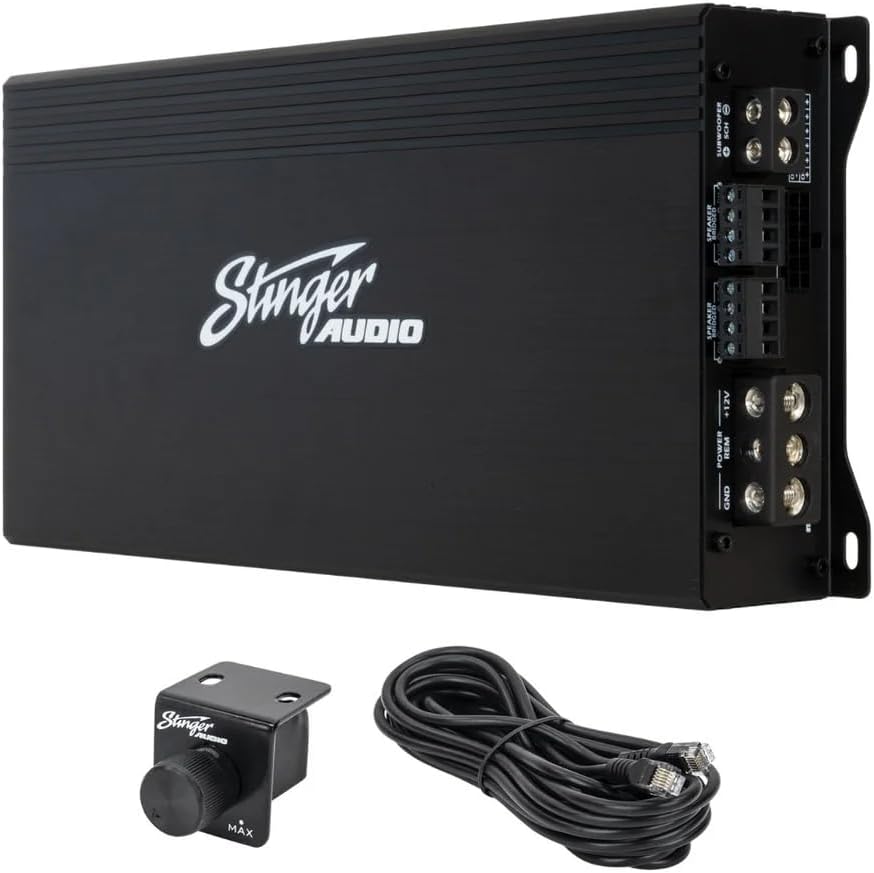
The Stinger Audio MT-1000.5 combines a compact five-channel layout with a high-output subwoofer section. Its 4.3 rating makes it a credible option for car builders who need substantial bass power and flexible signal connections without carrying a larger seven-channel enclosure.
We may earn a commission when you buy through this link, at no additional cost to you.
The amplifier can deliver 75 watts across four channels plus 300 watts in the fifth at four ohms. At two ohms, the supplied figures rise to 150 watts across four channels plus 500 watts for the subwoofer. The mono channel can reach 700 watts at one ohm, while the four full-range channels can be bridged for 300 watts across two channels.
Both high-level and low-level input paths are supported. Installers can use speaker-level connections from a factory head unit or conventional RCA preamp cables from an aftermarket unit. A zero-to-12 dB bass control, PWM power supply, and specialized Class X2 aluminum-zinc capacitor support efficient switching and output control.
The compact dimensions of approximately 6.10 by 13.23 by 2.09 inches help it fit where larger amplifiers may not. The included remote adds driver-side bass-level adjustment. It does not offer seven channels or extensive app-based diagnostics, but it delivers a versatile five-channel arrangement with particularly strong subwoofer specifications for a compact car installation.
High-level input support allows the amplifier to work with factory speaker outputs, while RCA connections remain available for aftermarket head units and signal processors. That versatility simplifies upgrades across different source configurations.
The MT-1000.5 preserves a shallow footprint while allowing its fifth channel to operate at 700 watts into a one-ohm load. It is particularly appealing for builds where trunk or under-seat space is limited.
We may earn a commission when you buy through this link, at no additional cost to you.
The best amplifier depends on speaker count, load, signal path, installation environment, and desired control features. These factors help narrow the field before comparing technical ratings.
A true seven-channel amplifier is most useful when seven independent speaker groups need power, such as a complete home theater or a large vehicle system with multiple full-range zones. Several excellent multi-channel alternatives use four, five, or six channels and can power a subwoofer through a dedicated or configurable section. Before buying, list every speaker that requires amplification and determine whether each zone needs independent control or can share a filtered channel.
Amplifier output figures are meaningful only when the impedance and channel configuration match. A manufacturer may quote maximum power, total rated power, or continuous RMS output under different conditions, so those figures should not be compared directly. Look for the power available into the impedance of each planned speaker load and verify whether all channels are driven simultaneously or only a subset is active.
Every connected speaker affects the load seen by its amplifier channel. A two-ohm speaker requires more current than a four- or eight-ohm speaker, while paralleled drivers can lower the combined impedance further. Confirm that the amplifier supports the minimum load, and never assume that a subwoofer's nominal impedance is the only value to consider. Wiring configuration, internal driver impedance, and bridged operation all influence safe setup.
High-pass filters keep low frequencies from small speakers, low-pass filters direct bass to larger drivers or subwoofers, and band-pass filters isolate a narrower range for specialized applications. Variable controls are useful for matching different speaker positions and cabin or room characteristics. More complex DSP models can route signals and adjust equalization digitally, while simpler amplifiers provide the basic crossover tools needed for conventional layouts.
RCA inputs suit aftermarket head units and processors, while XLR connections can provide a balanced path in professional installations. Some car amplifiers also accept high-level speaker inputs to simplify factory-system upgrades. A wired remote for subwoofer level or bass enhancement improves everyday use, particularly in a vehicle where fine adjustment after installation would otherwise require access to the amplifier.
Class-D designs are generally efficient and well suited to compact mobile installations, while Class-AB amplifiers can offer a different operating approach but often require more heat management. A home amplifier can live in a ventilated cabinet, whereas a car amplifier must tolerate vibration, temperature changes, and limited mounting space. Check the supplied dimensions, clearance requirements, and chassis shape, then ensure the unit can be mounted securely without blocking airflow.
Short-circuit, thermal, overvoltage, undervoltage, and excessive-DC protection help protect both the amplifier and connected speakers. Per-channel status LEDs are useful in home theaters, while diagnostic tools and monitoring interfaces are valuable in vehicle systems where troubleshooting happens away from the installation. Independent channel protection can prevent one fault from shutting down every output, although exact protection coverage should be confirmed in the documentation.
The amplifier must work with the source unit, processor, wiring, speakers, and room or vehicle acoustics. Check signal compatibility, speaker sensitivity, and whether external crossovers are already present to avoid duplicating filtering. A car installation may also need a remote turn-on lead, adequate power and ground wiring, sound insulation, and a secure enclosure. A home theater may require a 12-volt trigger, balanced processor outputs, rack space, and ventilation.
Begin by planning each channel's role before connecting any speakers. Label front, rear, surround, center, and subwoofer outputs, then confirm that every load matches the amplifier's supported impedance. Use appropriate power, ground, signal, and speaker wiring, tighten terminals carefully, and check polarity so each driver receives the correct signal.
Set filters before applying substantial gain. Start with conservative crossover points, adjust the subsonic filter when a subwoofer is used, and use gain as a headroom control rather than a substitute for proper output settings. Turn the system down while making changes, listen for clean playback, and increase levels gradually while monitoring for distortion, clipping, heat, and protection indicators.
Give the amplifier unrestricted airflow and mount it securely away from moisture, sharp edges, and excessive vibration. In a vehicle, inspect connections periodically, particularly after rough roads or changes in cargo placement. In a home, keep ventilation paths clear and use the trigger or standby behavior appropriately. Test every channel and remote control after installation, and consult the manual before changing internal settings.
A seven-channel amplifier can be better when the system requires seven powered zones and the installer wants fewer separate units. It simplifies wiring and may reduce installation space, but it also concentrates power, heat, and fault responsibility in one enclosure. Separate amplifiers can provide better channel isolation, specialized power, or easier replacement and are often preferable in complex professional systems.
It depends on whether the speakers can share channels safely and whether the amplifier can configure the appropriate crossover settings. Two speakers can be wired in series on one channel in some applications, but that increases the load and changes the available output. Never parallel ordinary speakers merely to obtain another channel, because doing so may exceed the amplifier's minimum impedance.
A typical installation may use separate channels for front and rear door speakers, additional front or rear tweeters, and a subwoofer. Some installers use the extra channels for midrange drivers, center speakers, or rear-seat entertainment displays. The exact allocation depends on the vehicle, speaker count, crossover design, and whether the amplifier uses a dedicated mono section.
Class-D amplifiers are often attractive for compact, efficient installations and can provide substantial output with relatively low heat. Class-AB designs may appeal to buyers who prefer their particular sonic behavior or architecture and can be appropriate in a well-ventilated home setup. The better choice depends on room space, thermal conditions, speaker loads, system design, and personal system preferences.
A wired remote is useful when the installer places the subwoofer amplifier where it is difficult to access after installation. It allows the driver to adjust the bass level from the front seat without opening a trunk or equipment cabinet. It is optional for many home installations, where the amplifier may already be within reach or controlled by a processor.
The appropriate amount depends on the subwoofer's rated power, impedance, sensitivity, and the amplifier's clean continuous output at that impedance. Matching the amplifier to the subwoofer's needs improves control and reliability. A higher headline wattage does not automatically produce better bass, particularly if the amplifier cannot deliver clean power into the intended load.
It is generally not advisable unless the manufacturer specifically approves automotive use. Home amplifiers may lack the low-voltage tolerance, transient protection, compact mounting design, and remote turn-on features required in a vehicle. Even if they operate temporarily, vibration, heat, electrical noise, and load conditions can create safety and reliability problems.
Confirm wiring, polarity, speaker impedance, grounding, remote turn-on, filter settings, and gain controls before switching it on. Begin with audio muted and inspect the connections for loose terminals or accidental shorts. Then increase the level gradually while listening for distortion and watching protection indicators, temperature, and system stability.
The Kicker LX1300.7 stands out as the most complete choice for a sophisticated seven-channel car system, combining full-range output, a powerful subwoofer channel, real-time monitoring, and remote bass control. The Marantz MM8077 leads the home-theater group with uniform seven-channel architecture and premium power-supply design, while the KENWOOD KAC-835 offers the best budget-oriented car installation.
For a real car build, prioritize the actual speaker layout, supported impedance, source compatibility, and remote access. For home theater, balanced inputs, a 12-volt trigger, channel monitoring, ventilation, and consistent performance across all zones deserve more attention. DSP-heavy models can excel when complex routing is needed, while simpler fixed-channel amplifiers often provide a more straightforward path.
Specifications and market conditions can change, so verify the current manufacturer information, included accessories, channel configuration, warranty, and price before ordering. Match the amplifier to the rest of the system rather than selecting on headline power alone, and use the comparison table to narrow the field before a final purchase.