
AKASO EK7000
4.4Editor score
4K30 and 2.7K30 video
131-foot waterproof housing
Built-in electronic stabilization
Wrist remote included
Recording a jetski ride requires more than simply placing a camera on the handlebars. Wind, spray, engine vibration, rapid turns, changing light, and limited mounting space all affect the result. The best Action Camera for Jetski must therefore combine durable waterproofing with effective stabilization, clear footage, simple controls, and a secure way to position the camera.
We compared ten action cameras using the supplied specifications, focusing on the features that matter most around open water and on a personal watercraft. The list covers 4K recording, image sensors, stabilization systems, waterproof ratings, battery life, front and rear screens, wireless features, quick-release mounts, and the accessories supplied with each model.
Each review explains where that camera stands out, what trade-offs to consider, and which riders it is best suited for. The top recommendations represent three distinct priorities: value, overall performance, and premium features. Product configurations, bundles, availability, and prices can change, so confirm the current listing and included accessories before purchasing.
4.4Editor score

4.7Editor score

4.6Editor score
As an Amazon Associate we earn from qualifying purchases.
The comparison below highlights the differences most relevant to jetski filming: maximum video resolution, water protection, stabilization, battery capability, and control options. It is designed to make it easier to identify a camera that matches your preferred balance of value, image quality, durability, and convenience.




The AKASO EK7000 is a straightforward action camera for riders who want usable 4K footage without moving into a more advanced camera system. It carries a 4.4 rating and records professional-style 4K at 30 frames per second, plus 2.7K at 30 frames per second and still photographs at 20 megapixels. Those specifications are more than adequate for documenting a jetski route, close passes, spray, and open-water scenery.
We may earn a commission when you buy through this link, at no additional cost to you.
Its strongest jetski-specific advantages are the included waterproof housing, built-in electronic image stabilization, and remote control. The housing is rated to 131 feet, so the camera can be protected against spray, rain, and accidental submersion. Electronic stabilization helps soften the combination of engine vibration and hull movement, although it cannot eliminate severe shake or replace a correctly positioned mount. The wrist remote makes it easier to start or stop recording when the camera is mounted away from easy hand access.
Built-in Wi-Fi expands the camera beyond basic recording. Riders can download the AKASO GO app, connect from a phone or tablet, and transfer or edit footage without removing the microSD card. The supplied information states that the wireless range reaches up to 10 meters and notes that the remote is not waterproof. A microSD card is also not included, so both storage and proper remote handling should be planned before heading out.
This is the best budget Action Camera for Jetski for buyers who prioritize resolution, protection, and useful controls at an accessible price. It is less suited to riders demanding advanced low-light performance, native waterproof operation without a housing, or exceptionally long recording sessions. For routine rides and varied action sports, however, the EK7000 provides a convincing combination of essentials.
Electronic image stabilization reduces distracting movement caused by spray, vibration, and the uneven motion of a personal watercraft. Position the camera rigidly and keep the lens as clear as possible for the most effective results.
The supplied 131-foot waterproof housing and wrist remote cover the two basic needs of jetski filming: guarding the camera from water and making it easier to operate while riding.
We may earn a commission when you buy through this link, at no additional cost to you.
The DJI Osmo Action 4 is the most balanced option in this roundup, earning a 4.7 rating among the listed products. Its 1/1.3-inch sensor, 2.4-micrometer pixels, 10-bit color, and D-Log M support give it a strong foundation for detailed jetski footage. The camera can also capture 4K at 120 frames per second through a 155-degree ultra-wide field of view, useful for slow-motion turns and dramatic water-level perspectives.
We may earn a commission when you buy through this link, at no additional cost to you.
Stability is particularly important when the camera is attached to a moving watercraft. Three stabilization modes are designed to smooth footage and maintain a level view in different shooting situations. Combined with the magnetic quick-release system, this makes camera repositioning fast: a rider can change from landscape to vertical framing without fumbling with a conventional clamp. Front and rear full-color touchscreens also simplify framing, playback, and exposure adjustments while the camera remains mounted.
Water protection and battery endurance are strong. The camera is waterproof to 18 meters without requiring the housing, and the 1770mAh battery is listed for up to 150 minutes of recording. It also operates down to -20 degrees Celsius, a useful qualification for cold-weather adventures rather than a typical jetski trip. Pre-Recording can capture several seconds before the record button is pressed, and direct connection to DJI Mic 2 or Mic Mini transmitters expands the audio options.
The Essential Combo is more compact because it does not include the curved adhesive base. That omission matters only if the rider specifically depends on that base; other mounting choices are still essential to check. The Osmo Action 4 is a strong all-around recommendation for riders who want excellent stabilization, flexible mounting, sophisticated color, and convenient controls without moving to the most premium tier.
The larger sensor, automatic white balance, and 10-bit color are valuable when sunlight, reflections, and shadowed water change rapidly. D-Log M also preserves additional tonal information for later editing.
The magnetic quick-release system makes switching mounts and orientations straightforward. Dual touchscreens reduce the need to remove the camera, helping riders frame a shot without stopping the action.
We may earn a commission when you buy through this link, at no additional cost to you.
This generic action camera combines a 1/1.3-inch sensor with 4K120 recording, a broad stabilization feature set, and a stated battery runtime of up to three hours. It carries a 4.4 rating and is positioned for action filming, point-of-view capture, and scenic recording. Those characteristics make it a credible option for jetski riders who prioritize sensor size, slow motion, and stabilization over a recognized brand ecosystem.
We may earn a commission when you buy through this link, at no additional cost to you.
Its stabilization suite is particularly relevant on the water. The camera lists 360 Lock, TiltGuard, and MotionMaster to manage roll, tilt, and general movement. A magnetic universal quick mount makes it easier to change between horizontal and vertical orientations while also helping the camera remain secure. Night View Mode brightens low-light scenes, which can help during dawn, dusk, shaded coves, or late-day rides.
The stated 52-foot waterproof capability is unusually deep for this category, and the camera is presented as ready for swimming, snorkeling, and wet environments. The exact supplied information does not specify whether every function is available without an additional housing, so buyers should confirm the physical design and operating limitations on the product listing. It also offers up to three hours of recording, which is useful for long routes and multiple stops.
This camera's main strength is its unusually broad feature set for the money. The drawback is that its generic name provides less clarity about the manufacturer, app, included mounts, and exact configuration than a recognizable model name would. Prospective buyers should inspect the package contents carefully. It is still a strong choice for riders who want 4K120 footage, horizon leveling, large-sensor detail, and long recording capability in one device.
Combining 360 Lock, TiltGuard, and MotionMaster addresses several forms of instability. Riders should still test the selected mode on their specific mounting position because aggressive stabilization can introduce cropping or warping.
A stated three-hour runtime reduces the likelihood of missing a long ride. Actual duration will depend on resolution, frame rate, stabilization, temperature, and screen use.
We may earn a commission when you buy through this link, at no additional cost to you.
The AKASO EK7000 Pro is an upgraded version of the EK7000 and combines 4K30 video, 20MP photos, electronic stabilization, a touch screen, and a substantial accessory package. It earns a 4.4 rating. The core recording specifications remain approachable, while the floating hand grip and carrying case make it particularly convenient for days spent boating, swimming, and filming around personal watercraft.
We may earn a commission when you buy through this link, at no additional cost to you.
The waterproof housing is rated to 131 feet, providing dependable protection against spray and immersion when correctly sealed. Two rechargeable 1350mAh batteries are included, and the supplied information states that each can record for up to 140 minutes. A USB dual charger helps keep both batteries ready, while the floating hand grip can be useful when entering or leaving the water. The remote control adds another way to operate the camera.
Electronic image stabilization helps control shake and vibration while the camera is mounted to a jetski. A 5X zoom option is included, although zoom cannot create detail that the sensor did not capture. Because a jetski changes direction rapidly and often, maintaining a wide, stable view is normally preferable to relying on digital zoom. The touch screen is helpful for reviewing settings and previewing composition.
The external microphone is explicitly not included, so anyone who wants wind-protected narration or higher-quality audio must arrange that separately. Even so, the combination of a floating grip, dual batteries, charger, remote, case, and waterproof housing makes the EK7000 Pro convenient for riders who prefer a ready-to-use kit. It is especially attractive for family outings where the camera may be passed among several people.
The floating grip, carrying case, remote, dual charger, and spare batteries cover common needs without requiring a separate list of add-ons. Check each accessory against the final package listing before ordering.
Two 1350mAh batteries are useful for extended rides. Recording time varies with the chosen resolution and whether stabilization or displays remain active.
We may earn a commission when you buy through this link, at no additional cost to you.
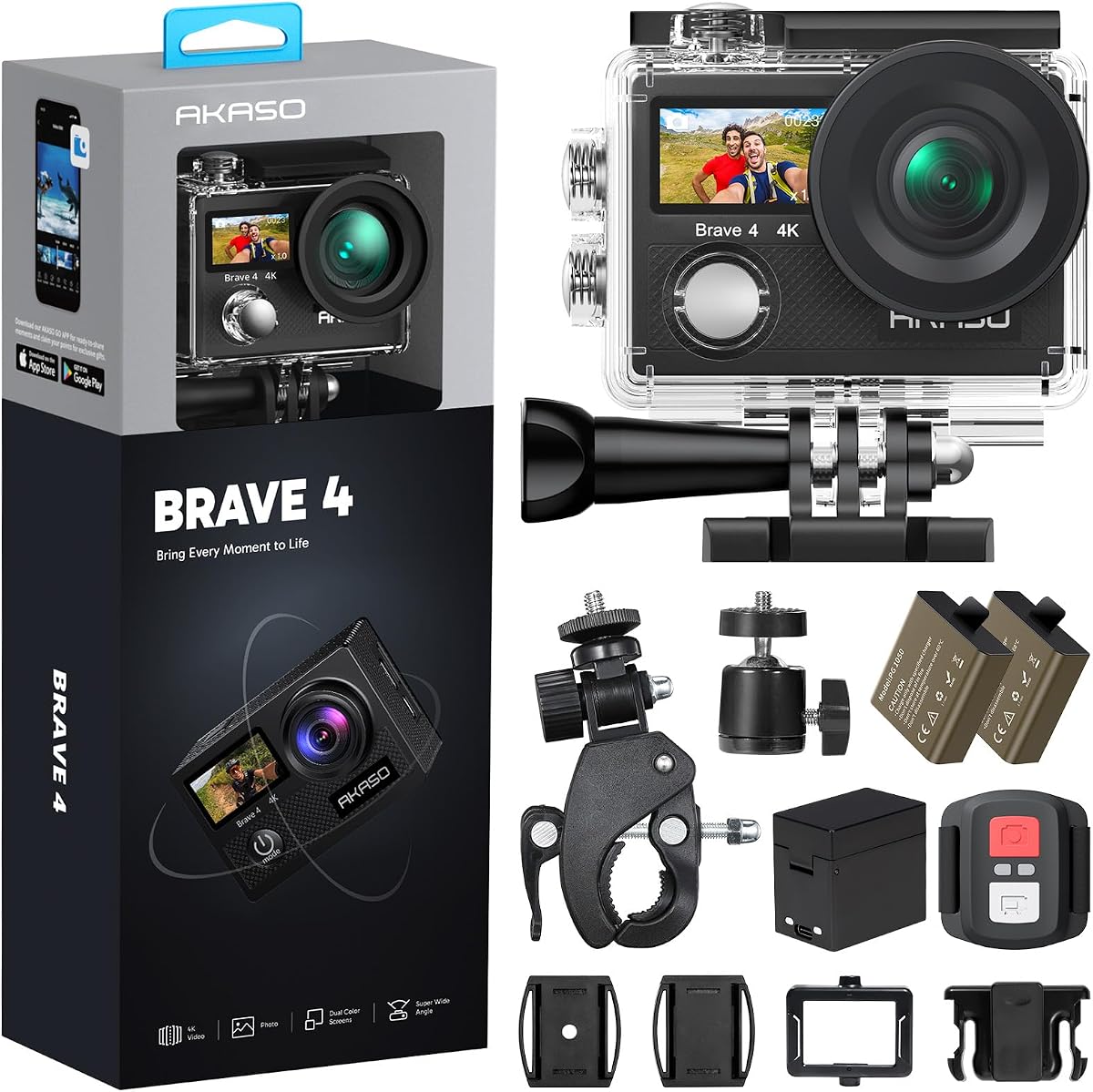
The AKASO Brave 4 is a well-equipped action camera for riders who want flexibility in framing and easy playback. It records 4K at 30 frames per second or 1080p at 60 frames per second and captures 20MP photos. Its 4.4 rating reflects a solid general-purpose feature set, including a 170-degree maximum viewing angle, image stabilization, Wi-Fi, HDMI, and two screens.
We may earn a commission when you buy through this link, at no additional cost to you.
The adjustable field of view offers four listed settings of 170, 140, 110, and 70 degrees. That range is useful on a jetski because a wide view can capture spray, handlebars, and other riders, while a narrower angle may reduce edge distortion or suit a conventional cinematic composition. Image stabilization is supported by a smart gyroscope system intended to make footage smoother and more resistant to shock.
A 2-inch rear screen and 0.96-inch front screen allow the rider to check framing from different positions. For example, a rider may prefer the front display when reviewing a selfie angle or use the rear screen for standard landscape framing. Wi-Fi supports app-based transfer and editing, while HDMI allows playback on a larger television. Both features are helpful for organizing footage after a ride.
The supplied 131-foot waterproof case protects the camera during water sports, and two rechargeable 1050mAh batteries are stated to record for up to 90 minutes each. The remote wristband is not waterproof, so it should remain dry. Compared with newer models, the Brave 4 lacks some of the latest sensor and stabilization sophistication, but it remains a versatile option when adjustable views, dual screens, and conventional 4K recording are the priorities.
The four adjustable angles let riders trade immersive width for a more focused perspective. Testing a wide setting at full speed can reveal whether edge distortion is acceptable for the intended edit.
Front and rear displays simplify selfie and standard compositions. The larger rear screen is convenient for menu navigation, while the front display helps frame action-facing shots.
We may earn a commission when you buy through this link, at no additional cost to you.
The DJI Osmo Action 5 Pro represents the premium end of this list, with a 4.6 rating and several features aimed at demanding action footage. Its new 1/1.3-inch sensor uses 2.4-micrometer pixels, while the listed 13.5-stop dynamic range and advanced processing are designed to preserve detail in bright reflections and darker areas. For jetski riders filming at sunrise, sunset, or under bridges, that combination is especially compelling.
We may earn a commission when you buy through this link, at no additional cost to you.
HorizonSteady is one of the standout features. The camera is designed to eliminate roll-axis shake and keep the horizon level through turns, reducing the tilted-water effect that can occur when a rigidly mounted camera leans with a personal watercraft. The camera can also keep fast-moving subjects centered in 16:9 or 9:16 formats, useful when another rider crosses the frame. Dual OLED touchscreens provide bright, responsive framing and playback controls.
Battery life is the premium model's strongest practical advantage. The 1950mAh battery is listed for up to four hours of recording, or 3.6 hours at -20 degrees Celsius. IP68 protection supports underwater use to 20 meters. Automatic white balance uses a color temperature sensor to produce natural-looking footage and smooth transitions, while direct wireless connection to DJI Mic 2 or Mic Mini can improve audio without a separate receiver.
Voice control offers another hands-free option, with the stated optimal recognition range of one meter. The Essential Combo omits the curved adhesive base, which may matter for certain mounting arrangements, but it is otherwise a compact package. For riders creating polished action videos, prioritizing image quality, horizon control, battery life, and premium stabilization, this is the strongest choice in the roundup.
360-degree HorizonSteady targets roll-axis movement, which is a common problem for cameras attached to a leaning jetski. This can create a more natural-looking ride even when the craft banks noticeably.
Large sensor pixels, a wide dynamic range, and sensor-assisted white balance help manage mixed daylight and shadow. Night footage can still require careful exposure settings, but the hardware offers a strong foundation.
We may earn a commission when you buy through this link, at no additional cost to you.
The 4K Action Camera 20MP Touch Screen WiFi EIS is a budget-oriented option for casual jetski filming. It records 4K video at 30 frames per second, captures 20MP photos, and carries a 4.4 rating. Its most useful features for riders include two screens, built-in electronic stabilization, a 131-foot waterproof housing, Wi-Fi control, a remote, and two rechargeable batteries.
We may earn a commission when you buy through this link, at no additional cost to you.
The 2-inch rear IPS touch screen gives straightforward access to settings and playback, while the 1.4-inch front display helps with selfie-style framing. Electronic image stabilization is designed to reduce shake from the jetski, road vehicles, or other fast movement. As with every small action camera, the result depends on the mount and the severity of vibration, so a rigid attachment remains important.
Water protection is provided through the included housing. The supplied information is explicit that waterproof operation applies when the case is installed, meaning the bare camera should not be treated as waterproof. The housing can protect the camera during spray, rain, swimming, snorkeling, and underwater filming up to the stated 131-foot depth when used correctly.
Wi-Fi allows connection to a smart app for control, viewing, and wireless sharing, and the included remote provides additional operating convenience. The camera supports memory cards up to 256GB, but no card is included. This makes the package attractive for buyers who already own suitable storage or want to choose a card with the required speed and capacity. It is a practical choice for straightforward 4K jetski videos without a premium camera price.
The rear touchscreen simplifies configuration and review, while the front display supports action-facing compositions. Neither display replaces the need for a secure, vibration-resistant mount.
Wi-Fi and the remote reduce some of the friction of moving footage off the camera. Buyers should verify app compatibility and purchase an appropriate memory card before their first outing.
We may earn a commission when you buy through this link, at no additional cost to you.
The GoPro HERO12 Black is built for high-resolution action capture, offering 5.3K60 video, 27MP photos, HDR, and a 1/1.9-inch image sensor. It carries a 4.5 rating. For jetski riders who plan to crop action clips, create slow-motion inserts, or produce a high-detail travel video, the extra resolution offers meaningful editing flexibility.
We may earn a commission when you buy through this link, at no additional cost to you.
HDR applies to both 5.3K and 4K video as well as photos, helping retain information in bright highlights and deep shadows. That matters on the water because glare, white spray, dark hulls, and shaded scenery can all appear in one frame. The camera can also extract still images up to 24.7MP from video through the GoPro Quik app. HyperSmooth 6.0 with AutoBoost is designed to stabilize bumpy action while limiting image cropping.
Unlike many action cameras in this list, the HERO12 Black has a waterproof rating of 33 feet or 10 meters without requiring a separate housing. It can therefore be mounted close to the craft or briefly submerged without adding the bulk of a protective case. A water-repelling lens cover is also intended to reduce flare and related artifacts. The included curved adhesive mount, buckle, thumb screw, Enduro battery, and USB-C cable provide a basic starting point.
The trade-off is that some third-party protective housings can limit underwater performance or prevent use of certain functions, so riders should check accessory compatibility before adding a housing. For users who want a compact, natively waterproof camera with high-resolution capture and strong stabilization, the HERO12 Black remains one of the most recognizable and flexible choices in the roundup.
Recording at 5.3K gives editors room to crop, stabilize, or reframe portions of a scene. The practical benefit is greatest when the original mount was not perfectly positioned.
HDR helps preserve detail in both bright reflections and darker portions of the scene. Exposure and color settings still matter, but the format gives the footage a wider tonal foundation.
We may earn a commission when you buy through this link, at no additional cost to you.
The GoPro Hero12 Black E-Commerce Package is another version of the HERO12 Black, with a 4.6 rating and a supplied feature list that emphasizes ride footage. It records 5.3K60 video, captures 27MP photos, supports HDR, and is waterproof to 33 feet or 10 meters. It is particularly relevant to jetski riders because 360-degree Horizon Lock can keep the view level when the camera rotates during a turn or a deliberate tumble.
We may earn a commission when you buy through this link, at no additional cost to you.
HyperSmooth 6.0 is intended to produce smooth footage even in demanding conditions. The wide field of view supports immersive point-of-view clips, while the 5.3K resolution preserves more detail than standard 4K. Slow-motion capture reaches up to 8x at resolutions up to 2.7K, making it possible to isolate a rooster tail, passing wave, or sharp spray detail in a way that standard-speed footage cannot.
The Enduro battery is listed at 1720mAh and provides up to 70 minutes of continuous 5.3K60 recording. This figure should not be interpreted as the duration for every lower resolution or stabilized mode. Actual runtime varies with settings, temperature, wireless connections, and screen activity, but riders can extend sessions with spare compatible batteries.
Bluetooth audio connectivity allows the camera to connect with external microphones or earbuds for improved audio, voice commands, and camera alerts. The package includes the camera, Enduro battery, USB-C cable, curved adhesive mount, mounting buckle, and thumb screw. This Hero12 variant is a compelling all-around choice for riders who value high resolution, strong stabilization, waterproof construction, and slow-motion flexibility.
Horizon Lock is particularly useful when the camera is fixed to a jet ski that leans through corners. It reduces the need to correct rolled footage during editing.
Up to 8x slow motion can reveal fine movement in waves and spray. Use a high-speed memory card and confirm the exact resolution and frame-rate combinations supported in the camera menu.
We may earn a commission when you buy through this link, at no additional cost to you.
The AKASO Brave 7 LE is a well-rounded starter package for jetski action videos. It has a 4.5 rating, records 4K at 30 frames per second, captures 20MP photos, and includes a 64GB MicroSDXC U3 memory card. That inclusion removes a common point of friction for new buyers who would otherwise need to select a compatible card separately.
We may earn a commission when you buy through this link, at no additional cost to you.
The camera body has an IPX7 water-resistant design intended to protect it from rain, snow, and splashing. For underwater filming, the included waterproof housing is rated to 131 feet or 40 meters. This distinction matters: body-level water resistance is not the same as full underwater capability. If the housing is required, riders must allow for its extra bulk and confirm that every control remains accessible.
A vivid front display and 2-inch rear touch screen make the camera easy to frame and configure. Improved six-axis Electronic Image Stabilization 2.0 is designed to deliver gimbal-like stability and improve footage during rapid movement. Digital zoom, time-lapse, burst photo, and fast-motion modes round out the feature set. Wi-Fi and the included remote provide options for control and file sharing.
The kit also includes two rechargeable batteries, the waterproof housing, a remote, and multifunctional mounting accessories. The package is particularly convenient for riders building a first action-camera setup, while the 64GB card and accessory selection offer more immediate utility than a bare camera. It may not deliver the newest premium imaging performance, but its combination of 4K recording, stabilization, dual screens, and included essentials is difficult to overlook.
The included 64GB MicroSDXC U3 card, two batteries, remote, housing, and mounting hardware provide a practical starting point. Verify that the card and other accessories remain included in the exact bundle shown at checkout.
IPX7 protection helps with rain and splashes, while the supplied housing enables the stated underwater depth. Use the appropriate protection level for the conditions rather than assuming the bare body can handle full submersion.
We may earn a commission when you buy through this link, at no additional cost to you.
A jetski camera must handle motion, spray, vibration, glare, and frequent changes in direction while remaining easy to mount and operate. The most important factors are stabilization, waterproof protection, image quality, battery endurance, controls, and a secure connection to the craft.
A personal watercraft moves continuously, and its hull can vibrate under acceleration. Electronic stabilization, gyroscope-assisted stabilization, horizon leveling, and subject tracking can reduce visible movement, but they cannot compensate for a loose or poorly positioned mount. Riders who make sharp turns should give particular attention to roll-axis control and horizon lock, since a camera mounted rigidly to a leaning craft may otherwise produce footage that repeatedly tilts.
Choose a camera with several stabilization modes so you can match the setting to the activity. Standard electronic stabilization is useful for general riding, stronger smoothing can help in choppy conditions, and horizon leveling is valuable when the craft banks sharply. Check how much the camera crops the image, because aggressive stabilization may remove some of the edges needed for reframing later.
In short, prioritize effective stabilization and level horizons, but pair them with a rigid mount that cannot shift during the ride.
Water protection comes in two forms: a water-resistant camera body and a separate waterproof housing. A body rated for rain, splash, or accidental submersion can simplify mounting close to the handlebars, while an enclosed housing is necessary for deeper underwater shooting. Depth claims also depend on correct sealing, undamaged ports, and the specific housing design.
For jetski use, the relevant question is whether the camera will be exposed only to spray or deliberately placed underwater. A body with a stated 10- to 20-meter waterproof rating offers convenience, but it may not provide the same protection as a camera enclosed in a housing rated to 131 feet. Riders should also consider whether controls and displays remain usable inside the housing.
In short, check both the camera's body rating and the housing's depth rating, and never assume splash resistance permits unrestricted underwater use.
A 4K camera at 30 frames per second is a practical starting point for jetski videos because it provides detail without making files unnecessarily large. Higher frame rates such as 60, 120, or even 240 frames per second are useful for slow-motion sequences of turns, waves, wake, and spray. They also demand a faster memory card, more storage, and often more battery power.
Resolution should be considered alongside cropping and editing needs. A 5.3K camera may retain useful detail after an edit crops around a rider or cuts away excess sky. A 4K camera can still produce excellent results, particularly when the mount is positioned carefully. Frame rate is often more valuable than moving from 4K to 5.3K when the goal is to slow down a dramatic maneuver.
In short, choose 4K30 for general-purpose footage and prioritize higher frame rates or extra resolution for slow motion and aggressive cropping.
A larger sensor can gather more light and retain more detail than a smaller sensor, particularly in shaded water, around sunset, or beneath bridges. Jetski footage often includes difficult contrast because bright sky, reflective water, and dark clothing can all appear together. Automatic white balance, HDR, and ten-bit color can help preserve natural color and tonal transitions.
A larger sensor does not guarantee a perfect image in every situation. Stabilization settings, lens clarity, exposure, water droplets, and the camera's underwater color response all influence the result. Still, the supplied specifications show meaningful differences among these models, including 1/1.3-inch sensors in several premium and midrange options and a 1/1.9-inch sensor in the GoPro HERO12 Black.
In short, favor a larger sensor, HDR, and automatic white balance if you ride around dawn or dusk or want more flexibility in post-production.
Longer battery life allows continuous recording without interrupting a ride to swap batteries. The listed runtimes range from roughly 70 minutes at a demanding high-resolution setting for one GoPro configuration to as much as four hours for the DJI Osmo Action 5 Pro, but real results depend on resolution, frame rate, stabilization, temperature, and display use.
For riders who cover long routes, consider a model with multiple batteries and a dual charger. Cold water can reduce battery performance even when the air temperature is comfortable, and screen use consumes additional power. A spare battery should be stored appropriately and kept away from moisture until needed.
In short, compare realistic recording time in your chosen mode, then prioritize models that include spare batteries or make charging between rides convenient.
A rear screen is important for configuring exposure, checking field of view, and reviewing clips. A front screen is particularly useful for selfie angles, group shots, and showing the rider while the camera faces backward. Touch controls can make menus faster, but they may be difficult to use with wet hands or through a waterproof housing.
Remote controls, voice commands, and phone connectivity offer alternatives to pressing buttons while moving. Pre-Recording can capture moments that begin before the rider presses the record button, which is valuable for unexpected maneuvers or passing scenery. Audio connectivity to wireless microphones can improve narration, although wind noise remains a challenge around a personal watercraft.
In short, favor easy-to-reach physical controls, a responsive rear screen, a front display for self-facing shots, and remote operation that works in wet conditions.
The supplied mounts should be checked carefully because most action cameras rely on strong adhesive, straps, clamps, or quick-release systems to stay attached. Jetski vibration can loosen a mount that would remain stable on land. Position the camera where it will not interfere with steering, visibility, safety equipment, or the rider's movement.
A magnetic quick-release system makes it easy to change between landscape and vertical framing, but a secondary safety tether is still sensible in active water sports. Riders should confirm that the chosen base can handle the camera's weight and that the camera cannot rotate into the frame during a hard turn. Accessory compatibility with third-party protective housings is another important check.
In short, prioritize a rigid, vibration-resistant mount, a secure locking mechanism, and enough positioning options for bow, handlebar, chin, or rider-mounted perspectives.
High-resolution action video creates large files, so the memory card must offer adequate capacity and speed. Some bundles include a MicroSDXC U3 card, while others explicitly do not include storage. The listed capacity support varies, and cards should be formatted in the camera before important outings to reduce the chance of interrupted recording.
Wi-Fi and app support can simplify file transfer, editing, and sharing, but they should be treated as conveniences rather than substitutes for backup storage. Riders should maintain a separate copy of important footage and avoid deleting the original card until a backup is confirmed. HDMI output, removable storage, and direct wireless microphone connections can also improve the post-ride workflow.
In short, confirm card capacity and speed, preserve backups, and choose connectivity features that complement rather than complicate your editing process.
Begin by fully charging the battery, installing a compatible memory card, and formatting the card in the camera. Check the waterproof housing seals, closure, and lens window before mounting. Choose a resolution and frame rate that suit the edit rather than automatically selecting the highest setting, then confirm that the storage card can sustain that mode during a short test recording.
Mount the camera rigidly to a suitable part of the jetski using the supplied hardware and a safety tether where possible. Set the field of view before launching, wipe away fingerprints and droplets from the lens, and verify that the horizon, horizon stabilization, and recording status are visible from either the front or rear screen. Use the remote or voice control when it is safer than reaching for the camera while moving.
After the ride, power down the camera before opening any housing, rinse the camera with clean fresh water when appropriate, and let it dry fully before charging or installing a memory card. Keep lens glass clean with a soft cloth, inspect mounts for looseness, and back up important clips to more than one location. Store batteries and the camera away from prolonged heat, moisture, and direct sun.
Only if the camera or its housing is explicitly rated for underwater use. Some models have water-resistant bodies intended for rain and splashes, while others need a sealed waterproof housing for diving. Check the stated depth rating, inspect the seals before use, and never assume an action camera can be submerged simply because it is called waterproof.
A rigid mount on the handlebar, bow, or another accessible section can produce stable footage, provided it does not obstruct steering or safety equipment. Choose the position based on the desired perspective: forward-facing mounts emphasize the ride ahead, while rider-facing mounts capture speed and spray. Use a safety tether and confirm that the camera cannot rotate during hard turns.
It depends on the edit. Standard 4K30 footage is suitable for normal-speed riding, while 60, 120, or higher frame rates allow smooth slow motion of turns, waves, and spray. High frame rates use more storage, require a faster card, and can reduce battery life, so 4K30 remains a practical general-purpose choice.
Yes, because a leaning craft can cause rigidly mounted cameras to roll with the hull. Horizon lock or horizon leveling keeps the water and horizon visually straighter, which is especially noticeable during sharp turns. Stabilization does not eliminate vibration, so a secure mount remains just as important as the camera's electronic processing.
5.3K provides extra detail that can be useful for cropping and reframing, but 4K is often more practical for storage, processing, and battery life. Choose 4K when your editing workflow prioritizes simplicity, or a higher resolution when slow motion, detailed crops, and large displays are important. Always test the chosen mode with your memory card before a long ride.
Keep the lens clean and dry before filming, and avoid touching the outer glass with greasy fingers. If a housing is used, allow any trapped moisture to escape and verify that its seals are seated correctly. After the ride, rinse the housing with clean fresh water and dry it thoroughly before opening it.
It is optional but can improve narration and general audio quality. Engine and wind noise are difficult to eliminate completely, so a wireless microphone in a sheltered position can make spoken commentary clearer. Check whether the camera supports direct microphone connection and whether any external accessory is included; several bundles explicitly omit one.
Copy important clips to a computer or external drive, then keep another backup in a separate location before deleting the memory card. Wireless transfer is convenient but should not be the only backup method. Format cards only after confirming that the footage has been copied successfully.
The AKASO EK7000 is the strongest budget choice, combining 4K30 recording, electronic stabilization, a 131-foot waterproof housing, Wi-Fi, and a wrist remote. The DJI Osmo Action 4 is the most balanced overall recommendation because of its large sensor, flexible stabilization, magnetic mounting, dual touchscreens, native waterproofing, and strong battery life. The DJI Osmo Action 5 Pro takes the premium position with refined low-light imaging, HorizonSteady, dual OLED screens, voice control, and the longest stated runtime.
For any jetski camera, prioritize a rigid mount, effective stabilization, and water protection appropriate to the intended exposure. Riders who want easier editing should favor 4K30, while those creating slow-motion action can justify a higher frame rate. Large sensors, HDR, dual screens, spare batteries, and fast accessory swapping are useful refinements, but they matter less than keeping the lens clear and the camera securely attached.
Bundles change more often than core camera specifications, and current prices, accessories, ratings, and product configurations can vary over time. Before buying, verify the exact card status, waterproof rating, mounting hardware, remote compatibility, battery contents, and app requirements for the chosen listing.