
GlowShift Black 7 Color Dual Wideband Air Fuel Gauge Kit
4.5Editor score
Dual-bank AFR monitoring
Seven customizable display colors
Complete sensor and harness kit
Aftermarket O2 systems give performance drivers, builders, and mechanics the real-time fuel-mixture data needed for safer tuning and more useful diagnostics. A quality system should combine a responsive wideband sensor, dependable electronics, clear readings, and hardware that suits the vehicle’s installation space.
We compared all 10 products by examining their sensor technology, display options, supported output, installation requirements, included hardware, fuel flexibility, and intended vehicle applications. The list covers complete kits, controller-only systems, single-gauge packages, and dual-bank configurations for comparing exhaust sides.
Each pick reveals what a particular package contributes, whether that is flexible display customization, detailed logging, dual-channel monitoring, or a compact installation. Product configurations and availability can change, so readers should confirm current specifications, compatibility, and the latest selling terms before ordering.
4.5Editor score
4.5Editor score

4.4Editor score
As an Amazon Associate we earn from qualifying purchases.
The comparison below highlights the major differences among these aftermarket O2 systems, including sensor type, channel count, display design, output capability, and the hardware included for installation.


The Universal Digital Wideband Air/Fuel Ratio AFR Gauge is a compact display option for builders who want live air/fuel-ratio information without a large multi-function meter. It carries a 3.8 customer rating and stands out for its standard 52mm housing, digital wideband technology, and support for vehicle or system voltages up to 16V.
We may earn a commission when you buy through this link, at no additional cost to you.
Its main strength is installation flexibility. The 2-inch gauge can fit many common instrument pods, while compatibility with a wide range of engine-management systems and data loggers makes it practical for mixed workshop environments. The stated no-free-air-calibration requirement when paired with the manufacturer’s wideband system also reduces one recurring setup concern.
The trade-off is that this listing focuses on the gauge rather than presenting a complete controller-and-sensor package with the same level of detail as several alternatives. Its 3.8 rating is also the second-lowest in this group, so prospective buyers should carefully review included components, connector details, and compatibility information before choosing it.
It is a sensible option for a driver who already has a suitable wideband controller or needs a simple, compact AFR display. For a plug-and-play kit with the sensor, control box, and extensive wiring already organized, one of the more complete packages may be the safer all-around choice.
The 52mm housing follows one of the most common automotive gauge formats, making it easier to position the display in a pod, dashboard panel, or custom installation. That standardized size offers useful flexibility without requiring a large controller screen.
Compatibility with engine-management systems, data loggers, and electrical systems up to 16V broadens the potential uses of the display. Confirming the exact output interface and controller pairing remains essential before installation.
We may earn a commission when you buy through this link, at no additional cost to you.
The Wideband UEGO Air/Fuel Ratio Gauge is a complete single-sensor system with a 4.1 rating. It combines a 52mm digital display, LSU 4.9 wideband sensor, controller, and 0-5V analog output, giving builders several useful ways to view and share exhaust fuel data.
We may earn a commission when you buy through this link, at no additional cost to you.
The color-changing display makes lean-to-rich changes easy to interpret at a glance. Its analog output can feed compatible data loggers and engine-management systems, while the LSU 4.9 sensor is designed to react quickly to even 0.1 AFR changes. The package also avoids free-air calibration when used with the specified wideband controller.
Its most obvious limitation is the stated 10-20 AFR range, which may be less suitable for operators needing a broader display span or dedicated E85 information. The gauge also offers fewer personalization choices than premium color-programmable systems. Buyers should verify dimensions, outputs, and sensor requirements against their installation.
This is a strong option for a single-cylinder or single-bank project that wants an integrated gauge, sensor, and controller without a dual-channel setup. It offers more installation convenience than a display-only purchase and better visualization than systems exposing data exclusively through a logger.
The digital needle and changing display colors make fuel-mixture direction easy to recognize while driving or testing. That visual feedback can help a tuner react sooner than with a plain numeric display alone.
The 0-5V analog output allows compatible loggers and engine-management systems to receive the controller’s air/fuel-ratio signal. This makes the kit useful for recording and reviewing data beyond the gauge face.
We may earn a commission when you buy through this link, at no additional cost to you.
The 30-0300 Wideband UGEO Air Fuel Ratio Gauge provides a particularly flexible display in a standard 52mm housing. It has a 4.2 rating and uses a 24-color-coded LED readout with AFR, lambda, and oxygen-percentage modes, allowing the same gauge to suit different monitoring preferences.
We may earn a commission when you buy through this link, at no additional cost to you.
Its LSU 4.9 UEGO sensor has a stated typical response time of 20 milliseconds, which is useful when changes in mixture need to be identified quickly. The reversible faceplate and selectable modes also make the package attractive for users who want a gauge that can present information in whichever format is most familiar.
Calibration flexibility is another notable strength. The sensor is factory calibrated with a trim resistor, and resistor-trim mode is recommended, while free-air mode is available as an alternative. Buyers must still follow the supplied instructions carefully because calibration choice can affect data quality and should match the installation method.
This kit is best for a tuner who wants live visualization in multiple formats and has room to install a 52mm gauge and exhaust sensor. It may be less attractive for a simple daily-driver display because the package offers more display modes and calibration choices than many buyers need.
AFR, lambda, and oxygen-percentage modes let the user interpret the same sensor data in different frameworks. This is useful when comparing tuning targets with instructions that use lambda or oxygen concentration.
Resistor-trim calibration uses the factory resistor in the sensor connector and requires no further action for most users. Free-air mode is available when appropriate, though following the manufacturer’s procedure remains important.
We may earn a commission when you buy through this link, at no additional cost to you.
The Holley EFI Wbo2 Sensor is a sensor-focused option intended for Sniper Tbi and compatible Holley EFI applications. It has a 4.1 rating and provides a more specialized alternative to the complete gauge kits elsewhere in this guide.
We may earn a commission when you buy through this link, at no additional cost to you.
Its black e-coated construction is designed to protect against rust, a relevant concern for an exhaust-mounted component exposed to heat, moisture, and road debris. The requirement for one sensor per vehicle also helps buyers plan the correct quantity for a single exhaust application.
Unlike the other selections, this is not presented as a full monitoring system with a gauge, controller, and extensive wiring. Users may already own compatible Holley equipment and only need the correct wideband replacement sensor. Compatibility outside the named application should not be assumed.
This sensor is best for an existing Holley EFI build with a confirmed wideband-controller connection. For a new installation or a vehicle needing a dashboard readout, a complete kit would generally provide a more coherent path.
Choosing the sensor for a named EFI platform can reduce uncertainty about connector, control, and installation expectations. Buyers should still confirm the exact Holley configuration and existing wiring requirements.
The e-coated exterior helps defend the sensor body against rust. Proper heat management, sealing, and installation practices remain necessary for long-term reliability.
We may earn a commission when you buy through this link, at no additional cost to you.
The Innovate Motorsports 38070 LM-2 is the most technically expansive system in this roundup, combining dual-O2 monitoring with advanced data acquisition. Its 4.2 rating reflects a package designed for serious tuning, diagnosis, comparison of multiple exhaust channels, and comprehensive logging.
We may earn a commission when you buy through this link, at no additional cost to you.
Patented DirectDigital wideband sensor control and compatibility with all fuel types form the technical core. Two O2 channels allow monitoring of separate exhaust sides, while the included OBD-II scan function can read and clear diagnostic trouble codes and log up to 16 channels of CAN OBD-II data. Direct SD card logging keeps the system focused on analysis after a test session.
The feature set also creates a steeper learning curve than a straightforward 52mm gauge kit. A user who needs only a live numeric readout may find the setup excessive, while a tuner who values channel comparisons, fault-code access, and recorded information can gain considerable diagnostic depth.
This is a strong premium recommendation for performance workshops, advanced builders, and drivers who need more than a single visual indication. It is particularly compelling for projects where comparing left and right banks or correlating wideband readings with other vehicle data is central to the tuning process.
Dual O2 channels allow the system to monitor two separate exhaust locations. This is useful for identifying uneven fuel delivery or comparing cylinder-bank behavior during a controlled tuning process.
Direct SD card logging and support for numerous CAN OBD-II channels create a record that can be studied after a drive or pull. The scan-tool function adds fault-code reading and clearing capabilities beyond basic AFR display.
We may earn a commission when you buy through this link, at no additional cost to you.
The Wideband Air/Fuel Ratio AFR Gauge Kit is a relatively direct complete system with a 52mm LED display, controller box, LSU 4.9 sensor, and a 3.2 rating. It targets straightforward installations in modern and classic vehicles, as well as racing applications.
We may earn a commission when you buy through this link, at no additional cost to you.
Its digital screen presents the air/fuel ratio clearly, while the specified LSU 4.9 sensor is designed for fast response and stable readings at high exhaust temperatures. The package claims compatibility with both 12V and 16V systems, which can be useful when adapting electronics to different vehicles.
The 3.2 rating is the lowest among these ten products, and the description offers fewer concrete details about output interfaces, calibration, included harness length, and gauge color controls. Those omissions make careful comparison with the listing and installation manual especially important before purchase.
The kit is most appropriate for a builder seeking a complete, uncomplicated digital package rather than extensive logging or display personalization. Its standard dimensions and universal format may be attractive, but a higher-rated model offers more clearly documented features and support.
Including the controller, sensor, and gauge reduces the number of separate components a builder must source. The round 52mm format also suits many common aftermarket gauge positions.
Support for 12V and 16V systems gives the package a broad intended fit. Actual electrical compatibility still depends on the vehicle, grounding method, and the final wiring configuration.
We may earn a commission when you buy through this link, at no additional cost to you.
The GlowShift Black 7 Color Dual Wideband Air Fuel Gauge Kit is the most complete matched dual-bank option in the guide. Its 4.5 rating, paired 52mm displays, two LSU sensors, and extensive installation hardware make it a premium choice for engines where both sides need continuous monitoring.
We may earn a commission when you buy through this link, at no additional cost to you.
The kit measures gasoline from 10.00 to 20.00 AFR and E85 from 6.00 to 12.00 AFR. Each display offers seven solid colors and two cycling modes, including blue, red, green, teal, purple, white, and yellow. Connecting the dimmer wire to the headlight switch reduces brightness by 30 percent when the headlights are on.
Installation hardware is unusually comprehensive: two sensors, stainless and mild-steel weld-in bungs, two control boxes, sensor harnesses, gauge-to-controller wiring, a power-harness splitter, data-logging leads, a visor, and mounting hardware. That completeness reduces the need to source extra pieces, but it also requires more planning and underhood space.
This is an excellent recommendation for a V-type or other dual-bank performance engine where imbalance between exhaust sides matters. It is less suitable for a single exhaust system, where one of the displays, sensors, and control boxes would remain unused.
Two displays and two complete sensor channels present left- and right-bank information in a coordinated format. Matching readings are easier to interpret when both sides use the same display colors and configuration.
Separate gasoline and E85 ranges help users view meaningful values for the fuel being run. The correct selection should correspond to the vehicle’s actual fuel mixture and tuning strategy.
We may earn a commission when you buy through this link, at no additional cost to you.
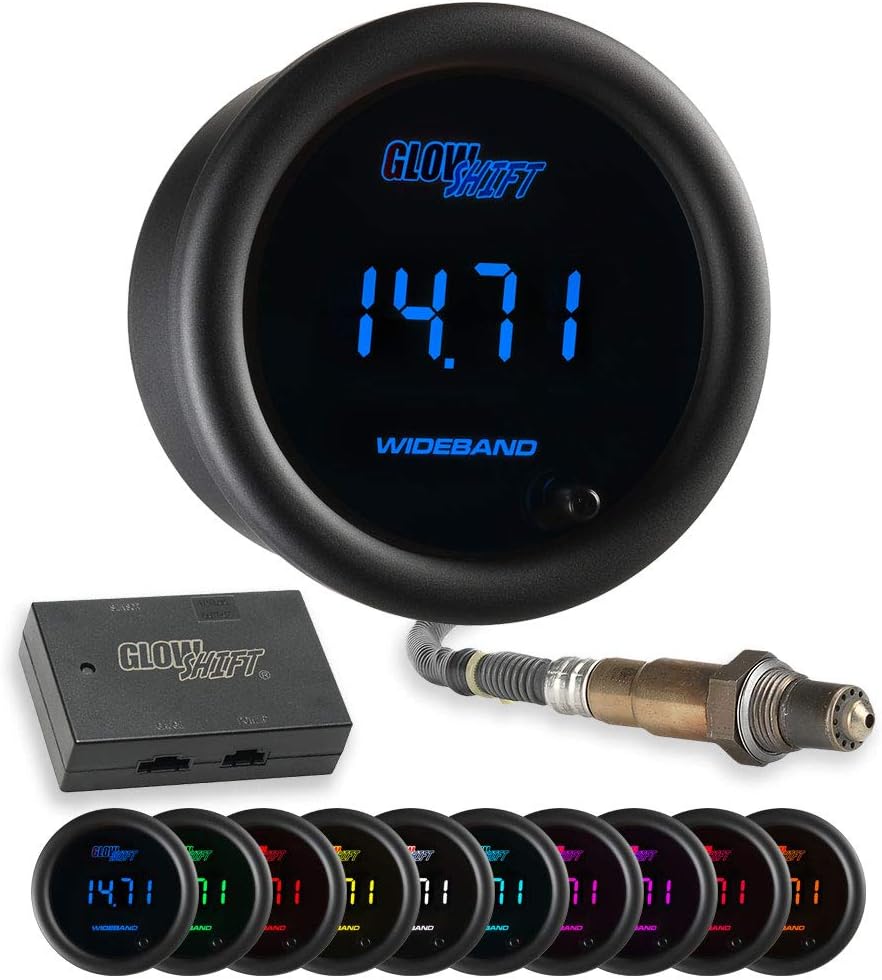
The GlowShift Black 7 Color Digital Wideband Air Fuel Gauge Kit delivers a polished, customizable single-bank monitoring package. It carries a 4.4 rating and includes the sensor, control box, mounting pieces, and wiring needed to build a complete wideband gauge installation.
We may earn a commission when you buy through this link, at no additional cost to you.
The digital gauge supports gasoline readings from 10.00 to 20.00 AFR and E85 readings from 6.00 to 12.00 AFR. Seven solid color modes and two cycle modes allow the display to match factory lighting or establish a custom cockpit look. The dimmer connection reduces brightness by 30 percent when linked to the headlight switch.
Compared with the dual-bank version, this package uses one LSU 4.9 sensor, one control box, and one display, making it more appropriate for a single exhaust side. That simplification also means it cannot directly compare two banks. The control box adds an underhood or concealed component even though the visible gauge is compact.
It is an excellent choice for a single-bank performance vehicle or a builder who values appearance and lighting coordination as much as raw measurement. The included visor, bracket, hardware, and step-by-step instructions also make the package more complete than a basic display-only option.
Seven selectable solid colors and two cycling modes make it easy to integrate the gauge with an existing instrument theme. This is a practical benefit for show-quality builds as well as functional performance dashboards.
The included LSU sensor, controller, harnesses, bung, data lead, and mounting hardware provide a coherent foundation for one exhaust channel. It removes much of the parts-searching associated with assembling a system independently.
We may earn a commission when you buy through this link, at no additional cost to you.
The Innovate Motorsports 3884 LC-2 Lambda Oxygen Controller Kit is a controller-centered package with a 4.4 rating. It provides an LC-2 controller, LSU 4.9 sensor, 3-foot sensor cable, 1-inch mild-steel bung, programming cable, and manual for a flexible monitoring foundation.
We may earn a commission when you buy through this link, at no additional cost to you.
Two configurable linear 0-5V analog outputs are central to its versatility. They can support compatible instruments or logging equipment, while the integrated green-and-red status LED gives a quick visual indication of operating condition. The controller can be calibrated for accuracy and supports wideband operation with all fuel types.
Unlike the gauge kits, this product does not include a dashboard display. A user must add a compatible gauge, ECU, or logger to visualize the readings. That makes the package particularly attractive to users who already have a preferred display or want to integrate the controller into a larger data-acquisition setup.
The LC-2 is a strong budget-minded choice for builders who prioritize a capable controller and flexible outputs over decorative cockpit features. The included programming cable and manual support setup, although users with no electronics experience should expect a greater learning curve than with a simple display.
Separate 0-5V outputs can serve compatible logging or display devices. This gives the system more integration flexibility than a package designed only for a dedicated gauge.
The ability to calibrate the O2 sensor helps the controller establish an appropriate reference for the installation. The included program cable and manual provide the means to complete that process.
We may earn a commission when you buy through this link, at no additional cost to you.
The GlowShift 10 Color Digital Wideband Air Fuel Ratio Gauge Kit leads the guide in display-color flexibility. It has a 4.5 rating, a 2-1/16-inch digital gauge, ten solid color modes, two cycle modes, and a tinted lens for a highly customizable single-bank installation.
We may earn a commission when you buy through this link, at no additional cost to you.
Startup self-calibration is a notable feature because the gauge checks that the system is operating optimally when it begins. The kit also includes a 4.9 LSU wideband sensor, weld-in bung, control box, sensor harness, gauge-to-controller lead, power harness, data-logging wire, visor, mounting hardware, and instructions.
Its listed 10.00-to-20.00 AFR range is designed around gasoline use, so buyers operating E85 should verify whether that fuel type is appropriate before installation. The single sensor and one display also make this package less suitable when both banks must be compared simultaneously.
This kit is an appealing choice for a builder who wants maximum color coordination, a complete set of installation components, and a straightforward digital gauge. It stands out particularly in carefully finished interiors where lighting color and consistency matter as much as functional monitoring.
Ten solid modes plus two cycling options offer more visual choices than the seven-color systems in the guide. The display can be aligned with a broader range of dashboard lighting preferences.
Self-calibration at startup provides a built-in check of the gauge and sensor system. It supports a more confident initial setup, while normal operating and fuel-specific target selection still require attention.
We may earn a commission when you buy through this link, at no additional cost to you.
The right aftermarket O2 system depends on exhaust layout, fuel type, display preferences, logging needs, and the vehicle’s electrical and mounting requirements. Reviewing the complete package rather than focusing only on the display prevents costly compatibility gaps.
Start by determining whether the engine has one exhaust bank or two that need independent monitoring. A single-channel system is simpler to install, uses fewer sensors and control boxes, and is appropriate for most inline engines and single-side V configurations. A dual-bank system adds valuable comparison data for engines where exhaust-side imbalance can reveal fuel-distribution or cylinder-to-cylinder issues, but it also needs more sensors, more wiring, and more dashboard space.
Choose dual-bank capability when comparing left and right readings is central to the work. Choose a single-channel system when only one exhaust location needs measurement.
The products in this guide rely on wideband sensing, with several packages explicitly including an LSU 4.9 sensor. Wideband systems provide a broader operating range and more detailed mixture information than a conventional narrowband sensor. Buyers should also consider whether the sensor, controller, harness, connector, and software were designed to work together. A sensor purchased for a specific EFI platform may not be interchangeable with a universal controller or dashboard gauge.
Match the sensor to the controller and verify the connector, cable length, exhaust-bung size, and calibration method. A complete matched kit generally reduces integration risk.
A useful display should make the intended reading understandable without prolonged interpretation. Digital numerals are precise, while color changes can reveal rich or lean movement quickly. Programmable color systems help integrate the gauge with a finished dashboard, and dimmable outputs reduce glare when connected to the headlight switch. Gauge diameter also matters: the 52mm format used by most selections is widely compatible with common pods, but installation depth and visibility should be checked.
Prioritize readable modes, suitable brightness, and a size that fits the intended mounting position. Cosmetic options matter most when the display will be part of a finished show-quality interior.
Air/fuel ratio, lambda, and oxygen percentage express related information in different numerical formats. Some packages support several modes, while others specify a fixed gasoline range of 10.00 to 20.00 AFR. Dedicated E85 ranges are particularly useful for flex-fuel vehicles because the stoichiometric reference differs from gasoline. Choosing the wrong range can make a normal reading look abnormal or cause incorrect comparisons with tuning targets.
Confirm the selected fuel, operating range, and display mode before installation. If the vehicle may change fuels, favor a controller or gauge that supports selectable modes.
Gauge-only monitoring is useful during casual driving, but serious tuning often depends on recorded information. A 0-5V analog output can feed compatible loggers or engine-management systems, while data-logging wires support remote recording. Advanced packages may add OBD-II scan functions, CAN channel logging, and direct SD card capture. These features make it easier to compare operating conditions, diagnose faults, and revisit a pull after the vehicle has returned to the workshop.
Choose basic live display for simplicity, or prioritize logging and configurable outputs for repeatable tuning. Confirm that the engine-management system or logger accepts the signal format.
Calibration establishes the relationship between sensor output and the true exhaust mixture. Some systems use a resistor-trim reference, some permit free-air calibration, and others perform a startup self-check. A factory-calibrated resistor can make initial setup simpler, while the ability to calibrate gives the user more control over the installed system. The procedure must be followed carefully, and the sensor must be properly installed and operating temperature for dependable results.
Review the required calibration steps before ordering. Choose the method that matches your installation experience and do not skip manufacturer instructions.
A complete kit may include a sensor, control box, gauge, power leads, sensor cable, data wire, weld-in bung, bracket, visor, and fasteners. These included parts can make installation more cohesive than assembling a system from separate components. However, the quality and length of every harness cannot be judged by the number of pieces alone. Plan where the control box will be mounted, how much sensor cable is needed, and whether the gauge can be installed without obstructing other controls.
Prefer kits that supply the essential mounting and wiring hardware. Measure the vehicle before ordering and budget time for routing, grounding, sealing, and any exhaust welding.
Modern performance electronics may operate on 12V systems, while certain older or race-oriented vehicles can use higher voltages. Several products in this guide state compatibility with systems up to 16V, which broadens their potential applications. Voltage compatibility is only one part of the electrical picture: ground quality, fuse selection, sensor connection, and ECU integration also matter. A gauge’s analog output should be checked against the receiving equipment rather than assumed to be universally interchangeable.
Verify voltage, polarity, grounding, and signal requirements against the vehicle. Use appropriate circuit protection and follow the installation instructions supplied with the selected product.
Begin by identifying the exhaust location, fuel type, target reading format, and whether the system will display one bank or two. Install the sensor in a clean, correctly sized bung and route its wiring away from sharp edges, excessive heat, moving exhaust components, and ignition interference. Connect the control box, gauge, power, and ground according to the product instructions, and verify every connection before operating the vehicle.
Complete the specified calibration procedure after the sensor has reached normal operating temperature. During initial testing, compare the displayed mixture with the engine manufacturer’s targets for the current fuel and operating condition. Use the color modes, data outputs, or logging features to look for changes under load, and investigate persistent lean or rich indications rather than relying on a single reading.
Care for the system by keeping the sensor connector and wiring harness clean, dry, and properly supported. Check that the bung remains sealed, inspect the cable for heat damage, and confirm that the gauge remains readable in changing light. Recalibrate when the product instructions call for it, especially after sensor replacement or a substantial change in installation or fuel configuration.
A wideband O2 system measures a broad range of exhaust oxygen conditions, allowing it to report detailed air/fuel-ratio or lambda values across rich and lean conditions. A narrowband sensor is designed mainly to switch around stoichiometric operation, making it less useful for wide-ranging fuel-map tuning. The systems in this guide focus on wideband monitoring for performance and diagnostic applications.
One sensor is generally sufficient for an engine with a single exhaust bank or when the vehicle’s configuration does not require bank comparison. Two sensors are useful for a V-type engine with separate left and right banks, particularly when diagnosing uneven mixtures or tuning individual sides. Dual systems also require two displays or a suitable multi-channel logger if both readings need to be viewed.
Some packages provide dedicated E85 ranges, while others are documented only for gasoline. The sensor technology may support multiple fuels, but the displayed scale must also match the fuel in use. Check the manufacturer’s specifications carefully and select the correct range before interpreting the gauge as lean or rich.
A 0-5V analog output sends the controller’s measurement to another compatible device, such as a data logger, ECU, or display. It allows fuel-mixture information to be recorded and analyzed rather than viewed only on the dashboard. The receiving system must support the same signal configuration and reference.
Calibration requirements depend on the specific controller and sensor package. Some systems use a factory resistor or perform a startup self-calibration, while others provide a free-air method. Follow the included instructions and allow the sensor to reach normal operating temperature before trusting the readings.
The sensor should be installed in an appropriate exhaust bung at a location specified by the controller manufacturer. It must be properly sealed, mechanically secure, and connected with the correct harness. Avoid routing the cable through excessive heat or moving parts, and ensure the installation leaves room for the sensor to operate normally.
A dual-bank system is better when the goal is to compare left and right exhaust sides, diagnose imbalance, or tune banks separately. A single-gauge system is simpler, uses less space, and is usually more appropriate for an inline engine or single-sided exhaust. The better choice depends on the engine layout and the depth of data the driver needs.
Not always. A wideband monitoring gauge and controller serve a different role from a narrowband sensor used by the factory ECU for closed-loop fuel control. Installation may also require a bung, additional wiring, grounding, and an appropriate ECU signal connection. The engine-management compatibility must be confirmed before any connection is made.
The Innovate LM-2 stands out for advanced dual-channel measurement, OBD-II tools, and detailed logging, while the GlowShift dual 7 Color package offers a complete and visually coordinated solution for two exhaust banks. For a single channel with exceptional display flexibility, the GlowShift 10 Color kit is especially compelling, and the Innovate LC-2 provides a practical controller-first foundation for custom logging or display integration.
Prioritize the features that match the vehicle rather than the number of features in a listing. Dual-bank capability, fuel-specific ranges, analog outputs, self-calibration, and the size of the display all affect the usefulness of the final installation. Confirm sensor, controller, harness, bung, power, and ECU compatibility before cutting, soldering, or drilling.
Product contents, vehicle requirements, availability, and selling terms can change, and current prices should be checked directly on the linked product pages. With the current configuration verified and the included installation instructions understood, an aftermarket O2 system can provide clearer diagnostics, more controlled tuning, and better awareness of engine mixture.

