iFixit Portable Anti-Static Mat
4.7Editor score
Portable folding design
Adjustable wrist strap
Sixty-centimeter square surface
Anti Static Mats create a controlled work surface for handling circuit boards, computer parts, phones, and other sensitive electronics. A properly grounded mat helps dissipate electrostatic charge before it can damage components. The right choice depends on workspace size, soldering conditions, portability, and which grounding accessories you need.
We compared all ten products using the supplied specifications, including physical dimensions, resistance ratings, material construction, heat resistance, storage options, and included grounding equipment. The list covers portable kits, compact silicone repair mats, low-profile desk pads, and large rolls suited to more demanding electronics work.
Each review explains the mat's strongest qualities, practical limitations, and ideal user, while the comparison table makes the main differences easy to scan. Product details and availability can change, and prices fluctuate, so readers should confirm the current listing and grounding requirements before purchasing.
4.7Editor score

4.7Editor score

4.3Editor score
As an Amazon Associate we earn from qualifying purchases.
The comparison covers mat dimensions, resistance characteristics, heat tolerance, grounding accessories, and practical features such as compartments, portability, and roll-based coverage. These details help distinguish compact repair kits from full workbench solutions.


This 17-by-25-inch mat combines a blue dissipative surface with a black conductive layer, giving electronics technicians a generous area for components and tools. Its 4.2 rating reflects a practical balance of size, construction, and included grounding equipment. The two-layer design is particularly relevant when the mat will serve as more than a simple protective pad.
We may earn a commission when you buy through this link, at no additional cost to you.
The stated surface resistivity of 10^6 to 10^8 ohms and volume resistivity of 10^5 to 10^8 ohms provide clear technical benchmarks. Grounding hardware includes an adjustable wrist strap, coil cord, common-point ground cord, and ring terminal. That equipment supports a grounded workstation for repairing PCs, circuit boards, pads, and cellphones, although an outlet ground adapter is not included.
The principal compromise is that this product focuses on functional ESD control rather than workstation organization. It does not provide the numbered compartments, ruler, or divided storage seen on several silicone repair mats. Buyers also need to account for the missing outlet adapter when planning how to establish the ground connection. Its 0.08-inch profile is suitable for general repair work, but the supplied information does not establish it as a dedicated high-temperature soldering surface.
This is a practical choice for a technician who wants generous coverage without purchasing a large roll. It works especially well when a common-point grounding arrangement suits the bench. People building a compact organized station, however, may prefer one of the silicone mats with built-in storage. For spacious grounded repair work, this remains a straightforward and adaptable option.
The dissipative top and conductive bottom give static charge a controlled path toward the grounding system. The specified resistance values make this mat more appropriate for ongoing electronics work than a thin, ungrounded pad.
The 17-by-25-inch surface leaves space for a repair in progress rather than forcing components onto a small sheet. It can accommodate circuit boards, phone repairs, computer work, and assorted hand tools.
We may earn a commission when you buy through this link, at no additional cost to you.
This HPFIX silicone mat combines static protection, heat resistance, and an organized repair surface in a compact 15.9-by-12-inch format. Its 4.7 rating makes it one of the strongest all-around options in the group. It is especially useful for mobile phone, tablet, laptop, camera, and circuit board repairs where small parts need to remain sorted.
We may earn a commission when you buy through this link, at no additional cost to you.
The surface resistivity of 10^6 to 10^8 ohms provides a stated basis for its ESD performance, while the 932°F heat rating makes it suitable for demanding soldering and disassembly tasks. Built-in trays, compartments, and a ruler help keep screws, components, and tools under control. The supplied grounding plug, grounding cord, and wristband provide a more complete starting setup than a mat sold alone.
Compared with the largest rolls and the 24-by-27.5-inch StarTech pad, its usable area is more modest. Large motherboards, multiple open devices, or crowded benches may require more room. The product information also gives surface resistivity but does not provide a separate volume-resistivity figure, so buyers with formal verification requirements may need additional documentation. Otherwise, the organization and thermal specifications make it unusually well rounded.
This mat is a strong recommendation for mobile repair technicians, electronics hobbyists, and anyone who wants soldering resistance without giving up component storage. It is also a convenient first ESD work surface for a home workshop. Those needing an expansive mat for several simultaneous projects should look toward a roll, but for a compact, organized station this is an excellent balance.
The stated 932°F rating offers useful protection when a hot soldering iron or rework tool contacts the work surface. That makes the mat more versatile than standard padded desk accessories.
Compartments and trays reduce the chance that tiny screws or components will be lost during disassembly. The integrated ruler also supports more accurate layout and measurement without occupying separate bench space.
We may earn a commission when you buy through this link, at no additional cost to you.
The StarTech mat offers a large, low-profile surface for users who want static control without a bulky repair mat. Its 24-by-27.5-inch footprint is intended to accommodate equipment such as a CPU, VDT, and keyboard, while its 4.6 rating supports its reputation as a dependable home or workplace option.
We may earn a commission when you buy through this link, at no additional cost to you.
Unlike conductive systems that can permit rapid discharge, this product uses a static-dissipative approach intended to protect sensitive equipment. The listed construction is designed to meet high specifications, including IBM and US military static control standards. At only 0.1 inch thick, it sits comfortably beneath desktop equipment and can integrate with a professional workstation more discreetly than thicker silicone or rubber mats.
The main drawback is that the wrist strap is not included; StarTech identifies its SWS100 anti-static wrist strap as an optional addition. There is also no built-in parts organizer or ruler. A buyer focused on electronics assembly may also need an appropriate separate grounding arrangement. These limitations keep it from being the most turnkey option, but they do not undermine its core value as a thin, standards-oriented protective surface.
This mat is a sensible choice for offices, home computer desks, and formal electronics environments where low profile and broad coverage matter. A mobile repair hobbyist wanting a wrist strap and compartments would be better served by a silicone kit. For a clean desktop installation that can sit under equipment, the StarTech remains a focused and professional solution.
The 0.1-inch thickness allows the mat to fit beneath computer equipment without creating a pronounced ledge. This is useful when the anti-static surface needs to share a desk with a keyboard, monitor, or other system components.
Static-dissipative behavior is intended to manage charge gradually, protecting delicate equipment without the abrupt discharge associated with a bare conductive system. The supplied information emphasizes compliance with recognized static-control standards.
We may earn a commission when you buy through this link, at no additional cost to you.
This larger HPFIX model provides a 20.9-by-13.5-inch mat with a 20.5-by-10.4-inch active working zone. Its 4.7 rating reflects a combination of useful electrical specifications, 932°F heat resistance, and well-organized storage. The magnetic feature distinguishes it from conventional compartment mats by helping keep small disassembled parts visible and sorted.
We may earn a commission when you buy through this link, at no additional cost to you.
The surface resistivity of 10^6 to 10^9 ohms supports a controlled ESD work environment. A grounding plug, ground cable, and anti-static wrist strap are included, with both the cable and strap measuring 3 meters for flexible positioning. Numbered divided slots help separate screws, capacitors, and other small parts, improving access during motherboard, laptop, tablet, camera, and phone repairs.
The product information makes broad heat and service claims, but formal users may still want specific certification documents for their own procedures. It is also a rectangular mat rather than a long roll, so it cannot cover a full bench edge in one piece. Magnetic organization also works best on a suitable flat steel surface. These are modest constraints compared with the convenience of having a large active zone and several grounding components supplied together.
This mat is well matched to repair professionals or serious hobbyists who handle multiple devices and want both heat protection and strong organization. It is less appropriate for someone who needs to move between locations, since portability is not its defining feature. For a stationary, organized soldering station, it offers one of the most complete feature packages in the list.
Magnetic divided areas keep small components visible and separated from tools. This is particularly useful during multi-part disassembly, where screws and capacitors can otherwise be moved, scratched, or misplaced.
The 3-meter cable and wrist strap allow more freedom of movement than shorter leads. That helps position the mat and grounding point around a crowded bench without forcing awkward working positions.
We may earn a commission when you buy through this link, at no additional cost to you.
This portable 24-by-24-inch ESD kit is designed for PC building, component upgrades, classroom projects, and repair work away from a permanent bench. It carries a 4.7 rating and emphasizes accessibility, with a simple grounding sequence and no need to assemble additional accessories before starting.
We may earn a commission when you buy through this link, at no additional cost to you.
The package includes the mat, adjustable wrist strap, grounding hub, grounding cord, alligator clip, and grounding plug. Its static-dissipative design is intended to release charge gradually, making it more appropriate for real-world builds than a bare conductor. The 24-inch square surface offers enough room for a tower PC, laptop, motherboard, phone, or several smaller components, while the foldable construction fits into a backpack or tool bag.
This is not a heavy-duty soldering bench, and the supplied information explicitly excludes direct multimeter continuity testing and industrial ESD certification testing. Users should also expect light creases and a mild new-mat smell that dissipates with airing. Those limitations do not undermine its stated role, but they make it better for temporary electronics work than a permanent professional installation.
The kit is an attractive choice for first-time PC builders, students, mobile repair workers, and travelers who need a dependable temporary workspace. It is particularly helpful for people who want a clear wrist-to-ground connection without researching every accessory separately. For high-temperature industrial soldering, choose a specialized mat explicitly rated for that work.
The included hub, cord, alligator clip, plug, and wrist strap create a straightforward setup. Instructions and quick-start images reduce the chance of leaving part of the grounding system disconnected.
A 24-by-24-inch mat offers more room than a small repair pad while remaining foldable. It can support a full PC build in a classroom, living room, hotel workspace, or traveling technician's setup.
We may earn a commission when you buy through this link, at no additional cost to you.
The Pangda roll brings bench-scale ESD coverage in a 2.5-by-10-foot format. Its 4.3 rating may be lower than those of several compact kits, but the product stands apart through detailed electrical specifications, pure natural rubber construction, and a roll size that can cover an entire work area.
We may earn a commission when you buy through this link, at no additional cost to you.
The two-layer material places a static-dissipative gray surface over a conductive black base. Listed surface resistance is 10e6–10e9 ohms, base resistance is 10e3–10e5 ohms, and volume resistance is 10e5–10e8 ohms. The stated charge dissipation time is under 0.5 seconds. Natural rubber also brings flexibility, durability, lower odor, resistance to oil, grease, common solvents, hot solder, and soldering irons, plus a textured surface intended to reduce glare and slipping.
Proper operation depends on connecting the mat to a grounded point with a dedicated grounding cord, and the supplied information does not indicate that such a cord is included. Installing a long roll is less convenient than placing a compact mat on a bench, and cutting or storing it requires planning. Its lower rating also suggests some buyers may have experienced satisfaction or fit concerns, even though the technical feature set is extensive.
This roll is best for permanent repair benches, electronics workshops, and technicians who want broad uninterrupted coverage. The detailed resistance values are also valuable for users who compare specifications carefully. It is less appealing for occasional mobile work, but for a dedicated installation it offers more technical detail and professional flexibility than most compact alternatives.
Separate surface, base, and volume resistance values allow a more informed comparison than a simple static-safe label. The stated under-0.5-second charge dissipation adds another measurable performance detail.
Pure natural rubber is described as flexible, durable, and lower in odor than conventional synthetic blends. Its resistance to common shop contaminants also supports repeated electronics and soldering work.
We may earn a commission when you buy through this link, at no additional cost to you.
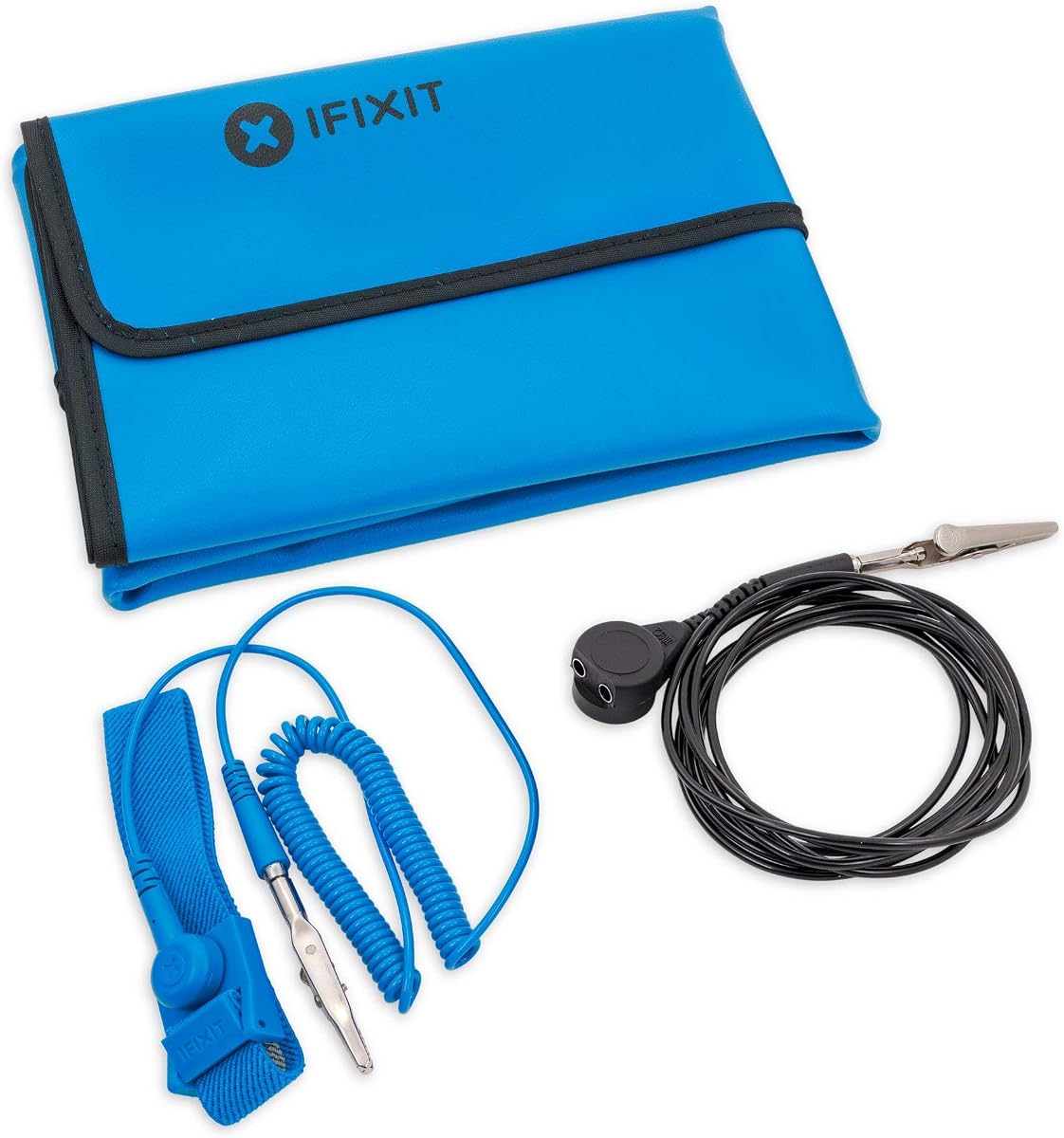
The iFixit mat combines a portable 60-by-60-centimeter surface with a wrist strap and grounding cord. Its 4.7 rating makes it one of the most highly regarded products in the list, while its straightforward design is aimed at hobbyists and professional engineers who need reliable protection away from a fixed bench.
We may earn a commission when you buy through this link, at no additional cost to you.
The surface resistivity of 10^7 to 10^9 ohms provides a clearly stated static-control range. A 10-millimeter grounding snap and a 1.8-meter grounding cord support the connection process, while the adjustable wrist strap can accommodate an XL wrist. The mat can be folded, wrapped, and transported, making it practical for computers, phones, tablets, and field repairs.
The instruction to connect the mat roll to a ground, with a heater given as one example, should be approached carefully: users need an appropriate verified grounding point rather than assuming any nearby object is electrically suitable. The square footprint also has less depth than rectangular repair mats, and its supplied specifications do not focus on high-temperature soldering performance. Portable use also requires enough flat space to unfold it securely.
This is a strong recommendation for repair technicians who travel, students, and hobbyists who want a complete wrist-strap setup without dealing with a rigid desktop pad. Its ease of packing and clear components make it especially useful for service calls. Those establishing a permanent hot-soldering bench should instead select a mat with explicit high-temperature and broad-area specifications.
The flexible mat can be folded, wrapped, and carried between locations. That makes it easier to maintain the same grounded workflow in a home, classroom, client site, or temporary workshop.
The included adjustable XL wrist strap connects the person handling the electronics to the mat's grounding system. This adds an important layer of control beyond merely placing a component on a dissipative surface.
We may earn a commission when you buy through this link, at no additional cost to you.
The Kaisi mat combines a large 21.6-by-16.9-inch surface, high-temperature resistance, and 48 dedicated screw and parts positions. Its 4.4 rating reflects a useful blend of soldering capability, organization, and included grounding accessories for computer, laptop, MacBook, tablet, phone, drone, PCB, and Raspberry Pi projects.
We may earn a commission when you buy through this link, at no additional cost to you.
The mat is stated to withstand temperatures up to 932°F, resist corrosion, and support direct contact with soldering irons and hot-air workstations. It includes a grounding plug, grounding wire, and ESD wrist strap, providing the three elements needed to establish a grounded work area. The wide assortment of storage positions helps separate small components and reduces the likelihood of confusing similarly sized screws during disassembly.
One noteworthy packaging detail is that the grounding accessories are located in the middle of the paper tube, so buyers should inspect the package before assuming anything is missing. The product information gives a resistivity of 10^6 ohms but does not provide the same multi-range surface and volume data offered by some technical competitors. It also has no explicit permanent-magnet feature, so its organization depends on the physical compartments.
This mat suits a technician who combines hot-soldering work with frequent device disassembly and wants a broad, organized surface. Its generous dimensions are more useful for larger electronics than the compact iFixit pad. For buyers who need detailed resistance ranges, industrial documentation, or roll coverage, one of the more specification-heavy alternatives may be a better fit.
The stated 932°F resistance supports soldering and hot-air tasks where a conventional soft mat may not be suitable. It is intended to help shield the underlying workbench from heat and contact damage.
Numerous physical positions help sort screws, caps, and precision parts by project. The system makes small components easier to find and reduces mix-ups during reassembly.
We may earn a commission when you buy through this link, at no additional cost to you.
This green ESD mat roll offers 23.7-by-118-inch coverage and a 5.0 product rating, making it the highest-rated option in the supplied group. It is designed for users who want a continuous, heat-resistant work surface rather than a compact pad with a fixed shape. The long roll can cover a substantial bench edge for electronics, semiconductor, aerospace, and medical work.
We may earn a commission when you buy through this link, at no additional cost to you.
A static-dissipative green top sits over a conductive black bottom in a thick rubber core. The stated top resistivity is 2×10^6 to 10^8 ohms, the bottom resistivity is 8×10^6 to 10^8 ohms, and static clears in less than 0.1 second. The surface is described as resistant to heat, oil, grease, and solvents, while the embossed texture reduces glare and slipping.
The abrasion figure of 0.02 grams per square centimeter is presented as evidence of wear resistance, but buyers should still consider how the mat will be cut, stored, and cleaned. The supplied information does not clearly state which grounding cord or connection accessories accompany the roll. Its long format also requires sufficient bench length, and a permanent installation may be less convenient for occasional mobile use.
This roll is an excellent choice for dedicated workbenches, especially where rapid charge dissipation and uninterrupted coverage are priorities. It is well suited to professional repair operations and technical environments handling sensitive devices. A hobbyist with a small desk will likely find it unnecessarily large, but institutional and professional users can gain a durable, specialized surface from the format.
The stated under-0.1-second clearance time is the fastest figure listed among these products. It provides a clear technical advantage for workflows where components move quickly across the surface.
The 118-inch length can cover multiple projects without a seam between smaller mats. This creates a consistent working area for soldering, inspection, component sorting, and device assembly.
We may earn a commission when you buy through this link, at no additional cost to you.
The Relaxweex set includes two 17-by-25-inch anti-static mats, two wrist straps, and two grounding wires. Its 4.7 rating reflects the convenience of a matched dual setup, which can serve two work areas, two benches, or two people. The package is aimed at computer repair, circuit boards, mobile phones, watches, electronics assembly, and professional workshops.
We may earn a commission when you buy through this link, at no additional cost to you.
Each rubber mat is 0.08 inch thick and has a stated surface resistivity of 10e9 to 10e10 ohms. The listed operating range extends from negative 20°F to 160°F, making it suitable for many everyday workshop environments, although that maximum is below the 932°F ratings highlighted by several dedicated soldering mats. The rubber material is described as durable, easy to clean, and resistant to heat within its stated range.
Setup is straightforward: connect the mat to an appropriate ground, wear the wrist strap, and place components and tools on the surface. Each mat can also be rolled for cabinet storage. The set has no built-in ruler or parts compartments, and the relatively high surface-resistivity range may not align with every formal ESD program's requirements. Its strongest appeal is the duplication of complete components rather than advanced organization.
This two-pack is a strong fit for workshops with more than one repair station, families sharing an electronics hobby, or technicians who want a backup mat. It is also useful for separating computer and phone repair work. For intensive hot-soldering, a mat with a higher stated heat tolerance would be preferable, but for broad everyday repair coverage the duplicated setup is convenient.
Matching wrist straps and grounding wires allow both mats to function as separate stations. This is helpful when multiple people work simultaneously or when one surface can remain dedicated to a different repair category.
The flexible 0.08-inch mats can be rolled and placed in a cabinet when not needed. This helps preserve a protected storage and transport method without requiring a permanently installed bench covering.
We may earn a commission when you buy through this link, at no additional cost to you.
The right anti-static mat depends on the equipment you handle, the type of soldering you perform, the available bench area, and the level of grounding control required. Comparing the physical design, electrical characteristics, and included accessories prevents buying a mat that is too small, too specialized, or incomplete for the intended workflow.
Choose a surface that can hold the device being serviced without forcing components or tools to rest outside the protected area. Compact silicone pads suit phones, tablets, and small circuit boards, while broad rectangular mats accommodate motherboards and laptops. Long rolls are appropriate for permanent benches, multiple simultaneous projects, and users who want an uninterrupted work surface rather than separate pads.
In short, match the mat to the largest project normally handled on the bench and leave room around it for tools and component organization.
Static-dissipative materials allow charge to leave gradually, while conductive layers provide the path toward ground. Look for stated surface and volume resistance, along with a clear explanation of the layer structure. Some products provide detailed ranges and charge-dissipation figures, while others offer only a single resistivity value, so compare the available technical information rather than relying on the phrase ESD safe alone.
For formal work, request documentation and follow the manufacturer's specified grounding method. For ordinary repair projects, a clearly described dissipative surface and complete grounding accessories are the essential combination.
A mat becomes more useful when it includes the pieces needed to connect a person and the work surface to a verified ground. Look for an adjustable wrist strap, grounding cord, plug, snap, hub, or alligator clip, and confirm that the listed items will work with the intended grounding point. Some kits omit an outlet adapter, and some rolls require a separate dedicated cord.
Choose a complete kit for a new station, but verify the included pieces rather than assuming that every grounding component is supplied. Separate accessories may be necessary for professional or fixed installations.
Heat resistance matters when a soldering iron, hot-air tool, or rework station may touch the mat. Dedicated soldering mats in this guide carry stated ratings up to 932°F, while general-purpose rubber options list narrower operating ranges. A mat advertised only for computer assembly may still be adequate for light tool use, but it should not be assumed to withstand direct contact with hot equipment.
Match heat tolerance to the intensity and frequency of soldering work. Always follow the manufacturer's temperature guidance, especially for a first-time high-heat installation.
Portable kits are valuable for service calls, classrooms, travel, and shared workspaces. Folding or rolling protects the surface between uses and makes it easier to maintain a consistent grounding setup away from home. Rigid desktop mats generally provide a more permanent arrangement, while long rolls require adequate storage length and a plan for installation.
Choose portability when you move between projects and value a compact storage footprint. Choose a fixed mat or roll when a dedicated bench is available and uninterrupted coverage matters more.
Built-in compartments, trays, rulers, numbered slots, and magnetic areas can improve workflow by separating tiny screws, capacitors, and other parts. These features are particularly useful during complex disassembly, where a clean parts layout reduces confusion and makes reassembly easier. They are not substitutes for grounding, but they can make an electronics station more efficient.
Prioritize organization when you regularly open devices with many small components. A simple unsegmented mat remains suitable if you already use separate trays, containers, or a magnetic parts holder.
Natural rubber, silicone, and conventional rubber blends differ in flexibility, odor, temperature tolerance, chemical resistance, and ease of cleaning. The supplied data highlights lower odor and solvent resistance for natural rubber, high heat tolerance for silicone products, and a wipe-clean surface for several rubber rolls. A textured or embossed top can also reduce glare and help keep small tools from sliding.
Choose a material that suits your shop environment and cleaning routine. Keep the surface free of debris and follow the maker's cleaning directions, especially when solvents or heat are involved.
Some products are aimed at home and hobby use, while others mention recognized static-control standards or broader workshop applications. The supplied information distinguishes genuine static-dissipative products from bare conductors and notes that certain portable kits are not intended for industrial certification testing or direct multimeter continuity testing. Buyers should match the mat to their own compliance requirements and avoid treating all ESD labels as equivalent.
For professional quality control, ask for current technical documentation and test requirements. For personal repair work, a correctly grounded, clearly specified mat from a reputable electronics-focused brand is the practical baseline.
Begin by placing the mat on a clean, flat, dry work surface with the designated dissipative side facing upward. Review the included instructions and identify the correct grounding point for the specific mat. Connect the grounding cord, plug, hub, snap, or alligator clip as directed before placing sensitive components on the surface.
Wear the included anti-static wrist strap and adjust it for a secure but comfortable fit. Place the device, circuit board, loose components, and relevant tools on the mat, and keep movement within the grounded area. For soldering, use only a surface whose stated heat rating covers the tool and temperature involved, and avoid dragging sharp or dirty tools across the mat.
After completing the task, disconnect the grounding connection before folding or rolling the mat. Wipe away solder residue, dust, and oils using the manufacturer's recommended method, and allow the surface to dry fully. Store a flexible mat rolled rather than sharply folded, check it for cuts or damaged grounding points, and replace the wrist strap or cord if its connection becomes loose or unreliable.
For proper static control, the mat should be connected to an appropriate verified ground using the manufacturer's specified method. A dissipative surface by itself may help charge spread and decay, but the grounding connection provides the intended path for controlled discharge. The required connection hardware varies, so follow the instructions included with the specific mat.
Choose a mat that can hold your largest typical device plus room for tools and small parts. Phone and tablet repairs work well with compact silicone pads, while laptops, motherboards, and PC builds benefit from larger rectangular surfaces. A long roll is most useful for a permanent bench or several projects being handled at once.
Only if its stated heat rating covers your soldering conditions. Several dedicated silicone mats in this guide are rated to 932°F, while general-purpose rubber products may list lower operating ranges. Check the product specifications before allowing a hot iron or hot-air tool to contact the mat, and follow the manufacturer's placement guidance.
A wrist strap is strongly recommended because it connects the person handling the electronics to the mat's grounding system. It limits charge that might otherwise accumulate on the user and transfer directly to a sensitive component. If the strap is not included, choose a compatible adjustable model and follow the grounding instructions.
A dissipative mat allows static charge to move away gradually, which helps protect sensitive components. A conductive layer or bare conductor provides a more direct electrical path, so it must be installed and grounded correctly. Many quality repair mats combine a dissipative working surface with a conductive bottom layer for controlled performance.
They are not necessary for basic ESD control, but they improve workflow when disassembling devices with many small parts. Numbered slots, trays, rulers, and magnetic areas can keep screws, capacitors, and tools organized. If you already use separate parts containers, a simpler mat may meet your needs equally well.
Only if the manufacturer explicitly permits cutting and provides clear instructions for preserving the grounding and layer structure. A cut edge may separate the dissipative top from the conductive base or damage the intended construction. When a custom size is required, confirm the procedure with the manufacturer or choose a product manufactured in the required dimensions.
Confirm that all specified grounding parts are present, connections are secure, and the wrist strap has a reliable contact with the user. Some products provide technical resistance figures, but ordinary users should not substitute a multimeter continuity check for the intended ESD verification procedure. Formal organizations should use appropriate test equipment and current standards.
The HPFIX 15.9-by-12-inch silicone mat is the strongest all-around choice for organized electronics repair, combining a 4.7 rating, heat resistance, grounding accessories, and built-in storage. The iFixit portable mat is ideal for technicians and hobbyists who need a folding setup, while the Pangda natural-rubber roll serves permanent workshops that value detailed electrical specifications and broad coverage.
Most buyers should prioritize correct grounding, an area that fits the largest project, and a heat rating appropriate to the tools used. Add organization features when frequent disassembly is part of the workflow, and choose a roll when bench coverage matters more than portability. Formal industrial users should also request current documentation before adopting any model in a controlled process.
Ratings, included accessories, product dimensions, and prices can change, so check the current listing before ordering. Confirm that the grounding components are included as expected, review the heat guidance, and follow the manufacturer's setup instructions. With those checks completed, the right anti-static mat can provide a more controlled and organized workspace for electronics repair or PC building.