
Fluke 15B+
4.8Editor score
AC and DC voltage to 1000V
AC and DC current to 10A
CAT III 600V safety rating
Resistance continuity diode capacitance
Explore the best Auto Range Multimeter options, comparing accuracy, safety, display, measurement range, extra features, and value for home and professional use.
An auto-ranging digital multimeter simplifies electrical testing by automatically selecting the appropriate measurement range. It is a practical tool for checking voltage, current, resistance, continuity, batteries, and other circuit conditions, but the best models also balance accuracy, safety features, readability, and useful functions such as True RMS and non-contact voltage detection.
This guide compares ten auto-range multimeters suitable for household maintenance, automotive troubleshooting, HVAC work, and light-industrial electrical tasks. The comparison considers measurement capabilities, overload protection, display size, backlighting, data retention, safety markings, included accessories, and the practical differences between compact, rechargeable, general-purpose, and professional models.
Each review explains the strongest reasons to consider one meter, along with limitations that may affect a particular buyer. The list identifies the most useful choices for different needs while recognizing that ratings, availability, and prices can change over time. Always verify the current specifications and accessories before purchasing.
4.8Editor score

4.7Editor score

4.6Editor score
The table below compares all ten meters by their core measurement functions, display characteristics, safety features, and practical extras, making it easier to identify the model that matches a particular electrical troubleshooting workflow.




The Klein Tools MM420 is a well-balanced auto-ranging multimeter for technicians, electricians, HVAC workers, and serious do-it-yourself users. Its 4.7 rating reflects a strong combination of True RMS accuracy, useful safety prompts, and a durable design. The display is clear, the controls are practical, and the measurement set covers the functions most commonly required during electrical troubleshooting.
We may earn a commission when you buy through this link, at no additional cost to you.
Its principal strengths are versatility and deliberate safety features. The meter measures AC and DC voltage up to 600V, AC and DC current up to 10A, and resistance to 50 MOhms. Continuity, temperature, capacitance, frequency, duty cycle, and diode testing are also included. LEDs illuminate when the test leads are not placed correctly, reducing the chance of a setup error while the backlit LCD remains readable in dim workspaces.
The MM420 is built for repeated use in residential, business, HVAC, and light-industrial environments. Its stated ability to withstand a 6.6-foot drop adds confidence when the tool is used on ladders, in vehicle interiors, or around active equipment. A rear kickstand, rear lead holders, and compatibility with an optional magnetic hanger make it easier to examine a reading without repeatedly setting the meter down.
The trade-off is that the magnetic hanger is optional rather than included, and the general measurement ceiling of 600V may be less appropriate for some specialized industrial work. It is also a meter for de-energized circuits, not a substitute for energized-circuit PPE. Overall, the MM420 is the strongest all-around choice here for users who value accurate AC readings, thoughtful lead alerts, accessories, and dependable construction.
For homeowners working on outlets, fixtures, or small appliances, the feature set may feel more than sufficient. For automotive technicians, the measurement range and lead-alert system are helpful. Professionals who regularly work in demanding environments will find the construction and hands-free features particularly valuable, while anyone needing readings above 600V should choose a model explicitly designed for that application.
The MM420 uses illuminated indicators to show when test leads are placed incorrectly. This is a simple feature with meaningful practical value because a misplaced lead can produce a confusing or unsafe result even when the meter itself is operating correctly.
True Root Mean Squared measurement is valuable on modern electronics, variable-speed equipment, and other AC loads whose waveforms are not always smooth. It helps present a more representative reading than a basic average-response meter in these applications.
We may earn a commission when you buy through this link, at no additional cost to you.
The Fluke 15B+ is the premium-oriented selection in this guide, with a 4.8 rating and a measurement range built around professional electrical work. It handles AC and DC voltage up to 1000V, AC and DC current up to 10A, resistance, continuity, diode checks, and capacitance. That makes it especially compelling for electricians and advanced users who need more voltage headroom than most compact meters offer.
We may earn a commission when you buy through this link, at no additional cost to you.
The 1000V capability is the model's most important distinguishing feature. It provides room for diagnosing higher-voltage circuits while remaining rated to CAT III 600V for common residential and commercial systems. A separate input terminal for current measurements to 10A helps keep the intended connection clear, while resistance, continuity, and diode functions cover the checks needed to isolate faults.
Fluke is a recognizable professional brand, and the 15B+ emphasizes dependable measurement and safety rather than decorative extras. Its function set is focused, which may appeal to users who want a straightforward instrument for panels, equipment, automotive systems, and commercial installations. It is not the feature-heaviest meter in the comparison, but that restraint can make it easier to operate regularly.
The main disadvantage is the higher tier of spending compared with general-purpose models. The listing also does not describe the same extensive convenience features found on some alternatives, such as a color display, rechargeable battery, integrated flashlight, or non-contact voltage detection. Buyers wanting the most expansive interface may prefer the Rechargeable FS899L or Crenova MS8233D.
This is the pick for professionals who place a high value on voltage range, established safety credentials, and a focused set of core electrical measurements. It also suits advanced learners seeking a capable meter that can grow with their skills. For basic household checks, a lower-tier meter may offer more extras for less, but the 15B+ is the strongest premium option listed.
The ability to measure up to 1000V separates the 15B+ from meters limited to 600V. That extra headroom is particularly useful for professionals who service equipment beyond ordinary low-voltage household circuits.
Voltage, current, resistance, continuity, diode, and capacitance measurements cover the core workflow of electrical diagnosis. The model avoids unnecessary display complexity, which can be advantageous for regular field use.
We may earn a commission when you buy through this link, at no additional cost to you.
The Crenova MS8233D combines a 4.6 rating with an unusually broad set of functions for a budget-oriented model. It measures AC and DC voltage and current, resistance, capacitance, frequency, and duty cycle, while also providing continuity, diode, live-wire, and non-contact voltage detection. The 6000-count display gives users a useful balance of resolution and readability.
We may earn a commission when you buy through this link, at no additional cost to you.
One standout feature is the option to switch between manual and automatic ranging. Auto-ranging is convenient for routine work, while manual selection can help a user maintain a stable range for certain changing readings. Maximum and minimum tracking, data hold, a low-battery indicator, and automatic power-off support practical field operation, and the bright backlight helps in dark locations.
The non-contact voltage detector uses both sound and light alarms. According to the product information, the buzzer becomes faster as stronger AC voltage is detected, giving users an additional indication of signal strength. Two internal fuses provide overload protection, while the rubber holster adds insulation and helps shield the meter from impact and handling damage.
The package includes test leads, alligator clips, two AAA batteries, a carrying case, and a user manual. That is a generous accessory set for a value-focused choice. The limitation is that the 3-times-per-second sampling speed is modest, and access to manual ranging may feel unnecessary to a beginner who only wants fully automatic operation.
The MS8233D is a strong recommendation for students, home users, mechanics, and electricians who want many functions without moving to a premium model. It is particularly useful when NCV detection, capacitance, frequency, and duty-cycle measurements are desired in the same package. Users who only need voltage, resistance, and continuity can choose a simpler meter, but this model delivers unusually complete capability for its tier.
The choice between automatic and manual ranging gives the meter flexibility. Beginners can leave it on automatic, while experienced users can select a range when monitoring a value that changes near a range boundary.
Audible and visible NCV alerts can help identify active AC wiring before placing test leads near a conductor. The detector should still be treated as an aid rather than a substitute for appropriate electrical safety procedures.
We may earn a commission when you buy through this link, at no additional cost to you.
The Rechargeable FS899L stands apart with a 4.5 rating, True RMS measurement, and an unusually large 5-inch color display. It is designed for home, automotive, and industrial troubleshooting, with a visual interface that should be easier to read than a conventional compact monochrome screen. The display includes a high-brightness backlight, and the built-in flashlight helps illuminate crowded wiring areas.
We may earn a commission when you buy through this link, at no additional cost to you.
Its measurement coverage is broad, including AC and DC voltage, current, resistance, capacitance, frequency, diode, continuity, and temperature. Auto-ranging simplifies operation, while NCV detection provides a non-contact way to identify live wiring. The protective ABS housing, CAT III rating, overload protection, and dual fuses make the safety design a major part of the product's appeal.
Recharging is handled through USB-C, and the built-in lithium battery is stated to support up to eight hours of continuous operation. This removes the need to keep spare cells on hand and offers a cleaner alternative to meters that use replaceable batteries. The trade-off is that the meter must be recharged before extended jobs and cannot generally continue indefinitely without power.
The five-inch screen increases the device's overall footprint compared with pocket meters and may make it less convenient for work in a tightly packed panel or a small vehicle glove compartment. Color graphics may also be less important to users who mainly want a conventional numeric display. Nevertheless, the screen is a major benefit for anyone who struggles to read small characters or wants more information visible at once.
The FS899L is a compelling choice for technicians, advanced DIY users, and anyone who prefers a large, modern display. It is especially suitable for field repairs where visibility, rechargeable power, and broad functions matter. Users seeking a lightweight meter with disposable batteries may prefer the AstroAI M4K0R or Neoteck 8233D PRO instead.
The 5-inch color screen presents more visual information than a standard character-based LCD. It can be particularly useful under a vehicle hood, behind an open panel, or in workshop conditions where a small display would require frequent repositioning.
USB-C charging and an eight-hour stated runtime reduce battery-management friction. Users can recharge the meter between jobs and keep working without searching for compatible replacement cells.
We may earn a commission when you buy through this link, at no additional cost to you.
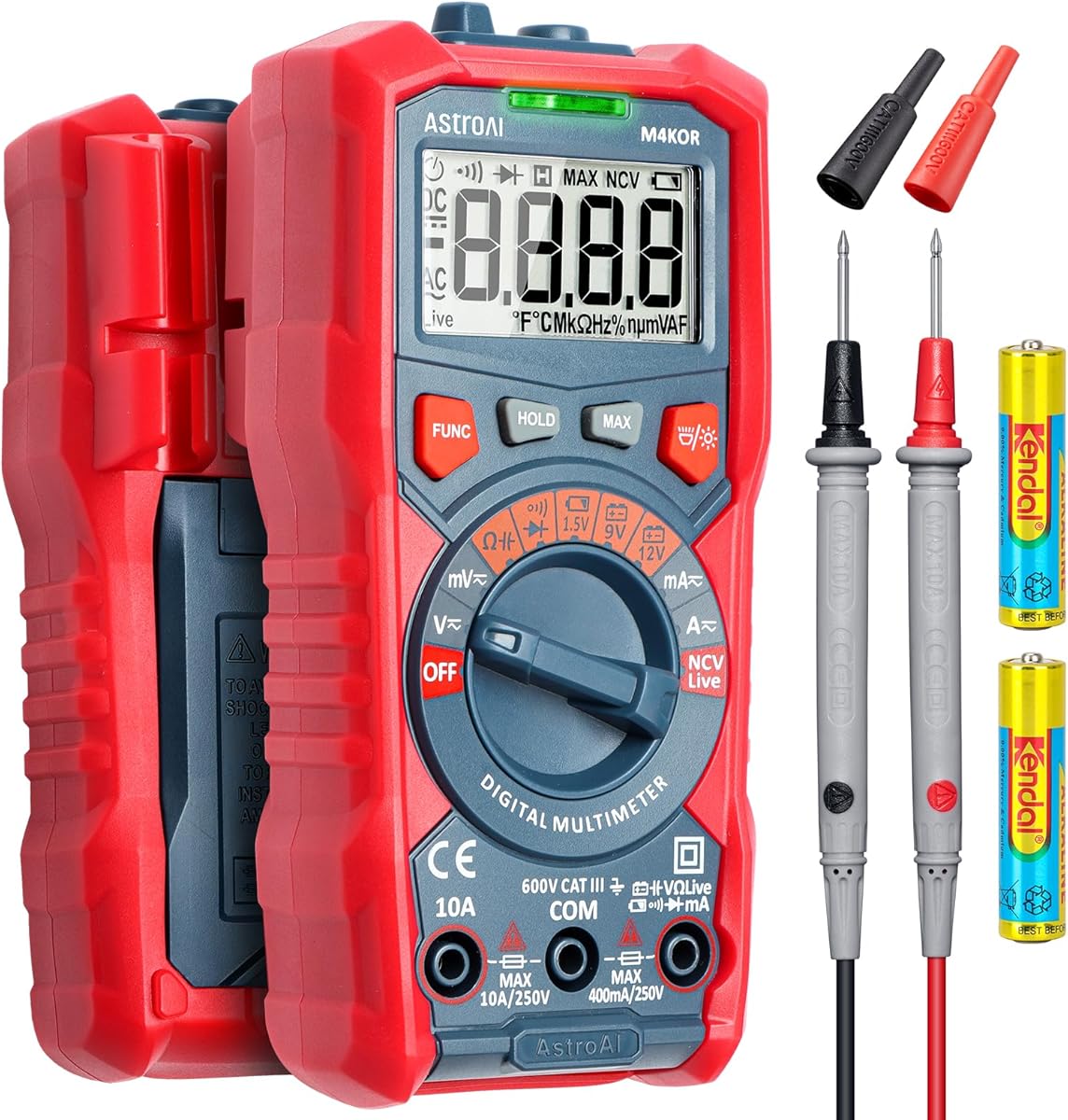
The AstroAI M4K0R is a compact 4000-count auto-ranging multimeter with a 4.7 rating, making it one of the strongest-rated models in the collection. It measures AC and DC voltage to 600V, current to 10A, and resistance to 40 MOhms. True RMS support, continuity, diode testing, live-wire detection, and non-contact voltage testing make it more capable than a basic entry-level meter.
We may earn a commission when you buy through this link, at no additional cost to you.
Its defining practical feature is dedicated testing for 1.5V, 9V, and 12V batteries. A red light indicates low voltage and a green light indicates sufficient voltage, giving users a quick visual assessment. This is useful for maintaining remote controls, smoke alarms, flashlights, toys, and other common devices without needing a separate battery tester.
The meter also includes data hold, maximum tracking, automatic shutoff, a low-battery indicator, a continuity buzzer, a backlit LCD, and a flashlight. Its non-contact detector provides both sound and light alarms when it senses a strong AC signal. Two AAA batteries are included, while a silicone cover helps protect the body and reduce the risk of damage from everyday handling.
Compared with the 6000-count AstroAI models, the M4K0R offers fewer display counts and its product information does not list temperature, capacitance, frequency, or duty-cycle measurement. That makes it a better fit for users who prioritize battery checks and core electrical tests over a very broad function list. Its 40 MOhm resistance range is also lower than the 50 MOhms offered by the Klein Tools MM420.
The M4K0R is a strong option for homeowners, hobbyists, and general repair users who want reliable basics, NCV detection, and battery assessment in one instrument. It is less suitable for users who need extensive capacitance, temperature, or frequency diagnostics. Within those needs, however, it is compact, highly rated, and unusually practical for everyday battery and circuit checks.
Dedicated 1.5V, 9V, and 12V modes make the meter useful beyond standard circuit diagnosis. Color-coded results provide a quick way to judge whether a common battery has enough charge.
Data hold, maximum tracking, a flashlight, a backlit display, and an audible continuity signal cover many small tasks. Automatic shutdown and a low-battery indicator help reduce interruptions and preserve operating time.
We may earn a commission when you buy through this link, at no additional cost to you.
The AstroAI 6000-Count True RMS model is a well-rounded general-purpose meter with a 4.6 rating. It covers AC and DC voltage and current, resistance, capacitance, frequency, duty cycle, continuity, diode testing, and temperature. That extensive range makes it suitable for automotive troubleshooting, household electrical work, and other diagnostic tasks that would otherwise require multiple instruments.
We may earn a commission when you buy through this link, at no additional cost to you.
True RMS applies to both AC voltage and current, a useful feature for modern electronics and variable AC loads. The 6000-count display offers more resolution than a basic 2000-count meter, while the large backlit screen helps users read values in dim conditions. Data hold preserves a measurement when needed, and the rear kickstand supports hands-free viewing.
Protection is centered on two ceramic fuse tubes, specified as F400mA/600V and F10A/600V. The stated anti-burn construction is intended to protect against overload conditions. The product information also notes that the probe caps should be removed before use and advises consulting the manual for additional operating guidance, which reinforces the importance of correct setup.
Compared with the black AstroAI version in this list, the visible differences in the supplied information center on the fuse voltage ratings rather than the core measurement functions. The black model lists F600mA/250V and F10A/250V fuses, while this version uses higher-rated 600V fuse tubes. Buyers should therefore check the intended circuit environment and replacement-fuse requirements carefully.
This AstroAI is a good match for a DIY user or technician who wants one meter to cover many disciplines without paying for the most premium professional option. Its large display and broad functions are particularly attractive for vehicle and household use. Those needing a smaller body, rechargeable design, or expanded voltage range may prefer another model, but the core feature set is difficult to overlook.
The combination of electrical measurements, frequency, duty cycle, capacitance, and temperature allows this meter to move beyond basic continuity checks. It is useful for users who work across different types of equipment rather than focusing on only one type of circuit.
The large illuminated LCD makes values easier to see in garages, basements, and under vehicle hoods. Data hold is useful when the meter is positioned where the leads, rather than the display, require most of the user's attention.
We may earn a commission when you buy through this link, at no additional cost to you.
The Neoteck 6000 Counts is a versatile True RMS auto-ranging meter designed for professionals, technicians, DIY enthusiasts, and home maintenance. Its 4.6 rating reflects a balanced combination of measurement coverage, protective design, and everyday usability. Measurements include AC and DC voltage and current, resistance, capacitance, frequency, diodes, continuity, temperature, live-wire detection, and NCV.
We may earn a commission when you buy through this link, at no additional cost to you.
Auto-ranging and manual-ranging modes can be switched to suit the task. Automatic polarity and unit-symbol displays reduce the need to interpret signs or measurement symbols, which is useful for beginners. A 6000-count backlit LCD and a rear stand that positions the meter at approximately 45 degrees make the instrument easier to read during extended diagnostic work.
Safety features include overload protection, built-in dual fuses, a CAT III 600V rating, and a sturdy silicone protective cover. The cover helps reduce damage from drops and provides a safer grip around live test leads. A data hold function, continuity buzzer, auto-off feature, and integrated flashlight add convenience for nighttime or confined-space work.
The potential downside is that many controls and functions are available to someone who is still learning electrical testing. Manual ranging can be a valuable professional feature, but a beginner may initially prefer a simpler fully automatic meter. NCV detection is useful for preliminary screening, yet it should not be used as the only method of establishing that a conductor is safe.
The Neoteck is a strong general recommendation for homeowners who take on appliance, outlet, automotive, and electronics projects, as well as technicians who want a feature-rich meter. It balances True RMS capability, a readable screen, and protective construction. Buyers prioritizing a rechargeable battery or much larger display may prefer the FS899L, while the most demanding professionals may favor the Fluke 15B+.
Polarity and measurement units are shown automatically, which lowers the learning curve for new users. This is particularly helpful when moving among resistance, voltage, and current tests without constantly consulting a reference chart.
A silicone cover, dual fuses, overload protection, and a CAT III 600V rating form a sensible protection package for routine electrical work. The cover also improves grip when the meter is used with gloves or in damp conditions.
We may earn a commission when you buy through this link, at no additional cost to you.
The black AstroAI 6000-Count True RMS is a polished general-purpose meter with a 4.6 rating. It measures AC and DC voltage and current, resistance, capacitance, frequency, duty cycle, continuity, diodes, and temperature. The auto-ranging design and True RMS performance place it above basic continuity-only meters while keeping the controls straightforward for common household and vehicle tasks.
We may earn a commission when you buy through this link, at no additional cost to you.
A large backlit LCD is one of its most user-oriented features, providing a readable result in garages, workshops, and dim utility spaces. Data hold keeps the displayed value on screen, and the built-in kickstand allows the meter to sit at a practical angle while both hands work on a circuit. These details are modest but can make a meter more convenient during real troubleshooting.
The safety system uses two explosion-proof ceramic fuse tubes, listed as F600mA/250V and F10A/250V. Ceramic construction and the dual-fuse arrangement are intended to guard against overload damage. As with any meter, correct category, range, lead placement, and fuse selection remain essential; a protective design does not authorize use beyond its ratings.
Its measurement functions are nearly identical to the other AstroAI 6000-Count model in this guide, so the decision ultimately comes down to color, supplied fuse specifications, and personal preference. The black version's stated 250V fuse tubes differ from the 600V fuse tubes listed for the other model. That difference should be checked against the intended application rather than assumed to be inconsequential.
This AstroAI is a good choice for a homeowner, automotive hobbyist, or general technician who values a clear screen, True RMS capability, and a wide selection of measurements. Its understated black styling may suit a professional tool kit better than brightly colored models. Those needing rechargeable power, a large color display, or higher voltage measurement capacity should consider the alternatives in this comparison.
The restrained black enclosure gives the meter a professional appearance, while the large backlit screen preserves easy readability. Data hold and the kickstand support the common pattern of positioning the meter and examining a result.
Voltage, current, resistance, capacitance, frequency, duty cycle, continuity, diode, and temperature functions cover many diagnostic needs. This breadth makes the meter adaptable across automotive, appliance, electronics, and household projects.
We may earn a commission when you buy through this link, at no additional cost to you.
The Neoteck 8233D PRO is a compact, auto-ranging meter intended for beginners, home users, and hobbyists who want more than a basic voltage tester. It has a 4.5 rating and covers AC and DC voltage to 600V, AC and DC current to 10A, resistance to 20 MOhms, capacitance to 2000μF, and frequency to 200KHz. Continuity buzzer and maximum-reading tracking are also included.
We may earn a commission when you buy through this link, at no additional cost to you.
Its 2000-count display is less detailed than the 6000-count alternatives, but it remains adequate for many common household and electronics checks. The large backlit LCD provides good visibility, and automatic polarity display makes the reading easier to interpret. A rear stand positions the unit at a convenient angle for hands-free use.
The orange shell is made from a slightly soft, non-slip plastic intended to improve grip and drop protection. Its bright color is also easy to identify in a toolbox. The package includes test leads, an included 9V battery, and a banana-plug-to-alligator-clip cable, which adds flexibility when the probe tips are not convenient for the task.
The main limitation is the absence of stated True RMS measurement, an important specification for modern AC electronics and variable outputs. Its 2000-count resolution and 20 MOhm resistance range are also lower than those of the higher-ranked Neoteck. As a result, it is more appropriate for basic diagnostics than detailed professional work or low-level circuit analysis.
The 8233D PRO is a good starting instrument for a new owner who wants a full set of core measurements in a small package. It is particularly handy for household troubleshooting, electronics projects, and basic automotive checks. Users who expect to work with distorted AC waveforms, need finer display resolution, or want advanced safety features should save for one of the 6000-count models.
The meter covers voltage, current, resistance, capacitance, frequency, and continuity in a pocket-oriented enclosure. It is easier to carry than many larger general-purpose models while still supporting common diagnostic tasks.
The orange non-slip housing improves visibility and handling, and its slightly soft construction provides basic drop protection. The built-in stand also keeps the display angled toward the user.
We may earn a commission when you buy through this link, at no additional cost to you.
The INNOVA 3320 is a straightforward auto-ranging multimeter designed for automotive and household electrical troubleshooting. It has a 4.5 rating and focuses on the essential jobs rather than a long list of specialized functions. The meter automatically selects the correct range, reducing setup time and making it approachable for users who do not want to manage ranges manually.
We may earn a commission when you buy through this link, at no additional cost to you.
Its large digital display is designed for quick reading, and color-coded LEDs provide an easy visual check of battery charge status. A single-setting resistance function handles AC and DC voltage measurements, simplifying routine testing. The design is centered around clear operation and immediate results rather than menus, touchscreens, or complicated controls.
The 10 MegOhm input impedance is particularly relevant to automotive use because the product information notes that it helps prevent damage to a vehicle's ECU. The meter is also described as a UL-certified product, giving it a recognizable safety credential. Those concerned with protecting sensitive electronics should still verify the correct operating procedure and connection points before testing.
The trade-off is a comparatively modest feature set. The 10 MOhm resistance range is lower than several other models, and the supplied information does not advertise True RMS, NCV, capacitance, temperature, frequency, or duty-cycle measurement. Users who need detailed electronics diagnostics may find a 6000-count meter with more functions more adaptable.
The INNOVA 3320 is a practical choice for basic vehicle battery and circuit checks, household outlets, and general electrical troubleshooting. Its uncomplicated interface and automatic ranging suit beginners and users who want a tool that does the work without extensive configuration. Advanced technicians may prefer a meter with wider measurement coverage, but simplicity is this model's defining strength.
The meter chooses the appropriate range for the measurement, reducing the need to consult a range chart before taking a reading. This makes the INNOVA especially approachable for occasional users.
The stated 10 MegOhm input impedance is useful around vehicle electronics because it is designed to limit the possibility of harm to the ECU. Appropriate connection and testing practices remain important even with this protection.
We may earn a commission when you buy through this link, at no additional cost to you.
Choosing an auto-range multimeter requires balancing the measurements you need against safety, readability, portability, and the accuracy of the electrical signals you expect to encounter. The following factors help narrow the field without overlooking the details that affect long-term usefulness.
Begin with the jobs you expect to perform. Most users need AC and DC voltage, AC and DC current, resistance, continuity, and diode testing, while automotive and appliance work may also require temperature, capacitance, frequency, or duty cycle. A broad function set can prevent the need to purchase separate instruments, but every extra mode is useful only if you understand it and can configure it correctly. Review the exact measurement ranges as well as the function list, because two meters may offer the same test at different limits.
True RMS measurement is especially important for modern electronics, variable-speed motors, lighting systems, and other AC signals that do not resemble a clean sine wave. A basic average-response meter can display a reading that is not representative of the true RMS value. True RMS does not automatically make every measurement more accurate, but it is a valuable distinction when testing contemporary equipment or diagnosing unusual AC behavior.
Check the stated safety category, voltage rating, fuse arrangement, and housing design. Dual fuses and overload protection are useful safeguards, but they must be matched to the intended measurement mode and range. A CAT III 600V marking is common among several models in this guide, while the Fluke 15B+ supports measurements up to 1000V within a CAT III 600V safety rating. Users should never treat a fuse as permission to exceed the instrument's ratings.
A large display is valuable in dim garages, under vehicle hoods, and behind equipment panels. Backlighting makes the numbers easier to see, while a kickstand or angled housing can keep the screen facing the user. Models with more display counts can show finer numerical changes, although that extra resolution is less important when the task only requires confirming that a circuit is open, closed, or supplying power. Consider character size and layout as carefully as the count number.
Replaceable batteries are simple, inexpensive to maintain, and allow spare cells to be carried. A rechargeable USB-C model is more convenient for regular users because it can be recharged between jobs and is stated to offer up to eight hours of continuous operation in the FS899L. Rechargeable power requires access to a charging cable and adds a dependency on the built-in battery, while disposable cells require occasional replacements and correct disposal.
Consider where the meter will be carried and how it may be handled. Compact models fit easily into a pocket or small tool pouch, while large screens and integrated flashlights can make a device more substantial. Protective silicone covers, rubber holsters, and stated drop resistance offer better protection for workshop, vehicle, and construction environments. The Klein Tools MM420 is specifically described as withstandable to a 6.6-foot drop, while several other models use protective shells or covers.
Non-contact voltage detection can help identify energized AC wiring using audible and visual alerts, making it useful for preliminary screening. It should never be the sole method of confirming that a circuit is safe. Data hold, max and min tracking, continuity buzzers, flashlights, automatic shutdown, and low-battery indicators are also useful. Accessories matter too: test leads, alligator clips, thermocouples, protective caps, carrying cases, and magnetic hangers can make a model more practical for a specific workflow.
A complete package can reduce immediate extra purchases. The Crenova MS8233D includes probes, alligator clips, batteries, a carrying case, and a manual, while the Klein Tools MM420 includes safety-capped test leads, a thermocouple, instructions, and batteries. Compare the listed accessories with your needs, particularly for temperature testing or alligator-clip connections. Manufacturer support and included documentation can also be valuable when learning unfamiliar functions.
Before using the meter, inspect the case, rotary selector, test leads, input jacks, and display for visible damage. Install the correct batteries or charge the unit as directed, select a measurement function and range, and confirm the lead sockets match that function. If the meter includes a battery-test mode, use only the battery voltage specified by the manufacturer. A quick test against a known source can confirm basic operation, but unknown or unstable circuits should not be used for calibration.
Always de-energize circuits when possible, and treat every conductor as potentially live. Wear appropriate protective equipment, verify the test leads are rated for the task, and never exceed the meter's category, voltage, current, or input limits. For resistance, continuity, capacitance, and diode tests, remove power from the circuit before connecting the leads. Current testing requires placing the meter in series with the load; connecting it incorrectly across a supply can damage the instrument or create a hazardous condition.
After use, switch the meter off, disconnect the leads, and store it in a dry area away from direct heat, moisture, and physical impact. Remove disposable batteries if the meter will remain unused for an extended period, and keep replacement fuses in the correct type and rating. Clean the exterior with a dry or lightly damp cloth, avoid solvents that could damage the housing, and periodically inspect the leads for cracked insulation. The product manual should remain accessible for model-specific cautions and replacement-part details.
Auto-ranging means the meter automatically chooses the measurement range that best fits the value it detects. This removes the need to estimate a range and select it manually, making the tool easier for beginners and faster in routine work. Some models also provide a manual mode for situations where a user wants greater control over the selected range.
True RMS is not mandatory for every basic household check, but it is valuable when measuring modern electronic equipment, variable-speed motors, or complex AC waveforms. An average-response meter may show a less representative value on those loads. For general outlets, lighting, and conventional resistive AC circuits, the practical difference may be small, so the remaining features and safety design often matter more.
Non-contact voltage detection helps identify energized AC conductors without touching them with the probes. The meter commonly provides a buzzer and light, sometimes with faster beeping as the detected signal becomes stronger. It is a preliminary screening aid rather than a guarantee of safety, so proper de-energization and voltage verification procedures must still be followed.
A 6000-count model generally displays finer numerical changes and can be more useful for electronics work or low-resistance measurements, but it is not automatically better for every task. A 2000-count meter may be sufficient for basic household checks and is often easier to carry. Compare display resolution together with True RMS support, safety, accuracy, and the measurement functions you actually need.
Yes, all ten models listed here support current measurement, though the limits and implementation vary. A current must flow through the meter in series, so the circuit is opened and the meter is inserted in the path of the load. Connecting a current input directly across a voltage source can cause serious damage, so the input jack, fuse, and selected mode must be checked carefully.
CAT III 600V indicates that the meter's applicable safety testing covers up to 600V in Category III environments, such as fixed electrical installations and distribution equipment. It is a safety classification, not an invitation to test any circuit at that voltage. The complete category rating, probe ratings, fuse requirements, and instrument instructions must all be considered before use.
Battery-powered models are simple to keep in service and can continue working with standard spare cells. Rechargeable models, such as the FS899L, reduce routine battery replacement and are convenient for frequent work. The rechargeable model must be charged before use, while a disposable-battery model can be prepared by carrying spare cells of the correct type.
Look for AC and DC voltage and current, resistance, continuity, diode testing, and any battery-test function that matches your vehicles. Also consider NCV detection, display visibility, lead protection, and safe input impedance around electronic modules. The INNOVA 3320's stated 10 MegOhm input impedance is specifically relevant to protecting vehicle ECUs, while several newer alternatives offer broader diagnostics and True RMS readings.
The Fluke 15B+ is the premium selection for users who prioritize professional safety credentials, focused core functions, and measurement capability to 1000V. The Klein Tools MM420 is the strongest all-round option, combining True RMS readings, lead-placement alerts, useful accessories, and drop-resistant construction. The Crenova MS8233D stands out as the best budget-oriented feature package, with a 6000-count display, NCV detection, and manual and automatic ranging.
For most buyers, choose according to the work rather than the number of buttons. A homeowner may value simple automatic ranging and a backlit display, while an automotive or electronics technician may need True RMS, capacitance, frequency, temperature, or battery testing. A professional working with higher voltages should pay particular attention to category ratings and current limits, while a frequent field user may prefer a rechargeable model and large screen.
Ratings, availability, included accessories, and prices can change, so confirm the current product listing before making a final decision. Use the chosen meter within its stated limits, follow the included manual, and maintain the leads, fuses, and housing carefully. With the right combination of measurement range, protection, readability, and portability, an auto-range multimeter can become one of the most useful tools in a household or professional toolkit.