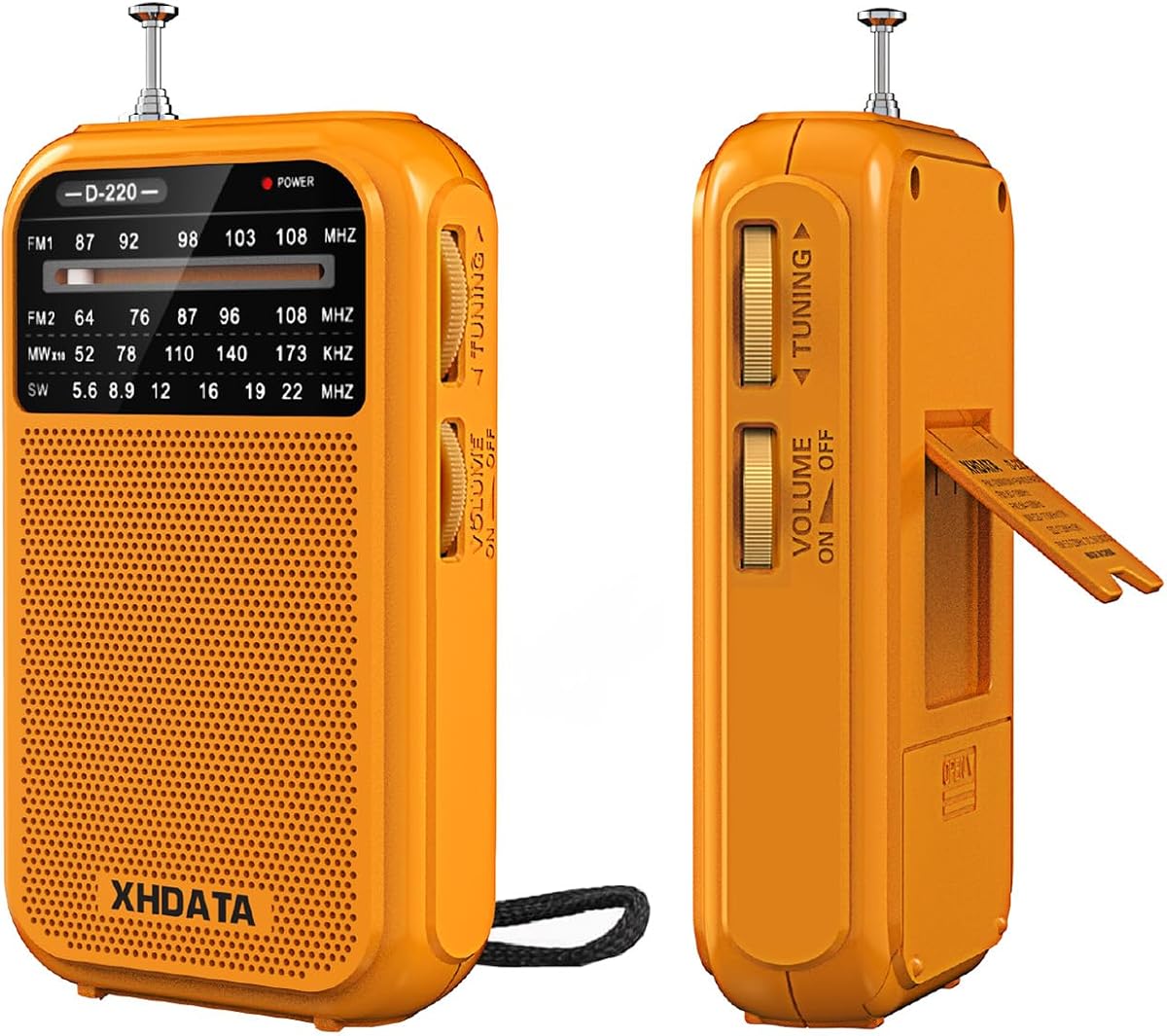
XHDATA D220
4.4Editor score
Pocket-sized 125mm width
Broad shortwave frequency coverage
Two AA battery operation
Built-in clear speaker
Headphone jack included
Our Battery Powered Shortwave Radio guide compares reception, power options, weather alerts, portability, and audio features across ten emergency-ready models.
A battery powered shortwave radio can deliver local news, international broadcasts, music, and emergency weather information without relying on household electricity or cellular service. The most useful models combine dependable reception with multiple charging options, clear controls, useful lighting features, and enough runtime for camping, travel, or emergency preparedness.
We compared all ten radios across shortwave and AM/FM coverage, power flexibility, weather-alert functions, portability, display readability, speaker performance, headphone support, and emergency accessories. The list includes compact pocket sets, traditional home radios, rechargeable emergency models, and multipurpose units designed for power outages and outdoor use.
Each review explains the product's strongest benefits, practical compromises, and ideal user, while the comparison table makes the differences easier to scan. Ratings and product details reflect the supplied listing information, while availability and prices can change, so check the current listing before making a final purchase decision.
4.4Editor score

4.1Editor score

4.5Editor score
The table below compares the ten radios by their most important buying considerations: radio bands, power methods, emergency functions, portability, and listening flexibility. It is designed to show which model best fits a compact travel kit, home emergency package, or multipurpose outdoor radio.


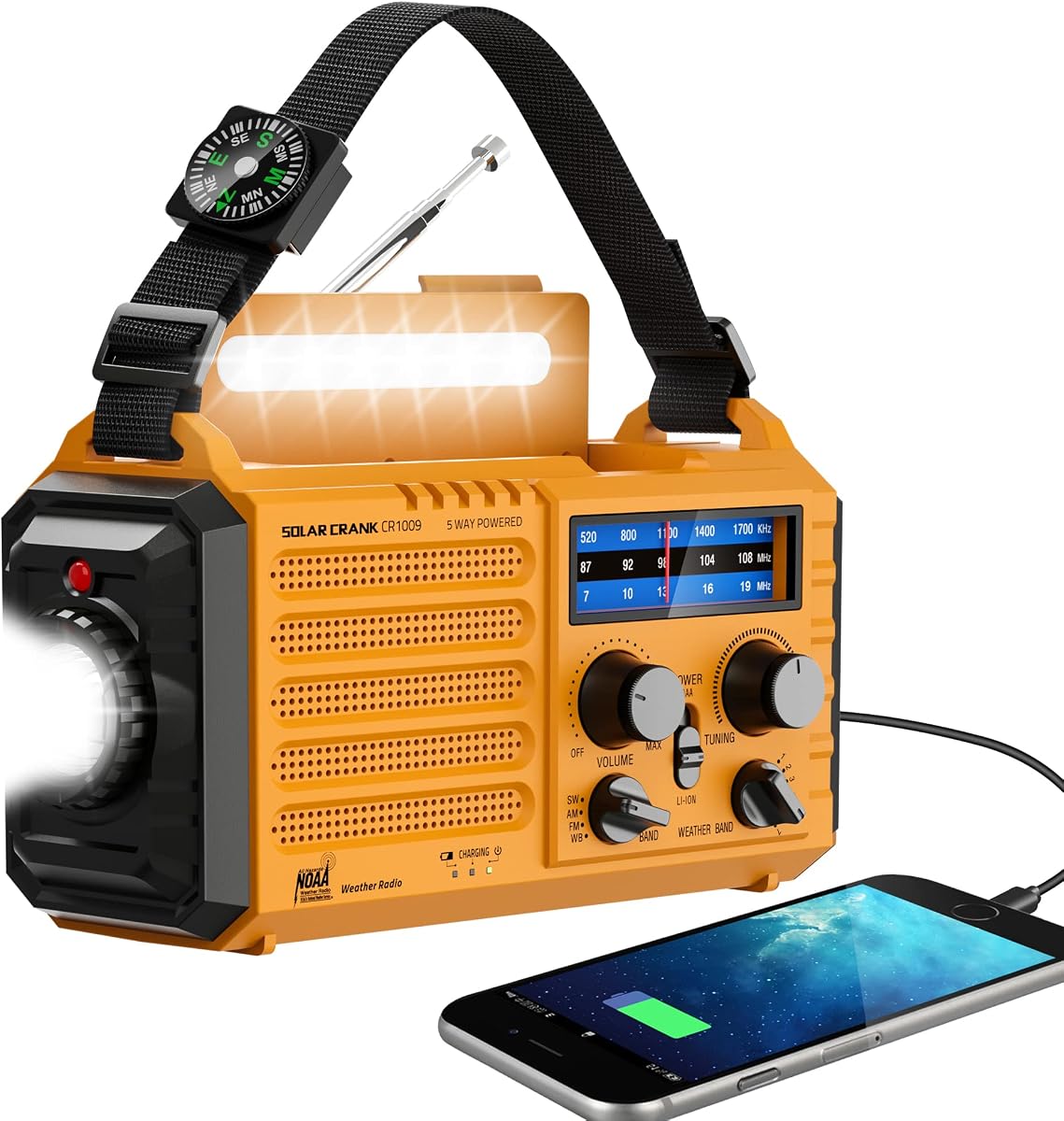


The Digital AM FM Shortwave Radio 4000mAh Rechargeable Battery Best Reception has a 4.1 rating and stands out as the most feature-rich conventional radio in this guide. It combines AM, FM, and shortwave reception with a rechargeable 4000mAh battery, 40 preset stations, NOAA weather alerts, a backlit LCD, and playback from USB devices or microSD cards.
We may earn a commission when you buy through this link, at no additional cost to you.
Its power arrangement is unusually flexible. A USB Type-C connection can recharge the internal battery, which is listed for up to 18 hours of listening after a roughly five-hour charge. Four D-cell batteries can serve as an alternative when the internal pack is depleted or when the radio is used away from a charging source. The listing notes that a short charge may be needed before restarting after the internal battery is exhausted.
The radio also supports MP3, WMA, and WAV playback from storage devices up to 256GB, with high and low tone modes. A 10-to-90-minute sleep timer can conserve power at night, while the lock function helps prevent accidental button presses. NOAA reception across seven selectable weather stations adds practical emergency value, although users should confirm local coverage and programming before relying on it.
This is the most convincing all-around choice for someone who wants more than basic radio reception without moving into a dedicated survival-radio format. It is particularly suitable for bedside listening, emergency preparation, and travel where a single device can handle broadcasts, stored music, and weather warnings. The main compromise is its crowded feature set, which may feel less streamlined than a simple pocket radio or analog home set.
The internal rechargeable battery makes routine use straightforward, while the D-cell backup broadens its usefulness during outages. Keeping spare cells available is advisable because the listing does not include them.
USB and microSD support turn the radio into a compact media player, although file compatibility depends on using the listed formats and appropriately formatted storage.
We may earn a commission when you buy through this link, at no additional cost to you.
The Portable AM/FM Transistor Radio with Loud Speaker, Battery or USB Powered carries a 4.2 rating and offers a refreshingly straightforward way to receive broadcasts. Its AM, FM, and shortwave coverage is controlled with dedicated buttons, a large channel tuner, and separate volume controls, making it approachable for older listeners as well as people who prefer physical knobs.
We may earn a commission when you buy through this link, at no additional cost to you.
A DSP anti-jamming chip is included to improve sensitivity, while the telescopic antenna supports reception across the listed FM range of 88 to 108MHz, AM range of 530 to 1710kHz, and shortwave range of 2.8 to 22MHz. The 5W speaker is designed for clearer music, talk, and sports programming in a home, office, workshop, or casual outdoor setting.
Its rechargeable internal battery can be replenished through a five-volt USB supply, which is convenient for bedrooms, kitchens, and offices. The supplied information does not list a specific runtime, NOAA alert capability, headphone connection, or alternate removable-battery option, so this model should be considered a simpler listening radio rather than a full emergency communications device.
It is a good fit for a user who wants shortwave reception and a large speaker without a complicated digital interface. The radio may be especially useful for casual news listening, music, and talk radio. Those needing automatic storm warnings, emergency lighting, hand-crank charging, or phone charging should choose one of the dedicated emergency models instead.
The large tuner and volume buttons make the radio easy to adjust without navigating menus. This is a practical advantage for anyone who values immediate, tactile control.
The wide shortwave span offers access to numerous international stations when conditions and local regulations permit. Reception still depends on location, antenna positioning, and atmospheric conditions.
We may earn a commission when you buy through this link, at no additional cost to you.
The Greadio Portable Shortwave Radio has a 4.3 rating and balances home convenience with portable shortwave listening. Its large LCD, oversized tuning knobs, carry handle, and two-speaker design make it feel more substantial than a pocket radio while remaining suitable for picnics, camping, and indoor use.
We may earn a commission when you buy through this link, at no additional cost to you.
A long antenna and DSP chip support reception of AM, FM, and shortwave stations, with the display intended to make frequencies easy to read. The radio also includes a time display and high or low tone selection. Two built-in speakers are designed to fill a room or provide clearer group listening, and a 3.5mm headphone jack offers a private alternative.
Power can come from an included charging cable connected to household AC or from four D-cell batteries. That makes it possible to keep listening during an outage if suitable cells are available. The batteries are not included, and the listing does not advertise NOAA alerts, a hand crank, solar charging, or a USB charging output, which limits its role as a comprehensive survival radio.
This Greadio model is best for listeners who want a readable screen, strong physical controls, and flexible power at home or on the go. It is a sensible choice for older adults or families seeking a traditional transistor-radio format with modern digital tuning. Emergency specialists should instead consider a radio with certified weather alerts and multiple independent charging methods.
The large LCD reduces the strain associated with small displays and tiny controls. The visible clock also adds convenience when the radio is placed in a kitchen or bedroom.
AC charging supports regular indoor use, while D-cell power preserves access to broadcasts when mains electricity is unavailable. Buying spare cells in advance completes the emergency setup.
We may earn a commission when you buy through this link, at no additional cost to you.
The Eoxsmile Emergency Radio with NOAA Weather Alert, Solar Hand Crank Portable holds a 4.5 rating and is built for people who want a radio to do more than play broadcast audio. It combines AM, FM, and shortwave reception with certified NOAA weather alerts, a hand crank, solar charging, multiple wired charging options, and emergency lighting.
We may earn a commission when you buy through this link, at no additional cost to you.
The radio includes a 5000mAh rechargeable battery, a three-AAA backup compartment, a USB cord, a 5V/2A power-plug option, and solar and hand-crank charging. The listing says a full charge can provide up to 13 hours while playing FM radio. A USB output port can also charge compatible mobile devices, adding a useful emergency communication function.
Its safety equipment is extensive. A 3W LED flashlight is listed as illuminating up to 80 meters, while a 2.5W reading lamp with adjustable brightness uses six LEDs to light a small room or campsite. NOAA weather warnings trigger a nine-second SOS alarm and flashing red indicator. A telescopic antenna, 3.5mm headphone jack, compass, and hand strap complete the outdoor-oriented design.
This is a strong choice for campers, hikers, and households building a multi-purpose emergency kit. It offers more redundancy than a conventional battery radio and avoids dependence on a single charging method. The trade-offs are its larger size, the need to understand several power options, and the fact that AAA backup batteries and a 5V/2A power plug are not included.
Solar, hand-crank, USB, wall-power, and removable-battery options create several ways to keep the radio operating. Recharge it before an outing and carry spare AAA cells for the backup compartment.
The directional flashlight and adjustable reading lamp make the unit more useful after dark. They are especially helpful when a trip involves a campsite, vehicle breakdown, or temporary power loss.
We may earn a commission when you buy through this link, at no additional cost to you.
The Panasonic Portable AM/FM Radio, Battery Operated Analog Radio, AC Powered, Silver (RF-2400D) has a 4.5 rating and offers the straightforward appeal of a traditional portable radio. It focuses on AM and FM rather than shortwave, but its easy-to-see dial, fluorescent pointer, and digital automatic frequency control make it dependable for everyday listening.
We may earn a commission when you buy through this link, at no additional cost to you.
The radio can operate from four AA/LR6/R6 batteries or through the included AC adaptor. A 3.5mm headphone connection supports private listening, while the internal speaker and antennas are designed for clear AM and FM reception. The large dial is easy to view even in low-light conditions, reducing the need to shine a phone screen while searching for a station.
AFC, or Auto Frequency Control, helps maintain stable tuning. That feature is especially useful in a compact analog-style design because it reduces the need for repeated correction. The radio does not include NOAA alerts, shortwave bands, solar charging, a hand crank, or a USB charging port, so its emergency value depends on keeping fresh AA batteries available.
It is an excellent option for someone who wants uncomplicated AM/FM listening at home, in a workshop, or during a power cut. The RF-2400D also suits buyers who find modern menu-driven radios unnecessarily complex. Shortwave enthusiasts and emergency planners should look elsewhere, but for conventional local and terrestrial radio, its clear display and simple controls remain persuasive.
The fluorescent pointer provides a clear reference point when a backlit digital display would be inconvenient. This makes the radio particularly pleasant to operate in a dark bedroom or during a nighttime outage.
Automatic Frequency Control helps a selected station remain stable. Users can fine-tune the large dial without constantly returning to correct a drifting signal.
We may earn a commission when you buy through this link, at no additional cost to you.
The NOAA Weather Radio, Hand Crank Emergency Radio Solar Battery Operated AM FM carries a 4.5 rating and differentiates itself with a particularly prominent SOS alarm. It covers AM, FM, and shortwave, provides certified NOAA weather alerts, and combines five charging methods with lighting and device-charging functions.
We may earn a commission when you buy through this link, at no additional cost to you.
Its 5000mAh rechargeable battery can be charged through the solar panel, hand crank, USB connection, or 5V/2A power plug. A separate compartment accepts three AAA batteries for additional backup. The listing reports up to 13 hours of FM playback from a full charge, although actual results can vary with volume, display use, and selected functions.
The side SOS control produces an alarm listed at 116dB alongside a flashing red light. NOAA warnings similarly trigger a nine-second SOS-style sound and red indicator, helping draw attention during hazardous weather. A 3W flashlight, adjustable 2.5W reading lamp, telescopic antenna, compass, hand strap, 3.5mm headphone jack, and USB output for compatible phones make it a broad emergency tool.
This radio is best for people who want an attention-grabbing distress signal in addition to standard weather warnings. It works well in a household emergency kit, vehicle, hiking pack, or camping setup. Buyers should recognize that the AAA batteries and wall plug are not supplied, and that the numerous emergency functions make it less minimalist than a standard portable transistor radio.
The listed 116dB SOS alarm is intended to cut through normal household or outdoor background noise. The accompanying flashing light provides a second way to notice a triggered alert.
Selecting the appropriate NOAA weather band allows severe-weather alerts to activate the alarm. The radio should be configured and tested before an emergency rather than assumed to work without setup.
We may earn a commission when you buy through this link, at no additional cost to you.
The XHDATA D220 Portable Radio AM FM SW Shortwave Receiver Pocket Radio has a 4.4 rating and is the most compact model here. Measuring 125 by 74 by 30mm and weighing 125 grams without batteries, it can move comfortably in a pocket, handbag, day pack, or small travel case.
We may earn a commission when you buy through this link, at no additional cost to you.
Despite its size, the radio supports two FM ranges, AM, and shortwave from 5.6 to 22MHz. A DSP chip is included to improve reception, and a built-in speaker produces clear sound. Users can also connect headphones through the 3.5mm jack, which is valuable in shared accommodation or on public transport where a personal speaker would be intrusive.
Operation is deliberately pared down to three controls: a tuning knob, band switch, and combined volume/power switch. That simplicity helps new users, children, and older listeners get started. Power comes from two AA batteries, which can be replaced without a charger, although the batteries are not included.
The D220 is the strongest pick for a traveler who wants genuine shortwave capability without carrying a larger emergency unit. It is also a sensible first radio for casual listeners. Its limitations are clear: there are no listed NOAA alerts, USB charging, flashlight, SOS alarm, or media playback functions, so it should be paired with a separate emergency device for serious preparedness.
The broad shortwave range and DSP chip make the radio more capable than its compact dimensions suggest. An external antenna is not listed, so reception should be evaluated in the user's intended environment.
Band selection, tuning, and volume use dedicated physical controls. This avoids menu complexity and makes the radio an approachable everyday carry for children and adults alike.
We may earn a commission when you buy through this link, at no additional cost to you.
The Kaito KA500 5-way Powered Emergency AM/FM/SW NOAA Weather Alert Radio with Solar,Dynamo Crank,Flashlight and Reading Lamp, Color Black earns a 4.5 rating as a comprehensive emergency instrument. It combines AM, FM, two shortwave bands, seven NOAA weather channels, multiple power methods, a phone-charging output, and substantial outdoor-oriented construction.
We may earn a commission when you buy through this link, at no additional cost to you.
Power can come from a hand-crank generator, solar panel, three AA batteries, five-volt USB input, a five-volt AC/DC input, or the built-in replaceable NiMH battery pack. The AC/DC wall adapter is sold separately, and AA batteries are not included, but the range of alternatives makes the unit unusually resilient when conventional electricity is unavailable.
A 14.5-inch telescopic antenna supports reception, while a signal-strength indicator assists precise tuning. The built-in speaker is designed for loud, crisp sound, and the enclosure uses impact-resistant, water-resistant ABS. A five-LED reading lamp, flashlight, and red SOS beacon add value outdoors, while the USB output can charge compatible phones, GPS units, MP3 players, and digital cameras.
The KA500 is the top premium choice for a household, vehicle, or outdoor kit that needs more than radio reception. Its major limitation is geographic: the listed NOAA forecast and alert coverage applies to the United States and Canada. Buyers elsewhere should verify suitable local emergency broadcasting before treating the weather-radio function as their primary warning system.
The combination of hand crank, solar, removable cells, USB, AC/DC input, and an internal rechargeable pack provides exceptional resilience. A regular maintenance schedule helps ensure each option remains ready.
The impact-resistant, water-resistant housing suits camping and recreational activities. It should still be protected from severe weather and prolonged submersion, as water resistance does not mean waterproof.
We may earn a commission when you buy through this link, at no additional cost to you.
The Raynic Emergency Radio, 5000mAh/18500mWh Weather Radio, Solar Hand Crank Radio with AM/FM/SW/NOAA Alert, Cell Phone Charger, Headphone Jack, Flashlight and SOS Siren has a 4.5 rating. It offers a polished combination of radio reception, automatic weather monitoring, backup charging, and emergency lighting.
We may earn a commission when you buy through this link, at no additional cost to you.
The radio automatically scans for emergency and weather warnings when switched on or left in standby mode. Its large backlit HD LCD displays the current tuning frequency and battery level, while dedicated Tune+ and Tune- controls simplify station selection. Long pressing the Dimmer control turns off the backlight to conserve power.
Its 5000mAh rechargeable battery can be supported by an AC adapter, five-volt USB input, hand crank, solar panel, or three AAA batteries. The batteries are not included. A super-bright 3W flashlight, 2.5W reading lamp, 3.5mm headphone jack, and USB output for compatible mobile devices broaden the radio's emergency functions, while the SOS button combines a loud alarm with a flashing red light.
The Raynic is a good match for campers, anglers, hikers, and households wanting automatic weather warnings in a modern digital enclosure. It is also useful at night because a headphone connection allows quiet monitoring without disturbing others. The listed IPX3 rating indicates water resistance, but the radio should not be submerged or left in heavy rain without protection.
Automatic alert scanning means the radio can remain aware of emergency transmissions without requiring continuous manual tuning. A user should still test the alarm and learn how to disable or acknowledge it.
The readable LCD helps users confirm the selected frequency and battery status. Turning off the backlight during extended monitoring helps preserve the internal battery.
We may earn a commission when you buy through this link, at no additional cost to you.
The Portable AM FM Shortwave Radio AC & Battery Powered has a 4.4 rating and emphasizes simple operation. A large rotary knob, analog scale, and separate volume adjustment make it approachable for seniors or listeners who are not comfortable navigating a dense digital interface.
We may earn a commission when you buy through this link, at no additional cost to you.
A DSP anti-interference chip supports reception sensitivity, and the telescopic antenna is intended to improve signal pickup. The radio covers AM, FM, and shortwave, allowing access to music, news, traffic reports, and international programming. Bass control buttons can adjust the tonal character of music, talk radio, and sports broadcasts.
It can be connected to household AC power or operated with four C/LR-14 batteries. That makes it suitable for a bedroom, kitchen, or office during normal use, while removable cells provide backup during outages. The listing does not include the batteries, and it does not identify automatic weather alerts, a hand crank, solar charging, a flashlight, or a USB output.
This radio is best for listeners who prioritize uncomplicated tuning and broad shortwave access over emergency features. It works well for seniors, casual home listening, and camping with spare cells available. Users building a safety-focused kit should select a NOAA-capable model, while anyone wanting file playback should consider a digital radio with USB or memory-card support.
The visible scale and large rotary controls remove the need to learn complex menus. This is a useful format for older adults, children, and anyone operating the radio in poor light.
AC power supports continuous household listening, while four C cells allow operation away from an outlet. Keeping a set of charged spare cells is essential for planned emergency use.
We may earn a commission when you buy through this link, at no additional cost to you.
The most suitable radio depends on where it will be used, how much emergency capability is required, and how much attention you want to give to charging and controls. Compare shortwave coverage, power options, alert functions, portability, and sound before choosing a model.
A shortwave radio must support the SW band, but the usable range differs considerably between products. The D220 covers 5.6 to 22MHz, the Portable AM/FM Transistor Radio covers 2.8 to 22MHz, and several emergency models use a narrower 7 to 19MHz range. Wider coverage offers more stations and tuning flexibility, while a narrower range may still be sufficient for the stations a user regularly wants to hear.
AM and FM support should also be confirmed because every device needs local broadcasts. The Panasonic RF-2400D is an important exception: it offers excellent AM/FM operation but no shortwave reception. Review the full band ranges rather than relying on the generic shortwave label.
Battery flexibility is one of the most important distinctions in this category. A built-in rechargeable battery is convenient for regular use, but removable cells make it possible to continue listening after the internal pack is depleted. The Digital AM FM Shortwave Radio combines a 4000mAh internal battery with four-D-cell backup, while the Greadio and Portable AM FM Shortwave Radio rely on AC or removable D and C cells respectively.
For a radio that may face extended outages, prioritize the model with the most independent charging methods. Solar, hand crank, USB, wall power, and backup cells provide valuable redundancy. At the same time, consider whether you are willing to maintain spare batteries and regularly test the radio rather than simply leaving it stored until an emergency.
NOAA weather support is distinct from simply receiving regular AM or FM broadcasts. The Eoxsmile, NOAA Weather Hand Crank Radio, Kaito KA500, and Raynic provide dedicated weather-band functions and alert alarms. The Raynic automatically scans for warnings, while the other dedicated weather models use selectable NOAA channels and a nine-second alert sound. The Kaito lists seven preprogrammed NOAA channels and is intended for the United States and Canada.
Users outside the United States should verify whether NOAA stations provide useful local coverage. A radio with an international shortwave range may still offer general emergency information, but it should not be treated as equivalent to a certified local weather-alert receiver. Purchasers should also learn how to select their regional station and test the alert volume.
Size is more than a matter of comfort; it determines how easily a radio can be carried during travel or kept accessible during an outage. The XHDATA D220 is only 125mm wide and weighs 125 grams without batteries, making it suitable for a pocket or small daypack. The Greadio has a carry handle and is better suited to a room, picnic blanket, or vehicle. Emergency radios with solar panels, flashlights, and larger battery compartments naturally require more space.
Consider the included carrying features as well as the dimensions. A handle, hand strap, or stable base may be more useful than the smallest possible body. For hiking, minimize weight but bring spare batteries. For home use, prioritize display readability, speaker size, and access to power rather than compactness.
Emergency radios become more valuable when they provide functions that a phone may not have during a prolonged outage. The Eoxsmile and NOAA Weather Hand Crank Radio include directional 3W flashlights and adjustable reading lamps. The Raynic follows a similar lighting formula and includes an SOS alarm. The Kaito adds a reading lamp, flashlight, and red SOS beacon, giving it a broad emergency-light configuration.
A loud siren can help draw attention in a house, campsite, or vehicle, but it may also be distressing in some settings. Check whether the alarm can be managed and test it at a reasonable volume. A unit with a physical SOS button can be more intuitive than relying solely on a display menu, especially when the user is stressed or unfamiliar with the controls.
The best interface is the one that remains understandable under stress. Some radios use only three physical controls, as the D220 does, while the Panasonic and Portable AM FM Shortwave Radio use a large dial and analog scale. Digital models such as the Digital AM FM Shortwave Radio and Raynic provide backlit LCDs, preset storage, automatic scanning, or dimmer controls, which can be especially useful at night.
Consider the user rather than only the feature count. Large buttons, clearly separated volume and tuning controls, and readable frequency displays help older adults and anyone with visual or motor limitations. Preset stations are convenient once configured, although they are less important for a user who tunes manually as part of the listening experience.
Several emergency radios include a USB output that can charge compatible mobile devices. This is useful for preserving communication options during an extended outage, but it is not a substitute for a dedicated power bank and should not be assumed to charge every device quickly. The Kaito lists phones, GPS units, MP3 players, and digital cameras among compatible possibilities, while the Eoxsmile, NOAA Weather Hand Crank Radio, and Raynic also provide USB outputs.
Users should consider whether the radio will serve as their only communication backup or merely one item in a broader kit. Keeping a separate power bank, spare cables, and a written list of emergency contacts provides a more dependable plan. Phone-charging capability is an advantage, but it should remain secondary to radio reception, weather alerts, and battery maintenance.
Speaker quality determines how well a radio can serve a room, campsite, or group. The Portable AM/FM Transistor Radio has a listed 5W speaker, while the Greadio uses two built-in speakers. A headphone jack appears on many models and allows private listening at night or in shared spaces. The Digital AM FM Shortwave Radio also supports stored MP3, WMA, and WAV files from USB or microSD storage.
For outdoor use, the Kaito has an impact-resistant, water-resistant ABS body, while the Raynic is listed as IPX3 water-resistant. Neither description means the radio can be submerged, and neither eliminates the need to protect it from heavy rain. A protective case or sealed dry bag can extend service life during camping and travel.
Before relying on a new radio, spend time with its controls while ordinary household power and cellular service are still available. Identify the band switch, tuning control, volume, power input, headphone connection, and emergency alarm. If the model includes NOAA channels, select the station serving your area and confirm that you understand how alerts are activated, acknowledged, or muted.
Test reception in both indoor and outdoor locations. Shortwave signals can change with time, weather, interference, and antenna position. Extend the telescopic antenna fully, rotate the radio gradually, and try a clear outdoor location when a difficult station will not resolve. Keep favorite frequencies in presets if the radio supports them, and avoid repeatedly retuning when a distant station fades.
For long-term care, recharge the internal battery periodically and keep removable cells fresh. Test hand-crank and solar charging before an outing rather than during an emergency. Clean the speaker openings and controls gently, protect the unit from moisture and extreme heat, and store it somewhere dry and easy to reach. Replace any battery that leaks, swells, or corrodes, and do not use a damaged charging cable.
An AM/FM radio primarily receives local terrestrial stations, while a shortwave radio reaches broadcasts transmitted on shortwave frequencies. Shortwave can include international news, music, and other programming, although reception varies with the station, time, location, and atmospheric conditions. A model that includes both bands offers greater programming flexibility.
Yes, as long as their required power source is available. Removable-battery models keep working when you replace exhausted cells, while radios with an internal rechargeable pack require USB, solar, hand-crank, or other listed charging methods. A multi-source emergency radio offers the most redundancy, but every option should be tested before an outage.
No single method is ideal in every situation. Removable batteries are easy to replace, USB is convenient, hand cranking works without a wall outlet, and solar can maintain a charge over time. The strongest preparation strategy combines two or more methods and includes tested spare batteries in the emergency kit.
They are primarily designed for NOAA broadcasts in the United States, and the Kaito listing also specifies coverage for the United States and Canada. Users elsewhere should check whether NOAA stations are locally receivable and identify a suitable regional emergency broadcast system. A radio can still receive general shortwave news, but that is not the same as localized automated weather warnings.
A NOAA-capable radio can provide timely severe-weather warnings when power and cellular service are unavailable, but it should be part of a broader emergency plan. Keep a charged phone, weather application, local alert service, and enough supplies available when practical. Test the radio regularly so users know how its warnings sound and operate.
The XHDATA D220 is the most compact option in this comparison, with a listed width of 125mm and weight of 125 grams without batteries. It provides AM, FM, and shortwave reception with only three main controls. Larger emergency radios offer more charging and safety features but usually require a dedicated pocket, pack, or vehicle compartment.
Every radio needs an antenna, and the models here use built-in or telescopic antennas. Extending the telescopic antenna and repositioning the radio can improve results. If a station remains difficult to receive, try a clearer location, avoid obstructions, and wait for different propagation conditions rather than repeatedly forcing the tuner.
Recharge the internal battery periodically, inspect the charging ports, and confirm that removable cells still hold a charge. Exercise the hand crank and solar panel during routine maintenance so they remain usable. Store the radio in a dry, accessible location, clean it gently, and replace damaged cables or batteries before they are needed.
The Digital AM FM Shortwave Radio offers the strongest overall combination of broadcasting, preset stations, NOAA alerts, media playback, and two power approaches. The XHDATA D220 is the most compact and budget-conscious option, while the Raynic stands out with automatic weather scanning, extensive charging choices, and a polished emergency feature set.
Prioritize according to the situation rather than the number of buttons. A traveler may prefer the D220's pocketable design, a traditional listener may choose the Panasonic RF-2400D, and a household expecting outages may want the Eoxsmile, Kaito KA500, or Raynic. Always verify shortwave range, charging methods, local weather coverage, battery inclusion, and included accessories before ordering.
Product ratings, features, availability, and prices can change, so review the current listing and recent customer feedback at the time of purchase. Treat any emergency radio as a backup rather than the only source of weather or communication information, and test it before it is needed.