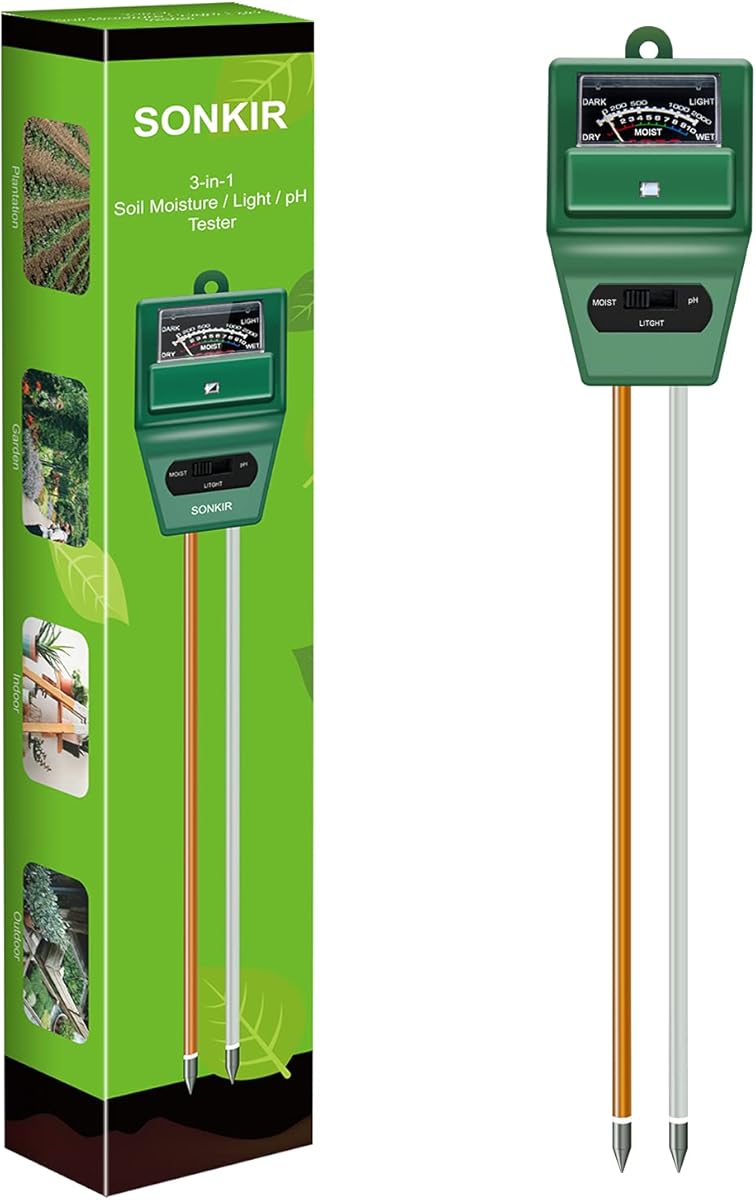
SONKIR MS02 3-in-1 Soil Tester
4.1Editor score
Measures pH, moisture, light
No batteries required
Compact indoor outdoor design
Simple analog-style display
Bluetooth soil pH meters compared for app connectivity, measurement features, accuracy, durability, display quality, and suitability for home growers.
Bluetooth soil pH meters combine chemical measurement with phone or tablet connectivity, making it easier to check growing conditions and retain useful records. A strong model should provide dependable readings, a clear display, simple pairing, and practical data storage while remaining appropriate for the plants and growing spaces you monitor.
The products in this guide were compared using their listed capabilities, including pH range, soil moisture measurement, temperature compensation, wireless functions, probe design, storage options, display readability, and intended applications. The list covers compact indoor tools, app-connected garden monitors, soil-only meters, multifunction probes, and more specialized agricultural instruments.
Each review explains how a product fits into a Bluetooth soil pH meter setup and where it may fall short. The top choices emphasize practical value, connected records, or advanced measurement capability. Product ratings and availability can change, and current prices should always be checked on the linked retailer page before making a purchase.
4.1Editor score

4.4Editor score

4.0Editor score
This side-by-side comparison highlights each meter's connectivity, measurement range, display, probe design, and strongest use case, helping you distinguish simple soil checks from app-based monitoring and professional multi-parameter tools.




The Moisture Meter for Plants 7-in-1 is a broad-purpose digital soil tester with a 4.4 rating and one of the most useful combinations of features in this guide. It measures soil moisture, pH, temperature, light intensity, fertility, EC, and TDS, allowing a grower to check several growing conditions with one instrument rather than switching among separate tools.
We may earn a commission when you buy through this link, at no additional cost to you.
Its strongest qualities are the large white-backlit LCD and the breadth of functions. The display presents numerical results with intuitive symbols, making the meter approachable for beginners while still offering data that experienced growers can use. The stated ten-second workflow is convenient: insert the probe, wait, and read the values. A low-battery warning helps prevent confusing results, although four AAA batteries are not included.
This model is not described as Bluetooth-enabled, so it does not satisfy a strict requirement for phone connectivity. It also measures TDS and EC as water-quality functions, and the instructions expressly say the tester should not be used directly to measure liquids. Dry or hard soil should be moistened first rather than forcing the probe, which protects both the tool and the sample quality.
Despite those limitations, this is the most versatile general-purpose meter in the list for anyone wanting a broad dashboard of soil and plant conditions. It suits indoor plants, garden beds, potted specimens, succulents, and outdoor collections. The best buyer is someone who values immediate readings, a readable screen, and several measurements in one device more than wireless record keeping.
Combining pH, moisture, temperature, light, fertility, EC, and TDS functions makes this a convenient all-in-one diagnostic tool. It is especially useful when you want to understand why a plant is struggling rather than checking moisture alone.
The large white-backlit screen is easy to read in both bright and dim settings. Clear numerical values and symbols reduce interpretation time, which is helpful during routine watering checks and outdoor garden visits.
We may earn a commission when you buy through this link, at no additional cost to you.
The Digital Soil pH Meter with App is one of the few explicitly Bluetooth-oriented products in this guide. It is designed to measure pH in soil and a broad range of liquids, including hydroponic solutions, pool water, aquariums, wine, beer, yogurt, and sauces. That versatility gives it more value than a soil-only model for users with mixed testing needs.
We may earn a commission when you buy through this link, at no additional cost to you.
The conical steel probe is presented as a durable element that helps protect the pH electrode from dirt and direct damage. Automatic Temperature Compensation adjusts readings according to temperature, while the backlight improves visibility in poor lighting. A HOLD/TEMP control locks the displayed value, which is useful when the meter is moved or when a sample needs time to settle.
Bluetooth connection to an app provides automatic data storage and access to plant pH records, although the supplied information gives few details about the interface, supported operating systems, export formats, or offline behavior. The meter also lacks a published customer rating, making it harder to judge long-term consistency from user feedback. Careful calibration and probe care may be more important than usual.
This is a sensible selection for a budget-conscious gardener who specifically wants connected records and a broad 0-to-14 pH range. It is less suitable for someone who needs soil moisture, fertility, or light measurements from the same device. As one of the top three connected options, it succeeds by concentrating on pH, app storage, ATC, and a protected probe instead of trying to include every conceivable sensor.
The listed app and Bluetooth connection make historical pH tracking more convenient than an entirely standalone meter. Since no paid service is mentioned, buyers should still confirm app availability and operating-system compatibility before ordering.
A 0-to-14 range, ATC, and a backlit screen make the probe useful for hydroponics and other liquid checks. The same broad platform can serve garden, aquarium, pool, and food-related testing needs.
We may earn a commission when you buy through this link, at no additional cost to you.
The 7-in-1 Wireless Soil Moisture Meter pH Tester is built for gardeners who want to monitor several locations without repeatedly inserting a handheld probe. Its split design separates the soil probe from the controller, allowing the probe to remain in the ground while readings are viewed from a more comfortable distance.
We may earn a commission when you buy through this link, at no additional cost to you.
The package includes one solar-powered soil probe, and one controller can support as many as 32 expandable probes. The system tracks soil moisture, soil temperature, fertility, and pH, while the controller adds air temperature, humidity, and light intensity. Soil data refreshes automatically every 20 minutes, and a controller button requests the latest reading when you need an immediate update.
The wireless approach is the product's defining advantage, but its 3.9 rating suggests that some buyers may have found the overall experience less compelling than the feature list implies. Placement matters because the controller—not the buried probe—collects the air and light readings. Corrosion-resistant stainless steel, zinc alloy, and aluminum components support outdoor use, although exposed sensors still require sensible protection.
This is a strong option for greenhouse rows, raised beds, vegetable plots, lawn patches, and larger growing areas. It is particularly useful for users who value leave-in sensors and centralized readings more than pocket-sized simplicity. Because the system is centered on expandability and remote monitoring, it also offers a different kind of Bluetooth-style convenience for gardeners willing to build a multi-probe setup.
Expandable probe support turns the controller into a central hub for multiple beds, rows, or lawn sections. This is more useful for a dedicated garden setup than for a household checking only a few houseplants.
Soil readings come from the buried probe, while air temperature, humidity, and light come from the controller's sensors. Placing the controller in the intended growing area produces more relevant ambient readings.
We may earn a commission when you buy through this link, at no additional cost to you.
The SONKIR MS02 3-in-1 offers a straightforward way to check soil moisture, pH, and sunlight without a battery or digital app. It has a 4.1 rating and a long-established garden-tool format, making it appealing to people who want a physical meter that starts working as soon as it is inserted into the soil.
We may earn a commission when you buy through this link, at no additional cost to you.
A function button lets the user switch among the three measurements, and the readout panel presents values without electronic menus. The tool requires no batteries, distilled water, or outside electrical power. Its portable, compact design is appropriate for houseplants, garden beds, lawns, and other indoor or outdoor plant-care settings.
The main compromise is obvious: there is no Bluetooth connectivity, electronic data history, temperature compensation, or advanced soil-analysis functions. The supplied instructions also caution that the tester cannot measure the pH of liquids. If the soil is too dry, the indicator may not move, so the area should be watered before testing rather than forcing the probe into hard ground.
This meter is best for occasional checks, beginner gardeners, and buyers who value simplicity over automation. It cannot satisfy a shopping list centered on app connectivity, but it can be a useful companion to a connected meter because it provides quick pH, moisture, and light information without batteries. For most routine plant care, the MS02 delivers the essential functions in a durable, uncomplicated format.
The analog-style readout avoids charging, pairing, and menu navigation. It is a practical option for quick moisture, pH, and light comparisons during routine plant inspection.
Adding sunlight measurement makes the MS02 more useful than a moisture-only probe. It can help identify whether a plant's location offers enough light while also showing when irrigation may be needed.
We may earn a commission when you buy through this link, at no additional cost to you.
The YINMIK Digital Soil pH Meter specializes in digital pH measurement while adding app-based storage and notes. Its 4.4 rating is strong for a focused soil meter, and its direct-probe approach avoids the need to make a slurry or estimate a reading from a moving dial.
We may earn a commission when you buy through this link, at no additional cost to you.
After connecting through the YINMIK app, users can store up to 1,000 readings, check conditions from a mobile phone, and add notes identifying where each sample was taken. Those location notes are particularly useful for comparing beds, pots, or separate plant groups over time. The ability to review trends matters because a single pH result is less informative than a consistent series.
Two tapered plastic dibbers help protect the pH electrode while allowing use in coco coir, potting mixes, sandy soil, and loam. The meter can also check hydroponic nutrient solution, well water, rainwater, and other water sources. The package includes three LR44 batteries, calibration buffer powder, a cleaning brush, a dropper, and a plant pH card.
This is a good fit for a grower who wants a dedicated pH tool with digital records and notes. It does not measure soil moisture, temperature, light, EC, or fertility, so buyers should pair it with another meter if they want a complete diagnostic picture. It also requires attention to calibration and electrode care. Even so, it offers an attractive combination of focused pH measurement and connected record keeping.
Recording where a sample came from turns a list of values into a useful map of your growing space. Repeated readings from marked pots or beds reveal changes that isolated spot checks can easily miss.
The tapered plastic dibbers reduce direct contact between the electrode and surrounding material. This is useful when working with loose potting mix, coir, sand, and loam.
We may earn a commission when you buy through this link, at no additional cost to you.
The YINMIK Soil pH Moisture Combo pairs two digital instruments: a soil pH meter and a 3-in-1 moisture meter. With a 4.5 rating, it has the highest customer score among the ten listed products. The arrangement is straightforward because each tool focuses on the measurement it is designed to perform.
We may earn a commission when you buy through this link, at no additional cost to you.
The pH meter uses a tapered stainless-steel dibber to protect the electrode while taking direct soil readings. It works with garden soil, yards, farms, and greenhouses without creating a slurry. The moisture meter uses an FDR method to measure soil moisture and temperature, helping users decide when a plant is ready to water.
The package also supports water and hydroponic use. The moisture instrument includes EC functionality, while the pH side can be used to examine nutrient solution. Four-point and seven-point calibration solutions, a probe solution, cleaning brush, dropper, and manual are included. That accessory set is valuable for buyers who want to maintain the pH electrode properly.
Bluetooth and app storage are not identified, so this is a more traditional digital combination rather than a connected system. You also need to carry and operate two instruments, which takes more effort than using a seven-function meter. Nevertheless, the set gives focused tools for two core plant-care decisions, and its accessories make it a strong choice for indoor growers, hydroponic hobbyists, and gardeners who value direct measurements and calibration supplies.
Separating pH from moisture measurement keeps each instrument focused on a distinct decision. This can be preferable to a general-purpose meter when you want dedicated readings and straightforward controls.
The pH and EC capabilities extend beyond garden beds into nutrient solution testing. This makes the set relevant to growers managing both container plants and soilleless systems.
We may earn a commission when you buy through this link, at no additional cost to you.
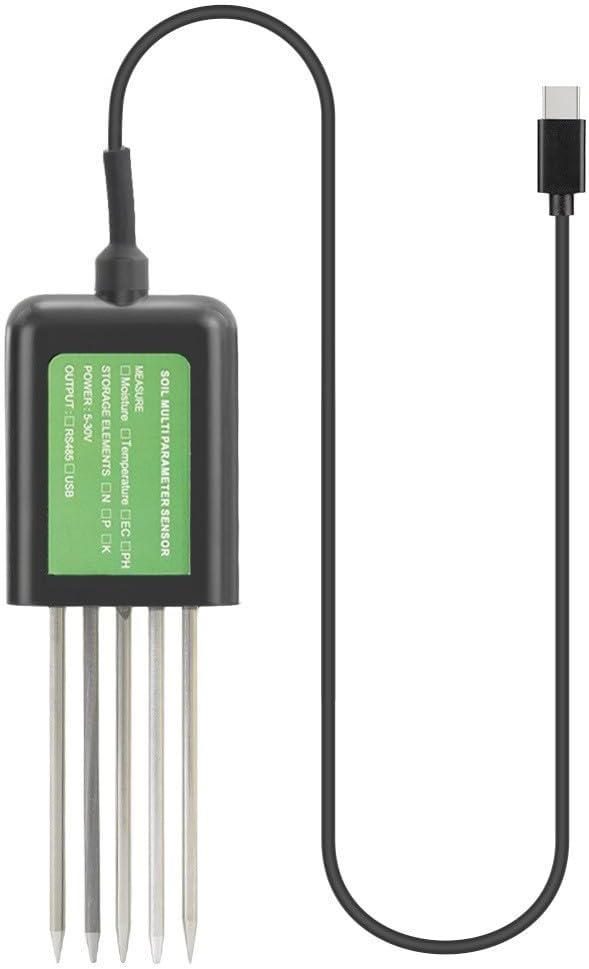
The USB Soil Sensor 7-in-1 targets users who want raw soil-analysis information transferred to an Android device. It measures moisture, conductivity, temperature, pH, and NPK values, offering a much wider parameter set than a typical three-in-one soil tool. Its battery-free design draws power through the USB connection.
We may earn a commission when you buy through this link, at no additional cost to you.
The listed measurement ranges cover moisture from 0 to 100 percent, conductivity from 0 to 20,000 microsiemens per centimeter, temperature from minus 40 to 80 degrees Celsius, pH from 3 to 9, and NPK from 0 to 1,999 milligrams per kilogram. Plugged into a compatible Android device, it can display, save, and export data through an application.
Its 2.6 rating is the lowest in this guide and deserves careful attention. The strong feature set does not necessarily translate into a polished or dependable user experience, and direct USB operation is less convenient than a wireless connection. The stated Android requirement also narrows compatibility, while the pH range is narrower than that of a full-range liquid meter. Buyers should assess support documentation and application requirements before committing.
Even with that caution, the sensor is relevant for agriculture, floriculture, landscaping, research, and advanced home analysis. Its IP68 housing, flame-retardant epoxy seal, and metal alloy probe are designed to withstand prolonged soil exposure. It is best for a technically confident buyer who values exportable NPK and conductivity data more than wireless convenience, simple construction, or a highly rated user experience.
Direct USB data access supports viewing, saving, and exporting soil readings. This is useful for structured record keeping, though a compatible Android device and suitable software are essential.
The IP68 enclosure and epoxy sealing are intended to withstand prolonged exposure. Those construction features are particularly relevant to agriculture and floriculture applications where ruggedness matters.
We may earn a commission when you buy through this link, at no additional cost to you.
The Bluelab OnePen is a polished 3-in-1 meter that measures temperature, EC or PPM, and pH while syncing records through Bluetooth. Its 4.0 rating supports a place among the leading connected options, and the product's design centers on quick readings, durability, and use within a broader digital monitoring ecosystem.
We may earn a commission when you buy through this link, at no additional cost to you.
Readings are automatically adjusted for temperature, and the replaceable double-junction pH probe uses titanium electrodes. The meter's stated accuracy reaches plus or minus 0.01, although that figure should be understood in the context of the specified measurement category and correct use rather than as a universal guarantee for every soil condition. A high-contrast screen supports low-light readability.
Bluetooth sync with the Edenic app allows users to manage, track, and share test data, including a history that can be combined with other Bluelab tools. The IP68 body is dustproof and waterproof to one meter, and the meter floats. A storage cap helps protect the probe, while the replaceable probe design improves long-term serviceability compared with a sealed disposable sensor.
The main omission is soil moisture: the OnePen does not tell you when to water based on volumetric moisture, so a separate moisture meter may be needed. Its pH, EC, and temperature focus is ideal for hydroponics, nutrient management, and professional grow environments. It is the premium choice here because it combines genuine Bluetooth tracking with a durable, serviceable instrument rather than treating connectivity as an added display feature.
Edenic app synchronization keeps temperature, EC, PPM, and pH data together. The ability to review and share history makes OnePen useful for growers who need to compare measurements over time.
The replaceable double-junction pH probe and titanium electrodes support long-term ownership. IP68 sealing and a floating body also make the meter suitable for wet growing environments.
We may earn a commission when you buy through this link, at no additional cost to you.
The Kelway HB-2 is a classic analog soil meter that measures pH from 3.5 to 8 and soil moisture from 0 to 100 percent. It has a 4.1 rating and requires no chemical, distilled water, or external electrical power, making it a durable field tool for repeated checks across a garden.
We may earn a commission when you buy through this link, at no additional cost to you.
The simple design makes it easy to carry from one location to another. A colored comparison display allows the user to interpret the reading against a reference scale without navigating menus or pairing a device. It focuses on the two measurements that many plant-care routines need most: whether the soil is wet enough and whether its pH appears suitable.
The absence of Bluetooth limits its appeal for connected monitoring, and the pH range is narrower than that of a full digital meter. The conditioning film is sold separately, so first-time buyers should review the complete package and available accessories before ordering. The color scale may also be less precise than a numerical screen, and results still depend on correct insertion, cleaning, and consistent comparison.
Kelway is best for a gardener who prefers an uncomplicated, battery-free instrument and wants to move quickly among many pots or beds. It can also serve as a visual cross-check beside a connected meter. For users who need app records, digital accuracy, or additional environmental parameters, it should be a companion tool rather than the sole monitoring solution.
The HB-2 avoids batteries, wiring, and charging, which simplifies outdoor use. Its portable form is convenient for checking multiple areas without needing a power source.
The color-based scale makes the meter approachable for basic plant care. It provides a quick indication rather than the detailed history and precision available from connected digital models.
We may earn a commission when you buy through this link, at no additional cost to you.
The 7-in-1 NPK Soil Tester is a data-heavy handheld instrument aimed at agriculture and other technical applications. It has a perfect 5.0 rating and measures nitrogen, phosphorus, potassium, pH, temperature, moisture, and conductivity through a single integrated device.
We may earn a commission when you buy through this link, at no additional cost to you.
Its standout feature is large-scale data handling. The embedded full-color LCD can query, record, and display results, while the listed storage capacity reaches 1,000,000 data records. Information can be exported to a computer in Excel format for editing and printing, giving researchers, growers, and field users a path from on-site measurement to organized analysis.
The device is not described as Bluetooth-enabled, so its appeal lies in advanced onboard storage and export rather than wireless synchronization. Its industrial positioning may make it more complex than a simple home-garden meter. Claimed system availability figures and broad applications should be considered alongside the need to understand calibration, sampling, and operating procedures for professional use.
A secure rear clip makes the large handheld unit easier to carry on belts, bags, and backpacks. The meter is a strong choice for agricultural testing, environmental work, experiments, surveying, mining, metallurgy, and petrochemical applications where NPK and conductivity records matter. For a home grower needing only a quick moisture check, it is excessive, but for a user producing large datasets, the storage and export functions are compelling.
A one-million-record capacity is dramatically different from a typical hobby meter. It supports repeated field measurements without constantly transferring and clearing data.
Excel export and an embedded color interface make the results easier to review and share. These features are aimed at users who need organized datasets for technical or agricultural work.
We may earn a commission when you buy through this link, at no additional cost to you.
The right connected soil meter depends on how you grow, what you need to measure, and how much automation suits your routine. Consider connectivity, sensor coverage, calibration needs, probe care, and environmental resistance before choosing.
Bluetooth is most useful when it adds something beyond a conventional digital display, such as automatic data storage, notes, history, or sharing. A product may mention an app, wireless probes, or a mobile platform without providing every detail buyers need, so check the compatibility requirements before purchasing. The Bluelab OnePen explicitly syncs with the Edenic app, the YINMIK pH meter stores records in its app, and the app-focused pH tester lists Bluetooth data storage. By contrast, several multifunction meters in this guide do not claim phone connectivity.
Prioritize explicit Bluetooth support, a named app, and clear operating-system requirements. If you only need an occasional reading, a non-connected meter may be simpler and more economical.
A Bluetooth soil pH meter may measure pH alone, or it may add moisture, temperature, light, EC, TDS, conductivity, fertility, and NPK. Home plant care often benefits from pH and moisture together, while hydroponic growers may prioritize pH, EC, and nutrient solution temperature. Research or agricultural users may require NPK and exportable data. Choosing based on the measurements you will actually use prevents an oversized tool from becoming another drawer gadget.
For frequent watering checks, look for pH plus moisture. For nutrient management, prioritize pH and EC. Choose NPK only when you have a reliable interpretation and sampling process.
The probe is the part most exposed to soil, moisture, abrasion, and contamination. Tapered plastic dibbers can protect an electrode in loose potting mix, coir, or sand, while stainless steel offers a more robust surface for direct insertion. Replaceable probes improve long-term serviceability. A conical or tapered tip also reduces the force required to enter the root zone and lowers the risk of disturbing roots.
Match the probe to your medium and check whether accessories or replacement parts are available. Clean and store the probe according to the manufacturer's instructions.
Accurate pH readings depend on proper calibration, clean electrodes, stable samples, and suitable storage conditions. Digital meters may include calibration fluid, powder, or buffer solutions in the package, while the YINMIK combo includes four-point and seven-point solutions. Check the number of points supported and how calibration is performed. A meter with more controls is not automatically better if calibration and maintenance are difficult.
Choose a model whose included or optional calibration supplies are easy to obtain. Budget time to recalibrate when necessary and never interpret an unstable result as precise.
Large displays, numerical readouts, backlighting, and clear symbols make measurements easier to interpret quickly. Digital models are particularly useful when you need precise values rather than a color comparison. For outdoor use, look for IP-rated sealing, corrosion-resistant components, and a body that can tolerate moisture. Wireless leave-in probes should also have clearly described sensor placement and solar charging behavior.
Choose a backlit screen if you often work in dim conditions. Choose a rugged, sealed model for frequently exposed greenhouse or garden use.
A single handheld meter is economical and flexible for a few pots, beds, or samples. A wireless controller with expandable probes is more appropriate when you want continuous readings from multiple locations. The 7-in-1 wireless system supports up to 32 probes, while its controller also gathers ambient temperature, humidity, and light data. A larger deployment adds complexity but can eliminate repeated walking and insertion.
Choose a single probe for occasional spot checks. Consider expandable monitoring for greenhouses, raised beds, and larger gardens.
Data history is valuable when you want to see whether watering, amendments, or weather are affecting soil conditions. App storage enables phone-based review, while onboard storage and Excel export can be more appropriate for field teams. Consider how many readings you expect to keep, whether notes and locations are useful, and whether data can be transferred without a proprietary account. The NPK tester and YINMIK app meter represent different approaches to record keeping.
Choose app tracking for personal notes and trend watching. Choose onboard storage and file export when records must be captured in the field.
Indoor potted plants, outdoor beds, hydroponics, aquariums, and industrial fields have different requirements. A simple battery-free meter can be ideal for occasional visual checks, while a waterproof connected instrument suits wet workspaces. A USB sensor may be attractive for Android-based analysis but inconvenient for quick round-the-house checks. Specialized NPK equipment makes more sense for field analysis than for routine houseplant care.
Think about where the meter will live, how often it will be exposed to water, and whether you need portability. The best tool is the one that matches the actual conditions you will measure.
Begin by reading the manufacturer's instructions and charging or installing the required batteries. If the meter supports Bluetooth, install the stated app, put the device and phone in pairing mode, and confirm that readings appear in the app. Before the first soil test, clean and calibrate the pH sensor using the recommended solution, and confirm that the displayed values remain stable.
Take a representative sample by inserting the probe into moist soil at the depth appropriate for the plant and growing medium. Avoid extremely dry ground, compacted areas, fertilizer granules, drainage gravel, and places where the probe could strike a pot edge. Remove the probe, wipe away clinging soil with a soft cloth, rinse or clean it as instructed, and repeat at several locations when a broad garden assessment is needed.
After each use, rinse the probe with clean water, remove residue, dry the exterior, and store the meter with the electrode protected according to its instructions. Keep the probe from freezing, excessive heat, and prolonged direct sunlight. Log readings with dates, plant locations, and relevant events, and recalibrate when results become unstable or whenever the manufacturer recommends.
A Bluetooth soil pH meter measures soil acidity and can transmit readings or records to a compatible phone, tablet, or app. The connection may support automatic storage, historical trends, location notes, or shared reports. Not every digital soil meter has Bluetooth, so verify the product description and app requirements before buying.
It depends on the model and its probe. The app-connected 0-to-14 meter, the YINMIK digital pH meter, and the YINMIK pH and moisture combo are described as suitable for water or nutrient-solution testing. The SONKIR MS02 cannot test liquid pH, and some general soil meters instruct users not to insert them directly into liquids.
Wireless operation does not automatically improve the sensor accuracy. Accuracy depends on probe quality, calibration, soil conditions, insertion technique, maintenance, and the limits of the measuring method. A leave-in wireless probe is valuable for convenient repeated monitoring, while a calibrated handheld meter may remain the better choice for deliberate spot checks.
Regular calibration is important for dependable pH readings, especially when the electrode is old, dirty, or frequently exposed to nutrient solutions. Use the calibration solution or buffer recommended in the manual, follow the specified number of points, and avoid touching the sensing surface. Recalibrate if readings become unstable or noticeably inconsistent with known conditions.
Suitable ranges vary by species, but many common indoor and garden plants grow in moderately acidic to moderately alkaline soil. Rather than trying to force every plant into one target, identify the species and compare its preferred range with current readings. Use trends and other growing information to avoid changing soil based on one isolated result.
Only use a product for permanent or extended installation if its manufacturer explicitly supports that use. The wireless 7-in-1 system is designed as a leave-in probe, while many handheld pH meters require removal and cleaning after each reading. Protecting connectors and electrodes from moisture, corrosion, and temperature extremes will extend service life.
For routine plant care, pH and moisture are often the most useful pair. Moisture helps answer when to water, while pH helps reveal whether the soil chemistry may restrict nutrient availability. If you grow hydroponic crops or need nutrient data, prioritize pH, EC, and temperature. Add NPK only when you have a clear need for that analysis.
Use the same location, depth, moisture level, and measurement method for each device, and make sure both meters are clean and properly prepared. Compare close readings rather than expecting identical decimals from different sensors. A second meter is often best used as a consistency check rather than as a substitute for careful calibration and sampling.
The SONKIR MS02 stands out as the most budget-friendly basic soil check, the Moisture Meter for Plants 7-in-1 offers the broadest general-purpose measurement suite, and the Bluelab OnePen is the strongest premium connected option. Together they represent simple visual testing, versatile digital diagnostics, and professional app-based monitoring with a serviceable probe.
Choose based on the information you need and the way you grow. Prioritize explicit Bluetooth compatibility, reliable calibration accessories, an appropriate probe, and a readable display over less important extras. App-connected models are best for histories and notes, multi-probe systems suit larger gardens, and simple meters remain effective for occasional checks.
Ratings, software compatibility, and product availability can change, while current prices vary across retailers. Before purchasing, verify the app requirements, package contents, calibration supplies, probe care instructions, and current product listing. Checking those details ensures that the selected Bluetooth soil pH meter matches both your routine and your growing environment.