
Bambu Lab Original Hot Bed Solid Glue Stick
4.8Editor score
Solid hot bed adhesive
Designed for Bambu printers
Supports common filament types
Simple targeted application
Our Build Plate Adhesive Glue guide compares ten liquid and solid options for adhesion, filament compatibility, easy cleanup, and dependable first-layer
Build plate adhesive helps printed parts remain attached while the first layer sets, reducing the risk of warping, lifting, and failed jobs. A useful product should grip consistently without damaging the plate, release completed parts after cooling, and clean up without leaving a stubborn residue.
We compared ten build plate adhesives based on their stated adhesion methods, supported filaments, build plate compatibility, application method, cleanup requirements, and user ratings. The list includes liquid foams, solid glue sticks, and a nano polymer formula for hobbyists and advanced users.
Each review explains who the product best suits and where it fits into a practical workflow. Ratings and product details reflect the supplied information, while current availability and prices can change, so confirm the latest listing and manufacturer guidance before purchasing.
4.8Editor score

4.8Editor score

4.4Editor score
The table below compares all ten products by format, filament coverage, plate compatibility, and application or cleanup features to help identify the most suitable adhesive for a particular printer and material.



Black Magic’s 60ml adhesive kit stands out for its precision foam applicator and the level of control it offers over coating thickness. Its 4.4 rating is solid, though not the highest in this guide, so the appeal comes primarily from a deliberately engineered application system. The manufacturer says the applicator spreads a thin, uniform layer without overspray, which is useful when keeping glue off hinges, rails, and other machine components.
We may earn a commission when you buy through this link, at no additional cost to you.
The product is described as compatible with PLA, PETG, ABS, ASA, TPU, nylon, and polycarbonate. That broad filament range is particularly relevant for users who switch between easy-to-print and high-temperature materials. A thermal-style adhesion approach is also claimed: the coating grips while hot and releases as the part and plate cool. One thin application can support several prints, reducing the need to rebuild a heavy coating before every job.
Cleanup is another important strength. The formula is water-soluble and can be washed from PEI, glass, and smooth surfaces with warm water, without a stated need for IPA, acetone, or scraping. The trade-off is that users still need to apply the product correctly and allow the coating to establish itself. A heavy or uneven application could undermine the very precision that makes this applicator appealing.
This kit is a strong choice for printers that work across numerous filament types and for anyone who values controlled, low-mess application. It is especially compelling for Bambu Lab, Prusa, Creality, Elegoo, Flashforge, and Ender systems, whether the bed is heated, unheated, enclosed, or open-frame. Choose it when multi-filament support and easy cleanup outweigh a preference for a simple solid stick.
The foam applicator targets the active printing area and is intended to avoid the overspray and buildup associated with less controlled coating methods. This makes it easier to refresh only the section of the plate actually being used.
Compatibility with everything from PLA and PETG to ABS, ASA, TPU, nylon, and polycarbonate gives this adhesive unusual flexibility. It is worth considering for mixed-material shops that need more than a PLA-focused solution.
We may earn a commission when you buy through this link, at no additional cost to you.
Bed Weld Original is a liquid bed adhesive centered on a thermal-dynamic coating concept: parts are intended to hold during printing and release after the bed cools. It carries a 4.5 rating and uses a built-in foam tip, placing it between a straightforward squeeze bottle and a more elaborate applicator kit. Its strongest appeal is the combination of strong initial grip and a coating that can be refreshed with a wet sponge.
We may earn a commission when you buy through this link, at no additional cost to you.
The listed filament support covers PLA, ABS, PETG, ASA, and CPE. A quick-drying formula forms a thin film intended to provide adhesion without sticky residue, while the low-odor and water-soluble characteristics make the product more approachable for a home workshop. The manufacturer also states that parts typically detach without tools once the bed returns to room temperature.
One caution is the explicit instruction to check the compatibility image for the surface type. Adhesion performance depends heavily on the plate, and a coating that works on one texture may behave differently on another. The same caution applies to the expectation of getting multiple prints from one application: the formula can be recharged with a wet sponge, but actual longevity will vary with plate, filament, and printing conditions.
Bed Weld is a practical choice for users who want a controlled foam application, low odor, and easy removal without moving to a solid stick. It fits well within a general FDM workflow and is especially relevant for ABS, PETG, ASA, and CPE users. Check the surface compatibility information before ordering, and keep the sponge-recharge habit if consistent first-layer adhesion is the priority.
A wet sponge can reactivate the coating when adhesion begins to weaken. This maintenance step is designed to extract more use from an application without beginning the cleaning process from scratch.
The thermal-dynamic approach is intended to create a bond during the hot print and reduce the force needed to remove the finished part after cooling. Waiting for the plate to reach room temperature remains an important part of that process.
We may earn a commission when you buy through this link, at no additional cost to you.
Creality’s official PVP glue stick offers a familiar and uncomplicated approach to build plate adhesion. It has a 4.7 rating and is intended to improve first-layer grip while reducing model lifting, warping, and related printing errors. Unlike liquid coatings, the solid format is especially convenient for applying a small amount directly to the active region of the bed.
We may earn a commission when you buy through this link, at no additional cost to you.
The stated filament range is broad for a solid adhesive, covering PLA, ABS, PETG, PC, PA, and TPU. The product is made from high-quality PVP material and is described as low odor during printing. Users are instructed to apply it only where printing will occur rather than coating the entire plate, which can reduce unnecessary buildup and make maintenance more manageable.
Cleanup is performed with water after the bed has cooled. The lid should be replaced immediately after use because the solid glue can otherwise dry out. A solid stick may also leave residue over time, so a water-based cleaning routine is still important. Nevertheless, for users who want fast application without dealing with a liquid bottle, this remains a practical format with fewer immediate handling concerns.
This glue stick is a good match for Creality users and anyone who values a targeted, low-mess application. It also makes sense for mixed-material users because PC, PA, and TPU are included alongside the most common filament types. Choose it when portability, simple application, and broad stated compatibility matter more than a liquid coating’s more uniform spread.
Applying the stick only to the effective printing area keeps the task focused. This can make routine bed preparation faster and reduce the amount of adhesive that must be removed later.
The PVP formula is described as low odor, which is useful for users who print near living spaces or shared work areas. It should still be stored capped in a cool, dry location.
We may earn a commission when you buy through this link, at no additional cost to you.
Magigoo All-in-One is a 50ml solid bed adhesive designed for a wide range of filaments and surfaces. Its 4.5 rating reflects a generally favorable reception, while the product’s strongest feature is the unusually broad build plate compatibility list. Flex Plate, glass, PEI, BuildTak, Kapton, and other common surfaces are all included.
We may earn a commission when you buy through this link, at no additional cost to you.
PLA, ABS, PETG, HIPS, and TPU are among the supported materials, with TPU Flex specifically mentioned. The application process is deliberately simple: shake the stick, press it against the active printing area, and allow the coating to bond. It is designed to keep parts in place and make removal easier once the bed has cooled, with water listed as the cleanup method.
The manufacturer advertises more than 100 prints from a single application, making longevity one of the product’s main selling points. It is also described as completely odorless and non-flammable, which supports use in homes, offices, and educational environments. The principal trade-off is that its filament list does not include the same advanced-material range offered by some liquid competitors, such as nylon, PEEK, or polycarbonate.
Magigoo All-in-One is best for users who move between multiple plate types and want one uncomplicated adhesive. It is particularly useful for mixed PLA, PETG, ABS, HIPS, and TPU printing, including flexible TPU projects. Choose it when surface versatility, odorless operation, and long-lasting solid application are more important than advanced high-temperature filament coverage.
The ability to use one adhesive across glass, PEI, Kapton, BuildTak, and flex plates is valuable for owners with more than one machine. It reduces the need to maintain separate products for different build surfaces.
The claimed ability to support more than 100 prints makes Magigoo attractive for regular production or extended hobby projects. Periodic cleaning and reapplication may still be necessary as the surface accumulates residue.
We may earn a commission when you buy through this link, at no additional cost to you.
Bambu Lab’s original hot bed solid glue stick combines a 4.8 rating with a very direct approach to bed preparation. It is positioned for the A1 Mini, P1, and X1 families and lists PLA, ABS, PETG, PC, PA, and TPU as compatible filaments. The limited specification may matter to buyers who want detailed application and cleanup information before choosing.
We may earn a commission when you buy through this link, at no additional cost to you.
A solid stick is the easiest format to control physically. It can be applied directly to the area being used without a separate sponge, bottle, or dispensing system, making it convenient for routine jobs and compact workspaces. Because it is an official Bambu product, it may also provide a more coherent fit for users already working within that printer ecosystem.
The trade-off is a shorter list of product details than several competing adhesives provide. The supplied information does not describe odor, washability, coating life, or a specific first-layer mechanism. It also includes a warning about the choking hazard of small parts, so it should be kept away from children under three and stored in a cool, dry place. Those factors deserve consideration for shared classrooms or homes with young children.
This glue stick is an excellent choice for Bambu Lab users seeking a simple, well-rated bed adhesive. Its solid format also makes it appealing to anyone who wants minimal equipment and quick application. Choose it as a straightforward option for common FDM filaments, but check the current manufacturer instructions for surface preparation and removal guidance before use.
The product is explicitly aimed at Bambu Lab A1 Mini, P1, and X1 users. That focused positioning may make it easier to choose for a compatible machine compared with a generic adhesive.
A solid glue stick requires little more than the plate and the user’s hand. It is useful for quick touch-ups and avoids the handling associated with liquid coatings.
We may earn a commission when you buy through this link, at no additional cost to you.
This 60ml liquid bed adhesive is an editor’s choice because it combines a 4.8 rating with controlled application, broad compatibility, and straightforward cleanup. The applicator head opens with a press, allowing the liquid to be spread evenly over the active printing area. Compared with a solid stick, this format can create a more uniform layer with less effort.
We may earn a commission when you buy through this link, at no additional cost to you.
PLA, PETG, PET, ABS, ASA, and TPU are explicitly supported. The adhesive is also described as compatible with low-temperature and high-temperature plates, as well as textured and smooth PEI, glass, PEO, PET, BuildTak, and aluminum surfaces. That makes it a general-purpose option for users with varied hardware or material requirements.
The manufacturer states that a small amount can provide lasting adhesion over many prints, though reapplication before each printing session is recommended for optimal results. This is an important distinction: the coating is designed to be durable, but a fresh thin layer remains the recommended workflow. Water or a wet rag can remove residue from the plate and bottom of a model, while the formula is described as odorless.
This liquid adhesive is well suited to users who want more control than a solid stick provides. It is a strong all-around choice for mixed filament work, different bed textures, and printers that experience first-layer lifting. Choose it when even spreading, easy cleaning, and broad platform support are central requirements, and follow the reapplication guidance to keep adhesion consistent.
The liquid format can be spread across the bed in a controlled layer. This helps users target the active area and avoid the ridges or uneven coverage sometimes associated with a solid application.
Compatibility spans smooth and textured plates as well as glass, PEO, PET, BuildTak, and aluminum. Combined with support for six common filament families, it offers flexibility across many printer setups.
We may earn a commission when you buy through this link, at no additional cost to you.
ELEGOO’s adhesive comes as two 60ml bottles, providing one of the largest combined liquid capacities in this roundup. It has a 4.6 rating and is designed to create a strong bonding layer that helps reduce edge lifting and deformation, particularly on complicated models where the first layer is vulnerable to movement.
We may earn a commission when you buy through this link, at no additional cost to you.
The formula supports ABS, PLA, PETG, TPU, and other filaments. It works with smooth or textured PEI, tempered glass, PEO, PET, and aluminum hotbeds, giving it a useful balance of material and surface flexibility. Application is direct: squeeze the bottle and press the applicator to spread the adhesive evenly across the active area.
Compared with solid glue sticks, the liquid format is described as allowing smoother, more controlled distribution while preventing uneven spreading and clumping. Cleanup is straightforward because the formula is water-soluble and can be wiped away with a damp cloth. The low-odor formulation is also suitable for enclosed spaces such as classrooms, offices, and home studios.
This two-bottle package is a good choice for regular printers or users managing multiple machines. The extra capacity reduces the frequency of repurchasing and provides a spare bottle for different build plates. Because it is a liquid, careful spreading remains important, and users should avoid allowing excess adhesive to pool. Overall, it combines useful capacity with straightforward maintenance and broad compatibility.
Two 60ml containers provide useful capacity for frequent printing or multiple printers. The format also makes it easy to keep one bottle associated with a separate build surface.
The applicator lets the user place and distribute the liquid directly across the printing area. A thin, even layer is important for maintaining the product’s intended adhesion and clean-release behavior.
We may earn a commission when you buy through this link, at no additional cost to you.
This 60ml liquid glue for Bambu Lab printers carries a 4.8 rating and emphasizes fast, even application. Its stated purpose is to keep prints attached during high-speed printing, prevent lifting and warping, and support a reliable first layer. The applicator opens by pressing its head, then places the adhesive across the bed for a uniform coating.
We may earn a commission when you buy through this link, at no additional cost to you.
The formula is intended for PLA, PETG, PET, ABS, ASA, and TPU. It is also described as compatible with low-temperature and high-temperature plates, smooth and textured PEI, glass, PEO, PET, BuildTak, and aluminum. This extensive list makes it suitable for users who want one liquid adhesive across several common machine and bed configurations.
Cleanup is water-soluble, and the product is described as leaving little residue on the plate or completed models. The application advice is straightforward: use a small amount, spread a thin coat, and apply a fresh layer before each job when peak adhesion is important. Although the product is associated with Bambu Lab in its title and description, the stated surfaces extend beyond a single printer brand.
This glue is a strong option for users who want a high-rated liquid adhesive with particularly easy application. It is useful for routine PLA and PETG printing as well as more demanding ABS, ASA, and TPU workflows. Choose it when even coverage and water-based cleanup are priorities, and follow the thin-coat recommendation rather than applying excess product.
The valve-style applicator makes it possible to place a controlled layer directly where needed. A uniform thin coat is especially helpful for models with small footprints or detailed first layers.
Because the formula is water-soluble, routine maintenance can be completed with water or a wet rag. This reduces the likelihood of adhesive transferring from the plate onto the underside of a completed part.
We may earn a commission when you buy through this link, at no additional cost to you.
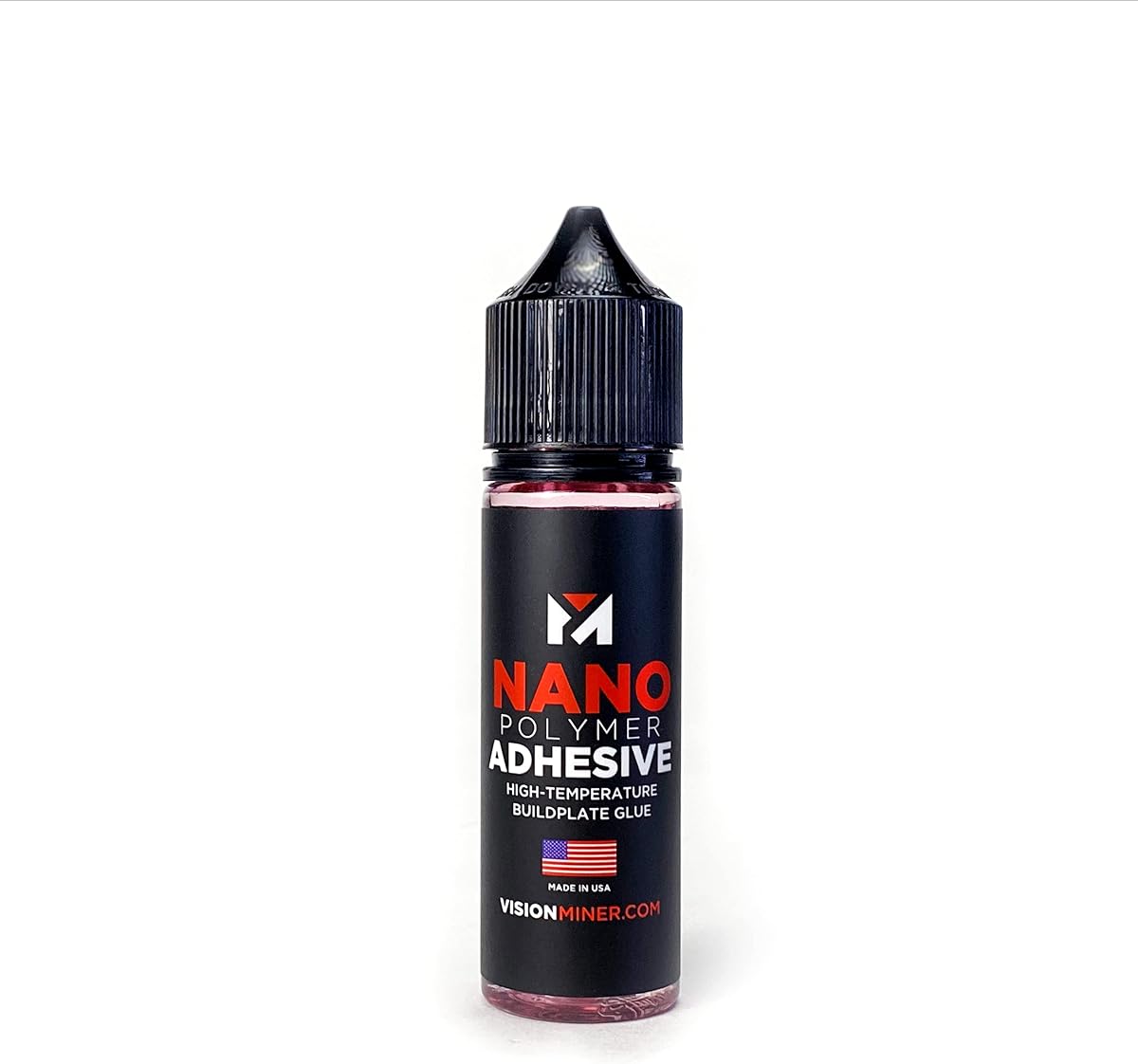
Nano Polymer Adhesive is aimed at users who work with demanding engineering polymers as well as everyday filaments. Its 4.7 rating reflects strong user reception, and the specification list includes PEEK, ULTEM, PPSU, PEI, PSU, nylon, ABS, ASA, PLA, and PETG. That advanced-material focus distinguishes it from the many adhesives centered primarily on PLA and PETG.
We may earn a commission when you buy through this link, at no additional cost to you.
Surface support is equally broad. The product is described as compatible with borosilicate and ceramic glass, PCB, FR4, Garolite, fiberglass BuildTak, PEI, WhamBam, flex plates, Kapton tape, and powder-coated PEI sheets. This makes it a candidate for a varied workshop where parts move between machines or materials with different thermal and surface requirements.
The formula is described as safe, non-toxic, and organic, and it dries clear without leaving residue on prints or the build plate. It is also positioned as less messy than glue sticks, hairspray, or homemade alternatives. The trade-off is that advanced polymers and exotic surfaces often involve demanding print conditions, so users still need to calibrate their machines carefully; adhesive cannot compensate for an unsuitable temperature, leveling, or first-layer setup.
Nano Polymer Adhesive is best for advanced users, small engineering operations, or laboratories printing with materials beyond the standard hobby range. Its wide filament and surface lists offer strong flexibility, while the residue-free cleanup claim is useful for maintaining parts and machines. Consider it when the project material—not merely the printer—determines the adhesive choice.
PEEK, ULTEM, PPSU, PSU, and nylon place this product in a different category from general-purpose hobby adhesives. Users working with these materials can choose a formula explicitly designed with their thermal demands in mind.
Support for PCB, FR4, Garolite, ceramic glass, and other specialist plates is valuable in mixed workshops. The extensive list reduces the need to search for separate products for every build surface.
We may earn a commission when you buy through this link, at no additional cost to you.
Bamboo Original 3D Printer Adhesive Glue is a 60ml liquid formula aimed at Bambu Lab P1, X1, A1, and A1 Mini users. It has a 4.8 rating and is designed to maintain adhesion while reducing the chance that models will lift or warp. Its central benefit is more uniform application than a traditional glue stick can provide.
We may earn a commission when you buy through this link, at no additional cost to you.
The listed material support covers ABS, PLA, PETG, HIPS, and TPU, all common choices in Bambu workflows. The liquid can be spread evenly across the build surface, and the manufacturer states that this approach leaves less residue on a printed model than a solid stick. It is also intended to make finished parts easier to remove once printing is complete.
Cleanup is one of the strongest aspects of this product. The adhesive can be removed from both the print surface and the model, while its ingredients are described as environmentally friendly, harmless to the human body, and lower in odor than other glues. The trade-off is that the product is specifically oriented toward Bambu build plates and has a less expansive stated material list than several general-purpose competitors.
This glue is a strong recommendation for Bambu Lab owners who want a high-rated, uniform liquid adhesive and an easy cleaning routine. It is particularly useful for users who regularly print with ABS, PETG, HIPS, or TPU and want consistent bed preparation. Choose it when the machine-specific fit and low-residue cleanup matter more than support for highly specialized engineering materials.
Liquid application allows the user to spread a thin layer across the active surface. This can produce more consistent coverage than dragging a solid stick over the plate.
The product is designed to leave less residue on completed models than a solid glue stick. That makes it appealing for users who value both clean plates and clean part bottoms.
We may earn a commission when you buy through this link, at no additional cost to you.
The right build plate adhesive depends on your printer, filament, plate texture, and tolerance for maintenance. The following factors cover the practical details that most influence adhesion, release, and cleanup.
Some products rely on a liquid film that creates an even bonding layer, while others apply a solid coating through a glue stick. Liquid adhesives are generally easier to spread uniformly and can be refreshed in thin layers, whereas solid sticks are convenient, portable, and easy to target. Consider how evenly you can apply each format and whether the plate needs a full coating or only the active area.
A useful adhesive should support the materials you actually print. PLA, PETG, and ABS are common considerations, but TPU, ASA, HIPS, PC, PA, nylon, and engineering polymers may require more specialized coverage. Check that the product names your filament and understand that the same coating can behave differently under the heat and stress associated with each material.
Adhesion is not identical on every plate. Glass, smooth PEI, textured PEI, PEO, Kapton, aluminum, BuildTak, and specialty engineering surfaces can each respond differently. A product that explicitly covers your exact surface is preferable to one that simply says it is universal. Also check whether a coating is intended for heated, unheated, textured, or smooth plates.
Controlled application helps create a thin, consistent layer without overspray, pooling, or residue outside the printing area. Foam and valve-style applicators can make liquid products easier to distribute. Solid sticks are inherently targeted, although strokes can leave visible ridges. Whichever format you choose, the goal is an even coat over the region occupied by the model.
The bond should be strong during printing but should not require tools or force to remove the finished model. Thermal-dynamic and cooling-release behavior can make removal easier. Let the bed and part cool fully before pulling them free, and avoid levering a part against the plate while it remains warm, because that can damage thin features or deform the first layer.
Water-soluble adhesives are easier to maintain because residue can often be removed with water, a wet rag, or a sponge. Some formulas also leave less transfer on the bottom of a model. Cleanup can still depend on the plate and how long the coating has been heated, so inspect the surface periodically rather than waiting for residue to become difficult to remove.
A long-lasting coating can reduce preparation time, but advertised print counts are best treated as guidance rather than a promise. Filament, bed temperature, plate texture, contamination, and printing frequency all influence how long a layer remains effective. Some products recommend a thin refresh before every job, while others allow the coating to be reactivated with a damp sponge. Follow the stated maintenance method for the product you buy.
Low-odor or odorless formulas are useful in homes, offices, classrooms, and enclosed printing areas. A non-toxic or environmentally friendly claim can also matter, although users should still follow storage and handling instructions. Solid sticks are simple to contain, while liquid adhesives benefit from careful application and proper storage. Keep products away from children and follow any warnings printed on the listing.
Begin with a cool, clean build plate. Remove loose residue and oils using the surface care method approved for that plate, then allow the surface to dry fully. For liquid products, apply a thin layer only to the active printing area; for solid sticks, apply a light, even coat where the model will sit. Avoid heavy buildup along the edges.
Allow the adhesive to dry or set according to the product instructions before starting the print. A uniform layer should look continuous without forming a thick ridge or puddle. If using a thermal-release formula, begin with the normal bed temperature for the selected filament and give the model time to cool before attempting removal. If the first layer shifts, stop the job and correct the coating rather than wasting the remaining filament.
After the print, let the bed cool and remove the part gently. Clean the plate with water, a wet rag, or a sponge when residue appears, following the adhesive and plate manufacturers’ guidance. Store liquid formulas with the cap or applicator closed and solid sticks with the lid replaced. Refresh the coating when adhesion declines instead of allowing several loose layers to accumulate.
Build plate adhesive helps the first layer of a printed part remain attached to the printer’s bed. This can reduce warping, edge lifting, and complete separation from the surface, especially with large prints or materials that shrink as they cool. It also helps create the stable foundation needed for a successful print.
Liquid glue is generally easier to spread as a uniform, thin film, which can be helpful for precise bed preparation. A glue stick is more portable, requires no liquid handling, and may be easier to apply only where needed. The better choice depends on your preferred workflow, plate surface, and the level of control you want.
A water-soluble adhesive is generally intended to make residue easier to remove, but care is still required. Avoid aggressive scraping and follow the adhesive’s cleanup directions as well as the plate manufacturer’s care instructions. A thin, even coating is less likely to become difficult to remove than a thick or contaminated layer.
Follow the product’s guidance, since coating life varies. Some liquid formulas are intended to last over many prints but benefit from a fresh thin layer before each session, while others can be reactivated with a wet sponge. Reapply sooner if the first layer starts to move, the plate becomes visibly contaminated, or completed parts no longer release cleanly.
No. Adhesive can improve grip, but it cannot correct poor leveling, an unclean plate, incorrect temperatures, excessive retraction, or poor filament conditioning. First-layer failures can also come from the sliced model itself. If adhesion is already reliable, inspect these other variables before blaming the glue.
No, frequent full cleaning is usually unnecessary. Remove the print after it cools, and clean the plate when residue becomes visible or when adhesion starts to decline. Allowing multiple layers of residue to build up can create an uneven surface, so a light maintenance routine is generally more useful than either ignoring buildup or stripping the plate after every job.
Many products in this guide explicitly support both PLA and PETG, but you should still check the exact listing. Adhesion can vary with bed temperature, plate texture, and print geometry. If you use only these two materials, a product supporting both can offer a convenient balance of adhesion, release, and cleanup.
Let the bed and part cool completely before trying to remove it. Gently flex the plate only if the manufacturer permits it, and lift from the easiest edge rather than pulling directly upward on a detailed area. Persistent resistance may indicate a dirty or uneven coating, so clean the surface before applying a fresh thin layer.
The Bambu Lab Original Hot Bed Solid Glue Stick stands out as a simple, high-rated budget option, while the 3D Printer Bed Adhesive Liquid offers controlled liquid application, broad surface support, and easy cleanup. For users seeking more precise coating control and support for numerous filaments, the Black Magic Precision Foam Kit is the feature-focused premium choice.
Prioritize the filament and build plate you use, then compare application and maintenance methods. A solid stick may be enough for a straightforward setup, while a liquid foam can provide finer control and broader material coverage. Advanced users working with PEEK, ULTEM, nylon, or specialist plates should pay close attention to explicit compatibility rather than choosing by brand alone.
Current prices and availability can change, so review the latest listing and manufacturer instructions before buying. Also consider how much adhesive the format provides, how the product should be stored, and whether water-based cleanup fits your maintenance routine before making a final selection.