
Klein Tools ET190
4.7Editor score
50 to 2,000 ppm range
Automatic 30-second zeroing
Pocket clip included
A combustible gas leak detector helps identify escaping methane, propane, butane, natural gas, and related fuels before a small leak becomes a serious safety problem. The best models combine useful alert systems, reachable probes, manageable warm-up procedures, and enough detection range for household appliances, RV systems, maintenance work, or commercial inspections.
We compared the 10 products using the information supplied for each model, focusing on detection range, sensor capabilities, probe length, visual and audible alerts, calibration, power options, portability, and intended applications. The list includes compact household tools, professional handheld instruments, and models with data logging or rechargeable batteries.
Each review explains the most useful features, practical limitations, and the situations in which that detector makes the most sense. Ratings and specifications can change over time, and current prices should be checked on the product listing, but the feature and performance details provide a solid basis for comparing these options.
4.7Editor score

4.6Editor score

4.4Editor score
As an Amazon Associate we earn from qualifying purchases.
This side-by-side comparison highlights the major differences in sensing range, probe design, alert options, power source, and ideal use case. It shows which detectors are built for quick household checks, extended professional inspections, or detailed gas-level monitoring.




The Klein Tools ET120 combines a broad methane-based detection range with an 18-inch flexible gooseneck, making it a strong all-around choice for homeowners, RV users, and service professionals. Its 4.6 rating reflects a generally favorable user response, while the supplied specifications show that it can cover concentrations from approximately 50 to 10,000 ppm.
We may earn a commission when you buy through this link, at no additional cost to you.
The most useful feature is its adjustable sensitivity. High mode covers 50 to 1,000 ppm, while Low mode covers 1,000 to 10,000 ppm, helping the user move from broad scanning toward a more focused search. Five red LEDs provide a clear visual indication, and the 85 dB audible alert intensifies as the detected concentration rises.
Automatic zero-point calibration occurs at power-up, reducing the need for manual adjustment in ordinary clean-air conditions. The 18-inch probe can reach around equipment, into narrow spaces, and toward joints that are difficult to view. Its clip-on storage arrangement also keeps the flexible section protected when the detector is not in use.
The main limitation is that it does not provide a numerical reading, so it is better suited to signaling and locating than to recording exact concentration values. Nevertheless, its range, probe reach, escalating alerts, and straightforward startup make the ET120 the most balanced option in this roundup. Choose it when you want a versatile detector without carrying a data-logging display.
The ET120 is particularly useful for checking gas appliances, exposed pipe connections, RV fuel systems, basements, and other areas where a visible or audible response is more important than a trend graph. It is also a practical pick for technicians who want a long probe and high-sensitivity option in a straightforward handheld instrument.
Two clearly separated sensitivity levels make it easier to move from a general search to a close inspection. High mode is suited to lower concentrations, while Low mode covers the upper portion of the stated methane-based range.
The 18-inch flexible gooseneck helps the sensor reach around obstacles and into confined locations. Its flexibility also makes it easier to position the sensing tip close to a suspected joint or leak source.
We may earn a commission when you buy through this link, at no additional cost to you.
The TopTes PT520A is designed for portable household and RV leak checks, with support for methane, propane, natural gas, LPG, butane, and other combustible gases. It carries a 4.6 rating and shares the same 50 to 10,000 ppm methane-based range as the leading Klein model, but it uses a slightly shorter probe and a seven-bar visual alert system.
We may earn a commission when you buy through this link, at no additional cost to you.
Its response can begin in 0.5 seconds, and both the colored bars and 75 dB alarm increase as gas concentration rises. The 17-inch gooseneck gives the user access to pipelines, storage tanks, gas fireplaces, basements, and other areas where a short handheld sensor would be difficult to position. The recommended operating distance is only 1 to 5 cm from the suspected source.
The controls are designed for convenience. An auto power-off function can be enabled or disabled, a mute button silences the audible alarm, and the non-slip housing is designed for a secure grip. The package includes three AAA batteries, a protective case, and a manual, making it a ready-to-use kit for storage in a home, vehicle, or RV.
Its trade-offs are the lack of a numerical concentration display and the need to allow a 30-second warm-up in clean air. Muting may also be inconvenient during a search if the user wants the strongest possible audio cue, although the rising visual bars still provide feedback. These limitations are acceptable for buyers seeking a portable, feature-rich detector rather than a recording instrument.
The PT520A is a strong fit for RV owners, DIY household checks, and users who need broad gas compatibility without a large professional display. Its protective case and included batteries improve convenience, while the flexible probe and fast alert system make it especially practical when working around appliances, tanks, and narrow service areas.
The compact body, included protective case, and flexible probe make the PT520A easy to carry and deploy. These traits are particularly useful for temporary checks around RV systems, gas fireplaces, basements, tanks, and household piping.
Seven colored bars and an intensifying 75 dB alarm provide both visual and audible feedback. This helps users recognize when the sensor is moving into a higher-concentration area and should be repositioned closer to the suspected source.
We may earn a commission when you buy through this link, at no additional cost to you.
The UEi CD100A is a handheld combustible gas leak detector aimed at homeowners, HVAC contractors, inspectors, and commercial service teams. Its 4.4 rating and broad listed gas compatibility make it a practical professional option, particularly for work involving methane, natural gas, propane, LPG, butane, ammonia, acetone, and jet fuel.
We may earn a commission when you buy through this link, at no additional cost to you.
The operating procedure is straightforward. After switching it on, the user allows a 10-second warm-up in open air and then directs the gooseneck toward the suspected area. As gas is detected, the tick rate increases and provides both audible and visual cues. This pattern gives technicians a changing signal rather than a single fixed alarm tone.
An 18-inch flexible gooseneck reaches into tight spaces, while a light at the probe tip helps illuminate the sensing area in dark environments. That combination is particularly useful behind appliances, inside equipment cabinets, beneath fixtures, and in other areas where seeing the leak source would otherwise be difficult. The product is also described as faster and more effective than a traditional soap-and-water method.
The provided information does not mention a numerical concentration display or detailed data logging, so this should be viewed as a locating and confirmation instrument rather than a recording meter. Users should also confirm that the target gas appears on the listed compatibility information, because the sensor's real-world response can vary by combustible substance.
The CD100A is a compelling choice for HVAC and maintenance professionals who need a long, illuminated probe and an instrument designed for both industrial and residential environments. It is also a sensible option for homeowners who want broader fuel coverage than a basic natural-gas-only sniffer, provided its listed detection capabilities match the intended application.
The built-in tip light is a practical advantage when checking behind equipment or inside dark cabinets. It helps users see where the probe is positioned while keeping attention on the suspected leak area.
An increasing tick rate gives the user a changing audible signal as the sensor approaches a leak. That feedback can make it easier to distinguish a stronger concentration from a brief, lower-level reading.
We may earn a commission when you buy through this link, at no additional cost to you.
The TopTes PT199 is a pocket-sized detector designed for quick checks around household gas appliances, RV systems, and other locations where a compact combustible-gas sniffer is useful. Its 4.6 rating is supported by features such as a rapid 0.5-second response, combined visual and audio alarms, and a red LCD at high gas levels.
We may earn a commission when you buy through this link, at no additional cost to you.
The detector supports natural gas, methane, propane, butane, LPG, and other combustible gases. Its methane-based range is 50 to 1,000 ppm, with a recommended detection distance of 1 to 5 cm. This makes it better suited to checking near a suspected connection or appliance than to sweeping a large area from several feet away.
Two AAA batteries are included, and a low-battery indicator activates below 2.4 volts. The unit automatically powers off after five minutes without operation or gas detection, helping preserve battery life. A storage bag and non-slip housing make it convenient to carry, while the simple layout suits DIY users, RV owners, and homeowners.
The most important limitation is its narrower upper range compared with detectors extending to 10,000 ppm. It also does not provide the long gooseneck found on several professional models, so it may be less useful in deeply confined areas. A responsive, inexpensive-format tool is still valuable for quick visual inspections when used at the specified distance.
The PT199 is best for users who want a small detector for a toolbox, RV, or household maintenance kit. It is especially effective when the likely leak point is already known and the goal is to determine whether a connection, appliance, or valve area is producing a combustible-gas response.
The 0.5-second response is useful when checking one fitting, valve, or appliance connection after another. A red LCD at high levels adds a clear visual warning alongside the audible alarm.
Its pocket-sized body, included storage bag, and AAA battery power make the PT199 convenient to keep close at hand. It suits users who want a compact tool for routine checks rather than a full professional instrument.
We may earn a commission when you buy through this link, at no additional cost to you.
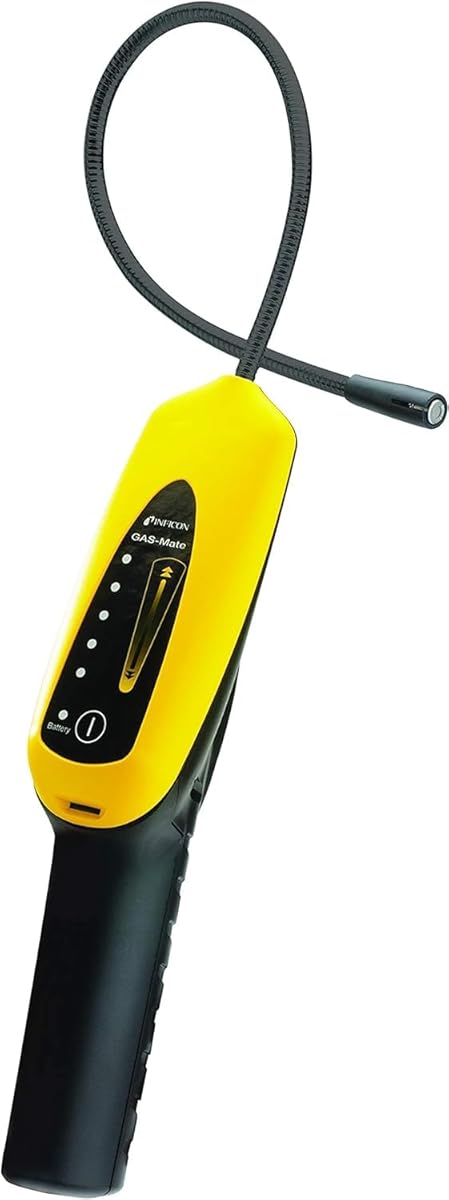
The Inficon 718-202-G1 is a professional-oriented combustible gas detector from a specialist instrumentation manufacturer. It carries a 4.5 rating, and the supplied information identifies Inficon as the manufacturer and the United States as the country of manufacture. That makes it a relevant option for buyers already familiar with technical gas-measurement equipment.
We may earn a commission when you buy through this link, at no additional cost to you.
The product is specifically identified as a combustible gas detector, which is its central strength. Inficon is a dedicated brand in this category, and the model's established position in the market may appeal to technicians who want a purpose-built instrument rather than a general household sniffer. Its 4.5 rating also places it well within the group reviewed here.
The available product data is limited. It does not list a detection range, supported gas types, probe length, alarm configuration, warm-up time, power source, or calibration procedure. Those missing details mean buyers should consult the current manual and manufacturer documentation before ordering for a specialized application.
That information gap is the main drawback. Without a stated numerical display, alert pattern, or probe design, it is difficult to compare the model directly with the feature-rich Klein, TopTes, UEi, and RIDGID alternatives in this guide. The listed package dimensions are 15 by 3.9 by 8.4 inches, and the product is identified as a test instrument and gauge.
The 718-202-G1 is most appropriate for an informed professional buyer who recognizes the model and has a specific reason to prefer Inficon equipment. It may serve well for established service workflows, but consumers who need clearly documented detection range, gas compatibility, alerts, and probe specifications should verify those details before making a final choice.
This is not described as a multi-purpose household device. It is a dedicated combustible gas detector from Inficon, a manufacturer associated with test and measurement equipment.
The supplied listing data does not detail range, sensor type, probe construction, or alerts. Professional buyers should confirm that those characteristics match the gases and working conditions required for their specific application.
We may earn a commission when you buy through this link, at no additional cost to you.
The Klein Tools ET190 combines a 4.7 rating, the highest numerical rating in this group, with a slim and lightweight design. Its stated 50 to 2,000 ppm detection range, dual sensitivity modes, and automatic 30-second zeroing make it a compelling budget-oriented option for routine household and professional checks.
We may earn a commission when you buy through this link, at no additional cost to you.
Portability is one of the model's strongest points. The detector is pocket-sized and includes a sturdy pen clip, so it can remain available without taking up much room in a toolbox, work vest, RV, or maintenance drawer. That makes it easy to carry to a suspected leak instead of keeping it stored near a single appliance.
Bright LED indicators and escalating audible tones make the instrument easier to monitor in dim, loud, or busy work areas. High and Low sensitivity settings help users switch between lower and higher concentration ranges, while automatic zeroing at startup supports consistent readings without manual adjustment. The 30-second process also clearly establishes when the unit is ready to use.
The 2,000 ppm upper limit is lower than the 10,000 ppm maximum listed for the ET120, PT520A, and PT-990. The supplied information also does not identify a flexible gooseneck, so the ET190 may be less convenient for deeply confined spaces. It also lacks a numerical display, limiting its usefulness for recording exact values.
Despite those limitations, the ET190 delivers an unusually strong combination of portability, automatic setup, sensitivity controls, and visual and audio alerts. It is an excellent choice for users who want a dependable compact detector without paying for advanced data logging or a rechargeable display-equipped instrument.
The slim housing and integrated pen clip make the ET190 easy to keep on a belt, in a pocket, or in a nearby toolbox. Always having a detector close at hand can encourage more frequent checks around gas appliances and fuel systems.
The 30-second automatic zeroing process establishes a clean baseline after activation. It reduces manual setup steps and gives users a clear indication that the instrument is completing its startup routine.
We may earn a commission when you buy through this link, at no additional cost to you.
The TopTes PT-990 is the most data-focused detector in this group, offering a 4.7 rating, real-time PPM readings, a trend graph, and automatic data logging. It is designed for propane, methane, and other combustible gases, with a listed detection range of 0 to 10,000 ppm, equivalent to 0% to 20% LEL in the supplied information.
We may earn a commission when you buy through this link, at no additional cost to you.
The Figaro sensor and built-in fan draw ambient air toward the sensor, supporting faster response and improved detection accuracy. The detector can respond in as little as 0.5 seconds. Its 11-inch flexible probe provides access to tight spaces, while the color TFT display presents both current concentration and a dynamic graph that helps users evaluate changes over time.
Alarm flexibility is another major advantage. A 90 dB buzzer, visual indicator lights, and vibration alerts can each be enabled or disabled independently. The unit also includes one-button quick mute, manual calibration, adjustable screen brightness, and auto sleep mode. These features are useful for professionals who need different notification methods in noisy environments.
Power comes from a 4000mAh rechargeable lithium battery that supports more than nine hours of use. A covered USB-C port protects the charging connection, and the package includes a cable, zippered storage case, and multilingual manual. Compared with simple AAA-powered models, it is more advanced but also more complex to operate.
The PT-990 is best for technicians, industrial users, inspectors, and serious DIY users who want documented readings and a record of alarm events. It is less necessary for a quick appliance check, but it provides far more information when diagnosing intermittent or difficult-to-locate gas concerns. Its data logging and selectable alerts justify the additional complexity for professional workflows.
Real-time PPM values and a dynamic trend graph make it possible to see how concentration changes as the probe moves. That information is more detailed than the simple escalating alerts found on many compact detectors.
The 90 dB buzzer, indicator lights, and vibration function can be configured independently. Users can retain the notifications best suited to a loud shop, quiet interior, or hands-busy inspection.
We may earn a commission when you buy through this link, at no additional cost to you.
The Forensics Gas Leak Detector is a rugged, display-equipped instrument for inspectors, technicians, and engineers. Its 4.4 rating and broad listed applications cover natural gas, methane, combustible fuels, alcohols, acetone, ethanol, propane, butane, gasoline, diesel, IPA, toluene, LPG, and LNG.
We may earn a commission when you buy through this link, at no additional cost to you.
The sensor is made in Japan and calibrated for methane. A large color LCD also displays temperature, giving the instrument a more instrument-like feel than simple LED-only sniffers. The supplied information does not state a numerical concentration range, so users should consult the current documentation for exact readings and operating limits.
Durability is a distinguishing feature. The ABS housing is described as capable of withstanding a 10-foot drop, making the detector suitable for field work where equipment may be handled roughly. The product also comes with a one-year limited warranty and is stated to have a seven-year sensor life, reducing concern about long-term ownership.
The supplied information does not describe probe length, warm-up time, alarm type, calibration controls, or power source. Those omissions prevent a full feature comparison with the ET120, CD100A, and PT-990. A buyer who needs a long probe, vibration alert, data logging, or documented ppm range may prefer a model whose full specifications are clearly stated.
This detector is most appropriate for users who value rugged construction, a large color display, and broad gas compatibility over a minimal handheld design. It is a compelling option for field inspection, industrial environments, and technical work where the physical durability and stated sensor longevity are important priorities.
The 10-foot drop-tested ABS housing is designed for equipment that may be carried into workshops, plant environments, or inspection sites. Its ruggedness complements the more specialized professional audience listed for this detector.
The large color LCD and temperature display give the instrument a clearer information interface. The display is useful for users who want more from a gas detector than a simple escalating tone, although exact concentration specifications should be confirmed separately.
We may earn a commission when you buy through this link, at no additional cost to you.
The RIDGID CD-100 is a handheld diagnostic detector built for service work, with a 4.5 rating and support for methane, propane, butane, ethanol, ammonia, hydrogen, and other combustible gases. It is positioned for gas-line installation checks, maintenance, repair, and pinpointing leaks in confined spaces.
We may earn a commission when you buy through this link, at no additional cost to you.
Its most notable feature is tri-mode detection. Visual, audible, and vibration alerts can communicate a leak, allowing the user to choose the method that works best in a particular environment. Vibration is particularly useful in noisy or tight spaces where looking at the display or hearing an alarm may be difficult. Adjustable sensitivity settings support faster location of lower gas levels.
The 16-inch flexible probe reaches around equipment and into hard-to-access locations. Its length falls between the PT177's compact design and the 18-inch probes offered by the ET120 and CD100A. The instrument is also described as ergonomically designed for comfortable handling and durable enough for heavy-duty use.
A field-replaceable sensor can reduce service downtime because a failed or aging sensor does not necessarily require the entire detector to be replaced. The supplied information does not mention a numerical concentration display or a stated detection range, so the instrument is best understood as a sensitive locator and alarm tool rather than a recording meter.
The CD-100 is a strong choice for gas-line installers, HVAC service professionals, maintenance teams, and advanced DIY users. Its vibration alert, replaceable sensor, flexible probe, and adjustable sensitivity make it particularly attractive where repeated professional use and dependable access are priorities.
The vibration alert gives technicians a third way to recognize a combustible-gas response. It can be useful around running equipment or in confined locations where maintaining sight or sound awareness is difficult.
A field-replaceable sensor helps limit downtime when the sensing element needs service. This is an important advantage for professional users who depend on a detector for repeated jobs.
We may earn a commission when you buy through this link, at no additional cost to you.
The TopTes PT177 is a compact, entry-level gas sniffer designed for homes, RVs, and routine checks around gas appliances. It has a 4.6 rating and supports detection of LPG, methane, ethane, propane, butane, natural gas, coal gas, and other combustible gas sources.
We may earn a commission when you buy through this link, at no additional cost to you.
The detector requires a 30-second auto-calibration in a clean, gas-free environment after being powered on. Once ready, it can trigger an alarm within approximately 0.5 to 3 seconds. Five red LEDs and a 75 dB audible alarm intensify as concentration rises, providing simple visual and audible feedback without a numerical display.
The pocket clip and included drawstring storage bag make it easy to carry and organize. Two AAA batteries are supplied, and a power indicator flashes when battery voltage falls below 2.4 volts. The unit automatically turns off after five minutes without operation or gas detection, helping conserve power during intermittent use.
Its limitations are substantial when compared with professional instruments. There is no listed flexible probe, numerical screen, data logging, or vibration alert, so it is most useful near accessible connections and appliance areas rather than deep inside equipment. The 30-second warm-up and clean-air requirement must be respected for reliable results.
The PT177 is a practical first tool for homeowners, RV enthusiasts, and DIYers who want an inexpensive-format, pocketable way to check for common combustible gases. It offers straightforward alerts and useful gas coverage without the complexity of advanced professional equipment, making it best suited to accessible, routine inspections.
The integrated pocket clip and drawstring bag make the PT177 simple to carry between storage locations. Its small form is useful for RV drawers, utility cabinets, and homeowner tool kits.
The five-minute automatic shutdown helps preserve the included AAA batteries. A flashing power indicator below 2.4 volts gives users advance notice that replacement is needed.
We may earn a commission when you buy through this link, at no additional cost to you.
The right combustible gas leak detector depends on where you will use it, which gases you expect, and how much diagnostic detail you need. Probe access, response method, alert style, startup procedure, power, and display capabilities should be compared before buying.
A wider stated range gives the instrument more flexibility when gas concentration varies. The ET120, PT520A, and PT-990 cover up to 10,000 ppm on a methane-based basis, while the ET190 reaches 2,000 ppm and the PT199 reaches 1,000 ppm. The Forensics model lists a wide variety of fuels but does not provide a numerical range in the supplied information. Always consider whether the target gas is included rather than assuming every combustible compound produces the same response.
Probe design determines where the sensor can be placed. The ET120 and UEi CD100A provide 18-inch flexible goosenecks, the PT520A has a 17-inch probe, the RIDGID CD-100 uses a 16-inch probe, and the PT-990 has an 11-inch flexible section. Compact sniffer-style models can be useful around accessible appliances, but a flexible probe is more valuable behind equipment, beneath fixtures, or inside confined areas.
The best detectors provide information that is noticeable under real working conditions. The ET120 uses five red LEDs and an 85 dB alarm, while the PT520A uses seven colored bars and a 75 dB alarm. The PT-990 combines a 90 dB buzzer, lights, and vibration, and the RIDGID CD-100 offers visual, audible, and vibration modes. Consider whether you need sound, light, vibration, or a combination.
Simple sniffer models indicate the presence and relative intensity of gas through escalating LEDs or bars. The PT-990 goes further with live PPM readings, a trend graph, and data logging that records alarm time and concentration. The Forensics detector has a large color LCD with temperature, while the RIDGID focuses on tri-mode alerts. Numerical data is most useful for professional diagnosis, repeated inspections, and documenting changing concentration levels.
Every model needs a clean baseline before it can be used reliably. The PT520A and PT177 use a 30-second warm-up, the ET190 automatically zeroes for 30 seconds, and the ET120 performs automatic zero-point calibration at power-up. The UEi CD100A specifies a 10-second warm-up in open air. Users should follow the manufacturer's startup location and timing rather than rushing directly into a suspected contaminated area.
AAA battery models are simple, familiar, and easy to keep on hand. The PT177, PT199, and PT520A include batteries, and the compact models automatically power down after inactivity. The PT-990 uses a 4000mAh rechargeable lithium battery with more than nine hours of operating time and a covered USB-C charging port. Rechargeability reduces routine battery replacement but requires the detector to be charged before a job.
A detector is most useful when it is easy to carry to the work area. The ET190 has a sturdy pen clip, while the PT177 has a pocket clip and storage bag. The PT520A includes a protective case, and the PT-990 comes with a zippered storage case. Consider the size of the work area, whether the tool must fit in a vest pocket, and whether the probe or accessories need protection during transport.
Household checks and professional field work create different demands. The Forensics detector has an ABS housing described as passing a 10-foot drop test, while the RIDGID CD-100 is presented as tough enough for heavy-duty use and has a field-replaceable sensor. Inficon's model is made in the United States, and the Forensics sensor is made in Japan. Consider the working environment, expected handling, serviceability, and warranty support.
Begin in a clean area with adequate ventilation and away from any suspected gas cloud. Install fresh batteries or charge the unit according to its instructions, power it on, and allow the complete warm-up or automatic zeroing period. The required time ranges from 10 seconds for the UEi CD100A to 30 seconds for several TopTes and Klein models. Starting in contaminated air can produce an inaccurate baseline.
Move the sensing tip slowly toward the likely source while watching the LEDs, alarm, vibration, or display. If the product uses a gooseneck, keep the tip approximately 1 to 5 cm from the suspected leak area when instructed to do so. Work methodically around valves, joints, appliance connections, burners, storage tanks, RV systems, and other fuel-related components rather than passing over them too quickly.
After the inspection, switch the detector off and store it with the probe protected and batteries removed if the manufacturer advises doing so. Keep the sensor opening clean, avoid exposing the instrument to moisture or damaging chemicals, and follow the specified replacement schedule for the sensor. A detector that gives inconsistent alarms, fails a startup calibration, or has a weak battery should be checked or serviced before it is relied upon again.
A combustible gas leak detector helps locate methane, propane, natural gas, butane, and other combustible gas sources around appliances, pipes, valves, tanks, and vehicle systems. It is useful for identifying potential leaks before fuel accumulates in a confined area. A detector can locate and characterize a suspected leak, but it does not replace professional repair, leak testing, or emergency response procedures.
Most of the listed models are designed to detect methane, propane, natural gas, butane, LPG, or closely related combustible gases. The PT520A, PT199, PT177, and RIDGID CD-100 specifically name several common fuel gases. Check the individual product specifications and calibration details to confirm compatibility with the exact gas involved in your system.
A warm-up or zeroing cycle establishes the sensor's clean-air baseline before it begins checking for gas. The required duration varies by model, from 10 seconds for the UEi CD100A to 30 seconds for the Klein ET190 and several TopTes detectors. Starting in an area with ambient gas can reduce accuracy, so calibration should be completed in clean, ventilated air.
A flexible probe is better for hidden connections, equipment cabinets, narrow gaps, and areas that cannot be viewed directly. Compact sniffers are easier to carry and work well around accessible appliances, valves, and RV connections. Consider where suspected leaks are likely to occur and choose accordingly; the ET120, CD100A, PT520A, CD-100, and PT-990 offer flexible probes.
A numerical display is useful when you need to watch concentration changes, compare readings, or document a repeated inspection. The PT-990 offers live PPM readings, a trend graph, and alarm-event logging, while the Forensics model includes a color LCD with temperature. For simple household checks near known connections, an escalating LED and audible alarm may be sufficient.
A handheld leak detector is primarily designed for locating and inspecting suspected gas sources. The supplied product information does not establish any of these models as a permanently mounted, continuously operating safety alarm. If continuous monitoring is required, use equipment specifically certified and installed for that purpose, following local requirements and manufacturer instructions.
Avoid operating switches, flames, or other possible ignition sources, and move people and pets away from the area if there is a strong reading. Do not attempt repairs that could create another spark. Contact the gas utility or a qualified gas professional for guidance and remediation, and use emergency services if gas is suspected inside or the situation feels unsafe.
Check the power source, startup calibration, audible alert, visual indicators, and probe condition before each use or job, following the manual's specific procedure. Pay special attention to low-battery warnings, inconsistent startup behavior, physical damage, or an alert that fails to respond as expected. Sensor life and replacement intervals vary by model, so consult the applicable manufacturer guidance.
The Klein Tools ET120 is the strongest overall choice because it balances a 50 to 10,000 ppm range, an 18-inch flexible probe, adjustable sensitivity, and escalating visual and audible alerts. The ET190 stands out as the best budget pick with its 4.7 rating, pocketable design, automatic zeroing, and dual sensitivity modes, while the UEi CD100A earns the premium position through broad gas coverage and an illuminated 18-inch probe.
For detailed professional analysis, the TopTes PT-990 provides the most advanced information with live readings, a trend graph, data logging, configurable alarms, and a rechargeable battery. RIDGID is attractive for service work because of its tri-mode alerts and field-replaceable sensor, while the compact PT520A, PT199, and PT177 serve portable household or RV checks. Choose based on target gas, range, probe access, display needs, power, and the professional demands of the job.
Before purchasing, verify the current specifications, accessories, warranty, and sensor details on the product listing. Prices and promotions can change, so check the current listing when ready to buy. Whatever model you select, follow its warm-up and calibration instructions carefully and use the detector only as part of a safe, responsible inspection process.
