
Water Pump Submersible Pump DC 12V
4.3Editor score
12V DC battery operation
1500 GPH maximum flow
25-foot maximum head
Explore the best DC powered sump pump options for basement drainage, emergency backup protection, portability, power compatibility, installation, and control
DC powered sump pumps offer a practical way to move water from basements, pits, pools, ponds, and other low areas without relying entirely on household power. A capable model should combine adequate flow, reliable automatic or manual control, durable construction, and a power setup suited to its intended use. The right choice depends heavily on whether you need routine drainage or emergency backup protection.
This guide compares ten products using the supplied specifications, including flow capacity, maximum head, construction, power source, controls, discharge connections, and special features. It covers compact battery-powered transfer pumps, complete sump systems, smart backup systems, and one water-powered emergency alternative. Because some listings combine AC primaries with DC backup components, the distinction is explained clearly throughout.
The picks show how DC pumps differ for basement protection, remote drainage, and high-volume transfer. Ratings reflect the supplied product data, while installation complexity, included accessories, and system requirements are considered alongside headline performance figures. Prices and availability can change, so compare current listing details, confirm local installation requirements, and choose the pump that best matches your actual drainage conditions.
4.3Editor score

4.4Editor score

4.1Editor score
The table below compares power sources, flow ratings, lift capabilities, control methods, and major system requirements. It also distinguishes standalone DC pumps from AC-powered systems with DC backup components and from a water-powered emergency pump that requires no electricity.




This compact 12V DC submersible pump combines a 1500 GPH maximum flow with a rated current of 13.5 amps, making it a versatile option for water transfer where an outlet is inconvenient. Its 4.3 rating reflects a practical balance of capacity, portability, and useful included accessories, while the black thermoplastic housing is designed to resist moisture, rust, and everyday wear.
We may earn a commission when you buy through this link, at no additional cost to you.
The pump includes a 20-foot battery cord, an on/off switch, alligator clips, a 1-1/4-inch NPT discharge, and a 3/4-inch garden-hose adapter. It is rated for up to 25 feet of head and 6000 rotations per minute, while the impeller can handle solids as large as 1/8 inch. The generous cord makes it easier to position the pump in a basement, yard, window well, or other drainage location without immediately reaching an outlet.
The principal trade-off is that this is a manual utility pump rather than a fully automatic sump system. The 13.5-amp draw is substantial, so battery capacity and recharge time need careful consideration. A battery is not included, and operating the pump without water is explicitly prohibited, making supervision important. It is also less appropriate for a permanent primary sump installation than for temporary drainage or emergency use.
This is a strong pick for homeowners who need a flexible, battery-powered transfer pump without a built-in battery package. It suits clean or dirty water, pools, ponds, flat roofs, window wells, camping and RV tasks, and other mobile pumping needs. Choose it for portability and broad compatibility, but select a larger fixed system when automatic standby response is the priority.
Because it connects through alligator clips and works with most 12-volt batteries, the pump can fit an existing battery setup. Verify battery output, charge state, and cable reach before operating it under a heavy load.
The included hose adapter and long power lead make this model convenient for draining basements, pools, window wells, and other areas where a permanently installed pump would be unnecessary.
We may earn a commission when you buy through this link, at no additional cost to you.
This cordless utility pump offers one of the most self-contained DC-powered packages in the group, with two compatible batteries, a charger, hose adapters, and a hose clamp included. Its 4.6 rating is among the highest listed, while the stated maximum output of 13.2 GPM and 26.2-foot head make it suitable for substantial pool, pond, garden, and emergency transfer work.
We may earn a commission when you buy through this link, at no additional cost to you.
The pump accepts 18V and 21V batteries, allowing compatibility with platforms from multiple tool ecosystems rather than requiring a specific 12V setup. Adapters for 1/2-inch, 3/4-inch, and 1-inch hoses broaden connection options. An anti-clog bottom plate is intended to reduce intake blockage, while rust-resistant, wear-resistant materials support durability in wet environments.
This is primarily a clean-water transfer pump, not a debris-handling sump pump or permanent automatic backup. Although its output figure is substantial, the listed use cases focus on clean water, and a hose is not included. Users must also account for the weight and handling requirements of two batteries and the charger when transporting the kit.
The pump is an attractive option for users who want cordless convenience without sourcing batteries separately. It is particularly useful around pools, ponds, water tanks, bathtubs, and gardens, as well as at remote jobs where AC power is unavailable. For primary basement protection, it would need a suitable float-control arrangement that is not specified in the supplied information.
Two batteries and a charger remove the need to build a compatible power kit from scratch. This makes the pump especially convenient for owners of supported 18V or 21V battery systems.
The supplied 1/2-inch, 3/4-inch, and 1-inch adapters accommodate common watering and drainage arrangements. A separate hose is still required for most setups.
We may earn a commission when you buy through this link, at no additional cost to you.
The AQUASTRONG 1 HP model is a high-output submersible pump with a listed maximum flow of 4500 GPH and vertical lift capability of 30 feet. Its 4.4 rating makes it a strong general-purpose drainage choice, particularly for removing substantial water from basements, hot tubs, and window wells. It is not a DC pump, but its specifications help establish the performance range against which portable and backup models can be judged.
We may earn a commission when you buy through this link, at no additional cost to you.
Bottom suction allows the pump to remove water down to one-fifth inch from the surface, and the listed solids-handling capacity reaches one-eighth inch. A 1-1/4-inch NPT discharge comes with a 1-1/2-inch elbow plus snap couplings for several hose sizes. The 10-foot UL-listed cord supports convenient positioning, while the reinforced thermoplastic casing and mechanical seal target corrosion resistance and leakage control.
Its most important limitation is power type. It requires an AC outlet, so it does not provide outage protection on its own. It is also a manual pump rather than an automatic float-switch model, and the 30-foot maximum head figure should be treated as a laboratory limit rather than a guarantee of equivalent performance in every real installation.
This is a compelling choice for high-volume routine drainage where a grounded outlet is available. It is less appropriate for remote work, emergency-only use, or basements where outages are the main concern. It offers no more than one-eighth-inch solids handling capability and should not be used for jobs involving larger debris.
A rated output of 4500 GPH gives this pump considerable capacity for moving water out of a flooded basement or similar area. Head and hose losses will affect real-world flow, so actual conditions should be considered.
The bottom-suction arrangement can lower the water level to one-fifth inch, reducing residual water that a conventional higher-mounted intake might leave behind.
We may earn a commission when you buy through this link, at no additional cost to you.
The Zoeller 508-0014 Aquanot Fit is a premium 12V DC backup sump system designed to operate alongside a primary submersible or pedestal pump. It provides up to six hours of continuous high-performance pumping during a power interruption or when additional capacity is needed, with a stated output of 35 GPM at 10 feet and 12.7 volts.
We may earn a commission when you buy through this link, at no additional cost to you.
Its Fit controller distinguishes it from ordinary utility pumps. Features include automatic charging and protection, a low-battery indicator and alarm, a redundant high-water switch, self-testing technology, early-warning diagnostics, and built-in Wi-Fi. Z Control cloud and app access allow remote visibility, making it useful for homeowners who want system status information away from home.
The package includes an integrated DC discharge check valve, an additional AC pump check valve, a tee, and an adapter to simplify installation. However, neither the 12V battery nor the primary pump is included. A complete, code-conscious installation therefore requires additional components and careful integration with the existing sump basin and discharge piping.
This system is best for homeowners seeking intelligent DC backup protection alongside a reliable primary pump. Its remote monitoring and diagnostic features make it more involved than a simple battery transfer pump, but that additional infrastructure can be valuable in a finished basement or a home where early warning matters. The 4.1 rating is lower than several alternatives, so buyers should weigh monitoring benefits against overall system cost and compatibility.
Built-in Wi-Fi and Z Control access provide visibility into power, high-water, switch, and pump conditions. This is especially useful for monitoring a basement from outside the home.
The controller, redundant high-water switch, and check-valve hardware are designed to supplement a primary sump pump rather than operate as a casual transfer pump.
We may earn a commission when you buy through this link, at no additional cost to you.
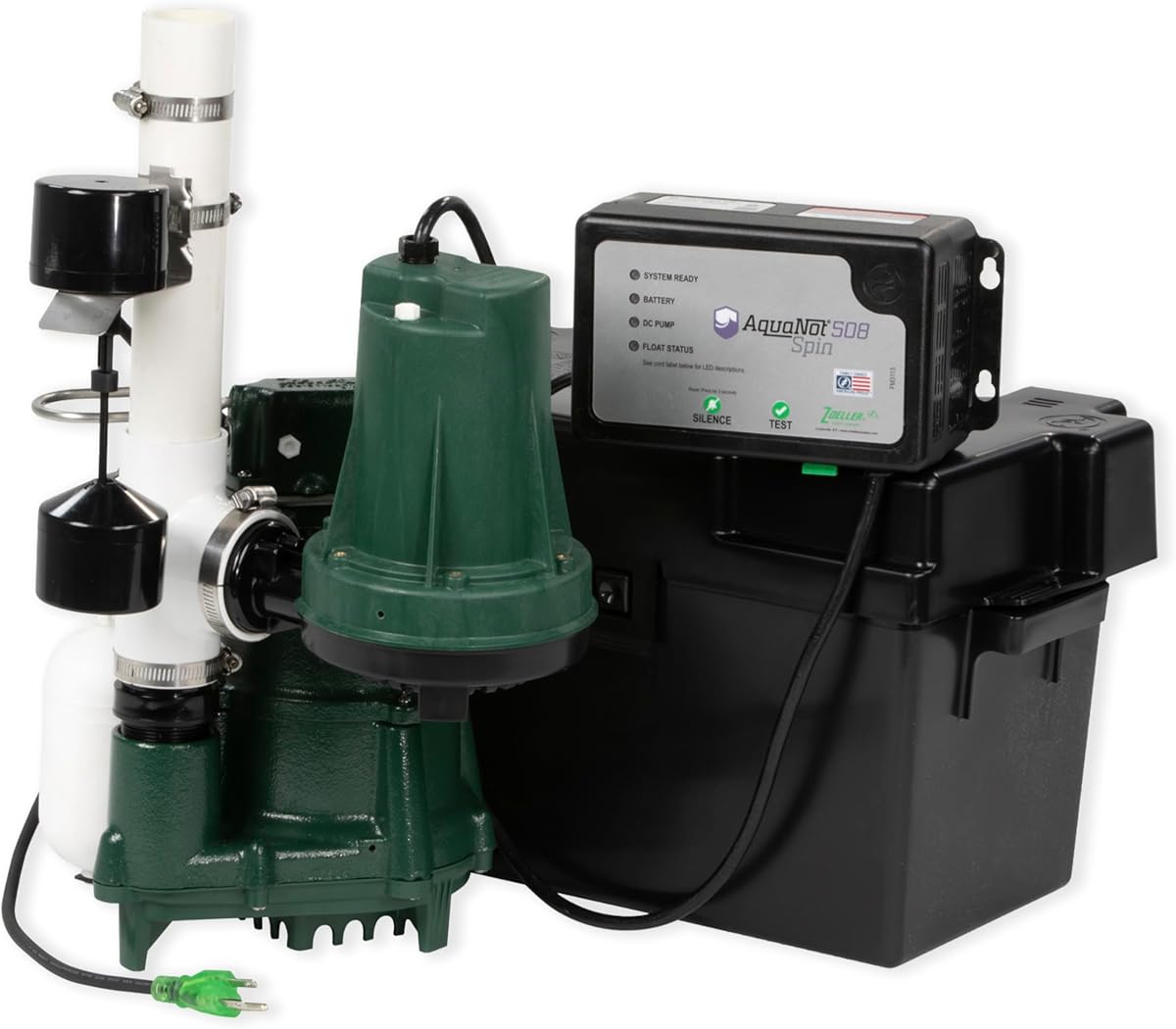
The Zoeller AquaNot Spin 508 ProPak is a complete sump protection package rather than a standalone pump. It combines a 1/2 HP Model M98 AC primary, an AquaNot Spin 508 controller, a 12V DC backup pump, check valve, float switches, and PVC discharge piping. Its 3.9 rating is the lowest in the group, so its appeal rests on the convenience and coordination of a packaged system.
We may earn a commission when you buy through this link, at no additional cost to you.
The DC backup can deliver up to six hours of continuous operation or more than 48 hours at a 10 percent duty cycle on a fully charged battery. The controller tests functionality and alerts for power outages, high water, obstructed switches, and pump faults. A double-sealed DC pump, corrosion-resistant materials, and a glass-filled thermoplastic vortex impeller support dependable operation.
Because the system comes pre-plumbed with 1-1/2-inch Schedule 40 PVC, a check valve, and a float switch, it can simplify installation compared with assembling individual components. It still requires appropriate basin space, a properly sized battery, sound electrical connections, and compliance with local requirements. A complete factory system does not eliminate the need to verify dimensions and plumbing compatibility.
This ProPak is well suited to a homeowner replacing or upgrading an integrated primary-and-backup installation. It is less attractive for temporary drainage or locations where a simple portable pump would meet the need. Its lower rating warrants attention to recurring customer feedback, but the supplied specifications present a notably complete package for basement protection.
Primary pump, DC backup, controller, float switches, check valve, and discharge piping are organized as one system, reducing the need to source individual core components.
Besides six hours of continuous pumping, the backup is stated to last more than 48 hours at a 10 percent duty cycle, which can help during extended outages.
We may earn a commission when you buy through this link, at no additional cost to you.
This cordless utility pump combines a listed 2113 GPH maximum flow with a 49-foot maximum head, making it a capable option for garden irrigation, pool and spa draining, and storm cleanup. Its 4.4 rating reflects a strong feature set, including two 4.0Ah batteries, fast charging, a one-button start, and automatic shutdown when water falls below 0.4 inches.
We may earn a commission when you buy through this link, at no additional cost to you.
The brushless motor eliminates carbon-brush wear and is described as quieter, cooler, and longer lasting. Three layers of protection cover automatic dry-run shutoff, overheating, and overload. The batteries have charge indicators, and their thickened circuit boards are designed for stable high-current output. A rubber-coated nylon shell adds resistance to shock and cracking in outdoor working environments.
Despite the one-HP marketing language, the listed maximum output of 2113 GPH is lower than several 4500-plus-GPH AC utility pumps, and the 49-foot head figure is a maximum rating rather than a guaranteed field output. The pump is restricted to clean water and should not handle sewage, mud, or debris-laden water. The 23-foot cord also limits how far the pump can sit from its batteries.
This is a good portable option for clean-water transfer where outlets are unavailable. The included adapters support common hose sizes, while automatic shutoff reduces the risk of leaving the pump running dry. It is less appropriate for permanent sump protection, heavy debris, or large flooded areas requiring the highest flow in this list.
The batteries can be alternated for extended use, and built-in indicators help the user monitor remaining charge. This supports remote jobs and repeated transfer tasks.
Stopping automatically below 0.4 inches of water helps protect the motor when the source runs low. The feature does not make the pump appropriate for debris-filled water.
We may earn a commission when you buy through this link, at no additional cost to you.
The WAYNE CDU980E combines a 3/4 HP motor with a stated maximum flow of 5490 GPH, giving it the highest headline flow figure among the compared products. Its 4.6 rating is also among the strongest in the group. Although it is an AC-powered automatic sump pump rather than a DC model, it represents a durable option for households seeking high-capacity primary protection.
We may earn a commission when you buy through this link, at no additional cost to you.
An integrated vertical float switch enables automatic operation and is designed to fit narrow sump pits. The top-suction arrangement helps prevent clogging and airlock, potentially eliminating the need for a weep hole during installation. Cast iron and stainless steel construction provide a robust, corrosion-resistant foundation suited to demanding sump environments.
The lack of DC capability is a significant limitation for anyone seeking continued operation during a power outage. This pump needs reliable household power and does not provide the same remote monitoring or battery-backed response offered by dedicated DC systems. Installation must also account for float-switch clearance and basin dimensions.
This model is most appropriate for a conventional residential sump pit with dependable AC service and adequate space for its vertical float assembly. It may appeal to buyers who prioritize simple automatic operation, heavy-duty construction, and a long warranty. For outage-sensitive basements, it should be paired with a separately selected DC backup pump.
The stated 5490 GPH rating supports fast water removal during substantial inflow. Real performance will vary with discharge height, pipe diameter, and friction losses.
The integrated vertical float switch provides automatic activation while conserving space. Adequate basin clearance remains necessary to prevent the float from becoming obstructed.
We may earn a commission when you buy through this link, at no additional cost to you.
The Westinghouse WH50BBU is an integrated basement drainage system with a 1/2 HP AC primary pump and a DC battery backup. It has a 4.6 rating and a listed maximum output of 5200 GPH, placing it among the strongest performers. The backup is designed to activate automatically when primary power is lost, providing continuous protection during storms and outages.
We may earn a commission when you buy through this link, at no additional cost to you.
Both pumps use corrosion-resistant stainless steel housings. The primary motor incorporates thermal overload protection, lubricated ball bearings, and a sealed shaft, while dielectric oil around the motor supports cooling and pump life. A top-suction design is intended to reduce debris buildup and airlock, helping maintain consistent flow in a sump pit.
The compact design is intended for tight residential and light-commercial basins. However, the battery is not included, and the supplied specifications do not state a DC backup runtime in hours. Users must also confirm the available basin dimensions, discharge configuration, and whether the installation meets local electrical and plumbing requirements.
This system is a strong option for a finished basement where automatic switchover is more important than a portable pump. It offers the convenience of coordinated pumps with less need to compare separate primary and backup units. It is less suitable for simple manual transfer work or installations where purchasing an appropriate battery and supporting components would be inconvenient.
The DC backup is designed to take over when AC power is interrupted, reducing the chance that rising water goes unattended during an outage.
Stainless steel housings and a sealed, oil-cooled motor are intended to withstand repeated wet service. Long-term performance still depends on installation and maintenance.
We may earn a commission when you buy through this link, at no additional cost to you.
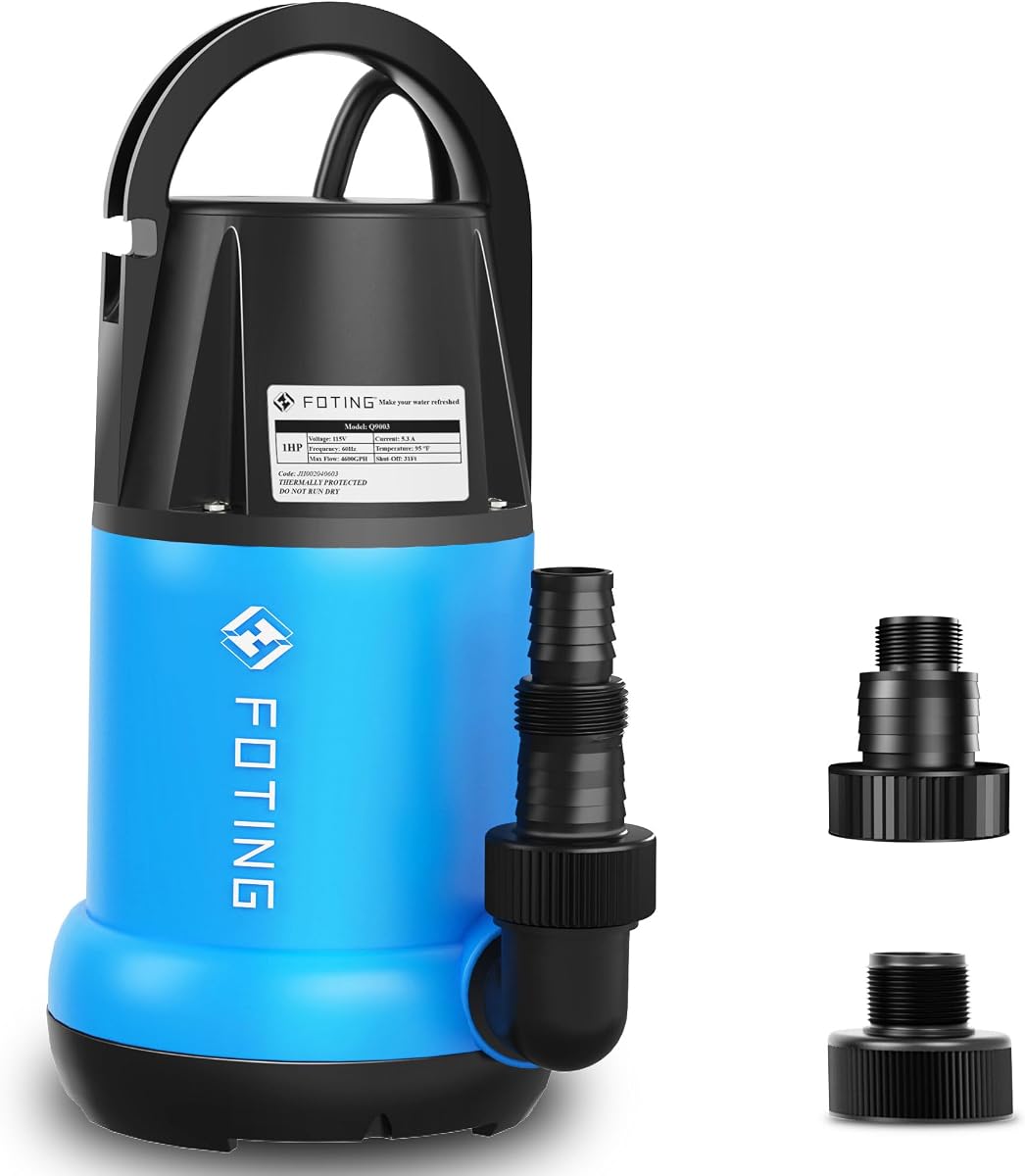
The FOTING 1 HP utility pump delivers a stated 4600 GPH at a five-foot lift and can handle a vertical lift of up to 31 feet. Its 4.3 rating reflects solid performance for manual drainage, and the listed ability to handle clean or dirty water makes it more versatile than pumps restricted to clean transfer applications.
We may earn a commission when you buy through this link, at no additional cost to you.
Bottom suction can reduce the remaining water level to one-fifth inch, while the pump handles solids up to one-eighth inch. A removable bottom simplifies cleaning and maintenance, and the rounded handle improves handling. The 10-foot cord offers some placement flexibility, while a 1-1/2-inch NPT discharge and several adapters allow different hose sizes to be used.
This product does not support automatic start or stop, so it requires an operator to turn it on and off. It is also AC powered, making it unsuitable as a standalone outage backup. Although the housing is described as corrosion-resistant thermoplastic and the motor has thermal overload protection, those features do not change the need for safe supervision and proper grounding.
FOTING is a sensible manual choice for hot tubs, pools, ponds, basements, and window wells where modest debris may be encountered. It is less appropriate for a conventional sump pit that needs automatic float-switch operation. The removable intake and included adapters are useful advantages for owners performing repeated draining and cleanup.
The stated one-eighth-inch solids capability broadens the pump beyond clean-water use. It remains important to remove larger objects before placing the intake.
Taking off the bottom for cleaning makes it easier to inspect the intake and maintain flow. The pump should be disconnected from power before servicing.
We may earn a commission when you buy through this link, at no additional cost to you.
The SumpJet is an unusual but practical emergency backup that uses the incoming household water supply rather than electricity or a battery. Its 4.6 rating makes it a strong conceptual fit for homes seeking protection when an outage disables the primary sump pump. It belongs in the comparison because it offers a different approach to standby water removal.
We may earn a commission when you buy through this link, at no additional cost to you.
The pump accepts inlet pressure from 20 to 100 psi and operates fully automatically. Its compact, fully assembled construction can simplify integration with an existing sump arrangement, provided the plumbing can support the required pressure and an appropriate flow path. The water pressure must be available when the emergency condition occurs.
The central limitation is that this is not a DC-powered pump and does not store energy in a battery. It also cannot operate during a municipal water outage or a loss of incoming water pressure, which is exactly when some homeowners may assume it would help. Because it is intended as an emergency backup, it should supplement rather than replace the primary sump system.
SumpJet is most relevant to homeowners with dependable incoming water pressure who want automatic emergency drainage without a battery-maintenance routine. It is less versatile than portable DC pumps because it cannot serve as a general transfer pump. Prospective buyers should review compatibility with their existing discharge and water-supply plumbing before selecting it.
The pump draws operating power from incoming water pressure, allowing emergency operation during an electrical outage when the water supply remains active.
Its fully assembled and relatively compact design can simplify supplemental installation. Existing plumbing and pressure conditions must meet the unit's requirements.
We may earn a commission when you buy through this link, at no additional cost to you.
The right DC powered sump pump depends on whether you need mobile transfer capability, a complete primary-and-backup system, or emergency-only protection. Flow, head, power compatibility, controls, and installation space should be evaluated before choosing a model.
Begin by identifying what the pump will move and where it will operate. Clean-water transfer pumps are suitable for pools, ponds, water tanks, and garden irrigation, while some utility pumps can also handle small solids. A dedicated sump system is designed around a basement basin, float control, discharge pipe, and primary pump. Choosing a portable transfer pump for a permanent sump pit may leave you with manual operation, while selecting a heavy fixed system for occasional cleanup adds unnecessary installation complexity.
Flow describes how quickly a pump can move water under stated conditions, while head represents the maximum vertical height the pump can support. Specifications are often measured at a particular lift and may decline as discharge height, hose length, and pipe friction increase. A pump that moves substantial water at a low head may perform differently when water must be lifted to a basement discharge. Compare figures using the same test points where possible and allow for the total vertical rise and distance of the actual discharge route.
A DC pump may draw from a 12V battery, accept 18V or 21V tool batteries, or operate as part of a system with both AC and DC components. Standalone DC models offer portability but require batteries, chargers, and adequate current delivery. Complete backup systems often use a permanently connected battery, while AC primary pumps need a reliable outlet. Confirm the required battery chemistry, voltage, terminal connection, charging arrangement, and whether those components are included.
Automatic systems use float switches, high-water sensors, and controllers to start and stop water removal without constant supervision. Manual pumps offer simpler operation and may be useful for draining a pool or flooded area on demand, but they do not protect a basement unattended. Look for high-water alarms, switch-obstruction alerts, self-testing, and remote notifications if the sump area is difficult to inspect regularly.
Sump pumps operate in wet, corrosive environments, so housing material, shaft sealing, thermal protection, and pump construction matter. Cast iron and stainless steel offer robust options for fixed systems, while reinforced thermoplastic and rubber-coated nylon can reduce weight and resist moisture. Features such as thermal overload, automatic dry-run shutoff, anti-airlock intake designs, and corrosion-resistant components help reduce the consequences of demanding or imperfect conditions.
A pump can perform well in the laboratory yet install poorly in a cramped basin. Vertical float switches need clearance, removable bottoms need room for cleaning, and discharge adapters must match the pipe or hose diameter. Record the sump-pit width, depth, outlet position, vertical lift, and available space around the float. For a complete system, also verify whether pre-plumbed piping can connect to the existing drainage line without modification.
Monitoring features are particularly valuable for sump pumps in finished basements, closets, or locations that are not inspected often. A low-battery indicator and alarm reveal a weak battery before an outage. High-water notifications can signal a blocked switch, excessive inflow, or pump failure, while self-testing can identify faults without requiring the owner to test the system manually. Wi-Fi and app access add convenience, although they should complement rather than replace sound installation and battery maintenance.
The difference between a complete kit and a bare pump can be substantial. Check whether the package includes batteries, a charger, alligator clips, hose adapters, a check valve, float switches, discharge piping, and installation hardware. A hose is not included with every product, and some battery-powered units require the owner to supply a compatible battery. Conversely, a fully plumbed system may include more than a homeowner needs for a simple transfer task.
Before operating any model, read the supplied instructions, confirm the pump is rated for the intended liquid, and inspect the housing, cord, battery contacts, intake, and discharge for damage. For portable models, submerge the pump appropriately to release trapped air and confirm that the intake is fully covered. Connect the correct power source or battery, arrange the discharge hose, and keep electrical connections away from wet areas. Do not operate the pump dry unless its instructions explicitly permit dry running.
For a fixed sump installation, verify basin clearance, float movement, discharge height, pipe diameter, and check-valve orientation before connecting the system. A battery backup should use the specified battery type and remain connected to its controller as intended. Test the system with water under normal operating conditions, confirm that the primary pump starts correctly, and then simulate the backup activation method described in the manual. Never energize an AC primary with a DC backup connected incorrectly.
During routine care, unplug the pump or isolate its power source before handling it. Clean the intake and impeller area, remove trapped debris, and keep the float switch free of obstructions. Check battery charge, terminal corrosion, and controller alerts on a regular schedule. After a flood, inspect the pump for damage and confirm that it still starts and stops correctly. For complete systems, follow local plumbing and electrical codes and seek qualified assistance when modifications are needed.
Yes, when it is connected to a properly sized and charged battery. Standalone 12V models, compatible-tool-battery pumps, and fixed backup systems can operate without household AC power, provided their batteries have sufficient capacity. Some complete products contain an AC primary and a DC backup, while others are entirely AC powered. Always check the power architecture and battery requirements before assuming outage protection is included.
It can be, but the required capacity depends on the amount of incoming water, the vertical lift, discharge pipe length, and pump design. The 12V model in this guide lists a 1500 GPH maximum flow, while larger complete backup systems use more powerful AC and DC pumps. Assess worst-case drainage conditions and local code requirements rather than relying on a single flow number.
A DC utility pump is usually a portable transfer device operated manually or by a simple control. A sump backup system is designed around a sump basin, float or high-water controls, a check valve, discharge plumbing, and a primary pump. The backup version is meant to protect a basement automatically, so its installation requirements and monitoring features are usually more extensive.
It depends on the model. The 12V Water Pump includes alligator clips and a cord but does not include a battery. The DARKBOOM cordless pump and One-HP cordless utility pump include batteries and chargers, while the Zoeller and Westinghouse backup systems do not include the specified 12V battery. Use only a battery meeting the manufacturer’s voltage, capacity, charging, and connection requirements.
It depends on the specific model. The 12V Water Pump and FOTING model list one-eighth-inch solids handling, and the AQUASTRONG also lists one-eighth-inch capability. The DARKBOOM and One-HP cordless utility pumps are designated for clean water. Always check the solids limit and remove larger obstructions before placing a pump in water.
Professional installation is strongly advisable when adding a fixed system, modifying discharge plumbing, installing an AC primary, or integrating complex controls. Electrical work and permanent plumbing must meet applicable local requirements. A simple portable transfer pump may need only basic setup, but a basement protection system deserves careful sizing, leak prevention, and operational testing.
Maximum head is the greatest theoretical height the pump can raise water under the test conditions used by its manufacturer. Actual performance can be lower because of long hoses, elbows, check valves, pipe friction, and the distance water must travel. Compare head at a meaningful operating point and consider whether the intended discharge route includes vertical risers or restrictive fittings.
No. The SumpJet uses incoming water pressure to operate and does not require electricity or a battery. It is included because it provides a distinct emergency-backup approach, but it cannot operate if incoming water pressure is unavailable. It is therefore different from battery-powered DC alternatives.
The Water Pump DC 12V stands out as a budget-conscious portable option with broad clean or dirty water uses, while the DARKBOOM cordless pump offers the most convenient all-in-one battery package for clean-water transfer. The AQUASTRONG 1 HP model delivers strong high-volume removal for installations where AC power is available, and the Zoeller 508-0014 provides the most advanced smart monitoring in a fixed backup design.
Prioritize the conditions that determine success: real drainage volume, vertical lift, power source, battery availability, float-control requirements, basin dimensions, and the ability to receive maintenance alerts. A portable transfer pump is not a substitute for a permanently plumbed sump system, and a complete backup installation should be evaluated as an integrated assembly rather than by the capacity of one pump alone.
Finally, check current product details, included accessories, availability, and installation requirements before purchasing. Prices and configurations can change, and local electrical and plumbing rules may affect what can be installed. The right DC powered sump pump is the one that fits the drainage environment, power arrangement, and monitoring needs of the property.