
WAVLINK USB 3.0 or USB C to Dual HDMI 4K@60hz Splitter Extended Display
4.4Editor score
Dual simultaneous 4K output
Hybrid USB-C USB-A cable
Windows macOS ChromeOS support
Twelve-month product warranty
This Displaylink Adapter guide compares 10 options for dual monitors, Mac and PC compatibility, 4K output, ports, drivers, and portability.
A Displaylink Adapter can add more external monitors than many modern laptops natively support, making it useful for MacBook owners, Windows users, and hybrid workers who need more screen space. The right choice depends on operating system, connector, supported resolution, power delivery, and whether one adapter must drive one or two displays.
The products in this guide were compared using their stated output configurations, monitor limits, system compatibility, port selection, driver requirements, and practical productivity features. The list covers dual-HDMI adapters, DisplayPort mini docks, universal single-display adapters, and more specialized options for MacBook Air and MacBook Pro owners.
Each review explains the strongest use case, important limitations, and the type of workstation that best matches the adapter. Ratings and product details reflect the supplied listing information, while prices and promotions can change, so readers should confirm the current listing and total setup requirements before purchasing.
4.4Editor score

4.3Editor score
4.0Editor score
The comparison below organizes all ten adapters by display output, connection style, system support, and standout features, making it easier to identify the right model for a particular workstation.


The ACASIS USB C to Dual HDMI DisplayLink Adapter combines two 4K-at-60Hz display outputs with 100W USB-C power delivery and three USB-A ports. Its 4.3 rating reflects a practical design for people who want to turn one laptop connection into a compact productivity hub. The standout feature is how power, video, and peripherals come together in one portable unit.
We may earn a commission when you buy through this link, at no additional cost to you.
Both HDMI outputs can deliver 3840-by-2160 content at 60Hz, and the adapter can extend rather than merely duplicate the desktop. That makes it useful for placing reference material on one screen while editing documents, communicating through video meetings, or running productivity software on another. The 100W charging input is especially valuable for a MacBook Pro or Air used at a desk for long periods.
There are trade-offs. The listing explicitly says the adapter is not intended for gaming or HDCP-protected content, so protected streaming services are not the focus. Its three USB-A ports support peripherals at 480Mbps, which is reasonable for a mouse, keyboard, or flash drive but not ideal for large file transfers. The DisplayLink driver is also required, and the instructions advise unplugging only while the computer is off.
This is a strong recommendation for a mobile professional who wants two external screens, dependable charging, and a few USB peripherals without assembling a large desktop dock. It is less suitable for gaming, protected video, or high-speed external storage. For general office productivity, however, the combination is unusually complete.
The dual 4K outputs make it possible to keep separate applications visible on separate monitors. The adapter is aimed at office work, coding, analysis, and other tasks that benefit from a larger desktop area.
A 100W PD input helps maintain laptop power during extended sessions, while three USB-A ports reduce the need for separate peripherals. The USB data rate is modest, so the hub is best for everyday accessories rather than intensive storage workflows.
We may earn a commission when you buy through this link, at no additional cost to you.
The WAVLINK USB 3.0 or USB C to Dual HDMI adapter delivers two simultaneous 4K-at-60Hz outputs from one host connection and carries a 4.4 rating. It is one of the most direct ways to overcome the limited number of external displays supported by many recent Macs. Its hybrid cable also reduces the need to carry separate host adapters.
We may earn a commission when you buy through this link, at no additional cost to you.
The included two-in-one cable supports USB-C, USB-A, Thunderbolt 3 and 4, and USB 4 host ports. The adapter is listed for Apple M1 through M5 Macs, MacBook Neo, Windows 10 and 11, and ChromeOS 100 or later on systems with suitable connections. Users can mirror one screen or extend the desktop across both displays, which gives it broad value for offices and home workspaces.
It is not intended for gaming, graphics-intensive work, or HDCP-protected content from services such as Netflix and Hulu. DisplayLink driver installation is required, and iOS, Linux, and Unix are not supported. Some listings call an extended-display device a splitter, so buyers should understand that this model can expand the desktop rather than only duplicate one image.
The WAVLINK is a compelling pick for value-conscious users who need two sharp 4K monitors and broad host-port compatibility. The driver and content restrictions are normal for a DisplayLink-based productivity adapter. For office software, web applications, spreadsheets, and communication tools, it delivers the core features at a more restrained cost than many premium alternatives.
The hybrid USB-C and USB-A cable lets the adapter work with newer Thunderbolt and USB4 laptops as well as compatible USB 3.0 systems. That flexibility suits mixed personal and office computer fleets.
Simultaneous 4K output is valuable for document comparison, financial analysis, development, and presentations. The adapter is explicitly positioned for productivity software rather than gaming or protected entertainment.
We may earn a commission when you buy through this link, at no additional cost to you.
The WAVLINK Universal Video Adapter uses one adapter per monitor, allowing a compatible PC to run as many as six additional displays. It has a 4.4 rating and is aimed at users who need more flexible multi-screen expansion than a standard dual-output adapter can provide. The support for audio input and output also makes it more versatile for communications and meetings.
We may earn a commission when you buy through this link, at no additional cost to you.
The adapter can mirror or extend the workspace through USB-C, USB-A, Thunderbolt 3, 4, or 5, and USB 4 connections. Its listed operating system support includes current and older Windows releases, several macOS versions, Ubuntu, ChromeOS, and Android with USB OTG. DisplayLink driver installation remains necessary, and the supplied information describes a certified USB 3.0 graphics component with an LED status indicator.
Resolution is a key limitation. The listed maximum is 2048-by-1152 at 60Hz or 2560-by-1440 at 50Hz, below the 4K-at-60Hz specification of several dual-HDMI options. The six-monitor figure also requires one adapter for each additional display and a compatible host, so it should not be interpreted as a single-adapter solution for six screens.
Users who need numerous desktop spaces, broad operating system coverage, or integrated audio should give this model serious consideration. It is a better fit for specialized control rooms, analyst workstations, and elaborate desktop arrangements than for a simple two-monitor office. Buyers who prioritize 4K resolution from one adapter may find a dual-output HDMI model more direct.
Using one adapter per display allows compatible PCs to expand into much larger workspaces. This is useful for monitoring, control, analysis, and other setups where users need many persistent windows.
External 2.1-channel microphone input and headphone output provide more than basic video. These connections can simplify calls and let users keep conference audio separate from the laptop.
We may earn a commission when you buy through this link, at no additional cost to you.
The Plugable USB C to HDMI Adapter is a focused solution for Mac users who need more screens than their laptop provides natively. It can add two 4K-at-60Hz HDMI displays, creating a three-screen arrangement when the built-in laptop display is included. Its 4.3 rating reflects a generally capable product with clearly defined productivity strengths.
We may earn a commission when you buy through this link, at no additional cost to you.
Compatibility is the central benefit. The adapter supports macOS 11 and later, Windows 10 and later, and ChromeOS 100 or later systems equipped with Thunderbolt, USB4, or USB-C. Mac users install DisplayLink Manager and grant the required macOS display permission, while the listing describes Windows and ChromeOS as plug-and-play. Extended and mirrored modes are both available.
The product is not suitable for HDCP-protected streaming applications such as Netflix, Disney+, Hulu, or Prime Video. The listing recommends a standard display adapter for entertainment. Although the device is described as appropriate for office, coding, and productivity applications, users who need protected video should plan to connect that content through another route.
This adapter is an excellent recommendation for MacBook Air or MacBook Pro owners who regularly work with two external monitors. The three-screen total is particularly useful for coding, research, finance, and general office productivity. It is less appropriate for protected streaming, but for its intended business setting, the combination of display capacity and lifetime support is compelling.
A single USB-C connection can produce two additional 4K displays even on base MacBook Air models with a restricted native external-display count. Users gain a laptop screen plus two external workspaces without replacing the computer.
Windows and compatible ChromeOS systems receive an easier setup path, while Mac owners install DisplayLink Manager once and approve the required display permission. The same adapter can therefore suit a mixed-device office.
We may earn a commission when you buy through this link, at no additional cost to you.
The Plugable USB-C and USB-A Dual 4K HDMI Adapter is built for offices where Windows computers still use a mix of modern USB-C and legacy USB-A connections. It has a 4.5 rating, the highest among the adapters in this guide, and its integrated host adapter makes switching between connection types unusually convenient.
We may earn a commission when you buy through this link, at no additional cost to you.
The DisplayLink DL-6950 chipset drives two HDMI displays at up to 3840-by-2160 resolution and 60Hz in extended or mirrored modes. Users can connect directly through Thunderbolt, USB4, or USB-C, or use the attached USB-A adapter with a compatible USB 3.0 system. No additional Thunderbolt port or external graphics hardware is required.
The product is explicitly not recommended for macOS, so Mac users should look elsewhere in this roundup. It also does not support HDCP-protected streaming services on DisplayLink-connected screens. For traditional office applications, coding, spreadsheets, web browsing, and multitasking, however, the adapter targets exactly the workloads it handles well.
This is a strong choice for IT teams, hot desks, and mixed Windows fleets. The retained USB-A adapter avoids requiring every worker to carry a separate converter, while the dual 4K output creates a consistent two-screen standard. It is less flexible for Mac-focused or entertainment-oriented setups, but very well aligned with professional PC deployment.
The integrated USB-A adapter allows the same dual-display unit to serve newer USB-C systems and compatible older laptops. That reduces accessory clutter and simplifies shared-workspace deployment.
Two simultaneous 4K screens provide ample room for spreadsheets, code windows, documentation, and communication tools. The adapter is designed for office reliability rather than graphics-heavy gaming.
We may earn a commission when you buy through this link, at no additional cost to you.
The StarTech USB-A DisplayLink Dual 4K mini dock combines two DisplayPort outputs with Gigabit Ethernet in a compact, bus-powered enclosure. Its 4.4 rating and broad device support make it a practical choice for offices, travel setups, and institutional deployments where connectivity and network access both matter.
We may earn a commission when you buy through this link, at no additional cost to you.
The DisplayLink-certified DL-6950 chipset supports dual DisplayPort output at 4K and 60Hz. A one-foot, 30-centimeter host cable provides placement flexibility and can reduce strain on USB-A ports. The dock works with a wide range of USB-A laptops, ultrabooks, Chromebooks, and Surface Pro models, while the attached cable keeps the overall footprint simple.
The important distinction is that its video outputs are DisplayPort rather than HDMI. Users need monitors with compatible DisplayPort inputs, or suitable adapters and cables if only HDMI is available. The product supports Windows and ChromeOS with automatic driver setup, which is useful in managed environments. It is bus-powered, so an additional power supply is not part of the stated design.
This mini dock is a good match for a compact Windows or ChromeOS workstation that needs two sharp displays and a wired network connection. It is less convenient for modern USB-C-only users, and its outputs are not directly interchangeable with HDMI monitors. For the environment it targets, though, it offers an unusually tidy and functional package.
Dual 4K DisplayPort outputs and Gigabit Ethernet replace several separate adapters with one compact unit. The result is a cleaner desk with fewer cables competing for space.
The integrated short cable and bus-powered construction make the dock easy to carry between offices or shared desks. Automatic driver setup also reduces friction in managed Windows and ChromeOS environments.
We may earn a commission when you buy through this link, at no additional cost to you.
The ACASIS Dual DP DisplayLink Adapter pairs two 4K-at-60Hz DisplayPort outputs with 100W power delivery and three USB-A ports. Its 4.8 rating is the highest in this selection, and its integrated hub design makes it especially interesting for MacBook Air and MacBook Pro users who want a complete desk setup from one connection.
We may earn a commission when you buy through this link, at no additional cost to you.
The DisplayLink technology allows true extended desktop operation, addressing the single-screen restriction associated with many M-series Mac laptops. A primary DisplayPort port near the PD input supports MST, while the dual DisplayPort configuration serves as the main two-monitor connection. The listed system support includes M1, M2, and M3 MacBook models as well as Windows laptops.
Setup requires installing the DisplayLink driver, and the video interface is specifically DisplayPort rather than HDMI. A user with HDMI-only displays must obtain a DisplayPort-to-HDMI cable. The listing also positions the adapter for designers and power users, although the listed 100W charging and three USB-A ports make it suitable for general productivity hubs as well.
This is a strong recommendation for users with DisplayPort-capable monitors who want high-resolution extended screens, charging, and peripheral connectivity in a portable aluminum unit. Its rating should not be treated as a substitute for checking connector and operating system requirements. When those align, it provides one of the most integrated Mac-focused solutions in the guide.
Two DisplayPort outputs, 100W charging, and three USB-A ports combine the functions of a display adapter and basic dock. Users can leave more of their usual desk equipment at home when traveling.
The adapter is designed to bypass native multi-screen restrictions and support separate desktop areas. The aluminum enclosure also aids heat dissipation during sustained use.
We may earn a commission when you buy through this link, at no additional cost to you.
The WAVLINK USB 3.0 and USB C to Dual HDMI Adapter delivers simultaneous 4K-at-60Hz output from USB-C or USB-A and carries a 4.6 rating. Its combination of broad system support and encrypted DL-chip technology makes it particularly interesting for corporate users who want a consistent two-monitor adapter across Mac and Windows environments.
We may earn a commission when you buy through this link, at no additional cost to you.
Both displays can be mirrored or extended, and the adapter supports Thunderbolt 3 and 4, USB4, and legacy USB 2.0 host connections. It is listed for Windows 10 and 11, macOS 11 or later, and ChromeOS 100 or later, including M1 through M5 Macs and MacBook Neo. For developers, analysts, and professionals comparing information across screens, the 4K dual output creates a useful workspace.
The driver is not optional, despite the product description occasionally using plug-and-play language elsewhere. Users must obtain the latest DisplayLink driver. Linux, Unix, iPad, and iOS are unsupported, and the adapter is not recommended for gaming or protected services such as Netflix. The encrypted chip is a differentiator for security-conscious deployments, though the listing's exact implementation details remain limited.
This adapter is well suited to mixed enterprise fleets and teams handling sensitive or high-value information on external displays. It is also a strong general productivity choice for users who want 4K resolution and broad host compatibility. Buyers should simply ensure that their operating system is supported and that the team can manage the required driver installation.
The encrypted DL-chip technology gives this model a distinct feature in business-focused listings. It is a useful consideration for organizations that treat external-monitor connections as part of their managed endpoint strategy.
Support for USB-C, USB-A, Thunderbolt, and USB4 hosts makes the adapter flexible across different computer generations. Once the DisplayLink driver is installed, it offers a consistent dual-4K workflow on supported systems.
We may earn a commission when you buy through this link, at no additional cost to you.
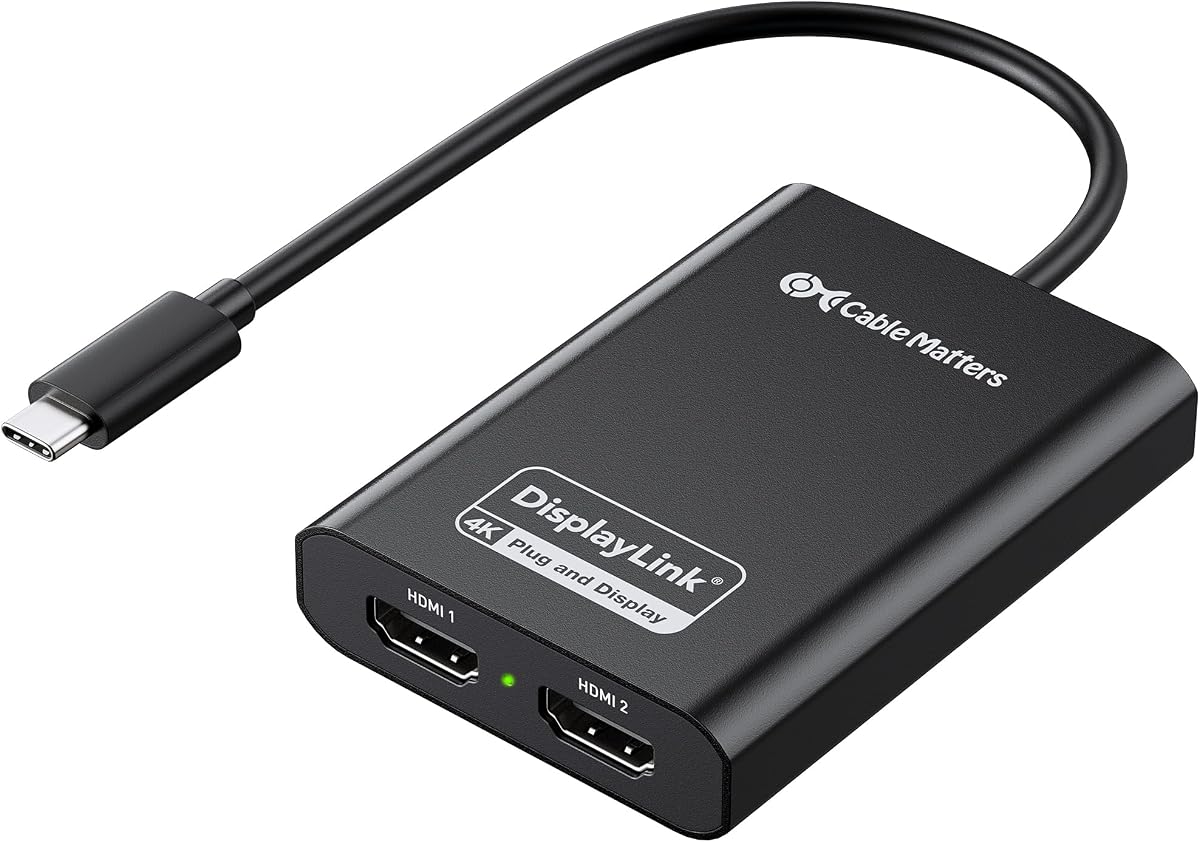
The DisplayLink Certified Cable Matters USB C to Dual HDMI Adapter is a premium-looking option designed to create two true extended 4K-at-60Hz displays from one USB-C, USB4, or Thunderbolt connection. It has a 4.0 rating and is particularly relevant to MacBook owners because it can overcome the single-external-display limitation on many M1, M2, and M3 laptops.
We may earn a commission when you buy through this link, at no additional cost to you.
Both outputs use HDMI 2.0, while the adapter leverages USB 3.2 Gen 1 bandwidth of 5Gbps. The listed compatibility includes MacBook Air and Pro, Dell XPS, HP Spectre, and Lenovo ThinkPad systems, along with macOS 11 and later, Windows 10 and 11, and ChromeOS. The aluminum housing is designed to dissipate heat and may feel warm during operation, which the listing describes as normal.
Setup requires the DisplayLink driver on systems that need it, and Mac users must install DisplayLink Manager and permit Screen Recording access. The listing also advises that performance can vary with processor, memory, USB bandwidth, and running applications. HDCP is unsupported, and HDMI cables are not included, so those items need to be accounted for in the complete setup.
This is a refined choice for professionals who value a true dual-extended-screen Mac workflow, durable construction, and broad modern-laptop support. It should not be chosen for protected streaming, and its current rating is the lowest in the roundup. Even so, the core display performance and aluminum housing make it a strong premium option for productivity-focused users who plan a complete workstation.
The adapter adds two separate extended workspaces to many M-series Mac laptops. That is valuable for research, editing workflows, communication windows, and detailed productivity applications.
The aluminum enclosure is intended to manage heat during sustained dual-display use. It also gives the adapter a durable, compact profile suited to travel between home and office.
We may earn a commission when you buy through this link, at no additional cost to you.
The Sonnet DisplayLink Dual 4K HDMI Adapter can connect two 4K monitors at 60Hz or, at lower resolutions, two displays at 144Hz. Its 4.4 rating makes it an attractive option for users who want more flexibility than a standard 60Hz productivity adapter provides, particularly on compatible Mac and Windows computers.
We may earn a commission when you buy through this link, at no additional cost to you.
A single Thunderbolt or USB 3 or 4 port can carry the dual-display connection, and a USB-A female-to-USB-C male adapter is included for compatible systems. The product supports M1 and M2 MacBook Air and Pro models as well as M1 Pro, M1 Max, and M1 Ultra systems. It also supports 1080p and other lower resolutions at 60Hz and includes audio support.
The refresh-rate capability depends on the selected resolution, while the maximum physical output count is two. Users who need more screens would have to consider a different architecture. The adapter is also primarily designed for display connectivity rather than the broader charging, network, and peripheral functions found in larger docks.
This Sonnet adapter is best for users who prioritize smooth motion or high-refresh visual work alongside a dual-screen desktop. It also suits Apple Silicon owners seeking to expand beyond native display limits. Standard office users seeking broader USB hub functionality may prefer a mini dock, but this model is focused and effective for its stated display roles.
The ability to run two lower-resolution displays at 144Hz makes the adapter more relevant to motion-sensitive work. Users should select monitor resolutions compatible with the stated refresh-rate options.
Support includes M1 and M2 MacBook families and higher-tier M1 Pro, Max, and Ultra systems. It is a natural fit for Mac users who want to expand an Apple Silicon workstation.
We may earn a commission when you buy through this link, at no additional cost to you.
The most important choices are the number and resolution of displays, host and monitor connectors, operating system support, driver requirements, power delivery, and intended content. A display adapter that fits one workstation perfectly may be unsuitable for another, so these factors should be evaluated before comparing models.
Decide whether you need one extra monitor, two simultaneous outputs, or a much larger multi-screen arrangement. Most dual-HDMI products in this guide add two screens to a laptop, while the universal WAVLINK model uses one adapter per display and can scale to six additional monitors on compatible PCs. Also account for the laptop's built-in panel if you want the total screen count to include it.
Choose the output count that matches your real workflow, not merely the largest advertised number. More displays demand more bandwidth, processing, desk space, and power.
A dual-4K-at-60Hz configuration is ideal for sharp office documents, spreadsheets, code, and detailed multitasking. The Sonnet model also supports 144Hz at lower listed resolutions, which may appeal to users who value motion smoothness. The universal WAVLINK adapter has a lower maximum resolution, so it favors screen count over individual display sharpness.
Match resolution and refresh rate to the actual monitors. A higher headline specification only helps when the connected displays, cables, and host computer can support it.
Check whether your computer offers USB-C, Thunderbolt, USB4, or USB-A. Several adapters include hybrid cables or attached host adapters, allowing one device to work across newer and older systems. The StarTech mini dock, for example, uses an attached USB-A cable, while the Plugable PC-focused model retains a USB-A adapter for older Windows laptops.
Avoid buying a USB-C-only solution if your primary computer relies on USB-A. Conversely, a dock with integrated USB-A support may be more convenient than carrying a separate converter.
HDMI and DisplayPort are not interchangeable without the appropriate cable or adapter. Most products here use dual HDMI, which suits many office monitors, while the ACASIS and StarTech products use DisplayPort. A DisplayPort-only adapter can still work with HDMI monitors through a suitable DisplayPort-to-HDMI cable, but that adds another component to the setup.
Inspect the inputs on both monitors before buying. Also note whether your existing HDMI or DisplayPort cables support the target resolution and refresh rate.
Most modern DisplayLink adapters support Windows, macOS, and ChromeOS, but the details vary. The Plugable USB-C and USB-A model is not recommended for macOS, while the WAVLINK dual-HDMI product explicitly excludes Linux, Unix, iPad, and iOS. The universal WAVLINK option lists the broadest range, including older Windows, macOS, Ubuntu, ChromeOS, and Android with USB OTG.
Confirm that the adapter supports your current operating system and intended future computer. Product names that mention a particular chip generation are useful clues but should not replace the complete compatibility listing.
DisplayLink adapters usually require a driver, and Mac users may also need DisplayLink Manager plus macOS display or Screen Recording permission. Some compatible Windows and ChromeOS systems provide a more plug-and-play experience, but installation and updates may still be managed centrally in an enterprise environment. This process is normal for virtual display technology but should be considered when deploying an adapter quickly.
Choose a model whose driver is supported by your organization and operating system. If quick setup is critical, verify the current driver availability and permission steps before purchase.
A display adapter that also provides 100W USB-C power delivery can keep a compatible laptop charged during a long workday. Models with three USB-A ports can accommodate a mouse, keyboard, and flash drive, reducing the need for another hub. The StarTech mini dock prioritizes Gigabit Ethernet instead, while the universal WAVLINK adapter includes microphone and headphone connections. Higher-speed storage should be considered separately because the ACASIS USB-A hub is listed at 480Mbps.
Choose the extra ports that your desk actually needs. More functionality can make a device more useful, but only if it replaces other equipment without adding unnecessary bulk.
Most of these adapters are designed for productivity, presentations, web applications, office software, and development. Several explicitly do not support HDCP-protected content, which affects services such as Netflix, Disney+, Hulu, and Prime Video. Some listings also advise against gaming, graphics-intensive work, or design work. A standard native display adapter may serve those protected or latency-sensitive tasks better.
Treat DisplayLink as a workspace-expansion tool unless the listing specifically confirms the content and performance you need. Avoid choosing solely by screen count when your primary use depends on protected playback or demanding graphics.
Begin by confirming that your computer, operating system, monitors, and cables meet the adapter's requirements. Install the current DisplayLink driver before connecting the displays, or complete the Mac-specific DisplayLink Manager and permission setup. Connect the host cable first, attach the monitor cables, power on the displays, and then select the desired extended or mirrored arrangement through the system display controls.
For the best experience, use the adapter's specified USB-C, Thunderbolt, USB4, or USB-A connection rather than an unlisted intermediary. Position the adapter according to its short integrated cable or attached host adapter, and route the display leads without creating strain on the connector. Allow the aluminum models to remain unobstructed so they can dissipate heat normally.
Avoid changing cables or unplugging the device while the computer is running unless the manufacturer's instructions specifically permit it; the ACASIS dual-HDMI listing advises unplugging only when the computer is off. Keep the enclosure dry, avoid leaving the adapter in direct sunlight or a hot vehicle, and use the supported DisplayLink software to check for driver updates. If a monitor sleeps or fails to wake, power the sequence down cleanly and reconnect it after the computer has started.
A DisplayLink Adapter lets a compatible computer send its display output through USB rather than relying only on the computer's native video connection. It can add one or more external monitors, mirror a desktop, or extend it across multiple screens. Many modern laptops support only one external display natively, so this technology is especially useful for creating a larger workspace.
Most DisplayLink-based products require a DisplayLink driver. Mac users generally install DisplayLink Manager and grant the required macOS display or Screen Recording permission, while some compatible Windows and ChromeOS systems offer a more plug-and-play setup. Check the current driver version before connecting the adapter, particularly in a managed office environment.
Yes, several adapters in this guide support two simultaneous HDMI or DisplayPort outputs at up to 4K and 60Hz. Actual results also depend on the host's processor, memory, USB bandwidth, applications, cables, and monitor capabilities. Performance is most suitable for productivity applications rather than gaming or graphics-intensive workloads.
No. The listed products generally do not support HDCP-protected content, which can prevent playback from services such as Netflix, Disney+, Hulu, and Prime Video. If protected streaming is important, connect the computer natively to one display and reserve the DisplayLink outputs for productivity screens.
Yes, but only with a model explicitly listed as compatible and after installing the required DisplayLink software. Many M-series MacBook models natively support only one external display, while compatible DisplayLink adapters can add two. Check the adapter's Mac generation support, connector requirements, and permission setup before purchasing.
Mirroring shows the same desktop on the laptop and external monitor, which is useful for presentations or shared viewing. Extending creates additional desktop space so applications and windows can appear on different screens independently. Most adapters in this guide support both modes, although the system and driver must support the selected configuration.
Yes. An adapter with HDMI outputs requires HDMI monitor cables, while a DisplayPort model requires DisplayPort cables. If your monitors only have HDMI, a DisplayPort version may need a compatible DisplayPort-to-HDMI cable. The Cable Matters dual-HDMI adapter also does not include HDMI cables, so those should be planned as part of the complete setup.
The WAVLINK universal video adapter supports a scalable arrangement of up to six additional displays on compatible PCs, but it requires one adapter for each monitor. The dual-HDMI and dual-DisplayPort products in this guide are designed to drive two external screens from a single adapter, so their maximum setup is fundamentally different.
The Plugable USB C to HDMI Adapter is the most balanced choice for Mac-oriented productivity, while the WAVLINK dual-HDMI splitter offers strong value for users seeking extended 4K desktops. The Cable Matters dual-HDMI model stands out as a premium option with true macOS extension, HDMI 2.0 outputs, and an aluminum housing. Each serves a different need, so the most important distinction is how it fits your computer, monitors, and daily applications.
Prioritize native display limits first, then confirm the monitor connector, supported operating system, driver process, and target resolution. If power delivery or network connectivity matters, consider a model that includes those functions. If protected streaming or gaming is central, choose a native video adapter for that screen and use DisplayLink specifically to expand the productivity workspace.
Ratings, availability, promotions, and prices can change over time, so confirm the current listing details and complete equipment requirements before ordering. Also verify that you have the necessary cables, drivers, permissions, and compatible host ports. Those checks prevent a technically capable adapter from becoming an inconvenient desk accessory.