
SwimJoy Industrial Grade Solar Kit
4.5Editor score
Strapless high-wind mounting system
Patented panel connection clamps
Open-flow low-head-loss design
A DIY solar pool heating system can extend your swimming season by using radiant solar energy to warm circulating pool water. The most effective setup depends on pool volume, local sunlight, available roof or ground space, pump capacity, and how much DIY plumbing and mounting work you are comfortable undertaking.
We compared ten systems according to the supplied specifications, focusing on collector dimensions, construction, mounting approach, flow design, durability, compatibility, and included installation hardware. The list covers complete kits, expandable panels, replacement collectors, compact systems, and installation options for above-ground and in-ground pools.
Each pick below explains the strongest feature, the practical trade-offs, and the type of homeowner it may suit. Product ratings and availability can change over time, and prices fluctuate frequently, so confirm the current listing, included components, and installation requirements before making a purchase.
4.5Editor score
4.7Editor score

4.6Editor score
As an Amazon Associate we earn from qualifying purchases.
The comparison below highlights collector configuration, material or construction, mounting method, and system compatibility. These details make it easier to identify a solar heater that fits your pool, pump, mounting area, and DIY skill level.



The SwimEasy DIY Solar Pool Heater Kit stands out as the most complete and performance-focused option in this guide, carrying a 4.7 rating among buyers. Its defining feature is the molded header, which surrounds the absorber tubes and removes the flow barriers that can restrict water movement through a collector. That design supports efficient heat transfer into circulating pool water.
We may earn a commission when you buy through this link, at no additional cost to you.
The package is positioned as a true full-system kit rather than a bare panel. It includes hardware for mounting the collectors, linking panels together, securing the installation, and connecting the system to existing supply and return plumbing. Buyers also receive a comprehensive installation manual and access to installation specialists, which makes the project more approachable for careful DIY homeowners.
Durability is another reason this kit ranks first. It is manufactured in the United States with high-grade materials and ultraviolet stabilizers, and the listed life expectancy is 15 to 20 years. The one-piece header reduces manufacturing variance and strengthens the bond between the header and riser tubes, addressing long-term leak concerns. These benefits come with meaningful requirements: secure rooftop mounting, compatible plumbing, and a circulation system capable of moving water through the collector.
This is the strongest general recommendation for a homeowner seeking a durable, complete rooftop system and willing to plan the installation carefully. It is particularly suitable when an existing pump and filtration system are already available and the goal is a long-term solar heating installation rather than a temporary seasonal accessory.
Because water exits the molded header directly into the absorber tubes, the design encourages free and consistent flow. That matters because the amount of water passing through the panels determines how much captured solar heat reaches the pool.
The included mounting, connection, and securing hardware reduces the need to source many accessories separately. A detailed manual and specialist support make it easier to verify measurements and plumbing direction before drilling or connecting anything.
We may earn a commission when you buy through this link, at no additional cost to you.
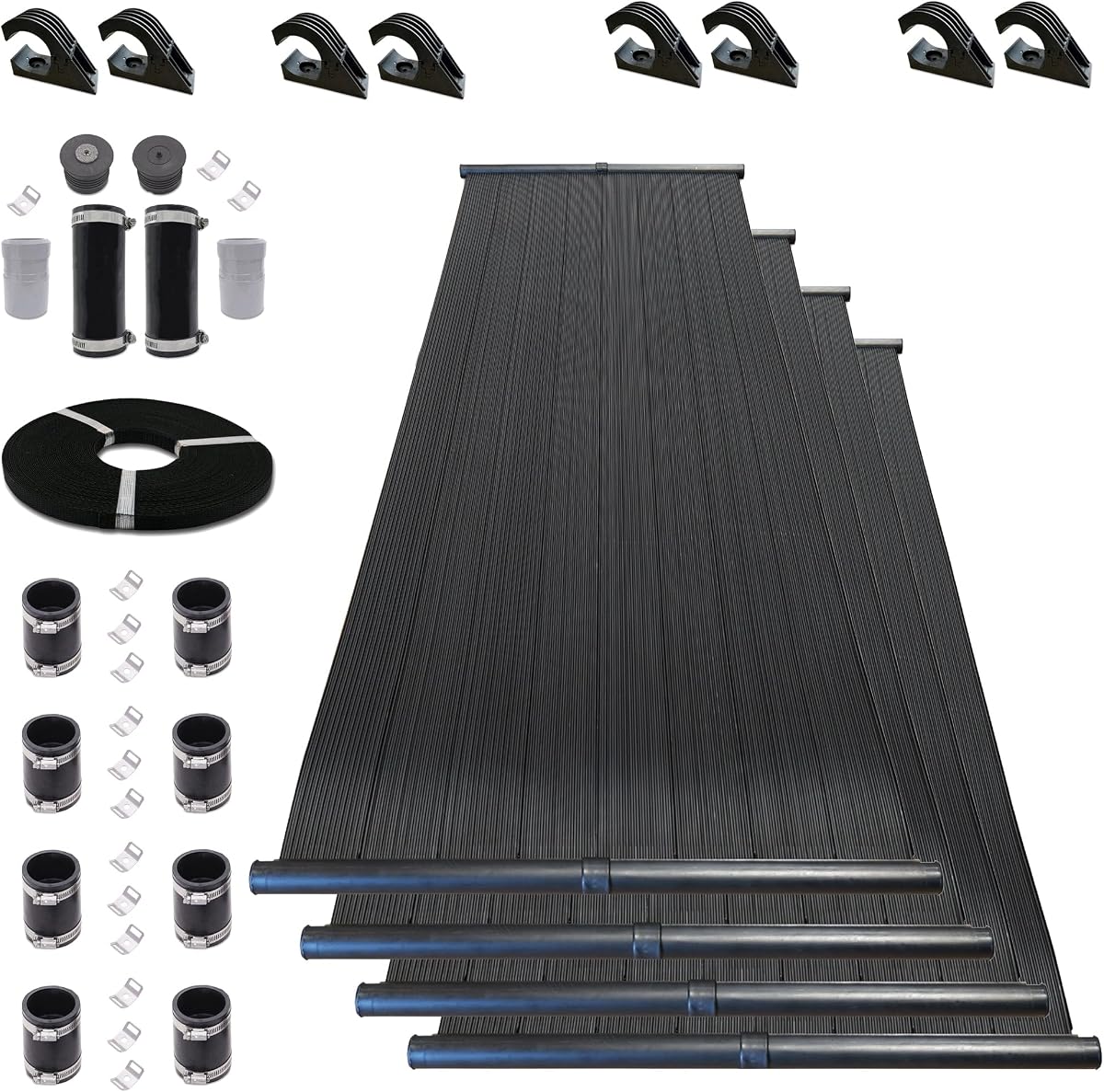
The SwimJoy Industrial Grade Solar Pool Heater DIY Kit is built around durability and simplified rooftop installation. It has a 4.5 rating, and its most distinctive claim is a certified high-wind, strapless mounting system designed for flush installation on virtually any roof type. That approach can reduce the visual clutter and ongoing attention associated with conventional tie-down straps.
We may earn a commission when you buy through this link, at no additional cost to you.
Its square header and open-flow configuration are intended to maximize flow while virtually eliminating backpressure. Low-head-loss riser tubes also reduce pressure and help guard against clogging. Construction uses a patented process in which the headers and risers become one solid piece, removing seams and welds that might otherwise deteriorate with age and mechanical stress.
The panel clamps are another meaningful upgrade. They connect collectors to one another and to PVC pipe without the rubber hoses and metal clamps that the product information says can require periodic replacement. They also allow panels to sit closer together, which can produce a more compact and visually organized array while improving the usable collector layout.
This is the pick for owners with a good roof, a need for strong-weather mounting, and a preference for fewer exposed connections. The trade-off is that the specialized system may require more careful planning than a basic hose-connected arrangement. Confirm roof conditions, panel orientation, local requirements, and the exact plumbing connections before installation.
The flush mounting concept is intended to withstand violent storm winds without relying on visible tie-down straps. It may appeal to owners who value a clean installation and reduced maintenance points.
The patented clamps avoid replaceable rubber hose connections between panels. Together with the one-piece header and riser construction, this creates a system designed to minimize vulnerable connection points.
We may earn a commission when you buy through this link, at no additional cost to you.
The Goplus solar heating panel set is a more flexible and approachable choice for owners who want to experiment with pool heating without committing to a large permanent rooftop array. It has a 3.7 rating and uses two connected collector sections to create a total length of 20 feet and a width of 2.5 feet.
We may earn a commission when you buy through this link, at no additional cost to you.
Its PE construction is specified to remain functional between minus 20 degrees Celsius and 90 degrees Celsius, while also offering strong solar heat absorption. The webbed tube housing is intended to capture sunlight efficiently, and the product information states that the setup can warm large pools and raise water temperature by 10.8 degrees under suitable conditions.
The roll-up format is one of the system's distinguishing advantages. Owners can position the collectors on the ground, on an inclined frame, or on a roof and use them with either above-ground or in-ground pools. Connecting accessories include end caps, hose clamps, connector hoses, elbow connectors, and hose adapters, so the basic system is well supplied for hookup.
The main limitation is that a water pump is not included. The system requires a pump rated at no less than 0.75 horsepower and operating pressure no higher than 1.5 bar, or 21 PSI. This makes it a good fit for a homeowner with compatible equipment who values portability and straightforward installation more than a permanently engineered rooftop system.
The roll-up collectors can be moved between ground, frame, and rooftop positions. This flexibility is useful for renters, seasonal users, and anyone testing whether solar heating works well at a particular property.
The stated operating range indicates that the PE housing is intended to tolerate both cold and hot conditions. That makes it more broadly usable than a lightweight seasonal panel, subject to correct installation and care.
We may earn a commission when you buy through this link, at no additional cost to you.
The SwimEasy Universal Solar Pool Heater Panel is a compelling choice when an existing installation needs a replacement collector or an additional panel. Its 4.6 rating is among the highest in the group, and its universal compatibility makes it more targeted than a complete all-in-one kit.
We may earn a commission when you buy through this link, at no additional cost to you.
It replaces panels that use rubber hoses and hose clamps and have a round 1.5-inch inner-diameter header. Its absorber blends loose-tube and flat-plate concepts, and the product information emphasizes more heat absorption and transfer. The header is molded directly around the absorber tubes, removing flow barriers and allowing water to enter each tube more freely.
Flexible zip joints appear every six inches across the absorber. By permitting adjacent panel sections to move slightly as temperatures change, these joints are designed to reduce stress and improve durability. The panel is manufactured in the United States using high-grade materials and ultraviolet stabilizers, with a listed 15- to 20-year life expectancy.
This is not a complete kit for a new installation, because the supplied information does not describe it as including the complete mounting and plumbing package offered by the top-ranked system. It is best for a homeowner who has confirmed the exact header diameter, hose connections, mounting space, and plumbing layout of an existing solar heater.
The key requirement is straightforward: the existing collector must attach with rubber hoses and hose clamps and have a round 1.5-inch inner-diameter header. Measure before ordering rather than relying on a visually similar panel.
The flexible zip-joint layout allows small movements between sections as temperatures vary. This addresses thermal expansion and contraction stresses that can contribute to premature aging.
We may earn a commission when you buy through this link, at no additional cost to you.
The vidaXL Curved Pool Solar Heating Panels provide a simple, visually neat setup for owners of above-ground pools. The package includes two panels, each listed at 43.3 inches long and 25.6 inches wide, and has a 3.6 rating. Their curved, black finish gives them a modern appearance that can blend more effectively into a backyard than plain rectangular collectors.
We may earn a commission when you buy through this link, at no additional cost to you.
Solar-powered heating is described as capable of raising above-ground pool temperatures by up to five degrees, making the system a potential season-extension tool. The construction combines HDPE, polycarbonate, and aluminum to provide outdoor durability and support efficient heat collection without electricity or gas.
The most useful feature is its adjustable aluminum legs, which range from 8.9 to 14.2 inches. Owners can change the panel angle to improve sun exposure and install the system on the ground, on a rooftop, or on a rack. That flexibility makes it practical for properties where a permanent roof attachment is undesirable.
The package also includes two hoses, four hose clamps, four connectors, four seals, and four screw caps. This helps simplify hookup, although it does not mean every installation tool or plumbing component is included. This is a good pick for an above-ground pool owner seeking an approachable, movable solar heater rather than a large engineered array.
Adjustable legs let users tune the collector angle as needed for direct sunlight. The range is useful for changing seasonal orientation or accommodating uneven ground around an above-ground pool.
The curved profile and black finish give the collectors a modern visual treatment. They can be placed on a rack or frame where exposed industrial-looking components would be undesirable.
We may earn a commission when you buy through this link, at no additional cost to you.
Doheny's 2.5-by-20-foot Collector Kit is aimed specifically at above-ground pool owners who want a practical solar circulation system and useful sizing guidance. It carries a 3.3 rating, but the product information includes a detailed chart that makes it easier to match collectors with common round and oval pool dimensions.
We may earn a commission when you buy through this link, at no additional cost to you.
For example, the guide associates one 2.5-by-20-foot collector with 12- to 15-foot round pools and 12-by-24-foot oval pools, while larger pools require more collector area. A two-way diverter valve is included, allowing the solar branch to function as an on-or-off part of the filter and heating circuit.
The collector can be mounted beside the pool on plywood or attached to a roof. Roof or rack installation requires the appropriate mounting kit, and PVC or flexible pipes are not included. The separate accessory requirement means buyers should plan the full plumbing layout rather than expecting a completely self-contained solar-heating installation.
The kit earns a place in this guide because it is purpose-built for a clear use case and provides sizing information that can reduce guesswork. It is best for an above-ground pool owner who can source the required pipes and mounting hardware and wants to add solar heating without gas or an electric heater.
The included chart links common round and oval pool dimensions with recommended collector combinations. This gives buyers a more concrete starting point than choosing solely by panel length.
The included two-way diverter valve lets the owner isolate or activate the solar branch. That control is useful when the sun is not providing useful heating or when returning water to the pool through the collector is unnecessary.
We may earn a commission when you buy through this link, at no additional cost to you.
Doheny's Solar Grid System is a compact, freestanding alternative for owners who want to add solar heating without mounting a large array of rooftop panels. It uses a contoured clear cover to create a greenhouse effect around the collector, helping concentrate sunlight and warm circulating water.
We may earn a commission when you buy through this link, at no additional cost to you.
The product information states that the system can increase pool temperatures by up to five degrees in four days. Sturdy legs hold the collector at an angle for better solar exposure, while the space-saving footprint makes it more suitable for constrained yards than a long panel array. Adapters for Intex pools are included.
A key installation consideration is the bypass requirement. The system requires a bypass when used with in-ground pools or pumps rated at 1.5 horsepower or greater. This requirement is intended to provide proper flow control and should be addressed before installation rather than treated as an optional refinement.
No customer rating is currently shown in the supplied data, so this recommendation relies on the stated design and compatibility features rather than a numerical buyer feedback signal. It is a practical choice for above-ground pool owners seeking a compact, movable collector and for Intex owners who can use the included adapters.
The clear, contoured cover traps solar energy around the collector area. This creates a greenhouse-like warming effect and allows the system to occupy less space than a conventional wide array.
Included Intex adapters simplify hookup for compatible pools. Owners of other pool types should confirm hose sizes and connection arrangements before ordering.
We may earn a commission when you buy through this link, at no additional cost to you.
The FAFCO Solar Cub 2-by-20-foot add-on kit is a popular-looking option for above-ground pool owners who already understand solar heating or want to build a collector array over time. It has a 4.5 rating, matching the stronger customer-feedback profile in this list.
We may earn a commission when you buy through this link, at no additional cost to you.
The pool pump circulates water through the collector, allowing the system to warm water without gas or an electric heater connection. It can be mounted on the ground or on a rack, giving the installer more freedom than a permanently roof-mounted system. It is explicitly described as an add-on kit, which makes it especially relevant to owners creating a larger system in stages.
Performance depends strongly on orientation. The supplied information recommends tilting the Solar Cub between 10 and 30 degrees toward the south. That guidance makes it less suitable for properties where the available rack or roof space cannot face the recommended direction, but it also helps users understand how to position the collector for stronger results.
This is a good selection for a DIY owner who wants a straightforward, long collector that can work with an existing pool pump and solar-heating layout. Check whether the rest of the required plumbing, rack, and connection parts are already in place, because this listing is specifically an add-on kit.
The existing pool pump handles circulation through the collector. This avoids a separate dedicated pump and lets the solar heater become part of the pool's normal water-moving equipment.
A south-facing angle between 10 and 30 degrees is recommended for effective collection. Site selection should therefore be planned around available sunlight, not merely around a convenient fence or roof edge.
We may earn a commission when you buy through this link, at no additional cost to you.
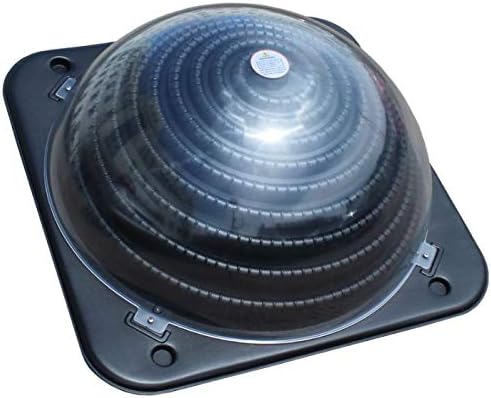
Doheny's Solar Dome Heating System offers a compact alternative to long exposed solar panels. Each dome measures 28 inches long, 28 inches wide, and 12 inches high, making it relatively easy to place near an above-ground pool. It carries a 3.4 rating and uses a dome structure to collect solar energy.
We may earn a commission when you buy through this link, at no additional cost to you.
The system can add weeks to the pool season, and the supplied information states that each dome may raise pool temperature by up to 10 degrees in approximately seven days. Multiple collectors can be connected in series to increase heating capability, although a bypass kit is required when connecting two or more heaters or when using a pool with a pump of 1 horsepower or more.
The broader collection includes flat collector configurations, and the product information provides a sizing chart for common round and oval above-ground pools. Mounting hardware is sold or supplied separately, while PVC and flexible pipes are excluded. Buyers need to account for those accessories and confirm how the solar branch will interact with the filter and pump.
This system makes sense for someone who values a small, enclosed collector and potentially owns several domes. It is less suitable for a buyer seeking a complete, turnkey kit because the necessary bypass, mounting, and plumbing components may need to be purchased or assembled separately.
The ability to place multiple domes in series gives owners a gradual path to greater solar coverage. A correctly installed bypass helps maintain proper flow as the collector count changes.
At 28 inches square, each dome is designed for a smaller installation area than a long panel collector. It can be positioned near a compact pool yard where horizontal space is limited.
We may earn a commission when you buy through this link, at no additional cost to you.
The Thirty-Tube Water Heater Pool Collector is a specialized evacuated-tube option for homeowners comfortable designing a more technical solar pool heating installation. It has a 2.9 rating, the lowest listed score in this group, so it is not the broadest recommendation for a simple DIY project.
We may earn a commission when you buy through this link, at no additional cost to you.
Its most notable specifications are the 30 high-boron silicon glass tubes, each measuring 58 millimeters in diameter and 1,800 millimeters long. The listed sun absorption efficiency is 93 to 96 percent. A 316L stainless-steel inner manifold is used for resistance to corrosion in chlorinated water, and the stated vacuum rating is less than 5.0 times 10 to the power of negative three pascals.
There are important constraints. Maximum operating pressure is only 4 PSI, which is substantially lower than many conventional pool-plumbing arrangements. The collector has one-inch male NPT inlet and outlet ports and can be disassembled, but proper circulation and pressure control are essential. Users should also consider the listed hailstone resistance specification and whether the system suits their local climate.
The projected lifespan is 70 percent at more than 15 years, and the specification list suggests potential for a durable specialized installation. Even so, the low pressure limit and lower rating make this the most project-specific choice. It is best for an experienced DIY builder who can design a compatible low-pressure loop and wants an evacuated-tube collector.
The evacuated glass tubes are specified for 93 to 96 percent sun absorption efficiency. Their sealed vacuum environment limits convective heat loss and supports solar collection.
The four-PSI maximum is the most consequential specification. A compatible pump, valves, and plumbing arrangement are required to keep pressure below this limit and protect the collector.
We may earn a commission when you buy through this link, at no additional cost to you.
A useful solar pool heater must match the pool, pump, plumbing, and available mounting area. Consider collector capacity and material first, then evaluate installation requirements, flow design, weather resistance, and the level of support included with the kit.
Collector area is one of the most important sizing considerations because it determines how much sunlight the system can absorb and how much water it can warm. A small collector may make a noticeable difference for a compact above-ground pool, but larger pools generally need more surface area. The Doheny's sizing chart links several common pool dimensions to specific collector combinations, which is more useful than choosing a panel solely by its product description. The Goplus 2.5-by-20-foot set and FAFCO 2-by-20-foot collector are long-format options intended to provide meaningful coverage, while the SwimEasy 4-by-12-foot panel is substantial enough to serve as a core collector.
Solar heating depends on moving enough water through the collectors to transfer captured heat. The Goplus system requires a pump of at least 0.75 horsepower with pressure no higher than 21 PSI. Doheny's Solar Grid requires a bypass for in-ground pools or pumps of 1.5 horsepower or more, while its dome system requires a bypass for multiple heaters or certain 1-horsepower pump arrangements. The Thirty-Tube Vacuum Collector has a particularly restrictive four-PSI operating limit. Check the existing pump rating, filter position, valve layout, and pipe diameters before selecting a collector.
The best collector receives strong, unobstructed sunlight. A roof is common because it provides an open view of the sky, but it introduces safety, waterproofing, and access concerns. A ground rack can be easier to service, although space, vegetation, and seasonal shade become important. The vidaXL panels have adjustable legs, the Goplus collectors can sit on the ground, an inclined frame, or a roof, and the FAFCO Solar Cub works on the ground or a rack. The SwimEasy kit prioritizes rooftop mounting, while SwimJoy uses a strapless flush-mount approach for compatible roofs.
Solar collectors experience intense ultraviolet exposure, heat, moisture, and seasonal temperature changes. The Goplus panels use PE material specified for a broad operating range, while the vidaXL set combines HDPE, polycarbonate, and aluminum. SwimEasy emphasizes United States manufacturing, UV stabilizers, and a stated 15- to 20-year life expectancy. The Thirty-Tube Vacuum Collector uses glass tubes and a corrosion-resistant stainless steel manifold. Match the material to the installation environment, but also consider fittings, seals, fasteners, and support components that may age faster than the main panel.
Connection style affects both installation effort and long-term maintenance. SwimEasy's complete kit includes mounting, tie-down, and supply-and-return connection hardware. SwimJoy uses patented clamps to connect panels and PVC without rubber hoses. The Goplus and vidaXL kits include hoses, clamps, connectors, seals, and caps. Doheny's products provide a diverter or explain bypass requirements, but some pipes and mounting accessories are excluded. Before buying, map how the collector will connect to the pump, filter, and pool without creating restrictions, leaks, or difficult-to-service joints.
Restricted flow can make a large collector underperform, and excessive backpressure can strain the pump. The SwimEasy header is molded around absorber tubes to remove flow barriers, while the SwimJoy square header, open-flow design, and low-head-loss riser tubes are intended to maximize flow and reduce pressure. Curved or open-web designs may also encourage water movement through the available channels. Consider both the collector's internal flow path and the resistance created by the rest of the plumbing loop.
A kit labeled as complete may still require roof work, basic plumbing knowledge, and compatible existing equipment. The SwimEasy system includes an installation manual and specialist support, making it more approachable for careful DIY work. Other products may require separate roof hardware, plywood construction, a bypass, or added pipes. Consider the tools you have, the safety risks of working at height, and your comfort with cutting, joining, sealing, and winterizing pool plumbing.
Solar heating is strongest where direct sunlight is plentiful and air temperatures are mild. A collector cannot compensate for a heavily shaded yard, and local pool-use habits influence how much roof space is worthwhile. The Goplus and vidaXL systems can be repositioned to follow changing sun exposure, while fixed roof systems require careful orientation. Doheny's FAQ and sizing information provide useful climate-oriented guidance, and the FAFCO system specifically recommends a south-facing tilt between 10 and 30 degrees. Plan to use the heater mainly during sunny periods and preserve the option to bypass the solar branch.
Plan the installation before connecting the collector. Confirm the pump's horsepower and operating pressure, identify the supply and return sides, locate a safe bypass or diverter, and ensure the chosen panels face the sun without obstruction. Assemble all panels, connections, seals, and mounting hardware according to the included instructions. Check that water can flow in the intended direction and that the plumbing can be isolated before placing the system into service.
Start the circulation pump and allow water to move through the collector before directing the heated return into the pool. Watch for leaks at every joint and verify that the solar valve or bypass can divert flow. Use the solar branch when sunlight is strong and the water is not already warm enough to benefit from additional heating. Close or bypass the collector during unsuitable weather, whenever the pump is off, and when the system needs to be drained for winter storage.
Inspect the collectors, connectors, clamps, seals, fasteners, and mounting points periodically. Clear leaves and debris without using tools that could scratch the surface. Confirm that panels remain secure and that the plumbing shows no leakage, corrosion, or restriction. Avoid leaving the system full in freezing conditions unless the manufacturer specifically permits it. Before seasonal shutdown, follow the manual's draining and storage instructions, and check the system again before restarting it in warmer weather.
Yes, but compatibility depends on the selected system and your plumbing. The Goplus collectors and vidaXL panels are described for both above-ground and in-ground use, while several Doheny's systems focus on above-ground pools. In-ground installations and higher-powered pumps may also require a bypass. Check connection sizes, pump output, pressure limits, and the manufacturer's guidance before connecting any collector.
The result depends on collector area, sunlight, air temperature, pool volume, flow rate, and how often the system operates. Individual products list different results, including temperature increases of up to 5, 10.8, or 10 degrees under stated conditions. Those figures should be treated as product claims rather than guarantees because seasonal weather and installation quality can change the outcome.
The collectors themselves do not require a gas or electric heating element, which is one of their main advantages. They do, however, need a circulation pump to move water through the panels. That pump may use electricity, and a separate pool pump may already be available as part of the pool's filtration system.
Many systems support multiple collectors, but the correct method depends on the design. Doheny's dome and flat collector products allow series connections, with a bypass required in the situations described in their installation information. SwimJoy panels use patented clamps, while other systems use hoses and clamps. Follow the product-specific connection instructions because joining panels incorrectly can affect flow, drainage, and pressure.
A bypass allows the pump to circulate pool water without sending it through the solar collector. It can be necessary when connecting several panels, using certain pump sizes, or operating an in-ground pool. The Doheny's Solar Grid requires a bypass for in-ground pools and pumps of 1.5 horsepower or greater, while the Solar Dome system has related multi-heater and pump requirements.
South-facing placement generally gives strong solar exposure in the Northern Hemisphere, but the best direction depends on location and site conditions. The FAFCO Solar Cub specifically performs most effectively when tilted 10 to 30 degrees toward the south. In other regions, adjust orientation according to the sun's path and choose a location with the fewest obstructions.
It depends on the manufacturer's instructions, local freezing conditions, and whether the panels remain full of water. Some product listings emphasize freeze resistance, while others specify draining or other precautions. Never assume one system's tolerance applies to another. Protect exposed plumbing, follow the manual's winterization steps, and fully drain any collector that is not designed for freezing conditions.
Routine maintenance includes checking panel surfaces, mounting hardware, seals, hoses, clamps, and plumbing for damage or leakage. Clear away leaves and debris, inspect connections after severe weather, and confirm that the bypass or diverter operates correctly. Periodic inspection is especially important because a small leak or restricted connection can reduce heating performance and strain the pump.
The SwimEasy DIY Solar Pool Heater Kit is the best overall choice for a complete, performance-oriented installation, with strong flow design, mounting hardware, and expert support. SwimJoy is the premium option for owners who prioritize specialized strapless mounting and durable panel connections, while the SwimEasy Universal Replacement Panel is the most practical budget pick for expanding or repairing a compatible existing system.
Before choosing, prioritize collector sizing, pump compatibility, pressure limits, mounting safety, and access to sunlight rather than relying only on a stated temperature increase. The best system is one that your pump can circulate efficiently, your plumbing can isolate safely, and your property can support for the sunny part of the season. Confirm the included accessories as well, since some listings exclude pipes, mounting hardware, or bypass components.
Finally, review the current listing before buying. Product ratings, included components, availability, and prices can change, and local pool-plumbing requirements may affect the total project. With the right match between pool size, equipment, and installation site, a DIY solar pool heating system can provide a practical way to preserve warm water and extend comfortable swimming opportunities.