
NOYITO AC to DC Power Supply Module
4.2Editor score
Dual 12V and 5V outputs
100W total power rating
Overcurrent and short-circuit protection
A dual voltage power supply for 12V and 5V can simplify projects that need both common DC levels from one AC source. The right unit depends on available current, thermal conditions, protection features, connector style, enclosure quality, and whether the installation requires an open module, DIN rail mount, or enclosed supply.
This guide compares ten products using their listed output ratings, input ranges, power limits, protection features, physical formats, and intended applications. It covers compact modules for electronics work, enclosed industrial models, DIN rail options, and one adjustable universal adapter to clarify which approach fits each project.
Each review highlights the strongest use case and honest trade-offs, while the comparison table makes current and capacity differences easier to scan. The picks show how similar output labels can conceal substantial differences in design, so shoppers should verify load requirements, connector details, and technical specifications before ordering.
4.2Editor score

4.5Editor score
5.0Editor score
As an Amazon Associate we earn from qualifying purchases.
The table below compares all ten supplies by output capacity, input range, total power, and installation format, making it easier to identify the model that matches a specific electronics or industrial load.


The NOYITO AC to DC Power Supply Module earns the Best Budget designation for offering a useful 12V output, a secondary 5V rail, and a stated 100W overall capacity. Its 4.2 rating reflects a practical balance of capacity and value, although the product description includes an important caveat about cooling when the 5V rail approaches 1A.
We may earn a commission when you buy through this link, at no additional cost to you.
Its strongest feature is the 12V output rated at 8A. That makes the module more appropriate for 12V LED systems, control boards, automation equipment, or other loads than a supply intended only for small 5V accessories. The 5V output is listed at 500mA, so buyers should treat the headline 1A figure as conditional rather than guaranteed at every operating temperature.
The wide 100–260V AC input supports use in regions with different mains systems, while 50/60Hz compatibility broadens its practical reach. Overcurrent, overload, and short-circuit protection improve confidence during operation. The trade-off is that this is an open power module, so it should not be handled as a finished consumer adapter or installed where users can contact live circuitry.
This is a strong choice for makers, installers, and small-scale industrial users who need more 12V current than a compact dual-output unit can provide. It also suits anyone who understands AC-to-DC conversion and can supply proper wiring, ventilation, and a protective enclosure. Confirm the device currents, connector requirements, and cooling needs before finalizing the installation.
The 8A 12V rail provides considerably more capacity than many small dual-output modules. It gives users room to power higher-draw 12V equipment while retaining a 5V output for control electronics, sensors, or auxiliary circuits.
The listed 500mA 5V output is suitable for many modest loads, but the description says stronger cooling is required if the rail is pushed to 1A. Adequate airflow and a suitable enclosure are therefore important parts of using this module correctly.
We may earn a commission when you buy through this link, at no additional cost to you.
The Mean Well RD-35A is the Editor's Choice because it delivers a balanced combination of a 4A primary 5V output, a secondary 12V output, and a compact 32W maximum output rating. Its 4.5 rating is among the strongest in this group, and the RD-35 family format makes it a logical choice for compact installations.
We may earn a commission when you buy through this link, at no additional cost to you.
A 4A 5V rail is more capable than the small auxiliary outputs found on many entry-level modules. That capacity can support control systems, LED controllers, and other electronics that need a dependable 5V feed, while the 12V branch offers useful flexibility for a second device. The 32W total output keeps the power budget easy to understand.
The primary limitation is that this is not a heavy 12V supply. Its title identifies the 12V output as 1A, so it should not be selected for motors, large LED runs, or other demanding 12V equipment. Users also need to follow the appropriate enclosure, wiring, ventilation, and electrical-code requirements for an industrial power supply.
The RD-35A is well suited to electronics benches, compact control cabinets, automation accessories, and mixed-voltage projects where 5V is the main requirement. It is a particularly sensible option for buyers who want a recognized industrial product family without moving to a much larger frame. Verify the exact output current on both rails and leave thermal clearance around the unit.
The 4A primary output gives this unit more capability for 5V control electronics than a supply with a fractional-ampere auxiliary rail. It remains compact at the same time, making it easier to integrate into a panel or project enclosure.
Understanding the 32W maximum helps prevent one output from being loaded as though it were independent of the other. Add the demands of both branches, observe the stated per-rail limits, and provide suitable ventilation.
We may earn a commission when you buy through this link, at no additional cost to you.
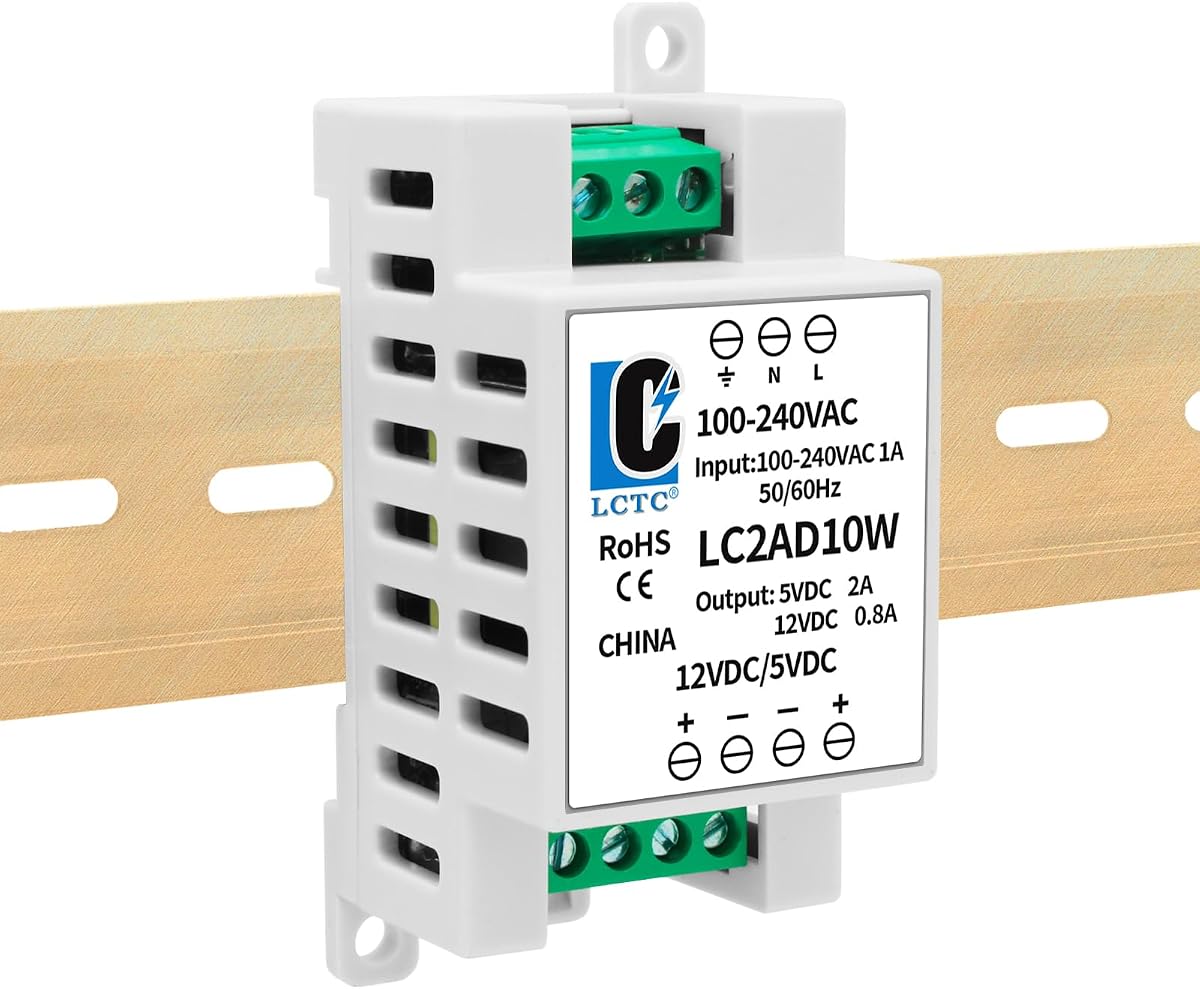
The 5V 12V DIN Rail Supply is built for compact control and distribution applications where mounting convenience matters more than high current. It provides a 2A 5V output and a 0.8A 12V output within a stated 10W total, and its 3.6 rating indicates that buyers should scrutinize expectations and reviews carefully.
We may earn a commission when you buy through this link, at no additional cost to you.
DIN rail installation is the defining advantage. The unit can be mounted in an appropriate distribution box, making it more convenient than arranging a free-standing module and loose wiring. Its 100–240V AC input is compatible with a broad range of mains environments, while overload, overvoltage, and short-circuit protection add basic safeguards.
Its limitations are substantial. A 10W combined output is modest, so this is better suited to LED controllers, small sensors, CCTV accessories, Arduino projects, and lightweight control circuits than to powered motors, large displays, or extensive lighting. The flame-retardant shell is a useful design feature, but it does not remove the need for correct enclosure selection and electrical installation.
Shoppers who need a clean, organized panel and only modest current should find this format useful. Before purchasing, check the physical dimensions, DIN rail standard, terminal arrangement, and output labels. Because the capacity is comparatively low and the user rating is modest, it is best treated as a specialized compact option rather than a general-purpose power source.
A DIN rail format keeps the supply in a predictable position and simplifies cable routing. It is especially attractive for builders of compact control boxes, low-power CCTV installations, and educational electronics projects.
The 2A and 0.8A outputs make capacity planning straightforward. Stay within the 10W combined rating and avoid using this unit when a project requires substantial motor, heating, or lighting current.
We may earn a commission when you buy through this link, at no additional cost to you.
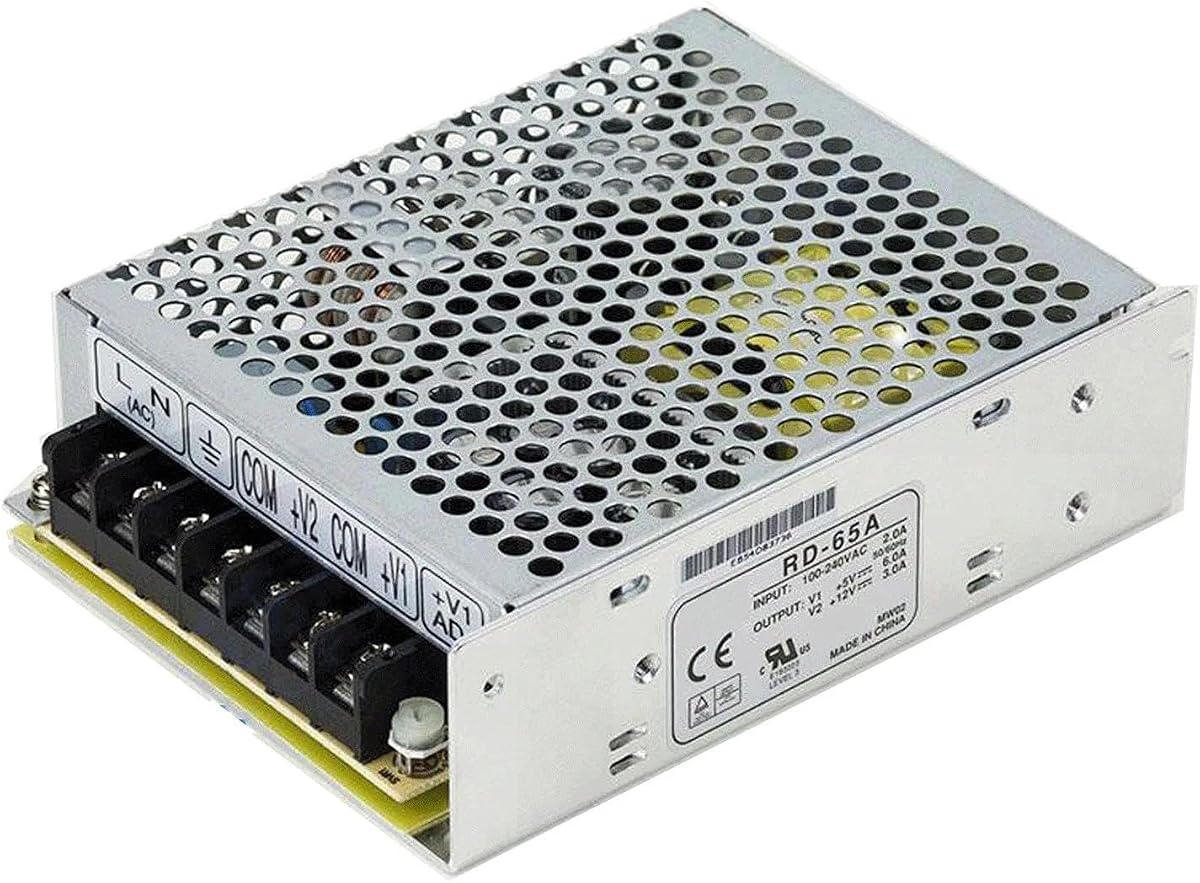
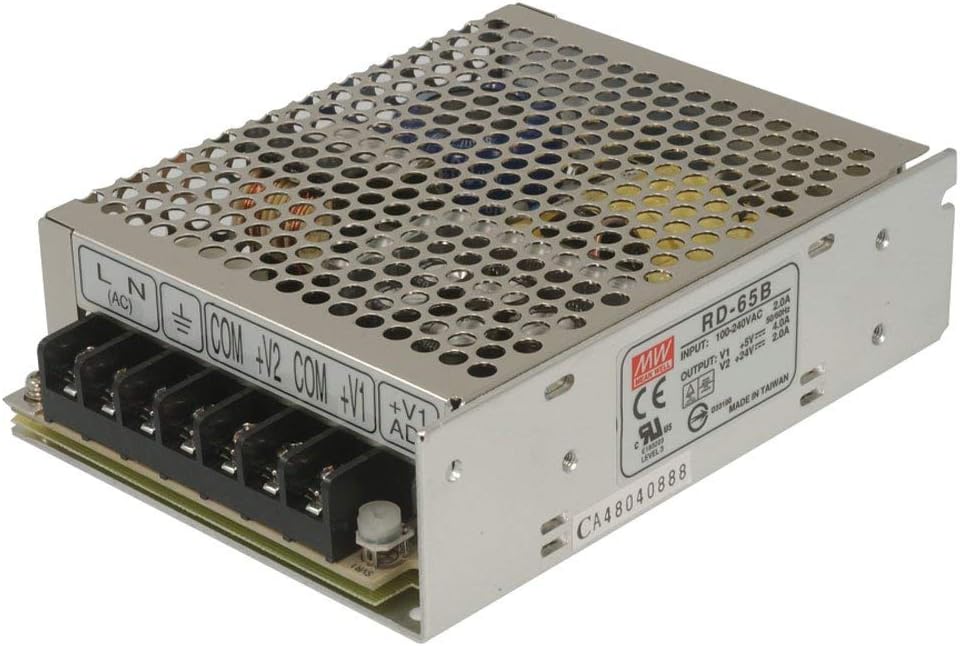
The Mean Well RD-65A provides an enclosed 66W supply with a 6A primary 5V output and an additional 12V output. Its 4.3 rating reflects a solid general-purpose option for users who prefer the construction and format associated with the RD-65 product family.
We may earn a commission when you buy through this link, at no additional cost to you.
The 66W output class gives substantially more room than the 10W and 32W alternatives in this list. A 6A 5V branch is suitable for more demanding control electronics, and the enclosed format is appropriate for installation environments where a fully exposed PCB module would be inconvenient or vulnerable. The 12V branch adds flexibility for peripheral equipment.
One detail deserves extra attention: although the product title prominently mentions 5V 8 Amp and 12V, the supplied bullet specifications list the primary output current as 6A. Buyers should not assume the higher headline figure without checking the current technical documentation or label. The stated 66W maximum is also the ceiling for combined output, not a separate allowance for each branch.
This model is a good middle ground for small control cabinets, industrial electronics, and mixed 5V/12V projects. It may be excessive for a single low-power device but more useful than an undersized module for a permanently installed system. Confirm both rail currents, terminal details, and dimensional requirements before incorporating it into an enclosure.
The 66W frame provides room for a 5V branch rated at 6A plus a secondary 12V branch. This makes it more versatile for industrial controls, access equipment, and mixed peripheral loads than a small panel module.
The listing title and bullet specifications present different 5V current figures. For a fixed installation, use the rating printed on the actual unit and its documentation as the authoritative reference before connecting sensitive or high-draw equipment.
We may earn a commission when you buy through this link, at no additional cost to you.
The Arcity Multi-Voltage Power Supply stands out with switchable 5V, 12V, and 24V outputs, a high 4.6 rating, and enough current for a broad range of electronics projects. It is particularly useful when a single supply can serve equipment at several common DC voltage levels.
We may earn a commission when you buy through this link, at no additional cost to you.
The listed outputs are 8A at 5V, 7A at 12V, and 5A at 24V. That flexibility makes the unit relevant to LED strips, 3D printers, game machines, CCTV equipment, audio amplifiers, radio gear, and household electronics. A switchable 110V/220V input adds convenience, while the enclosure design supports heat dissipation.
Its protection suite is unusually comprehensive for this category, covering overvoltage, overcurrent, short circuit, over-temperature, surge and inrush, and overpower conditions. The trade-off is that users must set the correct voltage before connecting a device, and the 160 by 98 by 38 millimeter housing is more substantial than that of a compact module. It is an open-frame unit intended for appropriate installation.
Choose the Arcity when one project may need several DC levels or when a high-output 12V branch is more important than a tiny footprint. It is especially relevant to experienced builders working on game systems, machine electronics, and sizable LED installations. Confirm output selection, connector polarity, ventilation, and input configuration before powering equipment.
The 5V, 12V, and 24V options reduce the need to keep several supplies around during prototyping. That versatility is valuable when moving between controllers, displays, printers, amplifiers, and other mixed-voltage equipment.
Protection against voltage, current, temperature, short circuit, surge, inrush, and overpower faults helps a permanent installation handle abnormal conditions. These features do not remove the need to select the correct output and maintain cooling.
We may earn a commission when you buy through this link, at no additional cost to you.
The Wefomey Universal Power Supply is a 3–24V adjustable adapter rather than a conventional unit with simultaneous 5V and 12V outputs. It earns a place in this guide because it is often the more practical choice for repair benches, portable projects, and devices that need a selectable DC level from a single adapter.
We may earn a commission when you buy through this link, at no additional cost to you.
Its LCD display shows the output voltage in real time, while the stated output range covers 3V through 24V with a maximum current of 3A and maximum power of 72W. The included collection of barrel tips, terminal connector, alligator clips, and polarity-reversal cable broadens device compatibility and makes temporary bench work less cumbersome.
However, this is not a true dual-rail supply. It produces one selected voltage at a time, so a device requiring simultaneous 5V and 12V cannot be served directly. The splitter shares one output among multiple attached devices, and the description limits each connected device to 0.75A when four interfaces are used. The stated voltage tolerance is also ±5%, so it is not ideal where a laboratory-grade regulated rail is required.
The Wefomey is best for technicians, hobbyists, and general users who work with many different low-power devices and value connector flexibility. It also suits LED strips, routers, cameras, small motors, pumps, and similar equipment. Use it for one voltage at a time unless a project's load calculations clearly support the included splitter.
The broad adjustment range replaces several fixed-voltage adapters for many common electronics. The LCD helps users verify the selected setting before attaching a tip or connecting bare wires.
The included one-to-four splitter does not create independent outputs. Total current must remain within the adapter's rating, and the description places a 0.75A ceiling on any one device when all four interfaces are occupied.
We may earn a commission when you buy through this link, at no additional cost to you.
The RD-65A 5V/12V Dual Output is the Best Premium pick in this guide because it combines clearly stated 5V and 12V current ratings with a 66W power budget and industrial durability features. Its 5.0 rating is the highest numerical customer score among the products compared.
We may earn a commission when you buy through this link, at no additional cost to you.
The supply provides 5V at 6A and 12V at 3A, giving both branches meaningful capacity. It is built for demanding industrial applications and includes a wide operating temperature range extending to 70°C. Long-life 105°C electrolytic capacitors and comprehensive protection features support its positioning as a dependable fixed-installation component.
Environmental testing provides another point of differentiation. The description states that the unit is tested to withstand 300VAC surge input and 5G vibration. Those qualifications matter in control cabinets, machinery, and other installations where ordinary consumer adapters would be unsuitable. The trade-off is that industrial capability requires careful mounting, wiring, and compliance with local electrical requirements.
This model is a strong recommendation for industrial controls, automation equipment, and permanent mixed-voltage installations where reliability matters more than compactness. The explicit 6A and 3A rail ratings also make capacity planning easier than with listings that mix headline figures and secondary specifications. Confirm connector layout and all electrical details before installation.
The stated 6A 5V and 3A 12V outputs allow installers to size each branch directly. These figures are easier to plan around than ambiguous or incomplete output information.
Surge endurance, vibration testing, long-life capacitors, and protection functions make this model more appropriate for industrial cabinets than a lightweight open adapter. Proper enclosure, ventilation, and installation practice remain essential.
We may earn a commission when you buy through this link, at no additional cost to you.
The Mean Well RD-125A targets larger installations that need more capacity than the lower-power RD models. Its supplied specifications identify a 5V primary output of 7.7A, an additional 12V output, and a maximum output power of 130.9W, making it the highest-capacity RD model in the list.
We may earn a commission when you buy through this link, at no additional cost to you.
The extra headroom is valuable for automation controls, communication equipment, industrial interfaces, and mixed loads that exceed the 32W or 66W classes. Because it is part of the RD-125 family, it follows the industrial product format that buyers often prefer for control-panel use rather than a temporary adapter arrangement.
There is a specification discrepancy to resolve before purchase. The product title mentions 15 Amp and 10 Amp, while the bullet data gives a 7.7A primary current and 130.9W maximum power. Those figures should not be treated as interchangeable. The physical label and official technical documentation should be checked to establish the usable output for each rail.
The RD-125A is a sensible candidate when a project has multiple 12V devices, substantial 5V control electronics, or both. It may be excessive for a small LED controller or single low-power device, and its larger frame will require more enclosure space. Verify the dimensions, wiring, thermal conditions, and actual output ratings before ordering.
A 130.9W maximum output class gives installers more room than the 32W, 54W, and 66W alternatives. That capacity can simplify a design requiring several 12V and 5V loads without splitting them across multiple supplies.
The title and bullet specifications show different output-current claims. Confirm the unit label and documentation before sizing a circuit, especially when equipment will draw substantial current from the 5V branch.
We may earn a commission when you buy through this link, at no additional cost to you.
The Mean Well RD-50A-VP is a compact enclosed 54W supply with 5V and 12V outputs, a 4.6 customer rating, and a wide 88–264V AC input range. Its enclosure and screw terminal block make it appealing for fixed control-panel work where a temporary barrel connector would be less dependable.
We may earn a commission when you buy through this link, at no additional cost to you.
The 54W power class sits between small DIN rail units and the larger 66W and 130.9W models. That middle ground is useful for projects with mixed loads that do not justify the footprint of the highest-capacity supply. The listed minimum isolation voltage of 3000V also supports its industrial positioning and suitability for suitably designed control systems.
The principal drawback is that the supplied product data does not state the individual 5V and 12V current ratings. A 54W total can be distributed in several ways, so installers should not estimate branch current from the total alone. The 1.4-inch height is compact, but terminal access, wire gauge, ventilation, and enclosure clearance still need to be considered during installation.
Choose the RD-50A-VP when a compact enclosed supply with screw terminals and a 12V/5V combination is needed. It is well suited to industrial control cabinets, access systems, and permanent electronics installations. Confirm both branch ratings and terminal details in the product documentation before connecting the load.
A screw terminal block creates a more permanent connection than a small barrel plug. It is useful in cabinets where movement, vibration, or frequent unplugging could interrupt service.
The stated 1.4 by 3.8 by 3.9-inch dimensions make the unit more space-efficient than many larger industrial supplies. Its 54W rating provides meaningful capacity without moving to the largest frame in the comparison.
We may earn a commission when you buy through this link, at no additional cost to you.
The RD-50A Dual Output Supply provides a straightforward 54W configuration with 5V at 6A and 12V at 2A. Its 85–264V AC input range is broad, and the explicit rail currents make the unit easier to evaluate than listings that provide only a product family and total wattage.
We may earn a commission when you buy through this link, at no additional cost to you.
The output distribution is well suited to projects with a stronger 5V control section and a moderate 12V peripheral section. At 54W, it offers a useful middle tier between the 32W RD-35A and the 66W RD-65A. This makes it relevant to compact panels, access equipment, communication hardware, and mixed low-to-medium-power electronics.
The supplied information is limited, and no customer rating is available for this listing. Beyond the output ratings, input range, and dual-output format, buyers cannot rely on additional listed details about connectors, protection, operating temperature, or enclosure construction. Those omissions make careful review of the current product documentation especially important before an installation is finalized.
This supply is best for a buyer who values clear 5V and 12V ratings and a 54W capacity in a relatively standard product class. It may serve a permanent project well, but it should not be selected blindly. Check physical dimensions, terminal type, environmental specifications, ventilation requirements, and safety certifications before ordering.
The 6A 5V branch and 2A 12V branch provide a practical split for projects with a control-heavy 5V side and a smaller 12V auxiliary load. The total still remains subject to the 54W ceiling.
Limited listing information and the absence of a customer rating make independent verification important. Review the actual label, mechanical drawings, connection guide, and environmental requirements for the intended environment.
We may earn a commission when you buy through this link, at no additional cost to you.
Choosing a dual voltage supply requires matching both the required voltages and the available current on each branch, then considering enclosure, connections, protection, environmental conditions, and the nature of the installation.
Start by listing every device that will draw from the 5V and 12V outputs. For each item, estimate its normal current draw, then add a reasonable margin for startup surges, uneven loading, or future expansion. The combined wattage also matters: a nominal 5V and 12V supply can still be limited by one shared output-power ceiling. Compare those requirements with the per-rail current ratings and total wattage stated for the candidate unit.
A genuine dual-output supply provides 5V and 12V at the same time, which is essential when a controller operates alongside a motor, relay, display, or 12V lighting. An adjustable universal adapter may cover many voltage needs, but it usually produces only one selected output at a time. A splitter distributes one output rather than creating a second voltage. If the project requires both levels simultaneously, choose a unit explicitly described as dual output.
The input range should comfortably cover the local mains voltage and expected variations. Listed ranges include 100–260V, 88–264V, 85–264V, and 100–240V, with several products also supporting 50/60Hz operation. A wide input range adds installation flexibility, but it does not make every location electrically or legally interchangeable. Confirm plug, cord, grounding, enclosure, and local installation requirements as well.
Open modules offer flexibility and often strong current capacity, but they require a suitable enclosure, insulation, wiring, and ventilation. Enclosed models are easier to integrate into control panels and generally have a more finished installation format. DIN rail supplies are particularly convenient in distribution boxes, while screw-terminal units suit fixed wiring. Consider available space, rail compatibility, access to terminals, and whether users can reach exposed circuitry.
Useful protection features include overcurrent, overload, overvoltage, short-circuit, and over-temperature handling. Some units add surge, inrush, and overpower protection. Protection circuits reduce risk, but they do not excuse poor ventilation or excessive loading. Check the stated operating temperature and any cooling notes, especially for modules whose output current depends on adequate airflow. Industrial use demands additional attention to component quality and environmental resilience.
Connector style determines how easily the supply can be used with a finished device or integrated into a panel. Barrel plugs suit bench work and simple electronics, while screw terminals are preferable for permanent installations. Open modules may require soldering, crimping, or careful connection to screw terminals. Universal adapters offer many tip sizes, but buyers must measure the device connector and confirm both voltage and polarity before connecting anything.
A switching supply converts AC to DC and produces heat that must be removed. Enclosed designs, compact form factors, and high output levels can all affect thermal performance. Look for a housing that promotes heat dissipation and avoid enclosing a high-output module in a tightly packed space. Remember that the unit should be sized for the combined load rather than operated continuously at its advertised limit without room for cooling.
Indoor electronics, control cabinets, CCTV installations, and industrial machinery can present different demands. An open module is usually inappropriate where conductive dust, moisture, casual contact, or moving parts are present. Industrial models may offer stronger surge, vibration, temperature, and capacitor specifications. The listed application examples are helpful, but the environment, enclosure rating, applicable codes, and required safety standards should guide the decision.
Before installation, identify the AC input, 5V output, 12V output, grounding point, and any rating label. Disconnect all loads and the mains source, then verify that each connected device requires the assigned voltage and can accept the available current. Use suitable wire, connectors, strain relief, and an enclosure appropriate for the environment. Never assume the connector shape alone establishes correct voltage or polarity.
Connect the loads with the power source off, observing the positive and negative conductors. Keep the total current within the lower of the branch and combined power limits, and do not exceed the conditions under which the manufacturer specifies output. For an open module, provide the stated cooling and keep conductive parts away from terminals. For a universal adapter, select the voltage before attaching a device and avoid adding loads beyond the adapter or splitter limits.
For ongoing care, inspect wiring, terminals, ventilation openings, and enclosure condition periodically. Disconnect power before making changes, and never work on exposed terminals while energized. Watch for unusual heat, discoloration, buzzing, odor, or repeated protection events, as these can signal overload, poor ventilation, incompatible connectors, or a failing component. Keep the supply dry, clean, and within its stated environmental conditions.
Yes, if it is a true simultaneous dual-output model and each branch remains within its current rating. The combined load must also stay within the total wattage limit. Do not use a single-output adjustable adapter or a one-to-four splitter as a substitute for independent 5V and 12V outputs.
The total wattage is the maximum combined power the unit is designed to deliver across its outputs. It does not mean that 100W is available independently on both the 5V and 12V rails. Calculate each branch by multiplying its voltage by its current, then confirm that the sum remains within the total and per-rail limits.
Only if the relevant branch can handle the motor's or strip's normal and startup current, with appropriate margin for the shared supply. Motors can draw large inrush currents, while long LED runs can create substantial demand. Use the correct voltage, observe the current rating, and provide protection and ventilation suited to the load.
Open modules are intended for installation inside a suitable protective enclosure where live terminals cannot be accidentally contacted and ventilation is available. A plastic project box may be appropriate for some low-risk electronics projects, while industrial or accessible installations require a more considered enclosure and compliant wiring.
First choose the required voltage, set the adapter, and confirm the displayed value. Match the barrel size and polarity, allowing for the stated normal voltage tolerance. If the device uses bare wires, verify the alligator clip polarity carefully and avoid connecting a center-positive adapter directly to a center-negative device.
It depends on the model, load, enclosure, and ambient temperature. Some modules explicitly require stronger cooling when the 5V output approaches its upper limit, while others are designed to dissipate heat through an enclosed housing. Preserve airflow and avoid placing the unit in a sealed, crowded space.
Headline titles, product-family descriptions, and detailed bullet specifications sometimes use different figures. For a fixed installation, treat the label and official technical documentation as the authoritative source. Check both the branch current and total wattage before connecting equipment.
An enclosed DIN rail or screw-terminal supply is usually easier to organize and protect than an exposed module. DIN rail mounting offers quick panel integration, while screw terminals support fixed, robust wiring. The best choice still depends on load capacity, rail compatibility, terminal layout, and the panel's available space.
The NOYITO module stands out as the Best Budget option for projects needing a strong 8A 12V branch, provided the 5V current and cooling requirements are respected. The Mean Well RD-35A is the Editor's Choice for compact 5V-centered work, while the RD-65A earns the Best Premium designation through its clearly stated 5V and 12V currents, 66W capacity, and industrial environmental features.
Prioritize the details that determine safe operation: simultaneous versus selectable output, current on each rail, combined wattage, input compatibility, connector type, cooling, and enclosure type. A higher headline wattage does not automatically make a supply better, and a product with clearly documented output ratings may be easier to integrate than one whose listing is more ambiguous.
Before ordering, review the current listing, manufacturer documentation, physical dimensions, and electrical requirements against the needs of the project. Catalog details, availability, and technical information can change, so confirm the specifications on the actual product rather than relying solely on a product title or a general category description.