
VCE UL Listed Cat6 Keystone Jacks
4.7Editor score
25 white Cat6 jacks
Supports 10GbE networks
T568A and T568B labeling
Discover the best Ethernet Keystone Jack options for structured cabling, comparing Cat6 and Cat6A performance, wiring, installation methods, compatibility, and
An Ethernet keystone jack provides the structured termination point where a permanent Ethernet cable meets a wall plate, patch panel, or surface-mount box. A worthwhile model should provide a secure fit, clean conductor alignment, consistent electrical performance, and a termination method suited to the installer. Cat6, Cat6A, shielded, toolless, and coupler-style options each serve different network needs.
The products in this guide are compared using the information supplied by their manufacturers and customer ratings. The evaluation considers supported Ethernet category, wiring standards, conductor compatibility, installation options, environmental protections, high-density fit, and the number of units included. It also separates true bulk-cable termination jacks from female-to-female couplers, since those solve different cabling problems.
Each review explains the standout features, practical limitations, and most suitable installation scenario for its product. The Cable Matters multipacks and the VCE range offer several installation-focused choices, while the Rapink and toolless designs address compact or simplified setups. The two coupler products are useful for extending existing patch cables, but they are not substitutes for terminating solid bulk Ethernet cable. Product availability and pricing can change over time.
4.7Editor score

4.7Editor score
4.7Editor score
This side-by-side comparison highlights the category, termination method, compatibility, and best use case of each option. Rankings reflect the supplied ratings and product information, while important differences such as bulk-cable termination, toolless installation, shielding, and coupler design help determine which jack fits a particular project.




The Cable Matters 10-Pack Cat6 Keystone Jacks combine a 4.6 customer rating with a versatile termination design and a practical quantity for small projects or repairs. These are conventional Cat6 RJ45 termination jacks rather than couplers, so they are intended to connect permanent bulk Ethernet cable to patch panels, wall plates, or surface-mount boxes.
We may earn a commission when you buy through this link, at no additional cost to you.
The jacks accept 23 and 24 AWG unshielded twisted-pair cable and support 110-style punch-down blocks. Their dual IDC terminals work with both 110 and Krone impact tools, giving installers more flexibility than designs limited to one punch-tool system. Color-coded T568A and T568B labels help reduce wiring uncertainty, while gold-plated contacts and dual IDC covers support durable contact performance.
The most notable trade-off is that the punch-down stand is not included with this particular 10-jack set. An impact tool is also not identified as included, although the product supports impact-tool and tool-free 90-degree termination methods. It is also a UTP design, so it may not suit an installation where shielded cable and a shielded pathway are required.
This is a strong option for a small office addition, several wall outlets, or a repair project where a Cat6 jack needs broad tool compatibility. Choose it when 10-gigabit Category 6 performance, clear wiring standards, and flexible termination outweigh the convenience of having a large box with a punch-down stand.
Acceptance of both 110 and Krone impact tools is useful when a technician has different tools at the bench or works across multiple job sites. Clear T568A and T568B markings help maintain consistent color mapping during punch-down.
A snap-in retaining clip helps keep the jack secure after installation, while gold-plated contacts and covered IDC terminals are intended to preserve reliable connections. The fire-retardant housing also suits professional structured-cabling environments.
We may earn a commission when you buy through this link, at no additional cost to you.
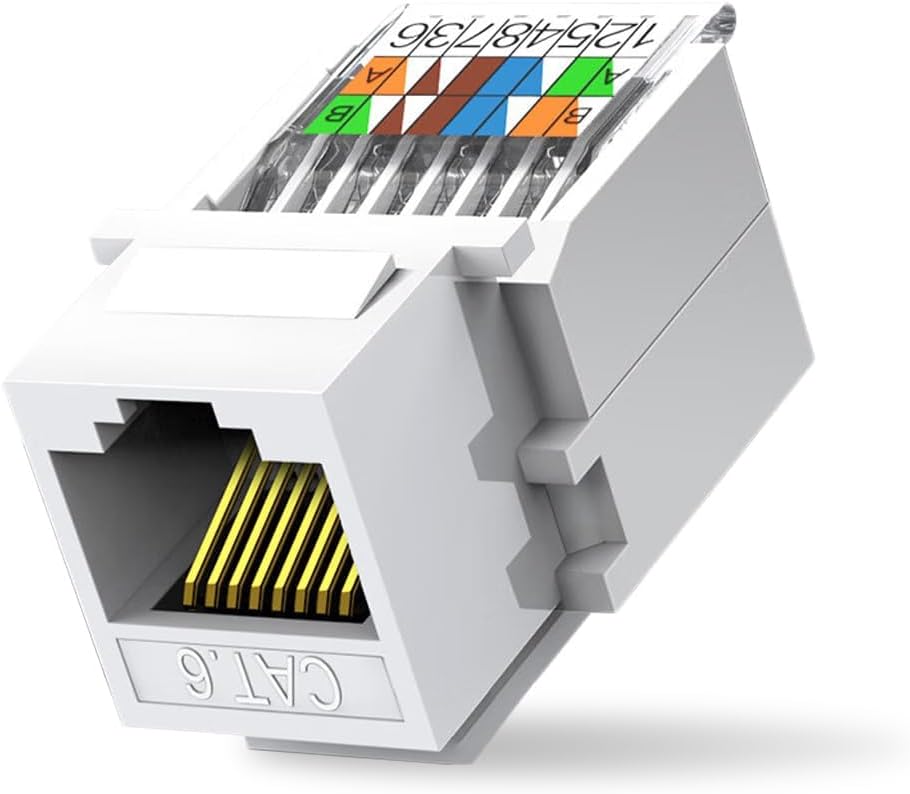
The VCE 25-Pack Cat6 Keystone Jacks hold a 4.7 rating and provide a balanced combination of installation convenience, electrical specifications, and project-ready packaging. They are designed for standard patch panels, surface-mount boxes, and wall plates, making them a common choice for residential and commercial structured cabling.
We may earn a commission when you buy through this link, at no additional cost to you.
These 90-degree white jacks support up to 10-gigabit Ethernet and are backward compatible with Cat5 and Cat5e cabling. Their height-dislocated gold-plated contacts are designed to reduce near-end crosstalk and resist corrosion. The color-coded 110-style termination blocks support T568A and T568B wiring and accept 23 AWG or 24 AWG Ethernet cable.
The primary limitation is that this is an UTP-style Cat6 product rather than a shielded Cat6A jack. It also relies on 110 impact-tool termination, so users who require a fully toolless process will need to look elsewhere. Its slim profile is helpful, but buyers should still verify compatibility with the specific patch panel or plate.
The 25-unit quantity makes this option particularly useful for office fit-outs, smart-home backbones, and larger wall-plate projects. It is an excellent all-around selection for installers who prioritize UL listing, 10-gigabit Category 6 support, corrosion-resistant contacts, and a large number of identical jacks in one package.
The height-dislocated contact arrangement is intended to limit near-end crosstalk, an important consideration when multiple Cat6 links operate in the same enclosure. Combined with gold plating, it also supports stable performance over repeated plug cycles.
The slim standard design and integrated snap-in clip help installers fit multiple jacks into compatible panels or boxes. Twenty-five units also reduce the need to mix batches when completing a room, office, or structured-cabling run.
We may earn a commission when you buy through this link, at no additional cost to you.
The Cable Matters 25-Pack Cat6 Keystone Jacks combine a 4.7 rating with an unusually complete termination package. Unlike the related 10-pack, this set includes a punch-down stand intended to make cable placement and termination easier and safer during repetitive installations.
We may earn a commission when you buy through this link, at no additional cost to you.
The jacks meet or exceed the stated Category 6 standard of ANSI/TIA/EIA 568-C.2 and support 10-gigabit Ethernet while remaining compatible with 10/100 Mbps networks. They accept 23 and 24 AWG UTP cable, provide T568A and T568B labels, and use 110-style punch-down blocks with dual IDC terminals for 110 or Krone tools.
Tool-free 90-degree termination is also listed as an option, although a compatible punch-down stand does not eliminate the need for every installation tool. This remains an UTP product, so buyers needing electromagnetic shielding should consider the dedicated Cat6A alternative in this guide instead. The white housing is conventional and unobtrusive in most residential or office environments.
This is a strong all-around choice for professional installers and serious DIY users completing a multi-port installation. The included stand adds workflow value, the 25-jack quantity is practical for larger jobs, and the standards labeling and broad tool compatibility make repeated terminations easier to manage.
The included punch-down stand keeps the cable positioned more consistently while the conductors are seated in the IDC blocks. That can improve workflow on installations involving numerous wall outlets or patch-panel ports.
T568A and T568B labels, dual IDC terminals, and support for 110 and Krone impact tools give installers several ways to work. These details are especially useful when maintaining structured cabling that must remain easy to service.
We may earn a commission when you buy through this link, at no additional cost to you.
The Cable Matters 6-Pack Shielded Cat6A Keystone Jack is the most specialized termination product in this guide. Its 4.5 rating is supported by a full metal-jacket design, 10GBASE-T channel compliance, and compatibility with Cat6A cabling in environments where shielding and PoE+ capability are priorities.
We may earn a commission when you buy through this link, at no additional cost to you.
The metal housing is designed to reduce EMI/RFI interference and crosstalk, including NEXT, AXT, and alien crosstalk. Termination can be performed with the included tool-free cap or through the IDC modules using a 110 impact tool. Universal T568A and T568B labels simplify conductor placement, and the 180-degree layout provides a clean cable presentation.
An auto-closing shutter protects RJ45 contacts from dust and debris before a patch cable is inserted. The jack also includes a snap-in retaining clip, an integrated metal collar for strain relief, and internal stickers intended to prevent accidental metal contact. These additions distinguish it from a basic unshielded Cat6 module.
This product is best for data-center-adjacent wiring, high-speed backbones, shielded pathways, and PoE+ devices such as cameras or access points. It is not a pass-through coupler and should be used to terminate bulk Ethernet cable. Buyers should plan for compatible shielded cabling and ensure that the entire channel follows the installation requirements associated with Cat6A.
The full metal jacket is intended to limit electromagnetic and radio-frequency interference while improving control of crosstalk. This makes the jack more appropriate for shielded, high-performance channels than a conventional UTP keystone.
Support for IEEE 802.3at PoE+ applications up to 30 watts makes the jack relevant to powered network equipment. The auto-closing shutter helps keep unused ports cleaner without requiring a separate dust cap.
We may earn a commission when you buy through this link, at no additional cost to you.
The Rapink 10-Pack Slim Cat6 Keystone Jacks offer a 4.6 rating and focus on compact installation. Their slim profile is intended for 24-port and 48-port high-density patch panels, faceplates, surface-mount boxes, and other RJ45 network outlets where every millimeter of available space matters.
We may earn a commission when you buy through this link, at no additional cost to you.
The jacks support 10-gigabit Ethernet at a stated 550 MHz and are compatible with the latest TIA-568.2-D standard. They accept 23 through 26 AWG stranded or solid Ethernet cable, a broader conductor range than many competing Cat6 modules. Gold-plated contacts are used for signal integrity and corrosion resistance.
Installation uses a traditional 110 wire tool or a compatible Rapink keystone tool, with T568A and T568B color coding provided on the housing. The absence of a listed tool-free option means a punch-down tool is likely required. These are UTP jacks, so they do not provide the EMI shielding of the Cable Matters Cat6A model.
This is a useful choice for dense office panels, compact wall plates, and installations involving smaller conductor sizes. It is also versatile for technicians who may work with both solid and stranded cable. Confirm the panel or plate dimensions before purchasing, and keep the wiring scheme consistent across every connected outlet.
The slim profile is the defining feature, helping multiple jacks occupy a crowded panel without excessive side clearance. It is particularly useful where a standard full-size module would be difficult to insert or remove.
Support for 23 to 26 AWG solid or stranded cable gives this model more flexibility than many standard Cat6 jacks. That range can be valuable when combining newer thin conductors with legacy structured cabling.
We may earn a commission when you buy through this link, at no additional cost to you.
The ZoeRax 10-Pack Tool-Less Cat6 Keystone Jackes have a 4.3 rating and distinguish themselves by removing the need for a traditional punch-down tool. The product is aimed at wall plates and surface-mount boxes where fast, repeatable field installation matters more than compatibility with every type of patch panel.
We may earn a commission when you buy through this link, at no additional cost to you.
The installation process is straightforward: align the conductors with the color-coded labels, insert them, and secure the snap-down cover. The listed wire support is 24 to 26 AWG round or flat stranded wire, while solid Cat6 cable support is limited specifically to 23 AWG and up to a 6.1 mm outer diameter. The product is not intended for arbitrary solid conductor sizes.
The construction includes gold-plated connectors, solid copper conductors, and a dust-proof shutter. It adheres to ANSI/TIA/EIA 568-C.2 for Category 6 performance and is described as PoE compatible. A notable limitation is explicit incompatibility with patch panels, so installers should not treat it as a universal keystone.
This design is best for DIY users, smart-home wiring, and wall-plate projects where the correct conductor size is known and a tool-free workflow is preferred. It is less suitable for professional high-density panels, mixed-gauge installations, or technicians who require broad support for different solid-wire diameters.
The snap-down cover gives installers a way to terminate compatible cable without managing a punch-down tool. Working with one or two conductors at a time can make the process more controlled and easier to inspect.
The 24 to 26 AWG stranded range and specific 23 AWG solid limitation mean cable should be checked before work begins. Users with different gauges may need to reterminate the cable to a suitable type.
We may earn a commission when you buy through this link, at no additional cost to you.
The Sokqovt 24-Pack Cat6 Keystone Couplers have a 4.7 rating and provide a different function from most products in the guide. These are female-to-female inline couplers that join two already terminated Ethernet patch cables without requiring conductors to be punched down.
We may earn a commission when you buy through this link, at no additional cost to you.
The product supports up to 10-gigabit transmission and is described as capable of extending a connection up to 100 meters without reducing transmission speed. Its compact, narrow construction is intended to fit standard wall plates and patch panels, including a 24-port rack and a six-port wall plate without adjacent modules rubbing together.
Because the coupler adds another interface in the link, it should be used strategically rather than added throughout a structured-cabling backbone. It is also not a pass-through module for solid bulk cable. The various color coding mentioned by the manufacturer can help users organize connected services, although this particular listing is identified as black.
This is an excellent choice for moving a desktop, access point, or camera to a nearby wall outlet without pulling a new cable. It is also handy for temporary installations and repairs where avoiding punch-down work is valuable. For a permanent structured cabling system, a true termination jack remains the more appropriate component.
The inline female-to-female design allows two patch cables to meet at a standard keystone opening. That makes it useful for temporary relocations and simple DIY network extensions.
Its slim profile is intended to reduce interference between neighboring couplers in high-density panels. Buyers should still confirm the dimensions of the specific wall plate or patch panel they intend to use.
We may earn a commission when you buy through this link, at no additional cost to you.
The VCE 25-Pack Cat6 Keystone Couplers earn a 4.7 rating and focus on extending existing Cat6 patch cables through a standard keystone opening. Their PoE compatibility makes them relevant to powered Ethernet equipment, while their 25-unit quantity suits installations that need several inline connection points.
We may earn a commission when you buy through this link, at no additional cost to you.
Each coupler uses high-conductivity gold-plated contacts intended to resist corrosion and maintain a stable connection. The housing is made from flame-retardant material and the product is UL Listed under E521847. A precision-fit design is intended to snap securely into standard keystone wall plates or patch panels.
The product supports voice, data, audio, and video applications through straightforward plug-and-play use. Nevertheless, a coupler necessarily introduces an additional connection into the link, so it is not the preferred solution for a backbone that should be permanently terminated and dressed into the wall or panel.
This is a practical option for home offices, media centers, and network rooms where a device needs a nearby Ethernet port and another patch cable is already available. It is also useful for creating temporary service points. For permanent cabling, choose a true Cat6 or Cat6A termination jack instead.
PoE compatibility makes these couplers useful when connecting access points, cameras, or other powered devices over an existing patch-cable arrangement. The exact network power standard should still be confirmed with the connected equipment.
UL Listed flame-retardant construction and gold-plated contacts align with the needs of professional installations. The secure snap fit helps keep the coupler stable in compatible panels.
We may earn a commission when you buy through this link, at no additional cost to you.
The Cable Matters 25-Pack Rapid-Install Cat6 Keystone Jackes have a 4.6 rating and offer one of the broadest termination choices in this roundup. They support tool-free, impact-tool, and crimp-tool methods, giving technicians more ways to complete a Cat6 link according to the tools and workflow available.
We may earn a commission when you buy through this link, at no additional cost to you.
The slim profile is compatible with standard or slim keystone openings, patch panels, Cat6 wall plates, and surface-mount boxes. The product data specifically notes compatibility with Leviton QuickPort Systems and slim Cat6 Decora-style wall plates. It accepts 23 and 24 AWG UTP cable and supports 10-gigabit Ethernet while remaining backward compatible with lower-speed Ethernet and Cat5e cabling.
A punch-down stand is included, but the Cable Matters RJ45 crimp tool, model 180169, is sold separately. The product also remains an unshielded Cat6 design, so it does not offer the interference control of the shielded Cat6A alternative. These are genuine termination jacks rather than inline couplers.
This set is a strong option for technicians who want one module that can accommodate several installation methods. It is particularly useful for mixed residential and commercial jobs, slim decorative plates, and larger projects needing 25 matched jacks. Choose it when installation flexibility and broad device compatibility outweigh the need for shielded hardware.
Tool-free, 110 impact-tool, and compatible crimp-tool termination give installers a high degree of workflow flexibility. A 110-style punch-down tool is sold separately when that method is selected.
The ability to fit both standard and slim openings makes this model useful for conventional patch panels as well as compact QuickPort and Decora-style wall plates. Physical fit should still be verified against the exact product being installed.
We may earn a commission when you buy through this link, at no additional cost to you.
The Cable Matters 50-Pack Cat6 Keystone Jackes have a 4.7 rating and are the largest termination-jack set in this guide. They are aimed at contractors, installers, and advanced home-network builders who need enough matching modules to complete multiple rooms, offices, or equipment racks.
We may earn a commission when you buy through this link, at no additional cost to you.
Each jack supports up to 10-gigabit Ethernet and meets or exceeds the stated ANSI/TIA/EIA 568-C.2 Category 6 performance standard. The set accepts 23 and 24 AWG UTP cable and includes T568A and T568B labeling. Dual IDC terminals support 110 and Krone impact tools, while the included punch-down stand helps organize repetitive terminations.
The jacks use fire-retardant housings, gold-plated contacts, dual IDC covers, and snap-in retaining clips intended to produce stable connections. As with other UTP products in the roundup, they do not provide a full shielding layer. Fifty units may also be more than a small residential project requires, and unused modules should be stored away from moisture and impact.
This package is best suited to high-volume cabling where a consistent, readily available supply of Cat6 jacks matters. It reduces the need to purchase several smaller batches and provides a supporting stand for orderly installation. For a single outlet, a smaller pack is more practical; for a structured deployment, this is a comprehensive option.
Using one matched 50-unit batch across a project can simplify procurement and provide uniform construction. The quantity is especially relevant for offices, renovation work, and advanced smart-home cable infrastructure.
The included punch-down stand improves handling during repetitive work, and the dual IDC design accommodates common impact-tool standards. Fire-retardant housings and snap-in clips support a professional, serviceable installation.
We may earn a commission when you buy through this link, at no additional cost to you.
The right Ethernet keystone depends on the cable category, wiring environment, available tools, and whether the application requires permanent termination or a simple in-line extension. Use the following factors to narrow the options before checking current product listings and compatibility details.
Cat6 is appropriate for many standard structured-cabling projects and supports 10-gigabit Ethernet according to the specifications of the selected products. Cat6A is the stronger choice when a shielded channel, future headroom, or PoE+ requirements are important. The shielded Cat6A model in this guide is intended for 10GBASE-T channels and compatible Cat6A cabling, while the Cat6 options support 23 or 24 AWG UTP in most cases.
Match the jack to the actual bulk cable rather than relying only on the marketing category. The cable category, conductor gauge, shielding, and intended run length all affect the complete channel.
A true keystone termination jack has conductor slots, color-coded wiring guides, and IDC blocks for connecting solid bulk Ethernet cable. A female-to-female coupler instead joins two already terminated patch cables and does not punch down a wall cable. Couplers are useful for temporary extensions or moving equipment, but they are not replacements for proper structured-cabling terminations.
Confirm that the product terminates bulk cable if that is the task. Choose a coupler only when both ends of the connection are already RJ45-terminated patch leads.
T568A and T568B are the two principal color-code schemes commonly used for RJ45 terminations. Every product here that performs a termination is described as supporting both schemes, but a single consistent scheme should still be used throughout a project. Clear color coding and separate terminal blocks make it easier to place each conductor accurately.
Never rely on visual memory alone. Identify the color sequence for the selected standard and verify it against the labels printed on the jack before seating the conductors.
Traditional 110 or Krone impact-tool termination is common among professional Cat6 keystone jacks and can create consistent conductor seating. Toolless designs are more approachable for DIY work, but they may support narrower conductor ranges. Some products, such as the Rapid-Install model, accept tool-free, impact-tool, and crimp-tool methods, providing flexibility across different jobs.
Also check whether an impact tool, crimp tool, or punch-down stand is included. The specifications in this guide note that certain tools and stands must be purchased separately.
Most Cat6 termination jacks support 23 and 24 AWG UTP cable, while the Rapink model accepts 23 through 26 AWG stranded or solid wire. The toolless ZoeRax design supports 24 to 26 AWG stranded cable and specifically 23 AWG solid cable. Shielded Cat6A installations require compatible shielded cable and appropriate pathway hardware.
Measure or identify the cable before ordering. Attempting to force an unsupported conductor size can produce an unreliable connection regardless of the nominal category of the jack.
The slim profile of the Rapink and Rapid-Install products is useful in high-density panels and compact wall plates. Other models use a standard keystone format intended for conventional patch panels, surface-mount boxes, and wall plates. The Rapid-Install product also lists compatibility with Leviton QuickPort Systems and slim Cat6 Decora-style plates. The toolless model is specifically described as incompatible with patch panels.
Check the dimensions and mounting style of the destination rather than assuming every keystone is interchangeable. Also consider the number of ports, cable bend radius, and room behind the plate.
UTP Cat6 jacks are lighter and generally simpler to work with, while a shielded Cat6A jack provides a full metal jacket intended to reduce EMI/RFI interference and crosstalk. Shielding is most valuable in high-performance channels, data-center-adjacent environments, and installations with potential interference sources. It must be used with properly compatible shielded cable and pathway components.
Do not choose a shielded jack solely because its specification sheet looks more advanced. Match the shielding level to the complete cable system and the environment in which it will be installed.
Look for features that support long-term serviceability, such as gold-plated contacts, covered IDC blocks, strain relief, a secure retaining clip, and a fire-retardant housing. A dust shutter is useful in wall plates where ports may remain unused for long periods. The included punch-down stand on the 25- and 50-jack Cable Matters sets can also improve installation consistency.
Balance useful extras against the size of the project. A 50-jack pack is efficient for a large deployment, while a small repair usually requires only a few modules.
Begin by confirming that the jack category, conductor size, and wiring scheme match the bulk cable and the intended wall plate or patch panel. Route the cable without exceeding its intended bend radius, remove only the jacket needed for termination, and separate the twisted pairs carefully so individual conductors are not heavily stressed. Follow the printed T568A or T568B color guide and select one scheme for the entire link.
For a punch-down jack, place the conductors in the proper IDC slots, seat them evenly, and operate a compatible 110 or Krone impact tool. A punch-down stand can stabilize the module and reduce the chance of striking the housing incorrectly. For a toolless jack, insert the supported conductors one or two at a time, then engage the snap-down cover. After termination, inspect the conductor positions and check that the cable is held securely by the strain-relief feature.
Once the jack is wired, snap it into the compatible opening and confirm that its retaining clip is fully seated. Connect a known-good patch cable and test the link, then inspect the wiring if the connection fails or performance is inconsistent. Dust-protective shutters should remain functional, and unused ports should be protected from debris. For coupler-based extensions, keep both patch cables fully inserted and avoid creating unnecessary stress at either connector.
An Ethernet keystone jack terminates raw solid Ethernet cable onto color-coded IDC contacts and is intended for permanent structured cabling. A keystone coupler is female to female and joins two existing patch cables without punch-down termination. The coupler is useful for temporary extensions, while the termination jack is the correct component for a wall or panel installation.
They may physically fit similar openings, but they are not automatically interchangeable for performance purposes. A Cat6A installation should use components, cable, and pathway hardware that support the intended Cat6A channel. Cat6 jacks in this guide support up to 10-gigabit Ethernet within their stated design, but they do not add the shielding or channel characteristics of the Cat6A model.
Either scheme can produce a correct Ethernet connection as long as it is followed consistently from one end of the link to the other. T568B is widely used, but the most important consideration is matching the scheme at both ends and following the manufacturer's color labels. Mixing the two schemes will create an incorrect wire map.
Most traditional Cat6 keystone jacks in this guide are intended for 110 or Krone impact-tool termination, although some also support tool-free or crimp methods. The ZoeRax model is specifically designed for tool-free installation. Check the selected product's termination instructions and confirm that a compatible tool is available, as tools and punch-down stands are not included with every option.
Most of the reviewed Cat6 termination jacks accept 23 and 24 AWG UTP Ethernet cable. The Rapink model supports 23 through 26 AWG solid or stranded cable, while the toolless ZoeRax model supports 24 to 26 AWG stranded and specifically 23 AWG solid cable. Using a conductor outside the listed range can lead to poor contact or unreliable termination.
A standard home network can often use well-terminated UTP Cat6 equipment, provided the cable and pathway are appropriate and the installation is not affected by unusual interference. Shielded Cat6A becomes more relevant for higher-performance channels, data-center-adjacent areas, demanding PoE+ applications, or locations with notable interference concerns. Shielding should be planned across the entire channel rather than added only at the outlet.
A coupler can create a functional connection, but it is generally less appropriate for a permanent backbone because it adds an interface, consumes panel space, and may be more exposed to accidental disconnection. For permanent structured cabling, terminate the bulk cable into a proper jack and use a patch cable to connect equipment. Couplers are most useful for temporary extensions and simple equipment moves.
First test the cable run with a known-good patch cable and another confirmed-good network port. If the problem remains, inspect whether the conductors are seated in the correct T568A or T568B positions, then check for loose strands, crushed pairs, or an incompletely secured retaining clip. Also confirm that the jack, plate, panel, and cable category are compatible with the intended network.
The VCE 25-Pack Cat6 is a balanced choice for installers seeking UL Listed construction, 10-gigabit support, slim fitting, and 25 matching termination modules. The Cable Matters 25-Pack stands out with its included punch-down stand and flexible impact-tool compatibility, while the 50-pack version is better suited to larger deployments that need a high-volume supply of identical Cat6 jacks.
Prioritize the complete installation rather than the category label alone. Confirm conductor gauge, wiring scheme, panel compatibility, termination method, and shielding requirements. Choose a true termination jack for permanent bulk-cable work, reserve female-to-female couplers for extending existing patch leads, and use Cat6A when the channel design calls for shielding, higher PoE+ capability, or additional performance headroom.
Ratings, package contents, and product availability can change, so verify the current listing before ordering. Current pricing, included accessories, and compatibility details should also be checked directly on the product page, especially when purchasing a large pack for a time-sensitive installation.