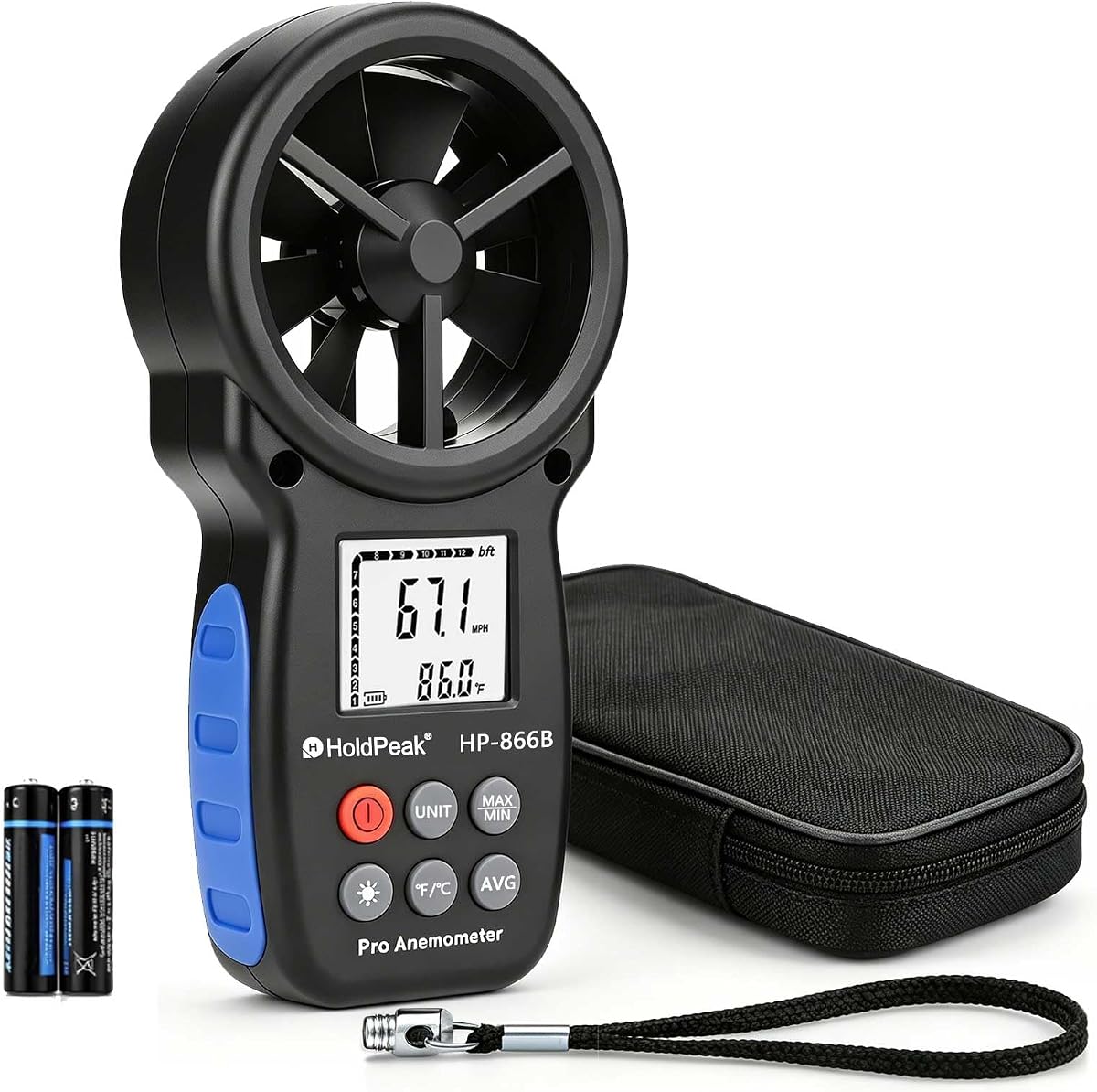
HoldPeak 866B
4.5Editor score
Five wind speed units
Maximum, minimum, average modes
Tripod mount and carrying pouch
This Handheld Digital Anemometer guide compares 10 top models for accuracy, display features, airflow readings, portability, and outdoor usability.
A handheld digital anemometer gives outdoor enthusiasts, drone pilots, HVAC technicians, and weather observers a quick way to measure wind speed, temperature, and sometimes humidity or airflow. The best model combines a readable display, responsive sensor, useful unit conversions, and a body that is easy to carry in demanding conditions.
We compared ten products using their published specifications and feature descriptions. The list covers compact models for sailing, kite flying, shooting, golf, and drone work as well as instruments with deeper airflow functions, backlighting, data hold, wind chill, and professional measurement features.
Each review highlights the strongest use case, practical advantages, and legitimate trade-offs so you can choose confidently. Ratings and availability can change over time, and the final recommendation should reflect the measurements and portability you need most rather than features you will rarely use.
4.5Editor score

4.6Editor score
4.3Editor score
The table below compares all ten models by their strongest measurement features, display capabilities, environmental readings, and practical extras, making it easier to match a meter to a specific outdoor or HVAC task.


The TopTes TS-301 earns the leading recommendation because it balances an unusually large display, a broad set of measurements, and straightforward portability. Its 4.6 rating is among the highest in this guide, while the 2.26-inch backlit screen makes it one of the easiest models to read during active outdoor use or while working in dim areas.
We may earn a commission when you buy through this link, at no additional cost to you.
Wind speed can be shown in feet per minute, feet per second, miles per hour, knots, kilometers per hour, and meters per second. Temperature and relative humidity readings broaden its usefulness beyond general wind checks, while the stated wind speed range is designed to cover activities including sailing, windsurfing, drone flying, boating, golf, shooting, and HVAC assessments. The rotatable fan blades and one-hand controls support quick field measurements.
There are some qualifications to consider. The temperature and humidity sensors may need at least 30 minutes to adjust after moving to a new environment, so the first reading should not be treated as an immediate equilibrium measurement. Unlike several competitors, the published feature list does not identify a tripod fitting, which may limit long-term fixed-point monitoring. These limitations are modest for most users because the meter remains light, easy to operate, and capable of automatic shutdown after ten minutes of inactivity.
Choose the TS-301 if you want one handheld instrument that can cover outdoor conditions, wind speed, temperature, and humidity without complicated setup. It is particularly compelling for sailors, drone pilots, golfers, shooters, and anyone who prefers a large display over a specialized airflow calculation. For the most balanced general-purpose option in this roundup, it is the strongest recommendation.
The 2.26-inch backlit LCD is large enough to check a reading without repeatedly angling the device toward your face. That matters when wind conditions are changing quickly or when you need to monitor a line, course, drone launch area, or indoor vent.
Temperature and humidity readings give the wind-speed figure practical context. They can help you evaluate comfort, heat exposure, or moisture around an activity, making the TS-301 more versatile than a basic speed-only meter.
We may earn a commission when you buy through this link, at no additional cost to you.
The HoldPeak 866B is a strong all-around recommendation, particularly for people who need reliable wind readings in very different settings. Its 4.5 rating reflects a well-rounded feature set, and the combination of dual temperature sensors, eight vanes, a smooth fan shaft, and sensitivity to low airflow gives it a credible role in both outdoor planning and HVAC work.
We may earn a commission when you buy through this link, at no additional cost to you.
The meter supports meters per second, kilometers per hour, feet per minute, knots, and miles per hour. Maximum, minimum, and average wind-speed modes make it easier to examine variations rather than relying on a single instantaneous number. The temperature display can switch between Celsius and Fahrenheit, while a backlight, battery indicator, and automatic shutdown improve everyday usability.
Its physical design is especially thoughtful. A tripod hole supports fixed measurements, while the included hand strap helps prevent drops during activities such as sailing, drone flying, and kite flying. A carrying pouch and screwdriver are also included, and the product ships with AAA batteries, a manual, and the necessary mounting hardware. The trade-off is that it does not include humidity sensing or the USB connectivity offered by one split-sensor model.
The 866B is ideal for users who alternate between outdoor hobbies and practical airflow checks. Choose it over the TS-301 if tripod capability, statistical wind modes, and a hand strap matter more than a larger screen or humidity measurement. For a flexible premium-feeling feature set, it is one of the most complete options here.
The stated sensitivity to very low airflow makes this meter useful around ducts and vents as well as outdoors. Its CFM calculation guidance uses wind speed and duct cross-sectional area, giving installers a practical starting point for airflow assessment.
You can monitor conditions while walking, sailing, or flying with the meter in hand, or mount it when a stable reading is more useful. Maximum, minimum, and average functions then help reveal changes over the monitoring period.
We may earn a commission when you buy through this link, at no additional cost to you.
The Mcbazel 3-in-1 delivers a particularly useful combination of functions without making the display difficult to interpret. Its 4.5 rating is strong, and the ability to show wind speed, temperature, and Beaufort scale together gives users both numerical readings and a quick description of wind conditions.
We may earn a commission when you buy through this link, at no additional cost to you.
Five unit options cover meters per second, kilometers per hour, knots, feet per second, and miles per hour. The double-line backlit LCD presents wind speed and temperature simultaneously, while maximum, minimum, average, and data-hold functions cover common field-monitoring needs. An automatic power-off function and low-battery indicator help reduce avoidable downtime.
The main practical drawback is that AAA batteries are not included, so you should plan to supply your own before a trip or job. It also lacks humidity measurement, explicit CFM calculation, and the extended temperature and airflow functions found among higher-feature models. Even so, it covers the essential needs of a sailor, angler, HVAC user, or casual weather observer with a compact and approachable design.
This is a sensible choice when you want more than a basic speed display but do not need data logging, sensors on a cable, or extensive accessories. It is particularly useful for anyone who appreciates Beaufort scale readings and simultaneous temperature information. On value and practical coverage, it stands out as the guide's best budget pick.
Wind speed, temperature, and Beaufort scale appear together, allowing you to interpret conditions at a glance. The double-line layout separates the most important numerical information and makes the backlight useful in dim surroundings.
Maximum, minimum, average, and hold modes make it easier to study gusty or changing winds. These are useful functions when you need a stable reading or want to understand variation rather than relying on a momentary value.
We may earn a commission when you buy through this link, at no additional cost to you.
The BTMETER BT-100 is a versatile meter for users who divide their time between technical airflow checks and outdoor activities. It carries a 4.5 rating and includes a wide 0.67 to 67.1 mph measurement range, a bright backlit display, and an advertised accuracy tolerance of two percent for wind speed readings.
We may earn a commission when you buy through this link, at no additional cost to you.
Five wind-speed units support m/s, km/h, ft/min, knots, and mph, while temperature can be shown in Celsius or Fahrenheit. Two temperature sensors, eight vanes, and wind-chill calculation add environmental context. Its stated sensitivity to low airflow is useful around HVAC installations and duct vents, and the included formula for CFM connects measured velocity with duct cross-sectional area.
A metal threaded tripod hole is a notable advantage over several compact alternatives. It allows continuous, hands-free monitoring while flying drones or remote-control aircraft, and it can also support repeated HVAC readings. The trade-off is that actual CFM is not displayed directly; users must perform the calculation. The BT-100 also omits humidity and offers no computer connection.
Choose this model if you need one dependable tool for drone launches, duct work, sailing, climbing, kite flying, shooting, or general weather checks. Its included AAA batteries, pocket-sized form, and flexible mounting options make it particularly convenient. It is not the richest model in the list, but its combination of airflow awareness and tripod support is highly practical.
The BT-100 can serve as the measuring component of a CFM estimate by pairing wind speed with the cross-sectional area of a duct or vent. This makes it useful for preliminary airflow checks rather than only recreational wind readings.
The built-in metal tripod hole is useful when a stable reading is needed near a launch area or during remote aircraft operations. Continuous readings can be more informative than holding the instrument while trying to operate equipment.
We may earn a commission when you buy through this link, at no additional cost to you.
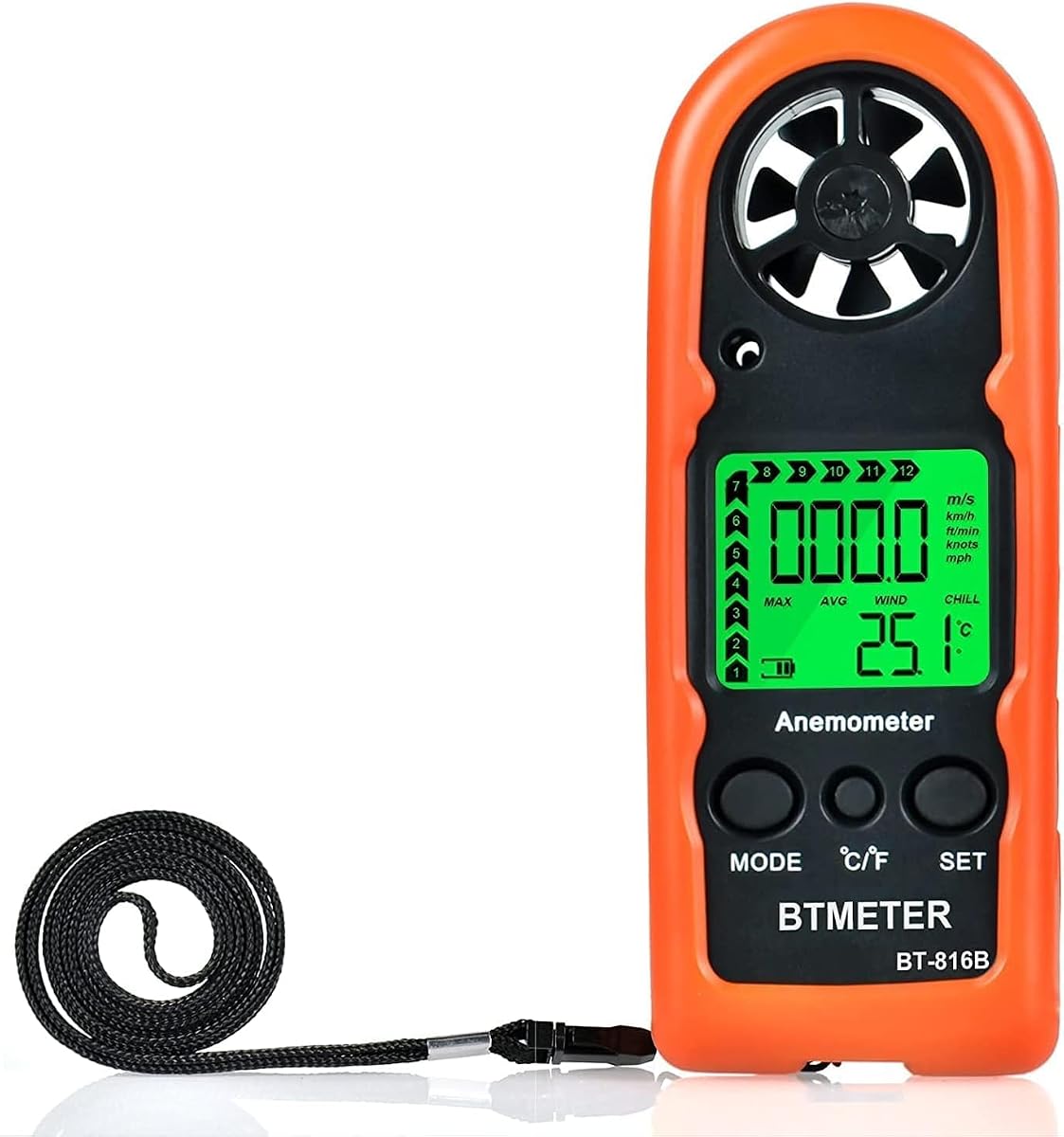
The BTMETER BT-816B is one of the most portable instruments in the guide, weighing 53 grams and measuring 114 by 40 by 18 millimeters. Its 4.3 rating is still solid, and the compact shell, one-handed design, and included lanyard make it a natural choice for hiking, sailing, shooting, climbing, and other mobile activities.
We may earn a commission when you buy through this link, at no additional cost to you.
The seven-blade sensor supports wind speed measurements from 0.3 to 30 meters per second, with a stated tolerance of plus or minus five percent. Five unit choices, Celsius and Fahrenheit switching, and current, maximum, and average modes cover the essentials. The backlit display improves visibility, while wind-chill readings add a safety-oriented environmental measure.
Its published accuracy tolerance is less tight than the two-percent figure given for the BT-100, which is important for users who need highly precise work. The BT-816B also does not list a tripod hole, humidity sensor, or detailed airflow calculation. However, its small size, light weight, manual or automatic shutdown, and low-battery indicator remain meaningful advantages for travel and field use.
Buy the BT-816B if pocketability matters more than advanced connectivity or a broad set of statistical functions. It is a straightforward, portable meter for anyone who wants quick wind and temperature readings in the field. For its size, it also provides a useful selection of units and display modes without becoming complicated to operate.
At 53 grams, the BT-816B is easy to carry during hikes, sailing trips, or shooting sessions. Its narrow body fits comfortably in one hand, while the lanyard helps keep it secure during active use.
Wind speed, temperature, and wind chill appear in a simple handheld format. Switching among current, maximum, and average modes helps users monitor changes without navigating a complicated interface.
We may earn a commission when you buy through this link, at no additional cost to you.
The Proster Digital Anemometer stands apart with its dedicated airflow area functions, making it a strong choice for HVAC and duct-related work. It has a 4.4 rating, a large backlit display, and a feature set that supports both handheld readings and fixed measurements.
We may earn a commission when you buy through this link, at no additional cost to you.
Wind speed can be displayed in meters per second, feet per minute, kilometers per hour, miles per hour, and knots. The meter also provides CFM, CMM, and CMS airflow ranges with a stated area range of up to 9.999 square feet or square meters, depending on the selected unit. Reading hold, maximum, and minimum functions help preserve and compare measurements.
The main limitation is its focus: the published specifications do not include air temperature, humidity, or wind chill. It also uses a 9V 6F22 battery rather than the convenient AAA format used by many competitors. Although the battery is included, replacement planning may be less convenient for people who already carry common household cells.
Choose the Proster when your priority is airflow measurement rather than a broad collection of environmental sensors. It is especially relevant to technicians who want explicit CFM-related setup in one instrument. For general recreation, several other models provide temperature and more integrated outdoor features, but for structured airflow work this option remains focused and purposeful.
CFM, CMM, and CMS modes set the Proster apart from general-purpose wind meters. These functions make it easier to enter or select an area reference when estimating airflow through a duct or opening.
The large backlit LCD is practical in mechanical rooms, construction areas, and other poorly lit spaces. Hold, maximum, and minimum functions reduce the need to repeat an operation when recording a result.
We may earn a commission when you buy through this link, at no additional cost to you.
The VEVOR Split Anemometer is the most specialized model in this roundup, using an extendable cord to separate the display and sensor positions. It carries a 4.4 rating and combines wind velocity, temperature, airflow, and wind-chill measurements with USB connectivity, making it a strong candidate for users who need placement flexibility or recorded data.
We may earn a commission when you buy through this link, at no additional cost to you.
The wind-speed range extends to 100.8 mph, and six unit options include meters per second, kilometers per hour, feet per minute, miles per hour, knots, and Beaufort scale. Maximum, minimum, average, and current modes are supported. The six-point-six-foot, or two-meter, extendable cord allows the sensor to reach a vent, work area, or outdoor position while the display remains in the user's hand.
This design introduces compromises. A corded sensor cannot be used as freely as an all-in-one handheld meter, and the vane unit is specifically excluded from the IP44 waterproof rating. Computer connectivity is also tied to compatibility with the listed Windows versions, which may not suit every modern setup. Despite those points, the separation of sensor and display is a genuine advantage where reach matters.
Choose the split model for HVAC inspection, weather observation, construction, agriculture, navigation, or activities where precise sensor placement is valuable. It is less convenient for moving quickly across a golf course or managing a small drone, but it compensates with reach, data access, and a broad measurement range. For a connected, extended-reach anemometer, it is the clear choice.
The two-meter cord allows the vane to be positioned at an opening or in a flow path while the display stays visible. That separation is especially useful when your body would otherwise disturb the measurement.
The USB connection gives supported Windows systems a route for transferring measurement data. This is a meaningful distinction for documentation, analysis, and users who want readings beyond the on-device display.
We may earn a commission when you buy through this link, at no additional cost to you.
The HT605 Digital Anemometer combines a 4.6 rating with one of the strongest all-around feature sets in the guide. Its large backlit LCD, six wind-speed units, and simultaneous wind, temperature, and humidity information make it particularly appealing for users who want environmental context rather than wind speed alone.
We may earn a commission when you buy through this link, at no additional cost to you.
Low-friction bearing technology, eight blades, and a wider blade diameter are intended to improve sensitivity and response. The stated speed range reaches 30 meters per second, with equivalent scales in kilometers per hour, feet per second, knots, miles per hour, and feet per minute. Maximum, minimum, average, data hold, backlight control, a low-battery indicator, and a ten-minute automatic shutdown are also included.
The published description does not mention a tripod hole or computer connection. It also makes fewer explicit CFM or airflow-calculation claims than the Proster or BTMETER models, so it may not be the first choice for a technician whose main objective is duct-volume work. The housing is described as ABS, compact, and lightweight, with a carrying pouch for storage.
Choose the HT605 for sailing, surfing, hiking, fishing, shooting, drone checks, golf, and general environmental monitoring. It is particularly well suited to users who value humidity readings and a clear display. Its combination of strong rating, compact construction, and broad outdoor compatibility makes it one of the safest all-purpose recommendations in this guide.
Relative humidity makes the temperature and wind readings more useful for planning and comfort assessment. It also gives the meter relevance for environmental work beyond sports and recreation.
Maximum, minimum, average, and hold functions make it easy to retain important readings. The large backlit screen improves legibility, while automatic shutdown and low-battery indication help manage field use.
We may earn a commission when you buy through this link, at no additional cost to you.
The Testo 410-1 is the most compact and professionally oriented recommendation in the guide. Its 4.4 rating, included calibration certificate, and support for timed mean readings distinguish it from general-purpose meters that focus mainly on outdoor activities and consumer conveniences.
We may earn a commission when you buy through this link, at no additional cost to you.
The pocket vane anemometer measures air velocity from 0.4 to 20 meters per second and temperature from minus 10 to plus 50 degrees Celsius. It also calculates wind chill. Air velocity and temperature appear simultaneously on a backlit LCD, while hold, maximum, minimum, and timed mean functions help users retain readings and evaluate averages over time.
The smaller unit set is a notable limitation compared with models offering five or six speed scales. Its maximum listed speed is also lower than several alternatives, so it may be less suitable for severe exposed conditions. However, the calibration certificate and timed mean function offer value for professional users who care about traceability and repeatable readings rather than an exhaustive list of outdoor features.
Choose the Testo 410-1 for HVAC work, building inspection, controlled environmental checks, and professional field use where calibration documentation matters. It is also convenient for anyone who prefers a small pocket format. For users primarily seeking knot readings, extensive unit switching, or a broader speed range, a different model would be a better fit.
The included calibration certificate is a meaningful advantage in work environments where instrument documentation matters. It helps distinguish the model from consumer-oriented meters that focus only on convenience and display features.
The timed mean function is useful when airflow or wind conditions fluctuate during an inspection. Combining it with hold, maximum, and minimum functions provides several ways to capture a representative result.
We may earn a commission when you buy through this link, at no additional cost to you.
The VEVOR Handheld Anemometer is a straightforward, all-in-one option with a 4.2 rating. It offers wind velocity, temperature, airflow, and wind-chill functions, six speed units, and a familiar handheld format, making it a reasonable choice for general outdoor, drone, sailing, and HVAC tasks.
We may earn a commission when you buy through this link, at no additional cost to you.
The stated speed range extends from zero to 69.35 mph, while the temperature range is 14 to 113 degrees Fahrenheit. The LED backlit screen supports low-light readability, and maximum, minimum, average, and current wind-speed modes make changing conditions easier to track. An automatic shutdown after five minutes and a low-battery alert help manage use away from a power source.
Its main weakness in this comparison is the 4.2 rating, which is the lowest listed here. It also omits humidity and offers less explicit documentation of specialized airflow calculation than the Proster or BTMETER BT-100. The IP44 protection applies to the main unit but excludes the vane, so users should not interpret it as full waterproof protection for exposed parts.
Choose this model when you prefer a single-piece meter that can be held in one hand or placed on a tripod for fixed-point readings. It covers a good range of outdoor and technical tasks without demanding complicated setup. While several alternatives offer more specialized features or a stronger rating, this one remains easy to understand and broadly applicable.
The handheld form supports quick checks, while tripod compatibility expands the meter into fixed-point monitoring. That versatility suits both outdoor activities and more stationary technical measurements.
Maximum, minimum, average, and current modes help separate short-term changes from sustained conditions. The LED backlight makes those readings accessible when daylight or ambient lighting is limited.
We may earn a commission when you buy through this link, at no additional cost to you.
The right handheld digital anemometer depends on where you will use it, which measurements you need, and how precisely you must record changing conditions. Review the following factors before comparing the ten models.
Choose a range that comfortably covers normal use, not merely the maximum advertised number.
Prioritize direct area functions when regular duct measurements are the main task.
Favor a large backlight when readings must be taken at a glance.
Choose humidity and wind chill when outdoor comfort and exposure matter.
Match the available units and statistics to your recording process and activity.
Prioritize either true pocketability or stable mounting, according to your activity.
Check excluded components and included accessories before expecting field-ready protection.
Choose computer export or calibration documentation when records must be auditable.
Before the first measurement, install the specified batteries, power on the meter, and confirm that the units and display are operating correctly. Position the sensor in clean, unobstructed airflow and keep your body, clothing, vehicles, walls, and other nearby surfaces away from the intake. For consistent results, hold the meter at a similar height and orientation for each reading, particularly when comparing different locations.
Allow environmental sensors to adjust after moving between indoor and outdoor conditions. The TopTes TS-301 specifically notes that its temperature and humidity sensors may need at least 30 minutes to settle into a new environment. For airflow calculations, use the correct area value for the duct or opening and keep units consistent. Select maximum, minimum, average, or hold mode according to whether you need an instant reading, a stable display, or information about variation.
Clean the fan and sensor area gently after dusty jobs, keeping moisture and debris away from the housing openings. Do not immerse the instrument unless its entire construction is explicitly rated for immersion; the VEVOR IP44 rating excludes the vane unit. Store the meter in its pouch or case, remove batteries during long storage if appropriate for the model, and replace depleted cells promptly. Periodic comparison against a known reference can reveal sensor blockage, battery weakness, or calibration drift.
The TopTes TS-301 is the strongest all-around choice because it combines a large backlit display, six wind-speed units, temperature, and humidity in a compact package. The HoldPeak 866B is also well rounded and offers maximum, minimum, and average modes plus tripod support. Choose according to whether humidity, statistics, or mounting capability is more important.
A humidity sensor is not essential for measuring wind speed, but it adds useful context when planning demanding activities, assessing comfort, or monitoring changing weather. The TopTes TS-301 and HT605 include humidity readings. For basic airflow or wind-speed checks, temperature and wind chill may be more relevant than relative humidity.
These meters can provide useful airflow estimates around vents and ducts. The Proster includes explicit CFM, CMM, and CMS functions, while the BTMETER BT-100 provides a formula based on wind speed and duct cross-sectional area. Accuracy depends on sensor placement, duct geometry, and the instrument's specified tolerance, so professional compliance work may require a dedicated calibrated airflow instrument.
A handheld meter integrates the display and sensor into one compact body, making it quick to carry and easy to move. A split model connects the sensor to the display with a cable, allowing the sensor to reach a vent or measurement point while the display stays visible. The split VEVOR provides a two-meter extendable cord, while its extra reach makes it less compact.
A tripod is valuable when you need stable, continuous readings because hand movement and changing grip can introduce variation. It is also useful for drone operations, weather observation, and repeated duct measurements. The HoldPeak 866B, BTMETER BT-100, and standard VEVOR handheld support tripod-style positioning.
Most users need only one or two units, but switching prevents calculation errors and improves compatibility with different equipment. Knots are common in sailing, miles per hour and kilometers per hour suit many outdoor activities, and feet per minute or meters per second are frequent in technical airflow work. Models offering five or six units offer more flexibility.
IP44 indicates protection against solid objects larger than one millimeter and protection against splashing water from various directions. It does not mean the device can be submerged, and it does not necessarily cover every component. The VEVOR models in this guide specifically exclude the vane unit from their IP44 protection, so the exposed sensor still requires care.
Keep sensor height, orientation, and distance from obstructions consistent, and ensure the fan is not blocked by a hand, bag, or clothing. Wait for the reading to settle, then record the same statistic in each location. Temperature and humidity sensors may also need time to adjust after a dramatic environment change.
The TopTes TS-301 is the best general recommendation because its large backlit display, six wind-speed units, temperature, and humidity create a versatile and approachable package. The HoldPeak 866B is an excellent alternative when maximum, minimum, average, tripod support, and low-flow sensitivity are priorities, while the Mcbazel 3-in-1 offers a budget-friendly way to view speed, temperature, and Beaufort scale together.
Specialized needs should guide the remaining choices. Select the BTMETER BT-100 for combined HVAC and drone work, the BT-816B for minimal weight, the Proster for direct airflow-area functions, the split VEVOR for extended sensor reach and computer transfer, the HT605 for humidity-aware readings, the Testo 410-1 for calibration documentation, and the standard VEVOR for a straightforward all-in-one design.
Before buying, verify the measurement range, units, mounting needs, environmental functions, and included accessories against your intended work. Ratings, product availability, and seller details can change, so check the current listing and manufacturer information at the time of purchase to confirm that the model still matches your requirements.