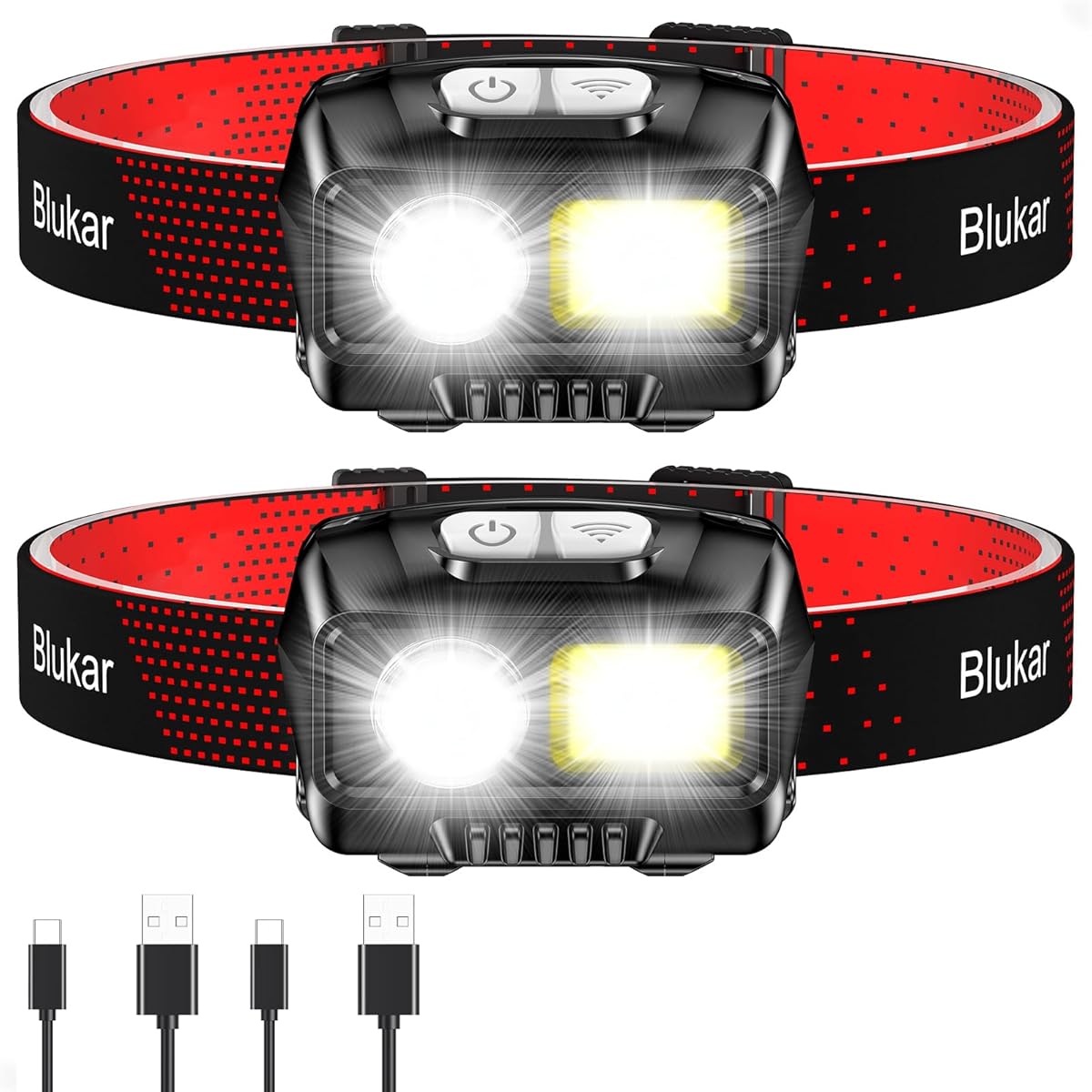
Blukar LED Headlamp Rechargeable, 2000L Super Bright Headlight Flashlight
4.5Editor score
Stepless brightness adjustment
Eight lighting modes
Motion sensor control
IPX5 waterproof rating
Our Headlamp for Electrical Work guide compares 10 rechargeable and hard-hat-ready lights for brightness, beam control, durability, comfort, and hands-free use
A headlamp for electrical work should provide controlled illumination without interfering with focus, balance, or mobility. The right model combines a useful beam pattern, dependable runtime, comfortable fit, and a housing that can tolerate active jobsites. Brightness matters, but usable light, precise aiming, and simple controls often make a greater difference during panel work.
This guide compares ten rechargeable headlamps using the specifications and customer ratings supplied for each product. It examines maximum output, focused and flood beams, mounting options, waterproofing, battery design, adjustment, and hard-hat compatibility. The list includes budget models, compact detachable lights, high-output professional tools, and rugged units designed for demanding conditions.
Each review explains where a headlamp is strongest, where compromises appear, and which electrical tasks suit it best. The top selections highlight three different approaches: a feature-rich value option, a versatile all-around choice, and a premium high-output model. Product availability, features, and prices can change, so confirm the current listing before purchasing.
4.5Editor score

4.6Editor score

4.4Editor score
The comparison below covers the key differences among all ten headlamps, including output, beam flexibility, mounting, water resistance, and battery features. Specifications are based on the supplied product information, while ratings reflect the listed customer scores.


The LHKNL Rechargeable Headlamp has a 4.5 customer rating and stands out as an approachable option for electrical work, particularly when both hands need to remain free. Its 1500mAh rechargeable battery, multiple white and red modes, and lightweight 1.87-ounce construction make it practical for inspections, cable tracing, panel work, and general maintenance.
We may earn a commission when you buy through this link, at no additional cost to you.
Two control features are especially useful in dirty work environments. A three-second long press shuts the light off from any mode, while the motion sensor allows the user to turn it on or off by waving a hand. The lamp head pivots 60 degrees, the elastic band adjusts for different head sizes, and a battery indicator provides a useful check on remaining charge.
The compromises are important. Its stated lighting is less powerful than the premium models in this guide, and the IPX4 rating offers less weather protection than IPX5, IPX6, or IPX7 alternatives. It is also packaged as a set of two, which may be unnecessary for a single electrician but is useful for a crew or for keeping a spare in a vehicle.
This is a sensible budget-oriented choice for routine electrical tasks where convenience, lightweight comfort, and simple operation matter more than extreme output. It also works well for technicians who want a backup light for service calls. For large outdoor installations or emergency searches in severe weather, a higher-output model with stronger water protection would be preferable.
The motion sensor is more than a convenience feature in an electrical environment. It lets a worker turn the lamp on without touching a dirty switch or removing gloves, while long-press shutdown prevents the light from remaining on in a toolbox.
Main and side beams cover a useful range of tasks, from broad panel illumination to more concentrated work. Red and SOS red-strobe modes also make the model relevant to emergency signaling and work around locations where preserving dark adaptation is useful.
We may earn a commission when you buy through this link, at no additional cost to you.
The Coast XPH30R carries a 4.7 rating, the highest listed score among these ten products, and combines a wearable headlamp with a removable work light. Its 1200-lumen turbo mode and twist-focus beam make it a strong choice for electricians who alternate between inspecting nearby components and illuminating a larger panel or mechanical area.
We may earn a commission when you buy through this link, at no additional cost to you.
The output levels are clearly documented at 1200, 500, 160, and 46 lumens. Stated runtimes are 6.75 hours at high, 10 hours at medium, and 28 hours at low. The body detaches from its bracket and strap, and its magnetic base provides another way to place the light on suitable metal surfaces without holding it.
The main trade-off is weight and output relative to the budget models. At 4.37 ounces, it is not the lightest option here, and using turbo or high settings will consume the battery faster than low mode. Its IP54 rating is suitable for water-resistant jobsite use but does not equal full submersion protection.
Choose the XPH30R when dependable controls, documented output levels, and flexible placement are priorities. It is particularly effective for panel maintenance, building service, mechanical inspections, and vehicle electrical work. A technician who only needs a lightweight close-range light may prefer a simpler model, but this headlamp offers more versatility for mixed electrical duties.
The twist-focus optic transitions between broad short-range illumination and a concentrated long-range beam. This is valuable when an electrician needs to cover a whole cabinet with one setting and then inspect a distant component without changing equipment.
Removing the light body converts the product into a handheld flashlight, while the magnetic base makes it easy to position in a cabinet, on a ladder, or against another metal surface. That versatility helps reduce repeated headband adjustments during a service call.
We may earn a commission when you buy through this link, at no additional cost to you.
The Nitecore HC75 UHE has a 4.4 rating and is the premium selection in this guide because it combines 3000-lumen output, 209-yard beam throw, stepless focus, and white and red illumination. It is aimed at industrial work and other demanding jobs where users need to move from broad task lighting to distant inspection.
We may earn a commission when you buy through this link, at no additional cost to you.
Its stepless E-focus system adjusts continuously from a wide floodlight to a focused spotlight or a mixed beam. Two-button operation provides direct access to ultra-high, low, and red modes, while five white levels offer finer control. The integrated USB-C port charges in just over two hours, and the power indicator plus lockout mode help manage battery awareness and accidental activation.
The main drawback is that its capability and likely size are more than some electricians need for routine panel work. The 3000-lumen maximum may create unnecessary heat, battery drain, or glare in confined areas, and premium output does not automatically make a headlamp more comfortable. Users should select a practical output level for the task rather than leaving turbo on continuously.
This headlamp is best suited to industrial electricians, facilities teams, and technicians who work in large, dark, or partially energized spaces. It is also a strong choice for nighttime outdoor installations and emergency response. For smaller residential jobs, one of the lighter mid-output models may be easier to manage.
Unlike a model with only a few fixed beam shapes, the E-focus system offers gradual control. Electricians can narrow the light around a terminal, widen it across a control panel, or use a mixed beam when neither extreme is ideal.
The package includes the headlamp, a USB-C to USB-C cable, headband, storage case, and Nitecore sticker. The storage case is useful for protecting the light during transport between jobsites, while the included cable supports straightforward charging from compatible sources.
We may earn a commission when you buy through this link, at no additional cost to you.
The NEBO Transcend 1500 has a 4.6 rating and is a well-rounded headlamp for electricians who want a replaceable battery and a removable work-light configuration. It provides up to 1500 lumens, five modes, a controllable tilt, and a magnetic base, making it suitable for vehicle maintenance, electrical inspections, and general facilities work.
We may earn a commission when you buy through this link, at no additional cost to you.
The brightness dial makes output selection straightforward. Turbo provides the maximum 1500 lumens, while High, Medium, and Low balance visibility and runtime; Strobe serves emergency signaling. The stated low-mode runtime reaches 28 hours, and a replaceable 3200mAh lithium-ion battery reaches a full charge in as little as 3.5 hours using the included USB-C cable.
Its waterproof and impact-resistant construction is reassuring for work environments, although the listing does not provide a formal IP rating. Users may also find it less convenient to change between headlamp and handheld positioning because the light detaches from the strap. The highest output is best reserved for large spaces and short bursts rather than every close inspection.
This is a particularly good fit for technicians who prefer to carry a spare battery or who want one tool for wearable and stationary lighting. It also works well for low-light vehicle electrical work and residential service calls. Those seeking a formally rated water-resistance designation may prefer one of the Coast, Blukar, or Nitecore models listed here.
A replaceable battery is useful for long service days, travel, and storage in a vehicle. It reduces the need to replace the entire headlamp when battery aging affects runtime and offers a more practical service path than an integrated cell.
The dedicated brightness dial is convenient when a user needs to change output quickly. Its five modes include three primary brightness levels, turbo, and strobe, covering routine illumination and emergency signaling without a complicated menu.
We may earn a commission when you buy through this link, at no additional cost to you.
The 230-Degree Wide Beam Headlamp has a 4.6 rating and is the most directly oriented toward hard-hat work in this group. Its 31 LEDs, stated 1500-lumen output, and 230-degree field of view are designed to illuminate a broad area without requiring workers to move their heads constantly.
We may earn a commission when you buy through this link, at no additional cost to you.
The 5000mAh rechargeable battery is another major attraction for electrical crews. Stated runtime is 12 hours in low mode and six hours in high mode, with a USB-to-Type-C charging cable included. A 90-degree tilting head directs the light toward the work surface, while a red rear light can operate with the front lights to improve visibility.
This headlamp has fewer controls than several alternatives. High, low, and strobe provide a straightforward selection, but there is no advertised narrow spot beam for looking deep into a cabinet or along a cable route. The wide coverage is an advantage for wiring rooms and open panels, yet a focused model can be more useful when precise illumination is required.
Choose it when broad coverage, hard-hat mounting, and a visible rear light are the leading requirements. The eight included clips make it particularly convenient for multiple workers or different helmet configurations. Electricians who regularly inspect distant components may want to pair it with a focused beam headlamp rather than rely on flood illumination alone.
The included eight clips are a meaningful advantage over models that merely mention helmet use. They help position the wide light on compatible hard hats without requiring the worker to remove a safety helmet or secure the headband in an improvised way.
A 230-degree field provides illumination across the wearer’s forward visual area, useful for working with both hands in a wiring space. The adjustable tilt lets the beam remain aimed near the hands even when the wearer's posture changes.
We may earn a commission when you buy through this link, at no additional cost to you.
The Blukar 2000L Headlamp has a 4.5 rating and offers one of the broadest feature sets among the more approachable models. It combines a stated 2000-lumen maximum, COB and XPG LEDs, stepless dimming, eight modes, motion activation, USB-C charging, and an IPX5 waterproof rating in a compact 2.96-ounce package.
We may earn a commission when you buy through this link, at no additional cost to you.
The main control is especially useful for electrical work. A long press adjusts brightness from 100 percent to 30 percent, allowing a technician to reduce glare when inspecting a live area or reflectively labeled component. Three sensor modes cover the main white beam, side white beam, and combined output, while normal operation adds red and red-strobe choices.
The 1200mAh built-in battery is smaller than the cells advertised by several larger models in this guide. It may require more frequent charging during extended jobs, and there is no stated runtime in the supplied information. The removable, washable headband is practical for maintenance, while the 45-degree tilt offers adequate directional adjustment.
This Blukar is a strong value for electricians who want multiple output types and touch-free control without moving to a premium industrial model. It suits residential service, vehicle repair, inspections, and emergency kits. Users who need extended all-night runtime should verify battery expectations carefully, and those in exposed environments may prefer a higher IP rating.
Stepless adjustment is a meaningful advantage over fixed low, medium, and high steps. Electricians can reduce output to a comfortable level for reading labels or working inside a panel and increase it when moving into a dark area.
Three motion-controlled modes let the user select among the main, side, and combined white beams. This reduces button presses while preserving the ability to match the light to the immediate task.
We may earn a commission when you buy through this link, at no additional cost to you.
The AKNEAR 99000-Lumen Headlamp has a 4.3 rating and distinguishes itself with a claimed 99000-lumen output, 10500mAh battery, IPX7 rating, and aluminum alloy body. These specifications position it as a rugged, high-capacity option for outdoor electrical work, emergency response, and large-area illumination.
We may earn a commission when you buy through this link, at no additional cost to you.
Its tactical zoom switches between flood and spot configurations, with high, medium, low, strobe, and SOS modes available in each state. The lamp head rotates from 0 to 125 degrees, the headband has an EVA comfort pad, and a USB output port can charge a phone or other device during emergencies. The supplied information states a maximum runtime of 95 hours.
The extraordinary maximum-output figure should be treated carefully because published lumen claims can be difficult to compare across manufacturers. The large battery also adds bulk, and maximum output is unlikely to be the most practical setting for ordinary wiring work. IPX7 protection is a strong advantage, but the model should still be operated within its stated charging and environmental limits.
This headlamp is best for technicians who work in large outdoor sites, basements, utility areas, or emergency situations and value battery endurance and water resistance. It may also appeal to crews that want emergency device charging. For compact residential work, a smaller model would be easier to wear for extended periods.
The large 10500mAh battery and USB output function add value during outages, remote service calls, or emergency jobs. The output port can provide a limited charging option when conventional power is unavailable, making the headlamp more than a light.
The aluminum alloy body and IPX7 rating provide a stronger sense of weather resistance than the IPX4 through IPX6 models here. These features are particularly relevant for outdoor electrical work exposed to rain, mud, or washdown conditions.
We may earn a commission when you buy through this link, at no additional cost to you.
The Coast XPH34R has a 4.6 rating and is the most versatile overall pick for electrical work. It combines 2700 lumens, a 295-meter maximum beam distance, twist focus, a detachable magnetic body, and a stated 120-hour maximum runtime in a rugged aluminum design.
We may earn a commission when you buy through this link, at no additional cost to you.
Its Pure Beam focus transitions from an edge-to-edge Ultra View flood to a concentrated BULLS-EYE spot. That makes it useful for both general illumination and detailed long-range inspection. The body can roll within its bracket for directional lighting, detach for handheld use, and attach magnetically through its tailcap. A real-time power indicator helps prevent an unexpected battery failure.
As with other high-output lights, the longest runtime comes from the lowest setting, so expecting 120 hours at maximum brightness would be a mistake. The IP54 rating covers water resistance but offers less weather sealing than IPX7 alternatives. Its aluminum body may also feel more substantial than basic plastic headlamps, although that can benefit durability on active jobsites.
Choose the XPH34R for technicians who regularly move between close panel work and larger spaces, need a focused beam, or want the freedom to use the product as a magnet-mounted work light. It is equally suited to facilities maintenance, vehicle electrical work, and nighttime outdoor service. Those who need the absolute highest output may prefer the Nitecore HC75 UHE.
The smooth transition between flood and spot illumination is the model's defining advantage. A broad beam covers a work area, while the focused pattern reaches farther without requiring another flashlight, making this a practical one-tool approach for electrical service.
The magnetic tailcap provides stable placement on suitable ferrous surfaces. Electricians can use it under a raised panel, inside a cabinet, or on a ladder, where a headlamp cannot safely direct light toward the exact task.
We may earn a commission when you buy through this link, at no additional cost to you.
The Blukar Three-Light Headlamp has a 4.6 rating and uses a multi-light arrangement to cover a variety of work conditions. T6 and XPE emitters provide a main light, a side light, and a combined mode, while a red rear light improves awareness in dark work areas.
We may earn a commission when you buy through this link, at no additional cost to you.
The main lens rotates to adjust focal length, allowing a shift between flood and spot illumination. Five one-touch modes cover main white, side white, all white, flashing white, and main red. The lamp head adjusts through 90 degrees, and the elastic band is described as firm, breathable, and adjustable for different head sizes.
USB-C charging takes approximately five hours, and the integrated battery is not user-replaceable. That design keeps the product compact but may be less attractive to workers who want to carry a spare cell. The advertised IPX6 rating is useful for rain and spray, while the rear light adds a safety function not found on every model.
This headlamp is a good choice for technicians who value multiple light sources, simple one-button operation, and both focused and broad illumination. It can handle residential electrical work, vehicle maintenance, outdoor service, and general emergency preparation. A single-battery alternative may be preferable for extended off-grid use.
Having separate main and side emitters allows users to choose whether to concentrate light ahead or spread illumination across the working area. Combined and flashing modes provide quick alternatives for different tasks.
The rotatable main lens adds focused-beam capability to a model that otherwise resembles a broad multi-LED headlamp. It gives technicians more control when inspecting a back panel, conduit run, or distant component.
We may earn a commission when you buy through this link, at no additional cost to you.
The FINICO 99000-Lumen Headlamp has a 4.3 rating and emphasizes endurance, weather resistance, and detailed battery awareness. It offers a stated 99000-lumen maximum, up to 95 hours on low mode, USB-C charging, a USB output port, an IPX7 rating, and a four-level power display.
We may earn a commission when you buy through this link, at no additional cost to you.
Both flood and focused states provide high, medium, low, flash, and SOS modes. The housing also has constant and flashing red rear-light functions, which can help warn others during roadside, outdoor, or low-visibility electrical work. Its head rotates through 125 degrees, and the sponge forehead pad and adjustable headband are designed for longer wear.
The integrated rechargeable battery cannot be removed or replaced by the user, so long-term degradation eventually affects the entire light. The 99000-lumen figure should also be interpreted carefully, since maximum headline output does not indicate practical battery life or beam quality. USB-C charging takes three to five hours depending on the power source.
Choose the FINICO for extended low-output work, outdoor installations, emergency preparation, or users who value a clear battery gauge. The IPX7 rating and emergency charging capability are useful in harsh or remote settings. For a technician who prefers replaceable cells or needs a focused professional beam, one of the Coast or Nitecore options may be a better fit.
The four-level indicator shows 25, 50, 75, and 100 percent status. That level of detail is useful when planning a long job and helps reduce the chance of beginning a remote task with insufficient charge.
The stated 95-hour runtime focuses on low-mode use rather than maximum output. This makes the headlamp especially practical for navigation, standby lighting, repeated inspections, and emergency kits where preserving battery capacity matters.
We may earn a commission when you buy through this link, at no additional cost to you.
The right electrical headlamp balances usable illumination, safe operation, all-day comfort, and resistance to the conditions encountered on a job. Rather than focusing only on the largest lumen number, consider how each light will be mounted, controlled, charged, and used around energized equipment.
Electrical work often involves both broad and narrow illumination. A flood beam is useful for seeing an entire panel, while a focused beam helps inspect terminals, cable routes, ceilings, and equipment deeper inside a cabinet. Twist-focus and stepless-focus systems make transitions quick and precise. Some lower-cost models instead rely on separate side LEDs, which can work but may not provide the same level of continuous control.
Prioritize a beam that is smooth, even, and easy to aim. Extra maximum lumens are less valuable if the beam has harsh hot spots, weak edges, or an awkward transition. Match the available beam patterns to the spaces you work in rather than selecting output on headline specifications alone.
High output can illuminate large rooms, outdoor work areas, and deep equipment bays, but sustained maximum use drains the battery faster and may create glare. Medium or low output is often more suitable inside panels, where the goal is to illuminate a small working area without overwhelming nearby surfaces. Models with a brightness dial, stepless dimming, or clearly separated levels provide better control.
Choose enough output for the work, not simply the highest claim. A 1200- to 3000-lumen range covers many professional needs, while lower-output models can still be effective for close inspection. Always evaluate the stated low-mode and high-mode runtimes together because the maximum-lumen figure alone says little about all-day endurance.
USB-C charging is convenient because it reduces cable-specific friction and supports charging from compatible work batteries, computers, vehicles, and wall outlets. Integrated batteries keep the headlamp compact, while replaceable cells can extend service life and provide a spare during long assignments. Built-in power-output ports are useful for emergency device charging but should not be treated as a primary charging station.
Look for a clear battery indicator and realistic runtime information. Consider whether your work requires a replaceable battery, a long low-mode runtime, or rapid charging. Keep a charging cable with the light, and verify the stated input requirements before relying on a particular power source.
A comfortable headlamp encourages consistent use, while a poor fit can cause pressure, slipping, or distracting neck strain. Elastic, breathable bands, moisture-resistant padding, and adjustable sizing help accommodate different workers and helmet configurations. The lamp housing should tilt enough to place light on the task without requiring an awkward neck angle.
Try the fit with the headgear and clothing you normally use. Workers who wear hard hats should verify that the band, clips, and lamp body can coexist safely with the helmet and suspension. A slightly larger, adjustable design is often more useful than the lightest possible model when worn for a full shift.
Electrical work can occur in damp crawlspaces, outdoor installations, basements, and partially enclosed equipment rooms. IPX4, IPX5, IPX6, and IPX7 ratings represent increasing levels of water protection, though they do not describe every impact or environmental condition. A higher rating is reassuring for exposed work, while impact resistance and a durable housing also matter.
Choose protection appropriate to the environment rather than assuming every lamp can handle the same exposure. Check the product instructions for charging, water exposure, and temperature limits. Even a high-rated light should be dried before storage and kept away from damaged seals or cracked components.
A headlamp that detaches from its band can become a handheld flashlight or a magnet-mounted work light. This is useful when a cabinet has a narrow approach, a ladder blocks head movement, or the light must remain on a metal surface. Hard-hat clips and brackets are also helpful for crews, but attachment methods must be checked for stability and compatibility.
Consider how often you will change working positions. A fixed wearable model is simple and reliable, while a detachable design offers more placement options. Magnetic bases are most useful on suitable metal surfaces and should not be relied upon in overhead or hazardous locations where the light could fall.
Simple buttons, motion control, long-press shutdown, and lockout modes can make a headlamp easier to operate with gloves or dirty hands. Motion activation helps preserve the work area because users do not have to touch the housing repeatedly. Lockout prevents accidental activation inside a bag and reduces unexpected battery use.
Look for controls that are easy to distinguish by touch and that do not require navigating complicated menus. Red light can be helpful for emergency signaling or preserving dark adaptation, while strobe and SOS modes add signaling options. Whichever controls are offered, users should understand them before entering an active work area.
A longer stated runtime is valuable when charging opportunities are limited, but the relevant number is the mode you will actually use. Low mode may last for many hours while turbo can offer only minutes. Consider battery capacity, charging time, replaceability, and whether a spare cell or cable is available. Included cases, straps, clips, and cables improve the overall ownership experience.
Set expectations around all-day use. For a full shift, carry a charging solution or a spare battery rather than relying on maximum output. Confirm that the headband and mounting hardware meet the demands of your worksite, and review the maker's warranty and support information for long-term ownership.
Before work begins, charge the headlamp fully and verify the output, zoom, and motion-sensor controls. Inspect the housing, charging port, seals, strap, and mounting clips for visible damage. When working in potentially energized areas, choose an appropriate brightness level and position the light before bringing your hands near exposed components. Do not rely on any headlamp as a substitute for required isolation, testing, and electrical-safety procedures.
Wear the band securely and adjust the lamp angle so the beam points slightly downward toward the work area. Use flood illumination for panels and broad task zones, then switch to a focused beam for deeper inspection. Motion control is helpful when your hands are dirty, but lockout or long-press shutdown is useful during transport. On ladders or elevated work, confirm that the light is stable and positioned so it cannot fall into an active area.
After use, switch the headlamp off and disconnect the charging cable. Wipe off moisture and debris with a soft cloth, allow any damp housing to dry naturally, and keep the charging port clear. Do not charge a damaged or wet unit, and follow the manufacturer's instructions for storage, battery care, and any replacement procedures. Periodic testing helps ensure the light, battery indicator, and controls remain ready for the next call.
The best output depends on the task and working distance. Medium output is often ideal for panels, junction boxes, and close terminal work because it provides useful visibility with less glare. A focused high-output beam is preferable for large rooms, outdoor equipment, ceilings, and distant components. Choose a model with several brightness levels so you can adjust rather than relying on maximum output continuously.
No. Higher maximum lumens can be useful for large spaces, but they may shorten runtime, increase heat, and create glare inside enclosed cabinets. Beam quality, control, comfort, mounting options, and battery design often have a greater effect on daily usefulness. A headlamp with controlled medium output and a focused beam may serve an electrician better than a maximum-output model that is less comfortable or harder to aim.
Some models are designed for helmet use, and the 230-Degree Wide Beam Headlamp includes eight clips specifically for hard-hat work. Other products can be secured to a helmet using suitable clips or a bracket, provided the attachment is stable and does not interfere with the helmet's suspension. Workers should verify compatibility and safe positioning before use.
The IPX portion describes resistance to water under specified test conditions, with higher numbers generally indicating greater protection. These ratings do not mean every light can be submerged, and they do not guarantee resistance to impact, chemicals, heat, or all forms of severe weather. Use the product within its documented limits and avoid charging it while wet unless the manufacturer explicitly permits that action.
A detachable design can be highly useful because it allows the same light to be worn, held, or placed on a suitable metal surface. Magnetic placement can illuminate a cabinet interior or under-panel area that is difficult to reach with a headband. It must be used carefully around electrical equipment, and workers should never use magnetic placement as a substitute for proper isolation or approved work practices.
A replaceable battery is convenient for long assignments, remote work, and users who want to carry a charged spare. A built-in battery is generally simpler and more compact, but it cannot be serviced separately by the user. The NEBO Transcend 1500 uses a replaceable rechargeable battery, while the other highlighted models generally use integrated cells according to their supplied specifications.
Red light can help with emergency signaling and can be less disruptive to dark adaptation than white light. It is useful when checking a route or coordinating with coworkers in dim surroundings, but it generally provides less detail for reading wiring labels and inspecting small components. Most electricians will still want white light for the primary task.
Store the headlamp fully charged or at the level recommended by the manufacturer, with the power off and the charging port dry and unobstructed. Keep it in a temperature-appropriate, dry location and avoid leaving it compressed under heavy equipment. Periodic charging and function checks help prevent battery degradation and reveal a damaged cable, housing, or control before it is needed on a job.
The Blukar 2000L Headlamp is the strongest feature-rich value option, combining stepless dimming, motion control, multiple light types, USB-C charging, and a comfortable removable band. The Coast XPH34R is the most versatile overall choice because its twist-focus beam, 2700-lumen maximum output, magnetic detachable body, and long stated runtime adapt to a wide range of electrical tasks.
For premium performance, the Nitecore HC75 UHE provides 3000 lumens, stepless electronic focus, white and red modes, lockout, and an integrated USB-C port. Before choosing, prioritize the beam pattern needed for your normal work, the runtime available in the mode you will use, comfortable fit, compatible mounting, and an IP rating appropriate for the environment.
Features and prices can change, so review the current product listing, included accessories, warranty terms, and charging requirements before buying. For routine panel work, a controlled medium setting and replaceable battery may be more valuable than headline maximum output. For outdoor, industrial, or emergency assignments, prioritize weather resistance, long low-mode runtime, and flexible mounting.