
VIVOHOME 4 CFM Kit
4.5Editor score
Four CFM single-stage pump
Complete gauge and hose kit
Clear oil sight glass
R410A adapter included
Portable carry bag
This HVAC Vacuum Pump guide compares ten leading options for flow rate, vacuum depth, portability, maintenance, refrigerant compatibility, and value in 2026.
An HVAC vacuum pump is essential for removing air, moisture, and other contaminants from refrigeration and air-conditioning systems before refrigerant is added. A capable pump must pull a deep vacuum, move air efficiently, run cleanly, and work reliably with the refrigerants and hose connections used on modern service equipment.
The ten pumps in this guide were compared using the specifications and product information supplied for each model. We considered airflow, vacuum depth, stage design, motor power, port compatibility, oil-management features, noise, portability, maintenance needs, and the extra equipment bundled with each option.
The list covers professional field pumps, dual-stage and single-stage models, all-in-one HVAC kits, and a sparkless design for newer A2L refrigerants. Each review explains the strongest benefits and practical trade-offs, while product availability and prices can change at any time.
Every product in this guide is designed for HVAC vacuum work, but the most suitable model depends on refrigerant type, system size, job frequency, portability requirements, and whether accessories such as gauges and hoses are already on hand.
4.5Editor score

4.7Editor score
4.4Editor score
The comparison below highlights the major differences in airflow, vacuum depth, motor configuration, stage design, and included HVAC equipment, making it easier to identify the pump that matches a particular service setup.




The Fieldpiece VP67 has a 4.7 rating and combines a portable professional design with an eight CFM flow rate and a listed 15-micron ultimate vacuum. Although its product name describes a 6 CFM model, the supplied performance information identifies an 8 CFM flow rate, so buyers should verify the exact specification on the listing before ordering. The half horsepower DC motor is designed to provide substantial power without adding unnecessary bulk.
We may earn a commission when you buy through this link, at no additional cost to you.
Its standout feature is the RunQuick oil-change system, which allows oil to be changed in seconds according to the manufacturer. That matters greatly for technicians who perform repeated evacuations because a conventional pump can lose productive time draining, refilling, and cleaning the oil reservoir. A backlit reservoir makes oil level and condition easier to observe, while the quarter-turn gas ballast includes an LED indicator for rapid recognition of its status.
The pump also offers 1/4-inch, 3/8-inch, and 1/2-inch port sizes, accommodating common service hose configurations. Error messages for power-source issues can help diagnose low-voltage or connection problems, and the DC motor is described as operating efficiently under low-voltage conditions. Its upright base, compact 1,478-cubic-inch footprint, and 29-pound weight are sensible for technicians who move equipment between vehicles and job sites.
The VP67 is a strong all-around choice for professionals who service modern systems, especially those working with A2L refrigerants. Its limitations are primarily financial and operational: it is positioned as a premium tool, and technicians still need appropriate hoses, manifold gauges, adapters, refrigerant-handling equipment, and correct vacuum pump oil for each job. For a buyer who values fast oil service, clear monitoring, and modern refrigerant compatibility, it remains an especially well-rounded option.
The RunQuick system is the most consequential feature for heavy service schedules. Fast oil changes reduce downtime, and the illuminated reservoir helps technicians check oil quality before beginning another evacuation.
A2L compatibility makes this pump relevant to systems using newer flammable refrigerants. Its broad selection of inlet sizes also improves compatibility with the hoses and adapters commonly found in professional HVAC tool bags.
We may earn a commission when you buy through this link, at no additional cost to you.
The VIVOHOME 4 CFM kit has a 4.5 rating and is one of the most approachable starting setups for automotive air conditioning, residential HVAC, and heat-pump service. It combines a single-stage rotary vane pump with a manifold gauge set, three color-coded hoses, a leak detector, can taps, quick couplers, an R410A adapter, and a carry bag.
We may earn a commission when you buy through this link, at no additional cost to you.
The one-third horsepower motor and four CFM flow rate are sufficient for carefully evacuating smaller residential and automotive systems. A high-volume cooling fan supports extended operation, while the die-cast aluminum body and anti-slip base provide a stable foundation. The clear oil sight glass and bottom drain port make basic oil inspection and changes more convenient.
The included gauge set is a major advantage for buyers who do not already own one. Its large viewing window supports easier reading, and the shock-resistant core is intended to preserve accuracy during transport. The three reinforced five-foot hoses are identified by color, with red for the high side, blue for the low side, and yellow for service. The supplied adapter allows the set to connect with R410A systems.
This package is most attractive to DIY enthusiasts, entry-level technicians, and professionals assembling a backup kit. It is less compelling for a technician who already owns a full gauge set and regularly services large systems, because the single-stage pump and moderate airflow may not match the speed or depth of higher-end dual-stage models. It also includes both self-sealing and piercing-style R134A can taps, so users must confirm which style matches their refrigerant container.
The gauge set, hoses, leak detector, adapters, can taps, oil, and carry bag remove the need to assemble a basic service kit from separate components. This convenience makes the package especially useful for new HVAC technicians and do-it-yourself users.
A visible oil level, built-in cooling fan, and bottom drain port simplify routine care. Regularly checking and replacing pump oil helps preserve vacuum performance and keeps the pump ready for repeated service calls.
We may earn a commission when you buy through this link, at no additional cost to you.
The Robinair 15500 VacuMaster has a 4.6 rating and is a compact two-stage pump built specifically for air-conditioning and refrigeration service. Its five CFM free-air displacement offers more airflow than many single-stage economy pumps, while the factory rating of 35 microns reflects the level at which it is designed to operate.
We may earn a commission when you buy through this link, at no additional cost to you.
Robinair's offset rotary-vane design is central to the pump's performance and is intended to deliver high-vacuum capability while reducing evacuation time. The intake screen helps prevent foreign material from reaching the pumping chamber, and an internal exhaust filter separates oil vapor from the outgoing air. The aluminum housing helps control weight without sacrificing the rigid construction expected in a service tool.
Routine usability is improved by the molded one-piece handle, which is described as remaining cool during operation. Finned aluminum surfaces dissipate heat, the sight glass is easy to read, and the oil fill port and angled drain valve make maintenance more accessible. Both 1/4-inch MFL and 3/8-inch ACME inlet fittings are included, along with a 3/8-inch FFL to 1/2-inch ACME adapter.
This is an appealing option for a technician seeking a recognized two-stage pump without moving to the largest professional model. It supports systems using CFCs, HCFCs, and HFCs and works with mineral, ester, alkyl benzene, and PAG oils. The main caveat is that recommended high-vacuum oil is sold separately, and changing oil after each use is advised for best performance. A buyer with a full service setup may also prefer a model with more prominently documented A2L support.
The staged rotary-vane arrangement helps pull a stronger vacuum and shorten evacuation time. That makes the pump more versatile than a basic single-stage model when faster pull-down is important.
The easy-access oil fill port, angled drain valve, sight glass, and filtered exhaust support convenient servicing. Routine oil changes remain essential for dependable performance and should be planned into the pump's use.
We may earn a commission when you buy through this link, at no additional cost to you.
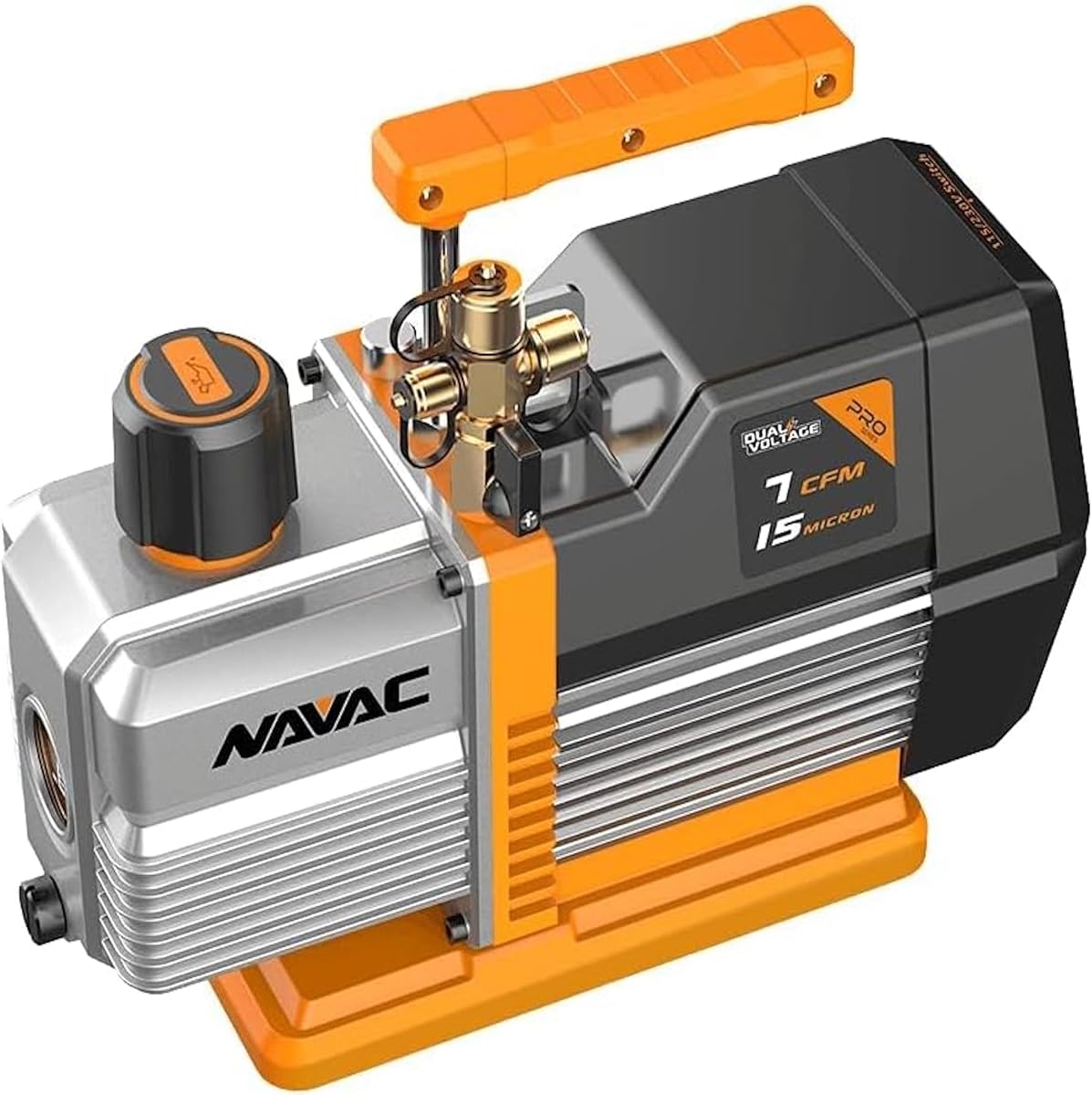
The NAVAC NP7DP has a 4.3 rating and is a professional-oriented dual-stage pump with a seven CFM flow rate and a listed 15-micron ultimate vacuum. Its twin-cylinder configuration is designed to remove contaminants and non-condensable materials from refrigeration lines efficiently.
We may earn a commission when you buy through this link, at no additional cost to you.
A particularly useful feature is the built-in check valve. It helps retain the vacuum if the pump is unplugged or power is lost, reducing the risk of oil migrating into the system being serviced. That protection makes the model more reassuring for extended evacuation work where maintaining a stable vacuum is important.
The oil mist filter is another practical addition. By trapping excess oil mist, it helps keep the work area cleaner and limits the discharge of fine oil into the surrounding environment. The motor is described as dual voltage, which can be convenient in different service environments, although users should verify the available power configuration before operating it.
At 26 pounds, the NP7DP balances professional capability with manageable transport. The seven CFM rating offers useful capacity for routine HVAC service, and the 15-micron figure gives technicians a clear target for deeper vacuum work. The main trade-off is that the supplied information provides fewer details about included hoses, gauges, adapters, and oil than it does for the bundled kits. Existing technicians with a complete tool inventory may find that focus appealing.
The integrated check valve helps prevent backflow and keeps pump oil away from the inside of the serviced system. This is a meaningful safeguard during longer evacuation procedures.
The oil mist filter collects excess mist before it exits the pump. Cleaner exhaust is especially helpful in crowded workspaces, residential interiors, and locations where oil around equipment would be inconvenient.
We may earn a commission when you buy through this link, at no additional cost to you.
The XtremepowerUS 3 CFM kit has a 4.4 rating and combines a compact single-stage vacuum pump with the gauges, hoses, refrigerant connections, and oil needed for basic air-conditioning service. Its one-quarter horsepower motor and three CFM output make it more naturally suited to smaller automotive and residential systems than larger commercial equipment.
We may earn a commission when you buy through this link, at no additional cost to you.
The included manifold gauge supports diagnosis and repair for R12, R22, R134A, and R410A applications. Three 36-inch hoses provide useful reach between the pump, gauges, and service ports, while the storage bag helps keep the kit organized and protected from dust. An R134A can tap with hand-operated punch-and-valve control connects to standard quarter-inch male threads on compatible refrigerant containers.
The die-cast aluminum alloy casing keeps the pump both light and durable. Brass fittings use tethered safety caps to help prevent oil leakage during transport, and an internal high-volume cooling fan supports extended operation. Oil maintenance is designed to be straightforward: a simple fill port accepts new oil, a plug beneath the reservoir allows draining, and a spillage meter provides a visual reference for oil level.
The package offers good value for a technician building a first or secondary service kit, particularly one already focused on common automotive and residential refrigerants. Its limitations are its three CFM airflow and single-stage design, which may make deeper or faster evacuations less convenient. It is also not presented as a sparkless A2L pump, so users servicing systems with flammable refrigerants should select a model explicitly designed for that requirement.
The pump, manifold, hoses, can tap, oil bottle, accessories, and storage bag form a convenient portable package. It reduces the number of separate items needed for common servicing tasks.
Tethered brass fitting caps help contain oil during movement. The accessible fill and drain arrangement also supports quick routine maintenance between service calls.
We may earn a commission when you buy through this link, at no additional cost to you.
The VIVOHOME 5 CFM has a 4.4 rating and is a dual-stage rotary vane pump built around a half horsepower motor. It delivers five CFM of airflow and is listed as reaching an ultimate vacuum of 0.3 Pa in three minutes, making it a capable choice for common residential HVAC evacuation work.
We may earn a commission when you buy through this link, at no additional cost to you.
Motor current protection is included to guard against overload and phase loss during the recommended duty cycle. The pump also uses a two-pole pure copper motor, a 304 stainless steel coarse filter, and a cotton-layer exhaust filter designed to capture oil mist and impurities. These features support both durability and a cleaner operating environment.
The ergonomic handle, intuitive on/off switch, clear oil window, simple fill port, and bottom drain valve make the pump approachable for regular users. A built-in cooling fan supports thermal management, and the non-slip base remains stable during operation. Its stated noise level of approximately 65 dB is useful for technicians working in homes, offices, or other spaces where excessive sound can be disruptive.
The main configuration issue is R410A compatibility: the pump can be used with that refrigerant when paired with a 5/16-inch adapter, but that adapter is not included. The package also focuses on the pump rather than providing a complete hose-and-gauge set. For a technician who already owns those accessories and wants a quiet, compact dual-stage unit, this model offers a strong balance of performance and practical handling.
The two-stage design and five CFM flow rate support rapid evacuation, while the stated three-minute pull-down to 0.3 Pa is particularly relevant for technicians who repeatedly prepare systems for service.
At approximately 65 dB, the pump is designed to reduce workplace disruption. The stainless steel coarse filter and exhaust filter also help protect the pump and reduce the escape of oil mist.
We may earn a commission when you buy through this link, at no additional cost to you.
The OMT 14.4 CFM has a 4.3 rating and is built for technicians who want high airflow and deep vacuum performance in a two-stage design. Its one-and-a-half horsepower motor drives a 14.4 CFM pump, allowing it to evacuate systems using R134A, R410A, R22, R142B, and R152A more quickly than smaller compact models.
We may earn a commission when you buy through this link, at no additional cost to you.
The listed pull-down capability is 1.5 microns, equivalent to 0.2 Pa. Combined with the 14.4 CFM rating, that specification makes the pump appropriate for demanding service work and larger systems where evacuation time matters. The two-stage configuration also gives it more flexibility for a broad range of refrigerant applications.
Oil-mist control is handled through a combined oil fill and exhaust port with an oil-mist-free cap. The pump operates at or below 70 dB, which is not silent but is designed to keep the workspace reasonably comfortable. A 22-fluid-ounce tank supports longer operation with fewer refills, while the gas ballast valve assists with removing water vapor and the anti-reflux design helps prevent gases from flowing backward.
This model is a good match for mobile technicians handling frequent or larger evacuation jobs. Its substantial airflow comes with a larger physical footprint than the 4 CFM and 5 CFM options, and the 1.5 HP motor makes it less appealing when compact storage is the priority. The product information does not establish sparkless operation for newer A2L systems, so technicians working with those refrigerants should choose a pump specifically rated for them.
The 14.4 CFM airflow and 1.5 HP motor make this pump well suited to rapid, high-volume evacuation. Its capacity is particularly useful for technicians who service larger systems or perform several jobs in a day.
The anti-reflux design helps prevent gases from returning toward the pump, supporting system protection and pump longevity. A gas ballast valve also assists with removing water vapor during evacuation.
We may earn a commission when you buy through this link, at no additional cost to you.
The VIVOHOME A2L 14.4 CFM has a 4.6 rating and distinguishes itself with a sparkless, dual-stage design intended for flammable refrigerant systems. Its ignition-proof switch supports safe handling of A2L refrigerants including R32, R1234yf, and R454B, while compatibility also extends to R410A, R134A, R12, R22, and R502.
We may earn a commission when you buy through this link, at no additional cost to you.
A one-and-a-half horsepower copper motor running at 3,456 rpm provides a 14.4 CFM flow rate. The listed pull-down performance reaches 0.2 Pa, or 1.5 microns, in three minutes. The total-pressure figure is 2 Pa, or 15 microns, so the separate total and partial pressure ratings should be considered when comparing the pump with specifications from other manufacturers.
Thermal protection, a cooling fan, and heat fins are included to reduce overheating and phase-loss concerns. A coarse filter blocks dust, while an exhaust filter traps oil mist and helps maintain a cleaner workspace. Dual oil ports, a clear oil window, and a quick-drain valve make maintenance more convenient, and two 330-milliliter bottles of vacuum oil are included.
This is a compelling model for technicians who service modern A2L systems and need substantial airflow. The sparkless design addresses a key requirement in contemporary service work, while the two-stage architecture supports fast evacuation. Its 34.6-pound weight is substantial for a portable tool, and the specified optimal operating range of 41 to 104 degrees Fahrenheit means it should be protected from extreme cold or heat. The included oil and modern compatibility make it a particularly complete choice for newer HVAC practices.
The sparkless switch and ignition-proof configuration are designed specifically for flammable refrigerant systems. This makes the pump more relevant for R32, R1234yf, R454B, and other modern A2L service work.
The 14.4 CFM flow rate and listed 1.5-micron partial-vacuum capability provide strong evacuation performance. Dual-stage operation and the cooling system support efficient work across a range of HVAC applications.
We may earn a commission when you buy through this link, at no additional cost to you.
The Fieldpiece VP87 has a 4.6 rating and combines an eight CFM flow rate with a three-quarter horsepower DC motor. It is positioned as a portable professional HVAC tool and uses the same RunQuick oil-management approach favored by technicians who want to reduce the time spent changing oil between jobs.
We may earn a commission when you buy through this link, at no additional cost to you.
Its compact DC-motor design offers an appealing power-to-weight option for mobile work. A portable field pump must be easy to move without sacrificing the airflow needed for a meaningful evacuation, and the VP87 is designed to address both requirements. The product is also listed as A2L compatible, making it relevant to technicians who service newer flammable refrigerants.
The supplied information is less detailed than that for the VP67 and VPX7, so the full port arrangement, dimensions, and stated ultimate vacuum are not documented in the provided data. Buyers should consult the current listing and manufacturer documentation for those specifications before comparing the model on fine details. Two eight-ounce bottles of oil are included, giving users a useful starting supply for maintenance.
The VP87 is best suited to professional technicians who want a powerful, portable pump and already understand the Fieldpiece maintenance platform. Its advantages include strong airflow, a compact motor configuration, quick oil changes, and A2L relevance. The trade-off is less information in the supplied product listing and a premium position. It may be a better fit than the largest pump for technicians who regularly move equipment and want to preserve cargo space.
The three-quarter horsepower DC motor is designed to deliver strong evacuation performance in a portable package. This balance is useful for technicians who transport their equipment between job sites.
RunQuick oil changes can reduce downtime between jobs, while the included oil bottles help new owners begin with the correct supplies. The system's main advantage is the speed of routine oil service.
We may earn a commission when you buy through this link, at no additional cost to you.
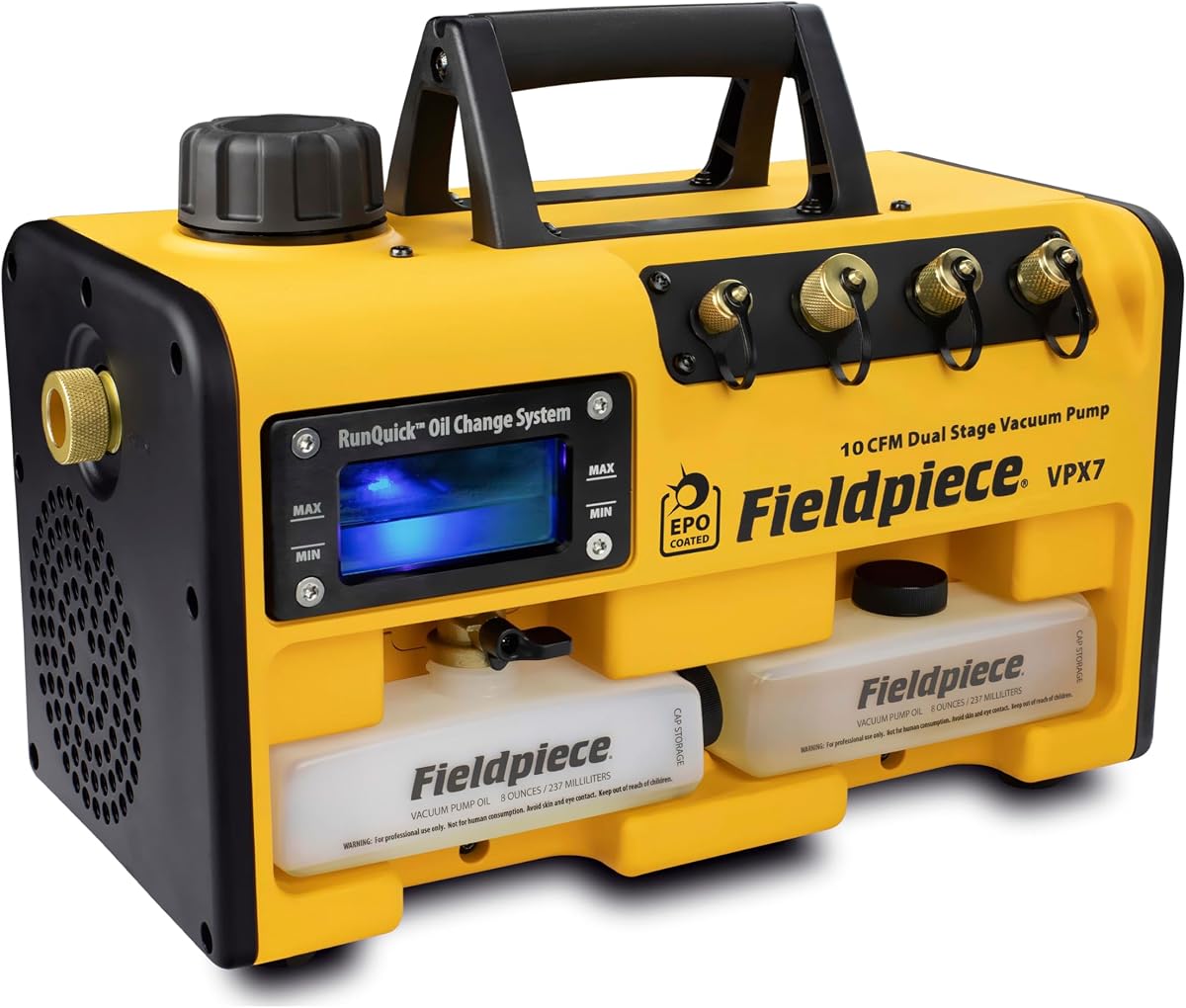
The Fieldpiece VPX7 has a 4.4 rating and represents the highest-capacity model in this Fieldpiece group. Its ten CFM flow rate, 15-micron ultimate vacuum, and three-quarter horsepower DC motor are aimed at demanding professional HVAC and refrigeration evacuation work.
We may earn a commission when you buy through this link, at no additional cost to you.
Despite its strong performance ratings, the listed weight is only 24 pounds. The 1,346-cubic-inch footprint is also smaller than the stated footprint of the VP67, which demonstrates that a high airflow figure does not have to mean a large, difficult-to-transport tool. A sturdy base keeps the unit upright, and a removable cord-storage feature supports cleaner handling in a vehicle or service bag.
RunQuick is once again the feature most likely to affect day-to-day productivity. Oil can be changed in seconds, reducing downtime for a technician who uses the same pump throughout the day. The backlit oil reservoir allows quick inspection of oil level and quality. A three-quarter horsepower DC motor is described as operating efficiently even in low-voltage conditions, which can be valuable when available power is less than ideal.
The VPX7 is best for high-volume professionals who want fast evacuation, rapid oil changes, and modern refrigerant compatibility in a portable package. Its premium acquisition cost is the main limitation, and it still needs compatible hoses, manifold gauges, adapters, and correct oil. A technician working only on small systems or with limited frequency may find a lower-capacity pump more economical, while a specialist who prioritizes throughput may see the VPX7 as the stronger long-term tool.
The ten CFM flow rate gives the VPX7 an advantage for users who need to move air from larger systems or complete repeated evacuations quickly. A strong motor supports that capacity while maintaining a portable 24-pound weight.
RunQuick oil changes, a backlit reservoir, and removable cord storage address common service-tool pain points. These details reduce downtime and make the pump easier to monitor and transport.
We may earn a commission when you buy through this link, at no additional cost to you.
Choosing an HVAC vacuum pump involves balancing evacuation speed, ultimate vacuum, refrigerant compatibility, portability, maintenance, and the equipment already available in your service kit. The following factors help narrow the field before you commit to a model.
Airflow, commonly expressed in cubic feet per minute or CFM, indicates how quickly the pump can remove air from a system. Models in this comparison range from three CFM to 14.4 CFM. A higher figure generally means faster evacuation and can be valuable for larger systems, long refrigerant lines, or technicians running multiple service calls. Lower-flow pumps may still achieve a useful vacuum, but they can require more time to reach the target pressure and may be better suited to smaller residential and automotive applications.
Choose airflow based on the size and frequency of the work rather than assuming the largest number is always necessary. A compact pump may be more practical for occasional automotive work, while a 7 CFM, 10 CFM, or 14.4 CFM model offers greater room for demanding service tasks.
A deeper vacuum helps remove moisture and other unwanted material from a refrigeration system before refrigerant is introduced. Specifications may be expressed in microns, pascals, or torr, and it is important to distinguish a manufacturer's ultimate vacuum claim from the system's required pressure threshold. Listed figures range from 35 microns for the Robinair 15500 VacuMaster to 15 microns for several Fieldpiece and NAVAC models, with some high-capacity units listing a 1.5-micron partial-vacuum figure.
Compare like-for-like measurements and check the complete specification. For consistent results, use the appropriate gauge, service hose, pump oil, and evacuation procedure required by the equipment manufacturer.
A single-stage pump is simpler and can be sufficient for smaller service tasks or occasional use. A dual-stage rotary vane pump uses two pumping stages to achieve a stronger vacuum and reduce evacuation time. Most of the higher-capacity options in this guide are dual-stage, while the VIVOHOME 4 CFM kit and XtremepowerUS 3 CFM kit use single-stage designs.
Dual-stage construction is generally the more versatile choice for professionals, especially when systems contain more moisture or require repeated evacuation. A single-stage pump may be adequate for light-duty use and can provide better value when speed and ultimate vacuum are less critical.
The refrigerant list is more than a convenience detail because fittings, oil type, electrical design, and operating rules can all vary by refrigerant. The VIVOHOME A2L model is explicitly designed with a sparkless switch for flammable systems using R32, R1234yf, and R454B. The Fieldpiece VP67, VP87, and VPX7 are also listed as A2L compatible, while several other pumps support common R134A, R410A, R22, R12, and R502 service.
For A2L work, choose equipment explicitly identified for that application rather than assuming every conventional HVAC pump is suitable. Also verify that any adapters needed for R410A or other connections are included or can be purchased separately.
The pump inlet must match the service hose and system connection being used. Many models accept a common 1/4-inch SAE connection, while 3/8-inch SAE and 1/2-inch ACME options offer greater flexibility. The Fieldpiece VP67 and VPX7 list 1/4-inch, 3/8-inch, and 1/2-inch ports. The OMT pump supports all three formats, while the VIVOHOME 4 CFM kit includes a 1/4-inch to 5/16-inch adapter for R410A connections.
Check the existing hose inventory before purchasing. A pump with more port options is convenient, but it does not help if the required adapter is missing. Confirm hose condition, thread size, and refrigerant suitability for every connection used during evacuation.
Vacuum pump oil supports lubrication, seals internal clearances, and helps the pump reach its rated vacuum. Fast oil-change systems are especially valuable to busy technicians because draining, cleaning, refilling, and refilling a conventional reservoir can consume valuable time. Fieldpiece's RunQuick design is the clearest example in this group, while other models offer accessible drains, clear sight glasses, or dual oil ports.
Use the oil type approved for the pump and refrigerant application, and change it at the interval recommended by the manufacturer. Several listings specifically advise changing oil after each use or using a designated high-vacuum oil for maximum performance.
A vacuum pump must be carried from the vehicle to the equipment, positioned on uneven surfaces, and operated without interfering with the technician. Compact dimensions, manageable weight, a stable base, an ergonomic handle, and protected power-cord storage all improve field usability. The listed weights range from 26 pounds for the NAVAC NP7DP to 34.6 pounds for the VIVOHOME A2L, with the Fieldpiece VPX7 weighing 24 pounds according to its supplied information.
Choose a model that one person can safely lift and carry. If a pump will remain in a van and be used for smaller systems, prioritize compact storage. If it supports larger systems or heavy daily use, power and stability may matter more than minimizing every pound.
Vacuum pumps generate motor and airflow noise, but excessive sound can make residential and indoor service work less comfortable. The VIVOHOME 5 CFM is stated at approximately 65 dB, and the OMT and VIVOHOME A2L models operate at or below 70 dB. Filtration features also influence cleanliness: integrated exhaust oil-mist filters, coarse intake filters, and mist-control caps can help keep the surrounding workspace cleaner.
For customer-facing work, consider both sound and oil-mist control. A quieter, filtered pump can make service in occupied homes, offices, and other sensitive environments more pleasant while reducing cleanup around the equipment.
A pump-only purchase can be economical when you already own manifold gauges, hoses, adapters, and oil. Kits such as the VIVOHOME 4 CFM set and XtremepowerUS 3 CFM set provide the major components needed to begin a service setup. These bundles are particularly useful for new technicians, students, and owners of a backup kit, but included components should still be checked for compatibility.
Compare the bundle with the value of equipment you already own. A complete kit may cost less than sourcing every component separately, while a professional who already has a full inventory may prefer a stronger standalone pump and choose accessories based on actual job requirements.
Before starting, inspect the pump, oil reservoir, inlet fittings, power cord, hoses, and gauge set. Confirm that the oil is at the correct level and has not become contaminated or degraded. Check the service manual for the manufacturer's required oil, duty cycle, operating temperature, and compatible refrigerants. Connect the pump to the system with clean, undamaged hoses and the correct adapters, ensuring that every connection is tightened appropriately.
Follow the evacuation procedure specified for the equipment and refrigerant. Start the pump according to its instructions, monitor the gauge readings, and allow the system to reach the required vacuum. Do not rely solely on the pump's published ultimate-vacuum figure because the final reading can be affected by the system, moisture, hose condition, leaks, and the accuracy of the gauge. A gas ballast may be used where supported, but it should be handled according to the manufacturer's instructions.
After the job, disconnect the vacuum hose before stopping the pump when the equipment requires it, allowing the system to remain sealed while the pump is shut down. Then change the oil as directed, clean or replace filters as needed, and inspect the fittings and housing for damage. Store the pump upright in a clean, dry location with the exhaust and intake protected. Regular oil changes and careful handling are central to preserving vacuum performance and extending the useful life of the pump.
The appropriate CFM depends on system size and how often the pump will be used. A three to five CFM pump is generally positioned for smaller residential and automotive work, while seven to 14.4 CFM models provide more capacity for larger systems and faster evacuation. Frequent professional use also favors higher airflow because the time saved per job accumulates quickly.
A dual-stage pump generally pulls a deeper vacuum more efficiently, which can shorten evacuation time and make it more adaptable to demanding service work. A single-stage pump can be sufficient for smaller systems and lighter use. The right choice depends on system size, job frequency, budget, and how much emphasis you place on evacuation speed and ultimate vacuum.
If you service systems using A2L refrigerants such as R32, R1234yf, or R454B, select a pump explicitly identified for those applications. The VIVOHOME A2L 14.4 CFM and the A2L-compatible Fieldpiece models are designed with that consideration in mind. Do not assume a pump supporting older refrigerants is automatically suitable for every flammable-refrigerant system.
The appropriate interval depends on the pump, oil, workload, and manufacturer's instructions. Some manufacturers recommend changing oil after every use, while others permit longer intervals under lighter service. Oil should also be replaced sooner if it becomes dark, contaminated, or unable to support the pump's rated vacuum, because proper oil condition is essential for sealing and lubrication.
Yes, provided the pump supports the refrigerants and connection sizes used by the systems. Many pumps in this guide cover common automotive and residential refrigerants, including R134A, R22, and R410A. A larger system may benefit from greater airflow, while smaller systems can be serviced with a compact model, so matching capacity to the job remains important.
At minimum, most service work calls for suitable service hoses, manifold gauges, an oil fill, correct adapters, and a way to recover refrigerant according to local requirements. Some kits include these items, while standalone pumps generally do not. Check the included accessories carefully so that you do not assume a pump, gauge set, and all required refrigerant connections are supplied.
Ultimate vacuum is the lowest pressure the manufacturer states the pump can reach under defined test conditions. It is useful for comparing pumps, but it is not necessarily the vacuum a particular system will hold in the field. Hose volume, moisture, leaks, system configuration, gauge accuracy, and oil condition all influence the final reading.
Oil mist can make the work area dirty and may be undesirable in homes, offices, or customer-sensitive environments. Pumps with coarse intake filters, exhaust oil-mist filters, and dedicated mist-control caps can reduce the problem. Correct oil level, proper maintenance, and suitable oil also help limit misting.
The Fieldpiece VP67 stands out as the strongest all-around professional option in this guide, combining an eight CFM flow rate, 15-micron ultimate vacuum, A2L compatibility, and fast RunQuick oil changes. The VIVOHOME 4 CFM Kit is the most practical budget choice for someone needing a complete starter package, while the Fieldpiece VPX7 is the premium option for buyers who prioritize ten CFM throughput, fast oil service, and compact professional construction.
Before purchasing, prioritize airflow appropriate to the systems you service, refrigerant safety requirements, connection compatibility, and the maintenance workflow that matches your schedule. A high CFM rating is valuable for demanding work, but a well-matched pump with the right fittings and dependable oil management may be more useful than choosing solely on the largest specification.
Finally, confirm the current listing, included components, compatibility information, availability, and price before ordering. Models, bundles, and manufacturer specifications can change, and current product details are essential when making a final HVAC Vacuum Pump purchase.