
LinkTap G2S Smart Garden Hose Timer & Gateway
4.5Editor score
Weather-adaptive irrigation control
Real-time leak and fault alerts
Expandable Zigbee mesh network
Explore the best Linktap Water Timer options for gardens and lawns, comparing smart watering, zones, flow monitoring, wireless range, scheduling, and setup.
A dependable irrigation timer helps gardens receive consistent water while reducing unnecessary watering, missed schedules, and the need for constant manual attention. LinkTap products combine app-based control with weather awareness, flow monitoring, anti-freeze features, and wireless networking, making them useful for both simple hose setups and more elaborate in-ground irrigation systems.
This guide compares ten LinkTap and closely related smart watering products across zone count, scheduling methods, valve compatibility, flow detection, connectivity, outdoor protection, and installation requirements. It considers standalone hose timers, multi-zone controllers, a gateway, and an alternative LoRa-based sprinkler timer so readers can identify the option that matches their watering setup.
The recommendations highlight what each product does best, from flexible single-zone control to dual-zone management and long-range communication. Product details and ratings reflect the available listings, while availability, configuration, and prices can change, so readers should confirm the current package contents and compatibility before purchasing.
4.5Editor score
5.0Editor score

4.5Editor score
The comparison below covers single-zone hose timers, dual-zone controllers, in-ground irrigation controllers, a gateway, and one alternative smart timer. The key differences are valve type, zone capacity, included flow measurement, wireless technology, weather automation, and whether a separate gateway is required.





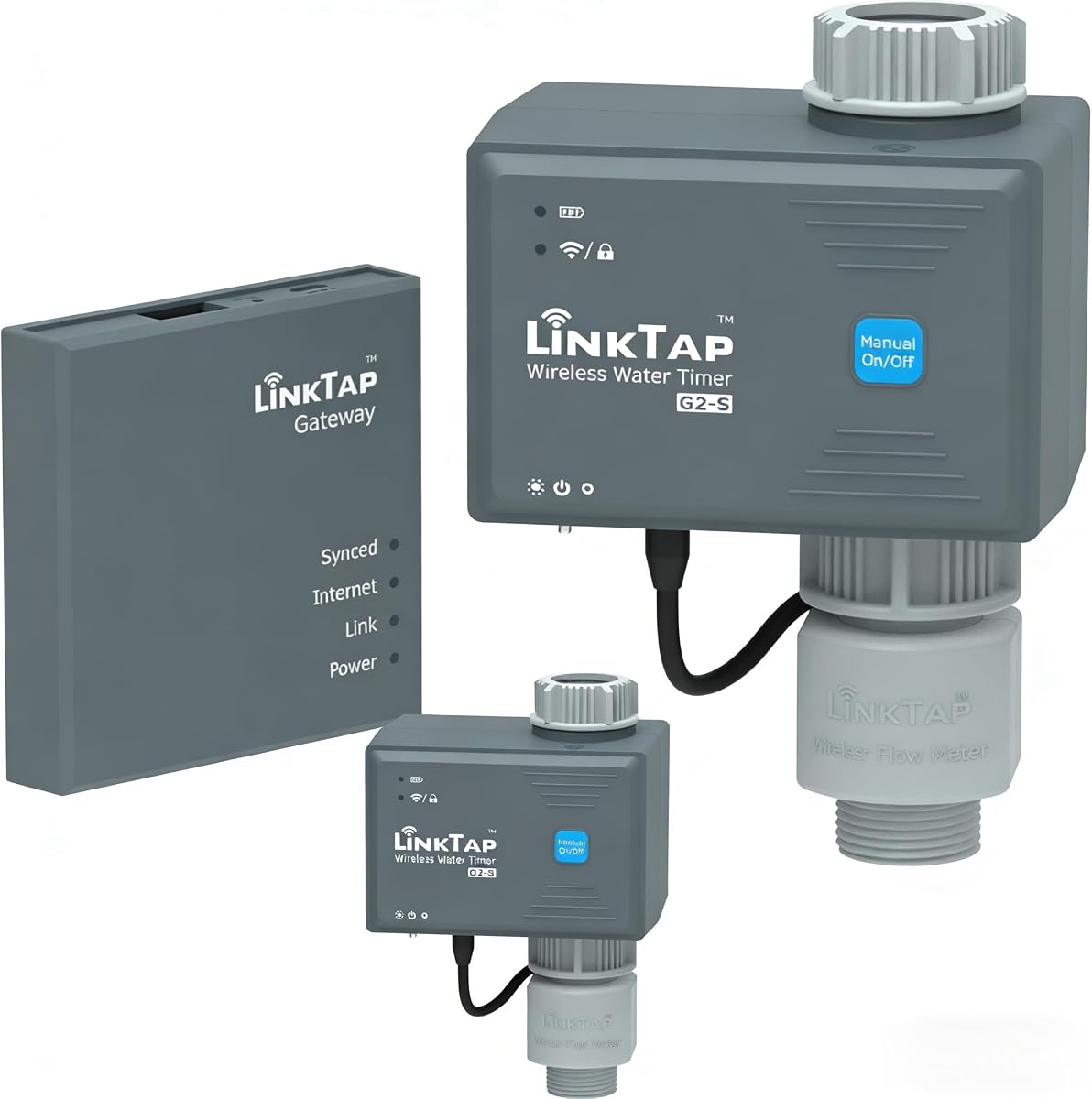
The LinkTap G2S Smart Garden Hose Timer & Gateway combines a single-zone hose timer with the central hardware needed for smart control. Its 4.5 rating reflects a well-rounded feature set: remote operation, weather-adaptive watering, multi-cycle scheduling, leak monitoring, and anti-freeze protection. The composite inlet is also designed to resist rust and avoid the seizing problems associated with some metal connections.
We may earn a commission when you buy through this link, at no additional cost to you.
One of the G2S's strongest features is its flexible scheduling. Users can start or stop water directly, establish repeating cycles by date, duration, or volume, and connect the timer to drip lines, sprinklers, or another custom irrigation arrangement. Weather data can influence irrigation automatically, helping reduce unnecessary watering when outdoor conditions do not justify a scheduled cycle.
The fault-monitoring system adds a valuable layer of protection. Around-the-clock flow monitoring can identify leaks, clogs, valve failures, or disconnections, with push notifications sent through the app. That makes the timer more useful than a simple remote shutoff, particularly for unattended properties, vacation homes, and installations where a small irrigation problem could otherwise continue unnoticed.
This is a sensible choice for someone who wants a capable single-zone smart timer without moving immediately to a dual-zone model. The trade-offs are that the gateway must connect to a router and a single G2S cannot water two hose-based zones independently. Buyers who need separate schedules for separate beds or irrigation types should consider the D1, while those with one well-defined watering circuit will find this setup highly adaptable.
Weather-adaptive control works alongside schedules based on time, date, duration, or volume. This combination makes it easier to match watering to seasonal demand while preserving manual control when conditions or plant needs change.
Flow alerts, anti-freeze behavior, and a two-year battery specification improve reliability. The system can also grow through additional supported timers, controllers, and extenders, making it practical for a developing smart irrigation setup.
We may earn a commission when you buy through this link, at no additional cost to you.
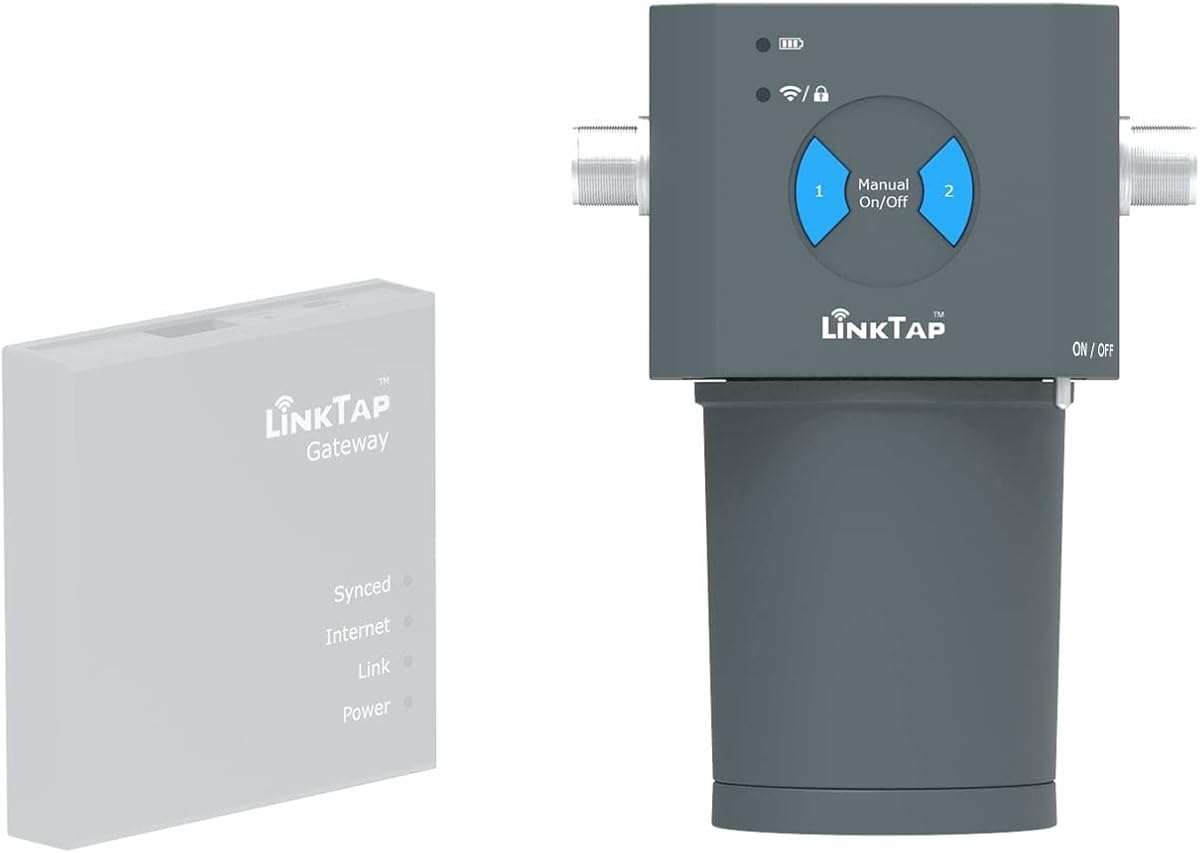
The LinkTap D1 is built for gardeners who want two independent watering circuits under one smart controller. It carries a 4.5 rating and distinguishes itself with two built-in flow meters, allowing the system to monitor each zone separately. That makes it especially interesting for properties where a lawn, drip system, flower bed, or container area requires a different schedule or watering pattern.
We may earn a commission when you buy through this link, at no additional cost to you.
Both zones can be controlled remotely through the LinkTap app or web interface. Scheduling supports multiple cycles organized by date, duration, and volume, while weather-aware control can adjust irrigation according to current conditions. Manual start and stop functions remain available for immediate watering needs, so users do not have to wait for the next programmed cycle.
The pair of flow meters supports one of the D1's most important advantages: more precise fault awareness. The system can issue real-time alerts for leaks, clogs, valve failures, and disconnections. Because the meters measure the two zones individually, the user gains a clearer indication of where an abnormal flow event is occurring instead of receiving only a general system warning.
The D1 is the most compelling choice here for dual-zone hose irrigation, but it is not necessarily the simplest starting point. Buyers should verify that two separate water sources or suitable splitting arrangements are available and be comfortable installing a more involved fixture. For users who only have one basic hose circuit, the G2S or G1S is a more streamlined route. For a larger property with genuinely distinct watering needs, however, the D1's zone-specific monitoring is difficult to replicate with a basic hose timer.
Separate flow meters allow each connected zone to be evaluated individually. This is valuable when one area uses a sprinkler and another uses drip irrigation, because both can run on different schedules while still benefiting from centralized monitoring.
The D1 supports a broader LinkTap ecosystem that includes multiple timer models, valve controllers, and extenders. This makes it useful as the central watering device in a hybrid system rather than as an isolated hose accessory.
We may earn a commission when you buy through this link, at no additional cost to you.
The LinkTap G2S Smart Watering Timers with Gateway earns a 5.0 rating in the available product data and presents a balanced combination of range, scheduling, and protection. It is designed as a complete smart watering solution rather than a basic Wi-Fi hose timer, with remote app and web control, weather-aware operation, and round-the-clock monitoring built into the system.
We may earn a commission when you buy through this link, at no additional cost to you.
Its multi-cycle scheduling is one of the most useful features. Watering can be organized by time, date, or volume, giving users multiple ways to define a program. The timer supports sprinklers, drip irrigation, and standard hose arrangements, allowing the device to serve many common garden configurations rather than forcing a particular watering style.
A low-power wireless network is central to the product's longer-range proposition. Rather than depending on a Wi-Fi signal at the outdoor faucet, the G2S uses a LinkTap mesh approach that can provide more stable coverage across yards and around structures. Flow monitoring adds another layer of value by detecting leaks, abnormal usage, and valve failures and alerting the user before potential damage progresses.
This G2S is a strong all-around recommendation for a property with one outdoor water circuit and a need for dependable remote control. It may not be the right choice when independent watering of two hose zones is essential, but its combination of range, scheduling, and fault detection makes it particularly compelling. For many homeowners replacing a basic mechanical timer, it offers a meaningful upgrade without requiring an in-ground valve-box controller.
The low-power wireless architecture is intended to maintain control across larger outdoor spaces where Wi-Fi reception may be inconsistent. Mesh support also creates a path for improving coverage on difficult properties.
Real-time flow checks can reveal leaks, unusual consumption, or valve failures. These alerts turn the timer into both a scheduling device and an early-warning system for irrigation problems.
We may earn a commission when you buy through this link, at no additional cost to you.
The LinkTap G2S Smart Water Timer, Gateway, and Micro Flow Meter package is tailored to low-flow drip irrigation. Its most important distinction is the included micro flow meter, which is designed for a 0.05 to 1.3 GPM operating range. That makes the package more relevant than a general-purpose timer for gardeners monitoring a drip line with relatively modest water demand.
We may earn a commission when you buy through this link, at no additional cost to you.
The G2S still provides the core smart watering functions. Users can manage the system through mobile or web apps, make immediate changes to water flow, and build multi-cycle schedules by date, duration, or volume. Weather-adaptive control is also included, allowing the timer to reduce unnecessary watering when real-time conditions warrant it.
Flow monitoring adds practical value to a drip system, where small leaks may not be obvious immediately. The listing describes alerts for leaks, clogs, valve failures, and disconnections, allowing a gardener to identify an abnormal condition before a larger portion of the bed is affected. Anti-freeze protection is another useful feature for outdoor installations exposed to cold weather.
This package is best for someone with a dedicated drip zone and a need for more precise usage measurement than the standard G2S provides. Its limitation is obvious: it remains a single-zone hose timer, so a property with separate drip and sprinkler requirements may need a multi-zone alternative. Because the product listing has no customer rating, buyers should evaluate the package carefully against their flow range and existing irrigation layout.
The micro meter's stated range is particularly relevant to drip lines that deliver water below the output of many conventional irrigation meters. It gives the system a more meaningful basis for tracking usage in that environment.
Duration, volume, date, and weather-aware options let gardeners fine-tune watering without operating a manual timer. Immediate app control is useful when plants need an extra drink between programmed cycles.
We may earn a commission when you buy through this link, at no additional cost to you.
The LinkTap 2-Zone Smart Irrigation Controller & Gateway is a more specialized option for properties with an existing in-ground irrigation system. Its 5.0 rating reflects a feature-rich controller designed to operate common DC latching solenoid valves from 1/2-inch to 2-inch sizes. It is intended to serve as a remote smart upgrade where a hose timer would not be appropriate.
We may earn a commission when you buy through this link, at no additional cost to you.
Weather-aware automation includes rain skip and temperature-adaptive watering. Users can create multi-cycle schedules using date, time, or duration, as well as start or stop the system remotely. This gives a conventional valve-box installation many of the same conveniences associated with a modern smart home irrigation system.
The anti-freeze system offers unusually detailed configuration. Users can set a temperature threshold, interval, and flushing duration, with the ability for protection to increase as conditions worsen. That is potentially valuable for cold snaps, exposed pipework, and vacation properties where frozen or damaged lines would be costly and disruptive.
This controller is a compelling option for someone with compatible in-ground valves, but compatibility must be checked before purchase. It does not work with AC solenoids, and a more advanced valve configuration may be required if the existing system uses that type. Those with a simple above-ground hose connection should generally choose a G-series or D1 timer instead. For the right in-ground installation, however, the controller offers strong weather logic, mesh expansion, and remote control in a weather-resistant package.
The controller is designed to sit in an irrigation system and operate mainstream DC latching solenoid valves. This makes it suitable for properties where sprinklers or other permanent irrigation lines are already installed.
Threshold, interval, and flushing settings allow the anti-freeze routine to respond more precisely than a fixed timer. The result is better protection for exposed infrastructure during sustained cold weather.
We may earn a commission when you buy through this link, at no additional cost to you.
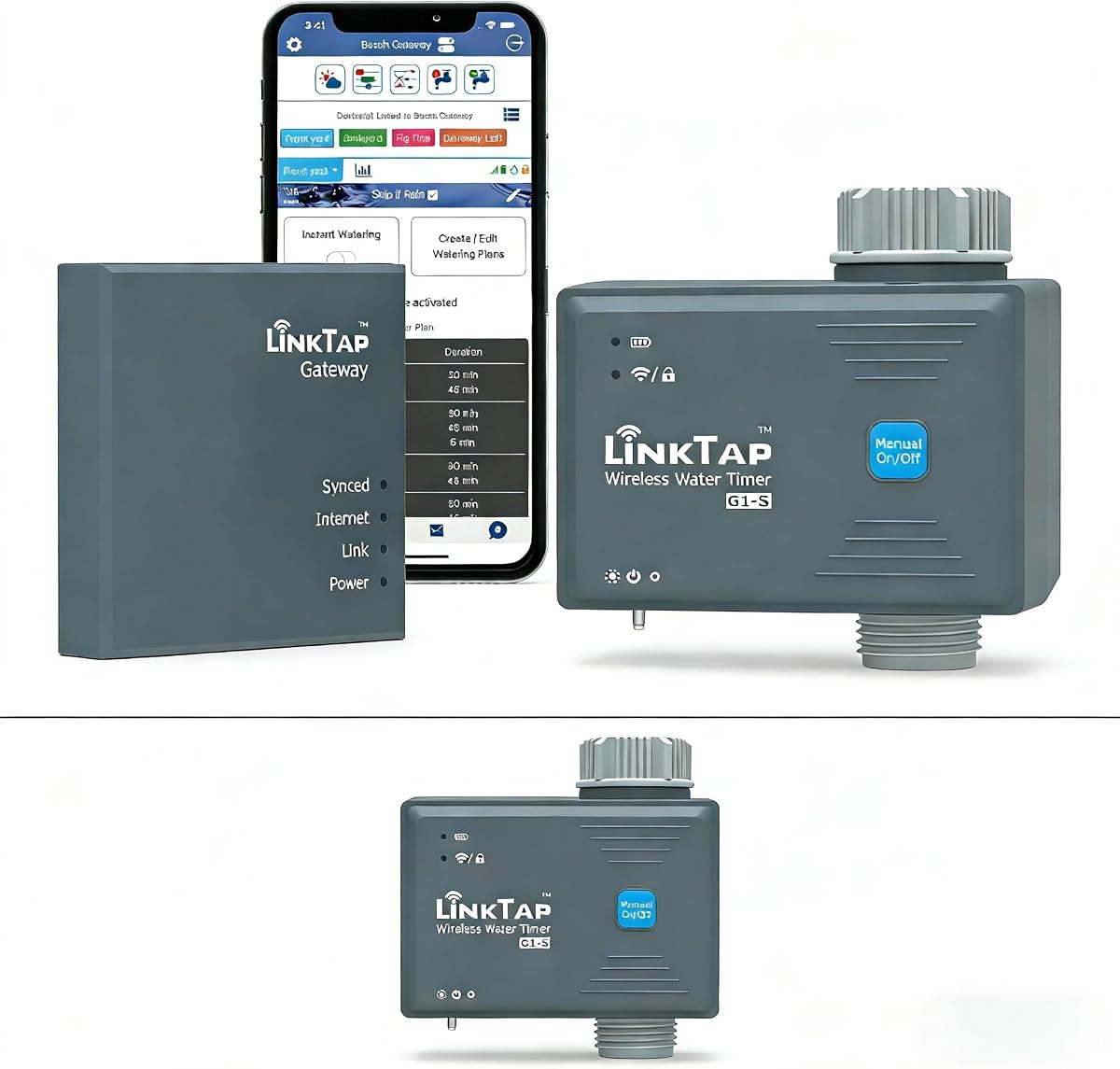
The LinkTap G1S Wireless Water Timer & Gateway focuses on an uncomplicated single-zone experience with a strong emphasis on outdoor durability. It includes a gateway, supports app-based irrigation control, and uses LinkTap's proprietary Zigbee protocol to provide wider wireless coverage than a conventional Wi-Fi tap timer. Its stated battery life is two years.
We may earn a commission when you buy through this link, at no additional cost to you.
Weather-aware scheduling helps ensure that plants receive water according to actual conditions rather than relying entirely on a rigid clock-based program. When a watering schedule is due, the system can account for current weather, reducing waste and helping maintain more consistent plant care. Immediate remote control remains available through the app.
The enclosure is rated IP66 and has a UV-resistant exterior, providing protection in outdoor installations. The G1S also includes smart anti-freeze protection that opens the valve below a preset temperature threshold, helping reduce the risk of ice buildup and related pipe damage. A two-year warranty adds confidence in the product's long-term design.
Setup is one of the G1S's clearest selling points. Scanning the device's QR code through the app automatically connects the timer to the gateway, removing much of the manual pairing work associated with smart irrigation. The product is a good fit for a garden with one hose-fed zone, while a household needing independent schedules for a lawn and drip bed should move to a dual-zone model. The absence of a current listing rating means the feature specifications and warranty should be weighed particularly carefully.
QR-code scanning automatically connects the devices, reducing setup friction for first-time smart irrigation users. The hardwired gateway also provides a stable connection to the user's network.
An IP66 waterproof enclosure and UV-resistant exterior help the timer withstand rain, seasonal sunlight, and other outdoor conditions. The stated two-year battery life also reduces the frequency of routine maintenance.
We may earn a commission when you buy through this link, at no additional cost to you.
The LinkTap D1 Smart Hose Timer & Gateway provides two independently managed watering zones in a hose-timer format. Its scheduling options are unusually flexible, allowing irrigation to be organized by duration, weather conditions, or volume. That makes it a practical choice for users who want different watering approaches for separate areas of a yard.
We may earn a commission when you buy through this link, at no additional cost to you.
Remote app and web control gives users the ability to change programs or operate water flow without being at the faucet. The same flexibility is useful for seasonal changes: a bed with young plants may need frequent short cycles, while a more established area may benefit from a different volume-based schedule. The listing also identifies the device as suitable for small gardens through larger yards.
Intelligent fault detection monitors for leaks, clogs, valve failures, and disconnections. Push notifications allow the user to respond before a fault becomes a larger problem. Automatic anti-freeze behavior further protects the installation, while the scalable mesh network offers a way to extend reliable communication across a property with difficult coverage.
The D1 is best for gardeners who need two hose-based zones but do not require the built-in dual flow meters found in the other D1 package. It offers more scheduling granularity than a single-zone G1S or G2S, but it still requires a more elaborate setup than a basic mechanical timer. The product listing has no customer rating, so the lack of independent feedback should be considered alongside the strong feature set.
Two independent zones prevent one area's schedule from dictating another's. Duration and volume controls make it possible to serve plants with substantially different moisture requirements.
Mesh extender support helps extend communication where the main gateway faces distance or structural obstacles. This is valuable for large yards, complicated landscaping, and installations with multiple separated watering areas.
We may earn a commission when you buy through this link, at no additional cost to you.
The LinkTap 2-Zone Indoor/Outdoor Smart Sprinkler Controller is a capable in-ground irrigation controller designed for properties without continuous AC power. Its 5.0 rating and extensive feature list make it a strong option for users who already have a valve box and compatible DC latching solenoid valves. The gateway is required but is not included in this particular package.
We may earn a commission when you buy through this link, at no additional cost to you.
The controller supports configurable one, two, or four-zone arrangements and works with mainstream DC latching solenoids ranging from 1/2-inch to 2-inch. It cannot operate AC solenoid valves, making compatibility the most important installation question. For a suitable system, the controller can serve as a remote upgrade to traditional battery-operated irrigation equipment.
Rain skip and temperature-adaptive watering help prevent waste, while multi-cycle programs can be based on dates, times, and durations. Users can also begin or stop irrigation from the LinkTap app or web interface. Configurable anti-freeze settings offer threshold, interval, and flushing controls, allowing the protection routine to adapt during severe cold periods.
Advanced flow monitoring becomes possible when a compatible LinkTap flow meter is added, enabling usage tracking and alerts for cutoff, leaks, clogs, and valve failures. The IP66 enclosure supports outdoor placement, and an optional DC converter can add solar or mains-power flexibility. This is a strong controller for a compatible permanent system, but users who need a simple hose timer or a package with the gateway included should choose one of the G-series or bundled D1 options.
Battery operation makes the controller suitable for valve boxes and irrigation sites without nearby AC power. The optional DC converter adds another installation path when solar or mains power is more practical.
A compatible flow meter can add real-time usage data, problem alerts, and automatic shutoff protection. This optional layer is useful for larger or unattended irrigation installations.
We may earn a commission when you buy through this link, at no additional cost to you.
The YoLink Smart Sprinkler Hose Timer is included as a useful alternative for readers comparing smart hose timers rather than shopping exclusively within the LinkTap ecosystem. It has a 4.6 rating and pairs a hose timer with a hub. Its defining feature is LoRa communication, which the listing states can reach up to 2,034 feet in open air and does not require the device itself to use Wi-Fi.
We may earn a commission when you buy through this link, at no additional cost to you.
The timer provides two primary watering modes. Duration mode stops after a selected time, while volume mode aims to deliver a specified quantity of water. Users can schedule daily, weekly, odd-or-even-day, or custom cycles, including intervals such as every two days. Those choices make it adaptable to lawns, vegetable gardens, and delicate planting areas.
ECO mode uses real-time weather information to delay irrigation during rain and resume when conditions clear. The integrated flow meter tracks real-time and cumulative water use, helping users evaluate overwatering. The app also retains 180 days of logs with start times, durations, and consumption, providing a more detailed history than many basic timers.
This kit is an attractive alternative for a large garden or small farm where long open-air range is a priority. It supports remote app control and quick manual operation through the device button. However, it is not part of the LinkTap ecosystem and cannot expand into a LinkTap mesh network. Buyers should choose it for its LoRa range, flow history, and simple modes, while LinkTap remains the stronger path for users seeking multi-zone, fault-alert, and expandable irrigation systems.
LoRa communication can cover substantial open-air distances without requiring Wi-Fi at the timer. That makes the system attractive for large gardens, backyards, and small farms with separated watering points.
The flow meter and 180-day history help gardeners identify inefficient schedules. Detailed start times, run durations, and usage totals make it easier to refine watering over time.
We may earn a commission when you buy through this link, at no additional cost to you.
The LinkTap Gateway is not a watering timer by itself, but it is the connectivity component that allows compatible LinkTap timers and irrigation controllers to join the smart system. It carries a 4.5 rating and is intended for large houses, gardens, and locations where a simple Wi-Fi connection at the outdoor device would be unreliable or inconvenient.
We may earn a commission when you buy through this link, at no additional cost to you.
The gateway connects through the LAN port of a Wi-Fi router, Wi-Fi extender, or network switch. Its support for LinkTap mesh networking and extenders helps distribute the connection across broad or challenging properties. This is a key difference from hose timers that rely directly on Wi-Fi at the outdoor faucet or valve box.
Compatibility is broad within the supported LinkTap range. The listing names Q1, D1, T1, G1S, G2S, G1, and G2 wireless timers, wireless valve controllers, and the Extender. A single LinkTap user account can include up to 20 gateways, making the product suitable for a household managing a substantial smart irrigation network.
This gateway is the right purchase for an existing LinkTap system that needs another central connection point, particularly when a property has multiple distant irrigation areas. It is not a substitute for a timer and offers little standalone value to someone whose compatible devices are already linked to a suitable gateway. Before buying, check the required networking arrangement and confirm that the chosen LinkTap equipment uses the appropriate protocol.
Wired connectivity to the router gives the LinkTap network a stable central point. Mesh extenders can then carry the smart irrigation connection into areas where direct Wi-Fi would be weak.
Up to 20 gateways can be associated with one account. This accommodates households with several irrigation zones, outbuildings, extensive gardens, or other widely separated watering areas.
We may earn a commission when you buy through this link, at no additional cost to you.
The right smart timer depends on the number of watering areas, the type of valve or hose connection, the size of the property, and the level of monitoring required. Start with your irrigation layout, then compare connectivity, scheduling, outdoor protection, and compatibility before comparing convenience features.
A single-zone timer is appropriate when sprinklers, drip lines, or hose-connected beds all need to follow the same schedule. A dual-zone model is preferable when a lawn and garden bed require different run times, watering methods, or frequencies. Independent zones are especially useful for combining high-volume sprinklers with low-volume drip irrigation, since treating both as one circuit makes it difficult to avoid overwatering one area. The G1S and G2S cover basic single-zone installations, while the D1 models and multi-zone irrigation controllers provide more independent control.
Choose enough zones for today's needs, but avoid paying for unnecessary complexity if one circuit handles the entire property. Confirm how many hose outlets or in-ground valves you actually intend to automate.
Above-ground hose timers attach directly to a faucet, while the LinkTap irrigation controllers are built for permanent in-ground valve boxes. The in-ground controllers work with mainstream DC latching solenoid valves from 1/2-inch to 2-inch and are not compatible with AC solenoids. This distinction is critical because a controller that offers excellent remote features cannot operate an unsupported valve. Review the existing solenoid markings and wiring before selecting a controller, and consult an irrigation professional if the valve configuration is unclear.
Use a G-series or D1 hose timer for a standard outdoor tap, and reserve the irrigation-controller models for an existing permanent sprinkler system with compatible DC latching valves.
Flow monitoring can identify leaks, clogs, valve failures, unusual consumption, and disconnections. Some LinkTap hose packages include built-in meters, while the D1 includes two meters for separate zone measurements. The larger irrigation controllers support optional compatible flow meters for permanent systems. A dedicated micro flow meter is especially relevant to drip irrigation operating within a low-flow range. A meter is not merely a consumption counter: when paired with alerts and appropriate shutoff behavior, it can help prevent unattended leaks from continuing.
Prioritize integrated or supported metering if the property is left unattended regularly, contains valuable plants, or has concealed hose connections where a small leak may go unnoticed.
LinkTap uses a low-power Zigbee-based mesh network rather than requiring each outdoor device to maintain a direct Wi-Fi link. This generally offers more reliable coverage across yards, around walls, and through complicated terrain. Extenders can expand the network with multi-hop daisy chaining. Most complete LinkTap bundles include a gateway, but some controller-only listings do not, so package contents must be checked carefully. A gateway connects to the LAN port of a router, Wi-Fi extender, or network switch, and one user account can support up to 20 gateways.
For the YoLink alternative, consider its LoRa network and stated open-air range instead. It supports long-distance communication but belongs to a separate ecosystem and does not provide the same LinkTap expansion path.
The most useful schedules allow more than a simple daily clock. LinkTap products support combinations of time, date, duration, and volume, with multi-cycle programs and immediate manual control. Weather-aware behavior can reduce unnecessary irrigation, while rain skip is especially helpful for in-ground sprinkler systems. Anti-freeze protection adds another layer of unattended protection by acting when temperatures cross a configured threshold. The larger controller permits threshold, interval, and flushing settings, while hose timers use a preset or configurable temperature response. These features are particularly valuable in locations with sudden rain or winter freezes.
Match the automation to the planting type. Volume-based watering is useful for consistent delivery, while duration-based schedules are often easier to tune for ordinary beds and lawns.
An outdoor timer must tolerate rain, sunlight, and seasonal temperature changes. Some listings specifically identify an IP66 waterproof or weather-resistant enclosure, a UV-resistant exterior, and a two-year battery specification. The G1S and G2S are designed for extended battery operation, while the larger in-ground controllers can also use an optional DC converter connected to solar or mains power. Battery operation is convenient at remote valve boxes, but external power can reduce battery-related maintenance. Anti-freeze functions add protection but do not replace physically securing hoses and checking the installation before severe weather.
Consider the location, exposure, and access to power before selecting a model. An outdoor-rated hose timer is sufficient for a standard tap, while a permanent controller should have suitable weather protection and dependable zone compatibility.
Most LinkTap hose timers and gateways are set up by connecting the gateway to the router and scanning the device's QR code in the app. This simplifies pairing compared with manually entering network details at every outdoor fixture. In-ground controllers require more planning because they must connect to compatible valves and mount within the irrigation system. Dual-zone models also need enough plumbing or hose arrangements to separate the two circuits. A simple setup is valuable for occasional users, but larger properties should inventory each zone, its valve, and its water source before ordering.
Read the included component list carefully. A timer, gateway, flow meter, extender, controller, and optional DC converter are not always bundled together, and each serves a distinct networking or irrigation function.
A single timer is often enough for a small garden, but the LinkTap platform supports a larger hybrid network. Depending on compatibility, a gateway can connect supported G-series, D1, Q1, and T1 timers, valve controllers, and extenders. This makes it possible to start with a simple hose setup and later add in-ground control or extended wireless coverage. The alternative YoLink kit also supports a hub-based system, but it does not connect into the LinkTap mesh. Consider current and future irrigation plans, not just today's immediate watering requirement, when deciding on a platform.
Expanding one consistent ecosystem usually simplifies app management. Choose a platform that can accommodate additional zones, difficult signal paths, and permanent irrigation hardware if those upgrades are likely.
Begin by confirming that the faucet, hose, valve, and controller are compatible with the selected model. For a hose timer, clean the faucet threads, check the washer, and attach the timer according to the manufacturer's instructions. For an in-ground controller, verify that every solenoid uses the required DC latching format, connect the valves, and place the controller in a location protected from direct impact while still allowing access for maintenance. Position outdoor hoses so they cannot kink, snag, or create a trip hazard.
Connect the LinkTap gateway to the LAN port of a router, Wi-Fi extender, or network switch, then power it up. Open the LinkTap app, create or sign into the user account, and scan the timer's QR code. Allow the automatic pairing process to finish, then confirm that the device appears online. Begin with a short manual watering cycle to verify flow and valve operation. After that, create programs using the appropriate duration, volume, date, and weather settings, and test each zone independently before relying on unattended schedules.
For routine care, inspect the inlet and connections for dirt, mineral deposits, and wear, and check hoses or pipes for leaks. Clean the flow meter according to its instructions so residue does not affect readings. Review app alerts and usage history regularly, especially after storms or seasonal changes. Test freeze-protection settings before cold weather, confirm that the gateway remains connected, and update schedules to reflect plant growth, rainfall, and seasonal water demand.
Most complete LinkTap packages include a gateway, while some controller-only listings require one to be purchased separately. The gateway provides the connection between the user's network and compatible LinkTap devices. Check the package contents carefully, especially when buying a standalone irrigation controller or adding another timer to an existing system.
A basic G1S or G2S is designed for one hose-connected zone. Two independent areas generally require a dual-zone D1 or a compatible multi-zone irrigation controller, provided the plumbing can separate the circuits. Independent control is valuable when the lawn and drip garden need different schedules or watering volumes.
No. The listed LinkTap irrigation controllers are designed for mainstream DC latching solenoid valves and are explicitly not compatible with AC solenoids. Check the valve type before ordering. If the existing system uses AC solenoids, the valves may need to be replaced or a different controller category may be required.
Flow monitoring can reveal leaks, clogs, valve failures, unusual consumption, and device disconnections. Depending on the model and configuration, it may also support automatic shutoff. This is especially useful for unattended gardens, vacation properties, and installations where a small leak could continue for an extended period.
LinkTap uses a low-power Zigbee-based mesh network rather than requiring each outdoor timer to depend directly on Wi-Fi. The system can use a wired gateway and mesh extenders to improve coverage across large or difficult properties. This design can provide more consistent communication where the outdoor faucet is far from the router or blocked by walls and landscaping.
Yes. LinkTap products use weather-aware control to adjust irrigation based on current weather information. The in-ground controller also lists rain skip among its automation features. Users should still verify local conditions and inspect the system, because weather automation complements rather than replaces sound watering practices and properly installed sensors.
The included YoLink kit is a strong alternative for users who prioritize long open-air wireless range, duration and volume modes, and detailed flow history. It does not integrate with the LinkTap mesh or offer the same broader multi-device ecosystem. The right choice depends on the irrigation layout and the importance of future expansion within one platform.
LinkTap's anti-freeze function can open the valve below a configured temperature threshold, helping reduce ice buildup and pipe damage. The larger irrigation controller also provides interval and flushing settings for more detailed protection. Before winter, secure hoses, confirm the app and gateway are operating, and test the configured response before freezing conditions arrive.
The LinkTap G2S with Gateway stands out as a balanced single-zone option, combining app control, weather-aware schedules, flow alerts, anti-freeze protection, and expandable mesh networking. The D1 2-Zone model is the stronger choice for two independent hose-based areas, particularly when zone-specific flow meters are important, while the multi-zone irrigation controllers suit permanent sprinkler systems with compatible DC latching valves.
The most important decision is to begin with the plumbing rather than the feature list. Count the independent zones, verify the valve type, identify where reliable wireless communication is needed, and determine whether unattended leak detection justifies flow monitoring. A simpler G1S or G2S is often the most rational choice for one zone, while dual-zone and in-ground models become more useful as irrigation complexity increases.
Finally, check the current package contents, warranty details, compatibility requirements, and availability before ordering. Product configurations and prices can change, and the latest listing information is the best source for confirming what is included. Use the comparison to select the right irrigation architecture, then verify the live product page for the most current purchasing details.