
Arlington TVL508-1 Low Profile TV Box for Shallow Walls
4.7Editor score
Shallow 1.25-inch depth
Fits half-inch drywall
Includes decorator receptacle
Paintable white trim
A low profile junction box helps installers fit wiring enclosures into shallow walls, tight cavities, and other areas where a standard electrical box leaves too little clearance. The right choice depends on the wiring application, available depth, required capacity, mounting method, and whether the box must handle moisture, impact, or fire-rated construction.
This guide compares ten options ranging from compact old-work outlet boxes to round fixture boxes, surface-mount back boxes, electronics project cases, and a shallow television box. The evaluation emphasizes dimensions, construction, installation features, listed uses, included components, and suitability for residential, commercial, or DIY projects.
The list shows why low profile does not mean one-size-fits-all: each pick serves a distinct installation need, from retrofitting outlets in finished walls to protecting power supplies outdoors. Ratings reflect the supplied customer feedback, while availability and pricing can change, so confirm the current listing and requirements before purchasing.
4.7Editor score

4.8Editor score
4.5Editor score
As an Amazon Associate we earn from qualifying purchases.
The comparison below organizes all ten options by their most useful distinguishing attributes, including form, depth, capacity, material, installation method, and environmental protection.
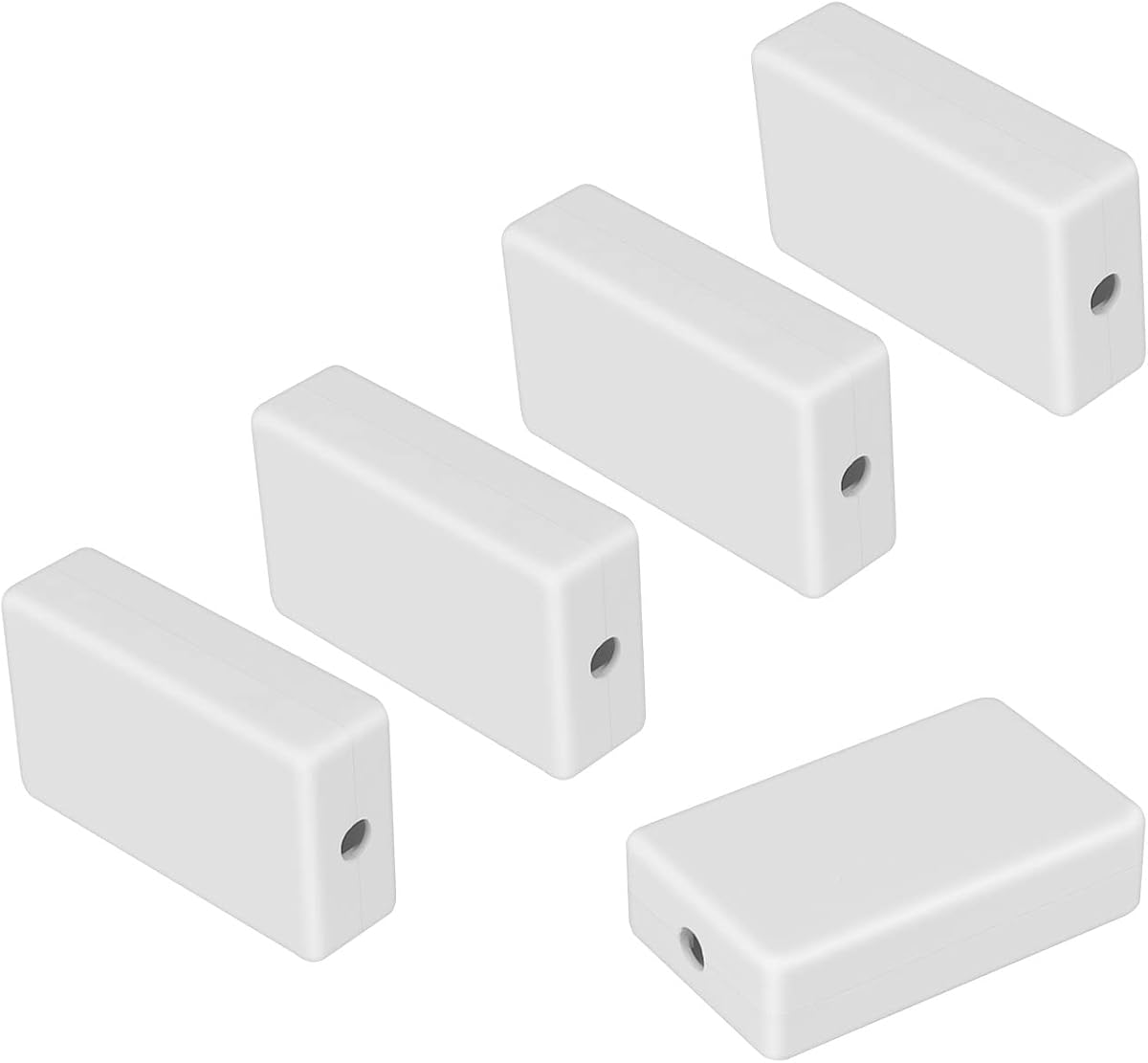



The LeMotech Mini Project Box is a compact enclosure for small electronics rather than a conventional household wall box. Its 2.36-by-1.42-by-0.67-inch external size makes it useful where depth is scarce, while the supplied customer rating reflects a generally favorable reception. The five-piece pack also gives builders several housings for separate circuits, modules, or prototypes.
We may earn a commission when you buy through this link, at no additional cost to you.
ABS construction is the main practical strength. The case is described as durable, practical, and easy to drill without cracking, which matters when a maker needs to create cable openings or fit a board and power accessories. The listed internal space is 2.17 by 1.22 by 0.47 inches, giving buyers a more useful picture of available clearance than the exterior dimensions alone.
Its limitations come from the intended category. It is not presented as a listed electrical outlet box, old-work remodel box, or fire-rated wall enclosure. It also lacks the IP65 sealing arrangement found in heavier weather-resistant project boxes, so exposure to splashing, rain, dust, or snow should be addressed separately rather than assumed.
This enclosure is a strong choice for ESP32, ESP8266, circuit-board, power-accessory, and portable DIY projects. It also works well for anyone who wants several inexpensive small cases in one purchase. For an in-wall outlet installation, choose a purpose-built electrical box instead; for compact electronics that need basic physical protection, this is a practical pick.
The shallow profile and tiny footprint make the case easy to conceal behind a panel, within a tight equipment area, or inside a compact portable project. The stated internal measurements help determine whether a board, connector set, and wiring bundle will actually fit before modification.
Five identical white cases support organized prototypes or several small assemblies. Buyers can reserve one for each subsystem instead of repeatedly modifying a single enclosure, while the consistent finish suits coordinated electronics projects.
We may earn a commission when you buy through this link, at no additional cost to you.
This 4-inch round shallow electrical box is tailored to ceiling fans and wall light fixtures, with a half-inch depth that addresses especially restricted installation spaces. Its strong customer rating makes it a credible option when the installation requires a conventional fixture box but the available cavity is minimal.
We may earn a commission when you buy through this link, at no additional cost to you.
The round shape and 4-inch diameter match a familiar class of electrical housing used for fixtures. Two half-inch bottom knockouts provide places for cable entry and routing, while the shallow design avoids taking up unnecessary room above a ceiling or behind a wall surface. Packs of two or four are available for multi-fixture work.
Because the box is only half an inch deep, it is not a general answer for receptacles, switches, or dense junction assemblies. The available space for conductors and splice connections is limited, so users still need to confirm that the wiring can be gathered safely without crowding the enclosure.
Choose this product for a ceiling fan or wall light installation in a shallow ceiling cavity where the fixture and its connection need a dedicated, low-clearance housing. It is less suitable for remodels that must contain modern device wiring, smart controls, or multiple branch circuits. Measure the cavity and fixture requirements first.
The half-inch profile is the defining advantage. It helps installers accommodate a light fixture where a deeper round box would protrude or require additional space, making it especially relevant to shallow ceiling installations.
Bottom knockouts allow installers to select suitable entry points for the fixture conductors. This makes the housing adaptable to different routing directions while retaining its shallow round design.
We may earn a commission when you buy through this link, at no additional cost to you.
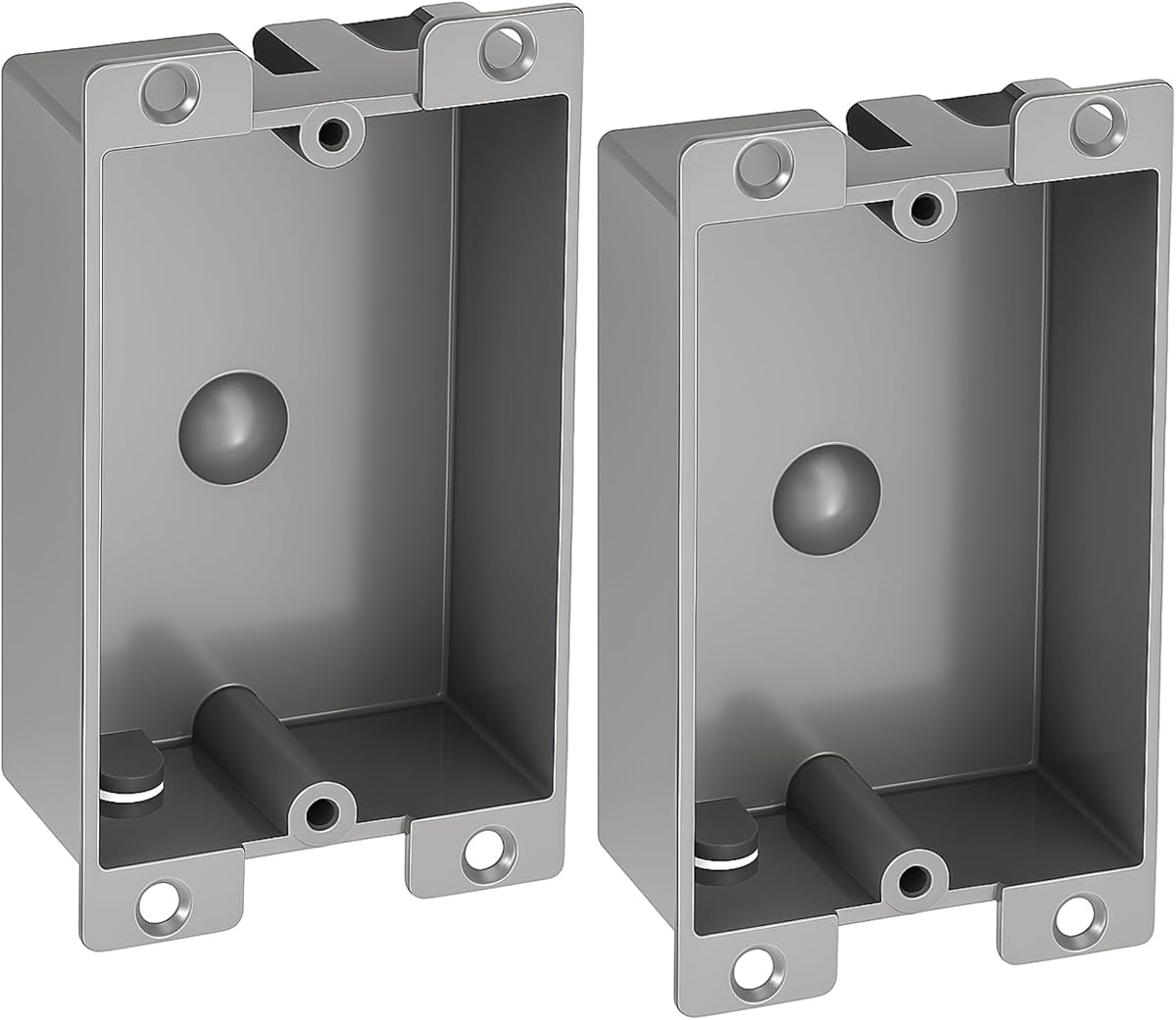
The 2-Pack Shallow Outlet Box combines a low-profile single-gang design with the installation features expected from an old-work remodel box. It is intended for finished walls where a standard electrical box will not fit, and its two-unit configuration is convenient for rooms needing more than one outlet or switch location.
We may earn a commission when you buy through this link, at no additional cost to you.
The product is made from gray PVC and is described as resistant to cracking, warping, and corrosion. Pre-drilled mounting holes and integrated clamps help secure the housing in an existing wall, while the shallow profile accommodates tight wall cavities, shallow drywall, and renovation projects with limited clearance.
The box offers eight cubic inches of space and can be used for compatible switches, receptacles, or low-voltage wiring. Its listed use cases include kitchens, bathrooms, basements, and other renovations. Nevertheless, the title identifies it as a fire-rated product, but the supplied details do not specify an exact listing duration or certification mark, so buyers should verify those details for their particular installation.
This is a useful choice for homeowners and electricians adding a device to a finished wall with limited depth. The two-pack provides a ready option for paired outlets, switch extensions, or separate rooms. Confirm cavity dimensions, clamp operation, local electrical requirements, and any required listing before installation.
The old-work format is designed for retrofitting existing walls without opening the full surface. Integrated clamps and pre-drilled holes support a secure placement in shallow drywall or tight cavities where conventional boxes are impractical.
The multipack supports two installations from one order, which can simplify renovation planning. It is particularly useful for paired devices or for completing more than one room with matching shallow housings.
We may earn a commission when you buy through this link, at no additional cost to you.
The Shallow Old Work Electrical Box offers an unusually balanced combination of compact depth, useful capacity, and documented safety credentials. It is designed for renovations in existing finished walls, and its supplied customer rating is the highest among the ten products in this guide.
We may earn a commission when you buy through this link, at no additional cost to you.
Its 1.24-inch depth helps it fit where a full-depth housing will not, while eight cubic inches still provide a defined interior volume for compatible switches, receptacles, and wiring connections. Non-metallic PVC keeps the enclosure lightweight, and the product is ETL listed and described as acceptable for compatible two-hour fire-rated walls.
The main tradeoff is the one-gang format. It is intended for a single device and cannot substitute for a multi-gang enclosure or a spacious junction housing. Like all shallow boxes, it also requires careful cable planning because the wiring must fit without being forced or crowded.
This is the most versatile all-around choice for a conventional low-profile remodel. It suits installers who want an established listing, shallow finished-wall installation, and enough volume for common device wiring. Choose it over a generic project case when the application is a wall device, and verify local code, box-fill, and fire-rated assembly requirements before installation.
The stated ETL listing and compatibility with two-hour fire-rated walls distinguish this model from generic plastic enclosures. That makes it more relevant for professional remodel work where a recognized electrical box is required.
Eight cubic inches gives the box a useful volume while preserving a 1.24-inch profile. This balance makes it easier to assess than an extremely shallow fixture box when conductors and device connections also need accommodation.
We may earn a commission when you buy through this link, at no additional cost to you.
The Leviton Surface Mount Backbox solves a different low-profile problem: it does not need a recessed wall cavity at all. Its single-gang surface housing can support installations where adding a conventional wall box is impractical, and the supplied rating indicates a well-regarded option within that category.
We may earn a commission when you buy through this link, at no additional cost to you.
The housing is white and designed to coordinate with Leviton's color-matching wallplate series. Breakouts correspond with common surface-mount raceway systems, giving installers a way to route wiring into the enclosure. A depth of 1.45 inches keeps the assembly relatively shallow even though it projects from the mounting surface.
The obvious limitation is visibility. A surface-mount backbox extends beyond the wall instead of disappearing into it, and it may not provide the cleanest finished appearance in a room where a recessed device is desired. Its suitability also depends on the selected wallplate, raceway, and device arrangement.
This box is ideal for retrofits in finished commercial spaces, workshops, utility areas, or locations where wall access is limited. It is a strong option for voice, data, audio, or raceway-based wiring plans that need a neat surface housing. For a hidden installation, choose a recessed old-work box instead.
Because the housing mounts on the surface, it can be installed without cutting into an existing wall. That simplifies retrofits in occupied, finished, or structurally sensitive spaces where opening the wall would be inconvenient.
Breakouts designed for common raceway systems help create a coherent cable path into the enclosure. This is especially helpful for commercial or low-voltage installations where multiple communications lines need organized access.
We may earn a commission when you buy through this link, at no additional cost to you.
The IP65 Waterproof Project Box is the most rugged enclosure in the guide, combining a sealed ABS shell with cable glands, gaskets, and stainless steel screws. Its strong customer rating reflects a favorable balance of protective construction and DIY convenience, although it is not the smallest product here.
We may earn a commission when you buy through this link, at no additional cost to you.
The external dimensions are 3.94 by 2.68 by 1.97 inches, with an internal space of 3.66 by 2.4 by 1.69 inches. That room accommodates more substantial electronics than the miniature project cases. The IP65 designation indicates protection against splashing water, rain, dust, snow, and oil during appropriately sealed use.
Because it is deeper than the wall boxes, it is not the first choice when only a few millimeters of clearance are available. Its weather performance also depends on drilling appropriate openings and fitting the supplied sealing gaskets and M16 cable glands correctly. The housing is described as easy to drill and shape without cracking.
This is an excellent option for Arduino enclosures, power-supply units, temperature controllers, and other electronics exposed to harsh conditions. It is the preferred choice among these products for outdoor or moisture-prone installations, provided the final assembly uses the seals and cable entries as intended.
The IP65 enclosure is intended to block dust and water ingress while insulating and protecting the installed equipment. This makes it more suitable for outdoor electronics than a standard open project box.
The package includes two black junction boxes, eight stainless steel screws, two sealing gaskets, and eight M16 cable glands. Those components support a complete enclosure setup rather than leaving the buyer to source basic sealing hardware separately.
We may earn a commission when you buy through this link, at no additional cost to you.
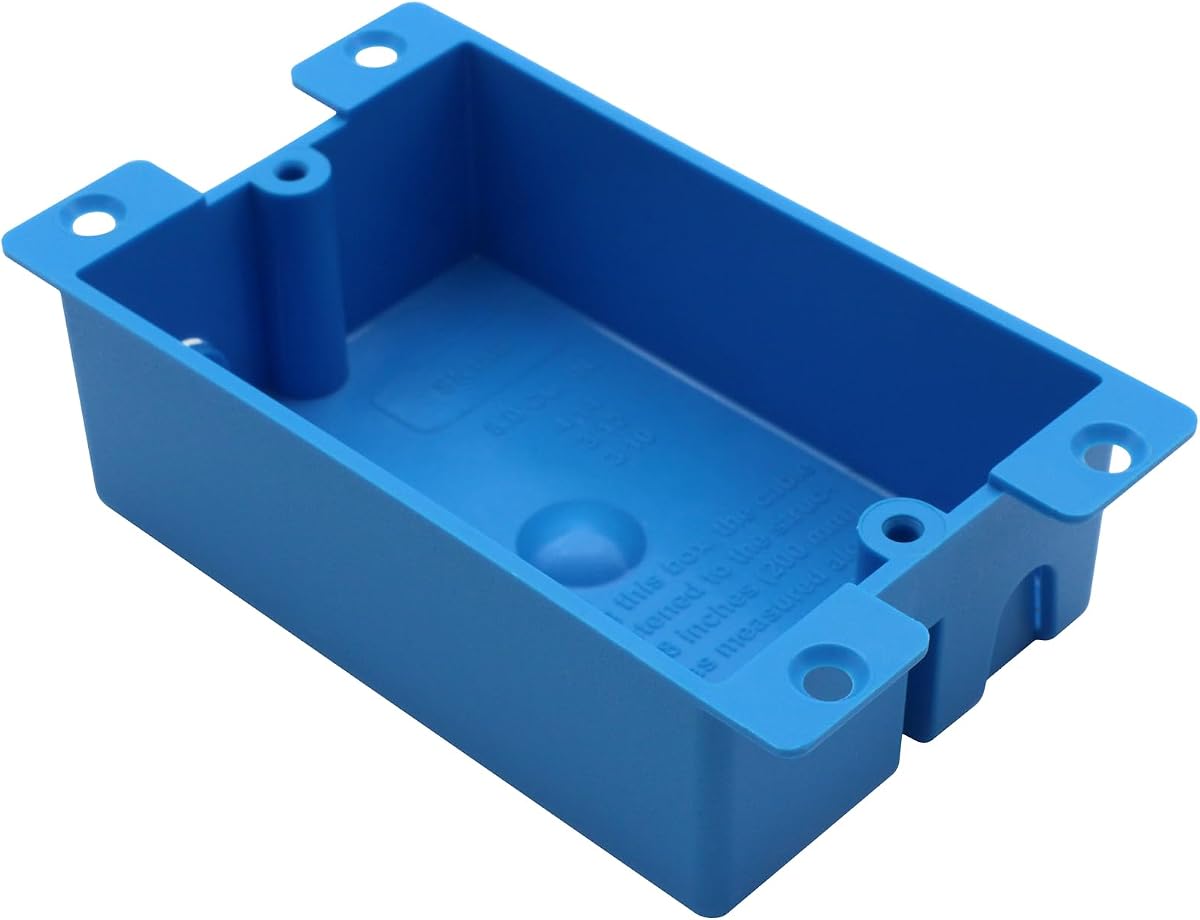
The 1-Gang Old Work Outlet Box delivers a compact electrical enclosure with an eight-cubic-inch interior and a 1.25-inch depth. It is made for adding outlets, switches, or dimmers to existing walls when the cavity is too shallow for a conventional box, and it combines that practical format with ETL certification.
We may earn a commission when you buy through this link, at no additional cost to you.
Built-in mounting tabs and a snap-on connection support installation in finished walls. The recessed plastic design is intended to blend into the wall, while the stated compatibility with 7/14, 6/12, and 5/10 AWG wire standards gives users useful guidance when evaluating conductor fill and device requirements.
The product is fire-rated for two hours and described as suitable for indoor and outdoor use, although a general outdoor suitability claim does not replace confirmation of the complete assembly, cover, and installation conditions. It also includes just one box, so buyers planning several locations need to order accordingly.
This is an attractive value-oriented choice for one shallow remodel location. It is especially suitable for adding a receptacle in a finished wall, replacing a device, or creating a compact switch location. Confirm the exact wall depth and required box volume, then verify local electrical and environmental requirements.
Built-in tabs engage the back of the wall to hold the box in place, and the snap-on connection simplifies the final attachment. These features reduce the need to cut a large opening for a conventional new-work box.
The listed AWG standards help installers think about cable selection and conductor volume before installation. This is valuable when every fraction of an inch affects whether the wiring and device will fit properly.
We may earn a commission when you buy through this link, at no additional cost to you.
The ICC Low Profile Back Box is a surface-mount communications enclosure designed for voice, data, CATV, fiber, audio, and video applications. It earns the highest supplied customer rating in this roundup, giving it exceptional feedback despite being designed for a specialized segment of the category.
We may earn a commission when you buy through this link, at no additional cost to you.
The housing works with standard NEMA boxes and raceway systems, and it can be attached with adhesive backing or screws. Internal routing and rear entry help keep cables organized, while two #6-32 threaded brass inserts provide secure attachment points for compatible faceplates.
Its specialized purpose means it should not be treated as a substitute for every conventional electrical junction box. The listed communications applications and compatibility with ICC faceplates should guide selection, particularly in commercial work where a consistent faceplate and raceway system matters.
Choose the ICC back box for low-voltage or communications wiring in commercial or residential environments where surface mounting is preferred. It is an especially attractive option for organized retrofit work, provided the selected faceplate, raceway, cable type, and mounting surface are compatible.
Adhesive backing provides a quick option for suitable surfaces, while screw mounting offers a more mechanically secure method. This flexibility makes the housing adaptable to different retrofit conditions.
Internal routing and rear cable entry help separate and guide lines inside the enclosure. The result is a cleaner installation than leaving connectors and slack exposed at the faceplate.
We may earn a commission when you buy through this link, at no additional cost to you.
The ARLINGTON Industries FSC405R Shallow Sconce Box is a purpose-specific housing for wall-mounted light fixtures where conventional electrical box depth is inconvenient. Its positive customer rating and recognized sconce-box format make it relevant for installers seeking a cleaner match to lighting hardware.
We may earn a commission when you buy through this link, at no additional cost to you.
The product is described simply as a shallow sconce box and outlet or handy box. That focused format indicates a housing designed around the limited cavity behind a sconce rather than a general junction enclosure for multiple branches or a standard wall device.
The supplied information is intentionally brief, so the buyer should check the physical dimensions, knockout arrangement, and fixture compatibility on the current listing. It should not be selected for a standard duplex receptacle, switch, or electronics enclosure simply because another option uses a low-profile description.
This box is best for a qualified installer or homeowner who already knows the sconce dimensions and electrical requirements. Its dedicated design can simplify fixture replacement in a shallow wall, but accurate measurement and local-code compliance remain essential.
A sconce-specific format is easier to match to the geometry of a wall light than a general-purpose box. This specialization is useful when the fixture's canopy and back box must sit close to the wall.
The product is built around outlet or handy-box applications for sconces. It is therefore most appropriate when the intended fixture and conductor arrangement are known before the box is selected.
We may earn a commission when you buy through this link, at no additional cost to you.
The Arlington TVL508-1 Low Profile TV Box is the most specialized and complete product in the guide, designed to place a flat-screen television and its power connection within shallow drywall. Its strong customer rating reflects a focused solution that combines the box, receptacle, and paintable trim in one kit.
We may earn a commission when you buy through this link, at no additional cost to you.
The housing measures 8 by 5 inches and has a 1.25-inch depth, making it suitable for walls with one-half-inch or five-eighth-inch drywall. It is intended for LCD, LED, or plasma flat-screen televisions and can simplify both retrofit and new construction by placing the receptacle directly behind the display.
This is not a general-purpose junction box for a collection of splices, and it is not appropriate for every wall or attachment arrangement. The television's weight, mounting method, wall structure, cord path, and the appropriate fastening system must all be considered separately from the electrical box.
For a homeowner mounting a television on a shallow wall, this is the most convenient dedicated option in the roundup. The included UL-listed decorator receptacle and paintable white trim reduce the need to assemble a custom media box. Confirm the wall construction and television mounting requirements before installation.
The kit includes a UL-listed decorator-style receptacle, allowing the power connection to sit within the shallow media housing. This integrated approach can simplify a television installation compared with a general electrical box.
The white trim can be painted to blend with the wall, reducing the visual impact of a shallow installation. Its broad face also helps organize the receptacle and cable area behind the television.
We may earn a commission when you buy through this link, at no additional cost to you.
The correct low profile junction box depends on what it must hold, how deeply it must fit, and which installation method and safety conditions apply. Measure before ordering and separate general enclosure needs from listed electrical box requirements.
Depth is the first constraint because a box that appears small on a product page can still be unusable if it includes projecting ears, attachment tabs, or a faceplate assembly. Measure the space between the wall surface and the obstruction behind it, then compare that figure with the housing depth and any required connector or device projection. The 1.24-inch and 1.25-inch remodel boxes, the 1.45-inch surface backbox, and the half-inch fixture box each solve different clearance problems.
Measure the finished opening rather than just the stud bay. Drywall thickness, backing, trim, wiring bends, and the depth of the attached device all affect the usable space. Choose a housing with room for its specified internal cavity, not merely an exterior depth that passes a narrow spot check.
A wall device, lighting fixture, communications plate, media receiver, and small electronic controller have different enclosure requirements. Products explicitly described as old-work electrical boxes, surface-mount back boxes, sconce boxes, TV boxes, and electronics project cases should not be treated as interchangeable. Match the product to the device, conductor path, number of connections, and whether it will remain exposed or be concealed.
The phrase junction box can describe both professional electrical enclosures and general-purpose electronics cases. Check the listing carefully for outlet-box construction, mounting tabs, knockouts, flame rating, and included accessories. This prevents choosing a case that looks appropriate but lacks the features required for the intended application.
Low depth often means less room for conductors, device bodies, and wire nuts. Where volume is published, compare it with the amount and gauge of wire required for the installation rather than choosing by exterior dimensions alone. The two eight-cubic-inch remodel boxes provide a stated working volume, while the shallow fixture housing deliberately prioritizes depth over generous capacity.
Allow enough room for the conductors to enter without sharp bends, crowding, or being forced behind the device. Verify the device's volume allowance and any applicable box-fill calculation with the relevant electrical authority. More space can be valuable even when the housing remains shallow, so balance capacity against the available cavity.
Old-work boxes are designed for existing finished walls and commonly use hinged ears or clamps that grip the back of the wall. New-work boxes are usually secured directly to framing and are often installed before the wall surface is closed. The LeMotech, ICC, sconce, TV, and waterproof project enclosures are not automatically substitutes for an old-work electrical box, even though each is compact in at least one dimension.
If the wall is already finished, verify that the box has the retention mechanism needed to hold it in place. If construction is still open, a box secured to a stud or bracket may be more appropriate. Select the mounting method around the actual stage of the project rather than relying on a generic low-profile description.
ABS and PVC are common lightweight enclosure materials, but their suitability depends on the location. Dry indoor electronics may need only a drillable plastic case, while outdoor power equipment calls for a housing with a stated IP65 protection level, sealing gaskets, and cable glands. Fire-rated wall requirements are also separate from weather resistance and should be checked independently.
Inspect the intended environment for moisture, dust, impact, sunlight, oil, temperature variation, and physical load. A weather-resistant box still needs correctly sized sealed cable entries, while a fire-rated wall box may require compatible components. Do not infer one certification from another or assume that an ABS case can be exposed outdoors merely because it resists moisture better than bare equipment.
Look for the features that make installation cleaner: pre-drilled holes, integrated clamps, mounting tabs, knockouts, raceway breakouts, cable glands, gaskets, and included screws. These details can determine whether the box is ready to install or whether the user must source additional hardware. The IP65 project case includes a substantial accessory set, while the TV box includes a receptacle, and the television mounting system remains a separate consideration.
Check what is actually included before planning the installation. A useful kit should complement the installation method, but it does not replace suitable fasteners, wall anchors, cable connectors, device screws, or a properly selected device. Make a short parts list based on the wall, device, and wiring route.
For electrical work in walls, look for a clear certification such as the ETL listing stated for the shallow remodel boxes and the UL-listed receptacle included with the TV kit. A listing is most valuable when it covers the exact product, configuration, and application. Generic electronics cases are not automatically approved as outlet boxes or fire-rated assemblies.
When the installation involves a fire-rated wall, weather exposure, or a regulated electrical system, confirm the documentation and local requirements with the appropriate authority. The two-hour rating stated for selected remodel boxes should be matched with compatible installation components. A listed part can still be used incorrectly, so complete-system planning remains necessary.
Begin by identifying the device, conductor path, mounting surface, and available depth. Turn off and verify electrical power before working on any connected wiring, then mark the opening according to the box instructions and local requirements. For a remodel box, install the retention tabs or clamps in the opening before securing the housing; for a surface enclosure, use the appropriate screw or adhesive method for the surface and load.
Route conductors through the intended knockouts, rear entry, or cable glands without removing material that the manufacturer expects to remain intact. For a weather-resistant project box, fit the supplied gasket and M16 cable glands around properly sized openings, then tighten the hardware evenly. Leave the conductors loose enough to make required bends but free of pinching, strain, and contact with sharp edges.
After securing the box, connect the appropriate device and check that it sits squarely without forcing the faceplate or trim. For the TV box, follow the television manufacturer's mounting instructions and confirm that the chosen mount is supported by the wall structure rather than the electrical enclosure. Keep covers dry, keep seals free of damage, and inspect gaskets or old-work tabs periodically for cracking or loosening.
A low profile junction box is designed with a shallower depth or a surface-mounted configuration for locations where a standard recessed box cannot fit. The trade-off is often less internal space, so it is important to confirm that the conductors, device, and connections will fit. The products in this guide include several distinct formats, so the exact construction matters.
Only use a housing that is explicitly designed and suitably listed for that outlet or device. The shallow one-gang old-work boxes in this guide are intended for compatible switches and receptacles, while the miniature project cases are for electronics and should not be treated as outlet boxes. Always check the listing, device compatibility, and local electrical requirements.
Measure the distance from the front of the finished wall to the nearest obstruction, and include the depth of the device and any cable bends. The listed 1.24-inch and 1.25-inch dimensions describe the boxes themselves, not necessarily the total space needed by every connected component. A shallow box should not be forced into a cavity that is even slightly too tight.
The IP65 Waterproof Project Box is the most suitable of these products for that use because it includes sealing gaskets, cable glands, and a weather-resistant ABS enclosure. It is also deeper than the wall boxes, so adequate space is still required. Correct drilling, gasket placement, and cable-gland fitting are essential to maintaining its intended protection.
No. Fire-rating is a specific construction and listing characteristic, not a generic benefit of shallow plastic boxes. Two of the remodel selections state a two-hour fire-rated use and an ETL listing, but the exact conditions and compatible components should be verified. Electronics cases and some fixture boxes have different intended uses.
Yes, when the housing, faceplate, raceway system, and wiring method are compatible with the installation. Surface mounting avoids cutting into the wall, although the enclosure remains visible and projects from the surface. The ICC model is aimed at communications and raceway applications, while the Leviton model serves surface-mounted device and back-box installations.
The Arlington TVL508-1 is purpose-built for that application, with a shallow media box, included UL-listed decorator receptacle, and paintable trim. It fits specified one-half-inch or five-eighth-inch drywall conditions and has a 1.25-inch depth. The television itself still requires a suitable mounting system and adequate structural support.
It depends on the box volume, device depth, wire size, number of conductors, and applicable box-fill rules. The listed eight-cubic-inch boxes offer a defined starting point, but the final answer also depends on the conductors entering the box. Confirm that cables bend without force and check the applicable electrical requirements before making the connection.
The Shallow Old Work Electrical Box stands out as the strongest all-around option because it combines a 1.24-inch depth, eight cubic inches of capacity, a clear ETL listing, and suitability for compatible two-hour fire-rated walls. The Arlington TVL508-1 leads for a complete shallow-wall television installation, while the 1-Gang Old Work Outlet Box delivers a focused, economical solution for a single shallow remodel location.
Prioritize the application before the size. Choose a listed remodel box for a wall device, a fixture-specific housing for lighting, a raceway-compatible back box for communications, a sealed project case for outdoor electronics, and a dedicated TV box for a shallow media installation. Accurate depth measurements, internal volume, mounting method, and environmental conditions are more important than a generic low-profile label.
Ratings and product configurations offer useful guidance, but the current listing should remain the final source for dimensions, included parts, certifications, and compatibility. Pricing and availability can change, so compare the current options before purchasing and confirm that the chosen enclosure satisfies the device, wall construction, and applicable electrical requirements.