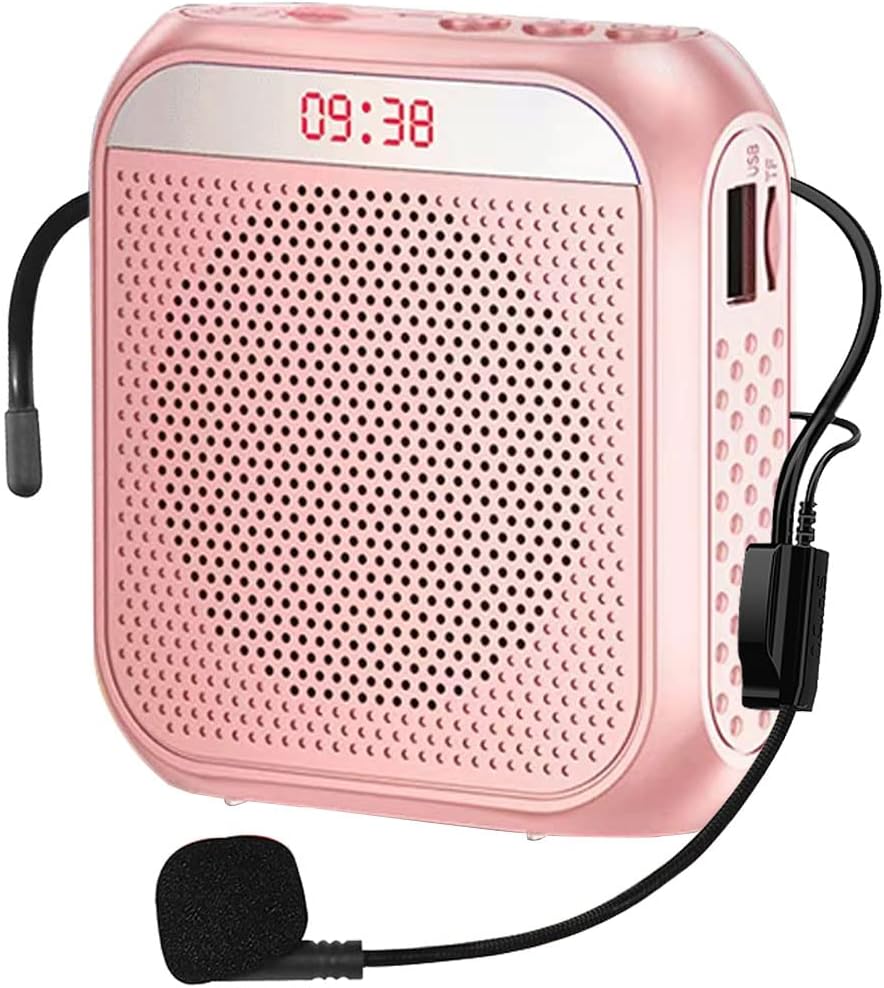
Portable 2200mAh Voice Amplifier
4.3Editor score
Eight-watt personal amplifier
Twenty-hour voice runtime
Adjustable headset microphone
TF and USB playback
Multiple carrying options
Discover the best microphones for teachers, comparing wireless range, sound quality, battery life, comfort, connectivity, and classroom coverage.
A classroom microphone can transform lessons that are difficult to hear, especially in large rooms, busy shared spaces, or outdoor learning environments. The right model should project a clear voice without making instructors shout, while remaining comfortable enough for a full teaching day and simple enough for anyone to operate.
The products in this guide were compared using the specifications and feature descriptions supplied for each model. Key considerations include microphone style, amplification power, wireless range, battery runtime, supported audio connections, portability, and the degree of control offered during lessons, presentations, and other public-speaking situations.
Each review explains the product’s strongest benefits, practical limitations, and ideal classroom situation. The top picks demonstrate the range available in this category, from compact wired personal amplifiers to wireless lapel systems with extended range. Product availability, ratings, features, and prices can change, so confirm current details before purchasing.
4.3Editor score

4.4Editor score

4.0Editor score
The comparison below highlights the main differences among wired personal amplifiers, wireless headset systems, and clip-on lavalier packages, with particular attention to output, range, runtime, and classroom flexibility.


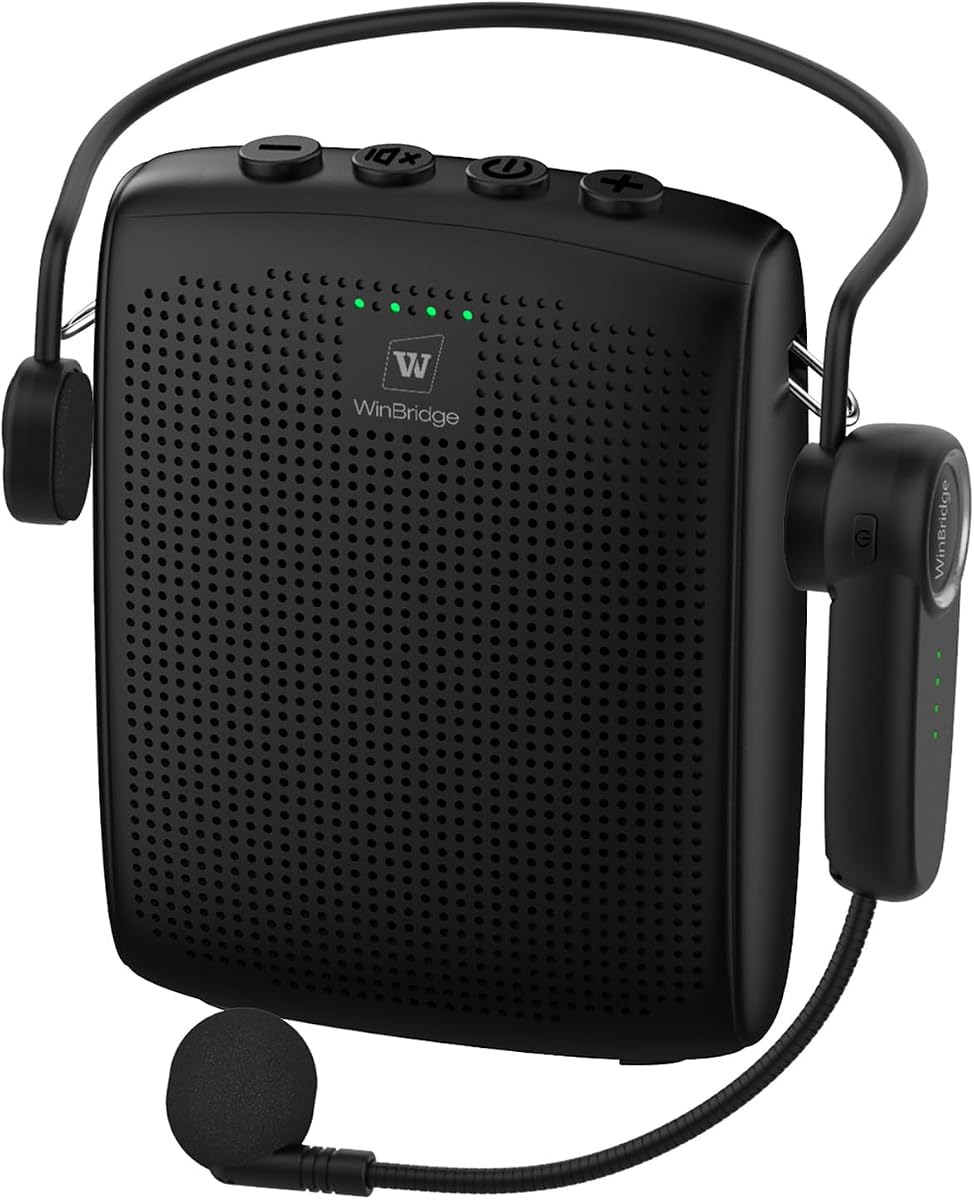


The ZOWEETEK Original Portable Wired Microphone is a compact personal amplifier designed to make an instructor’s voice easier to hear. It carries a 4.4 rating and stands out for its 10-watt output, rechargeable 1,800mAh battery, and flexibility in how it can be worn. Its small dimensions and low weight make it easy to carry between classrooms.
We may earn a commission when you buy through this link, at no additional cost to you.
The system is described as producing clear, distortion-free sound with coverage for areas up to 10,000 square feet. The adjustable microphone lets the user alter the distance between mouth and mic, while the amplifier can sit on a belt, in a pocket, or hang from the neck. It also supports TF card playback, USB flash drives, and a 3.5mm AUX connection.
Its wired design is the main limitation. Teachers who move constantly, work around students, or want to leave the speaker on a desk may find the cable less convenient than a wireless lavalier. The stated room coverage and output should also be understood as maximum figures rather than a guarantee for every acoustic environment, since walls, furnishings, and background noise affect results.
This is a sensible choice for educators who want a simple personal amplifier without navigating complicated wireless controls. It suits smaller classes, meetings, indoor presentations, and anyone comfortable with a cable. Teachers seeking unrestricted movement should instead examine the wireless systems later in the guide.
The adjustable mic-to-mouth distance gives teachers a way to balance clarity and comfort, while the back clip, waistbelt, and neck-hanging options make the unit adaptable to different clothing and lesson formats.
TF card, USB flash drive, and AUX support allow instructors to play recorded material, background music, or other audio without needing a separate speaker for every task.
We may earn a commission when you buy through this link, at no additional cost to you.
The ZOWEETEK Portable Rechargeable Mini Voice Amplifier combines a 10-watt speaker with an adjustable wired headset microphone. It holds a 4.4 rating and offers much of the same classroom utility as the company’s Original model in a particularly compact package. The stated 10,000-square-foot coverage and 12-hour amplification time make it appear suited to extended teaching use.
We may earn a commission when you buy through this link, at no additional cost to you.
The amplifier weighs 0.36 pounds and measures 4.1 by 1.4 by 3.4 inches. It can be clipped to a belt or pocket, tied around the waist, or worn around the neck. Its 1,800mAh battery takes approximately three to five hours to charge, while music playback is listed at up to ten hours. A 3.5mm AUX input also allows it to operate as a wired speaker.
As with other personal voice amplifiers, maximum coverage depends on room acoustics and speaker placement. The wired headset avoids battery use on the microphone and may provide consistent transmission, but it also means a cable must run between the instructor and speaker. The supplied description does not mention Bluetooth, so users should not assume phone or laptop connectivity is available.
The model is best for teachers who value a light body, simple operation, and a stable wired headset. It works particularly well for small-to-medium classes, training sessions, indoor presentations, and tour guiding. Those who require hands-free wireless movement should favor one of the clip-on lavalier systems instead.
The adjustable headset can be repositioned around the mouth, and the light amplifier body can be carried in several ways. That flexibility is useful for instructors who move between lecturing, demonstrations, and one-on-one student support.
A claimed 12-hour voice runtime and three-to-five-hour recharge period make the amplifier suited to a typical school day. Actual duration can vary with volume and use, so charging before important lessons is prudent.
We may earn a commission when you buy through this link, at no additional cost to you.
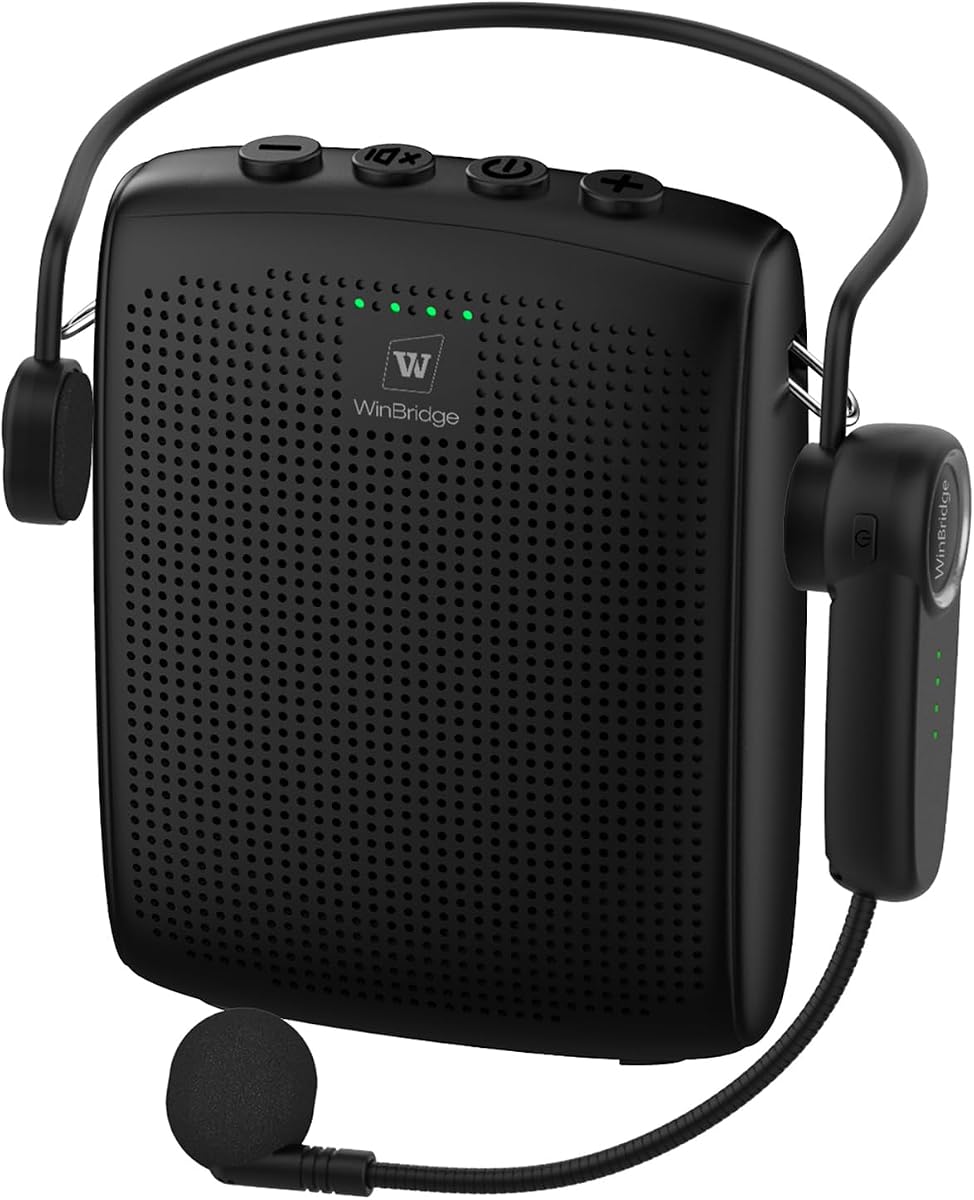
The WinBridge Wireless Voice Amplifier with Clip-On Lapel Mic combines 15-watt amplification with a lightweight 0.64-ounce wireless microphone. Its 4.4 rating reflects a favorable balance of output, portability, and simple operation. The system is specifically positioned for educators in small-to-medium classrooms who need to move freely without holding a microphone or managing a long cable.
We may earn a commission when you buy through this link, at no additional cost to you.
Automatic pairing removes the most complicated part of using wireless audio. Both the speaker and microphone have mute buttons, allowing an instructor to interrupt amplification briefly without powering down the entire system. The speaker includes a 2,600mAh battery with a stated 12–15 hours of voice amplification, while the microphone has a 300mAh battery offering more than ten hours. A dual Type-C cable charges both units together.
Bluetooth playback lets the amplifier handle background music from a phone or laptop while voice amplification remains active. The supplied information does not provide a precise wireless range, which makes this model less transparent than systems that publish a distance. Teachers covering very large areas should test the system in the intended environment and consider the 35W SHIDU alternative for its much longer stated range.
This is the most broadly balanced choice in the guide. It suits teachers, presenters, coaches, and trainers who want a discreet microphone, straightforward setup, useful mute controls, and enough power for a conventional classroom. It is particularly attractive for users who dislike the pressure and bulk of headset-style microphones.
The tiny lavalier microphone can be clipped to a collar, held in hand, or carried with the included strap. That makes it less intrusive than a headset and allows teachers to write, gesture, or move around the room naturally.
Automatic pairing, straightforward controls, and a one-touch mute on both units reduce the training required for substitute teachers, support staff, or anyone using the system only occasionally.
We may earn a commission when you buy through this link, at no additional cost to you.
The B006 15W Wireless Lavalier System is built for teachers who need to move beyond a small teaching zone. It has a 4.4 rating, 15-watt speaker output, and a stated 2.4GHz range of at least 98 feet in open areas. The lavalier format avoids the pressure and visual bulk of a headset.
We may earn a commission when you buy through this link, at no additional cost to you.
The system supports fast pairing, low audio delay, and stable transmission, while Bluetooth music can operate alongside voice amplification. Its most useful teaching control is the microphone’s one-touch mute, which lets an instructor pause transmission without walking back to the speaker. The microphone can provide up to 15 hours of use, while the speaker is listed at up to seven hours under specific testing conditions.
The seven-hour speaker runtime may be limiting for teachers with long instructional days, especially if they use high volume or Bluetooth audio throughout. The 98-foot range also depends on open space; walls, crowds, and classroom furniture may reduce practical reach. A longer speaker battery and range specification make this model easier to evaluate than the preceding wireless option.
The B006 is a good fit for large classrooms, campuses, outdoor instruction, guided tours, and training sessions where a teacher may walk far from the speaker. It is particularly attractive for users who need a clearly stated range and want the option to use music while speaking.
A stated 98-foot open-area range gives instructors room to cross a gym, field, or auditorium. In furnished interiors, realistic expectations should be based on a hands-on trial rather than the maximum figure.
The built-in mute button is a practical classroom feature because it lets teachers pause private exchanges or eliminate accidental feedback without returning to the speaker.
We may earn a commission when you buy through this link, at no additional cost to you.
The Portable Voice Amplifier for Teachers is an approachable personal system for small classes and other moderate-size speaking environments. It has a 4.3 rating, an eight-watt output, and a stated ability to cover a room of roughly 25–50 people. Its 2,200mAh battery is one of the larger capacities in the guide.
We may earn a commission when you buy through this link, at no additional cost to you.
The supplied information lists up to 20 hours of voice amplification and 13 hours of music playback after a four-to-six-hour charge. The head microphone uses a flexible gooseneck for positioning, while the speaker body can be clipped to a belt or waistband or worn around the neck. TF card and USB flash drive playback add value when teachers need recorded material.
Its eight-watt output is lower than the 15-watt and 35-watt alternatives, so it is less appropriate for auditoriums, gyms, or very large groups. The wired microphone may also feel less natural when students crowd around a demonstration. As with the other personal amplifiers, the stated room capacity will depend on acoustics, speaker placement, and ambient noise.
This model is a good budget-oriented choice for small classrooms, tutoring sessions, conferences, outdoor speeches, and training with modest attendance. It prioritizes long runtime, simple media playback, and low weight. Teachers with larger groups or a need for wireless movement should save up for one of the more powerful lapel systems.
The claimed 20-hour amplification time offers flexibility across multiple class periods. Charging the unit before its first use and between major teaching blocks is still advisable.
The flexible gooseneck lets the microphone sit near the mouth even while the amplifier is clipped to clothing, improving voice pickup without requiring a separate handheld microphone.
We may earn a commission when you buy through this link, at no additional cost to you.
The WinBridge Bluetooth Headset System provides 15-watt output in a wearable two-part design. It carries a 4.3 rating and is described as suitable for classrooms with around 50 middle school students. The speaker can be clipped to a belt or hung from the neck, while the wireless headset can also be handled as a handheld microphone.
We may earn a commission when you buy through this link, at no additional cost to you.
Automatic pairing makes setup quick, and the 2,600mAh speaker battery offers a stated 12–15 hours of operation. The headset itself is listed at eight to ten hours, and both components use the included Type-C charging cable. Bluetooth adds compatibility for music and other audio, making this a broader teaching and presentation package.
The principal trade-off is physical comfort. Some teachers prefer a headset because it keeps the microphone in a predictable position, while others dislike the pressure or feel of wearing one for an entire day. The speaker’s maximum runtime is also not guaranteed at every volume level, and keeping both units charged requires planning.
This model is best for instructors who like headset microphones and need strong output without a complicated setup. It is suitable for traditional classrooms, indoor presentations, training, and group activities. Teachers who prioritize a nearly invisible profile and unrestricted movement may prefer a clip-on lavalier model.
A headset keeps the microphone close to the mouth and hands-free, which can be useful during demonstrations or when both hands are needed for classroom materials.
The long speaker runtime is designed to support a school day, while the shorter headset runtime still covers many consecutive periods when recharged between uses.
We may earn a commission when you buy through this link, at no additional cost to you.
The A006 combines a 15-watt amplifier with a small wireless lavalier microphone and earns a 4.4 rating. It is designed for teachers who want clear classroom projection without a headset, and its stated 49-foot range supports movement around conventional classrooms, studios, and tour groups.
We may earn a commission when you buy through this link, at no additional cost to you.
Automatic connection takes only seconds, while the amplifier provides a back clip and adjustable strap. The microphone weighs 0.6 ounces and has a one-touch mute button. Bluetooth 5.0 and USB flash drive playback allow background music to run alongside amplified speech, and the supplied dual charging cable simplifies recharging both components.
The amplifier’s listed 12–15-hour battery life and the microphone’s 15-hour runtime are useful for extended teaching days. The 7.05-ounce speaker is portable but not as light as the smallest personal units. The 49-foot range is suitable for many indoor spaces, though it is shorter than the B006 and SHIDU systems for large venues or outdoor campuses.
This is an attractive option for teachers who want wireless freedom, discreet placement, and convenient audio playback without a complicated interface. It works well in regular classrooms, yoga studios, small auditoriums, and guided tours. Those needing much greater reach should examine the higher-output SHIDU system.
The 0.6-ounce microphone clips to clothing and avoids the pressure associated with a headset. Its low visual profile also suits professional presentations and recorded teaching environments.
Bluetooth 5.0 and USB playback turn the amplifier into a multi-purpose classroom speaker, allowing teachers to play music or instructional audio while retaining live voice control.
We may earn a commission when you buy through this link, at no additional cost to you.
The Skin Tone Wireless Lavalier System is a compact 10-watt package designed for lectures, meetings, presentations, and teaching. Its 3.7 rating is the lowest in the group, but the system still offers a useful feature set: automatic connection, a 49-foot stated range, rechargeable components, and Bluetooth 5.0 playback.
We may earn a commission when you buy through this link, at no additional cost to you.
Its 20-gram, coin-sized microphone can be concealed under a collar or tie, helping teachers maintain a professional appearance. The speaker’s 1,800mAh battery is listed for eight to twelve hours of continuous playtime, while the microphone’s smaller 120mAh battery provides more than seven hours. A 15-meter range supports movement around a classroom or event space.
The system’s lower rating and 10-watt output warrant more attention when choosing it for a large group. The seven-hour microphone runtime may not cover an entire uninterrupted conference day, and no specific feedback controls or advanced noise-processing features are detailed in the supplied information. Actual pairing performance should also be verified in a busy wireless environment.
This model is most appropriate for teachers, facilitators, and presenters who value a nearly invisible microphone and compact portability. It can work well for small classes, meetings, and short workshops. For demanding rooms or long continuous sessions, alternatives with stronger output, longer battery life, or higher customer ratings offer greater confidence.
The small skin-tone microphone can sit discreetly on clothing, helping instructors focus on presentation rather than visible equipment. It is particularly useful for professional meetings and recorded sessions.
Powering on both units triggers automatic connection, and Bluetooth 5.0 makes the speaker useful for background audio from common mobile or laptop devices.
We may earn a commission when you buy through this link, at no additional cost to you.
The SHIDU 35W Wireless Lavalier System is the most powerful model in this guide. It has a 4.0 rating, 35-watt output, and a stated ability to cover approximately 22,604 square feet with as many as 320 people. Its 131-foot wireless range is also the longest published figure among these products.
We may earn a commission when you buy through this link, at no additional cost to you.
The 2.4GHz lavalier microphone is designed for sensitive pickup and strong penetration through a large space. The speaker has a 3,100mAh battery, charges in an estimated two to four hours, and offers up to 16.5 hours of continuous use. Bluetooth 5.3 provides a separate connection for music, while the wireless microphone handles the teacher’s voice.
Power and range do not eliminate setup considerations. The microphone battery is rated for only two to three hours, far below the speaker’s claimed runtime, so it will need recharging during a long event. Feedback or sharp sounds can occur when the mic is too close to the speaker, so the units need thoughtful placement and should not point directly at one another.
This is the premium choice for large auditoriums, gyms, outdoor assemblies, campuses, and crowded training events where room size and audience scale exceed ordinary classroom needs. The 4.0 rating is lower than several alternatives, but the specified output, range, and large battery set it apart. Users should confirm room acoustics and charging logistics before committing.
A 35-watt speaker and stated 2,100-square-meter coverage make this system better suited to large venues than the 8-watt and 10-watt personal amplifiers in the guide.
The stated 131-foot 2.4GHz range supports teachers who cross a field, gym, or exhibition area. Structural barriers and audience density can still affect real-world performance.
We may earn a commission when you buy through this link, at no additional cost to you.
The Tearstone Dual Magnetic Mic System offers a distinct approach to teacher amplification. It has a 4.1 rating, a 2,600mAh rechargeable battery, and two magnetic wireless lavalier microphones. The microphone stores on the back of the amplifier, which doubles as a charging dock and creates a compact all-in-one package.
We may earn a commission when you buy through this link, at no additional cost to you.
The system uses automatic pairing and combines power and volume in a single control wheel. Its Bluetooth name is listed as KY02, while USB mode supports additional playback. The 270-degree omnidirectional microphone is paired with a DSP noise-reduction chip and an anti-interference horn, with claimed coverage up to 10,000 square feet and total runtime up to 15 hours.
The exact wireless range is not specified, so users must judge the system by its available features rather than a published distance. The magnetic arrangement is convenient, but the instructions note that the clip must be removed before replacing the microphone on the amplifier. The two microphones also need independent attention during charging, and real-world coverage depends heavily on placement.
This is a strong option for teachers who want multiple microphone choices, fast setup, and a speaker that stores its accessories in one place. It suits classrooms, training rooms, meetings, tours, and outdoor events. Those who need a confirmed long-distance range should favor the SHIDU or B006 instead.
The included dual microphones can support different speakers or give teachers a spare option. Magnetic attachment makes switching and transport more convenient than managing separate loose wireless units.
Keeping the microphone on the back of the amplifier creates a compact teaching kit and provides a convenient charging location, though the included clip must be removed before docking.
We may earn a commission when you buy through this link, at no additional cost to you.
The right teaching microphone depends on room size, movement, lesson length, audio sources, and comfort. Comparing these factors before buying helps prevent an underpowered system, a distracting cable, or a setup that becomes tiring by the end of the day.
Match the speaker’s output to the audience rather than relying on a broad coverage estimate. The products here range from 8 watts for rooms of roughly 25–50 people to 15 watts for conventional larger classrooms and 35 watts for very large venues. Teachers should also consider ambient noise, wall surfaces, and whether the speaker will be placed near students or on a desk far from the instructor.
Wired personal amplifiers provide a direct, dependable connection and keep microphone battery use to a minimum, but the cable can restrict movement or become a trip hazard. Wireless lavalier systems provide cleaner movement and a more professional appearance, although they require charging, pairing, and enough range for the teaching area. The best choice depends on how much instructors move and how comfortable they are managing cables.
A headset keeps the microphone close to the mouth and can feel familiar to users of commercial audio equipment, but some people dislike its pressure or appearance. A lavalier microphone is lighter and more discreet, and its position near the collar can provide clear speech capture. Personal amplifiers with adjustable headsets offer another compromise, allowing the microphone to be positioned near the mouth while remaining connected by cable.
Published range figures provide a useful comparison, but they normally describe open-area conditions. Walls, furniture, people, and interference can shorten the usable distance. Products in this guide list ranges from 49 feet to 131 feet. Teachers should measure the furthest point they may teach from and select a system with a comfortable margin beyond that distance.
Compare voice runtime, music-playback time, charging duration, and the battery needs of every separate component. A long-running speaker is less useful if its wireless microphone needs frequent recharging. The SHIDU system illustrates this distinction with a claimed 16.5-hour speaker runtime but a much shorter microphone runtime, while the ZOWEETEK personal amplifier benefits from a larger battery because it uses wired power.
Some teachers need only live speech, while others play recorded audio, background music, or online material. TF card and USB flash drive support appear on several wired amplifiers, while newer wireless systems add Bluetooth and sometimes USB playback. Bluetooth 5.0 or 5.3 is useful for phones, tablets, and laptops, but teachers should verify whether auxiliary, microphone, and playback modes can operate simultaneously.
The best portable system is one that can be carried, charged, clipped on, and put away without disrupting lesson preparation. Consider amplifier weight, microphone weight, storage space, clip or strap options, and the time required to reconnect components. Magnetic docking and automatic pairing are convenient, but they should complement rather than replace sound quality and comfortable wearability.
Voice amplifiers can produce feedback, whistling, or harsh reflections if the microphone is too close to the speaker or aimed directly at it. A small separation between components, suitable placement, and gradual volume adjustment help control those issues. Product descriptions that mention anti-interference hardware or DSP noise reduction may help, but correct positioning remains essential.
Charge both the speaker and microphone completely before the first lesson or a major school event. Read the included instructions, identify the power, pairing, mode, and volume controls, and test the microphone in an empty room before students arrive. Confirm the battery level and make sure all cables and adapters needed for the day are packed.
For setup, place the speaker away from the microphone, begin with a low volume, and increase it gradually until the audience can hear without harsh feedback. Clip the microphone securely to a collar or shirt, keeping it clear of jewelry, scarves, and moving bags. Wear the amplifier in the position that feels most stable, and avoid turning toward the speaker while speaking.
After use, switch off the components, disconnect charging cables only as directed, and inspect the microphone head and clips for damage or debris. Store the system in a dry location, keep the speaker and microphone charged according to the manufacturer’s instructions, and clean the surface with a soft dry cloth. Replace aging batteries or damaged cables before they affect classroom reliability.
A wireless lavalier microphone usually provides the most freedom because it avoids a trailing cable and can be clipped discreetly to clothing. Choose a stated range that comfortably exceeds the farthest teaching distance, and check that the battery can last through your longest schedule. For very large spaces, the SHIDU model offers the highest stated output and range.
They can be, but performance depends on the system, room layout, and wireless environment. Automatic pairing simplifies setup, while stated ranges generally assume open areas with fewer obstructions. Test the microphone in the actual classroom, keep the speaker separated from the mic, and adjust placement if feedback occurs.
A personal amplifier can make one instructor easier to hear, especially in a regular classroom or moderately large group. A complete room sound system may be more appropriate for broad coverage, multiple speakers, fixed installations, and large audiences. Teachers should consider room size, student noise, and whether the amplifier can support the number of people present.
A wired system is simpler and avoids the need to charge a separate microphone, so it can be dependable for stationary teaching. Its cable can restrict movement or create a snag hazard, however. Wireless systems are generally more convenient for demonstrations, group activities, and instructors who walk around the room.
The requirement depends on room size, acoustics, and background noise rather than wattage alone. In this guide, 8-watt personal amplifiers are described for smaller groups, 15-watt systems for conventional larger rooms, and a 35-watt system for very large spaces. Placement and microphone position can matter as much as the listed maximum.
Several models support Bluetooth music playback, while some wired amplifiers accept TF cards, USB flash drives, or AUX input. Check the supplied feature description for a specific model because not every connection works identically. Models that explicitly state simultaneous voice and Bluetooth operation are the most convenient for lessons with background audio.
Keep the microphone away from the speaker, never point the mic directly at the speaker, and begin with the volume turned down before increasing it. Use the available mute control when appropriate and position the speaker where it can project toward the audience without reflecting directly into the microphone.
Choose a complete system unless a compatible speaker is already available. A personal amplifier package generally includes the speaker, microphone, charging cable, and wearing accessories needed for setup. Products with two microphones or an integrated charging dock can be especially useful for shared teaching roles or quick handoffs between presenters.
The WinBridge wireless clip-on system is the strongest all-around recommendation because it combines 15-watt output, a very light lavalier microphone, automatic pairing, mute controls, and flexible battery life. The Portable 2200mAh Voice Amplifier represents the best budget-oriented route into personal amplification, while the SHIDU 35W Wireless System stands apart for large venues and extended movement.
For most conventional classrooms, focus first on comfortable microphone placement, enough output for the room, and a battery routine that matches the teaching day. Wired models can be excellent for stationary instruction, while wireless lavaliers offer better movement and a more professional appearance. Always check microphone range, charging requirements, and audio connectivity before ordering.
Ratings, product details, availability, and prices can change over time, so review the current listing before making a final purchase. The most successful setup is one that teachers can deploy quickly, wear comfortably, and operate without distracting from the lesson. Use the guide to match the hardware to the classroom rather than choosing solely by the largest stated specification.