
20 Miles 6-12KV Adjustable Solar Electric Fence Charger, Max 2J Pulse, LED
5.0Editor score
Adjustable 0.3-2J output
Solar and AC dual power
Eighteen-thousand-mAh battery
Wide operating temperature range
Solar Electric Fence Chargers are compared by power, range, battery, weather resistance, monitoring, and setup to help you select the right model.
Solar electric fence chargers provide dependable wildlife and livestock control without requiring a nearby electrical outlet. A worthwhile model balances usable pulse energy, realistic fence coverage, dependable solar charging, and dependable operation through cloudy periods. The right choice also depends on the animals, vegetation, grounding, and portability you need.
This guide compares ten solar electric fence chargers from compact garden models to high-output ranch units and complete polywire bundles. We evaluated the published specifications, energy output, coverage claims, battery or backup claims, weather resistance, monitoring features, installation details, and included components. Coverage figures are manufacturer claims and assume suitable fence conditions and proper grounding.
Each review explains the most useful features, practical trade-offs, and the type of property owner most likely to benefit. You will find selections for small gardens, portable poultry enclosures, broad pastures, and demanding livestock applications. Product availability and prices can change, so confirm the current listing and complete your own site assessment before purchasing.
5.0Editor score

4.6Editor score

5.0Editor score
The comparison below highlights each charger's published energy, coverage, power-management system, and practical use. Remember that maximum mileage depends on correct grounding, fence construction, vegetation control, and the number of active fence lines.




This 0.32J solar electric fence charger combines a strong published pulse with monitoring that is unusual at this output level. Its 4.6 rating reflects a broadly favorable buyer reception, while the three-indicator dashboard gives owners quick information about battery level, faults, and solar exposure. The red enclosure also makes the unit easy to identify among equipment mounted around a pasture.
We may earn a commission when you buy through this link, at no additional cost to you.
The headline strength is the combination of 0.32 joules and a claimed coverage of up to 20 miles with proper grounding. That makes it more appropriate for large, long-haired livestock, including bulls and yaks, than the smaller portable units in this guide. A one-touch power button is a practical safety improvement when moving animals, repairing a line, or shutting down the charger without handling live fence wires.
Its internal battery is claimed to maintain output during up to 14 straight days of extreme overcast or rainy weather, while the solar panel replenishes the reserve during brighter periods. Real results will vary with sunlight, panel orientation, battery condition, fence load, and temperature. Likewise, the 20-mile figure should be treated as a maximum claim rather than a promise under heavy vegetation or poor grounding.
This is the strongest general recommendation for owners who want substantial output and useful status information without grid power. It suits rotational grazing, permanent pasture boundaries, and remote installations where early fault detection matters. Choose it when a 0.32J pulse and potential long fence runs are priorities, but plan grounding and vegetation management carefully.
Battery, fault, and sunlight indicators make routine checks more informative than simply looking for a light. A fault indication can prompt an earlier inspection of vegetation, fence lines, connections, or grounding before animals are left inadequately contained.
The 0.32J pulse is intended to handle demanding pasture work, including long-haired animals. It is a more substantial choice than 0.06J and 0.18J units, although no charger can compensate for a badly grounded or heavily overgrown fence.
We may earn a commission when you buy through this link, at no additional cost to you.
This portable 0.18J charger is aimed at owners who need a flexible fence solution for smaller livestock, poultry, gardens, and temporary boundaries. Its 4.1 rating indicates positive but less emphatic buyer satisfaction than the highest-rated products. The lightweight all-in-one format makes relocating the unit between grazing areas, chicken coops, and garden fencing straightforward.
We may earn a commission when you buy through this link, at no additional cost to you.
Published specifications include up to 10 miles of coverage, 5700-10200V output, and a 0.18-joule pulse. The upgraded, thicker solar panel is designed to collect energy efficiently, while an integrated conversion battery supplies power at night. The manufacturer claims that a fully charged internal battery can operate for 10 days without sunlight, providing a meaningful reserve for remote or variable conditions.
Users should distinguish the stated 10-mile range from a guaranteed result. Fence length, vegetation, animal behavior, and ground quality all affect performance. The unit is better suited to dogs, goats, small pets, poultry netting, and modest pasture sections than to the toughest large-animal applications served by 0.32J or higher-output chargers.
This model is a practical choice for a homestead that rotates one portable charger among several modest enclosures. It offers useful all-weather operation and nighttime support without external battery wiring. If the goal is simple mobility, compact construction, and reliable coverage for smaller projects, it fits well within the category.
Portability is the central advantage. Moving a compact charger can let one power source serve temporary paddocks, poultry runs, and garden boundaries, provided the fence and grounding are set up correctly at each location.
The internal battery allows daytime solar collection to support nighttime operation. Its claimed 10-day reserve adds resilience, but regular visual inspection remains important because vegetation and extreme weather can consume stored energy faster.
We may earn a commission when you buy through this link, at no additional cost to you.
This model is presented as a 0.32J solar charger with coverage of up to 20 miles, making it relevant to medium and large pasture properties. It has a 4.1 rating and a portable all-in-one design that eliminates the need for external battery wiring. Published features include 5700-10200V pulses, continuous day charging, and nighttime battery support.
We may earn a commission when you buy through this link, at no additional cost to you.
Its light, integrated enclosure is easy to install and move among rotational grazing areas, temporary fences, gardens, and remote fence lines. The solar approach reduces dependence on grid electricity and routine wiring, while the built-in battery is intended to keep the fence energized after sunset. The claimed range is useful for owners who want one unit to serve long boundaries.
There is an important specification inconsistency in the supplied listing information. The product title identifies 0.32J output, while one description bullet refers to a 0.18-joule pulse, and another says 0.32J. Buyers should confirm the actual output and current package information with the manufacturer or seller before relying on a specific figure.
Despite that ambiguity, the product's broad range claim, high-voltage output, and portable solar construction make it worth considering for pasture users. It is most suitable when you can verify the final specifications and maintain a clear, well-grounded fence. For buyers who require consistent published data and built-in monitoring, one of the better-documented alternatives is easier to evaluate.
A self-contained solar design is valuable where bringing mains electricity would be inconvenient or expensive. The unit can be moved as grazing patterns change, reducing the need for a permanently wired charger.
Mixed joule descriptions affect comparison with other chargers. Check the current product documentation and seller listing, then size the unit according to verified output rather than the title alone.
We may earn a commission when you buy through this link, at no additional cost to you.
This grey 0.32J charger shares the strongest feature set in the category, including a three-indicator visual dashboard and a claimed 20-mile range. Its 4.6 rating places it among the better-reviewed products here. For owners who value fault awareness, quick battery checks, and a substantial pulse, it is one of the most complete options.
We may earn a commission when you buy through this link, at no additional cost to you.
Battery level, fault, and solar-status indicators let users assess system condition without interpreting a complex display. The fault alarm is particularly valuable on long fences because it can indicate a short or grounding issue. A one-touch output button also makes it easier to stop the fence safely during repairs, movement, or shutdown without manually disconnecting wires.
The charger is described as fully solar powered, with an internal smart battery that charges by day and supports 24-hour operation. A 14-day reserve is claimed for extreme overcast or rainy conditions. As with the red version, actual backup duration depends on sunlight, weather, fence load, vegetation, and battery health, so the stated period should be treated as a best-case estimate.
This is an excellent choice for broad pastures, rotational grazing, and remote livestock enclosures where both output and system visibility matter. It also suits owners who appreciate a rugged tempered-glass enclosure and portable construction. Select it for large-animal work where the 0.32J class is appropriate, and maintain the fence and grounding so the electronics can deliver their intended performance.
The three status indicators reduce the need for guesswork during routine checks. Seeing battery, fault, and sunlight status together gives a more complete picture of whether the fence system is operating as intended.
The independent one-touch button provides a convenient way to interrupt output when work is required. This is safer and faster than disconnecting fence wires by hand.
We may earn a commission when you buy through this link, at no additional cost to you.
The Gallagher S6 is a compact solar charger designed for gardens, chicken coops, goat pens, and small pet enclosures. Its 4.4 rating reflects a solid reception among buyers seeking a small, straightforward unit. The 0.06-joule output and 0.74-mile range clearly position it as a light-duty solution rather than a ranch energizer.
We may earn a commission when you buy through this link, at no additional cost to you.
Its built-in solar panel charges a lithium-iron-phosphate battery that is claimed to support up to three weeks of operation without sunlight. Digital pulse control is designed to deliver consistent voltage through light vegetation, and the enclosure's compact shape makes it practical for seasonal or temporary setups. The battery chemistry is presented as more thermally stable and less prone to overheating than older lithium-ion designs.
Installation has an important limitation: the unit mounts directly to an unpainted grounding rod up to 0.5 inches in diameter and does not support another grounding method. It cannot be mounted to a T-post, and the grounding rod is not included. The manufacturer recommends driving the rod at least 18 inches into the soil, or deeper in dry or sandy ground.
This charger is best for owners of a small garden, poultry run, or compact animal enclosure who value established manufacturer support and a stable battery platform. It is less appropriate for long pastures, dense vegetation, or demanding livestock. Confirm the grounding-rod requirement before buying, and do not mistake the three-week battery claim for three weeks of continuous heavy-load operation.
Lithium-iron-phosphate chemistry is valued for thermal stability, long service life, and resistance to overheating. It is a sensible foundation for a compact solar charger expected to operate outdoors through changing seasons.
This model uses the grounding rod as both its support and electrical ground. The specified rod diameter, lack of T-post support, and need for a deeper rod in dry soil are essential installation details.
We may earn a commission when you buy through this link, at no additional cost to you.
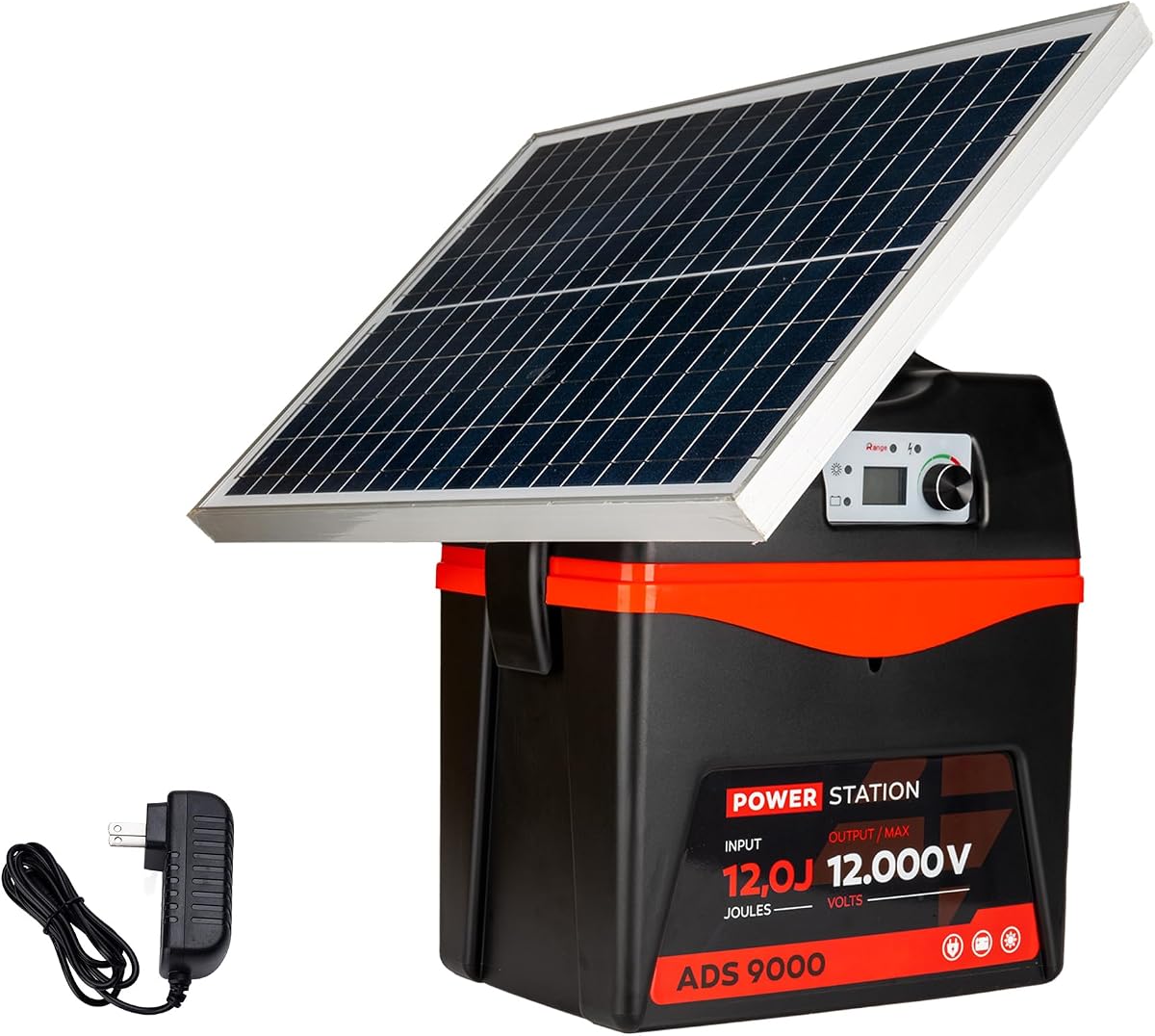
This adjustable solar charger is the most feature-oriented premium option, with a 5.0 rating and published output reaching 2 joules. Rather than offering one fixed setting, it supports 0.3-2J energy levels and 6-12KV voltage options. That adjustability makes it attractive for owners who move between small paddocks and demanding livestock or wildlife boundaries.
We may earn a commission when you buy through this link, at no additional cost to you.
The charger combines a 6W high-efficiency solar panel with an 18,000mAh internal battery. It can operate off-grid through solar collection, and the listing says it can switch to mains power when the battery is low. This dual-power approach adds resilience for farms with occasional grid access, although the charger does not need to remain tethered to a mains outlet in normal solar use.
A small LED display and indicator lights provide real-time operating feedback, simplifying daily inspection. The stated discharge interval is 1.3 seconds, and the product is rated for operation from -20°C to +60°C. A claimed 20-mile range places it in the upper tier for large properties, though actual output still depends on fencing, vegetation, and grounding.
This is a strong recommendation for serious farms and ranches that want adjustable output, long-term solar storage, and optional mains support. The package includes the main unit, input and output cables, a power adapter, mounting screws, warning signs, and an instruction manual. It is the top premium choice for users who value control and resilience over minimum size.
Adjustable voltage and energy levels let an owner tailor the pulse to the animal, fence load, and environment. This flexibility is particularly useful when a single charger is moved between poultry netting, pasture lines, and stronger wildlife barriers.
Solar charging and an 18,000mAh battery support off-grid use, while mains switching offers another way to continue operation when needed. The dual-power arrangement reduces the consequences of an extended low-solar period.
We may earn a commission when you buy through this link, at no additional cost to you.
This is the category's highest-output and most specification-heavy listing, with a 3.0 rating that warrants careful comparison. Its title describes a 9-joule energizer, a 25W solar panel, a 12V battery, and a 120-mile range, while the supplied description refers to 6 effective joules and 100 miles. Those differences make direct verification especially important.
We may earn a commission when you buy through this link, at no additional cost to you.
The controls include a multifunction button, a variable voltage display, and a 21-position adjustment range. A large-capacity battery is optional rather than included, according to the supplied information, and the connection board can accept a solar panel or AC adapter for charging. Built-in lightning protection and an enclosure claimed to reach IP65 are useful for exposed outdoor installations.
Its low rating may reflect the complexity of the product, fulfillment variations, or buyer dissatisfaction, but the provided information does not establish a specific cause. The inconsistent output and coverage claims are a clear drawback. Buyers should confirm whether the actual delivered model is 6 or 9 joules, whether a battery is included, and what range applies to their fence configuration.
This unit may suit an experienced owner who wants very high energy output and accepts the need to verify specifications. For a straightforward garden, poultry system, or ordinary pasture, more consistently documented chargers offer less risk. Consider it only after confirming the final package, technical data, warranty terms, and compatibility with the intended fence.
A high-joule design is intended for demanding barriers and large-animal control. Even with substantial energy, the fence must be properly insulated, grounded, and maintained for the output to reach the full boundary.
Conflicting joule, range, and battery information makes the current listing especially important. Review the seller's final specifications, package contents, warranty, and installation instructions before ordering.
We may earn a commission when you buy through this link, at no additional cost to you.
The Gallagher S60 delivers 0.6 joules with a claimed 6-mile range, placing it between compact garden units and very large high-output chargers. Its 4.7 rating is among the strongest in this guide. It is suited to rotational grazing, perimeter fencing, and small to medium livestock properties where dependable pulse energy matters.
We may earn a commission when you buy through this link, at no additional cost to you.
A lithium-iron-phosphate battery supports long service life and stable outdoor performance, while the weather-resistant, UV-stabilized enclosure is paired with a tempered-glass solar panel. The unit is described as capable of powering up to three full-length sections of electric poultry netting under typical conditions, making it unusually versatile across livestock and predator-control applications.
Installation is straightforward: the lightweight enclosure can be mounted to posts or T-posts, and the supplied fence and ground leads support quick setup. The 6-mile range is less extensive than 10- and 20-mile claims elsewhere, but the 0.6J output provides a strong pulse for goats, chickens, pets, and other animals. Coverage depends on vegetation, grounding, and fence design.
This is an excellent middle-ground choice for acreage owners and hobby farms that want more output than a small garden charger without moving to a high-output ranch system. It also suits users who want one charger for both poultry netting and ordinary pasture lines. Confirm the current package contents and grounding requirements before installation.
The ability to power poultry netting and conventional pasture fencing makes the S60 adaptable to mixed-use properties. Owners can adjust the setup as flock, garden, or livestock needs change.
Its 0.6J pulse is more substantial than compact units, while the 6-mile range remains more manageable than the largest advertised fences. That balance is attractive for small and mid-size properties.
We may earn a commission when you buy through this link, at no additional cost to you.
This bundle pairs the compact Gallagher S6 0.06J charger with 1,312 feet of polywire, making it a convenient starting point for a temporary electric boundary. It has a 4.2 rating and is designed for owners who want the charger and primary fence material together. Suitable uses include portable livestock pens, temporary paddocks, and compact animal or wildlife areas.
We may earn a commission when you buy through this link, at no additional cost to you.
The included polywire has six stainless steel strands for conductivity and UV protection. The energizer includes built-in solar panels and an internal lithium battery, so it can operate without grid power once properly installed. The entire system is built for outdoor use and can be moved as a temporary fencing solution rather than permanently installed in one location.
The bundle still requires insulated fence posts, which are not included, and users must establish suitable grounding. It also does not include the grounding rod required by the standalone S6 listing. Because the charger provides only 0.06 joules and covers 0.74 mile, it is better for light vegetation and small enclosures than broad pastures or stubborn large animals.
This bundle is most attractive to a new owner building a first temporary fence or an experienced user who wants a matched charger-and-wire package. It reduces the need to source wire separately, though posts and grounding supplies remain necessary. Choose it for portability and convenience rather than maximum range or livestock power.
Including 1,312 feet of conductive polywire makes it easier to assemble a portable boundary without separately selecting fence material. The result is especially convenient for temporary pens and seasonal containment.
Insulated posts and a proper grounding rod are still required. The compact 0.06J output should be matched to short fence sections, light vegetation, and smaller animals rather than long, heavily overgrown boundaries.
We may earn a commission when you buy through this link, at no additional cost to you.
The Gallagher S30 bundle combines a 0.3J solar charger with 1,640 feet of polywire and carries a 5.0 rating. It is the most convincing budget-oriented package in this guide because it includes enough wire to create several fence layouts without a separate wire purchase. The charger is suitable for cattle, horses, goats, sheep, gardens, and beehives when the fence is properly maintained.
We may earn a commission when you buy through this link, at no additional cost to you.
The polywire contains six stainless steel strands for reliable conductivity and rust resistance, while UV-resistant construction is intended to resist outdoor deterioration. Depending on the number of strands used, the total material can provide approximately 820 feet of two-strand fencing, 547 feet of three-strand fencing, or 410 feet of four-strand fencing.
Despite the budget label, this is not a bare charger. It includes the energizer, a substantial quantity of quality polywire, and fence and ground leads. Insulated posts and any additional grounding components are not stated as included, so buyers should account for those needs. As with every solar charger, actual results depend on sunlight, vegetation, and grounding.
This bundle is a strong recommendation for new owners, small farms, and anyone seeking a complete starting point for portable fencing. It offers more material than the smaller Gallagher bundle and more output than the 0.06J model, while remaining easier to assemble than a custom long-distance system. It is the best budget pick for flexible small-to-medium enclosures.
The included length can be divided among two, three, or four strands, allowing the owner to select the arrangement that suits the animals and terrain. Separate fences can also use sections of the same roll where appropriate.
The 0.3J solar charger provides more useful livestock energy than compact 0.06J units. It is a practical middle ground for cattle, horses, goats, sheep, gardens, and other moderate-demand boundaries.
We may earn a commission when you buy through this link, at no additional cost to you.
Choosing a solar electric fence charger requires balancing stored-energy output, fence demand, animal behavior, climate, and installation quality. A smaller charger may be ideal for a short poultry run but inadequate for a long pasture containing cattle, while an oversized unit adds cost and complexity without correcting poor fencing or grounding.
Pulse energy, measured in joules, helps indicate the strength of the electrical output. The products in this guide range from 0.06J for small enclosures to adjustable or high-output units for larger livestock and wildlife barriers. Horses, cattle, long-haired animals, and persistent predators generally create greater demand than poultry, rabbits, or a short garden boundary. A rule of thumb is to avoid selecting by mileage alone; the animal load and severity of the fence problem are equally important.
Advertised mileage represents the maximum length a charger may support under suitable conditions. Actual coverage can be reduced by heavy vegetation, poor connections, multiple fence wires, long distances, unsuitable fence materials, and inadequate grounding. A high-energy charger may also be less useful if a low-cost polywire fence has poor conductivity or becomes badly overgrown. Compare the range with your intended boundary, then leave room for future paddock expansion and temporary lines.
The solar panel replenishes the internal battery during daylight, while the battery carries the fence through the night and cloudy periods. Consider the stated sunlight reserve, but recognize that a long reserve under ideal conditions does not guarantee the same duration under heavy fence load or winter weather. Larger panels and higher-capacity batteries are generally more resilient, though they should be matched to the application rather than treated as substitutes for sound grounding and vegetation control.
Every charger depends on a sound electrical ground. The Gallagher S6 standalone model is especially specific, requiring an unpainted rod up to 0.5 inches in diameter, driven at least 18 inches into the soil and deeper in dry or sandy ground. Other products may allow more conventional grounding methods, but their instructions should still be followed. Also inspect insulators, connections, fence wire, vegetation, and any metal structures that may create leakage paths.
Status indicators can save considerable troubleshooting time. Battery, fault, and sunlight lights offer quick confirmation that a charger is operating as intended, while an LED display and adjustable controls can be useful on larger installations. A one-touch power button also makes routine shutdown safer and easier. These features do not replace physical inspections, but they make it easier to notice a developing problem before a livestock loss or prolonged fence outage.
Consider where the charger will live and how often it must move. A lightweight all-in-one design is convenient for rotational grazing, seasonal fencing, chicken coops, and temporary paddocks. A compact model with a specific rod-mount system may be less flexible on permanent posts. Bundles with polywire can reduce setup work, but insulated posts, grounding hardware, and other installation items may still need to be purchased separately.
Outdoor chargers face rain, snow, heat, sunlight, and impact. Look for weather-resistant enclosures, tempered solar panels, and stated temperature limits relevant to your location. A wider operating range can be valuable where summers are hot or winters severe. Weather resistance does not eliminate the need to mount the unit where water cannot accumulate, protect electrical connections as directed, and check the fence after major storms.
A bundle can be economical when it includes the charger, suitable polywire, fence leads, and ground leads, as the Gallagher S30 package does. Check everything included, especially whether a battery, grounding rod, insulated posts, warning signs, or mounting hardware are supplied. Manufacturer support and warranty can be valuable for a durable electrical product, particularly if the unit is installed remotely where troubleshooting is inconvenient.
Begin by mapping the fence and testing the route with the intended livestock. Check every insulator, connection, switch, and post, and remove or trim vegetation that may contact the fence. Install the charger where the solar panel receives strong, unobstructed sunlight. Establish the required ground according to the product instructions, using a properly sized rod and adequate soil depth. Where a model specifies a particular mounting method, follow it rather than improvising.
Before energizing the fence, confirm that all terminals are secure and that the output is switched off. Connect the fence and ground leads as directed, then turn the charger on and check the status indicators. Walk the boundary to look for shorts, damaged wire, or unwanted contact with structures. A fault reading or unexpectedly low output should be investigated before animals are placed inside the enclosure.
Routine care includes clearing vegetation, checking the panel for dirt or damage, inspecting grounding connections, and reviewing battery or charge indicators. After storms, inspect posts, wire, and the charger enclosure. If a battery is replaceable or supplied separately, use the specified type and observe the manufacturer's safety guidance. Turn off the output before working on connections, and always follow local fencing and wildlife laws, including any requirement for warning signs.
The useful lifespan depends on the charger's build quality, battery chemistry, local sunlight, operating temperature, and maintenance. Compact units with lithium batteries may suit seasonal or light-duty applications, while higher-capacity systems are often better for demanding work. Protect the enclosure, keep the panel clean and unobstructed, and inspect the battery and ground regularly for the most reliable service.
Yes, because the internal battery stores energy collected by the solar panel. The available reserve depends on how much sunlight the panel received before the weather event and how heavily the fence is loaded. Models with larger batteries or longer published no-sunlight reserves provide more margin, but extreme weather and continuous heavy use can still reduce operating time.
Cattle and horses generally call for more pulse energy than poultry or small pets, especially on long fences with vegetation. The 0.3J to 0.6J units in this guide are more suitably aimed at moderate livestock work, while 0.32J and adjustable higher-output models better fit large pastures. Correct grounding, sound insulators, and vegetation control remain essential regardless of charger size.
Most solar chargers in this category include an internal battery that charges during the day and powers the fence at night. Some listings mention a separate large-capacity battery for longer low-sunlight periods, so check the package contents before ordering. Do not add an unsupported battery, because voltage, chemistry, charging requirements, and protection circuits must be compatible.
A fault commonly indicates a short, poor grounding, vegetation touching the wire, a damaged lead, or a connection problem. Turn off the output before inspecting the fence, then check vegetation, insulators, terminals, and grounding. If the issue continues, consult the charger's instructions or the manufacturer rather than bypassing the protection system.
Yes, and both Gallagher bundles include polywire designed for electric fencing. Conductivity and durability depend on the strands, insulators, connections, and whether the wire is UV-resistant and adequately conductive for the load. The S30 bundle includes 1,640 feet of six-strand wire, while the S6 bundle includes 1,312 feet of 1/16-inch six-strand polywire.
The listed maximums in this guide range from 0.74 mile to as much as 120 miles for a high-output model, but these figures reflect very different conditions and some listings contain inconsistent specifications. Actual range can be much shorter when vegetation, fence resistance, animal load, or grounding conditions are poor. Use the range as a starting point and evaluate the animal, terrain, and fence construction.
Choose a location with strong, direct sunlight and no prolonged shade from trees, buildings, or equipment. Mount the charger securely according to its instructions, protect it from impact where necessary, and avoid locations where water can collect. The Gallagher S6 has a special requirement: it mounts to an unpainted grounding rod of a specified diameter and does not support T-post mounting.
The 0.32J red charger is the best overall choice because it combines substantial pulse output, a long claimed range, a 14-day backup claim, and a three-indicator dashboard. The adjustable 2J model is the best premium option for owners who want output controls, a large battery, LED feedback, and optional mains support. The Gallagher S30 bundle is the best budget pick because it pairs a capable 0.3J charger with 1,640 feet of conductive polywire.
Prioritize the animal and fence over the largest advertised range. Compact 0.06J models suit small enclosures, 0.18J and 0.3J units handle modest livestock or portable systems, and 0.6J or higher-output chargers are better suited to demanding pasture work. Before buying, verify grounding requirements, sunlight exposure, package contents, battery details, and any inconsistent specifications. Vegetation control and routine inspections remain essential with every model.
Product listings and prices can change, so check the current details, seller information, warranty, and customer feedback before making a final purchase. The best solar electric fence charger is not simply the largest or least expensive unit. It is the model whose output, reserve, installation method, and fence coverage fit your animals, property, weather, and maintenance routine.