
KODAK PIXPRO AZ405
4.1Editor score
40x optical zoom
20MP CMOS sensor
Optical image stabilization
Our Superzoom Bridge Camera guide compares 10 models for optical zoom, stabilization, video quality, controls, portability, and travel-ready features today.
A superzoom bridge camera combines the long reach of a telephoto lens with the familiar controls and automatic shooting modes of a point-and-shoot model. The best examples make it practical to photograph birds, distant landmarks, performers, and sports while still offering 4K video, stabilization, and enough manual control for more deliberate compositions.
This guide compares 10 superzoom bridge cameras based on optical zoom range, sensor resolution, stabilization, video capabilities, viewing options, connectivity, batteries, and ease of use. It covers affordable general-purpose models, advanced Nikon offerings with long reach and electronic viewfinders, and feature-rich kits designed for travelers who want flexibility without a interchangeable-lens system.
Each review highlights the product's strongest qualities, along with the compromises that shoppers should understand before buying. The three highlighted picks represent a budget choice, an all-around recommendation, and a premium option, although the right camera depends on your subjects, travel plans, and preferred level of control. Product prices and availability can change.
4.1Editor score

4.4Editor score

4.2Editor score
This side-by-side comparison covers ten superzoom bridge cameras, ranging from 40x optical zoom models to a 125x option for extreme reach. Key differences include stabilization, video resolution, electronic viewfinders, battery type, RAW support, connectivity, and the inclusion of accessories or memory cards in selected bundles.




The Panasonic Lumix FZ80 is a travel-oriented bridge camera that combines a long 60x zoom with 4K video and a bright 2,360K-dot electronic viewfinder. Its 4.2 rating reflects a capable feature set for users who want more control than a basic point-and-shoot without carrying a large interchangeable-lens kit.
We may earn a commission when you buy through this link, at no additional cost to you.
One standout feature is Post Focus, which allows a selected area to be chosen for focus after the photograph has been taken. That flexibility is unusual at this level and can be helpful when the ideal focus point is difficult to identify in advance. The camera also records 4K video and allows 8-megapixel still images to be extracted from 4K footage.
For handling the lens, POWER O.I.S. optical image stabilization helps suppress hand-shake vibration at the telephoto end, where small movements become magnified. The 0.74x-equivalent electronic viewfinder is designed to make framing easier in bright sunlight, while the 4K mode provides useful room for cropping and reframing. These capabilities make the FZ80 especially appealing to vloggers and travel photographers.
The trade-offs are the shorter zoom range compared with the 83x, 125x, and even 68x models in this guide, and the extra decision-making involved with Post Focus. Nevertheless, it is a convincing all-purpose option for someone who values 4K video, electronic-viewfinder framing, and useful focus controls. It is a strong fit for holidays, sightseeing, and family trips.
Post Focus changes the usual sequence of focusing and capture. You can shoot first, review the image, and then select the area that should appear sharp, making the camera useful when depth of field is narrow or the subject position is difficult to judge.
The 4K video mode provides substantially more framing flexibility than Full HD, while 4K Photo makes it possible to save selected 8-megapixel images from recorded footage. These features are valuable for travel content, quick edits, and social media cropping.
We may earn a commission when you buy through this link, at no additional cost to you.
The Nikon COOLPIX P950 is the strongest all-round recommendation in this guide, combining an 83x optical zoom with a 16-megapixel sensor, 4K UHD video, RAW capture, and built-in Wi-Fi. Its 4.4 rating and broad feature set make it a persuasive option for wildlife, travel, sports, celestial photography, and general-purpose shooting.
We may earn a commission when you buy through this link, at no additional cost to you.
The NIKKOR lens spans an impressive 2000mm equivalent at the telephoto end, giving photographers considerable reach without digital zoom. Bird and Moon modes simplify two specialized shooting situations, while scene modes help novices get started. At the same time, RAW capture and a rotating LCD provide enough creative flexibility for users who want to move beyond fully automatic operation.
Stabilization is especially important when using this amount of optical reach. The P950's image stabilization helps support handheld framing, although distant subjects still demand careful technique and good light. The 4K UHD recording function broadens its appeal to families and content creators, while Wi-Fi provides a convenient way to transfer images to compatible devices.
Its main disadvantage is its substantial size when extended, particularly compared with the 40x and 42x Kodak models. The rotating screen is also not as flexible as the vari-angle displays found on newer Nikon bodies. Even so, the combination of reach, stabilization, 4K video, RAW support, and user-friendly modes makes the P950 the most balanced choice for a shopper who wants one camera for many different subjects.
The P950's 83x optical zoom can bring distant wildlife, performers, and landscape details into frame without relying on a digital crop. Dedicated Bird and Moon modes make it easier to begin working with these challenging subjects when you are still learning the appropriate camera settings.
Automatic scene modes and straightforward controls help casual users get usable results, while RAW capture supports more flexible post-processing. This makes the camera useful across a broad range of experience levels rather than restricting it to a single shooting style.
We may earn a commission when you buy through this link, at no additional cost to you.
The KODAK PIXPRO AZ405 is the most approachable budget choice among these superzoom bridge cameras. It combines a 40x optical zoom, 20-megapixel CMOS sensor, optical image stabilization, and automatic scene modes in a straightforward package intended for travelers and first-time bridge camera owners.
We may earn a commission when you buy through this link, at no additional cost to you.
The 24mm wide-angle starting point allows the camera to cover group portraits and broad landscapes before zooming toward birds, athletes, or stage performers. Its 20MP sensor offers enough resolution for detailed stills, while optical image stabilization helps reduce softness from hand movement when shooting near the maximum zoom distance.
One especially practical feature is its use of standard AA batteries. That means a traveler does not need to depend on a proprietary charger or a nearby outlet during a safari, road trip, or outdoor excursion. Automatic scene detection keeps operation simple, and Full HD video is suitable for ordinary travel clips and family memories. Compatible Class 10 SD, SDHC, and SDXC cards can support substantial storage capacity.
The AZ405 does not offer 4K recording, RAW output, or the advanced controls found on higher-end Nikon cameras. It is also less suitable when extreme telephoto reach is essential. Those limitations are understandable for a budget model, and they do not outweigh the convenience, stabilization, and generous zoom range for many everyday users.
Using familiar AA batteries removes a common source of inconvenience for travelers. Replacement cells are widely available, and you can keep spare batteries in a bag without planning around a proprietary charging system.
Automatic scene detection handles many of the technical decisions, allowing users to concentrate on framing the subject. The result is a camera that should appeal to anyone who wants meaningful zoom without navigating a complex menu system.
We may earn a commission when you buy through this link, at no additional cost to you.
The KODAK PIXPRO AZ425 is a colorful, approachable bridge camera that pairs a 42x optical zoom with a 20-megapixel backside-illuminated CMOS sensor. Its 4.0 rating reflects a capable general-purpose package, and the rechargeable battery, optical stabilization, and scene-oriented controls make it especially relevant to travelers.
We may earn a commission when you buy through this link, at no additional cost to you.
The backside-illuminated sensor is designed to gather light more efficiently, supporting image quality in golden-hour conditions, overcast weather, and indoor gatherings. Its 24mm wide-angle capability covers group scenes, while the 42x zoom reaches toward distant performers, birds, and athletes. Built-in optical image stabilization compensates for hand movement across the telephoto range.
The AZ425 records 1080p Full HD video and supports panorama and custom modes alongside simpler automatic options. A rechargeable lithium-ion battery provides roughly 240 shots per charge, while Class 10 SD, SDHC, or SDXC storage up to 512GB gives users plenty of room for large image files and video. USB transfer supports sharing and archiving.
The main limitations are Full HD rather than 4K video and a more modest 42x zoom compared with the premium Nikon models. Its 4.0 rating is also among the lower scores in this list. Even so, it offers a strong combination of sensor resolution, stabilization, and simple operation for users who do not need extreme reach or advanced video formats.
The 20MP backside-illuminated CMOS sensor gathers light efficiently, which is useful when a scene cannot be controlled. Its resolution supports detailed prints and enlargement while remaining approachable through automatic modes.
Panorama and custom modes offer room to experiment, while scene modes cover routine travel and family photography. This combination lets beginners start quickly and still provides options for users who want greater involvement.
We may earn a commission when you buy through this link, at no additional cost to you.
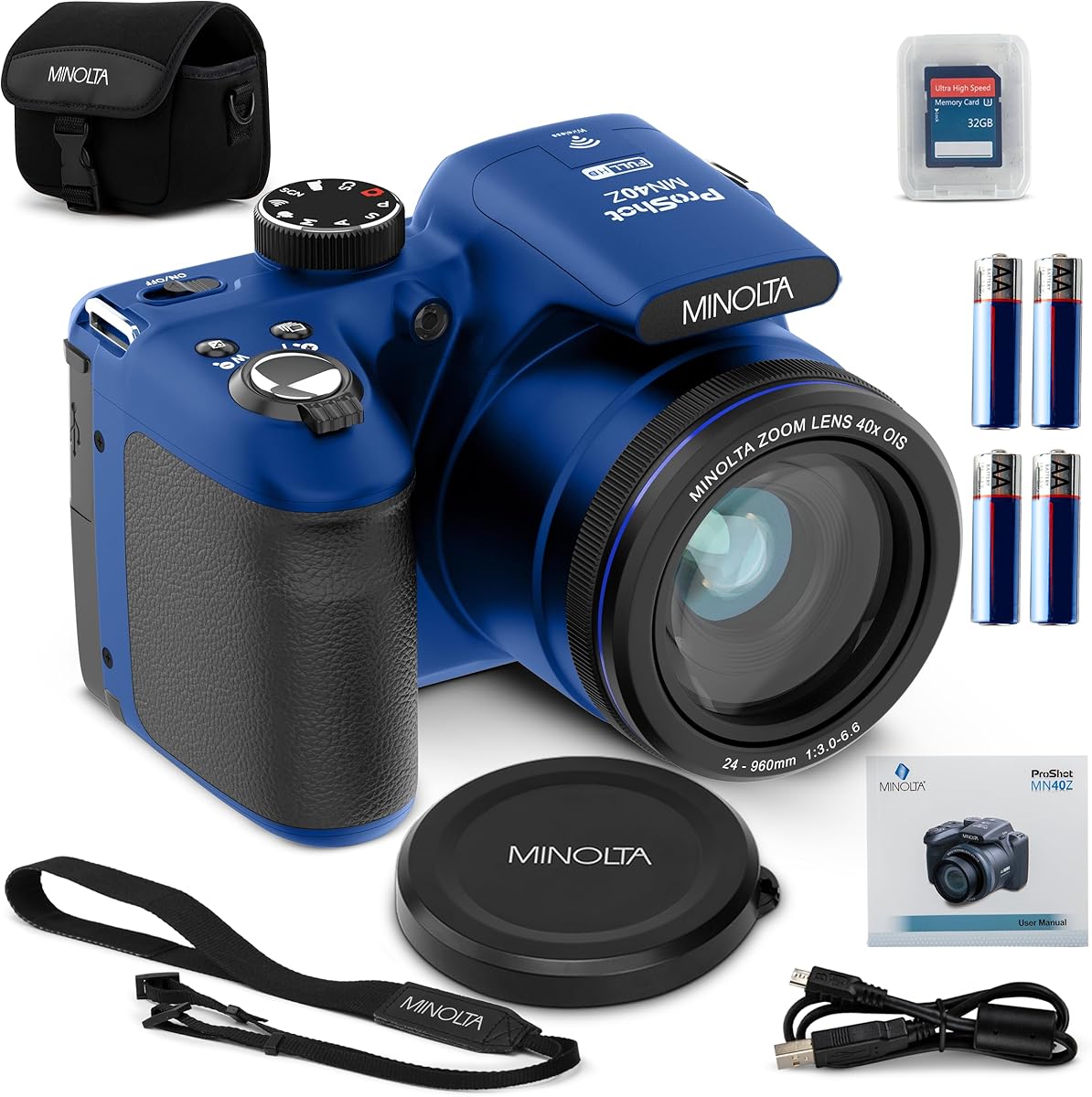
The Minolta MN40Z ProShot offers a relatively compact route into bridge-camera photography, with a 40x optical zoom, 20-megapixel still images, Full HD video, and Wi-Fi app integration. Its 4.1 rating aligns it with other accessible 40x models, although the supplied information gives fewer details about advanced shooting features.
We may earn a commission when you buy through this link, at no additional cost to you.
The 40x lens provides meaningful reach for landscapes, family gatherings, animals, and distant action without reaching the extreme magnification of the Nikon P1100. A three-inch LCD screen offers a practical surface for composing images, and Wi-Fi connectivity provides a convenient way to share or transfer content to a compatible mobile setup.
The camera uses four AAA batteries, which are included according to the product information. That makes it immediately usable for basic travel and family photography, while the lack of a rechargeable battery specification keeps the power system easy to understand. Its stated suitability for both novice and experienced photographers suggests a user-friendly design with additional features.
The main drawback is that the documented feature set is relatively limited. Full HD video is less flexible than 4K, and the absence of details about RAW capture, electronic viewfinders, or advanced control rings makes comparison with the P950 and P1100 straightforward. For a shopper who values compactness, basic connectivity, and 40x zoom, it remains a sensible option.
Built-in Wi-Fi and app integration reduce the need to manage files through cables. This is especially helpful for travel pictures that you want to transfer and share soon after taking them.
The 40x optical zoom offers a useful balance between reach and portability. It can frame details that a standard compact camera may struggle to isolate without reaching the bulk associated with larger 83x and 125x bodies.
We may earn a commission when you buy through this link, at no additional cost to you.
The Minolta MN68Z stands out for combining 68x optical zoom with 20-megapixel stills and 4K Ultra HD video. It is also sold as a comprehensive kit with a carrying case, a 32GB SD card, and a rechargeable battery, reducing the number of extra items a new buyer needs to source.
We may earn a commission when you buy through this link, at no additional cost to you.
Its 68x optical zoom is a versatile middle ground between the 40x and 42x budget cameras and the 83x Nikon P950. It can isolate distant wildlife, performers, and architectural details while remaining less extreme than the 125x P1100. Optical image stabilization is included to help keep handheld images more stable at longer focal lengths.
Built-in Wi-Fi supports convenient transfers, while USB-C and HDMI outputs provide practical ways to move files or connect the camera to other equipment. The supplied 32GB memory card makes the kit ready for a first outing, and the rechargeable battery reduces day-to-day inconvenience compared with models that require disposable cells.
A published customer rating is not provided for this listing, so the MN68Z cannot be evaluated through a numerical score in the same way as the established options. Buyers should therefore pay close attention to warranty coverage, included accessories, and the final specifications shown at the point of purchase. Even so, the 68x zoom, 4K video, and bundled kit create an attractive package.
The included carrying case, 32GB SD card, and rechargeable battery make this a convenient starter package. It is especially helpful for travelers who want to begin shooting without first building a list of essential accessories.
The 68x lens provides enough magnification for many distant subjects without moving into the largest and heaviest category. Pairing that reach with 4K Ultra HD recording gives the camera broader appeal for both still photography and video.
We may earn a commission when you buy through this link, at no additional cost to you.
The Nikon COOLPIX P1100 is the premium extreme-reach option, offering an extraordinary 125x optical zoom with a 24–3000mm equivalent range. It also includes a 16-megapixel sensor, 4K UHD video, RAW capture, Dual Detect Optical VR, Wi-Fi, a rotating screen, and a customizable control ring.
We may earn a commission when you buy through this link, at no additional cost to you.
Its focal range allows photographers to isolate birds, distant performers, celestial details, and small architectural features with exceptional magnification. Dual Detect Optical VR is stated to be equivalent to a four-stop stabilization improvement, a meaningful benefit when the camera is held at very long focal lengths. The camera also includes a 1cm close-focus macro mode for subjects much nearer than typical telephoto shots.
Specialized Bird-watching Mode is accessible from the mode dial and optimizes settings for one of the most difficult categories of superzoom photography. For broader creative work, the control ring can manage manual focus or adjust exposure compensation and white balance. RAW recording, 4K UHD video, slow-motion, time-lapse, and Super lapse movies broaden the camera beyond conventional still photography.
Extreme reach comes with size and handling trade-offs. The lens becomes very long when fully extended, so steady technique and support can matter. It is also a more advanced and costly camera than the basic Kodak and Minolta alternatives. For dedicated birders, distant-landscape enthusiasts, or photographers who genuinely need 125x optical magnification, the P1100 offers a remarkably capable package.
The 125x optical zoom extends to a 3000mm equivalent, making the P1100 suitable for subjects that would appear very small in a standard compact camera frame. Optical magnification also avoids relying on digital zoom, which can reduce image quality.
The customizable control ring and manual options provide more room for deliberate work, while Bird-watching Mode simplifies a difficult genre. This mix makes the camera approachable for birders while still rewarding users who want manual adjustment.
We may earn a commission when you buy through this link, at no additional cost to you.
This Nikon COOLPIX P950 bundle combines the camera's 83x optical zoom with several useful accessories: a 64GB UHS-I memory card, a three-piece 67mm lens filter kit, a camera bag, and an EN-EL20 battery. The arrangement is particularly convenient for buyers who want a complete setup rather than a body alone.
We may earn a commission when you buy through this link, at no additional cost to you.
The camera itself pairs a 16-megapixel CMOS sensor with EXPEED processing and an 83x NIKKOR lens covering a 24–2000mm equivalent range. Dual Detect Optical VR supports handheld framing, and the camera can capture JPEG, RAW, and 4K UHD video at 30p. ISO sensitivity up to 6400 and continuous shooting around seven frames per second further enhance its appeal for action-oriented users.
Its 2.36-million-dot OLED electronic viewfinder provides detailed framing in bright sunlight, while the 3.2-inch vari-angle LCD supports low and overhead compositions. Built-in Wi-Fi and Bluetooth work with the SnapBridge app for transfers, remote control, self-portraits, group shots, and automatic time or location stamping. These features improve the camera's daily workflow rather than simply adding specification-sheet appeal.
The main limitation is that the bundle does not have a published numerical customer rating in the supplied information. Some buyers may also find the filters or extra battery unnecessary if they already own compatible accessories. Otherwise, this package makes the P950 especially attractive for travel, where storage, carrying protection, and backup power are valuable.
A 64GB card provides immediate storage, while the camera bag protects the body and lens during transport. The spare EN-EL20 battery and filter kit round out a package that is well suited to travel and extended shooting days.
The OLED electronic viewfinder aids precise framing outdoors, and the vari-angle LCD makes unusual camera positions easier. SnapBridge connectivity then provides a convenient bridge between the camera and compatible smart devices.
We may earn a commission when you buy through this link, at no additional cost to you.
The Nikon COOLPIX P900 is an established superzoom travel camera with an 83x optical zoom, 16-megapixel CMOS sensor, electronic viewfinder, and vari-angle TFT LCD. Its 4.4 rating is tied for the highest published score in this guide, providing a favorable customer-feedback signal for buyers considering long-zoom point-and-shoot models.
We may earn a commission when you buy through this link, at no additional cost to you.
Its NIKKOR super ED VR lens covers a 24–2000mm equivalent range, and the camera also offers 166x Dynamic Fine Zoom and 332x digital zoom. That optical range can isolate distant details across wildlife, travel, and event photography. The electronic viewfinder supports more stable long-distance framing, while the vari-angle screen helps with low-angle and overhead shots.
Video recording is Full HD at up to 60p rather than 4K, and the camera does not have the same advanced RAW-oriented video feature set as the newer P950. On the other hand, built-in Wi-Fi, NFC, and GPS support convenient sharing and location-related workflows. The maximum ISO is 6400, and a six-level brightness adjustment helps evaluate images under changing conditions.
Compared with newer models, the P900's principal compromise is age: its 16MP sensor and Full HD video no longer represent the latest specifications. However, its optical zoom, stabilization, viewfinder, flexible screen, and strong customer rating remain meaningful advantages. It is an appealing choice for a buyer who prioritizes the Nikon system, familiar superzoom handling, and reliable essentials over 4K capture.
An 83x optical zoom provides substantial reach while remaining shorter than the most extreme 125x model. This makes the P900 a practical middle option for travel and recurring wildlife or event photography.
The electronic viewfinder and vari-angle display offer useful ways to compose under bright conditions or at unconventional angles. Together they provide a familiar bridge-camera experience with fewer assumptions about screen movement.
We may earn a commission when you buy through this link, at no additional cost to you.
The renewed Nikon COOLPIX P1100 combines the same extraordinary 125x optical zoom with 16-megapixel stills, 4K UHD video, RAW capture, and a rotating display. Its 5.0 rating is the highest published score among the listed models, although renewed products should be evaluated with their condition and warranty terms in mind.
We may earn a commission when you buy through this link, at no additional cost to you.
The lens provides an equivalent 24–3000mm range, making it possible to frame small wildlife, distant sports, celestial objects, and fine architectural details. Dual Detect Optical VR is stated to compensate by the equivalent of four stops, an important feature when small hand movements become dramatic at extreme magnification.
The camera records JPEG and NRW RAW files and supports 4K UHD video, smooth slow motion, time-lapse, and Super lapse movies. Bird-watching Mode is directly accessible from the mode dial, while Close Focus Macro Mode allows focusing at approximately 1cm. A customizable control ring can be assigned to manual focus, exposure compensation, or white balance.
Because this is a renewed listing, appearance, wear, accessories, and warranty coverage may differ from a new unit. It is best suited to a buyer who values the P1100's exceptional reach and features but can accept the uncertainties associated with a refurbished product. For most shoppers, the new P1100 or P950 will be the more straightforward premium choice.
The renewed format can make an advanced 125x camera more accessible to buyers who prioritize optical reach. The crucial point is to review the listing's condition details, included accessories, return policy, and warranty before making a decision.
The 125x reach is complemented by approximately 1cm close focusing, allowing the camera to handle distant scenes and small nearby details. Bird-watching Mode and the customizable control ring add practical tools for both automatic and deliberate shooting.
We may earn a commission when you buy through this link, at no additional cost to you.
A useful superzoom camera balances optical magnification, stabilization, image quality, video features, portability, and operating simplicity. Consider the subjects you photograph most often before comparing zoom ranges, because the difference between 40x and 83x can matter greatly when a bird or performer is too distant to fill the frame.
Optical zoom physically magnifies the subject and is the core feature of a bridge camera. The models here range from 40x to 125x, with 40x and 42x options serving general travel, 68x and 83x models offering stronger wildlife and event reach, and 125x providing exceptional magnification for distant birds, performers, and celestial subjects. Choose based on realistic subject distance rather than the largest number available.
In short, match optical reach to your subjects and accept a larger body when extreme magnification is genuinely necessary.
Long focal lengths magnify hand movement, making stabilization important even when a camera has a fast shutter speed. Models such as the Nikon P950, P1100, P900, and Panasonic FZ80 include optical stabilization, while the Kodak AZ405 and AZ425 use dedicated optical image stabilization and the Minolta MN68Z also lists it. Dual Detect VR is highlighted on the P1100 as offering four-stop-equivalent compensation.
In short, prioritize optical stabilization whenever handheld telephoto shooting is central to your plans.
The list includes 16-megapixel Nikon sensors and 20-megapixel models from Kodak and Minolta. Resolution influences the amount of visible fine detail, cropping potential, and enlargement options, but it does not act alone. Stabilization, focus, lens quality, lighting, and image processing also affect the final result. The Kodak AZ425's 20MP backside-illuminated sensor is designed to gather light efficiently in difficult conditions.
In short, compare resolution alongside sensor design and stabilization rather than treating megapixels as the only quality measure.
Four cameras offer 4K Ultra HD recording: the Panasonic FZ80, Nikon P950, Minolta MN68Z, and Nikon P1100. The Kodak AZ405, AZ425, Minolta MN40Z, and Nikon P900 record Full HD video, while the P950 bundle supports 4K UHD at 30p. For slow motion, time-lapse, or social media cropping, 4K provides greater flexibility, but storage requirements and processing demands also increase.
In short, choose 4K for framing flexibility and specialized video work, or Full HD for simpler, lighter recording.
An electronic viewfinder is valuable for framing distant subjects because it keeps the camera steady and avoids glare. The Panasonic FZ80 has a 2,360K-dot large LVF, the P950 bundle lists a 2.36-million-dot OLED viewfinder, and the P900 includes an electronic viewfinder. Rotating or vari-angle screens make low-angle, overhead, and self-facing compositions easier on several Nikon models.
In short, prefer an electronic viewfinder for long-distance work and a flexible LCD for creative camera angles.
The best bridge camera is one you can operate confidently. The Kodak AZ405 emphasizes automatic scene detection, while the AZ425 adds panorama and custom modes. Nikon models provide more specialized tools, including Bird and Moon modes, RAW capture, manual options, and a customizable control ring on the P1100. Beginners may prefer automatic assistance, whereas enthusiasts may value the room to adjust exposure, focus, and white balance.
In short, select automatic assistance for simplicity or advanced controls for greater creative involvement.
Power requirements affect how easily a camera fits into a travel routine. The Kodak AZ405 uses widely available AA batteries, and the Minolta MN40Z uses four included AAA batteries. The AZ425 uses a rechargeable lithium-ion battery, while the MN68Z kit includes a rechargeable battery and carrying case. A spare battery is sensible for any model because long zoom operations, 4K recording, and wireless features can consume power quickly.
In short, consider battery availability, charging time, and spare-power logistics before choosing your travel companion.
Built-in Wi-Fi appears across several models, while the P950 bundle adds Bluetooth and SnapBridge functionality. Wireless transfer can simplify sharing, but direct cable connections and removable memory cards remain important for dependable backups. Bundles may include a card, case, battery, or filter kit; these can be convenient, although they should not replace checking the camera's core specifications, warranty, and compatibility requirements.
In short, treat bundles as a convenience and verify every accessory before placing your order.
Before the first outing, charge the battery, install a compatible memory card, and learn the basic zoom, focus, and playback controls. Review the camera's stabilization setting, image quality option, and scene modes, then take practice photographs in both daylight and lower light. Keeping the lens hood or supplied filter clear will help preserve contrast and reduce flare.
At long focal lengths, stabilize the camera with both hands and keep your elbows close to your body. Use a support when possible, pause briefly before releasing the shutter, and increase the zoom only after locating the subject. For wildlife and action, choose a suitable scene mode, watch the focus indicator, and avoid repeatedly resetting the zoom if that causes hunting.
For care, keep the camera in a padded bag away from moisture, direct heat, and loose objects that could scratch the lens. Clean the front element with a soft lens cloth, protect the screen with a cover, and avoid opening the battery or card compartments in wet conditions. Transfer important files to two separate locations before formatting a memory card.
A superzoom bridge camera is often more convenient for travel because it combines long optical reach with automatic shooting modes and a relatively simple body. A DSLR or mirrorless camera may provide better control and broader lens options, but it usually requires additional equipment. Bridge cameras are especially useful for travelers who want one camera for wildlife, events, landscapes, and everyday photography.
Optical zoom uses the lens to magnify the subject and can preserve more detail than digital zoom. Digital zoom enlarges the captured image after it reaches the sensor, which may reduce quality. The cameras in this guide all offer substantial optical zoom, with listed ranges extending from 40x to 125x.
The Nikon P1100 has the strongest documented specifications for distant birds because of its 125x optical zoom, Dual Detect Optical VR, and dedicated Bird-watching Mode. The Nikon P950 is a more compact alternative with 83x zoom, bird modes, and 4K video. Actual results still depend on light, distance, focus, and steady technique.
Yes, several models in the guide include 4K Ultra HD recording, including the Panasonic FZ80, Nikon P950, Minolta MN68Z, and Nikon P1100. The other listed cameras primarily offer 1080p Full HD video. A compatible high-speed memory card and adequate storage are important for longer 4K recordings.
It is useful when you expect to photograph distant landmarks, wildlife, sporting events, or performers, but most travel scenes do not require maximum magnification. A 40x to 83x camera is lighter and easier to carry, while 125x models demand more careful handling and offer fewer opportunities to move closer to a subject.
Most models provide automatic scene modes that handle many exposure and focus decisions. The Kodak AZ405 and AZ425 are particularly straightforward, while the Minolta MN40Z also emphasizes user-friendly operation. Nikon options add more manual controls and specialized modes for users who want to progress beyond point-and-shoot operation.
Review the condition description, shutter count information if provided, appearance of the lens and screen, included accessories, battery health, warranty coverage, and return policy. The renewed P1100 offers exceptional optical reach, but a new model may be preferable if condition uncertainty and warranty differences are concerns.
A tripod can improve stability at very long focal lengths, but optical stabilization and careful handheld technique make these cameras practical without one for many subjects. Support is particularly helpful in low light, for long-distance wildlife, and during slow-motion video. A monopod or stable resting surface can also provide meaningful assistance.
The KODAK PIXPRO AZ405 is the most budget-friendly highlighted choice, combining a useful 40x optical zoom, 20MP sensor, optical stabilization, and universally convenient AA batteries. The Nikon COOLPIX P950 is the strongest all-round recommendation because it combines 83x reach, 4K UHD, RAW support, scene modes, Wi-Fi, and a strong customer rating.
For buyers seeking maximum reach, the Nikon COOLPIX P1100 stands apart with 125x optical zoom, 4K UHD video, RAW capture, Dual Detect Optical VR, and specialized bird-watching tools. Choose the model that matches your subjects rather than automatically selecting the largest zoom. Stabilization, portability, controls, battery type, and video needs can be just as important in daily use.
Finally, compare current listings, warranty terms, accessory contents, and product prices before purchasing. Prices and availability can change, and the same camera may appear as a standalone item or as a bundle. Checking the latest listing ensures that the included accessories and support match the features that matter most to your photography.