
14-Gauge Heavy Duty Power Strip
4.6Editor score
14 AWG heavy-duty cord
Eight AC outlets
Six USB charging ports
Explore the best surge protector for kitchen counter options, comparing outlet capacity, surge protection, USB charging, mounting, safety, and everyday kitchen
A kitchen counter rarely has enough conveniently placed outlets for appliances, phones, speakers, and charging cables. A well-designed surge protector adds capacity while helping protect connected electronics from voltage spikes, overloads, and other electrical hazards.
We compared ten options based on outlet layout, surge-protection rating, electrical capacity, USB charging support, cord length, mounting options, and countertop practicality. The guide covers wall taps, rotating outlet extenders, short-cord power strips, and models intended for heavier appliances.
Each review explains the product's most useful features, realistic limitations, and ideal kitchen setup. Ratings and specifications reflect the supplied product information, while availability, promotions, and other retail terms can change at any time.
4.6Editor score

4.7Editor score

4.7Editor score
The table below compares the ten products by their core outlet, protection, charging, and installation features, making it easier to identify the right format for a particular kitchen counter.



The Belkin 6-Outlet Surge Protector Power Strip combines a compact wall-tap design with six protected AC outlets, one USB-A port, and one USB-C port. Its 4.7 rating reflects a strong balance of capacity, safety features, and countertop convenience, making it the most versatile option in this guide.
We may earn a commission when you buy through this link, at no additional cost to you.
Its 1,680 joules of surge protection is one of the stronger figures among the wall-mounted choices, while the 14-point safety system includes protection against over-temperature, overload, over-current, short circuits, and overvoltage. The indicator light makes it easier to check whether the unit is operating as intended, and the ETL certification adds reassurance.
The direct wall-plug format avoids a trailing power cable, which is especially useful on a crowded counter. Its USB-C port is convenient for compatible phones and accessories, although households that regularly charge several devices may prefer a model with more USB ports. The included safety coverage also includes a two-year limited warranty and connected equipment warranty.
This is the strongest general recommendation for a kitchen counter where you want several outlets, basic USB charging, and a clean installation without a visible cord. Choose it when a balance of capacity and protection matters more than having the largest possible selection of USB connections or outlets.
Because the unit plugs directly into a wall receptacle, it avoids a cable crossing the work surface. Its wall-mountable design can also keep frequently used outlets accessible while reducing visual clutter.
The USB-A and USB-C ports reduce the need for separate charging blocks, while the 1,680-joule protection rating supports the unit's role as a centralized kitchen charging and power hub.
We may earn a commission when you buy through this link, at no additional cost to you.
The Outlet Extender with Rotating Plug offers six AC outlets, three USB ports, and a plug that rotates through 180 degrees. Its 4.7 rating and 1,800-joule protection rating make it a practical choice for counters where the wall receptacle is obstructed or awkwardly positioned.
We may earn a commission when you buy through this link, at no additional cost to you.
The rotating plug is the central benefit. Instead of forcing the entire extender into an uncomfortable angle, the body can remain accessible while the wall plug changes direction. Widely spaced outlets also reduce interference between bulky adapters, a meaningful improvement over tightly packed strips in a frequently used kitchen.
Its USB section includes one USB-C port capable of up to 3A at 5V and USB-A ports rated up to 2.4A at 5V. Smart charging technology is intended to detect connected devices and adjust output. The stated 1,800-joule protection uses TVS, MOV, and GDT circuits, while the housing uses fire-resistant ABS.
This model is a good fit for renters or users who cannot or prefer not to mount a permanent adapter. It is best when outlet reach and plug clearance are the main concerns. Buyers seeking a more obvious status light or many USB-C connections may find other options more suitable.
A rotating wall plug is especially helpful when cabinetry, an appliance, or another plugged-in device blocks direct access to the extender. The body can be positioned for easier cord routing and plug access.
The three-sided layout and generous spacing help accommodate larger AC plugs without taking over the same side. This makes the unit more practical for mixed countertop devices than a basic four-way adapter.
We may earn a commission when you buy through this link, at no additional cost to you.
The 14-Gauge Heavy Duty Power Strip is built for kitchens that need to support several higher-draw appliances along with everyday charging devices. It combines eight AC outlets, six USB ports, a 1,080-joule surge-protection rating, and a short but substantial 14 AWG cord. Its 4.6 rating remains strong for a broad-capacity option.
We may earn a commission when you buy through this link, at no additional cost to you.
The product is rated to handle up to 1,875 watts at 125 volts and 15 amps. Its stated applications include microwaves, cookers, steamers, dryers, aquariums, and freezers, although users should confirm that each appliance's requirements are compatible with the strip and the circuit serving it.
The 24-inch cord is thick but short, offering some positioning flexibility without creating the cable clutter associated with a long extension cord. Two screw-mounting tabs allow installation on a wall, workbench, or counter area. Three USB-C and three USB-A ports provide a maximum stated aggregate USB output of 22W.
This is the pick for a counter used as a charging and appliance hub, especially when eight AC outlets are important. Its visible cord and shared charging output make it less elegant than a direct wall tap, but the heavy-duty construction and broad connection capacity serve a more demanding setup.
The 14 AWG conductor and 1,875-watt rating distinguish this model from lightweight charging strips. That makes it a more practical hub when countertop appliances are part of the intended load, provided the connected equipment stays within the stated limits.
The two-foot cord can bridge a modest gap between the receptacle and appliance area without creating a long loop. Mounting tabs add another installation option for keeping the strip stable and elevated.
We may earn a commission when you buy through this link, at no additional cost to you.
The QINLIANF 5-Outlet Wall Extender combines five AC outlets with four USB ports in a format that sits close to the wall. Its 4.7 rating, 1,680-joule protection, and relatively generous outlet spacing make it an efficient option for smaller kitchen charging zones.
We may earn a commission when you buy through this link, at no additional cost to you.
Three sides of the body carry outlets, with 2.1 inches of space between them according to the supplied information. A center screw can secure the unit to a standard duplex receptacle, reducing the chance that it will be pulled loose when a cable is removed. The rear groove helps it sit flush against the wall.
The USB ports include USB-A connections rated up to 2.4A at 5V and a USB-C port rated up to 3A at 5V. The product description specifically notes that the USB-C port is not Quick Charge 3.0 and does not support devices requiring 9 to 22 volts. A protected indicator light shows when protection is active.
This extender is well suited to a phone-and-snack station or a counter where a compact, permanent-looking installation matters. Its mounting limitations deserve attention: it is intended for a duplex receptacle and cannot be secured to a GFCI outlet in the manner described by the manufacturer.
Larger gaps between sockets can make room for plug bodies that would otherwise compete for space. This is particularly helpful for phone chargers, smart-home adapters, and compact kitchen appliances.
The screw-secured design and flush rear profile minimize movement and visual clutter. It is a better fit for a frequently used station than a loose plug-in adapter.
We may earn a commission when you buy through this link, at no additional cost to you.
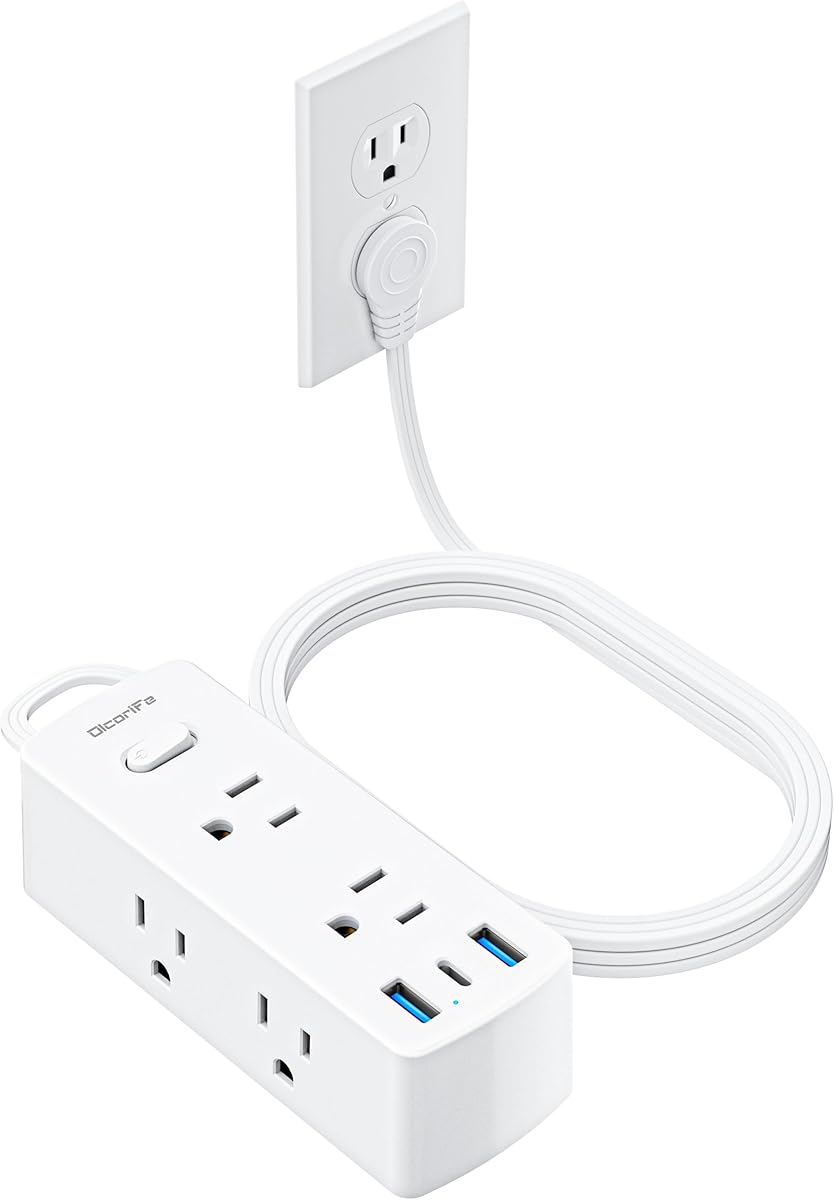
The Olcorife Flat Plug Power Strip provides six AC outlets, two USB-A ports, and one USB-C port, with a five-foot cord for flexible placement. Its 4.7 rating makes it an attractive general-purpose option for a kitchen counter where the receptacle is not conveniently located.
We may earn a commission when you buy through this link, at no additional cost to you.
The defining physical feature is the 0.27-inch flat plug, which can fit into a tight receptacle and sit behind nearby furniture or cabinetry. The three-sided body makes the strip compact, while the five-foot cord provides enough length to reach a counter, island, or side table without needing an extension of its own.
The unit's stated connection count is nine, covering six AC devices and three USB-charged devices. A built-in circuit breaker cuts power when the rated load is exceeded, helping reduce the risk of overheating. Two mounting holes on the back provide a way to secure it to a wall or other suitable surface.
This model is a good choice for a flexible kitchen setup, rental, or temporary charging station where a cord is acceptable. Because the supplied information does not state a surge-energy rating, it is less suitable for a buyer who wants to compare quantified surge protection directly.
The thin plug profile can preserve access to an outlet positioned behind an appliance or beneath cabinetry. It is useful where a conventional bulky plug would interfere with neighboring equipment.
The five-foot cord lets the strip sit where it is most useful rather than directly beneath the wall outlet. It also makes the unit easier to carry between the kitchen, office, or dorm room.
We may earn a commission when you buy through this link, at no additional cost to you.
The Philips 6-Outlet Extender Surge Protector is a straightforward wall tap with six grounded, three-prong outlets and 900 joules of surge protection. Its 4.7 rating reflects a dependable option for users who prioritize a familiar brand, simple construction, and a clean countertop installation.
We may earn a commission when you buy through this link, at no additional cost to you.
Unlike many competitors in the guide, this model does not include USB charging ports. Its focus is simply converting one grounded duplex receptacle into six outlets for electronics, lamps, chargers, and small household devices. That makes it a practical choice when USB charging is handled elsewhere.
The low-profile body is designed to fit behind furniture and save space. An LED indicator provides an at-a-glance indication that surge protection is operating. The unit is ETL certified, rated for 125 volts, 15 amps, and 1,875 watts, and backed by a limited lifetime replacement plan and connected equipment policy.
This wall tap is best for a kitchen where you need more AC connections but do not need integrated charging. Its 900-joule rating is lower than the 1,680- and 1,800-joule options in the guide, but the trade-off is a particularly simple, recognizable design with no charging ports to complicate the layout.
The direct wall-tap format expands one receptacle without introducing another cable. That simplicity suits counters where the main need is additional AC connections for several small appliances.
The illuminated indicator gives users an easy visual check of the protector's operating status. It is a small feature, but useful in a frequently used kitchen power hub.
We may earn a commission when you buy through this link, at no additional cost to you.
The Fosmon 3-Outlet Appliance Surge Protector includes two compact three-outlet units, each with 1,200 joules of surge protection. Its 4.7 rating makes this two-pack a versatile choice for protecting several kitchen appliance locations or keeping a spare protector nearby.
We may earn a commission when you buy through this link, at no additional cost to you.
Each adapter has a grounded, three-prong plug and a total capacity of 1,875 watts at 125 volts and 15 amps. The product conforms to UL498A and UL1449 standards, while protected and ground indicator lights provide simple visual feedback. Its small size also makes it convenient to pack when needed.
The two-pack creates more flexibility than a single larger unit. One protector can serve a refrigerator, microwave, or other compatible appliance area, while another can be installed near a different outlet. This is helpful in kitchens where major appliances use outlets in different locations and a single central strip would be inconvenient.
The main limitation is the absence of USB charging and the relatively small three-outlet count. It is best for straightforward appliance protection rather than creating a multi-device charging station. Buyers should also confirm that the connected appliance and circuit can handle the stated maximum load.
Two separate units allow appliance protection to be distributed around the kitchen. This can be more practical than routing one heavy cord from a central outlet to several widely separated appliances.
Each three-outlet unit uses a grounded plug and fits into a modest amount of space. The dual indicator lights help users confirm grounding and protection status.
We may earn a commission when you buy through this link, at no additional cost to you.
The Wall Outlet Extender with Surge Protector stands apart with a removable shelf that creates storage above the counter. It also supplies six AC outlets and three USB charging ports, earning a 4.5 rating for households that want power and a small landing area in one fixture.
We may earn a commission when you buy through this link, at no additional cost to you.
The shelf can hold common items such as razors, toothbrushes, speakers, and other compact objects, keeping them off the work surface. Its removable design allows users to change the configuration, while the direct plug-in installation avoids a cable stretching across the counter.
The USB section includes one USB-C and two USB-A ports with a total stated output of 3.1 amps. SmartIQ technology is described as optimizing charging speed, with individual USB-A output up to 2.4A at 5V. Safety features include protection from over-current, overcharging, and overheating.
This is the most specialized option in the guide, offering meaningful value when counter organization matters. Its 490-joule protection rating is considerably lower than those of most competing products, so buyers primarily interested in maximum quantified surge protection should choose a different model. It also requires compatible grounded wall receptacles.
The integrated platform gives small appliances and personal items a defined place near the outlets. That turns the extender into a small charging station rather than merely a power adapter.
Six AC outlets and three USB ports allow several device types to be served from one location. The removable shelf can be used only where it adds value, making the unit adaptable to changing counter needs.
We may earn a commission when you buy through this link, at no additional cost to you.
The Rotating Plug 10-in-1 Extender combines six AC outlets with two USB-C and two USB-A ports. Its 4.7 rating and 1,800-joule protection make it one of the most connection-rich wall adapters in the guide, particularly for counters with many phones and small accessories.
We may earn a commission when you buy through this link, at no additional cost to you.
The plug rotates 90 degrees in either direction, helping position the adapter around cabinets, appliances, and other obstructions. The three-sided body separates the six outlets with enough space for larger plugs, while the stated dimensions are 5.7 by 1.9 by 1.7 inches.
The USB-C ports use smart charging technology and are rated up to 3A at 5V, while the USB-A ports are rated up to 2.4A at 5V. Protection circuitry includes TVS, MOV, and GDT components, with a stated response time below 1 nanosecond and minimum energy-absorbing capacity of 1,800 joules.
Choose this model when a kitchen charging station needs both substantial outlet capacity and multiple USB connections. It is less suitable where space around the receptacle is extremely limited, and users must keep the connected load within the stated 1,875-watt and 15-amp ratings.
Two USB-C and two USB-A ports reduce dependence on wall blocks. The mix accommodates modern and older charging cables, making the adapter convenient for a shared household kitchen.
The rotating plug allows the outlet body to remain usable even when a nearby object blocks the direct path. It offers similar practical advantages to other rotating extenders without requiring a long cord.
We may earn a commission when you buy through this link, at no additional cost to you.
The TESSAN Short Extension Cord offers four AC outlets, one USB-C port, and two USB-A ports in a compact 0.5-foot format. Its 4.7 rating reflects a practical solution for a kitchen counter that needs a little more reach without accumulating excess cable.
We may earn a commission when you buy through this link, at no additional cost to you.
The five-and-a-half-inch extension cord can be flexibly positioned, and the 0.34-inch flat wall plug slides into tight spaces behind sofas, desks, beds, or cabinets. Its three-sided arrangement allows four large adapters to be connected, which is a useful detail for outlets with bulky plug bodies.
The USB-C port supplies up to 5V and 3A with a 15-watt maximum, while each USB-A port supplies 5V and 2.4A with a 12-watt maximum. The surge-protection section is described as providing over-current, overvoltage, and short-circuit safeguards, although no numerical joule rating is supplied.
This product is best for users who want a tidy, short-cord solution and need fewer than six AC connections. It is less compelling as a high-joule appliance protector because the protection level cannot be compared numerically with the other models in this roundup.
The half-foot cord offers enough movement to place the outlet body comfortably without creating the excess wire associated with a long extension. This supports a tidier work surface.
The ultra-thin plug head can fit behind furniture or cabinetry where a conventional plug would protrude. It also helps keep nearby furniture positioned close to the wall.
We may earn a commission when you buy through this link, at no additional cost to you.
The right kitchen surge protector depends on the appliances you intend to connect, the amount of counter space you can sacrifice, and whether you need USB charging or a more permanent installation. Electrical ratings and outlet design should take priority over decorative features.
A surge protector does not increase the available power from the wall circuit. Review its rated amperage, voltage, and wattage, and compare those figures with the combined requirements of the devices you plan to plug in. Several products in this guide are rated for 1,875 watts at 125 volts and 15 amps, but a high-power microwave, convection oven, or similar appliance may consume a substantial portion of that capacity on its own.
For heavier loads, pay particular attention to the cord gauge and construction. The 14-gauge model is specifically described as a heavy-duty appliance power strip, while the other options are primarily designed for electronics, chargers, and smaller countertop appliances.
The joule figure indicates the amount of surge energy the protector is designed to absorb. In this list, the 1,800-joule rotating extenders provide the highest stated figure, followed by the 1,680-joule Belkin and QINLIANF models. The Philips offers 900 joules, the Fosmon 1,200 joules, and the shelf extender 490 joules. These numbers are useful for comparison, but they are not guarantees against every type of damage.
Treat the joule rating as one factor rather than the sole selection criterion. Also look for over-current, over-temperature, overload, overvoltage, and short-circuit safeguards, as well as an indicator that shows whether the protection remains active.
A kitchen can consume outlets quickly, so count the devices rather than simply choosing the largest headline number. The Belkin, Olcorife, and Philips provide six AC outlets; the heavy-duty model provides eight; and the rotating extenders also provide six. The TESSAN offers four, while the Fosmon provides three per adapter. Plug size matters as much as the number because bulky transformer plugs can block neighboring sockets.
Look for side-mounted outlets, generous separation, and a three-sided body. These features are especially useful when a coffee maker, charging brick, and countertop appliance are all connected at once. Remember that every connected plug should remain fully accessible.
USB ports can simplify a kitchen charging area by reducing the number of separate charging blocks needed. The guide includes models with one to four USB connections, including USB-A, USB-C, or both. The Belkin offers the simplest mixed setup with one port of each type, while the QINLIANF, Olcorife, and TESSAN provide three USB ports.
Pay attention to output ratings. Several USB-C ports in the list support up to 3A at 5V, but the QINLIANF description explicitly states that its USB-C port is not Quick Charge 3.0 and does not handle devices requiring 9 to 22 volts. Check the requirements of every device before relying on fast-charging behavior.
Wall taps use almost no counter depth, which makes them ideal beneath cabinets or behind appliances. Rotating plug extenders also mount directly to the outlet but can project farther from the wall. Short-cord strips add modest flexibility while keeping cables relatively controlled. The five-foot Olcorife cord is the longest option and offers the most placement freedom, but it also introduces the greatest potential for visible cable clutter.
The shelf-style extender is deliberately different from conventional power strips because it adds a removable storage platform. The heavy-duty model's two-foot cord and mounting tabs make it suitable for a workbench, wall, or counter installation.
Not every wall outlet supports every mounting style. The QINLIANF is designed to secure to a duplex receptacle, and its supplied information says it cannot be secured in the same way to a GFCI outlet. The Belkin, Olcorife, and heavy-duty model offer wall-mounting features, although the exact mounting surfaces and hardware should be verified before installation.
Kitchen counters are often near water, but the products in this guide do not all carry the same level of wet-location rating. If a receptacle is exposed to splashing or moisture, check its markings and applicable safety requirements. A surge protector is not a substitute for a properly installed GFCI device where one is required.
An indicator light can provide quick confirmation that grounding or surge protection is active. Several models in this guide include such lights, while the product information for the TESSAN does not specify one. A light is useful for routine checks, but users should also follow the instructions for what to do if the indicator changes or a protective component operates.
Avoid repeatedly resetting or reusing a protector that has shut itself off after an overload. A built-in circuit breaker is intended to interrupt unsafe conditions, and repeated resets can conceal an underlying problem. Unplug unnecessary loads before checking the unit.
ETL certification appears in the supplied information for several products, while the Fosmon states conformity to UL498A and UL1449. These references provide useful evidence of tested safety standards, but buyers should review the listing and manufacturer documentation for the complete scope of the certification.
Warranty and connected-equipment policies add another layer of confidence. The Belkin includes a two-year limited warranty and a connected equipment warranty, the Philips includes a limited lifetime replacement plan, and the Fosmon includes a limited lifetime warranty. Review the terms rather than assuming every connected product is covered in every circumstance.
Before installation, read the product instructions and confirm that the wall receptacle is grounded and compatible with the selected mounting method. Place the protector where its outlets remain accessible, its cord or body will not contact hot surfaces or dripping water, and no appliance will place excessive weight on the connection.
Connect higher-draw appliances one at a time and remain within the protector's stated voltage, amperage, and wattage limits. Avoid daisy-chaining power strips unless the manufacturer expressly permits it, and do not route the cord beneath rugs, across walkways, or where it could be pinched or cut.
Inspect the unit periodically for cracks, discoloration, loose plugs, unusual heat, buzzing, or a warning indicator. If the protector shuts off, disconnect unnecessary loads before resetting it. Replace a damaged or repeatedly tripping unit, and never bypass the grounding pin or alter the plug.
Only if the microwave's power requirements fall within the protector's stated electrical ratings and the manufacturer's instructions do not prohibit it. The 14-gauge heavy-duty model is specifically described for higher-power appliances, including microwaves, and is rated for 1,875 watts at 125 volts and 15 amps. Even a higher-rated protector does not increase the capacity of the wall circuit, so high-wattage appliances should be used only when the entire connected load remains within the limits.
A higher joule rating indicates greater stated energy-absorption capacity, but it is not a guarantee against all possible damage. Other factors matter, including the quality of the protection circuit, proper installation, grounding, and the electrical load connected to the unit. It is also important to ensure the protector remains within its rated amperage and wattage.
A surge protector does not replace the GFCI protection required in applicable wet locations. Countertop receptacles may need GFCI protection depending on local requirements and installation conditions. A plug-in surge protector should never be assumed to provide ground-fault protection, and compatibility with a GFCI receptacle should be checked because some mounting designs are expressly limited to standard duplex receptacles.
A properly installed surge protector can remain connected, but it should be monitored for physical damage, excess heat, buzzing, discoloration, or a tripped breaker. Unplug it during long periods of absence if that is part of your household routine. If a protective light changes or the unit repeatedly trips, investigate the connected loads and replace the protector if necessary.
It is generally best not to daisy-chain power strips unless both manufacturers explicitly allow it, because doing so can create overloaded connections and make heat or fault conditions harder to manage. Instead, choose one protector with enough outlet capacity and suitable ratings for all intended devices. Keep the combined load within the electrical and surge-protection limits of the selected unit.
A wall-tap model usually preserves the most counter depth because it has no extended power cable. The Belkin, QINLIANF, and Philips options are direct wall-mounted designs, while the rotating extenders can project outward but improve access to blocked receptacles. Measure the available depth and consider nearby cabinets before deciding which form fits best.
That depends on the devices you regularly charge. USB-C is convenient for compatible modern phones, tablets, and accessories, while USB-A remains useful for older cables and many smaller electronics. A model with one USB-C and one USB-A may be enough for a two-person kitchen, whereas a shared or frequently used counter may benefit from more ports and greater total output.
Stop using the protector, unplug connected devices, and inspect the unit for visible damage. Check whether an overload or fault interrupted its protection, and review the manufacturer's instructions before resetting or replacing it. Never remove a cover, defeat a circuit breaker, or continue using a protector that has been damaged by heat, water, or impact.
The Belkin 6-Outlet Surge Protector is the most balanced overall choice because it combines six outlets, 1,680 joules of protection, two useful USB connections, and a wall-mounted footprint. The 14-Gauge Heavy Duty Power Strip stands out for eight outlets and a substantial 14 AWG cord, while the QINLIANF offers a compact five-outlet alternative with four USB ports.
Prioritize the format and electrical capacity that match your kitchen. A rotating plug solves awkward access, a flat or wall tap minimizes counter clutter, and a longer cord provides placement flexibility. For high-draw appliances, verify wattage, amperage, cord gauge, and the requirements of the wall circuit before connecting anything.
Finally, review the latest listing details and product instructions before purchasing. Retail availability, bundled accessories, warranty terms, and technical specifications can change, and the most reliable choice is the one that safely supports your devices while fitting the physical layout of your counter.