
NICE-POWER Variable DC Power Supply 200V 5A
5.0Editor score
High-power 1000-watt output
Precision four-digit display
Automatic CV and CC modes
Discover the best power supply for electrolysis by comparing voltage, current, controls, protection, portability, and laboratory suitability.
A dependable power supply for electrolysis must deliver stable, adjustable DC output while handling the changing demands of electrolytic cells. Voltage, current regulation, protection features, readable controls, and safe heat management matter more than decorative extras or headline wattage alone.
The ten products in this guide were compared using their listed output ranges, adjustment systems, displays, protection functions, physical design, and stated electrolysis applications. The list covers compact bench models, standard 30-volt units, and a much more powerful laboratory supply for demanding projects.
Each review explains where a model stands out, where its limitations may matter, and which type of electrolysis work it best suits. Product listings and availability can change, so confirm the current specifications, included accessories, and compatibility requirements before ordering.
5.0Editor score

4.6Editor score

4.6Editor score
The comparison below places all ten adjustable DC power supplies side by side, focusing on the output envelope, control method, display resolution, protection features, and practical distinction for electrolysis setups.
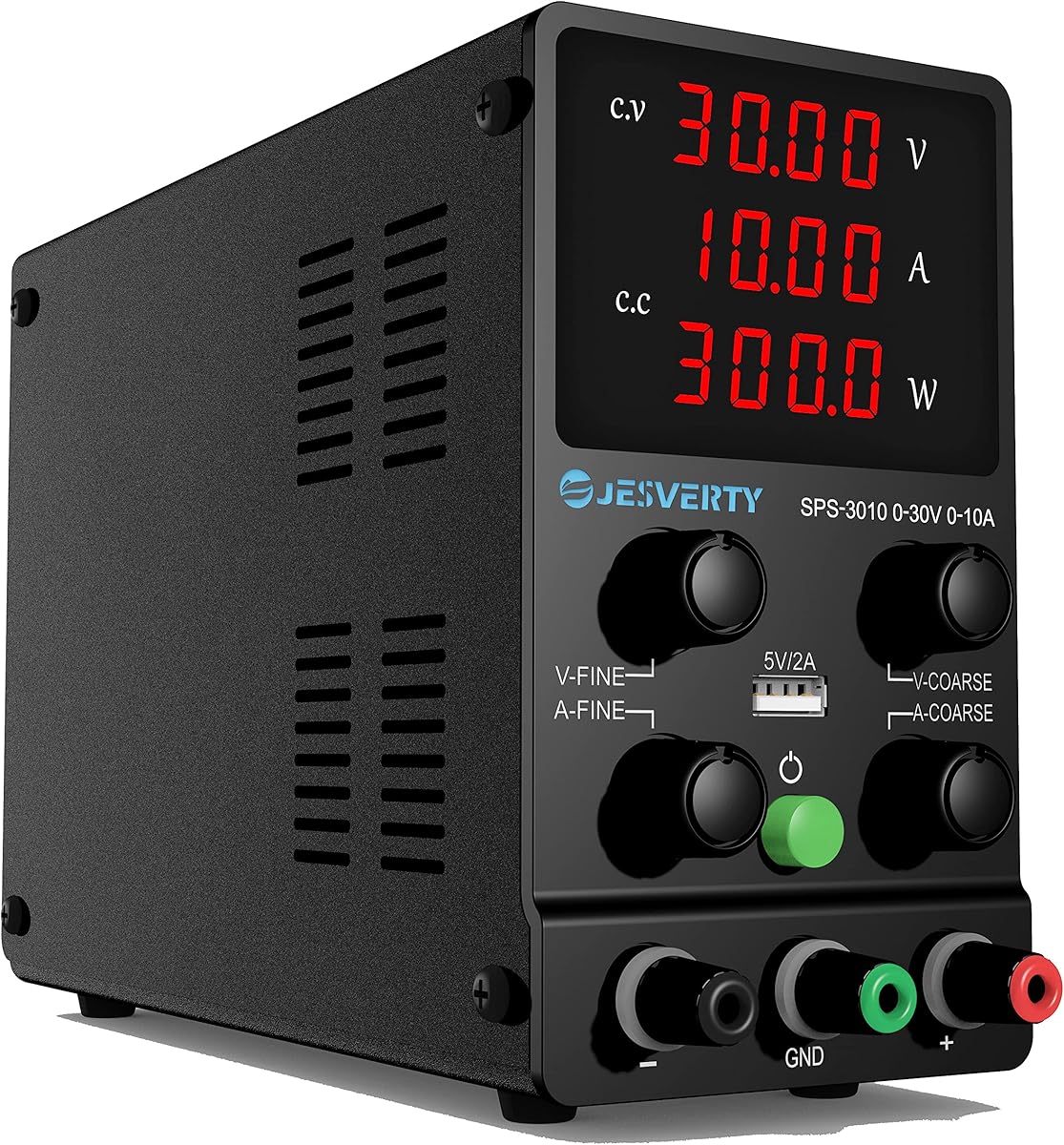


The Jesverty SPS-3010 is a conventional 30-volt, 10-amp adjustable bench supply with a bright four-digit display and a useful real-time power readout. Its 4.5 rating reflects a well-balanced combination of output range, compact construction, protective circuitry, and straightforward operation for electrolysis and general electronics work.
We may earn a commission when you buy through this link, at no additional cost to you.
The strongest feature is automatic switching between constant-voltage and constant-current operation. During electrolysis, cell resistance can change as the electrolyte warms, gases form, or electrode conditions vary. Setting both limits allows the supply to behave predictably instead of allowing current to rise without a defined ceiling. The display resolves voltage to 0.01 volt, current to 0.001 amp, and power to 0.1 watt.
Its dimensions of 7.1 by 3.35 by 6.1 inches and weight of approximately 2.5 pounds make it less imposing than a full laboratory instrument. Protection features include short-circuit, overload, grounding, and temperature-regulated fan support. The trade-off is that the included test leads are described as giveaways, so sustained high-current work may call for more substantial cables.
This is a sound general recommendation for water electrolysis, small plating cells, educational experiments, and electronics work. It is less suitable when an experiment requires substantially higher voltage, serious continuous power, or numerous high-current cells. Users should still match the electrode material, electrolyte, and cell geometry to the intended current and voltage limits.
The four-digit display presents voltage, current, and power in real time, making it easier to establish a repeatable operating point. That visibility is particularly useful when electrolytic cell behavior changes during a run and the operator needs to distinguish a load change from a control or connection problem.
Automatic constant-voltage and constant-current modes make the SPS-3010 useful for cells whose resistance is not perfectly stable. The configured values act as the transition point, allowing the supply to regulate the load while maintaining a defined operating envelope.
We may earn a commission when you buy through this link, at no additional cost to you.
The NANKADF 30-volt, 10-amp supply is built around a digital encoder rather than conventional rotary potentiometers. Its 4.5 rating and feature set make it a practical choice for electrolysis experiments where operators want repeatable, digit-level control without losing the form of a conventional bench supply.
We may earn a commission when you buy through this link, at no additional cost to you.
Pressing the encoder selects a digit, and rotating it changes the selected value from zero through nine. The four-digit display reports voltage and current to 0.01 volt and 0.001 amp. An output enable and disable button separates configuration from live output, reducing the chance that changing a setpoint will instantly alter a connected cell.
Overcurrent protection stops output and sounds a buzzer if the load is short-circuited. Constant-voltage and constant-current modes switch automatically as the load changes. The most noticeable limitation is that the product data does not state a maximum power rating, so users should avoid assuming that every combination within 30 volts and 10 amps can be sustained.
Choose this model when convenient numeric entry, clear output control, and short-circuit warnings are the priorities. It is well aligned with small electrolysis rigs, instructional demonstrations, and repair benches where a removable USB charging port is convenient but not the main reason to buy.
Digit selection makes it easier to enter a target voltage or current than estimating a potentiometer position. For electrolysis, that repeatability can make it simpler to document the operating point and return to it after changing a component or replacing an electrode.
The dedicated output button lets the operator prepare the next setting before energizing the cell. Combined with audible overcurrent alerts, it provides a more deliberate workflow than a design in which every adjustment is immediately applied to the load.
We may earn a commission when you buy through this link, at no additional cost to you.
The LONGWEI LW-K3010D is a 30-volt, 10-amp switching supply designed for laboratory, repair, aging-test, and educational use. It carries a 4.4 rating and emphasizes durability, straightforward operation, and thermal management rather than the most advanced interface found among newer competitors.
We may earn a commission when you buy through this link, at no additional cost to you.
Its backlit display shows voltage, current, and power with stated resolution of 0.1 volt and 0.01 amp. A temperature-controlled fan and side heat-radiation grooves help dissipate heat and reduce operating noise. The package includes an input cord, output cord, test probes, and alligator clips, which is convenient for assembling a basic electrolysis bench.
Safety functions include current limiting, overpower and overtemperature protection, voltage overload protection, and a grounding wire. Compared with four-digit models, the three-digit display gives less numerical detail and cannot show the same range of small current increments. The unit also weighs less than two kilograms and measures 2.7 by 8.6 by 6.3 inches.
This supply is best for users who value established lab styling, included connection hardware, and straightforward protection over premium charging ports or encoder-based fine control. It should suit small electrolytic cells, instrument repair, and teaching environments, provided the cell does not need higher voltage or a power envelope beyond the stated range.
Temperature-controlled fan operation is important when a power supply operates near the upper end of its range for an extended period. The sensor-driven fan and ventilation grooves are designed to remove heat efficiently while keeping noise lower than a continuously running cooling approach.
Included test probes and alligator outputs help shorten initial setup. They are useful for temporary experiments, although a serious installation should still confirm that wire gauge, insulation, and connector ratings are appropriate for the planned current.
We may earn a commission when you buy through this link, at no additional cost to you.
This 30-volt, 10-amp encoder supply earns the Editor's Choice distinction because it combines precise controls, clear safety behavior, and broad compatibility in a modern bench design. Its 4.6 rating is the highest among the standard 30-volt models in this comparison.
We may earn a commission when you buy through this link, at no additional cost to you.
Separate coarse and fine encoder knobs divide control logically: the coarse knob changes the value before the decimal point, while the fine knob changes the decimal portion. The four-digit screen and 0.01-volt or 0.001-amp adjustment make it useful for repeatable cell tuning. A Type-C output and a USB port rated at 5 volts and 3.6 amps add convenient power for phones and repair devices.
Its overcurrent protection shuts down output and sounds a buzzer during a short circuit. Grounding, leakage, overheat, voltage overload, and power overload protections are also listed. Automatic mains detection supports 110- and 230-volt environments without a rear selector, although the unit still needs a compatible regional power cord.
The main limitation is its modest 30-volt ceiling. It is a strong match for ordinary water electrolysis, small electroplating cells, electronics repair, and teaching experiments, but not for high-voltage electrolysis or heavily loaded multi-cell arrangements. Confirm the cell's expected operating point and ensure continuous operation remains within safe thermal limits.
Separating whole-number and decimal adjustments cuts the number of encoder turns required to reach a precise target. That control scheme is particularly helpful when an electrolytic process needs small current changes that would be difficult to reproduce with a conventional analog dial.
Overcurrent shutdown and an audible short-circuit alert provide immediate feedback when a cell, cable, or electrode develops a fault. The additional thermal, leakage, voltage, and power protections create a useful layer of defense for an unattended or changing bench setup.
We may earn a commission when you buy through this link, at no additional cost to you.
The Jesverty SPS-3010V is a 32-volt, 10-amp switching supply with a 4.6 rating. It refines the familiar compact bench-supply format with encoder-based coarse and fine adjustment, an output switch, and two 20-watt charging ports, making it a versatile bench companion for electrolysis and electronics projects.
We may earn a commission when you buy through this link, at no additional cost to you.
The four-digit display and encoder resolution of 0.01 volt and 0.001 amp support careful operating-point selection. An output on-off button allows the unit to be configured without immediately changing the load. Its OPN setting can also make the supply begin delivering voltage and current when the main power is switched on, which may suit repeatable automated or semi-automated routines.
Protection includes overcurrent limiting, while a temperature-regulated fan manages heat. The USB-A and USB-C ports can charge compatible devices or power common development boards. The listed measurements are 7.1 by 3.6 by 6.2 inches, with an approximate weight of 2.5 pounds, preserving a compact footprint.
The principal caveats are the absence of a stated continuous-power rating and the warning that included leads may not suit long-term high-current use. It is a good option for compact electrolysis cells and mixed electronics work, while higher-load users should verify cable capacity, ventilation, and sustained thermal performance.
The output button separates power availability from the decision to energize a cell. This is useful during setup because wiring changes can be made without the load receiving power, reducing accidental contact with an active output.
The Type-A and Type-C ports each support 20-watt charging. Although not central to electrolysis, they reduce bench clutter by providing convenient power for phones, Arduino boards, Raspberry Pi systems, and other modules used to monitor or document an experiment.
We may earn a commission when you buy through this link, at no additional cost to you.
The NICE-POWER 30-volt, 10-amp supply is a well-specified laboratory-style option with a 4.6 rating. Its defining strength is an extensive protection package, while real-time power calculation, automatic constant-voltage and constant-current operation, and a front output switch make it suitable for controlled electrolysis experiments.
We may earn a commission when you buy through this link, at no additional cost to you.
The bright four-digit display resolves voltage to 0.01 volt and current to 0.001 amp, and displays voltage, current, and power in real time. The supply automatically changes operating mode as the load changes, helping it regulate a cell whose resistance varies. An intelligent fan and heat sink activate when the working temperature exceeds the listed threshold.
Listed protections include leakage, grounding, overvoltage, overcurrent, overpower, overload, overtemperature, and short-circuit protection. The product is designed for 110-volt US input only, so it is unsuitable for direct use on a 220-volt supply without an appropriate, safe conversion arrangement.
At 8.4 by 3.3 by 5.5 inches and 2.6 pounds, it is larger than several ultraportable competitors but still practical for a lab bench. It is a strong recommendation for electrolysis, electroplating, brush plating, lamp testing, aging tests, and classroom use, particularly where operator and load protection are priorities.
The broad protection list covers several common failure conditions rather than focusing only on overcurrent. For electrolysis, where electrolyte, electrodes, and exposed connections can change, layered protection helps reduce the consequences of a wiring mistake or thermal event.
Showing calculated watts alongside voltage and current gives a faster indication of how hard the supply is working. This can help identify a developing change in cell resistance and makes it easier to keep an experiment within a repeatable operating envelope.
We may earn a commission when you buy through this link, at no additional cost to you.
The NICE-POWER SPS-E3010 is a compact 150-watt supply designed to operate in either a 15-volt, 10-amp or 30-volt, 5-amp configuration. Its 4.5 rating and unusually small enclosure make it attractive for electrolysis and electroplating work where bench space is limited.
We may earn a commission when you buy through this link, at no additional cost to you.
Users can switch between the two operating combinations, with the limit preventing simultaneous settings that would exceed 150 watts. The three-digit display provides 0.1-volt and 0.01-amp resolution. Encoder knobs let users select individual digits and set the desired values, combining precise numerical entry with a compact front panel.
The enclosure measures 10 by 18.5 by 8 centimeters and weighs less than one kilogram. A cooling fan starts automatically to help dissipate heat, although the manufacturer advises stopping use if the unit becomes excessively hot. Its 100-to-240-volt AC input is compatible with both 110- and 230-volt environments.
This is a sensible choice for portable experiments, smaller cells, and crowded teaching benches. It is less suitable for a large electrolytic tank or an application that needs both the highest listed voltage and highest listed current simultaneously. Treat the 150-watt ceiling as a central design limit when planning the experiment.
A width of only 10 centimeters leaves more room for tanks, electrodes, meters, and cable routing. That makes the SPS-E3010 useful in teaching labs and temporary setups where a full-size laboratory supply would dominate the available workspace.
The 15-volt, 10-amp mode is suited to lower-voltage work with greater current, while 30-volt, 5-amp mode supports higher voltage at lower current. The 150-watt ceiling makes the tradeoff explicit and helps prevent an incompatible setpoint.
We may earn a commission when you buy through this link, at no additional cost to you.
The SKY TOPPOWER 30-volt, 10-amp unit is one of the smaller models in the roundup, measuring 8.70 by 5.43 by 4.09 inches and weighing less than 1.5 kilograms. Its 4.3 rating is slightly lower than the group leaders, but the stated controls, protections, and explicit electrolysis application make it a relevant contender.
We may earn a commission when you buy through this link, at no additional cost to you.
The four-digit display resolves voltage to 0.01 volt and current to 0.001 amp. Smooth coarse and fine controls support careful adjustment, while the screen indicates automatic transitions between constant-voltage and constant-current operation. When current reaches or exceeds the programmed limit, the unit changes to constant-current mode and the voltage falls accordingly.
Protection includes leakage and thermal protection, voltage overload, current limiting, short-circuit handling, and a temperature-controlled cooling fan. A ground terminal and anti-reverse connection protection are valuable additions for a wet electrochemical environment where cables may be repositioned frequently.
The supply measures 8.70 by 5.43 by 4.09 inches and weighs less than 1.5 kilograms, making it easy to carry between workspaces. It is best for small electrolysis projects, etching, component testing, and mobile experimentation. Users seeking maximum thermal margin or a clearly stated continuous wattage may prefer a model with more explicit high-power specifications.
The listed reverse-connection protection helps address one of the most common bench mistakes: attaching a lead with reversed polarity. In an electrolysis circuit, preventing that error adds a useful safeguard, although correct cell polarity remains the operator's responsibility.
Combining a backlit four-digit display with a sub-1.5-kilogram weight gives the unit a strong balance of readability and portability. It is easy to move to a different bench and still monitor voltage, current, and operating mode during an experiment.
We may earn a commission when you buy through this link, at no additional cost to you.
The NICE-POWER 200-volt, 5-amp laboratory supply is the clear premium selection, with a 5.0 rating and a 1000-watt power class. It is the only model here designed to cover high-voltage electrolysis in addition to high-current laboratory work, making it suitable for serious experimental rigs rather than just desktop demonstrations.
We may earn a commission when you buy through this link, at no additional cost to you.
Its high-precision encoder selects and changes individual digits, while the backlit four-digit display presents voltage and current clearly. Preset limits support automatic constant-voltage and constant-current behavior. Internal overvoltage and overcurrent protection support stable operation when the load approaches the configured boundary.
An intelligent cooling fan is built around a temperature-controlled cooling system. The supply is also listed as CE and FCC certified, adding a level of documentation that can matter in professional or institutional settings. Its dimensions are 38 by 24 by 13 centimeters and weight is 3.3 kilograms, so it needs more bench space than the compact 30-volt units.
The package includes a power cord, English manual, and both low-power and high-power output cables. This is the strongest option for high-voltage electrolysis, battery charging, solar testing, aging tests, and other demanding laboratory applications. For small water-electrolysis demonstrations, however, the extra capacity adds cost, weight, and complexity without a corresponding benefit.
A 200-volt ceiling creates room for experiments that require more potential than standard 30-volt supplies can provide. That headroom is particularly valuable when the electrochemical process, electrode spacing, or test configuration demands a higher operating voltage.
The 1000-watt class and temperature-controlled fan distinguish this supply from compact hobby units. Those characteristics make it more appropriate for sustained loads, larger aging tests, and multiple applications where output stability and thermal management are central requirements.
We may earn a commission when you buy through this link, at no additional cost to you.
The NICE-POWER 30-volt, 5-amp supply is the most compact and accessible entry in the roundup, earning the Best Budget designation while maintaining a 4.6 rating. It explicitly lists electrolysis and electroplating among its intended uses, making it a sensible starting point for small cells and educational projects.
We may earn a commission when you buy through this link, at no additional cost to you.
Encoder knobs let the user select and change individual voltage and current digits. The backlit three-digit display resolves voltage to 0.1 volt and current to 0.01 amp, which is adequate for many introductory setups but less detailed than the four-digit alternatives. Output is adjustable from zero to 30 volts and zero to 5 amps.
Overvoltage, overcurrent, overpower, overtemperature, and short-circuit protection are listed, and the unit carries FCC and CE certification. A cooling fan starts when the supply is powered on to dissipate heat. Its 100-to-240-volt input range supports 110- and 230-volt environments, making it broadly compatible internationally.
The enclosure measures 6.5 by 4.0 by 3.2 inches and weighs only 1.54 pounds, so it is easy to store and transport. Its main limitation is the 5-amp ceiling, which restricts large-area electrodes and heavily loaded cells. It is best for modest electrolysis demonstrations, compact plating work, LED testing, and electronic repair.
The mini enclosure leaves room for small electrolytic vessels, electrode holders, and measurement equipment without taking over the bench. A 1.54-pound weight also makes the unit convenient for demonstrations in different classrooms or temporary workspaces.
Digit-based controls and a full set of stated protections make the unit more approachable than a basic unregulated or partly protected supply. It provides a controlled and monitored output for introductory projects without requiring a full laboratory installation.
We may earn a commission when you buy through this link, at no additional cost to you.
Choosing a power supply for electrolysis requires balancing cell requirements, output regulation, controls, protection, thermal capacity, and physical setup. The most important rule is to select the supply around the intended voltage, current, and continuous operating profile rather than around the largest headline rating.
Choose an adjustable range that comfortably contains the intended operating point. Avoid using a model whose maximum sits exactly at the required voltage, since line variation, load changes, and control tolerance can make operation less predictable.
Estimate the working current and leave a sensible margin rather than planning to operate continuously at the absolute maximum. Also confirm any combined power limit, such as the 150-watt ceiling in the compact SPS-E3010.
Look for automatic CV and CC conversion rather than relying on manual readjustment. Set both values deliberately: the voltage establishes the target, while the current limit defines the point at which the supply changes behavior.
Prioritize resolution that matches the experiment. Higher numerical detail is useful when small current changes must be repeated, while a simple accurate setpoint may be more important than the number of display digits.
Check that protection is automatic rather than merely described as a current limit. The ideal supply shuts down or reduces output when a fault develops, alerts the operator, and avoids forcing an unsafe operating point through the cell.
Leave clearance around vents and avoid enclosing the supply during operation. If the manufacturer warns about excessive heat, stop the experiment and allow the unit to cool rather than continuing to demand output.
Treat accessory specifications as part of the system rather than a minor detail. Replace inadequate leads before increasing current, and inspect cables regularly for heat, discoloration, looseness, or damaged insulation.
Choose based on the expected load rather than physical size alone. A portable model is ideal for demonstrations and temporary experiments, while a larger high-power unit makes more sense for a permanent laboratory installation with sustained workloads.
Before connecting the cell, confirm that the supply's DC output, voltage range, current range, and power limit match the experiment. Wire the positive and negative leads to the intended electrodes with the power output disabled, check electrode polarity, and make sure the supply is connected to a compatible grounded AC source. Use insulated leads rated for the intended current and secure every connection before energizing the circuit.
Begin with a conservative voltage and current limit, enable the output, and observe the display as the cell settles. Record the voltage, current, calculated power, and operating mode. Increase only one setting at a time, stay below the cell's required operating point, and never exceed the supply's combined power limit. If the current rises unexpectedly, the voltage behaves unusually, the unit becomes hot, or a protection alarm activates, disable the output and investigate the cell, electrolyte, wiring, and electrodes.
For ongoing care, keep the vents unobstructed, wipe away electrolyte residue from the enclosure and connections, and inspect the leads for heat or damaged insulation. Do not place the supply where liquid can enter it, and do not use it as a substitute for a purpose-built electrolysis current controller when a process requires exact current regulation. Shut down and disconnect mains power before moving the unit, changing a cell, or performing maintenance.
The correct values depend on the electrolyte, electrode material, electrode area, spacing, and desired reaction. A small demonstration cell may operate within the 0-30-volt range of many bench supplies, but the current requirement can still be substantial. Start with a conservative current limit and increase it only after observing the cell and supply. Never assume that all electrodes are safe at the supply's maximum output.
Yes, because an electrolytic cell's effective resistance can change as bubbles form, temperature rises, or electrode surfaces evolve. Constant-current mode helps maintain a repeatable reaction rate, while constant-voltage mode is useful when the cell is expected to remain stable. A supply with automatic CV and CC conversion provides a practical balance and makes mode changes visible to the operator.
It depends on the plating chemistry and required operating point. Several 30-volt, 5-amp or 10-amp supplies in this guide are explicitly listed for electroplating, brush plating, or related applications. Check the required voltage, current density, electrode area, bath chemistry, and supply power limit before connecting the tank. Use compatible leads and ensure the cell is properly ventilated and controlled.
Both provide the same maximum voltage, but the 10-amp model can support a higher current ceiling. That makes it more suitable for larger electrode surfaces, more conductive electrolytes, or more demanding loads. The higher current also increases heat and makes cable quality, connectors, cooling, and sustained power rating more important. A 5-amp unit may be sufficient for smaller cells and is usually easier to manage thermally.
They do not directly power the electrolysis cell, but several supplies include USB-A or Type-C ports for charging phones, powering development boards, or supporting monitoring equipment. These secondary outputs can make a bench more convenient. The main electrolytic output should still come from the dedicated DC terminals and be evaluated independently for voltage, current, power, and protection.
Included leads are often adequate for initial setup and light loads, but some product descriptions specifically recommend replacing them for long-term high-current work. Cable resistance causes voltage drop and heat, while inadequate insulation or connectors can become unsafe. Match wire gauge and connector ratings to the planned current, keep leads short where practical, and inspect them after sustained operation.
CV stands for constant voltage and CC stands for constant current. The supply attempts to hold the programmed voltage, but if the load tries to draw more than the programmed current limit, it changes to constant-current operation and reduces the voltage. This behavior helps control changing cell loads while keeping the operating point within the limits established by the operator.
A 200-volt supply makes sense when the electrochemical process genuinely requires a high potential difference or when the setup needs a larger power class for demanding laboratory work. It is unnecessarily large and complex for ordinary small-cell water electrolysis. The higher-voltage option should be paired with appropriate insulation, controlled access, suitable wiring, and a clear understanding of the chemistry involved.
The DC Power Supply Variable 0-30V 0-10A stands out as the most balanced Editor's Choice because its coarse and fine encoder controls, overcurrent shutdown, automatic mains detection, and broad protection features suit a wide range of ordinary electrolysis work. The NICE-POWER 200V 5A is the premium choice for users who need substantially more voltage and power, while the compact NICE-POWER 30V 5A provides an approachable foundation for smaller experiments.
For most users, prioritize a supply that comfortably covers the cell's expected voltage and current without operating continuously at its limits. Fine controls, a clear display, automatic CV and CC behavior, short-circuit response, and dependable cooling are more useful than secondary charging features. Larger electrodes, demanding baths, and long sessions justify moving toward a 10-amp or 1000-watt-class model.
Before ordering, confirm the current product specifications, regional input requirements, included accessories, protection behavior, and continuous power limits. Product listings and availability can change, so checking the latest manufacturer information and your cell's requirements will help prevent an unsuitable purchase.