
FlexSolar 25W Portable Solar Panel Charger
4.4Editor score
Lightweight folding design
Dual USB charging
23.2% conversion efficiency
Our Solar Backpacking Charger guide compares 10 portable solar panels for output, durability, charging options, portability, and outdoor reliability in 2026.
A solar backpacking charger can be a valuable source of power for phones, navigation tools, lights, and small electronics when the trail takes you beyond easy access to wall outlets. The best models combine useful solar output, efficient USB charging, low weight, and enough weather resistance for camping, hiking, backpacking, and emergency preparation.
This guide compares ten solar backpacking chargers using the specifications and stated features supplied for each product. It covers rated panel output, conversion efficiency, port selection, portability, weather resistance, foldability, monitoring features, and practical limitations, with particular attention to the difference between direct solar charging and energy storage.
Each review explains who the panel is best suited to and where its compromises may matter. The overall recommendations reflect the available product data rather than claims of personal testing, while pricing and availability can change at any time, so readers should verify current listings before purchasing.
4.4Editor score

4.5Editor score

4.5Editor score
The comparison below highlights each panel's stated output, charging flexibility, portability, and outdoor durability. Because solar performance depends heavily on sunlight, panel angle, weather, and device conditions, the specifications are best treated as practical design indicators rather than guaranteed real-world charging speeds.



The GEYOTO 45W Solar Panel Charger stands out as the most balanced option in this guide, earning a 4.5 rating from the supplied data. Its 45W panel rating, stated 26% conversion efficiency, and support for two USB-C ports plus one USB-A port make it well suited to hikers who want to charge several essential devices without carrying a separate wall charger.
We may earn a commission when you buy through this link, at no additional cost to you.
The most compelling feature is its charging flexibility. A compatible USB-C device can receive up to 25W through Power Delivery, while the additional ports allow phones, tablets, power banks, and other USB devices to be connected simultaneously. The stated 45W total output also gives the panel more headroom than the smaller 23W, 25W, and 28W selections when conditions are favorable.
Portability remains strong despite the higher output. The panel weighs 1.65 pounds and folds to 8.44 by 12.52 by 1.26 inches, a size described as approximately that of an iPad. Included carabiners, a USB-C extension cable, and a protective storage pouch make it easier to organize and attach during a journey.
There is no built-in battery, so this remains a direct-charging device rather than a miniature power station. Output can fall with cloud cover, poor angle, device temperature, or other conditions, and the manufacturer recommends pairing it with a power bank when energy needs to be collected for later use. For backpackers seeking the strongest balance of output, ports, and packability, this is the leading recommendation.
Two USB-C ports and one USB-A port reduce the need to rotate cables or devices. That flexibility is particularly useful when a hiker, camping partner, or family group needs to top up more than one small device during a sunny break.
The panel is described as IP68 water and dust resistant, making it suitable for camping, hiking, fishing, and boating. Keeping the ports dry and wiping the surface before storage remains important, as weather resistance does not mean every exposed connector is designed to sit in water.
We may earn a commission when you buy through this link, at no additional cost to you.
The FlexSolar 40W Foldable Solar Panel Charger combines a relatively generous 40W rating with an unusually broad selection of outputs. Its 4.4 rating reflects a strong overall proposition, while the USB-A, USB-C, and 19V DC connections make it more versatile than many competing direct-charging panels.
We may earn a commission when you buy through this link, at no additional cost to you.
The USB-C port supports PD 2.0 up to 18W, and the USB-A port supports QC3.0 up to 18W. The DC output can deliver as much as 40W to a compatible small station, giving backpackers another way to use the panel. Its smart load-distribution design prioritizes the use of a single port for peak efficiency, which is a sensible approach when the available sunlight cannot support every output simultaneously.
The physical design is well suited to travel. It folds to 8 by 11.1 by 1.8 inches and weighs 1.76 pounds. Monocrystalline cells are stated to deliver 24% conversion efficiency, while an ETFE laminate and IP67 construction improve resistance to rain, dust, and abrasion compared with basic PET panels.
The key compromise is exposed-component durability: the junction box is not fully waterproof and should be stored indoors during heavy rain. The manufacturer also warns that shade or partial coverage can reduce performance by as much as 70%. Still, for someone who values output options more than minimum weight, this panel is a flexible, capable choice.
The 19V DC socket can power compatible small stations directly from sunlight. This makes the panel more useful for campers who already carry a low-voltage DC input and want one panel to serve both conventional USB devices and portable equipment.
For best results, the manufacturer recommends positioning the panel at roughly a 45-degree angle toward direct sunlight. This advice is more important than the headline wattage because direct solar charging is highly sensitive to orientation, obstruction, and cloud cover.
We may earn a commission when you buy through this link, at no additional cost to you.
The BigBlue 28W High-Efficiency Solar Panel Charger offers a familiar and practical combination of three USB ports, solid stated efficiency, and a manageable weight. It carries a 4.3 rating and stands out for its unobstructed solar-cell surface, which the product information says helps capture more light and dissipate heat.
We may earn a commission when you buy through this link, at no additional cost to you.
Two USB-C ports and one USB-A port provide a maximum of 5V/3A per port, with combined output stated at 5V/4.8A. That allows compatible phones, tablets, GPS units, flashlights, and power banks to be charged at the same time, making the panel convenient for shared camps or travelers carrying multiple devices.
At 1.5 pounds, the charger folds to 11 by 6 by 1.4 inches and can fit inside a tight backpack. Its polymer surface is rated IP44 for resistance to rain, fog, and wear, although the USB junction box is not waterproof. The included cable, carabiners, and manual make the basic kit practical for emergency preparation.
Users should not expect it to charge laptops or large power stations, and the lack of internal storage means afternoon or nighttime use is impossible without a power bank. Devices should also be kept in the shade because excessive heat can activate thermal protection. Even so, the three-port layout, efficiency, and compactness make this a strong all-around backpacking option.
The front of the panel has no metal lines, an attribute the manufacturer links to greater light capture and improved heat dissipation. The same N-type cells are described as maintaining useful performance in lower-light conditions.
The three-port arrangement allows several small devices to draw power simultaneously. Output still varies with irradiance, angle, temperature, and device requirements, so using one device at a time may preserve charging speed when sunlight is limited.
We may earn a commission when you buy through this link, at no additional cost to you.
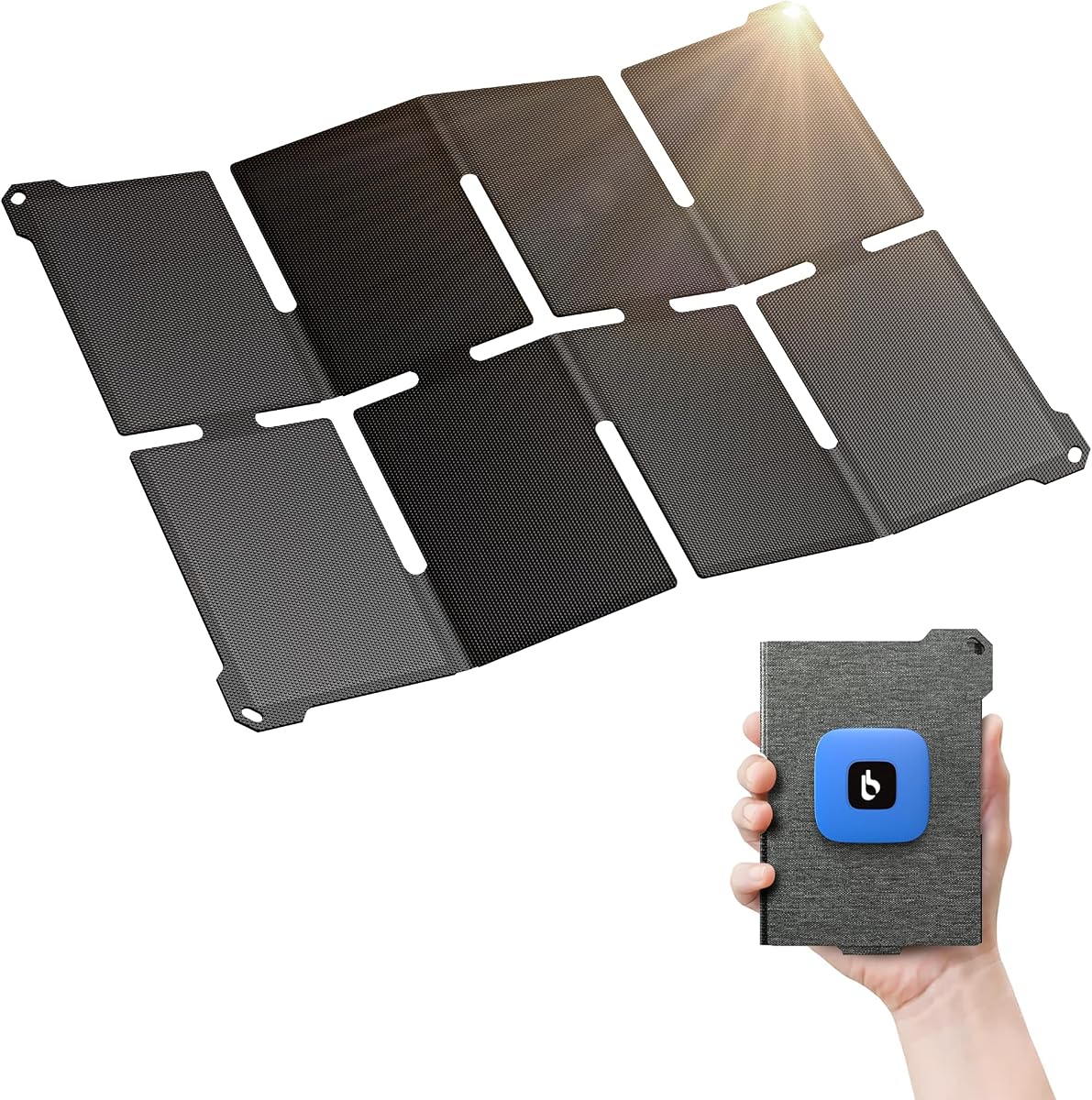
The FlexSolar 25W Portable Solar Panel Charger is the strongest lightweight pick here, weighing 1.2 pounds and holding a 4.4 rating. It offers dual USB-A and USB-C charging, a stated 23.2% conversion rate, and a compact folding format that is smaller than most tablets.
We may earn a commission when you buy through this link, at no additional cost to you.
Its charging system is designed for simultaneous use, with each port able to deliver 5V/3A. MPPT technology is used to maximize energy collection, including in partial shade, while intelligent power management adjusts the output and supports Qi and PD-compatible devices. The panel is therefore appropriate for topping up phones, navigation units, earbuds, or a small power bank.
Construction receives careful attention. The product uses a scratch-resistant surface film, UV-stabilized EVA encapsulation, and an impact-absorbing polymer baseplate. The manufacturer states that the design withstands more than 2,000 fold cycles, and its IP67 components are specified for dust, water immersion up to one meter for 30 minutes, heavy downpours, and dusty trails.
The main limitation is scale. A 25W panel may take longer to replace meaningful energy than the 35W, 40W, or 45W options, particularly under variable weather. It also lacks the DC output found on two FlexSolar models. For hikers who minimize pack weight and need dependable charging for small electronics, however, the trade-off is easy to justify.
At 1.2 pounds, this is among the lightest selections in the guide. The integrated carabiner system and reinforced elastic strap make it convenient to attach to a backpack or tent and secure during transport.
A folding panel lives a demanding life in a pack, where it may be compressed and unfolded repeatedly. The stated 2,000-plus-cycle test result and reinforced multilayer construction directly address that common source of long-term concern.
We may earn a commission when you buy through this link, at no additional cost to you.
The BigBlue 28W Solar Panel Charger with Digital Ammeter is the most useful option for users who like to see what the panel is actually producing. Its 4.3 rating, four-panel design, and 25.4% stated conversion efficiency make it a capable performer with a particularly informative display.
We may earn a commission when you buy through this link, at no additional cost to you.
The integrated digital ammeter shows real-time current output, helping a user identify the difference between strong sun, partial shade, and poor panel positioning. This is a valuable diagnostic feature in the field because wall-based charging speed is not a reliable benchmark for a portable solar panel.
The USB-A port can provide up to 5V/2.4A, while USB-C supports up to 3A, with combined output up to 5V/4A. Smart device identification helps the panel deliver suitable power to phones, power banks, GPS units, and tablets. At 1.47 pounds, the charger is also light enough for routine backpacking use.
Its industrial-grade PET polymer fabric and IP44 rating make it resistant to occasional rain and damp conditions, but the ports and ammeter should remain dry. A zippered compartment offers storage for small items, though phones should not be left inside while charging because of heat. For users who value feedback and diagnostic control, this is the most distinctive BigBlue model.
The digital ammeter turns the panel into a more interactive tool. It can help a camper decide whether to reposition the panel, wait for clearer conditions, or stop competing device demands when the displayed current falls.
Unfolding all four panels creates a broad collecting surface that can capture more sunlight than a compact single-panel design. The included cable and carabiners complete the field kit, while the secured compartment helps keep small accessories together.
We may earn a commission when you buy through this link, at no additional cost to you.
The FlexSolar 36W Ultra-Portable & Lightweight Solar Panel Charger offers a useful middle ground between the smaller 25W model and higher-output 40W alternatives. Its stated 4.0 rating is the lowest among the ten products, but the core specifications remain competitive for backpacking and camping.
We may earn a commission when you buy through this link, at no additional cost to you.
USB-A, USB-C, and a 5.5 by 2.1mm DC output provide more connection options than a basic dual-USB panel. MPPT technology is intended to improve energy harvesting even under partial shade, while intelligent power management adjusts output and supports Qi and PD-compatible equipment. The DC socket adds flexibility for compatible small devices, though it is less universally useful than USB.
The stated photovoltaic efficiency is 24%, and the triple-layer circuit protection covers over-voltage, over-current, and overheating. Components are rated for ambient conditions from minus 4 to 149 degrees Fahrenheit. These specifications make the panel appear well suited to prolonged exposure across changing outdoor temperatures.
At 1.7 pounds, the panel is heavier than the 25W FlexSolar but lighter than the 40W FlexSolar. It also folds to a compact 7.7 by 5.1 inches. The lower rating may reflect less customer history or mixed experiences, so buyers should consider the complete feature set. For users who need DC flexibility and balanced output, it remains a capable option.
USB-A and USB-C cover most phones, tablets, and power banks, while the DC connector can serve compatible equipment that does not use standard USB. The 5.5 by 2.1mm specification should be checked against the intended device before relying on that output.
The listed operating range is broad enough for common camping and hiking conditions. Circuit protection adds safeguards for connected devices, although actual performance will still depend on the amount of sunlight available and whether the panel is correctly oriented.
We may earn a commission when you buy through this link, at no additional cost to you.
The GEYOTO 35W Solar Charger pairs a relatively high 35W rating with one of the guide's best stated conversion rates. Its 4.1 rating reflects a capable design, and the combination of high efficiency, a 1.54-pound weight, and a compact 4.76 by 8.29 by 1.57-inch folded size makes it appealing for space-conscious backpackers.
We may earn a commission when you buy through this link, at no additional cost to you.
One USB-C port and one USB-A port can charge two compatible devices simultaneously, including phones, tablets, and power banks. Four layers of protection cover overcurrent, overcharging, overvoltage, and short circuits, while an intelligent charging system regulates output for connected equipment.
The laminated panel is described as IP68 water and dust resistant and is intended for camping, hiking, fishing, and boating. A protective storage pouch, USB-C extension cable, carabiners, and a manual are included. The product is also supported by a two-year warranty, which is a useful point of comparison when narrowing down the final options.
Compared with the GEYOTO 45W model, this version offers one fewer USB-C port but folds into a notably smaller package. The tradeoff is reduced simultaneous device flexibility. Solar performance will still fall in weak light, and the ports must be kept dry. It is best for a hiker carrying one primary phone and perhaps a small power bank.
The stated 26% conversion rate is a headline feature, but the smaller folded dimensions make this panel easier to carry than many higher-output alternatives. It gives a user a practical balance when pack volume matters as much as charging capacity.
Protection against four common electrical faults adds confidence during unattended charging. The intelligent output regulation is especially relevant outdoors, where changing sunlight can cause power input to rise and fall while a device remains connected.
We may earn a commission when you buy through this link, at no additional cost to you.
The ELECOM NESTOUT Portable Solar Panel is the premium pick, with a 4.5 rating and a design centered on outdoor organization. Its four-panel folding body, integrated ripstop-nylon bag, exterior hanging loops, and dual built-in stands distinguish it from basic direct-charging panels.
We may earn a commission when you buy through this link, at no additional cost to you.
The panel uses SunPower MAXEON cells, which the product information says can provide up to a 24% efficiency increase compared with traditional cells. A current-checker LED display allows users to check solar generation entering the USB ports, while two USB-A connectors support phones, tablets, Bluetooth earbuds, and other compatible devices.
Unlike many minimalist panels, this one is designed as a complete carrying system. The ripstop-nylon bag is water resistant for daily use, two mesh pockets organize cables and small items such as carabiners, and three exterior loops can secure the panel to a tree, tent, or cable. Two adjustable stands help users optimize the sun angle without adding separate equipment.
The main limitation is charging-interface age: dual USB-A provides broad support for older devices but omits the faster USB-C and PD arrangements offered by several competitors. No precise folded weight or efficiency percentage is listed in the supplied information. Even so, its integrated organization, current feedback, and four-panel design justify premium consideration for campers who value a refined outdoor system.
The built-in organization is a meaningful advantage over bare panel designs. Cable storage, hanging points, and protective fabric keep the charger ready for deployment rather than requiring a separate organizer for small accessories.
The two built-in adjustable stands help the panel face the sun at a useful angle. This convenience may be especially valuable at campsite, where maintaining a stable panel position can make the difference between steady collection and repeated interruptions.
We may earn a commission when you buy through this link, at no additional cost to you.
The BigBlue Ultra-Light Portable 25W Solar Panel Charger is the lightest product in the guide at just 0.84 pounds. It holds a 4.2 rating and is aimed at hikers who want to carry as little weight as possible while retaining a useful USB-C and USB-A charging setup.
We may earn a commission when you buy through this link, at no additional cost to you.
Its claimed 25.4% power-conversion efficiency is strong for a compact panel. N-type cells without front-side metal lines are designed to capture more light, produce less heat, and maintain a sleek profile. The USB-A port can supply 5V/2.4A, while USB-C supports 5V/3A, allowing two devices to charge simultaneously when conditions permit.
The folded dimensions of 4.65 by 6.42 by 1.38 inches make the charger genuinely easy to fit into a pack. It includes a USB-C to USB-C cable, two carabiners, and an elastic strap, allowing it to hang from a backpack or tent. Its IP68 rating offers strong protection against dust, splashes, spills, and light rain.
As with the other direct-charging models, it cannot store energy and may produce unstable or reduced output in weak sunlight. It is intended for phones, power banks, and camping lights rather than large electronics. For ultralight hikers, the 0.84-pound weight is the decisive advantage that compensates for the lower 25W output and limited port count.
The charger folds to dimensions smaller than a tablet while retaining a relatively high stated conversion rate. That combination makes it easier to justify carrying than a larger panel when every gram and cubic inch of pack space matters.
USB-C serves newer phones and compatible accessories, while USB-A covers many established power banks, lights, and navigation devices. Simultaneous output is possible, though solar conditions may not support the same rate on both connections.
We may earn a commission when you buy through this link, at no additional cost to you.
The Boltstar 40W Solar Panel Charger earns the highest rating in this comparison at 4.8. Its combination of a 40W panel, up to 36W maximum output, a 1.48-pound weight, and a 25% stated conversion rate makes it one of the most balanced choices for hikers who need more power than a basic phone panel provides.
We may earn a commission when you buy through this link, at no additional cost to you.
The USB-C port is specified to deliver up to 12V/3A, and a USB-A adapter is included. The stated compatibility covers iPhones, iPads, Apple Watches, Android phones, power banks, Bluetooth earbuds, and other small electronics. This makes the panel useful for a broad collection of gear rather than only modern USB-C devices.
Its foldable construction and light weight make it practical for backpacking, hiking, biking, and other mobile activities. IP67 protection is stated to withstand dust, water, rain, splashes, mud, and sand, and the product information says the panel can even be rinsed after use. The stated 25% conversion efficiency supports useful energy collection in direct sunlight.
The design does not include a battery, so charging is possible only while sufficient sunlight is available. Using the included adapter for a USB-A device also makes that connection slightly less streamlined than a native dual-port panel. Nevertheless, the high rating, low weight, and generous output make this a particularly compelling option for travelers who carry several kinds of small electronics.
A 40W rating and up to 36W stated output would normally imply a larger package, yet the panel weighs 1.48 pounds. That makes it a practical middle ground for backpackers who want faster potential collection without carrying one of the guide's highest-output models.
The fold, plug, and charge design removes unnecessary setup. The included USB-A adapter supports legacy accessories, while the native USB-C connection suits most modern phones, tablets, watches, and compact peripherals.
We may earn a commission when you buy through this link, at no additional cost to you.
The right solar backpacking charger depends on the devices you carry, the length of your trip, the conditions you expect, and how much weight you are willing to add to your pack. Output, port selection, folded size, weather protection, and energy-storage capability should be weighed together rather than treated as isolated specifications.
Panel wattage describes the panel's nominal generation capacity, while conversion efficiency indicates how effectively its cells turn captured sunlight into electrical energy. A higher number is desirable, but neither figure guarantees a fixed charging time. Actual output changes with cloud cover, solar angle, panel temperature, surface dirt, device demand, and the amount of shade falling across the cells.
Choose enough capacity for your realistic load without assuming every panel delivers its rated maximum. Phones, cameras, lights, and navigation tools are suitable targets, whereas laptops and large power stations generally require more powerful equipment. The 45W and 40W models offer greater headroom, while the 25W options prioritize pack weight.
Charging ports determine which devices can be used with the panel. USB-C is increasingly important for modern phones, tablets, and compact electronics, while USB-A remains common for power banks, camping lights, older phones, and accessories. Models with both formats offer more flexibility, and a third USB-C port can help a group charge several devices simultaneously.
A 19V or 5.5 by 2.1mm DC output can be useful with compatible equipment, but it is not a universal replacement for USB. Confirm the connector size, voltage, and polarity requirements before relying on DC output. If most of your gear uses USB, prioritize native USB-C and USB-A ports over a specialized socket.
Nearly every product in this guide is a direct-charging panel without an internal battery. It converts sunlight while a device is connected and cannot provide power after sunset, under heavy canopy, or during prolonged bad weather. This design keeps the unit lighter and avoids the weight and charging complexity of a built-in battery.
If you need power around the clock, carry a separate power bank and charge it from the panel during daylight. This two-piece approach is often more flexible because one stored battery can serve several devices at night. Treat a solar panel and a power bank as complementary tools rather than assuming a direct-charging panel can replace stored energy.
Backpackers should compare both weight and volume, not wattage alone. The lightest option here weighs 0.84 pounds, while several 40W and 45W panels weigh between 1.48 and 1.76 pounds. The difference becomes meaningful over a long route or when every piece of gear must share limited pack space.
Carabiners, straps, extension cables, storage pouches, and built-in stands can improve usability without dramatically increasing bulk. A panel that attaches easily to a backpack or tent is often more useful in practice than a marginally lighter model with awkward attachment points. Choose the lightest design that still provides the ports and durability required for your trip.
IP ratings are useful but should be interpreted carefully. IP44 indicates protection against solid objects larger than one millimeter and splashing water, while IP67 indicates dust-tight protection and temporary immersion. IP68 adds a higher level of water resistance, although the exact test conditions and manufacturer guidance still apply.
The USB junction box, ports, cables, and attached devices are often more vulnerable than the laminated panel surface. Keep connectors dry even on an IP67 or IP68 model, dry the panel before storage, and avoid prolonged submersion unless the instructions expressly allow it. Weather resistance helps extend the product's life but does not make careless use risk-free.
Monocrystalline and N-type cells are used across many of the featured products and are presented as high-efficiency choices. Designs without front-facing metal lines can expose more of the active cell surface, potentially improving light capture and heat dissipation. A laminated outer surface may also offer better abrasion resistance than basic exposed plastic.
Cell quality alone cannot overcome poor placement. Keep the surface clean, unfold every section when the design calls for it, and avoid placing the panel behind a window or inside a vehicle windscreen. The BigBlue 28W Triple-Port model specifically discourages use in a window or windscreen, a useful reminder that direct outdoor placement is essential.
An ammeter or current-checker display can show whether a panel is collecting power and help users diagnose incorrect positioning. The BigBlue 28W Digital Ammeter and ELECOM NESTOUT models include monitoring displays, allowing field users to compare conditions without waiting for a device to reveal a slow charge.
Intelligent charging chips, MPPT, and multi-direction protection can improve device compatibility and safeguard connected electronics. Look for overcurrent, overvoltage, overheating, overcharging, and short-circuit protection. These features are useful but should not be confused with internal energy storage; they regulate power the panel is producing at that moment.
A three-port panel is valuable for a camper who shares a tent with a partner or carries a phone, navigation unit, and power bank. The GEYOTO 45W model offers two USB-C ports and one USB-A port, while the BigBlue 28W Triple-Port model has a similar three-port arrangement. These designs reduce cable swapping during brief sunny periods.
Simultaneous charging does not mean every device receives full rated power. Solar energy is limited, and a system may distribute output among connected devices or recommend prioritizing one port. For group use, also consider how much room the panel occupies and whether it can be positioned in full sun without exposing devices to damaging heat.
Unfold the panel in direct sunlight, clean the surface, and position it as close to perpendicular to the sun as practical. Use the built-in stands, strap, carabiners, or a separate support to prevent it from falling. Avoid shade whenever possible because partial coverage can reduce output dramatically, and do not leave a phone or tablet on the panel surface where heat can build up.
Connect a compatible device with the appropriate cable, or connect a power bank if you want to store collected energy for later. Monitor charging behavior and reposition the panel if output is weak. Because these products generally do not contain batteries, they cannot supply power after sunset; carry a charged power bank for nighttime or extended low-light needs.
Disconnect devices before folding the panel, keep the junction box and ports dry, and wipe away dirt or salt after outdoor use. Allow the panel to dry before placing it in its storage pouch, inspect the laminate and cables for damage, and store the charger in a dry location. Avoid submerging it unless the manufacturer expressly permits that level of exposure.
Only if the model includes an internal battery that has been charged in advance. Every product in this guide is described as a direct-charging panel without energy storage, so it produces power only while receiving adequate sunlight. For nighttime charging, carry a power bank and use the solar panel to recharge that battery during daylight.
The right size depends on your devices, trip length, and weight tolerance. A 25W panel can be sufficient for phones, navigation, and small lights, while 35W to 45W models offer more headroom for power banks, tablets, or multiple devices. A larger panel is not automatically faster if it is poorly positioned or shaded.
These products are generally designed for phones, tablets, lights, earbuds, navigation devices, and power banks rather than laptops or large power stations. The 45W GEYOTO model can deliver 25W over USB-C, which may charge some compatible lightweight tablets, but laptop charging normally requires more voltage and power than a small direct-charging panel can provide.
Place the panel in unobstructed direct sunlight and adjust its angle so the surface faces the sun as squarely as possible. The FlexSolar 40W model specifically recommends approximately a 45-degree angle, while other models emphasize direct exposure. Recheck the position when shadows from trees, cliffs, tents, or clouds move across the panel.
Several models support simultaneous charging through multiple USB ports. The GEYOTO 45W and BigBlue 28W Triple-Port models each provide three USB outputs, while several dual-port panels can charge two compatible devices. The total energy remains limited, so output may be divided among devices or reduced when sunlight is weak.
Those ratings indicate substantial dust and water resistance for the panel construction, but exposed ports and the junction box still require care. Several manufacturers specifically advise keeping the connector area dry or storing the panel indoors during heavy rain. Even a weather-resistant panel should be dried and inspected after storms.
No. The BigBlue products in this guide recommend keeping connected phones and tablets in the shade because direct heat can trigger thermal protection and reduce or stop charging. Place the panel in full sun but keep the receiving device shaded whenever possible to prevent overheating.
Both figures matter, but neither overrides the need for adequate sunlight and correct positioning. A high-efficiency panel may generate more power from the same surface area, while a higher-wattage panel can provide greater peak output. Compare both alongside weight, ports, weather resistance, and whether your trip requires stored energy.
The GEYOTO 45W Solar Panel Charger is the strongest overall recommendation because it combines a high stated conversion rate, three charging ports, IP68 protection, and a manageable 1.65-pound weight. The FlexSolar 25W stands out for travelers who prioritize low weight, while the ELECOM NESTOUT earns the premium recommendation for its integrated outdoor organization, current display, and four-panel construction.
For most backpackers, the most important priorities are usable output, the charging connectors needed for carried gear, compact size, and realistic weather resistance. Larger panels are not automatically better if they are difficult to position, and a panel without storage should be paired with a power bank when power is required after the sun goes down. Check compatibility before buying, especially for DC equipment.
Finally, verify the current listing, included accessories, warranty details, and available offers before purchasing because product information and prices can change. Review the exact port ratings, storage behavior, and environmental cautions for the selected model rather than judging it only by its headline wattage.
