
Monoprice SCSI 68 Female Adapter
4.8Editor score
HPDB 68-pin female connector
IDC 50-pin female connector
SCSI-2 internal ribbon connection
Detailed connector identification
Discover the best 50 Pin Scsi Adapter options by comparing connector types, SCSI standards, device compatibility, build quality, and intended installations.
A 50 Pin Scsi Adapter can connect legacy storage, tape, optical, and peripheral equipment to systems using uncommon SCSI or IDE-style interfaces. The right adapter depends on pin count, connector gender, SCSI generation, ribbon-cable design, and whether the equipment requires internal or external installation.
We compared the available options by examining their stated connector combinations, supported devices, construction details, installation requirements, and suitability for legacy data-transfer or backup setups. The list covers 68-pin HPDB, 80-pin SCA, IDC, Centronics, termination, and external-access solutions rather than ordinary 40- or 44-pin IDE connectors.
Each review explains what a product is best suited to, including its standout features and practical limitations. Ratings and specifications reflect the supplied product information, while availability, connector details, and prices can change. Always verify the exact mating connectors and controller requirements before purchasing an adapter.
4.8Editor score

5.0Editor score

5.0Editor score
The following comparison highlights the connector configurations, supported SCSI formats, device uses, and key practical considerations for each 50 Pin Scsi Adapter.




The CERRXIAN SCSI HPDB 68 Pin Male to IDE 50 Pin Male Adapter is a purpose-built converter for industrial and server installations, carrying a 3.7 customer rating. Its most notable characteristic is the uncommon combination of a 68-pin HPDB male plug and a 50-pin IDE male plug, which makes it useful when the existing cable and motherboard connectors require matching male ends.
We may earn a commission when you buy through this link, at no additional cost to you.
The adapter is described as supporting hard disks, tape drives, CD-ROMs, rewritable optical drives, printers, and scanners. A high-thickness gold-plated connector layer is intended to improve conductivity, reduce signal loss, and resist corrosion. That construction detail is especially relevant in industrial equipment rooms where vibration, repeated servicing, and long service lives can affect ordinary connectors.
The principal limitation is that this is not a conventional desktop IDE adapter. The product information explicitly distinguishes its 50-pin IDE interface from 40-pin and 44-pin versions and says it cannot be used in ordinary computers. The male-to-male arrangement may also require cable routing or mating hardware that is not included with the product.
This option makes the most sense for a technician maintaining a server or industrial controller with a 50-pin IDE header and legacy 68-pin HPDB peripherals. Confirm both connector genders, ribbon-cable orientation, device termination, and controller support before buying. It is less attractive for ordinary home-computer upgrades, where standard 40- or 44-pin IDE connectors are much more common.
The plated contact layer is designed to support stable conductivity and corrosion resistance. That can be valuable in fixed industrial installations where the adapter must tolerate vibration, repeated insertion cycles, and long periods of use.
The stated device compatibility extends beyond hard disks to tapes, optical drives, printers, scanners, and other legacy equipment. Actual operation still depends on the host controller recognizing the attached device.
We may earn a commission when you buy through this link, at no additional cost to you.
The CERRXIAN SCSI HPDB 68 Pin Female to IDE 50 Pin Female Adapter Converter combines two female connectors and earns a 4.7 rating. It is intended to convert an HPDB 68-pin connection into an IDE 50-pin connection, offering a convenient gender-matched solution when cables are already equipped with male ends.
We may earn a commission when you buy through this link, at no additional cost to you.
Its connector seat uses a high-thickness gold-plated layer intended to provide good conductivity and stability. The stated applications include disks, tapes, CD-ROMs, rewritable optical drives, printers, scanners, and communication equipment. This breadth makes the adapter relevant to maintenance teams handling mixed peripheral inventories rather than a single storage drive.
As with the male version in this list, the 50-pin IDE side is the decisive restriction. The product is explicitly not compatible with 40-pin or 44-pin IDE and is intended for industrial server motherboards with a 50-pin interface. A protocol-compatible connector does not by itself guarantee that every legacy device will negotiate correctly with the host.
The adapter is best for users who have already identified the host as a 50-pin IDE system and need a female HPDB-to-female IDE transition. Check the pin orientation, establish whether the attached device handles termination, and confirm that the controller supports the device protocol. Its strong rating and plated construction make it a compelling option within its narrow technical category.
The matched female ends accept male-ended ribbon cables on both sides of the adapter. This can simplify internal installations where the existing cable set cannot be replaced easily.
Disks, tapes, optical drives, printers, scanners, and communication equipment are all listed as potential uses. Protocol support and termination requirements remain device-specific concerns.
We may earn a commission when you buy through this link, at no additional cost to you.
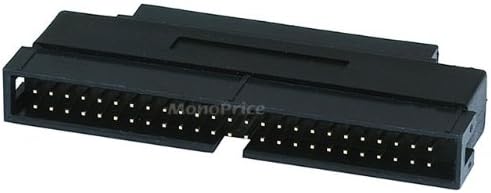
The Monoprice 100077 SCSI (HPDB) 68 Male to IDC 50 Male Adapter is a compact internal converter rated 4.3. It changes a 50-pin IDC connection into a 68-pin HPDB male connection, providing a recognizable option for technicians familiar with Monoprice model 100077.
We may earn a commission when you buy through this link, at no additional cost to you.
The male-to-male format is useful in custom internal builds where matching female-ended ribbon cables are already available or where the adapter must plug directly into two male header ends. The 50-pin IDC and 68-pin HPDB formats belong to the internal legacy SCSI ecosystem, making this most relevant to repair benches and equipment restoration projects.
Product information is much less detailed than for several competing adapters. It warns that the received item may not match the listed photo or specifications and states that it is manufactured in China. Because pinout details and included hardware are not described, buyers should rely on the model number and visually confirm all connector details.
This adapter is a sensible candidate for a technician who specifically needs the 100077 male configuration. It is less suitable for buyers who need detailed installation guidance, included power leads, or a guaranteed match to a photographed product. Confirm the host header, cable gender, device termination, and SCSI controller support before installation.
The specific 100077 designation makes it easier for experienced technicians to identify and cross-check the intended connector arrangement. It is particularly relevant to established legacy-equipment repair inventories.
A male-to-male adapter can connect two female-ended ribbon cables without requiring another gender-changing component. Cable length and routing still need to be planned around the adapter's physical position.
We may earn a commission when you buy through this link, at no additional cost to you.
The Belkin SCSI Internal Adapter – HD-68 (f) – 50 Pin IDC (f) stands out with a 5.0 customer rating, the highest listed score in this roundup. Its female-to-female design links an HD-68 SCSI connector to a 50-pin IDC header, making it a natural choice for internal systems assembled around standard female-ended ribbon cables.
We may earn a commission when you buy through this link, at no additional cost to you.
The product is positioned as a high-quality option, and its customer feedback emphasizes value and satisfaction. That matters in legacy storage work because a compact, dependable internal adapter can avoid modifying original system wiring. The clear HD-68 and 50-pin IDC labeling also helps reduce the risk of confusing it with similarly named 50-pin Centronics or IDE components.
The supplied information provides little detail about pinout, dimensions, or included accessories. Consequently, buyers should not expect a full installation guide or confirmation of every supported SCSI generation. It also does not bridge to a modern computer's ordinary IDE port; the host must expose the appropriate internal 50-pin IDC SCSI header.
For an internal legacy SCSI system needing an HD-68 female to IDC 50 female transition, this is a strong recommendation based on its perfect rating and clear construction. Verify the cable orientation and host-controller requirements, handle it gently during installation, and use ESD precautions appropriate for the connected storage equipment.
A 5.0 customer rating gives this Belkin adapter a notable advantage in the comparison. The rating does not replace technical verification, but it signals strong user satisfaction within the available listings.
HD-68 female and IDC 50 female ends are well suited to ribbon cables with corresponding male headers. This makes the adapter practical for internal restoration and repair work.
We may earn a commission when you buy through this link, at no additional cost to you.
The CERRXIAN SCSI SCA 80 Pin Female to IDE 50 Pin Male Adapter Converter is designed for SCA 80-pin systems and carries a 3.4 rating. It converts a 50-pin interface to an 80-pin interface, allowing a 50-pin low-speed SCSI device to be used with the host's 80-pin SCSI connection.
We may earn a commission when you buy through this link, at no additional cost to you.
The stated use cases include direct data transfers and backups, which reflects the kind of maintenance workflow that often motivates people to preserve vintage SCSI equipment. Hard disks, tapes, CD-ROMs, rewritable optical drives, printers, scanners, and communication equipment are also listed as possible devices. A four-pin Molex power connector must be attached to power the hard drive.
Its 3.4 customer rating is the lowest among the rated products in this guide, so buyer confidence should be tempered accordingly. The adapter also cannot be used with ordinary 40-pin or 44-pin IDE systems; its 50-pin side is intended for specific industrial server motherboards. Power and data termination must be handled correctly to avoid faults.
This adapter is best for a technician with an SCA 80-pin host who needs to bring a 50-pin low-speed SCSI device into a direct-transfer or backup workflow. Confirm the Molex power requirements, device termination, and controller support. It is not a general-purpose computer upgrade and should not be selected merely because a device uses a 50-pin connector.
The product is specifically recommended for direct data transfers and backups, two common reasons for connecting old storage to a maintained server chassis. Actual transfer speed remains limited by the older device and controller.
A Molex four-pin power connector is needed for the hard drive. This requirement adds a step compared with systems that deliver all required power through the main connector.
We may earn a commission when you buy through this link, at no additional cost to you.
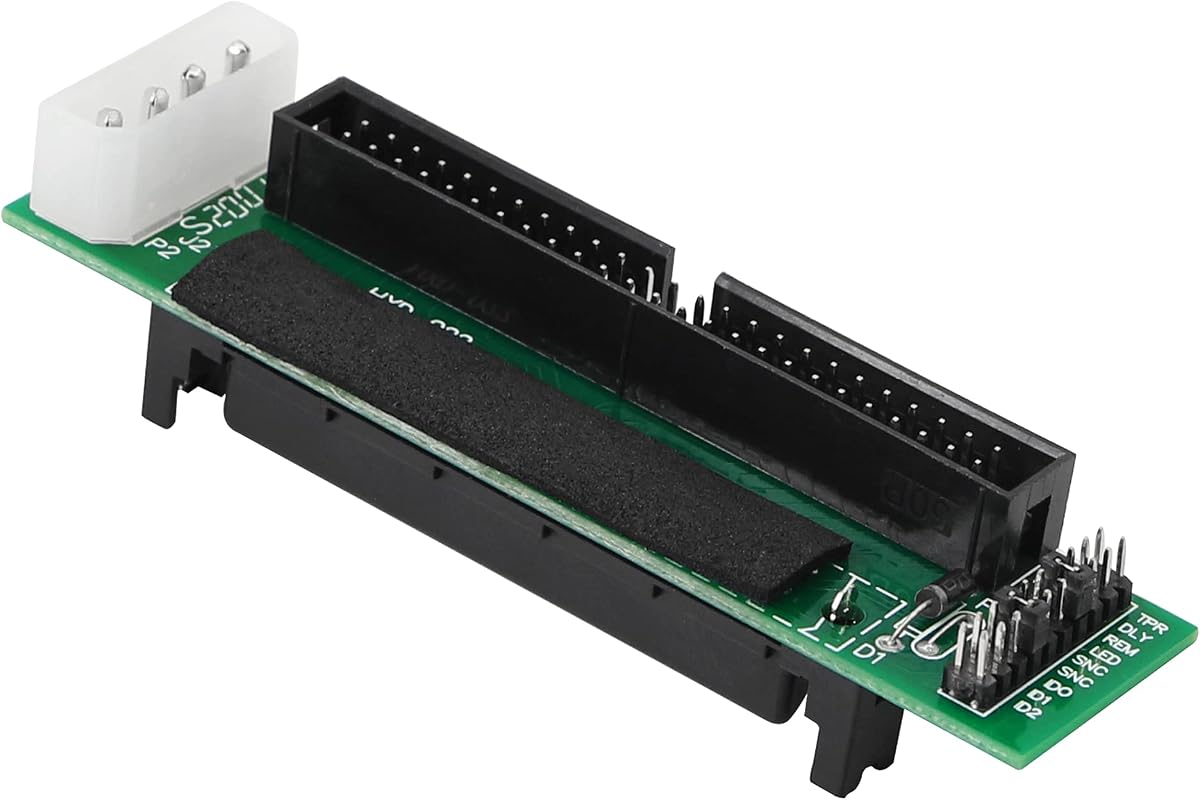
The PTC SCA 80 Pin to 68 50 Pin SCSI Adapter is a feature-rich server drive interface with a 4.6 rating. It converts an SCA 80-pin hard-drive interface to a SCSI I, II, or III Ultra Wide HD 50/68-pin connector and explicitly supports both SCA and SCA-2 80-pin formats.
We may earn a commission when you buy through this link, at no additional cost to you.
Its strongest differentiator is the jumper support for 16 SCSI IDs. The adapter also provides spindle synchronous, delay start, and remote start options, along with a four-pin power connector and status LED connector pins. These features make it more appropriate for an involved server configuration than a simple passive cable converter.
The trade-off is complexity. Users must understand SCSI ID selection, termination practices, startup behavior, and the relevant controller configuration. Incorrect jumper or termination choices can produce unreliable recognition or data-transfer problems. Because the host side is 80-pin SCA, it does not serve a normal desktop IDE installation.
This is the strongest choice in the group for a technician restoring or maintaining an SCA-based server with a 50/68-pin SCSI drive. Its 4.6 rating, broad generation support, and configuration options provide more depth than simple lead adapters. Documentation and component labeling should be checked carefully before assigning a SCSI ID or connecting power.
The jumper-based ID selection gives administrators considerable flexibility when fitting multiple devices to a bus. It also makes correct setup more involved than with a fully passive adapter.
Compatibility with SCA and SCA-2 80-pin connections makes the board useful across more than one legacy server format. SCSI I, II, and III Ultra Wide support broadens its potential device range.
We may earn a commission when you buy through this link, at no additional cost to you.
The CERRXIAN HPCN50 50 Pin Male to Female SCSI Centronics Mini Adapter Connector has a 4.3 rating. Unlike the HPDB, SCA, and IDC products in this roundup, it joins two 50-pin HPCN connectors rather than converting SCSI to IDE or between different SCSI standards.
We may earn a commission when you buy through this link, at no additional cost to you.
Its male-to-female arrangement allows it to function as a gender changer, a short port extender, or a strain-relieving coupler. Gold-plated contacts are designed to support signal integrity and corrosion resistance, while a locking mechanism helps maintain the connection in vibration-prone professional environments. The compact housing also makes it easier to place inside tightly packed equipment racks.
The key limitation is that it performs no electrical or protocol conversion. It is appropriate only where both ends of the intended connection use the 50-pin HPCN standard. A device with a 40-pin IDE, 68-pin HPDB, IDC 50, or another connector cannot be attached through this adapter merely because it shares a 50-pin designation.
Choose the CERRXIAN HPCN50 when you need to extend, change, or relieve strain on a matching Centronics-style connection. It is particularly useful for professional equipment with limited space and no need for software drivers. Before buying, inspect both equipment connectors and confirm that HPCN50 is the exact format involved.
The same unit can change connector gender, add a short extension, or reduce cable strain. This versatility is valuable when a permanent modification would be inconvenient.
Gold-plated contacts and a secure locking mechanism support dependable connections. The compact form also helps where a full-size gender changer would be difficult to position.
We may earn a commission when you buy through this link, at no additional cost to you.
The Monoprice SCSI (HPDB) 68 Female to IDC 50 Female Adapter (100076) combines an excellent 4.8 rating with unusually clear technical descriptions. It links a 68-pin 16-bit SCSI-2 HPDB connector to a 50-pin 8-bit SCSI header connector for internal ribbon-cable installations.
We may earn a commission when you buy through this link, at no additional cost to you.
The supplied explanation distinguishes the IDC 50 connector, also called the Alternative 2 format, from a conventional ATA/IDE cable. It has two parallel 25-pin rows and resembles an older IDE drive cable, but it is wider and contains more pins. The 68-pin HPDB connector uses two rows of 34 closely spaced pins and is physically narrower.
These dimensional and pin-layout distinctions are useful because superficially similar connectors can lead to serious installation errors. The adapter is limited to systems that expose the correct 50-pin IDC SCSI header, and it does not provide protocol translation, drive power, termination, or a bridge to a modern operating system.
This is a particularly compelling premium pick for an internal SCSI-2 restoration or upgrade. Its strong rating, identifiable model number, and accurate description make it easier to select than generic alternatives. Confirm the connector orientation, bus width, termination arrangement, and controller support before installing it in a live system.
The explanation of row spacing, dimensions, and pin counts helps buyers distinguish IDC 50 from standard IDE. Accurate identification is essential when internal connections are not physically interchangeable.
The adapter is built around 16-bit HPDB and 8-bit IDC SCSI formats. It can help integrate legacy devices, but the host controller must support the appropriate bus and termination.
We may earn a commission when you buy through this link, at no additional cost to you.
The QVS SCSI Terminator has a 5.0 customer rating and provides an important service function for 50-pin Centronics SCSI buses. It is a passive, single-end terminator supporting the CEN50M/F standard, with a male-to-female connector configuration intended for indoor use.
We may earn a commission when you buy through this link, at no additional cost to you.
Legacy SCSI buses may require termination at a physical endpoint to reduce signal reflections and support stable communication. This unit is designed for that purpose and is listed as compatible with hard drives, SSDs, tape drives, and Apple SCSI cables. Its white housing and passive design make it straightforward to integrate into an established installation.
A terminator does not convert SCSI to IDE, supply additional ports, or make a bus compatible with modern hardware. It also does not replace active termination for every SCSI configuration. The single-end specification means users should confirm that their controller and cabling arrangement use passive single-end termination rather than a different termination method.
The QVS is an excellent choice when a 50-pin SCSI installation needs proper bus termination and nothing more. Its perfect rating and clearly defined passive function make it a strong specialist recommendation. Verify the connector standard, place it only where the bus requires an endpoint, and power it down before changing the connection.
The terminator is designed for passive single-end SCSI arrangements. It reduces reflections at the end of the bus, helping maintain signal integrity in correctly configured legacy systems.
Hard drives, SSDs, tape drives, and Apple SCSI cables are among the listed compatible applications. The device still has to use the correct connector and termination topology.
We may earn a commission when you buy through this link, at no additional cost to you.
The CompuCablePlusUSA.com SCSI Computer Slot Adapter is a specialized bracket adapter that gives an internal IDC 50-pin male SCSI connection access through an external HPDB50 female connector. It offers a bidirectional pathway and is designed for systems where the internal SCSI header is difficult to access from outside the enclosure.
We may earn a commission when you buy through this link, at no additional cost to you.
The product uses a SCSI-2 PCB with an IDC 50-pin male connector and a nickel-plated HPDB50 bracket connector. That construction supports a secure physical connection and durable external interface. It is a particularly interesting option for a repair bench, test enclosure, or custom system in which an internal header must be made accessible without dismantling the equipment each time.
No customer rating is supplied, so there is no listed user-feedback history to support the selection. The narrow specification also means buyers must distinguish HPDB50 from HPDB68, Centronics 50, SCA 80, and ordinary IDE. The adapter should not be treated as a universal SCSI-to-USB, SCSI-to-IDE, or modern storage bridge.
This adapter is best for a specialist who has confirmed an internal IDC 50 male header and needs an external HPDB50 female access point. Its bidirectional design is useful for data-transfer tasks, while the bracket form is more specialized than a simple cable. Confirm pinout, chassis fit, grounding, and controller support before modifying equipment.
The adapter routes an internal IDC 50 male connection through an external HPDB50 female bracket. This can make legacy equipment easier to test without repeatedly opening its case.
Bidirectional signal routing supports more flexible transfer workflows, while nickel plating adds durability to the external connector. The SCSI-2 PCB provides the physical signal path.
We may earn a commission when you buy through this link, at no additional cost to you.
The correct adapter depends first on exact connector type, then on the SCSI generation, host interface, device type, gender, termination, and physical installation. Several unrelated standards use 50 pins, so a pin count alone cannot establish compatibility.
Begin by photographing and counting the pins on the adapter, host, and device. A 50-pin IDE header, IDC 50 SCSI header, HPCN50 Centronics connector, and HPDB50 bracket are not interchangeable merely because they share the same number of pins. Note the row spacing, shape, latch style, and whether the connector is male or female. The listed products cover several of these formats, so buying the first 50-pin listing without checking the physical interface is the most consequential mistake a buyer can make.
SCSI-1, SCSI-2, and later implementations differ in bus width, signaling, and termination. The PTC adapter explicitly supports SCSI I, II, and III Ultra Wide, while the Monoprice IDC product is described around 8-bit SCSI and 16-bit SCSI-2 connections. A physical adapter cannot make an unsupported controller or device negotiate properly, so identify the host adapter, bus width, and device standard before choosing the connector format.
Internal adapters are designed to work with ribbon-cable headers inside a chassis, while bracket adapters and Centronics couplers are used for external equipment. The CompuCablePlusUSA model routes an internal IDC 50 male connector to an external HPDB50 female bracket, and the CERRXIAN HPCN50 is a compact external-style coupler. Consider service access, chassis clearance, cable strain, and whether the case allows an external port before choosing.
The adapters in this guide are associated with hard disks, tape drives, CD-ROMs, rewritable optical drives, printers, scanners, and communication equipment. Compatibility does not follow from the connector alone; the attached device must use the expected protocol, and the host controller must recognize it. A 50-pin IDE side also does not imply that the product works with a typical 40-pin or 44-pin desktop IDE port.
Some SCSI installations need a terminator at the end of the bus, while others use termination built into the controller, cable, or device. The QVS product is a passive single-end terminator and should only be used in a matching topology. Installing an extra terminator or omitting a required one can cause unstable behavior. The bus design, controller documentation, and device instructions should be reviewed before adding or changing termination hardware.
Gold-plated contacts appear in several CERRXIAN products, while the CompuCablePlusUSA bracket uses nickel plating. Plated contacts can improve conductivity and resist corrosion, but connector quality is only one part of reliability. Inspect the housing, locking mechanism, strain relief, and soldered PCB connections. Industrial and server equipment may see vibration, dust, repeated maintenance, and long operating cycles, making robust construction more important than a compact profile.
Data connectors do not necessarily provide the power a drive needs. The CERRXIAN SCA 80 adapter explicitly calls for a four-pin Molex power connector, and internal IDC or HPDB installations may require additional power wiring or onboard termination. Check the power specification, connector orientation, ribbon length, and cable type. An adapter that mates correctly but leaves the device without suitable power will not function as a complete installation.
A simple gender changer may solve a cable-routing problem, but a server adapter with jumper-selectable SCSI IDs, startup controls, and status LED connections may be required for a more involved system. The PTC model offers 16 ID settings, remote and delayed start options, and status pins. More features are useful only when the host configuration can exploit them, so match complexity to the number of devices, bus topology, and monitoring requirements in the system.
Begin with the equipment powered off and disconnected. Identify the host interface, device interface, SCSI generation, termination arrangement, and power requirements from the manufacturer documentation. Compare those details with the adapter's specifications and inspect every connector for bent pins, damaged latches, dirt, or corrosion. Do not force a connector whose shape or pin count does not match.
Install the adapter and ribbon cables with correct orientation. On many internal headers, pin 1 is marked on the connector, board, or cable. For the 50-pin IDE-to-SCSI products, attach the specified Molex power lead when required, but avoid presenting power until all data connections and termination are in place. The PTC board's SCSI ID jumper should match the host's bus plan, and the QVS terminator should occupy only the required endpoint position.
For a bracket or external adapter, secure the HPDB50 connector to the chassis and provide suitable strain relief. Once connections are checked, power the system in the sequence recommended by its manufacturer and observe host messages for device detection. If a device is not recognized, shut down and revisit termination, SCSI ID, cable orientation, protocol support, and power before changing components. Keep unused adapters in an anti-static bag and protect their pins from dust and impact.
Not simply because the adapter has 50 pins. The CERRXIAN products that use a 50-pin IDE side explicitly state that they are for industrial server motherboards with a 50-pin interface, not ordinary 40-pin or 44-pin desktop IDE connectors. The physical connector, SCSI protocol, termination, and controller must all match.
IDC 50 is an internal 8-bit SCSI header used with ribbon cables, while HPCN50 is a compact 50-pin Centronics-style connector. HPDB50 in the CompuCablePlusUSA listing is an external 50-pin SCSI form factor. They have different shapes and intended uses, and a product cannot be selected safely from the shared pin count alone.
No. A terminator completes the electrical conditions at the end of a SCSI bus to reduce signal reflections. It does not translate protocols, change connector formats, or add data capacity. The QVS option is a passive single-end terminator and should be used only when the host and bus design require that type of termination.
Not universally. Some drives receive power through their SCSI connector, while others need a separate power lead. The CERRXIAN SCA 80 model specifically requires a four-pin Molex power connector. Check the drive's requirements and the host wiring before installation, and never assume an adapter supplies all required power.
A suitable HPDB-to-50-pin adapter can provide the physical transition, but it cannot guarantee protocol compatibility. The attached SCSI device must be recognized by the 50-pin host controller, and bus width, signaling, termination, and power must be compatible. The two CERRXIAN HPDB-to-IDE models are specifically framed for industrial 50-pin server interfaces.
The adapter provides jumper settings for 16 SCSI IDs, which reflects the number of address positions available on the bus rather than a guarantee that every position can be populated. The host controller, cable topology, device types, and bus limitations ultimately determine how many devices can operate together.
Reversing a ribbon cable can place power and ground on data signal lines, potentially damaging equipment. Pin 1 markings on the cable, adapter, and host board should be aligned. If the markings are missing or ambiguous, consult documentation or an experienced technician instead of relying on visual guesswork.
The physical adapters generally do not require their own drivers because they do not create a modern USB or network device. The host still needs appropriate SCSI controller and operating-system support for the attached legacy equipment. The CERRXIAN HPCN50 is specifically described as a driver-free hardware connection, while other systems may need specialized controller software.
The Belkin HD-68 female to IDC 50 female adapter is the strongest general choice for internal legacy work because of its 5.0 rating and clearly defined connectors. The Monoprice 100076 is another excellent option, offering a high 4.8 rating and detailed SCSI-2 format information, while the QVS terminator provides the essential passive endpoint for compatible 50-pin Centronics systems.
Prioritize the exact interface over every other consideration. Verify connector family, gender, SCSI generation, host support, device protocol, termination, and power before selecting an adapter. A server-oriented SCA board with configurable IDs suits a complex bus, whereas a simple HPCN50 coupler solves a matching-connector cable problem without protocol conversion.
Finally, check current availability, ratings, and prices immediately before ordering, because the market for legacy SCSI hardware is limited and can fluctuate. Also review the seller's current description and image alongside the specifications shown in this guide. A careful connector check is the best protection against an otherwise capable adapter being incompatible with the equipment you own.