
ASRock Intel Arc Pro B60 Creator 24GB
3.9Editor score
24GB GDDR6 graphics memory
197 INT8 AI TOPS
Four DisplayPort connectors
Explore our GPU for Comfyui guide, comparing ten options by memory, AI performance, cooling, power, connectivity, and workstation flexibility for creators.
ComfyUI places substantial demands on GPU memory, compute throughput, cooling, and sustained power delivery, so the right graphics card depends on the models, workflows, and display setup involved. This guide examines ten desktop GPUs spanning entry-level, enthusiast, creator, and professional configurations for local AI image generation.
The comparison prioritizes the supplied specifications, including VRAM capacity, architecture, AI capabilities, memory bandwidth, cooling design, physical dimensions, display connectors, power requirements, and multi-GPU potential. Consumer GeForce and Radeon options appear alongside Intel Arc Pro and NVIDIA RTX PRO hardware to show the trade-offs clearly.
Each selection highlights who benefits most from its combination of capacity and capabilities, while noting meaningful limitations. Product details and availability can change, so readers should verify current specifications, driver support, case clearance, and power-supply requirements before purchasing.
3.9Editor score
4.6Editor score

4.3Editor score
This side-by-side comparison shows how the ten cards differ in memory capacity, AI hardware, cooling, physical design, display support, and workload flexibility, making it easier to match a ComfyUI system to a specific budget and workflow.


The NVD RTX PRO 6000 Blackwell is the most specialized card in this guide, with 96GB of GDDR7 ECC memory designed for demanding professional workloads. Its 4.3 rating reflects a highly capable but specialized option rather than a mainstream gaming card. For ComfyUI users who routinely work with large models, multiple LoRAs, complex node graphs, or concurrent services, the memory capacity is the defining advantage.
We may earn a commission when you buy through this link, at no additional cost to you.
The supplied specifications emphasize 5th Gen Tensor Cores with FP4 precision, a new Blackwell streaming multiprocessor design, and neural shaders. These features target AI model processing and can reduce memory demands for supported precision formats. The card also offers Universal MIG, allowing one physical GPU to be divided into isolated instances with dedicated resources. That makes it relevant to studios that need to run separate workloads or users concurrently without assigning a complete card to each task.
Cooling and bandwidth are addressed by a double-flow-through design intended to sustain performance under a 600W power load. Its 96GB memory operates at a stated 1.8 TB/s bandwidth, while PCIe Gen 5 support doubles the available host-interface bandwidth relative to PCIe Gen 4. Those characteristics suit data-intensive local AI, 3D, and virtual-reality environments, although they also demand a suitably substantial workstation power system and chassis.
The main trade-offs are cost, deployment complexity, and the card's professional orientation. The listing notes that retail packaging is not included, uses bulk OEM packaging, and carries a three-year manufacturer warranty. Exporting outside the United States may also require compliance with EAR rules, KYC screening, and an appropriate license. Buyers should therefore consider this the premium choice for organizations that can exploit 96GB of memory, not merely creators seeking an upgrade for ordinary SDXL workloads.
The 96GB GDDR7 ECC allocation gives ComfyUI workloads far more room than the 8GB, 12GB, 16GB, and 24GB configurations represented here. That headroom can support larger models, more simultaneous components, and heavier local experimentation without forcing the same degree of offloading or model swapping.
Fifth-generation Tensor Cores, FP4 support, and Universal MIG distinguish this card from general-purpose gaming options. These features are particularly relevant to studios that value isolated concurrent workloads and professional AI throughput over gaming-oriented features.
We may earn a commission when you buy through this link, at no additional cost to you.
The ASRock Intel Arc Pro B60 Creator stands out because 24GB of GDDR6 memory is available in a relatively compact workstation card. Its 3.9 rating is the lowest listed here, but the core specification makes it compelling for ComfyUI creators who need more memory than typical 16GB consumer cards provide. The 192-bit memory bus and stated 456 GB/s bandwidth are designed around AI inference, generative design, and 3D rendering.
We may earn a commission when you buy through this link, at no additional cost to you.
Intel's Xe2-HPG architecture provides 20 Xe cores and 160 XMX engines, with the listing citing 197 INT8 TOPS of AI acceleration. The card supports PCIe 5.0 x16 and is also optimized for Linux multi-GPU LLM deployments. For ComfyUI, the 24GB allocation is the main attraction, offering room for larger diffusion models and additional assets while remaining practical for individual creators.
Physical design is unusually restrained for a creator-oriented GPU. It is a two-slot card measuring 271 by 112 by 39 millimeters, uses one eight-pin power connector, and has a listed 200W TDP. The blower-style cooler uses a single fan with a nickel-plated copper base and heatpipe, while a stated zero-decibel mode stops the fan at low loads. Four DisplayPort 2.1 outputs also support expansive multi-monitor arrangements.
The trade-offs are the card's lower user rating and the limits of a one-fan cooling solution under sustained maximum load. Buyers should confirm that their chosen ComfyUI software, nodes, and operating system are compatible with the Intel platform before committing. For a creator who wants substantial memory, a compact footprint, and multi-GPU potential without moving into professional enterprise hardware, the Arc Pro B60 is the most compelling value-oriented pick here.
A 24GB pool gives ComfyUI users meaningful room for models and workflows that exceed the capacity of 16GB cards. Combined with a two-slot, 39-millimeter-thick design, it can appeal to creators who need memory density without adopting a large multi-fan graphics card.
Four DisplayPort 2.1 connectors, workstation-oriented drivers, hardware media engines, and Linux multi-GPU scaling make this more than a basic display adapter. Its blower cooler also allows sustained expansion in dense multi-card workstations.
We may earn a commission when you buy through this link, at no additional cost to you.
The ASUS Dual GeForce RTX 5060 Ti 16GB GDDR7 OC Edition has a 4.7 rating, placing it among the strongest customer-rated products in the list. It combines NVIDIA's Blackwell architecture and DLSS 4 with 16GB of GDDR7 memory, making it a balanced option for ComfyUI creators who want modern NVIDIA features in a relatively compact, two-and-a-half-slot design.
We may earn a commission when you buy through this link, at no additional cost to you.
The card's stated AI performance is 767 TOPS, and its OC mode operates at 2632 MHz compared with a 2602 MHz default mode. Axial-tech fan design uses a smaller hub for longer blades and a barrier ring intended to increase downward air pressure. Although designed with gaming aesthetics and features in mind, those characteristics are also relevant to the power and space demands of ComfyUI generation.
A dual BIOS offers Quiet and Performance profiles, enabling the user to reduce fan activity during lighter workloads or prioritize higher performance when generating images. Dual ball fan bearings are listed as lasting up to twice as long as sleeve-bearing designs. These are useful long-term considerations because AI generation often places a graphics card under sustained, repetitive load.
The principal limitation is memory capacity. A 16GB pool is sufficient for many common ComfyUI workflows, but it is not equivalent to the 24GB available from the Arc Pro B60 or the 96GB available from the RTX PRO 6000. This card is best recommended for creators prioritizing NVIDIA ecosystem features, compactness, and strong ratings over maximum VRAM. Confirm case clearance and current power requirements before installation.
The 767 AI TOPS specification and Blackwell streaming multiprocessor design provide a clear focus on AI acceleration. For creators who prefer the NVIDIA software ecosystem, these features make the RTX 5060 Ti a logical midrange foundation for frequently used ComfyUI models.
The dual BIOS gives users a practical way to balance acoustic behavior against throughput. Quiet mode is useful during setup and light tasks, while Performance mode makes sense during extended generation sessions.
We may earn a commission when you buy through this link, at no additional cost to you.
The GIGABYTE GeForce RTX 5080 Gaming OC 16G is a high-bandwidth NVIDIA option with a 4.6 rating. Its 16GB of GDDR7 memory is connected through a 256-bit interface, and the card supports PCIe 5.0. Those headline characteristics make it a natural consideration for creators seeking a powerful GeForce platform without moving to the much larger professional RTX PRO 6000.
We may earn a commission when you buy through this link, at no additional cost to you.
The supplied details emphasize the NVIDIA Blackwell architecture, DLSS 4, GeForce RTX 5080 hardware, and GIGABYTE's WINDFORCE cooling system. The broad memory interface is particularly relevant to AI workloads because it supports high data-transfer rates, although the listing does not provide a separate bandwidth figure for this model. The modern PCIe interface also helps prevent host-transfer limitations in suitable workstation platforms.
Compared with the ASUS Dual RTX 5060 Ti, this card offers a larger 256-bit memory bus and a higher product tier. Compared with the ASUS TUF RTX 5080, it has a more compact specification sheet and does not list the same extensive clock, power, and dimensional details. That makes it easier to recommend only after checking the physical card and system requirements, which should be confirmed against the current manufacturer information.
ComfyUI users should not equate the RTX 5080 label alone with unlimited capacity: 16GB remains the decisive constraint for large models or many simultaneously loaded components. Within that boundary, the card's high rating, modern architecture, wide memory bus, and dedicated cooling make it a strong general-purpose NVIDIA choice. It is particularly suitable for creators who want strong throughput and a recognizable high-end platform without needing professional memory capacity.
The 256-bit interface distinguishes this model from narrower-memory alternatives. In a ComfyUI workstation, the relevant question is whether the desired model and node combination fits within 16GB while benefiting from the card's high-bandwidth design.
Blackwell architecture, DLSS 4, PCIe 5.0, and WINDFORCE cooling provide a clear foundation for modern creation systems. The rating of 4.6 also gives buyers useful confidence in overall customer reception.
We may earn a commission when you buy through this link, at no additional cost to you.
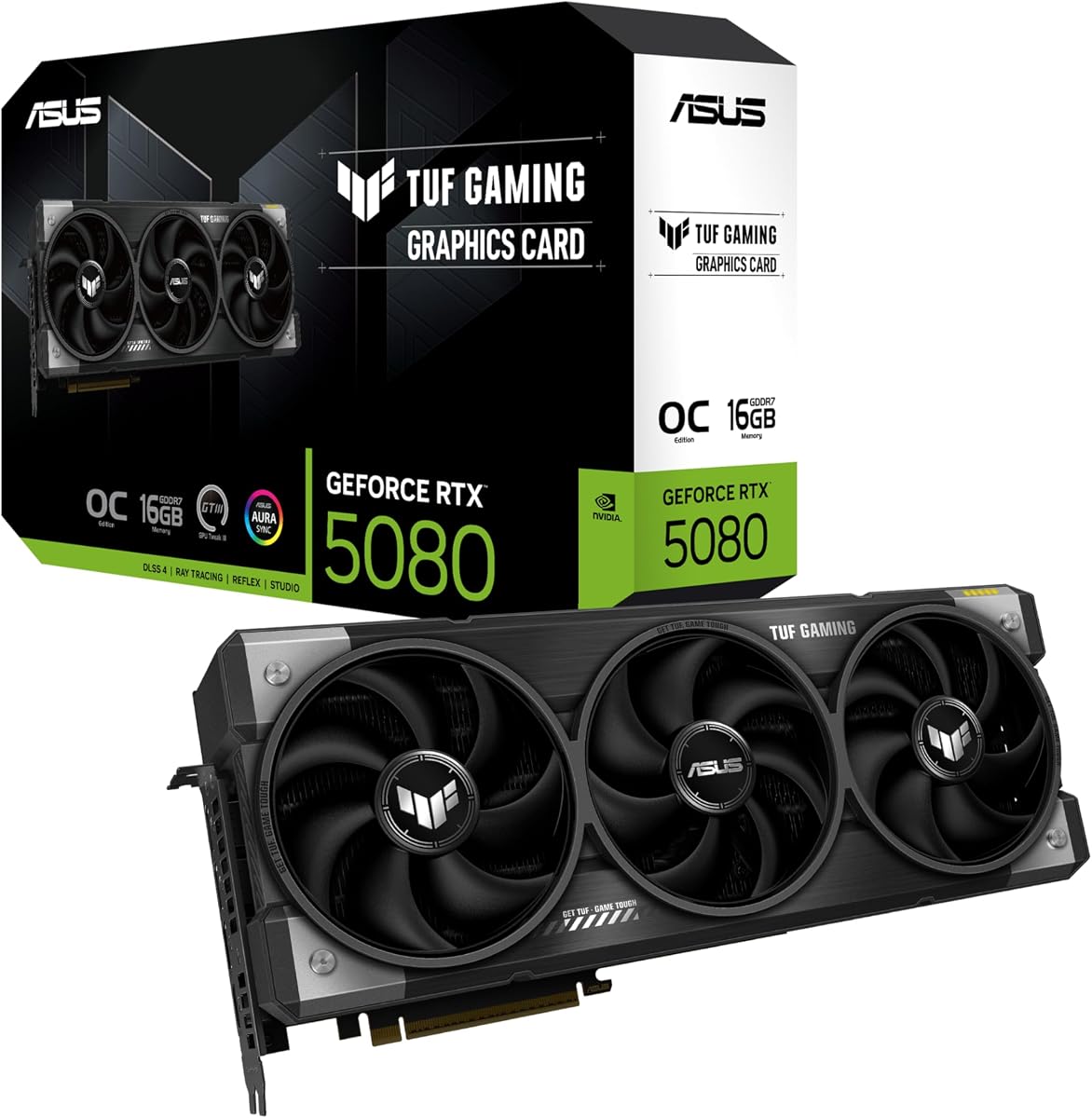
The ASUS TUF Gaming GeForce RTX 5080 16GB GDDR7 OC Edition is an Editor's Choice because it pairs strong customer reception with unusually detailed thermal, mounting, and power provisions. Its 4.6 rating supports its position as a well-regarded high-end NVIDIA card, while its three-fan TUF cooler and phased-change thermal pad are particularly relevant to sustained ComfyUI generation.
We may earn a commission when you buy through this link, at no additional cost to you.
The card uses NVIDIA's Blackwell architecture and supports DLSS 4. Its listed OC clock is 2730 MHz, compared with a 2700 MHz default boost clock. A massive fin array and three Axial-tech fans support sustained cooling, while the phase-change GPU thermal pad is designed to maintain thermal performance over long workloads. These details matter because image-generation jobs can keep a GPU at a high utilization level much longer than a short graphics benchmark.
The TUF design also includes military-grade components, a protective PCB coating, ASUS GPU Guard and bracket reinforcement, and automated manufacturing. GPU Tweak III adds clock tuning, thermal controls, and real-time monitoring. Collectively, these features give a ComfyUI creator more control over sustained performance and system stability than a basic card with minimal cooling information.
The trade-off is physical and electrical. The card measures 348 millimeters long, occupies 3.6 slots, weighs 4.3 pounds, and requires a minimum 850W power supply with a 16-pin 12V-2×6 connector. It is therefore best for a full-size workstation with deliberate airflow. Its 16GB memory still limits model size, but for users who want a robust and well-cooled NVIDIA build rather than maximum VRAM, this is the most balanced high-end recommendation in the guide.
Three Axial-tech fans, a large fin array, and a phase-change thermal pad form a cooling package aimed at consistent performance under load. These features are valuable for ComfyUI users who run generation queues for extended periods rather than alternating between brief tasks.
The 348-millimeter length and 3.6-slot width demand a case with generous clearance. The stated minimum 850W power-supply requirement and 16-pin connector should be checked before ordering, especially in systems that already contain multiple drives or other power-hungry components.
We may earn a commission when you buy through this link, at no additional cost to you.
The GIGABYTE Radeon RX 9070 XT Gaming OC 16G is a strong AMD alternative, earning a 4.7 rating that matches the highest customer-rated products in this guide. With 16GB of GDDR6 memory and a PCIe 5.0 interface, it offers the memory capacity and modern host connectivity commonly desired for local generative-image workflows.
We may earn a commission when you buy through this link, at no additional cost to you.
Its thermal design combines the WINDFORCE cooling system, Hawk fan design, and server-grade thermal conductive gel. These details suggest a focus on transferring heat away from the GPU effectively, which is valuable during repetitive ComfyUI jobs. The card also includes RGB lighting, adding visual customization without changing the core suitability for AI workloads.
The main benefit of considering this option is platform variety. A creator can build around Radeon hardware rather than defaulting to NVIDIA, potentially providing access to a different balance of performance, power, and cost. However, the supplied product information does not list a dedicated AI TOPS figure, tensor-core generation, memory-bandwidth value, or clock information, so detailed comparisons with the RTX 5060 Ti or RTX 5080 would require additional model-specific verification.
At 16GB, this card fits within the same general capacity class as several NVIDIA options. That is adequate for many ComfyUI pipelines, but larger models may require offloading or additional hardware. The RX 9070 XT is best recommended for creators who have confirmed that their preferred models, custom nodes, and software environment support Radeon hardware and who value its high rating, cooling design, and modern PCIe interface.
The RX 9070 XT's 4.7 rating and 16GB memory configuration make it a credible option for users who want an AMD-based ComfyUI system. Software and node compatibility should be checked before committing to a specific generation stack.
WINDFORCE cooling, the Hawk fan, and server-grade thermal conductive gel provide a thermal foundation for long generation jobs. Stable operation under repeated load is more useful to a creator than a short peak-performance result.
We may earn a commission when you buy through this link, at no additional cost to you.
The ASUS Dual Radeon RX 9060 XT 16GB is a compact, highly rated option for creators building a ComfyUI workstation around AMD graphics hardware. Its 4.7 rating is among the strongest in the guide, and the combination of 16GB GDDR6 memory with a 2.5-slot design provides a useful balance of capacity and physical flexibility.
We may earn a commission when you buy through this link, at no additional cost to you.
Its cooling system uses Axial-tech fans with smaller hubs, longer blades, and a barrier ring designed to increase downward air pressure. The stated OC mode reaches up to 3250 MHz boost and 2640 MHz game clock, while the default mode lists up to 3230 MHz boost and 2620 MHz game clock. These are factory-level figures for this particular card and should be understood within its supplied specification set.
A dual BIOS switch provides Quiet and Performance profiles, giving users a straightforward way to prioritize acoustics or throughput. Dual ball fan bearings are listed as lasting up to twice as long as sleeve-bearing designs, a useful attribute for a card expected to remain active during lengthy generation queues. The 2.5-slot design also improves compatibility compared with many high-end triple- or quad-fan cards.
This recommendation comes with two cautions. First, 16GB can be limiting for very large models or memory-heavy custom-node workflows. Second, the product data does not provide a dedicated AI TOPS metric or detailed memory bandwidth, so raw AI comparisons with NVIDIA Blackwell models are not possible from the supplied facts alone. It is best for creators who want a compact, well-rated AMD card and have validated their required ComfyUI packages on Radeon.
The 16GB allocation is large enough to serve as the central resource for many diffusion-model workflows, while the 2.5-slot format reduces the space required for cooling. It is a sensible design for creators upgrading an existing workstation without rebuilding around a full-size GPU.
The Quiet and Performance BIOS profiles let the card adapt to different phases of a work session. This is helpful when the system is being used for node editing and model management as well as during intensive batch generation.
We may earn a commission when you buy through this link, at no additional cost to you.
The ASUS TUF Gaming GeForce RTX 5070 12GB GDDR7 OC Edition combines a 4.7 rating with a durable TUF design, but its 12GB memory capacity is the defining constraint. It remains viable for moderate ComfyUI workflows and users who prioritize NVIDIA features, but it offers less room than the 16GB and 24GB alternatives in this guide.
We may earn a commission when you buy through this link, at no additional cost to you.
The card uses NVIDIA's Blackwell architecture and supports DLSS 4, with an OC mode of 2640 MHz and a default boost clock of 2610 MHz. Its massive fin array is served by three Axial-tech fans, creating a cooling package designed to manage sustained heat. A phase-change GPU thermal pad supports consistent thermal behavior and longevity under heavy graphics-card loads.
Several practical reliability features make the TUF line attractive for a working system rather than a temporary test platform. Military-grade components, a protective PCB coating, ASUS GPU Guard and bracket reinforcement, and Auto-Extreme manufacturing all contribute to durability. GPU Tweak III provides intuitive performance adjustment, detailed thermal controls, and system monitoring.
The physical design occupies 3.125 slots, so buyers must confirm room for the cooler and neighboring components. Memory is the larger concern: 12GB can constrain larger models, several loaded ControlNets or LoRAs, and high-resolution workflows that would run comfortably on 16GB or more. This is best for a creator with established, memory-compatible ComfyUI pipelines who values the NVIDIA platform and robust cooling.
The phase-change thermal pad, large fin array, and triple-fan configuration support consistent operation during long tasks. Protective PCB coatings and reinforced mounting hardware add resilience for a card installed in a permanently active workstation.
A 12GB pool should be matched carefully to the models and nodes in a workflow. It is most attractive when the creator already knows that the target pipeline stays comfortably inside that capacity.
We may earn a commission when you buy through this link, at no additional cost to you.
The ASUS Dual GeForce RTX 5050 8GB is the most compact-oriented NVIDIA selection in this guide and can work well for lightweight ComfyUI experiments. Its 4.3 rating provides reasonable customer reception, while Blackwell architecture and a stated 433 AI TOPS keep it relevant as an entry-level AI platform. The major limitation is its 8GB memory pool.
We may earn a commission when you buy through this link, at no additional cost to you.
The card is described as SFF-ready and uses a two-slot design intended to maximize compatibility in small chassis. Axial-tech fans feature smaller hubs, longer blades, and a barrier ring for increased downward air pressure. Zero-decibel technology stops the fans during light activity, while a dual BIOS lets users select Quiet or Performance profiles when workload demands change.
Clock specifications are listed at 2677 MHz in OC mode and 2647 MHz in default boost mode. Auto-Extreme manufacturing is intended to improve precision and reliability, and dual ball fan bearings are stated to last up to twice as long as sleeve-bearing designs. GPU Tweak III adds fan, thermal, and performance monitoring for users who want greater control over their ComfyUI system.
Memory capacity is the deciding issue. Eight gigabytes may be adequate for smaller models, optimized workflows, or experimentation, but it offers little flexibility when loading larger diffusion models, multiple LoRAs, or complex node graphs. The RTX 5050 is best suited to a small workstation where physical size matters more than maximum model capacity. Users expecting substantial ComfyUI workloads should step up to a 16GB or 24GB card.
The two-slot design and stated SFF-ready positioning make this card attractive for compact creator systems. It can deliver modern NVIDIA AI hardware without requiring the depth and slot allowance associated with large triple-fan models.
The 8GB configuration is most useful for testing workflows, controlling smaller models, and learning ComfyUI. Users who need room to grow should view this as an entry point rather than a long-term capacity solution.
We may earn a commission when you buy through this link, at no additional cost to you.
The PNY NVIDIA GeForce RTX 5060 OC Dual-Fan is a compact, accessible-looking option for a first dedicated ComfyUI system. Its 4.4 rating is solid, and the emphasis on a small footprint makes it interesting for mini-ITX cases, slim chassis, standard mid-towers, and media-center-style systems that cannot host a large triple-fan card.
We may earn a commission when you buy through this link, at no additional cost to you.
Two fans work together to distribute and dissipate heat across a compact design, providing thermal headroom while avoiding the footprint of a full-length multi-fan cooler. PNY states a factory-tuned 2535 MHz boost clock, which gives the card an out-of-box performance setting and some additional adjustment potential through VelocityX.
VelocityX provides control over core and memory clocks, custom fan curves, temperatures, and operating speeds. It can save as many as five profiles, allowing a creator to maintain separate configurations for model preparation, quiet editing, and intensive batch generation. This software flexibility partially offsets the card's more compact cooling package and provides useful visibility into system behavior.
The supplied information does not state the card's graphics-memory capacity, memory type, bus width, bandwidth, power draw, or physical dimensions. Those omissions prevent a complete comparison with the ASUS Dual RTX 5060 Ti, whose 16GB GDDR7 configuration is explicitly listed. The PNY card should therefore be shortlisted for compact builds, but buyers must verify its final specifications, power needs, and case fit before purchase. It is most appropriate for moderate, memory-compatible ComfyUI work.
The dual-fan design aims to provide stable heat dissipation without requiring a large multi-fan cooler. That balance can be especially useful in compact creator builds where airflow and expansion space are limited.
VelocityX gives users control over clock behavior, fan curves, monitoring, and five saved profiles. This makes it easier to tune one card for different stages of a ComfyUI workflow rather than maintaining a single fixed operating state.
We may earn a commission when you buy through this link, at no additional cost to you.
Choosing a GPU for ComfyUI requires balancing model size, inference throughput, memory behavior, cooling, power, software compatibility, and physical fit. The most important starting point is the memory required by the exact workflow rather than the model name or gaming-oriented performance figures.
Choose more memory when you plan to run large models, combine multiple auxiliary models, serve several users, or keep several workflows active. Prioritize less of your budget if your tested pipeline already fits comfortably in a smaller pool.
Compare architecture, numerical precision, and workload-specific support whenever those details are available. If they are not published, validate the target nodes and model stack on the chosen platform.
Use bus width and stated bandwidth as secondary criteria after capacity and software compatibility. A wider or faster memory system is most useful when the chosen workload actually exercises those resources.
Favor a cooler that matches the card's expected workload and chassis airflow. Quiet profiles are helpful for editing, while stronger cooling is preferable during long generation batches.
Plan the complete power and cooling path before buying. Confirm connector shape, PSU headroom, slot spacing, and case ventilation rather than focusing only on the GPU's advertised power figure.
Measure before ordering and leave room for cables and neighboring components. A compact card can be more valuable than raw performance when the case cannot support a larger cooler.
Prioritize the connector layout your desk requires, not just maximum resolution claims. Multi-monitor creators should count ports and verify cable and adapter support.
Check the complete software stack before purchasing. If a specific node or model is non-negotiable, confirm that it works on the selected vendor, driver, and operating system.
Install the graphics card in a properly ventilated case, connect the required power cables, and confirm that the operating system recognizes the device before installing ComfyUI. Update the appropriate graphics driver, verify the CUDA, ROCm, oneAPI, or platform-specific runtime needed by the selected ComfyUI environment, and test a small generation. Keep the card unobstructed, use the supplied or supported GPU-control software, and avoid changing power limits until stability has been established.
Create separate profiles for different uses. A quiet profile can handle model downloads, node editing, and light previews, while a performance profile can be activated for batch generation. Monitor temperature, fan speed, memory use, and workload stability. If a graph contains several large models or auxiliary assets, close unrelated applications and reduce concurrency when memory pressure becomes a problem. Do not treat a single successful image as proof that every graph will remain stable.
For long jobs, keep the case open or well ventilated if necessary, clean dust from filters and fans, and verify that power connectors are fully seated without leaving excessive cable tension. Back up workflow files and downloaded models, and record which driver and software versions were used for a working setup. When changing models, custom nodes, or operating-system packages, test incrementally so that a failure can be traced to a specific change.
The right amount depends on the model, quantization, resolution, and every auxiliary component loaded alongside it. The cards in this guide range from 8GB to 96GB, so the compact RTX 5050 serves very different needs from the RTX PRO 6000. Check the memory requirements of the exact workflow and leave room for peak loads rather than judging only by the base model size.
A workstation GPU is usually better when memory capacity, error correction, isolation, or multi-workload management justifies the added cost. Gaming cards can provide excellent value for standard workflows and often serve creators very well. The RTX PRO 6000 offers 96GB of ECC memory and Universal MIG, while the Arc Pro B60 provides 24GB in a compact creator-oriented design.
You need more than 16GB only if your tested workflow exceeds that capacity or benefits from keeping several heavy components loaded at once. The 24GB Arc Pro B60 is a middle path for larger individual models and multi-component graphs. The 96GB RTX PRO 6000 is intended for much heavier professional workloads rather than ordinary single-image generation.
Radeon cards can be suitable when the required drivers, backend, operating system, models, and custom nodes are supported. The Radeon RX 9070 XT and RX 9060 XT each provide 16GB of memory and have strong customer ratings. Validate the exact stack before purchasing, especially if the workflow depends on a particular node or numerical format.
The Arc Pro B60 includes 24GB of GDDR6 memory, 456 GB/s bandwidth, 197 INT8 TOPS, and hardware acceleration for AI inference and generative design. It also supports Linux multi-GPU deployments and workstation-oriented drivers. Confirm that the desired ComfyUI environment, models, and nodes work with the Intel platform before making it the centerpiece of a production system.
Cooling is important because ComfyUI generation can sustain high utilization for much longer than a brief graphics test. Good airflow and a suitable fan curve help maintain stable boost behavior and component longevity. Multi-fan cards offer substantial cooling hardware, while blower and compact dual-fan designs can work well when case airflow is carefully arranged.
Fan count is only one part of the decision; consider memory, thermal design, chassis clearance, and sustained workload. Dual-fan cards can be easier to fit and may run quietly at low loads, while triple-fan designs often pair with larger high-end cards and provide more cooling hardware. Measure the case and review the manufacturer's thermal specifications before choosing.
Verify memory capacity, model compatibility, power connector, PSU capacity, physical dimensions, slot spacing, case airflow, and current driver support. Also check whether the card's operating system and multi-GPU behavior fit your installation. Product specifications and pricing can change, so confirm the final listing and manufacturer documentation immediately before ordering.
The ASUS TUF GeForce RTX 5080 is the strongest all-around high-end choice for creators who want robust cooling, detailed monitoring, and modern NVIDIA architecture, provided their case and power supply can support its substantial footprint. The ASRock Intel Arc Pro B60 offers the most accessible route to 24GB memory, while the NVD RTX PRO 6000 provides unmatched 96GB capacity and professional workload features.
For most buyers, begin with model compatibility and memory rather than clock speed. A 16GB card can be ideal when the workflow fits, a 24GB option adds useful headroom, and 96GB changes the scope of possible projects. Physical size, cooling, power, and multi-GPU requirements should be evaluated alongside VRAM because the fastest or largest card is not useful if it cannot be installed or sustained.
Finally, check current product details, availability, software requirements, and prices before making a purchase. The GPU market and driver ecosystem evolve quickly, and a configuration that suits one ComfyUI workflow may not suit another. Confirming the exact models and nodes in your planned setup is the most reliable way to turn a general recommendation into the right system component.