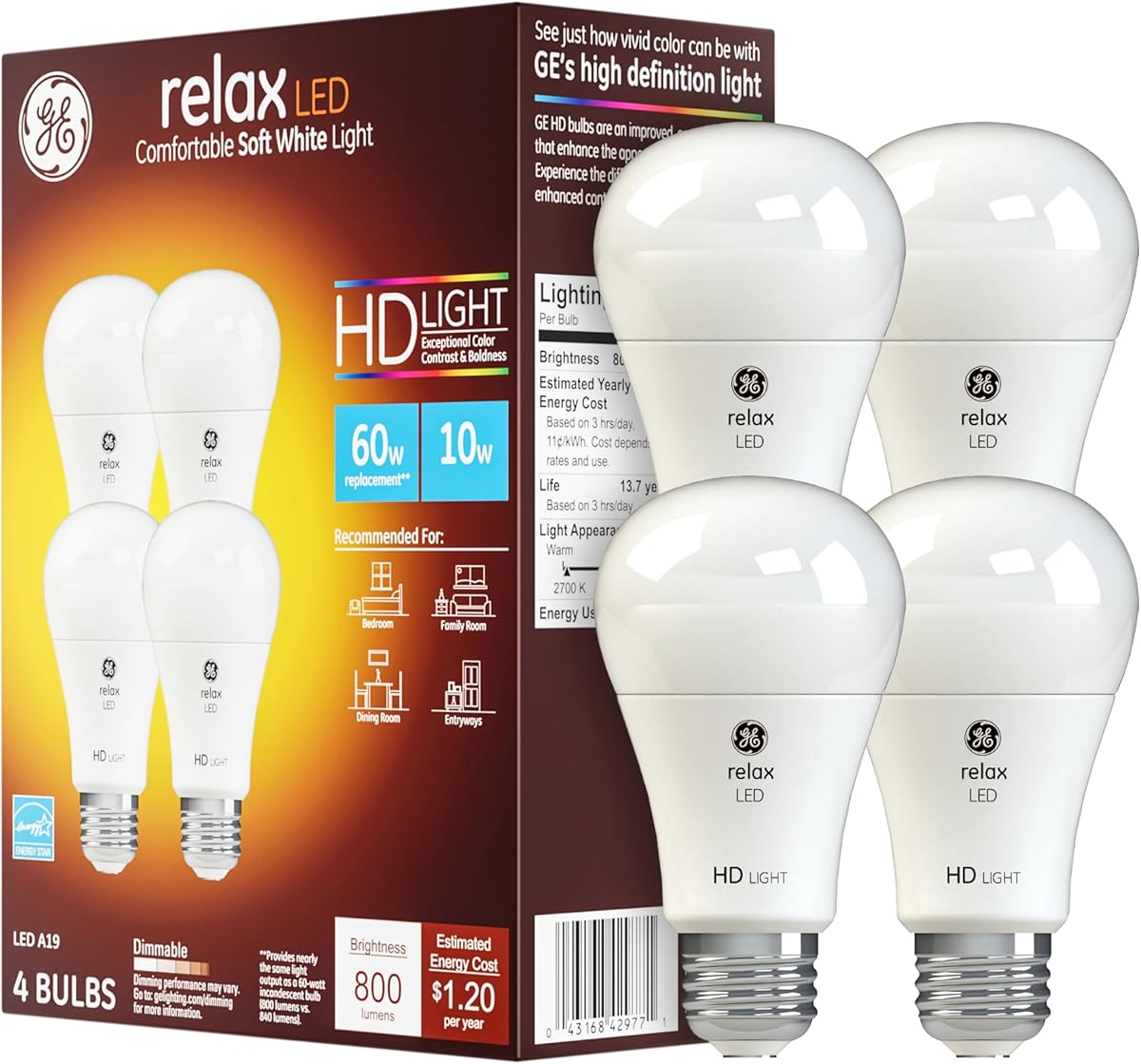
GE Relax LED A19
4.6Editor score
Warm, comfortable soft white
Dimmable for flexible control
800 lumens using 10 watts
Discover the best light bulbs for eye strain with expert comparisons of brightness, color temperature, dimmability, flicker reduction, eye comfort, and sleep
The right light bulb can make reading, working, and relaxing more comfortable by delivering the right balance of brightness, color, dimming, and glare control. The best light bulbs for eye strain are not simply the brightest options, but those that create steady, comfortable illumination while fitting the intended fixture and daily routine.
This guide compares ten LED bulbs using the supplied product specifications, including light output, color temperature, energy use, dimmability, base type, and eye-comfort features. It covers soft-white bulbs for living spaces, high-output daylight bulbs for task lighting, and amber bulbs designed for low-blue-light evening use.
Each selection highlights a different use case, from general-purpose soft lighting to bedside reading and nursery illumination. Ratings and product details reflect the supplied listings, while specifications and availability can change. Read the comparison and buying guide together to identify the most suitable bulb for your room, fixture, and sensitivity to light.
4.6Editor score

4.4Editor score

4.5Editor score
The comparison below highlights the principal differences among all ten bulbs, including their form factors, light output, color, dimming support, and intended application.


This Sylvania A19 is a strong all-around choice for anyone searching for light bulbs for eye strain. Its 4.4 rating reflects favorable customer feedback, and the listing emphasizes glare-free, flicker-free illumination designed to improve visual comfort. The frosted 2700K soft-white output creates a warm atmosphere rather than a stark, clinical look, making it suitable for bedrooms, living rooms, dining areas, and everyday task lighting.
We may earn a commission when you buy through this link, at no additional cost to you.
The most useful features are the fully dimmable design and 90 CRI. Dimming gives users a practical way to reduce brightness when a fixture is too bright, while the high color-rendering index helps colors and fine details appear more natural. With 800 lumens from an 8-watt LED, the bulb offers useful brightness without the energy demand associated with a 60-watt incandescent. It also turns on instantly, avoiding the warm-up delay that can make modern lighting feel less responsive.
The main compromise is color temperature. At 2700K, this is a noticeably warm bulb, which many people find restful but which may not provide enough visual contrast for highly detailed desk work. The four-pack format also assumes that several matching fixtures need replacement. Buyers who want a cooler, brighter light for intense reading or craft tasks may prefer the A21 daylight model listed later in this guide.
This is a recommended pick for households that want one versatile bulb across multiple rooms. It is particularly attractive for nightstands and living areas where glare-free output, warm color, instant-on performance, and adjustable brightness matter more than maximum possible brightness. Check that the fixture takes A19 bulbs and that any dimmer is compatible with LED loads before installation.
Full dimming is the feature that makes this bulb practical across different times of day. Lower output can reduce harsh contrast during reading or wind down without changing to a completely different color temperature.
A CRI of 90 supports more accurate rendering of colors and details. That can make artwork, food, fabrics, and printed material appear more natural while reducing the washed-out look associated with lower-CRI lighting.
We may earn a commission when you buy through this link, at no additional cost to you.
The JandCase Sleep Light Bulb is built for readers who find bright white household lighting tiring, especially near bedtime. It has a 4.5 rating and uses a 1900K amber output described as 99.9 percent free of blue-spectrum light. Rather than trying to make a cool bulb feel comfortable at night, it takes a different approach: creating a warm, low-blue-light environment suited to winding down.
We may earn a commission when you buy through this link, at no additional cost to you.
At 750 lumens, the bulb provides more usable light than a tiny night-light while remaining gentler in character than a standard daylight bulb. The listing specifically highlights no glare and no flicker, two useful qualities for close reading. Its standard E26 socket works with many bedside lamps, general fixtures, nurseries, and reading lights, giving it broader placement options than a dedicated plug-in night-light.
The important trade-off is that this product is not listed as dimmable. Users who want a wide brightness range within one warm bulb may prefer the dimmable Maelsrlg or Ajuns models in this guide. The amber color can also make colors look dramatically different, so it is better for winding down and low-level nighttime reading than for accurate color assessment, cooking, or office work. The supplied description does not provide a formal wattage figure for this particular bulb.
Choose this option if your main concern is eye comfort during the evening and your goal is to reduce blue-spectrum exposure without leaving a bright white lamp on. It is a particularly sensible fit for bedside tables, nurseries, and quiet reading corners. Because it is not described as dimmable, check whether your preferred fixture has a separate low-output setting or consider pairing it with a bulb that offers continuous dimming.
The bulb's defining advantage is its exceptionally low blue-spectrum output. That makes it well suited to evening reading and winding down when a bright white source feels stimulating or visually uncomfortable.
At 750 lumens, the output is bright enough to make pages and room details visible. The combination of amber color, no-glare design, and no-flicker operation keeps the experience softer than a conventional high-output bulb.
We may earn a commission when you buy through this link, at no additional cost to you.
This Sylvania A21 is the most capable choice for people who need serious task illumination without abandoning LED efficiency. Its 4.5 rating and 1600-lumen output distinguish it from most of the 800-lumen bulbs in this roundup. The frosted 5000K daylight color is designed for crisp visibility, making it a better candidate for home offices, worktables, kitchens, laundry rooms, and detailed hobbies.
We may earn a commission when you buy through this link, at no additional cost to you.
The product is also fully dimmable, which is essential when working with a bright bulb. Users can lower the output for more relaxed periods without physically changing the fixture. Glare-free and flicker-free illumination are explicit selling points, while 90 CRI helps colors and small details look accurate. Instant-on operation provides immediate illumination, and the estimated 15,000-hour lifespan supports long-term use in frequently occupied rooms.
The trade-offs are size and color. A21 bulbs are physically larger than A19 bulbs, so fixture clearance should be checked carefully, especially in tightly fitting lamps. At 5000K, the light is cool and energizing rather than warm or sleep-friendly. It can be less comfortable for people with light sensitivity, and it is not the best match for a dim bedside environment. The four-bulb pack is also more specialized than a small single-bulb purchase.
This is the top recommendation for people who equate eye comfort with crisp, abundant light rather than a dim amber glow. It is especially useful in a workspace where detailed reading or visual accuracy matters, provided the fixture accepts A21 bulbs and the room is not used immediately before sleep. Dim it for sensitive periods, and reserve warmer or amber bulbs for the evening.
The 1600-lumen output provides ample coverage for large work areas, kitchen counters, and hobby tables. It offers a useful way to reduce eye effort by supplying clear illumination without relying on multiple weaker lamps.
The 5000K output favors visibility and contrast, while full dimming gives users a practical way to soften it. This flexibility makes the bulb suitable for both focused daytime work and lower-output evening use.
We may earn a commission when you buy through this link, at no additional cost to you.
This eight-bulb Sylvania pack is designed for broad household use, particularly when several rooms or fixtures need matching bulbs. Its 4.3 rating is solid, and the product delivers 800 lumens of soft white light per bulb at 2700K. The listing recommends it for nightstands, living rooms, and dining rooms, all settings where warm, immediately available illumination can support comfort.
We may earn a commission when you buy through this link, at no additional cost to you.
The pack includes eight A19 bulbs, reducing the need to source replacements individually. Each bulb uses 9 watts as a replacement for a 60-watt incandescent and has a listed lifespan of up to 11,000 hours. Instant-on operation eliminates warm-up delay, while the mercury- and lead-free construction supports safer use in occupied homes. These characteristics make the set practical for a whole-home refresh or a rental with several mismatched lamps.
Its main limitation is the lack of detailed eye-comfort specifications in the supplied listing. Unlike several other Sylvania products in this guide, this one does not provide a CRI figure or explicitly emphasize the same reduced-blue-light and glare-free positioning. That does not make it unsuitable for eye strain, but it provides fewer objective details for buyers comparing color fidelity and specialized comfort features.
This pack is best for buyers who prioritize practical coverage and matching replacement bulbs over advanced technical specifications. It works well in multiple warm-lit areas and gives enough units to cover bedrooms, hallways, and common rooms. For very demanding visual tasks, consider a bulb with a stated CRI; for a single fixture, the smaller four-bulb set may be more convenient.
Eight matching bulbs are particularly helpful in homes with several A19 fixtures. The coordinated stock also makes future replacement easier, reducing the need to search for a similar color and brightness in a different listing.
The 2700K soft-white color creates a gentler atmosphere than daylight bulbs. That makes the set suitable for living areas, dining spaces, and bedside fixtures where visual comfort and ambience are equally important.
We may earn a commission when you buy through this link, at no additional cost to you.
The Philips Ultra Definition A19 distinguishes itself with a CRI95 rating, the highest stated color-rendering figure among the products compared. For eye comfort, accurate color perception can matter in areas filled with artwork, colorful objects, skin tones, fabrics, or printed material. The bulb also provides 800 lumens at 2700K and is described as flicker-free, giving it a credible combination of visual quality and steady output.
We may earn a commission when you buy through this link, at no additional cost to you.
Its dimming behavior is another major advantage. Philips says the LEDs dim to warm tones similar to traditional bulbs, so users can move from functional brightness to a more inviting atmosphere. The four-bulb pack supports multiple installations, and the listed life of up to 15,000 hours makes it a long-term option for frequently used fixtures.
The 3.7 rating is the weakest in this roundup, so buyers should not treat the technical specifications as a guarantee of universal satisfaction. Some user preferences may relate to the clear bulb design, which can reveal dust and fingerprints more readily than a frosted bulb. The listing also does not give a detailed wattage figure, although the title identifies it as an 8-watt equivalent of 60 watts and 800 lumens.
This is a strong pick for art displays, creative work, detailed hobbies, or any space where color fidelity matters. It is also appropriate for general soft lighting where a clean, dimmable LED is desired. For shoppers prioritizing warm nighttime comfort rather than color accuracy, a more strongly amber bulb may be a better fit. Verify dimmer compatibility and inspect the desired fixture for space.
CRI95 is the standout specification here. It can make colors look more faithful, which is valuable for art, design, makeup, food presentation, and close inspection of objects with subtle shades.
The clear enclosure complements the high-CRI output by allowing more direct light through. Buyers who want visible filament-style aesthetics and accurate color should compare it with frosted alternatives.
We may earn a commission when you buy through this link, at no additional cost to you.
The GE Relax LED A19 combines a 4.6 rating, the highest customer rating in this group, with a warm, comfortable output intended for bedrooms, family rooms, and dining rooms. Each bulb produces 800 lumens while using 10 watts to replace a 60-watt incandescent. The soft-white color is designed for comfortable moments and cozy spaces rather than bright clinical illumination.
We may earn a commission when you buy through this link, at no additional cost to you.
GE highlights bolder color and enhanced contrast compared with standard LED bulbs, which may make objects and room details easier to distinguish. Dimmability provides a second layer of control, allowing users to lower the light for relaxing or increase it for activities. The bulbs work with most dimmer switches, although compatibility should be verified before replacing an entire room.
The listing does not explicitly call the output flicker-free, and it provides no CRI value. Those omissions make it less suitable for buyers whose main criterion is a documented eye-comfort standard. Its 10-watt consumption is also slightly higher than the 8-watt output of several alternatives, though the difference in real energy use should not be the only consideration in selecting a comfortable bulb.
This is an excellent general recommendation for households seeking warm light, straightforward dimming, and a well-reviewed four-pack. It is particularly appropriate for living areas and family spaces where a relaxed appearance matters. People who work at desks may want to supplement it with a higher-output daylight bulb, while amber options remain better suited to late-night use.
The emphasis on bolder color and enhanced contrast helps details remain visible while the soft-white color preserves a cozy appearance. That balance is useful in rooms used for both conversation and everyday activities.
Dimmability allows one fixture to support bright household activity and a gentler evening setting. The four-bulb pack also makes it straightforward to create consistent lighting across several rooms.
We may earn a commission when you buy through this link, at no additional cost to you.
This amber sleep bulb is built for low-output nighttime illumination rather than full-room visibility. Its 4.5 rating reflects favorable feedback, while the 1800K amber color and claimed 99.99 percent blue-spectrum blocking make it a specialized choice for people who prefer warm, low-blue light near bedtime. The bulb delivers 300 lumens from 3 watts.
We may earn a commission when you buy through this link, at no additional cost to you.
Its small A15 shape and standard E26 medium base make it more flexible than a dedicated plug-in night-light. It can be used in bedside lamps, nursery lighting, reading corners, and ambient fixtures. The listing highlights no flicker, no glare, no ultraviolet light, and no blue-light stimulation, all of which support the product's eye-comfort positioning. A listed service life of up to 25,000 hours adds to its suitability as a long-lasting fixture upgrade.
The most important limitation is that the bulb is not dimmable. Its light level is fixed, so users who need a wider range or very bright reading output should look elsewhere. The A15 form may also be smaller than the standard A19 shape some people expect, and the listing asks buyers to confirm the base and dimensions before purchase.
Choose this product for overnight navigation, quiet nursery illumination, or a low-level bedside glow. It is also a thoughtful option for people who become uncomfortable under blue-enriched white light at night. It is not the right choice for a primary reading lamp, detailed work, or a fixture that requires a full-size bulb.
The combination of 1800K amber light and 300 lumens is intentionally soft. It offers enough visibility for late-night movement while creating a less stimulating atmosphere than a conventional white bulb.
A listed lifespan of up to 25,000 hours makes this suitable for fixtures that operate every night. Low power use and infrequent replacement needs are additional advantages for bedside and nursery applications.
We may earn a commission when you buy through this link, at no additional cost to you.
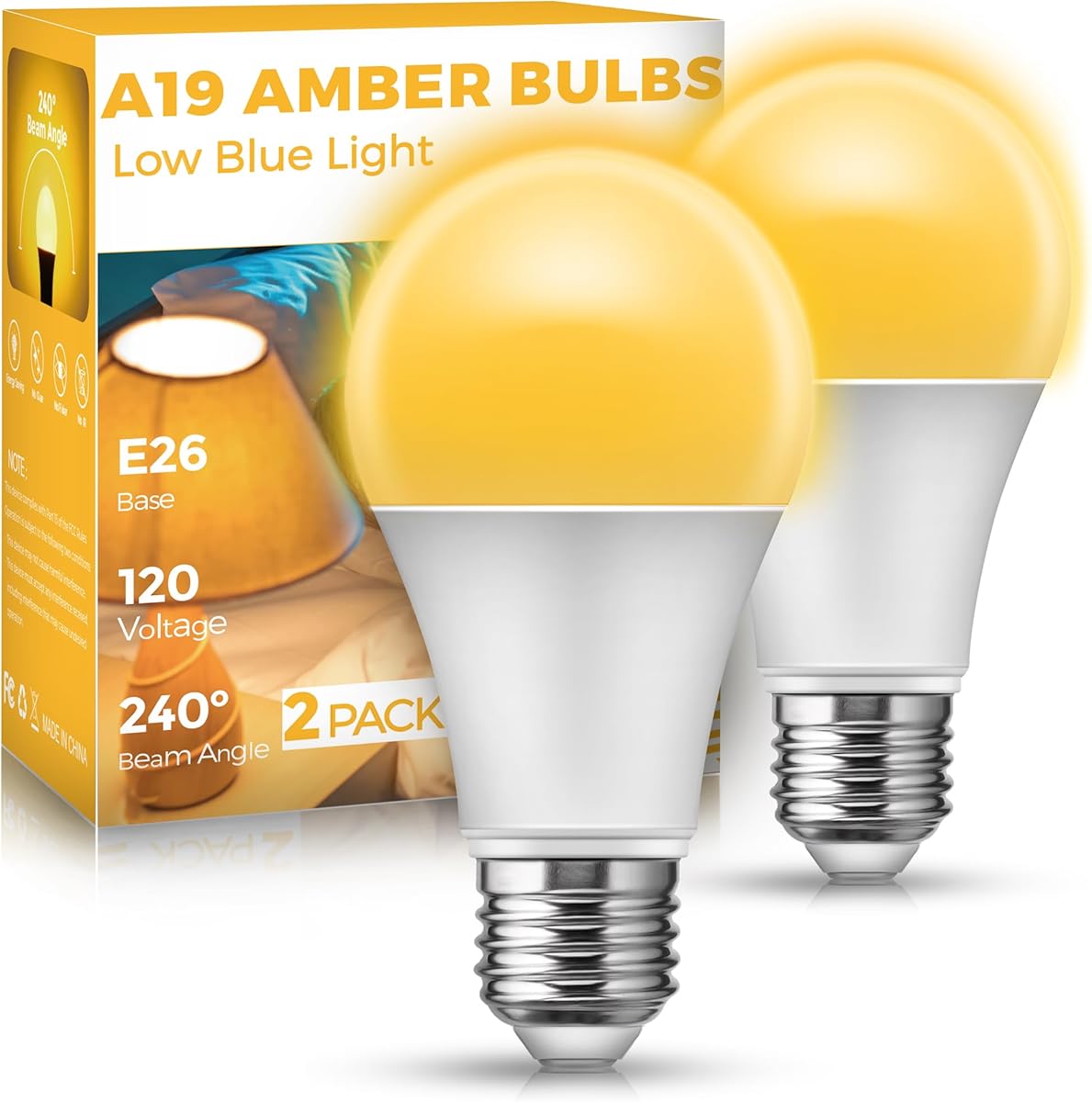
The Neporal four-pack provides unusually bright amber illumination for sleep-oriented bulbs. Its 4.5 rating and 800-lumen output make it more useful for reading than lower-output night lights, while the 1800K color creates a warm orange glow. The listing describes the output as 99.94 percent free of blue-spectrum light, positioning it for evening relaxation and reduced eye strain.
We may earn a commission when you buy through this link, at no additional cost to you.
A 9-watt draw and 60-watt-equivalent labeling reflect the bulb's higher output compared with the 300-lumen option. CRI above 80, no-flicker operation, and no-glare design are additional positive features. Because it uses the familiar A19 format with an E26/E27 base, it can serve many bedside, reading, bedroom, and nursery fixtures without requiring specialized hardware.
The amber color significantly changes how objects and colors appear, so this is not an appropriate bulb for makeup, color selection, painting, or detailed color work. The product is not described as dimmable, so users cannot fine-tune the already substantial 800-lumen output. The supplied listing also presents two slightly different blue-free percentages, which should be understood as product claims rather than a standardized laboratory comparison across every bulb in this guide.
This four-pack is a good fit for households with multiple bedside or reading lamps that need warm nighttime illumination. It works particularly well for adults or children who read in bed and want visible light without the blue-enriched white output of a standard bulb. Choose a dimmable amber alternative if gradual brightness adjustment matters more than higher maximum output.
The 800-lumen output provides enough illumination for comfortable page visibility in a bedside lamp. It occupies a useful middle ground between a small night-light and a bright white reading bulb.
The four-pack is practical for pairing beds, bedside tables, and nursery lamps. Matching bulbs create a consistent warm appearance throughout the spaces where evening light is most common.
We may earn a commission when you buy through this link, at no additional cost to you.
The Maelsrlg Sleep Light Bulb combines an extra-warm 1600K amber color with continuous dimming, giving it more control than most fixed-output sleep bulbs. It has a 4.4 rating and delivers 710 lumens from an 8-watt LED. The result is a versatile option for bedtime reading, nurseries, hallways, and other low-stimulation areas.
We may earn a commission when you buy through this link, at no additional cost to you.
The dimming range of 10 to 100 percent is particularly useful. A user can retain enough light to read comfortably and then lower the output to a faint nighttime glow. Flicker-free technology and soft illumination are designed to minimize glare and reduce the potential for additional visual fatigue. Its standard A19 size and E26 base make installation straightforward in many common lamps.
The 1600K color is warmer than most amber options, so it creates a pronounced sunset-like appearance. That is desirable for winding down but unsuitable where accurate color judgment matters. Dimmability also depends on a compatible standard dimmer, and some inexpensive wall dimmers may not perform properly with LED bulbs. The supplied data does not state a formal blue-light-blocking percentage.
This is a strong recommendation for readers who want one warm bulb to cover both focused reading and a very low night setting. It is more adaptable than fixed-output amber products and more relaxing in color than standard white LEDs. Choose it for evening comfort, but keep brighter neutral bulbs nearby for detailed daytime work.
The 10 to 100 percent dimming range lets users move from a readable 710-lumen setting to a subtle glow. That makes it easier to use one bedside fixture across multiple parts of the evening.
At 1600K, the bulb produces a deep amber tone designed to feel restful. The low-blue-light character can make it more suitable for bedtime than a conventional white LED.
We may earn a commission when you buy through this link, at no additional cost to you.
This compact dimmable amber bulb is optimized for minimal light rather than room-filling illumination. Its 4.5 rating and 1.5-watt power draw distinguish it as one of the most energy-conscious options in the guide. The 1800K warm output is described as 99.9 percent free of blue-spectrum light, intended to reduce eye fatigue and support a calmer nighttime environment.
We may earn a commission when you buy through this link, at no additional cost to you.
Dimmability is the standout feature. The listing describes a smooth adjustment from full brightness to zero, allowing the fixture to function as both a gentle reading light and an extremely low night-light. The bulb is also described as free of flicker and glare. Its A15 shape and E26/E27 base fit many bedside lamps, children's reading lamps, nurseries, and lounge spaces.
The low output means it will not substitute for a main ceiling light or illuminate a large workspace. Its compact A15 proportions may not suit fixtures designed specifically for full-size A19 bulbs. As with most dimmable LEDs, performance can vary with the dimmer, and the listing recommends compatibility with most LED dimmers rather than guaranteeing operation with every model.
Choose this product when the priority is a small, controllable nighttime glow with minimal power consumption. It is particularly useful in a bedside fixture where full brightness is unnecessary, or where a low amber light should be available without a separate night-light. For stronger reading illumination, consider the 710- or 800-lumen amber models.
The ability to dim to zero makes this more flexible than a fixed-output amber night-light. Users can select the exact level needed for orientation, a quiet conversation, or a softer presence in the room.
The 1.5-watt draw makes the bulb well suited to fixtures that remain on for extended periods. Low power use is especially practical in bedrooms, nurseries, and frequently used hallways.
We may earn a commission when you buy through this link, at no additional cost to you.
The most comfortable bulb is the one that provides adequate light for the task without excessive brightness, distracting flicker, harsh glare, or an unsuitable color temperature. Consider fixture shape, dimming, output, and the time of day when the bulb will be used.
Color temperature determines whether illumination feels warm, neutral, or cool. The 1800K and 1900K amber bulbs in this guide are optimized for relaxed evening environments, while 2700K soft-white bulbs work well in living rooms, bedrooms, and dining spaces. The 5000K Sylvania A21 provides a crisp daylight effect that may improve visibility during demanding tasks but can feel energizing or uncomfortable for some light-sensitive users. Choose based on the room's function rather than treating one temperature as universally easier on the eyes.
Lumens indicate total light output, but more is not automatically better. Most of the A19 bulbs produce 800 lumens, a versatile level for one ordinary room or several smaller fixtures. The 1600-lumen A21 is better suited to large work areas or a single brighter fixture. Amber options range from a very low 300 lumens to 800 lumens, showing that even warm bulbs can serve different purposes. Match output to both the fixture and the activity so that reading is easy without flooding a bedroom with unnecessary light.
A dimmable bulb provides one of the simplest ways to reduce glare, excessive contrast, and frustration caused by a fixture that is too bright. Sylvania's A19 and A21 models, the GE Relax set, the Maelsrlg amber bulbs, and the compact dimmable amber bulb all support dimming. Confirm that the existing switch is LED-compatible, particularly for mixed-wiring or older dimmers. Dimmability is most valuable in bedside lamps, living rooms, and workspaces where lighting needs change throughout the day.
Flicker-free operation is a major comfort consideration for people who spend extended periods reading or working under artificial light. Several products explicitly describe themselves as flicker-free, while the GE Relax listing does not make that claim. Glare control is also important because bright light reflected from glossy pages or screens can intensify visual discomfort. Look for frosted diffusers, reduced-glare design, and an appropriate fixture shade. A bulb alone cannot correct poor placement, so position the light beside rather than directly behind the viewer whenever possible.
The color rendering index, or CRI, indicates how accurately a bulb reproduces colors compared with a reference source. A CRI of 90 is a strong general-purpose specification, while the Philips Ultra Definition bulb's CRI95 can be especially useful for artwork, makeup, food, and detailed hobbies. Lower-CRI bulbs are not automatically uncomfortable, but colors can appear flatter or less natural. If accurate color perception is a major part of your work or hobbies, favor a product that states a higher CRI rather than relying on vague descriptions of brightness or whiteness.
A bulb must physically fit the intended fixture. A19 bulbs are the standard general-purpose shape in this roundup, while A21 bulbs are larger and suited to roomier fixtures. The amber sleep options include A19 and compact A15 formats. Most use an E26 medium base, and some explicitly support E27 bases as well. Check the fixture's maximum wattage, bulb shape, base type, and clearance before buying a multipack. This simple step prevents an otherwise suitable bulb from failing to install correctly.
A bulb that feels comfortable in a daytime office may be too stimulating in a bedroom, while an amber bulb may be too warm for precise daytime work. General soft-white bulbs offer the broadest application across homes, daylight bulbs suit bright task environments, and amber bulbs are strongest for the evening. Think about when the fixture is used, what must be visible, and whether the goal is alertness or relaxation. Buying separate bulbs for different routines is often more effective than forcing one light source to serve every purpose.
LED bulbs use substantially less power than the incandescent bulbs they replace, and several products here list long operating lives. A 1.5-watt bulb is appropriate for low-level night illumination, while 8- to 15-watt models support more visible room and task lighting. Lifespan ratings are useful for estimating replacement frequency, but actual performance depends on operating temperature, voltage, and usage. Energy use should complement, rather than replace, comfort criteria: a very efficient bulb that is too bright or poorly positioned may still contribute to visual strain.
Begin by matching the bulb to the fixture and confirming its base, maximum wattage, and clearance. Turn off the power before installation, then screw the bulb in without forcing it. For dimmable products, use an LED-compatible dimmer and begin at a high setting before lowering the bulb, following the switch manufacturer's instructions.
To minimize strain, position light beside or slightly behind the task rather than shining it directly into your eyes. Use a shade or diffuser to soften reflections from screens, paper, and glossy surfaces. Task lamps should illuminate the work area evenly, while bedside bulbs can be dimmed to the lowest useful level once reading is finished.
Clean bulbs with a dry or lightly damp soft cloth after they have cooled, and avoid liquid entering the base. Replace a bulb promptly if it flickers irregularly, develops a dark spot, or becomes unusually dim. For consistent comfort, keep several bulbs in the same room matched in color temperature and output rather than mixing very warm amber and cool daylight sources.
The best bulb depends on the activity and room, but dimmable, flicker-free LED bulbs with a comfortable color temperature are generally the most versatile. Soft white works well in living spaces, daylight can support detailed tasks, and amber is useful in the evening. Adequate, evenly distributed light matters more than choosing the brightest option available.
LED bulbs are generally more comfortable because they reach full brightness immediately and many models are designed for flicker-free operation. They also use less energy and last longer than incandescent bulbs. The biggest eye-strain benefits still depend on suitable brightness, proper placement, and a lamp that does not create harsh reflections.
A higher CRI can make colors and fine details appear more natural, which may improve comfort in visual tasks and creative work. It does not directly eliminate every source of eye strain. Brightness, glare, flicker, color temperature, and screen habits remain important factors, so CRI should be considered alongside those features.
Amber bulbs can be more comfortable for late-night reading because they emit less blue-spectrum light and create a warm atmosphere. Their output ranges widely, so choose enough brightness for the page and dim if possible. They are less appropriate for detailed daytime work, accurate color matching, or making the room feel fully alert.
Yes, dimming lets you reduce brightness when a room or fixture is too intense without replacing the bulb. It is especially helpful in living rooms, home offices, and bedside lamps. Make sure the dimmer is compatible with LED bulbs, since some older switches may cause flickering or limited low-level adjustment.
Daylight bulbs provide a cooler, higher-contrast light that can make small print easier to distinguish during demanding daytime tasks. They may be too energizing for the evening and uncomfortable for people with light sensitivity. Soft white is usually more relaxed, while amber is better suited to the hours before sleep.
No, and using different bulbs for different purposes often provides better comfort. Neutral or soft-white bulbs are useful for general living and work areas, while amber bulbs belong near the bed or in a nursery. Matching bulbs within a single room still helps prevent distracting differences in brightness and color.
Use a light that illuminates the page from the side, adjust the shade to prevent direct glare, and keep the room from becoming visually uneven. A dimmable bulb allows you to use the lowest comfortable brightness, while a desk lamp can be positioned closer to the reading material. Take regular breaks and keep the viewing distance consistent.
The Sylvania Reduced Eye Strain A19 is the most versatile overall recommendation because it combines warm 2700K output, 800 lumens, 90 CRI, instant-on performance, and full dimming. The GE Relax LED is another strong all-purpose choice for its high customer rating and comfortable soft-white illumination, while the Sylvania A21 leads the group in brightness for demanding daytime work.
Prioritize flicker-free operation, suitable glare control, adjustable brightness, and a color temperature that matches the routine. Amber bulbs are compelling for bedtime reading and nurseries, with the dimmable Maelsrlg and compact 1.5-watt option offering especially flexible nighttime control. For visual tasks, the Philips CRI95 bulb is worth considering when natural color rendering is important.
Before purchasing, confirm the bulb shape, base, wattage limit, dimmer compatibility, and intended room. Product details, ratings, and availability can change, so review the current listing and manufacturer information before making a final decision. With the right combination of output, color, and control, finding the best light bulbs for eye strain becomes a matter of matching the bulb to the way you actually use the room.