
BTECH RPS-30PRO
4.7Editor score
Adjustable 9-15V output
Multiple connection formats
Integrated noise offset
Overheat and short protection
USA warranty and support
Ham Radio Power Supply guide compares 10 compact 13.8V AC-to-DC units for current capacity, connections, noise control, protection, and convenience.
A ham radio power supply converts household AC into stable 13.8V DC for transceivers, amplifiers, scanners, and other mobile-radio equipment. A worthwhile model should provide adequate current, clean output, useful connections, dependable protection, and cooling suited to an operating position rather than merely occupying the bench.
We compared the ten featured supplies using their published specifications, supported device types, output ratings, connection options, display functions, noise controls, and safety features. The list covers 5A, 7A, and 30A designs, with particular attention to current handling, installation flexibility, radio noise, and ease of daily operation.
Each review explains the strongest reasons to choose a particular model and any limitations suggested by its specifications. Ratings and feature availability can change over time, and current prices vary, so compare the product details and listing information before making a final purchase decision.
4.7Editor score

4.7Editor score

4.7Editor score
The side-by-side comparison highlights output capacity, connection flexibility, display features, noise control, cooling, and protection across all ten compact ham radio power supplies.
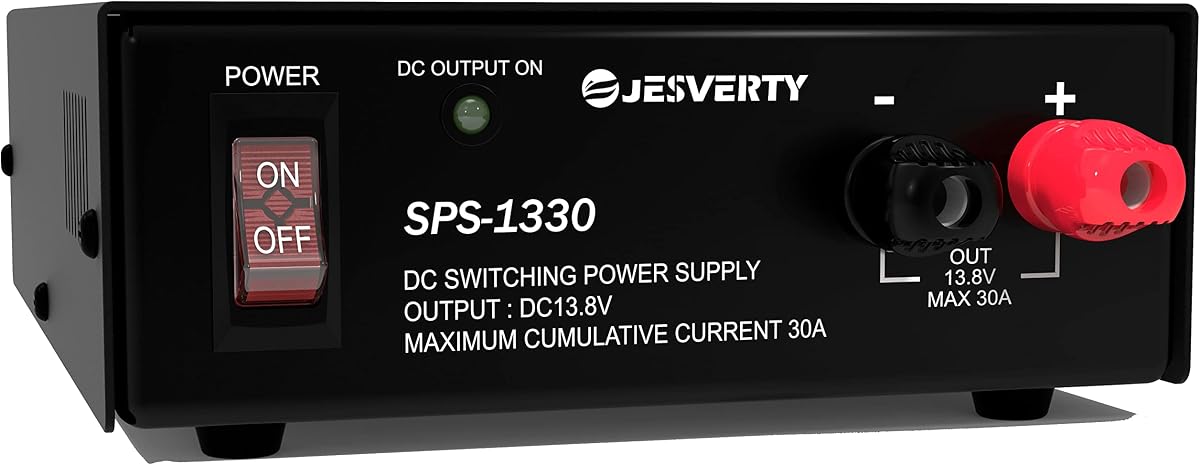


The JESVERTY SPS-1330 is a compact regulated bench supply designed around a fixed 13.8V output and a maximum current of 30A. It carries a 4.6 rating and is aimed directly at CB, ham, and amateur-radio equipment. Its most useful trait is the combination of substantial stated output capacity in a relatively small enclosure, making it easier to accommodate than a full-size communications installation.
We may earn a commission when you buy through this link, at no additional cost to you.
The front-mounted screw-type terminals allow cables to be attached without the need for a specialized connector. A switch-controlled power function keeps operation straightforward, while the built-in cooling fan helps the unit dissipate heat during sustained use. Over-voltage, over-current, and short-circuit protection add practical safeguards around the output stage and connected equipment.
The principal trade-off is connection flexibility. Unlike several competing models, the SPS-1330 does not list a cigarette-lighter socket, USB port, Anderson connector, or noise-offset adjustment. That means it is best treated as a dependable fixed-voltage bench source rather than a universal connectivity hub. Buyers who require those conveniences may prefer a more elaborately equipped alternative.
This is a strong choice for an operator with one or more conventional 13.8V radios who values a compact footprint, straightforward wiring, and a generous stated maximum current. It is especially suitable for home benches where a full communications power unit would take up more room. For most such users, its protection and cooling features outweigh the missing convenience connectors.
At 7.48 by 5.9 by 2.36 inches and approximately 3.1 pounds, the SPS-1330 is designed to remain accessible on a crowded desk. Its 30A maximum output gives it more headroom than a small radio-only converter without requiring a large tower-style chassis.
Over-voltage, over-current, and short-circuit protection work together to limit the consequences of common wiring or load faults. The integrated cooling fan adds thermal management for sustained operating sessions.
We may earn a commission when you buy through this link, at no additional cost to you.
The SKY TOPPOWER STP1330 is the strongest all-around choice in this group, combining a 30A maximum output with a clearly stated 20A continuous rating. Its 4.7 rating reflects a well-received feature set that includes backlit voltage and current meters, a noise-offset control, and a front-facing 10A cigarette-lighter socket.
We may earn a commission when you buy through this link, at no additional cost to you.
The distinction between maximum and continuous current is particularly useful for careful buyers. A radio may operate well below the headline limit, while an amplifier, mobile radio, or other heavy accessory can draw enough current that thermal limits matter. This supply specifies 20A continuous operation, giving users a more concrete basis for load planning than a peak figure alone.
Its protections include short-circuit and overload handling, over-current protection, and a user-replaceable 8A fuse. The cooling fan operates when the internal temperature reaches 55°C, so it need not run continuously in a cool room. The metal casing and rubber feet also make it feel purpose-built for a working bench rather than a lightweight temporary converter.
The trade-offs are minor. A temperature-triggered fan can still become audible during demanding operation, and there is no USB charging port despite the useful 10A accessory socket. Even so, the analog meters, noise control, continuous-current guidance, and clear protection package make this the most balanced supply for a wide range of amateur-radio users.
The listed 20A continuous capability is a key advantage over relying solely on a 30A headline figure. It gives operators a clearer basis for matching the supply to transceivers, amplifiers, and other sustained 13.8V loads.
Backlit analog meters make output behavior easier to observe at a glance, while the noise-offset knob can reduce pulse interference. Both features are particularly relevant in a home operating environment where a bench supply sits near the radio.
We may earn a commission when you buy through this link, at no additional cost to you.
This SKY TOPPOWER model delivers a fixed 13.8V output with a 30A maximum rating and adds a 5V 2A USB interface. Its 4.5 rating reflects a straightforward, versatile package for ham radios, scanners, mobile phones, CB equipment, and HF, VHF, or UHF stations. The USB port is particularly convenient for charging a phone directly from the bench.
We may earn a commission when you buy through this link, at no additional cost to you.
Its stated dimensions of 5.91 by 8.66 by 2.76 inches and weight below 1.5kg keep the supply reasonably compact for a 30A unit. A built-in cooling fan supports heat dissipation, and short-circuit and over-current protection help safeguard the supply and attached devices. The package includes a power cord and manual, making it a straightforward setup for a permanent station.
The specifications do not state a separate continuous-current rating, which is an important detail when planning a heavy load. Users should not assume that every 30A device can sustain the maximum current indefinitely. The 2A USB output is also modest, so it handles basic charging rather than demanding modern tablet workloads.
This supply makes the most sense for a radio operator who values a single box capable of supporting both 13.8V equipment and occasional USB charging. It is less compelling for someone who needs explicit continuous-output guidance or high-speed charging, but it remains a versatile and space-conscious option.
The 5V 2A USB port eliminates the need for a separate phone charger at the operating position. It complements rather than replaces the main 13.8V output, giving the station one more source of practical utility.
The listed support for HF, VHF, UHF, CB, scanners, and mobile devices reflects how widely compact fixed supplies are used in amateur-radio setups. Always verify the actual current draw of the intended load before operation.
We may earn a commission when you buy through this link, at no additional cost to you.
The JESVERTY 13.8V 30A Display is a fixed-output bench supply with a 30A maximum rating and a 4.6 customer rating. It is aimed at amateur-radio stations, CB radios, scanners, and cellular devices, offering a three-digit display alongside an adjustable noise-offset control. That combination makes it appealing for operators who want both immediate output information and some control over switching-supply interference.
We may earn a commission when you buy through this link, at no additional cost to you.
Its connections are unusually accommodating for a compact unit. The product supports alligator-to-banana test leads, hook-to-banana cables, Anderson Powerpole connectors, and a 12V cigarette-lighter socket adapter. Multiple protective measures are also listed, including grounding, boundary-current, thermal, voltage-overload, over-current, and short-circuit protection.
A fixed 13.8V output keeps the operating model simple but removes the flexibility to tune voltage for other devices. The listing also does not identify a separate continuous-current level, so operators should be cautious when planning a load near the headline maximum. These limitations matter more in a permanent high-power station than in occasional bench work.
Choose this model if the station uses conventional 13.8V equipment and values a digital readout, noise adjustment, and varied connector options. It is a strong all-around choice for experimentation and mixed accessory setups, particularly where the operator prefers a digital display to analog meters.
The three-digit display gives users a quick visual indication of operating conditions. It is useful during setup because the displayed value can be observed before and after a radio or accessory is connected.
Anderson Powerpole, banana-style leads, alligator leads, and a cigarette-lighter adapter cover several common installation methods. This makes it easier to keep the bench organized without relying on one specific cabling standard.
We may earn a commission when you buy through this link, at no additional cost to you.
The BTECH RPS-30PRO is the most versatile premium option in the lineup, earning a 4.7 rating while adding a 9-to-15V adjustment range around its standard 13.8V setting. That flexibility makes it more than a dedicated radio converter, while its 30A maximum output and multiple connection formats keep it firmly suited to serious communications work.
We may earn a commission when you buy through this link, at no additional cost to you.
Cigarette-plug, screw-type, and snap-in terminals give users several ways to connect equipment. The adjustable voltage is useful for 12V accessories that do not require exactly 13.8V, and the noise-offset adjustment can help reduce unwanted pulse interference near a receiver. A switch-controlled front operation also makes routine use uncomplicated.
Safety protection includes overheat, short-circuit, and amperage-surge handling. The product is also backed by a stated USA warranty and local support, which adds value for buyers who prefer a radio-focused brand with a domestic support structure. As with the other high-current units, the listing does not provide a clear continuous-output figure, making careful load matching important.
This is the best choice for an operator who wants more than a fixed 13.8V source. Its adjustable range, noise control, and three connection methods justify a premium selection for a versatile bench. Those who only need one uncomplicated 13.8V output can save money with a more specialized model.
The 9-to-15V range allows the supply to serve more than one class of 12V equipment. Operators can move away from a fixed 13.8V setting when a connected device benefits from a different voltage.
Cigarette-plug, screw-terminal, and snap-in connections support varied station wiring. The stated USA warranty and radio-focused support add reassurance for buyers who may need assistance beyond initial setup.
We may earn a commission when you buy through this link, at no additional cost to you.
The Tekpower TP30SWI is a focused 13.8V switching supply for ham and CB radio use. Its stated maximum output is 30A, and the analog display provides immediate voltage and current visibility. A 4.6 rating and included one-year USA warranty support its appeal as a traditional radio-bench product without an expansive accessory ecosystem.
We may earn a commission when you buy through this link, at no additional cost to you.
Noise offset is the feature that distinguishes it from simpler fixed-output converters. In a home station, switching power supplies can create audible interference in sensitive receivers, and an adjustment control gives the operator a way to minimize that effect. The analog display also allows the user to see how the output responds while connected equipment draws power.
The supplied information is more limited than that of several neighboring products. It does not list the connector formats, a continuous-current rating, USB charging, or a detailed range of protection features. Buyers who need those specifications should seek a more fully documented model, especially if they plan to install a high-draw amplifier.
The TP30SWI is a sensible option for a conventional radio installation where straightforward monitoring and noise adjustment are priorities. It works particularly well for operators who understand their equipment's current requirements and prefer an uncomplicated analog interface. More complex mobile setups may benefit from a supply with broader documented connectivity.
The analog meters suit users who prefer a direct visual indication of output. Voltage and current can be checked quickly while adjusting a connected radio or accessory.
The noise-offset control gives operators a practical way to reduce switching interference affecting nearby receivers. It is most useful where the supply and radio are installed close together.
We may earn a commission when you buy through this link, at no additional cost to you.
The JESVERTY SS-30P distinguishes itself with a clearly stated 25A constant output and a total maximum of 30A. It has a 4.7 rating and provides a fixed 13.8V regulated output intended for ham, CB, GMRS, LMR, scanners, and other 13.8V equipment. The explicit constant-current figure is especially useful for careful station planning.
We may earn a commission when you buy through this link, at no additional cost to you.
Its connection layout is designed for robust high-current use. Two front sets of Anderson connectors and five-way binding posts provide alternatives for high-current cables and standard bench connections. Each Anderson connection is listed as capable of handling up to 30A individually, while total combined output remains limited to 30A.
A built-in cooling fan, rugged housing, and protections for overheating, short circuits, and overcurrent support dependable operation. The package includes the supply, an AC cord, and an instruction manual, along with lifetime technical support. Unlike several neighboring products, it does not list a noise-offset control, so radio interference may require separate mitigation.
This model is well suited to an operator who values high-current termination options more than USB charging or adjustable voltage. It is particularly attractive for stations using high-current Anderson cabling or who want binding posts alongside a dedicated connector. Its clearer 25A constant-output specification is a meaningful advantage over headline-only 30A claims.
A stated 25A constant output gives operators a more useful planning figure than maximum current alone. It helps distinguish realistic sustained-load capability from a brief peak rating.
Two Anderson connector sets support proper high-current cabling, while five-way binding posts allow familiar bench connections. The total output ceiling still applies across the connections.
We may earn a commission when you buy through this link, at no additional cost to you.
The Pyramid PS9KX is a compact 5A supply aimed at lighter radio duties, and it earns a 4.7 rating despite being one of the most modest models in the collection. Its fixed 13.8V DC output, 115V AC input, and 70W input specification make it relevant for a basic home station, CB radio, scanner, or smaller 12V accessory.
We may earn a commission when you buy through this link, at no additional cost to you.
Despite its modest current rating, it includes useful conveniences. Screw-type terminals support standard hookup leads, and the 12V cigarette-lighter socket allows a compatible device to be connected without another adapter. The linear regulated design provides a constant output source, while electronic overload and short-circuit protection and a fuse-protected auto-reset arrangement help manage faults.
Thermal management is handled through a cabinet heatsink and built-in cooling fan. The 5A constant rating is the defining limitation, however, and the 7A surge figure should not be treated as a continuous operating allowance. It would be poorly matched to a power-hungry linear amplifier or a collection of several high-draw mobile radios operating together.
The PS9KX is a good budget choice for a new operator, a lightweight radio, a scanner, or a backup station where 13.8V access matters more than high-current capability. It offers a capable set of protections and convenient connections at a lower capacity tier. Users should first calculate the combined current draw of everything they intend to connect.
A 5A constant output is appropriate for many compact transceivers, mobile radios, and accessories used individually. It offers an approachable way to run a basic station without occupying a full high-current bench.
Electronic overload and short-circuit protection help manage common load errors. A cabinet heatsink and cooling fan supplement the compact linear-regulated design.
We may earn a commission when you buy through this link, at no additional cost to you.
This JESVERTY 13.8V 30A model combines a high stated maximum current with a 5V 2A USB Type-A port. It has a 4.6 rating and is positioned for CB, ham, marine radios, scanners, and other DC devices. A cigarette-lighter socket and screw terminals give it the flexibility to support both installed radios and smaller portable accessories.
We may earn a commission when you buy through this link, at no additional cost to you.
Its dimensions of 5.91 by 7.86 by 2.95 inches and weight under 1.5kg make it reasonably portable for a 30A supply. The built-in fan is temperature-controlled, remaining off when the internal temperature is below 55 to 60°C. That approach can reduce unnecessary fan noise during lighter bench use, which is a meaningful advantage in a home office or operating room.
Over-voltage, over-current, and short-circuit protection provide the main safety framework, and a built-in fuse adds another layer of protection. The listing does not state a continuous-current rating, so users should avoid treating the 30A maximum as a guaranteed sustained figure. The USB output is also limited to 2A and is intended mainly for ordinary charging.
This is a good option for a compact 30A installation where quiet operation and device-charging convenience matter. It combines more connection flexibility than a basic terminal-only model without adding adjustable voltage or a noise-offset control. It is well suited to mixed radio and accessory stations that value a compact footprint.
The fan starts only when internal temperature reaches the stated range, allowing it to remain off during cooler and lighter use. This can make the supply less distracting in a home station.
The USB Type-A port handles basic phone and tablet charging, while the cigarette-lighter socket and screw terminals serve conventional 13.8V equipment. Multiple outputs simplify a mixed accessory setup.
We may earn a commission when you buy through this link, at no additional cost to you.
The Pyramid PSU990KX is a 7A compact supply with a stated 4.5A continuous output and 13.8V DC output. Its 4.7 rating reflects a useful combination for light radio stations: banana-plug terminals, a cigarette-lighter connection, and two USB charging ports are included in one housing.
We may earn a commission when you buy through this link, at no additional cost to you.
The two USB ports are the feature that sets it apart from a conventional fixed-voltage converter. Mobile devices can be charged without occupying a wall adapter, while the cigarette-lighter socket and terminal block serve radio and automotive-style accessories. A switch-activated front control provides straightforward daily operation from a standard outlet.
Electronic overload and short-circuit protection are included, and the rugged housing incorporates a cabinet heatsink for thermal management. The main limitation is capacity. Although the 7A maximum sounds substantial, the explicitly lower 4.5A continuous figure should govern planning. It is unsuitable for a large amplifier and may be challenged by several high-draw radios connected simultaneously.
Choose the PSU990KX for a compact station built around a single radio, a scanner, or several low-draw accessories that benefit from USB charging. It is a convenient entry-level option and an easy way to organize a small operating position. Users with larger loads should move to a clearly specified high-current model.
Dual USB ports are helpful for operators who regularly use a phone, tablet, or other USB-powered device. Charging happens from the same bench unit as the 13.8V radio supply.
The listed 4.5A continuous output is the number to use when selecting connected equipment. The 7A maximum may accommodate brief demand increases, but it should not replace continuous-load planning.
We may earn a commission when you buy through this link, at no additional cost to you.
Choose a ham radio power supply by matching continuous current to the connected station, selecting the right output and connections, and considering noise, cooling, and protection. The lowest headline wattage or smallest enclosure should not determine the decision by itself.
Begin with the current consumed by the radio and every accessory that will operate at the same time. Add normal operating draw rather than relying only on a transceiver's transmit rating, and leave sensible headroom for future changes. Some listings distinguish a maximum current from a lower continuous rating, making the latter the more useful figure for sustained operation. A 30A maximum description does not automatically mean the unit can sustain 30A indefinitely without considering its thermal design.
Choose the documented continuous rating that covers your normal load. Save the larger 30A models for stations with amplifiers, multiple radios, or serious accessory requirements; basic compact radios may be better served by a 5A or 7A unit.
Most mobile-radio equipment is designed around a nominal 12V system, with 13.8V used as the standard bench-supply output. A fixed 13.8V unit is simple and appropriate for conventional transceivers. Adjustable models can serve additional 12V accessories or offer flexibility during bench work, although operators must set the voltage correctly before connecting sensitive equipment.
Fixed 13.8V is ideal for a dedicated radio station. Adjustable output is more versatile for mixed equipment, but it introduces another control that must be managed carefully.
Screw-type terminals are the most broadly useful option because they accept banana plugs and many common ring or fork leads. Cigarette-lighter sockets suit mobile installations and some accessories. Anderson connectors are valuable for higher-current runs because they provide secure, purpose-made terminations, while USB ports are convenient for charging but are not a substitute for the main radio output.
Match the connector set to the equipment and cable length you already own. High-current Anderson connections are especially useful for permanent installations, whereas screw terminals are generally the easiest choice for a flexible workbench.
Compact switching supplies can introduce switching noise that affects nearby sensitive receivers. A noise-offset adjustment gives the user a way to reduce audible interference, which can be decisive when the radio and supply share a small operating desk. Models without that control may still work well, but separation, filtering, and careful grounding can become more important.
Prioritize noise control in a home station or a receive-focused setup. A fixed-voltage supply with an offset control may be more useful than a more feature-rich unit without it.
Sustained current requires heat removal. A built-in fan is common among high-current models, while cabinet heatsinks help smaller linear units dissipate heat. Temperature-controlled fans can remain quiet during light use and activate only as internal conditions demand, making them preferable in offices and home operating rooms. Leave adequate space around vents and avoid placing papers or other heat-restricting objects over the enclosure.
A fan is not automatically undesirable, but automatic or temperature-based control is often quieter. Always provide clearance around the unit so that its thermal design can operate as intended.
Look for over-current, over-voltage, and short-circuit protection, with thermal protection as another valuable layer. A user-replaceable fuse can simplify recovery after a genuine wiring fault, provided the correct replacement type and rating are used. Protection does not make poor wiring safe, so it should be treated as a backup rather than a substitute for correct load selection.
Prefer units with several forms of documented protection. Keep the replacement fuse specification available and never exceed the manufacturer's stated rating.
Analog meters and digital readouts both allow an operator to observe voltage and current behavior. A display is useful during installation because it can reveal an unexpected load, an open connection, or an output change when equipment is switched on. A multi-function display may also show additional information, but simple voltage and current monitoring is usually enough for most ham-radio stations.
Choose a display that you can read comfortably in your operating position. Clear monitoring is especially valuable when the supply powers more than one device or when load changes occur during operation.
A compact supply makes a crowded bench more manageable and can be moved between a home station, workshop, and portable setup. Metal housings, rubber feet, and accessible front connections improve practical usability. However, a smaller case should not be assumed to be inferior; the key is whether its thermal and continuous-current ratings match the intended load.
Choose dimensions that fit the available space without restricting airflow. Favor front-facing controls and terminals when you need to change cables or read the display frequently.
Before connecting equipment, place the supply on a stable, dry surface with clearance around its vents. Read the model instructions, verify the output voltage, and identify the positive and negative terminals. For a fixed 13.8V unit, confirm that the radio and accessories are designed for that voltage before attaching any leads.
Connect the load with the power supply switched off, using properly rated cable and connectors. For Anderson systems, ensure the contacts are fully seated and the latch is secure. Check polarity before energizing the unit, then switch it on and observe the voltage and current indication. Do not connect or disconnect a load while the output is energized unless the specific instructions permit it.
Maintain the unit by keeping openings free of dust and avoiding long periods of operation beyond the documented load rating. Replace only the specified fuse after disconnecting power, and never bypass a protection circuit. If the supply becomes unusually hot, smells burnt, produces an abnormal display, or repeatedly trips protection, disconnect the load and have the setup inspected before further use.
It depends on the combined current draw of your radio, amplifier, antenna tuner, and other connected devices. A basic low-power transceiver may operate comfortably from a smaller supply, while a linear amplifier or multi-radio station usually calls for higher capacity. Compare the normal running load with the supply's stated continuous-current rating rather than its headline maximum.
Most mobile-radio equipment designed for a 12V vehicle system is intended to receive approximately 13.8V when connected to a proper bench supply. Always check the radio's power requirements, connector pinout, and grounding instructions. Connecting a supply with reversed polarity or an incorrect voltage can damage the equipment.
Maximum current is the highest short-term output the unit is described as supporting, while continuous current is the level it is expected to sustain during normal operation. Heat, internal components, and cooling determine the sustainable level. For a station that transmits regularly, the documented continuous rating is the more conservative and useful number.
Switch-mode converters can generate electrical noise that appears as interference in a nearby receiver. A noise-offset adjustment lets the operator tune the converter's behavior and reduce audible effects in many installations. It may not eliminate every source of interference, so proper grounding and separation remain important.
Anderson connectors are well suited to secure, high-current permanent runs and remain secure when equipment is handled. Screw terminals are more flexible for bench testing and accept common banana-plug leads. The best choice depends on current, cable type, portability, and how often connections need to be changed.
Only if the unit includes a dedicated USB port with a specified output. Several models in this guide provide a 5V 2A USB port, while others do not. Do not assume that a 13.8V DC terminal can charge a USB device directly; use the intended USB connector and its listed rating.
Over-current, over-voltage, and short-circuit protection are the core features to look for, with thermal protection providing additional safety. A replaceable fuse can also help isolate certain faults. These systems are safeguards rather than substitutes for correct polarity, proper wiring, and staying within the load rating.
The supply and receiver may be too close, their grounds may be connected in a way that creates a loop, or the supply may be operating near a sensitive frequency. Try the model's noise-offset control, move the radio and supply farther apart, and check all cable connections. A properly installed system should operate without persistent audible interference.
The SKY TOPPOWER STP1330 is the most balanced overall selection because it combines a 30A maximum rating, a stated 20A continuous output, backlit meters, noise adjustment, and temperature-controlled cooling. The BTECH RPS-30PRO is the premium choice for adjustable voltage and broad connector support, while the Pyramid PS9KX delivers practical 13.8V power for lighter stations at the budget tier.
Prioritize documented continuous current, correct output voltage, compatible connectors, and suitable noise control before considering secondary features. Match the supply to the normal combined load of the station, allow room for future equipment, and maintain ventilation. USB ports, displays, and accessory sockets are useful, but they do not compensate for inadequate current capacity.
Product ratings, specifications, availability, and current prices can change, so confirm the latest listing before purchasing. Compare the current output information and protection details with the equipment you intend to power, then select the model that best fits both your operating needs and your available bench space.