
Wireless Motion Sensor Door Chime
4.5Editor score
500-foot wireless transmission
32 selectable ringtones
Five adjustable volume levels
Silent visual alert mode
Expandable sensor system
Receiver and sensor included
Our indoor motion sensor alarm guide compares ten wireless PIR alarms, care pagers, and chimes for loud alerts, flexible mounting, long range, and easier setup.
An indoor motion sensor alarm can provide an inexpensive way to notice visitors, suspicious movement, or a loved one leaving a room. The best options combine reliable PIR detection, a useful alert method, flexible installation, and controls that make everyday operation straightforward without requiring a full smart-home setup.
We compared ten indoor motion sensor alarms using the information provided by each manufacturer, focusing on detection range, wireless transmission distance, alert volume, available tones, power options, mounting methods, expandability, and intended use. The list includes standalone sirens, plug-in receivers, business entry chimes, and caregiver paging systems.
Each review identifies the product's strongest use case and important limitations, helping you decide whether you need a loud security siren, a friendly entry chime, a multi-room caregiver alert, or a flexible hybrid. Product features and availability can change, so confirm current specifications and listing details before making a final purchase.
4.5Editor score

4.3Editor score

4.3Editor score
The table below compares all ten products by alert style, detection reach, wireless range, and installation options, making it easier to identify the model that matches a home, shop, garage, or caregiving situation.



The TECKNET 125dB Loud Indoor Motion Sensor Alarm with 328ft Remote Control offers the broadest balance of alert power and operating flexibility in this roundup. It carries a 4.3 rating and combines a 125dB siren, flashing strobe, two operating modes, and a remote that can manage the unit from up to 328 feet in an open area. Those characteristics make it suitable for entryways, hallways, garages, shops, storage rooms, and vehicle interiors.
We may earn a commission when you buy through this link, at no additional cost to you.
Its standout feature is the choice between a full alarm mode for security and a doorbell chime mode for less intrusive notifications. Users can select 80dB, 100dB, or 125dB output, while PIR sensing and intelligent signal analysis help reduce triggers caused by environmental interference. The sensor covers approximately 16–26 feet within a 120-degree field, and its 360-degree rotation lets you direct the detection zone after installation.
Power is equally adaptable. Three AAA batteries support portable use, while USB-C allows continuous operation in a fixed location. The remote can arm, disarm, change modes, and activate the SOS alarm, which is particularly useful when the detector is mounted in a garage, van, storage area, or another location that is inconvenient to approach. Installation can use the included adhesive pad or screws, and the unit can also sit on a flat surface.
The main trade-off is that the loudest setting may be excessive for a bedroom or quiet office, although the lower levels and chime mode offer practical alternatives. USB-C is for supplying power rather than charging installed batteries, and the product is designed primarily for indoor spaces. Even so, the combination of loud siren, visual signal, remote access, and two power options makes this our top overall choice for flexible standalone protection.
Switching between alarm and chime modes lets one detector serve different situations. Use the alarm for deterrence and the gentler chime when routine movement should not trigger a full siren.
A remote range of up to 328 feet in open areas makes it easier to control a detector mounted in a van, garage, shop, or storage room without walking directly toward the sensing zone.
We may earn a commission when you buy through this link, at no additional cost to you.
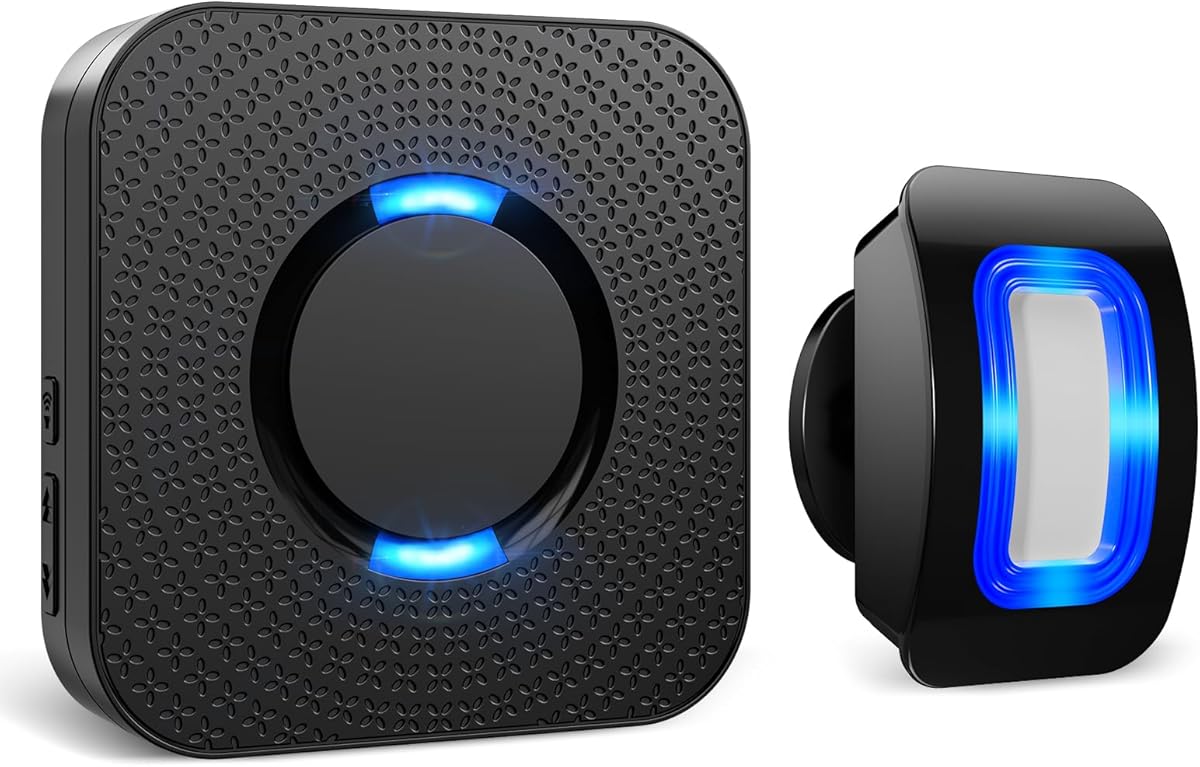
The Wireless Motion Sensor Door Chime: Business Entry Doorbell Indoor Alarm is the most polished option for households and businesses that need a versatile alert network. Its 4.5 rating reflects a strong combination of tone selection, volume control, visual signaling, and expansion support. The package includes a plug-in receiver and one battery-powered motion sensor, while additional sensors and receivers can be added to create a broader system.
We may earn a commission when you buy through this link, at no additional cost to you.
The receiver offers 32 distinct ringtones, including conventional doorbell sounds, longer melodies, and alarm-style tones. Five volume settings cover situations from a quiet office notification to a maximum 110dB alert, and a silent mode relies on the flashing LED indicator. That visual option is especially useful for hearing-impaired users or for environments where an audible chime would be disruptive.
Detection extends approximately 16–26 feet within a 110-degree area, while the wireless link between sensor and receiver can span up to 500 feet. This separation is valuable when the detector belongs at a front door, garage, shop entrance, mailbox, or driveway but the receiver needs to remain inside an office, retail counter, or home. One receiver can be paired with as many as 20 sensors.
Its limitations are modest. Because the receiver plugs into a standard outlet, it needs access to power and cannot be used where no outlet is convenient. The maximum output is lower than that of the 125dB standalone sirens in this list. Even so, the wide transmission distance, numerous tones, visual alerts, and exceptional expansion capability justify its premium position.
The ability to connect up to 20 sensors makes this receiver suitable for monitoring several entrances or movement zones. It can become the foundation of a small, independent alert network without requiring a hub or smart-home account.
Silent mode turns the receiver's flashing LED into a discreet notification method. This is useful in offices, rooms where silence matters, or households that want an additional visual cue.
We may earn a commission when you buy through this link, at no additional cost to you.
The CPVAN 125dB Motion Sensor Alarm, Wireless Indoor PIR Motion Detector with 328ft Remote, 40ft Detection Range, Battery Operated Siren for Home Garage Van Shed, CP2 Pro White is a strong choice for users who prioritize detection reach. It has a 4.1 rating and can detect movement up to 40 feet, although the manufacturer identifies 10–26 feet as the range that typically produces the best results.
We may earn a commission when you buy through this link, at no additional cost to you.
The unit uses infrared PIR technology to identify human movement and reduce unwanted activations. It offers two modes: a loud alarm for security events and a gentler chime for ordinary notifications. A remote control operates at up to 328 feet in open areas, allowing users to arm, disarm, or change modes without approaching the sensor. This makes the detector especially convenient in vans, garages, storage rooms, and other locations where direct access is inconvenient.
Installation is simple. The alarm can be attached with the included adhesive sticker, secured with screws, or simply placed on a table or shelf. Its wireless, battery-operated design eliminates the need for wiring, a hub, an app, or a Wi-Fi connection. It can also be carried temporarily for trips, making it more versatile than a permanently installed wall alarm.
The important limitation is environmental. It is not waterproof, and the sensor cannot detect through walls, windows, or glass doors. The stated 40-foot maximum should also be understood as a theoretical ceiling rather than a guarantee for every room. Within those boundaries, the combination of long detection reach, loud siren, remote operation, and portable installation makes this a convincing option for larger indoor spaces and temporary security.
The detector's stated range of up to 40 feet is the longest among the products reviewed. For dependable coverage, position it so the target walking path falls within the manufacturer-recommended 10–26-foot performance zone.
Battery power, adhesive mounting, and tabletop placement allow the unit to move with your security needs. It is especially convenient for temporary monitoring of a garage, vehicle, storage space, or rental property.
We may earn a commission when you buy through this link, at no additional cost to you.
The Wireless Motion Sensor LED Light – Motion Detector Alarm Chimes Door Sensor is a flexible chime system with an unusually large tone library. It carries a 4.3 rating and offers 58 ringtones, five adjustable volume levels, a flashing LED indicator, and wireless reception across up to 500 feet. It is best suited to homes, offices, shops, or homes where a personalized entrance sound is more important than a maximum-output siren.
We may earn a commission when you buy through this link, at no additional cost to you.
The infrared detector senses movement at approximately 13–16.5 feet and activates a 110dB alert at the receiver. The included receiver plugs into a standard outlet, while the sensor uses two AAA batteries, which are included. Adhesive mounting and screw options make it possible to place the sensor near a doorway, room entrance, garage, or other frequently traveled area.
One receiver can work with as many as 20 motion sensors, allowing a user to create a network covering multiple points. Each receiver can receive an alarm from the sensors paired with it, and the system includes a flashing visual indicator. Ringtones can be changed through the receiver's controls, providing a simple way to distinguish different spaces or notification types.
The receiver's outlet requirement is an inconvenience in locations without accessible power, and the sensor's detection distance is shorter than several alternatives. However, the wide tone selection, generous transmission range, visual alert, and expansion support compensate for those limitations. This product is particularly attractive for users who want a broad selection of non-threatening sounds for routine entry notifications.
With 58 ringtones and five volume levels, the receiver can be tailored to different rooms and routines. A distinct sound for a front door, rear entrance, or business counter can make it easier to identify where movement occurred.
Because the receiver uses a standard outlet and each can support up to 20 sensors, the system can grow across a home or small workplace without requiring a central hub. Placement should still account for walls and other obstructions.
We may earn a commission when you buy through this link, at no additional cost to you.
The Motion Sensor Alarm, Indoor Motion Detector with Remote Control 11-Language is a practical hybrid for shops, offices, homes, and warehouses. It has a 4.2 rating and offers three operating modes: a friendly welcome chime, a loud anti-theft siren, and a no-repeat mode. The 11-language announcement feature and remote control make it especially approachable for visitors and everyday users.
We may earn a commission when you buy through this link, at no additional cost to you.
PIR infrared sensing is advertised as detecting genuine human movement up to 26 feet while filtering pets and airflow. Although actual results depend on installation height, orientation, and environmental conditions, the sensor is intended to provide dependable coverage around doors, counters, hallways, and stairways. Four volume levels allow the notification to be tailored from a quiet office chime to a prominent storefront alert.
The product supports batteries or 5V USB power, and a low-battery voice reminder helps prevent an unnoticed loss of coverage. Tool-free mounting and remote pairing are designed to produce a quick setup, while the remote allows users to change modes, adjust volume, or arm and disarm the detector from across a room.
It does not offer the same large tone catalog as the 58-ringtone system, and it is not a full smart-home hub. Even so, the combination of three clearly differentiated modes, pet-oriented detection claims, remote operation, and flexible power makes this one of the easiest models to adopt. It is a good compromise when one device needs to handle both customer greetings and security notifications.
The welcome, alarm, and no-repeat modes make the detector easy to adapt across different parts of the day. This flexibility is valuable where customer arrivals and security concerns require different responses.
Tool-free mounting reduces installation effort, while battery and USB options allow the detector to be relocated. The included remote makes routine changes possible without repeatedly approaching the sensor.
We may earn a commission when you buy through this link, at no additional cost to you.
The Wireless Caregiver Pager Motion Sensor Alarm is the most purpose-specific caregiving product in this guide. It carries a 4.5 rating and includes one plug-in receiver and one motion sensor. Rather than focusing solely on intrusion deterrence, it is designed to notify a caregiver when movement is detected near a bed, doorway, room entrance, mailbox, garage, or driveway.
We may earn a commission when you buy through this link, at no additional cost to you.
The sensor detects movement within approximately 16.4 feet across a 110-degree area. It can transmit to receivers up to 260 feet in an open area and through a stated range of 10–40 meters when walls or doors intervene. The optional adjustable mounting bracket gives the caregiver more control over sensor direction, while the receiver provides both a flashing LED and an audible alert.
Sound customization includes 58 ringtones and five volume levels extending up to 110dB. The visual indicator is useful when the receiver is in another room, when someone is listening to music, or when audible alerts may be difficult to notice. Each receiver can be paired with up to 20 transmitters, and each transmitter can communicate with as many as 20 receivers.
The sensor can operate with batteries or a USB cable, which allows temporary placement during travel or flexible monitoring around the home. It is important to recognize that this is a general movement alert rather than a medical device, fall detector, or complete caregiving system. It can support supervision by drawing attention to movement, but it cannot diagnose a fall or replace professional care. With that expectation, it is a well-rounded paging option.
The system focuses on promptly drawing attention to movement near a bed or room exit. That makes it useful for elderly monitoring, dementia-related supervision, or notifying a caregiver when a child leaves a room.
Combining a flashing LED with selectable ringtones ensures that notifications can be noticed under different conditions. The visual alert is particularly useful where hearing may be limited or ambient noise is high.
We may earn a commission when you buy through this link, at no additional cost to you.
The Motion Sensor Alarm, Indoor Home Security System Electric Doorbells stands out because the package includes four motion detectors, two alarm receivers, and four sets of mounting screws. It has a 4.2 rating and is aimed at users who want to monitor multiple locations immediately. The system can serve as an entry chime, garage alarm, intruder warning, child or elderly care notification, or general home warning.
We may earn a commission when you buy through this link, at no additional cost to you.
The receiver-to-sensor transmission distance can reach 300 feet, while the infrared detection distance is approximately 20 feet. Two alert methods are provided: an LED light and a bell. There are 38 ringtones and three volume levels, including a silent mode that leaves only the LED warning active. This makes the system suitable for both audible security alerts and quieter monitoring.
Multiple detectors are especially useful for a home with several entrances, a small retail space, a warehouse, or a property that includes both indoor and sheltered access points. Multiple receivers can also let household members or staff receive alerts in different areas. The supplied screws provide a more permanent attachment, and the multi-sensor arrangement reduces the need to purchase individual detectors separately.
The four sensors require AAA batteries that are not included, so users will need to supply those before setup. Volume control is limited to three levels compared with the five offered by several competing models, and the system is not waterproof. Even so, the unusually generous component count makes this a practical choice for covering several zones from the outset.
Four detectors and two receivers provide broad initial coverage without requiring incremental purchases. This is useful for monitoring several doors, rooms, or work areas at once.
The LED-only setting supports environments where a sudden sound could be disruptive. It still provides a visible cue that movement has been detected at the corresponding receiver.
We may earn a commission when you buy through this link, at no additional cost to you.
The Wireless Motion Sensor Alarm Indoor: Motion Sensor Door Chime for Business offers an impressive combination of features in a straightforward package. It has a 4.3 rating and combines 35 tones, five volume levels, 500-foot signal transmission, adjustable detection angles, and support for up to 20 motion sensors on one receiver. These qualities make it a strong budget-oriented choice for a shop, office, warehouse, corridor, garage, or home.
We may earn a commission when you buy through this link, at no additional cost to you.
The receiver offers 32 regular tones and three alarm ringtones, with volume adjustment from silent through a maximum 110dB output. The sensor detects movement at approximately 13–26 feet and sends the alert across a stated 500-foot wireless range. Users can assign unique or shared tones to sensors installed in different zones, which can make it easier to understand where activity occurred.
Adjustment is a major strength. The sensor has an on/off control and a 360-degree rotatable base, while its effective detection angle can be set from approximately 30 to 110 degrees and its range from 4 to 8 meters. This helps narrow coverage in a smaller room or widen it across a busier commercial space. Adhesive and screw mounting options allow installation on walls, door frames, ceilings, or uneven surfaces.
As with other plug-in receiver systems, access to a standard outlet is necessary. It is also intended primarily for indoor use, so exposed outdoor locations would require additional weather protection. Despite those considerations, the tone variety, precise angle control, generous range, and expandability create a feature-rich package that can serve as an affordable first system or a business-wide alert network.
The adjustable angle and range make it possible to limit unnecessary triggers near a doorway or expand coverage across a corridor. A rotatable base also simplifies initial positioning.
Assigning unique or shared tones to individual sensors helps identify the source of an alert. That distinction is valuable in businesses with several entrances, rooms, or customer-facing zones.
We may earn a commission when you buy through this link, at no additional cost to you.
The Luckydeer 125dB Motion Sensor Alarm is a compact standalone siren designed for homes, sheds, kitchens, bedrooms, boats, garages, shops, and similar spaces. It has a 4.2 rating, uses PIR infrared detection with intelligent signal analysis, and can activate a 125dB siren when human movement is detected. Its remote control extends up to 328 feet in an open area.
We may earn a commission when you buy through this link, at no additional cost to you.
The detector operates in doorbell mode or alarm mode, allowing it to provide either a visitor-style chime or a forceful security warning. Its remote includes an integrated panic or SOS button, so the unit can trigger its own alarm from a distance. The stated PIR detection range is 16–26 feet, and two volume levels offer some adjustment over the alert output.
Setup is designed to be quick. The package includes the alarm, three AA batteries, double-sided tape, screws, an instruction manual, and the remote. Adhesive film allows installation without drilling, which is convenient for temporary protection or a rented space. The included hardware also makes it possible to secure the unit more permanently.
The product is intended for indoor use and is not presented as a waterproof outdoor siren. Two volume levels are fewer than the four or five offered by several alternatives. Nevertheless, the loud output, remote panic function, dual operating modes, and complete mounting package give it a strong identity as a portable standalone security alarm for an entry, storage room, garage, or vehicle.
The included batteries, adhesive, screws, and compact design support both temporary and fixed installation. It is convenient for spaces where wiring or permanent modifications are undesirable.
The remote's integrated panic button allows a user to activate the alarm without approaching the detector. That is useful in a garage, vehicle, shop, or storage area after movement has already been noticed.
We may earn a commission when you buy through this link, at no additional cost to you.
The METAK Wireless Motion Sensor Alarm is a compact receiver-and-sensor system suited to doorways, hallways, garages, mailboxes, pet areas, and business entrances. It has a 4.5 rating and combines a 110-degree PIR detection field with a stated 26-foot detection diameter. The receiver can communicate with the sensor from up to 500 feet, providing substantial flexibility between the detection point and the place where alerts are heard.
We may earn a commission when you buy through this link, at no additional cost to you.
The plug-in receiver offers 32 selectable ringtones and five volume levels extending from silent to 110dB. This lets users choose a subtle office chime or a much more prominent alert. The product can function as a doorbell for visitors as well as a motion sensor alarm for security, while its compact form allows discreet placement near a doorway or in a garage.
Expansion is another major advantage. One receiver supports up to 20 motion sensors, making it possible to build a multi-point system for a home or business. The sensor is powered by AAA batteries for flexible placement and also supports Micro USB for continuous operation, reducing the need for frequent battery changes in a fixed location.
Unlike the TECKNET and CPVAN options, the METAK package does not include a handheld remote, so users will configure and interact with the receiver directly. The outlet-powered receiver also needs a suitable electrical location. Despite those trade-offs, its high rating, broad wireless range, flexible power options, and expandability make it a well-balanced selection for entry alerts and small indoor monitoring networks.
The 500-foot transmission distance allows the sensor to sit at an entrance or garage while the receiver remains in a convenient occupied area. Obstacles can still affect real-world performance, so testing is important.
AAA batteries make temporary placement straightforward, while Micro USB supports a fixed installation. Choose the power method that best suits the location and how often you want to service the sensor.
We may earn a commission when you buy through this link, at no additional cost to you.
The right indoor motion sensor alarm depends on what you need to hear, where the detector will sit, how many areas you want to monitor, and whether a loud deterrent is more important than a pleasant entry notification.
A full siren is best when the immediate goal is to startle an intruder and create a noticeable alert throughout the area. Standalone products with 125dB outputs and flashing strobes are especially forceful, but their sound may be too intense for a bedroom, office, or small shop during ordinary use. A chime or doorbell tone is quieter and more suitable for visitors, elderly residents, children, or routine customer entry notifications. Look for adjustable volume and silent visual modes when the alarm must serve both security and everyday monitoring.
Choose a siren for deterrence, or a chime for routine awareness.
Detection range is only useful if the sensor is mounted correctly. Many products specify a broad maximum distance, while the most dependable performance occurs closer to the unit. Pay attention to the angle as well: a narrow beam can protect one corridor, whereas a wider 110-degree or 120-degree field can cover an open room or entryway. PIR sensors generally cannot detect movement through walls, windows, or glass, and airflow, moving objects, pets, and unstable mounting positions can affect the results.
Match the sensor's angle and practical range to the space.
Wireless range determines how far the detector can be from the receiver or remote. A 500-foot specification offers room to place a sensor at a driveway, garage, warehouse entrance, or separate building, but the useful distance is usually shorter when walls, doors, floors, or furniture sit between the two devices. Open-area figures are best treated as maximum conditions. If your receiver and sensor must be in different rooms or parts of a property, test the signal in the intended arrangement before committing to a multi-point installation.
Prioritize real placement tests over maximum range claims.
A single detector is often sufficient for one hallway or entrance, while a receiver that supports multiple transmitters is more useful for a home, office, shop, or caregiving setup. Some packages include several sensors and receivers, while others begin with only one of each and rely on expansion. Confirm how many sensors can pair with each receiver, how many receivers can respond to a transmitter, and whether different tones can identify specific zones. Expansion is especially helpful when you want to distinguish a front entrance from a garage or back door.
Check receiver capacity before building a multi-zone system.
Battery operation makes placement flexible and supports temporary use, while USB power suits fixed installations where changing batteries would be inconvenient. A product that supports both can offer the best balance, provided the USB connection is for continuous operation rather than battery charging. Low-battery warnings are another valuable feature because an unresponsive sensor can create a false sense of security. For vehicles, temporary rentals, or remote storage areas, verify that the required battery type is readily available and consider testing the unit regularly.
Match the power source to the installation and test interval.
Adhesive mounting is quick and renter-friendly, while screws provide a more secure fixed installation. Some products also support tabletop placement, which is convenient for temporary monitoring or vehicle interiors. Rotatable bases and adjustable brackets help refine the detection zone after installation. The mounting surface and angle can influence performance, so avoid placing the detector where moving air, direct heat, or nearby objects are likely to trigger it. Follow the supplied instructions and avoid obstructed or exposed outdoor positions unless the product is clearly designed for them.
Install the unit securely and aim it at the intended path.
Tone selection determines how noticeable and disruptive an alert will be. Products offering more than 30 ringtones provide room to assign different sounds to separate entrances, while dual alarm and chime modes add another layer of flexibility. Five volume levels are useful for adapting one system to a quiet home, office, or active retail environment. A flashing LED is also valuable for hearing-impaired users or places where visual cues can be noticed more easily than sound.
Look for enough customization to separate security from routine alerts.
Business-entry systems emphasize welcoming chimes, customer alerts, and zoned receivers. Caregiver pagers focus on movement near beds, room exits, and supervised areas, but they are not substitutes for medical alert devices or professional care. Standalone sirens are best for deters and immediate notification in garages, storage rooms, vans, and isolated indoor areas. Ensure the chosen model matches the environment, whether that means a commercial workspace, a family home, a temporary location, or a caregiving space.
Choose the alarm type designed for your specific environment.
Begin by identifying the exact area you want to monitor and the direction from which people will enter. Mount the sensor at the recommended height, aim it across the intended walking path, and keep the view free of large obstructions. Before fixing it permanently, temporarily position the unit and walk through the space to confirm that movement is detected when expected. Test the receiver or remote from the intended listening point as well, especially if walls or multiple floors separate the devices.
Pair the sensor and receiver according to the supplied instructions, select the appropriate alarm or chime mode, and set a comfortable volume level. Install fresh batteries, or connect the provided USB or Micro USB power option when the detector is in a fixed location. Allow the system to run briefly so you can verify every alert, LED indicator, and remote function. If the unit produces an unexpected trigger, adjust the angle, remove nearby obstructions, or reduce the sensitivity area where possible.
For ongoing care, check batteries on a regular schedule and clean the sensor window gently so dust or buildup does not interfere with detection. Test the system periodically by triggering the sensor from its intended coverage area. Recalibrate the position if furniture, doors, shelving, or renovations change. Keep any non-weather-resistant unit indoors and away from moisture, direct sunlight, and strong airflow. A brief written record of tones, pairing steps, and mounting positions can make troubleshooting much easier.
Generally, no. These products use passive infrared sensing, which detects changes in infrared energy within its field of view rather than sending signals through solid barriers. Walls, glass, closed doors, and certain furniture can reduce or block detection. The wireless signal between a sensor and receiver may still pass through some obstructions, but its reliable range is often lower than the stated open-area maximum.
Alarm mode produces a forceful security alert intended to warn or deter, while doorbell mode provides a gentler notification for ordinary visitors or movement. Several products also include a no-repeat mode that suppresses repeated alerts until movement stops. The best choice is one that lets you use the same detector for both security and routine awareness without relying on separate devices.
It depends on the model. Six products in this guide advertise support for as many as 20 sensors on one receiver, while others are primarily intended as standalone systems. Caregiver products also describe reciprocal pairing, with each transmitter potentially linked to multiple receivers. Check the specific listing because expandability varies, and confirm that the system includes enough sensors and receivers for your immediate plan.
Most of the reviewed products are designed for indoor use, and several explicitly state that they are not waterproof. A covered porch or sheltered entry may be suitable if the unit is protected from rain, but exposed outdoor locations require a product specifically rated for outdoor use. Even an indoor sensor should be installed according to its instructions and kept away from moisture and direct weather.
Yes, a caregiver-style movement alert can notify a caregiver when someone approaches a bed, room exit, doorway, or other monitored area. The Wireless Caregiver Pager is specifically oriented toward this use and provides audible and visual alerts. However, these products are general motion monitors, not medical devices, and they should not replace fall alarms, professional monitoring, or other appropriate caregiving safeguards.
Airflow from vents, fans, open doors, moving objects, pets, unstable mounting, or an incorrectly aimed detection zone can cause unwanted triggers. Test the sensor in its intended position, adjust its angle, remove obstructions, and move it away from direct airflow. If alerts remain inconsistent, check the manual for product-specific guidance and verify that the mounting surface is secure.
No. Every product reviewed operates as a standalone wireless system without a Wi-Fi connection, app, or hub. Standalone alarms control their modes locally or through a remote, while receiver-based products pair directly with sensors. This makes them straightforward to add to a home, shop, garage, or caregiving arrangement without relying on a broader connected ecosystem.
Choose a loud siren for a garage, isolated storage room, vehicle, or other area where an immediate deterrent is the priority. Choose a chime for an office, retail entrance, bedroom, or caregiving location where frequent movement makes a full alarm irritating. A hybrid model with selectable modes, volume levels, and a silent visual indicator can handle both environments more easily.
The TECKNET 125dB Indoor Motion Sensor Alarm is the strongest all-around selection because it combines a loud siren, strobe, three volume levels, two modes, a long-range remote, and flexible battery or USB-C power. The Wireless Motion Sensor Door Chime takes the premium position with 32 ringtones, visual alerts, a 500-foot transmission range, and support for up to 20 sensors, while the Wireless Motion Sensor Alarm for Business offers the best budget mix of tones, range, adjustable angles, and expansion.
Your priorities should guide the remaining decisions. Select a 125dB standalone model for deterrence, a receiver system for separate sensor and alert locations, a caregiver pager for supervised movement, and a multi-sensor kit when several rooms need immediate coverage. Always examine detection angle, real placement, power requirements, and tone controls before buying, because a long advertised range does not guarantee strong performance through walls or around obstructions.
Finally, confirm the current listing, package contents, specifications, availability, and support terms before ordering. Features and configurations can change over time, and checking the latest product page helps ensure that the model you select still matches the coverage, mounting, and alert requirements you need.