
Nitecore NU20 Classic
4.8Editor score
Only 1.34 ounces
Up to 360 lumens
Ninety-seven-hour low mode
IP66 waterproof rating
This Lightweight Mini Headlamp guide compares 10 compact models for brightness, comfort, runtime, charging, durability, and versatility.
A lightweight mini headlamp is most useful when it disappears on your head yet remains dependable when the lights go out. The best models balance low weight, comfortable fit, focused beam control, useful light modes, and weather resistance. They suit everything from bedside checks and power outages to night runs, camping, fishing, repair work, and navigating trails after dark.
This guide compares ten compact headlamps using the specifications and features supplied for each product. The evaluation covers output, beam reach, supported lighting modes, battery or charging design, weight, mounting flexibility, and environmental resistance. It also distinguishes lightweight cap clips from traditional headbands, giving extra emphasis to options that can serve as handheld lights or work lights.
Each pick below reveals what makes a particular model most suitable, from the extremely light Nitecore designs to the feature-rich OLIGHT Perun series and the long-storage Petzl emergency lamp. Ratings provide another useful comparison, but they should not be considered in isolation. Product availability, features, and prices can change, so confirm the current listing and specifications before purchasing.
4.8Editor score
4.7Editor score

4.7Editor score
The table below compares all ten headlamps by output, weight, lighting flexibility, and practical features. It is designed to make the differences clear at a glance, whether your priority is minimal weight, emergency readiness, long runtime, or flexible mounting.


The OLIGHT Perun 3 Mini combines a compact format with an unusually high maximum output of 1,250 lumens, making it the most powerful model in this roundup. It carries a 4.6 rating and stands out for its long 155-meter beam distance, extensive mode selection, and flexible mounting system. It is especially compelling for users who want one capable light rather than several narrowly specialized lights.
We may earn a commission when you buy through this link, at no additional cost to you.
Its lighting options are among the most versatile here. Five white modes cover activities ranging from close-range work to long-distance illumination, while three red modes add discretion, night-vision support, and emergency signaling. The rechargeable design can run for as long as ten days in Moonlight mode, which is useful for households that want emergency illumination without frequent charging.
The upgraded headband deserves attention because comfort determines whether a headlamp is genuinely practical. Breathable holes, an anti-sweat strip, and reflective material improve the wearing experience and visibility. Meanwhile, the quick-detach bracket permits transitions between head-worn and handheld use. A stainless-steel pocket clip, lanyard hole, and magnetic tail extend the carrying options further, allowing the light to work as a pocket light or hands-free work lamp.
The trade-off is that the Perun 3 Mini is not as aggressively compact or light as the dedicated ultra-mini models in this list. Its substantial output and accessory-oriented design also mean more complexity than a simple cap clip. Even so, that complexity is well rewarded for campers, tradespeople, runners, and homeowners who want strong output, long emergency endurance, and several carrying methods in one package. It is our premium choice for maximum capability.
Its metal control button and laser-micro-perforated tri-color power indicator help distinguish it from simpler models. The button should feel more durable during repeated field use, while the indicator gives useful charging information without activating the main light. Those details make the model feel thoughtfully designed rather than simply adapted from a larger headlamp.
The 1,250-lumen maximum and 155-meter beam distance set this headlamp apart from models intended mainly for nearby tasks. That power remains useful for campsite setup, trail navigation, roadside work, and searching a dark yard without sacrificing the convenience of a compact housing.
The quick-detach bracket, pocket clip, lanyard hole, and magnetic tail let you wear, carry, or attach the light according to the task. This is a major advantage over cap lights that can only perform one function.
We may earn a commission when you buy through this link, at no additional cost to you.
The OLIGHT Perun 2 Mini is a high-output compact headlamp with a 4.5 rating and a maximum output of 1,100 lumens. It is designed for people who need a capable light for work, outdoor activity, and home emergencies, yet still want the convenience of a mini housing. Its battery update increases capacity by 18% over the earlier Perun Mini, according to the supplied information.
We may earn a commission when you buy through this link, at no additional cost to you.
One of the most useful features is the red LED, which can help preserve night vision or serve as a warning signal. A detailed tri-color power display makes the remaining charge easy to understand: green indicates more than 60%, orange covers the middle range, red signals low power, and flashing red marks the lowest state. This takes the guesswork out of deciding when the light needs charging.
The second-generation headband uses less skin-to-head contact, improving comfort and reducing the feeling of a thick ring around the head. It can also be removed so the unit can operate as a handheld flashlight. A pocket clip permits attachment to a belt or backpack, while the magnetic base works on iron surfaces, creating a useful directional work light without requiring the headband.
Compared with the Perun 3 Mini, this model offers slightly less peak output and does not list the same five white and three red mode combinations. However, it remains an impressively capable all-purpose option. It is particularly good for mechanics, installers, campers, and anyone who wants one device to cover head-worn lighting, close work, and portable illumination. Its versatility and clear charge feedback make it an editor-friendly choice.
The magnetic work-light function deserves special attention for anyone who regularly works under vehicles, inside cabinets, or around machinery. Being able to place the light securely and aim it without holding it can make a difficult task considerably easier. Combined with the pocket clip, that flexibility makes the Perun 2 Mini more useful than a conventional headlamp restricted to a single mounting method.
The three-color indicator gives a much clearer picture of charge state than a single indicator light. It is particularly valuable for expedition users and households relying on the lamp as part of an emergency kit.
Removing the headband reveals a handheld flashlight, while the magnetic attachment turns the unit into a stable work light. Those options make the compact housing more adaptable than a basic elastic-band model.
We may earn a commission when you buy through this link, at no additional cost to you.
The Cyclops Micro 10 is the smallest and simplest option in the roundup, but its understated design serves a clear purpose. It weighs less than an ounce and clips onto a cap brim, providing 10 lumens from five white LEDs. Its 4.3 rating reflects a product that does not compete on brightness and instead focuses on minimal weight and unobtrusive hands-free illumination.
We may earn a commission when you buy through this link, at no additional cost to you.
The contoured top-mount design is especially useful because it stays out of the wearer's line of sight. A 15-degree tilt lets you direct the light without moving your head, making it handy for reading a trail map, checking tackle, tending to a small repair, or performing close work around camp. The sturdy clip also allows attachment to pockets, though a compatible cap is clearly the primary use case.
The Micro 10 uses two included CR-2016 coin-cell batteries and offers 118 minutes of burn time. That is enough for short camping or hiking trips, quick household tasks, and emergency checks, but it is not the practical choice for long nights outdoors or extended power outages. There is also no rechargeable battery, USB charging, or red-light mode in the listed specifications.
Its limited output can be viewed in two ways. It lacks the reach and flood power needed for navigating trails, searching larger spaces, or working on machinery. Conversely, the gentle 10-lumen output is appropriate for close tasks where a brighter beam would be unnecessary or disruptive. Choose the Cyclops Micro 10 when portability, simplicity, and cap compatibility matter more than reach or extended endurance.
The top-mount arrangement and low weight also make this an easy light to carry in a pocket when no cap is available. It can be clipped to other suitable edges, though stability varies by the material and shape of the attachment point. For users new to headlamps, it is a low-complexity way to add hands-free light without managing a rechargeable battery or learning a multi-button interface.
The contoured bracket grips a cap brim and keeps the LEDs above the brim rather than in front of the eyes. This makes the Micro 10 a natural choice for anglers, walkers, and anyone who already prefers wearing a cap.
At less than an ounce, the light is exceptionally easy to carry. Its 10-lumen output and 118-minute runtime are best treated as short-term convenience lighting rather than all-purpose outdoor illumination.
We may earn a commission when you buy through this link, at no additional cost to you.
The NEBO Mycro 250 is a compact, rechargeable headlamp offered in a two-pack, giving it unusual flexibility for shared, vehicle, or household use. Each light delivers up to 250 lumens and carries a 4.6 rating. The combination of USB-C charging, adjustable mounting, and a pocket-sized profile makes it an attractive everyday carry option for campers, runners, tradespeople, and families.
We may earn a commission when you buy through this link, at no additional cost to you.
The three primary brightness levels are 250, 50, and 15 lumens. Smart Power Control facilitates smooth transitions and is intended to optimize battery use, while the lowest setting provides a practical amount of light for close tasks. Unlike some competitors, the Mycro 250 does not advertise red-light illumination in the supplied specifications, so preserving night vision is not one of its stated strengths.
A major convenience is the ability to convert the unit from a headlamp into a clip-on cap light. Its 135-degree tilt provides precise directional control without requiring the wearer to move their head continuously. The adjustable head strap also offers a secure fit, and the supplied information describes the design as comfortable enough for all-day wear.
Each unit has a built-in rechargeable battery and USB-C charging, with up to five hours of runtime on low. This is a sound design for anyone who prefers not to carry loose coin cells. The main uncertainties are that no formal waterproof or impact rating is listed, and 250 lumens will not provide the long-range reach of the OLIGHT or Fenix models. The two-pack format is the feature that sets it apart, allowing one light to remain in a vehicle or emergency kit while the other is used daily.
For travelers, the two units can serve as backup companions without requiring a second charging setup. For households, separate lights can be placed in different rooms, reducing the chance that everyone is left without a light during an outage. Those use cases give the Mycro 250 broader practical value than a single-headlamp package.
The two-pack is more than a quantity upgrade. It lets you keep a spare in a backpack, vehicle, or emergency kit and rotate the light as needed without creating another charging or battery system.
The 135-degree tilt makes it easy to aim the beam toward the work area while wearing the light on the head or a cap. This directional control is useful for detailed tasks and avoids the need to keep looking down.
We may earn a commission when you buy through this link, at no additional cost to you.
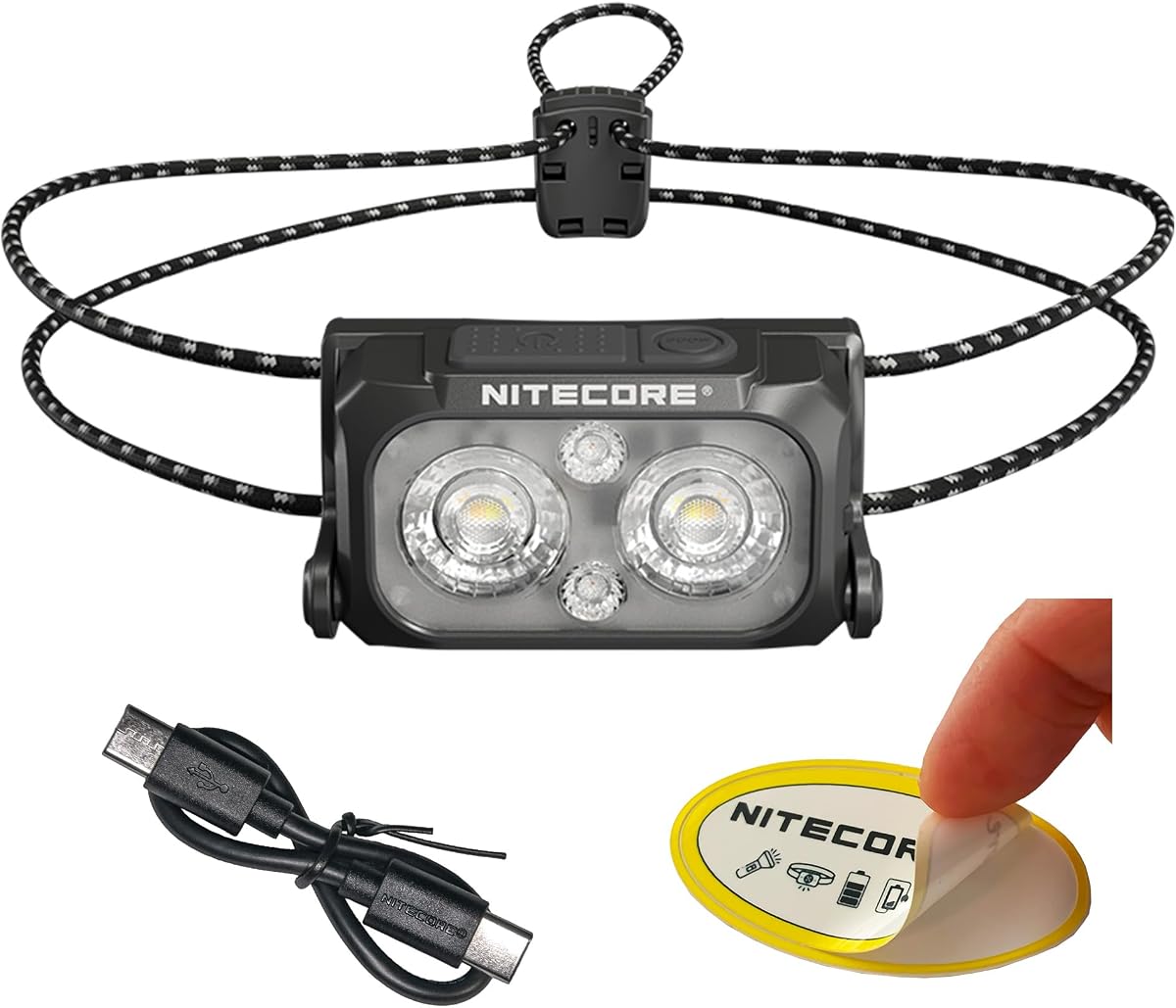
The Nitecore NU20 Classic is the standout lightweight pick in this guide, combining a 1.34-ounce weight with up to 360 lumens. It has the highest rating among the products reviewed, at 4.8, and delivers a rare balance of low weight, long low-mode runtime, useful color options, and rugged construction. For all-day wear, the excellent weight-to-output ratio is difficult to ignore.
We may earn a commission when you buy through this link, at no additional cost to you.
The main white LED offers three brightness levels, complemented by SOS and beacon functions, a soft reading light, and an auxiliary red light. The reading mode is a thoughtful addition for close indoor tasks, while red light can be used to preserve night vision. The light reaches 119 yards, giving it more outdoor range than many similarly compact alternatives.
Battery endurance is another major strength. It can run for as long as 97 hours on low, and recharges in just over an hour through USB-C. A battery indicator helps prevent an unexpected shutdown, an important feature for hikers and travelers who may not always have access to a charger. Its PC construction, IP66 waterproof rating, and one-meter impact resistance also support use in rain, dust, and rough conditions.
The main limitation is that the NU20 Classic does not list a removable cap clip, so it is less flexible than the Cyclops Micro 10, NEBO Mycro 250, or EverBrite in that specific respect. It also delivers less maximum output than the OLIGHT Perun models and Fenix HM50R. Nevertheless, most users do not need 700 or 1,000 lumens for routine tasks, and 360 lumens is more than sufficient for trails, campsites, household projects, and emergency visibility.
This is our best budget recommendation for good reasons: it is not merely the least expensive-looking alternative, but a compact headlamp with premium-minded features. It should appeal to hikers, night runners, backpackers, and anyone who is sensitive to the weight of gear worn around the forehead.
Delivering 360 lumens at only 1.34 ounces is a compelling combination for long-wearing activities. The low mass reduces fatigue and makes the lamp easier to carry as a routine everyday item.
The 97-hour low-mode runtime, quick USB-C charging, battery indicator, IP66 rating, and impact resistance form a practical package for travel and mild outdoor exposure. It is better suited to regular adventures than occasional emergency-only use.
We may earn a commission when you buy through this link, at no additional cost to you.
The EverBrite 400LM combines a 1.59-ounce listed weight with a 400-lumen turbo mode and an unusually broad set of lighting choices. Its 4.3 rating does not lead the group, but the underlying feature set makes this a compelling option for users who want color modes, mode memory, a cap clip, and serious weather resistance in a compact format.
We may earn a commission when you buy through this link, at no additional cost to you.
Seven modes are listed: White Low at 60 lumens, White High at 250 lumens, ECO at 5 lumens, Red, Red Flashing, Green, and Turbo. Holding the button for two seconds in any mode activates Turbo, which can reach 400 lumens and project as far as 130 meters. The mode memory recalls the last setting, saving users from navigating the interface repeatedly.
Its IP67 rating is among the strongest in the roundup, allowing resistance to heavy rain and submersion up to one meter for 30 minutes. The ABS housing is paired with a 120-degree ratchet adjustment that is intended to hold its position. A hat clip can also attach the unit to caps, backpacks, or belts, increasing its usefulness beyond conventional head-worn placement.
One important limitation is the built-in, non-removable 300mAh lithium-ion battery. The product information explicitly states that no standalone battery is sold and that the LN 602030 cell is integrated. This simplifies charging and reduces loose parts, but it also means the battery cannot be swapped when it ages or depletes. In EDC mode, the listed runtime is 22 hours, which is useful but short compared with the Nitecore models.
The EverBrite is best for users who value mode selection and attachment flexibility more than ultra-long endurance. Its low-light output is especially friendly for close indoor tasks, and red and green modes cover signaling, map reading, and visibility needs. For camping, hiking, work, and emergencies, it offers an unusually complete set of functions without moving into the larger and heavier high-output category.
White, red, green, strobe, eco, and turbo options cover close work, preserving night vision, signaling, and maximum visibility. The memory function helps you return directly to the setting you used most recently.
The IP67 rating makes this one of the strongest choices for rain, dusty jobsites, fishing, and camping. Its sealed design and broad ratchet adjustment support dependable use in demanding conditions.
We may earn a commission when you buy through this link, at no additional cost to you.
The Nitecore NU25 MCT UL is a refined 1.65-ounce headlamp with up to 400 lumens, a 4.7 rating, and a particularly thoughtful lighting system. Its main advantage over simpler ultra-lights is selectable color temperature. Warm, natural, and cool white outputs let the user adapt the light to fog, rain, indoor work, reading, and outdoor contrast, while auxiliary red light supports discreet nighttime use.
We may earn a commission when you buy through this link, at no additional cost to you.
The light reaches 144 yards and offers four main outputs, plus SOS, beacon, and three auxiliary red-light outputs. Warm light is easier on the eyes and can penetrate misty conditions, natural white supports everyday tasks, and cool white improves outdoor contrast. This makes the NU25 useful across a wider range of environments than a headlamp with a single fixed white tint.
Despite its small size, the battery specification is practical for regular use. It runs for up to 45 hours, recharges in just over an hour using USB-C, and includes a power status indicator. The supplied package contains the headlamp, a USB-C-to-USB-C charging cable, bracket, headband, diffusing stuff sack, and Nitecore sticker. The diffusing sack can help soften the beam or add a gentle glow.
Construction is based on durable PC material with an IP66 waterproof rating and impact resistance up to one meter. It therefore handles rain, dust, and routine outdoor knocks better than an unrated miniature light. The listed maximum runtime is shorter than the NU20 Classic's 97 hours, and there is no explicit cap clip, but the 400-lumen output, 144-yard reach, and selectable color temperatures compensate with greater flexibility.
This is our editor's choice for the best all-around lightweight headlamp because it avoids forcing a single-purpose choice. It is light enough for running and backpacking, bright enough for trails and campsites, and flexible enough for close household tasks. It is particularly suitable for users who appreciate warm light at night, quick recharging, and a compact tool with more than one way to illuminate.
Warm, natural, and cool white settings let you choose the most comfortable and effective output for changing conditions. The distinction is subtle in casual use but meaningful when reading, hiking in mist, or working with fine detail.
At 1.65 ounces with USB-C charging, 45-hour maximum runtime, IP66 protection, and one-meter impact resistance, the NU25 is well suited to backpacking, trail running, camping, and regular travel.
We may earn a commission when you buy through this link, at no additional cost to you.
The Fenix HM50R v2.0 is a premium compact headlamp for users who want a balance of strong output, long reach, and rugged construction. It produces up to 700 lumens, reaches 377 feet, and carries a 4.7 rating. At less than three ounces, it is not as light as the dedicated sub-two-ounce models, but it remains compact enough for hiking, camping, jogging, and running.
We may earn a commission when you buy through this link, at no additional cost to you.
Its 90-degree bracket is one of the most useful physical features. Sliding the light out converts it into a handheld flashlight, while the bracket can attach to a pocket, backpack, or belt. That design makes the HM50R more versatile than a headlamp with a permanently integrated strap, particularly for users who alternate between wearing and carrying the light.
The white-light output handles general illumination, while the red mode can preserve night vision and the flashing red mode can serve as an alert. USB-C charging is built into the housing, and the lowest setting runs for up to 42 hours. A maximum output of 700 lumens provides noticeably greater reach than most mini headlamps, making it useful for trails, large campsites, outdoor work, and emergency searches.
The IP68 rating is a major selling point because it indicates strong water protection. Together with durable materials, this makes the HM50R appropriate for harsh weather and regular outdoor use. It includes a USB Type-C charging cable and LumenTac organizer, though the listed package does not mention a conventional storage pouch or multiple color temperatures.
Compared with the Nitecore NU25, the Fenix offers more output and reach but weighs more and has less color flexibility. Compared with the OLIGHT Perun models, it delivers less peak brightness but a compact removable-bracket design and stronger IP68 protection. It is our best premium recommendation for users who want dependable construction and extended beam reach without moving to a full-size headlamp.
The 700-lumen maximum and 377-foot beam distance are useful when you need to identify trail markers, inspect a large area, or illuminate a campsite. Close work remains well within its capabilities through lower outputs.
The IP68 rating offers strong water resistance for rain, wet trails, and demanding outdoor conditions. Combined with the detachable bracket and compact weight, it suits users who want one durable tool for several environments.
We may earn a commission when you buy through this link, at no additional cost to you.
The Petzl e+LITE is a specialized emergency headlamp rather than a general-purpose performance light. Its 30 lumens, 4.6 rating, and ultra-compact design are supported by one standout feature: the supplied information says it can be stored with its batteries for up to ten years. That long-storage positioning makes it especially appropriate for emergency kits, vehicles, boats, and homes.
We may earn a commission when you buy through this link, at no additional cost to you.
White light assists safe movement in darkness, while the red strobe helps a user remain visible in an emergency. A locking on-off switch is a genuinely important safety feature because it reduces the chance of the light being activated accidentally inside a bag. Its simplicity also means there is little to learn when a stressful event occurs and immediate operation is needed.
Environmental tolerance is another strength. The e+LITE resists temperatures from -22 to 140 degrees Fahrenheit and can be submerged under three feet of water for 30 minutes. Those specifications make it credible for emergency use in a vehicle, a winter kit, or a coastal environment where temperature and moisture may be significant concerns.
The limitation is obvious: 30 lumens is designed for close-range visibility, not trail navigation or wide-area search. It has no rechargeable battery system and no listed color-temperature controls. The long-storage claim and locking switch compensate for that low output, but buyers should understand that this is a backup light rather than the main light for hiking, running, or large outdoor projects.
Choose the Petzl e+LITE when readiness matters more than brightness. Store it where it can be reached quickly, check the batteries according to the manufacturer's guidance, and treat it as a dependable backup rather than a replacement for a high-output headlamp. In that role, it is remarkably well suited to the task.
A claimed ten-year storage life changes how you think about emergency preparedness. Instead of frequently replacing a rechargeable light that may have lost capacity, the e+LITE can remain stored with batteries for long periods.
The locking switch is a simple but important safeguard in a pocket, pack, or emergency drawer. It reduces the chance of drainage or unwanted illumination while the light is being carried or stored.
We may earn a commission when you buy through this link, at no additional cost to you.
The Lepro LED Headlamp is a straightforward rechargeable option with a 4.5 rating and a useful combination of 300-lumen output, five lighting modes, and up to 30 hours of continuous lighting. It is less specialized than the Nitecore, Fenix, and OLIGHT models, but it offers the core functions many households and casual outdoor users want in an easy-to-understand headlamp.
We may earn a commission when you buy through this link, at no additional cost to you.
The mode selection consists of three white-light settings: High, Low, and Strobe, along with red light in steady and flashing forms. The listed illumination reaches up to 500 feet, although that figure should be understood as the stated maximum range rather than a guarantee of usable clarity across the entire distance. Red modes are helpful for preserving night vision or signaling without disrupting nearby people.
The built-in battery supports up to 30 hours of continuous lighting, and the included USB-C charging cable works with a 5V DC adapter. No adapter is included, which is worth noting if you do not already have a suitable wall plug or compatible charging setup. The light is also compatible with USB ports, giving it flexibility around the home, office, or vehicle.
At 2.86 ounces, the Lepro is heavier than most models promoted as ultralight. It may still be comfortable for short-to-medium outings, but it is less compelling for all-day running or long-distance backpacking. The sweat-resistant elastic headband and 45-degree adjustment help with fit and beam placement, while IPX4 protection handles rain and splashing water rather than full submersion.
This model works best as an affordable backup for the home, car, campsite, or occasional household task. It offers more flexibility than the smallest cap lights without reaching the weight or ruggedness of premium trail models. Users who need advanced color temperatures, exceptional runtime, or formal high-level water protection should look elsewhere, but the core output and mode selection remain easy to appreciate.
High, Low, Strobe, steady red, and flashing red cover general lighting, close work, signaling, and night-vision-friendly use. The controls are straightforward enough for occasional users and emergency preparation.
The IPX4 rating is intended for splashing water and heavy rain, making the light suitable for many outdoor activities. It is not the strongest choice for wet immersion compared with the IP66 and IP68 models in the roundup.
We may earn a commission when you buy through this link, at no additional cost to you.
The right lightweight mini headlamp depends on how and where you will use it. Weight, output, runtime, mounting, charging, color, and weather resistance should be considered together rather than as isolated specifications.
Weight is the defining feature of a mini headlamp, but the listed figure should be considered alongside the complete wearing system. The lightest products in this guide range from under an ounce to 1.65 ounces, while some feature-rich models reach 2.86 ounces. A low figure matters most during running, backpacking, extended work shifts, or any situation where the lamp remains on your head for hours. Elastic straps and contoured mounts can also influence comfort by reducing pressure points and keeping the housing above the wearer's line of sight.
Choose the lightest model that still meets your brightness and runtime needs rather than prioritizing the smallest number alone.
Output should match the size of the area you need to illuminate. Brightness near 10 to 30 lumens is generally suited to close tasks and emergency visibility, while models delivering 250 to 400 lumens are more useful for trails, campsites, and household projects. High-output models reaching 700 lumens or more provide greater reach but may be unnecessary if you mostly work inches from a surface. Beam distance also matters because a concentrated light can reveal distant markers or obstacles more effectively than a broad low-output glow.
Match maximum output to realistic use, then confirm that lower settings are available for close work and battery conservation.
Runtime varies dramatically by mode, and the most impressive figures generally refer to the lowest output rather than maximum brightness. The Nitecore models lead in extended low-mode endurance, while the Petzl e+LITE is designed around long-term battery storage. Rechargeable lights are convenient for regular use because they reduce loose batteries, but they are less convenient when the battery is not removable or when no charging source is available. Coin-cell lights can be useful for occasional backups, provided replacement batteries are carried.
Consider both realistic runtime and charging access, especially if the headlamp is part of an emergency kit or expected to work during an outage.
A conventional headband provides stable hands-free use, but a removable bracket can make a light more versatile. Some models detach for handheld use or magnetic attachment to iron surfaces, while cap clips let you position the beam directly above your eyes. Pocket clips, backpack attachments, lanyard holes, and magnetic tails are also useful when wearing the lamp on the head is inconvenient. The best choice depends on whether you value stable hands-free lighting or the ability to deploy the light quickly in several positions.
Look for a mount that matches your typical activities, and check that the bracket or clip holds securely under movement.
White-only models cover basic needs, but red light can help preserve night vision and provide discreet signaling. Green and flashing modes add further signaling options, while adjustable white color temperatures can make close work more comfortable and improve outdoor contrast. Strobe, SOS, beacon, reading, and eco modes are useful for specific tasks rather than everyday use. More modes provide flexibility, although they can make the controls less intuitive, so the mode-memory function offered by some models is worth considering.
Prioritize the modes you will genuinely use, and favor easy mode recall over a long list of rarely needed settings.
A headlamp is often exposed to rain, dust, mud, and accidental knocks. IPX4 indicates protection against splashing water, IP66 adds dust protection and stronger water-jet resistance, and IP67 allows temporary submersion under specified conditions. IP68 provides the highest listed protection in this group. Impact resistance is also relevant for camping, trades, and hiking, where a lamp may be dropped or struck against branches. Reviewing both ratings gives a more realistic picture than relying on general claims such as weather resistant.
Choose a formal rating appropriate to the environment, with IP67 or IP68 preferable for wet camping, coastal trips, and demanding work.
Controls should be easy to operate without looking, especially while wearing gloves or working with both hands occupied. Large or raised buttons are generally easier to identify, while a lockout reduces accidental activation during storage. Battery indicators can be simple, but a multi-color display is more informative. A light that appears to work normally is not necessarily ready for an emergency, so a visible charge state helps you decide when to recharge or replace its batteries.
Prioritize simple operation, a secure lockout when available, and an indicator that communicates battery status without guesswork.
Before first use, install the batteries or fully charge the built-in battery and confirm that the light turns on. Review the button sequence, including any long-press functions for turbo, red light, or mode changes. Adjust the headband or cap clip so the light sits securely without slipping, and test the tilt mechanism by moving your head and leaning forward. If the product has a locking switch, learn how it operates before storing the light in a bag.
Use the lowest suitable output for close work and indoor tasks, reserving higher modes for trails, campsites, search areas, and large outdoor spaces. Red light is helpful when you need to preserve night vision, while steady white light offers better color recognition and detail. Strobe, SOS, and beacon modes should be reserved for signaling or emergency situations because they can consume power rapidly and temporarily affect nearby vision. A magnetic-mounted light should be positioned on a stable iron surface and checked carefully before relying on it hands-free.
Clean the lens and housing with a soft, slightly damp cloth, avoiding harsh chemicals and abrasive materials. Let the light dry fully before charging or storing it. Rechargeable models should be topped up periodically according to the manufacturer's instructions, while coin-cell models should have their batteries checked before important trips. Replace damaged straps, clips, cables, or lanyards promptly, and keep charging ports free of dirt. After wet use, wipe the housing down and allow excess moisture to evaporate before sealing the light in a storage case.
For reading, campsite organization, and close repairs, lower outputs around 10 to 60 lumens can be sufficient. Hiking, running, and general outdoor use are better served by roughly 250 to 400 lumens, while higher-output models help when you need longer reach or a brighter wide-area beam. Always use the lowest mode that adequately illuminates the task to conserve battery life.
Cap lights are exceptionally light and can place the beam directly above your eyes, but they require a suitable cap and may shift on loose or curved brims. Traditional headbands usually fit more securely and work without a hat. Models with removable brackets offer a useful middle ground because they can be worn, clipped to a cap or bag, or removed for handheld use.
IPX4 means the light is protected against water splashing from multiple directions, which is useful in rain. It does not provide the same protection as a model rated IP66, IP67, or IP68, and it should not be assumed suitable for submersion. For river crossings, marine work, or severe wet conditions, choose a model with a higher stated rating and follow its care instructions.
Red light is helpful at night because it is less disruptive to dark adaptation and can serve as a visible emergency signal. It is especially valuable for astronomers, night hikers, campers, and people using the light around sleeping children. Models with adjustable white color temperatures can provide a softer alternative, but they do not replace the lower-disruption benefit of a dedicated red mode.
Runtime depends heavily on brightness mode and can range from a few hours at maximum output to many hours or days at the lowest setting. Frequent users should prioritize a model with USB-C charging and a battery indicator. Emergency-kit buyers may also value a replaceable-battery or long-storage design, such as the Petzl e+LITE, because stored rechargeable cells can gradually lose capacity.
No. The lightest model is ideal for running and backpacking, but it may offer limited output, short runtime, fewer modes, or fewer mounting options. A slightly heavier model with USB-C charging, stronger weather protection, and better beam control may be more useful for camping, work, or household emergencies. Balance weight against the tasks and conditions you actually expect to encounter.
Many can, particularly models with detachable brackets that operate as handheld flashlights. This makes them convenient because one device can cover head-worn and handheld use. Basic cap lights and fixed headbands are less flexible, while magnetic models can also serve as hands-free work lights on suitable iron surfaces.
Store the light in a dry, accessible place where it will not be crushed or exposed to extreme heat. Check rechargeable models periodically and top them up according to the manufacturer’s guidance. For coin-cell emergency lights, inspect the batteries and contact protection before every trip or seasonal check. Use the locking switch when available to prevent accidental activation during storage.
The Nitecore NU20 Classic stands out as the best budget-balanced option because it combines a 1.34-ounce weight, 360 lumens, 97-hour low-mode runtime, and solid outdoor ratings. The Nitecore NU25 MCT UL is the stronger editor’s choice for adaptable color and quick charging, while the Fenix HM50R v2.0 earns the premium recommendation for strong reach, IP68 protection, and a versatile removable bracket.
Your priorities should determine which of those qualities matters most. Runners and ultralight hikers may accept less brightness to minimize carried weight. Campers may prefer red light, long endurance, and a body that can become a work lamp, while tradespeople may prioritize a magnetic base, strong output, and precise tilt. Cap-clip models offer another useful route when a conventional headband feels unnecessary.
Before making a final purchase, check the current product listing, included accessories, battery details, controls, and current warranty information. Features, availability, and prices can change, so the linked listings are the best source for up-to-date terms. Whichever model you choose, carry the light with you and learn its controls before you need it in a genuine emergency.