
ASUS A31
4.7Editor score
Dual tempered glass panels
360mm AIO support
Hidden connector design
Eight-degree angled base
Our PC Case for AM5 Build guide compares 10 ATX and mid-tower cases for fit, airflow, cooling, cable routing, aesthetics, RGB, and installation quality.
A PC case for an AM5 build must accommodate the motherboard, graphics card, power supply, and cooling hardware without compromising airflow or visual appeal. The right enclosure also makes cable management and future upgrades easier, especially when Ryzen processors generate substantial heat and modern GPUs are often substantial components.
We compared ten mid-tower and ATX cases using the supplied specifications, focusing on motherboard support, maximum graphics-card length, radiator capacity, included fans, airflow design, glass styling, and practical features such as tool-free panels and rear-connect motherboard compatibility. The list covers budget, balanced, and premium options.
Each review explains where a case stands out, what compromises buyers should consider, and which AM5 configuration it best suits. Ratings and product details reflect the provided information, while current prices and availability can change, so check the listing before making a final purchase.
4.7Editor score

4.7Editor score

4.6Editor score
The table below compares the ten cases by their most important design traits, including included cooling, motherboard support, radiator capability, graphics-card clearance, and presentation. It is a quick way to identify the enclosure that best matches your AM5 components and preferred build style.




The Geometric Future M5 is a feature-rich mid-tower that receives a 4.6 rating and stands out for its combination of extensive cooling support, substantial hardware clearance, and five pre-installed 140mm ARGB PWM fans. It is designed for builders who want a visually dramatic AM5 system without assembling the entire cooling package from individual components.
We may earn a commission when you buy through this link, at no additional cost to you.
Its most valuable feature is the breadth of the cooling configuration. The case supports up to 420mm radiators and as many as ten 120mm fans, while the installed 140mm fans provide a substantial starting point for airflow and lighting. E-ATX motherboard support, graphics cards up to 460mm long, and modular power supplies up to 160mm give an AM5 builder considerable room to work with.
The tool-free tempered-glass side panel makes inspection and upgrades easier than a fixed-panel design. A steel frame measuring up to 1.2mm thick adds structural confidence, while the PSU shroud's display window allows a custom power supply or sleeved cables to remain visible. The tradeoff is that five 140mm fans and their lighting controls require careful planning to avoid crowding the interior or creating conflicting ARGB effects.
This M5 is a strong overall recommendation for a high-performance AM5 build, especially one using a long graphics card and substantial air or liquid cooling. It is less attractive for a very small desk setup because the case's mid-tower proportions and broad fan complement are geared toward a roomy gaming system. Buyers should confirm the exact motherboard, cooler, and cable arrangement before assembly.
Supporting 420mm radiators and up to ten 120mm fans gives the enclosure unusual flexibility for an AM5 system. The included 140mm fans also reduce the need to purchase basic intake and exhaust hardware immediately, making the M5 practical for builders creating a thermally capable gaming rig.
Compatibility with E-ATX boards, 460mm graphics cards, and 160mm modular PSUs reduces the risk of an expensive sizing mistake. The tempered-glass side and display-window PSU shroud complement the five ARGB fans with a coordinated presentation.
We may earn a commission when you buy through this link, at no additional cost to you.
The black-and-green Geometric Future M5 shares the robust foundation of the standard M5 while offering a more distinctive accent treatment. Its 4.6 rating reflects a case aimed at builders who want coordinated ARGB hardware and a gaming enclosure that does not look completely conventional.
We may earn a commission when you buy through this link, at no additional cost to you.
Five pre-installed 140mm ARGB PWM fans form the centerpiece of the cooling and lighting package. The enclosure can also accept 420mm radiators or up to ten 120mm fans, giving buyers considerable freedom if the included configuration is expanded. E-ATX and ATX motherboard support, 460mm graphics-card clearance, and a 160mm modular-PSU allowance make it suitable for a broad range of Ryzen components.
The green treatment is the central tradeoff. It can look deliberate in a coordinated system, but it will not suit every desk, room, or component palette. The case also demands attention to lighting synchronization and cable routing so the internal presentation remains clean. Those considerations are manageable, particularly because the built-in ARGB system is designed to work with major motherboard synchronization technologies.
Choose this version when color matching matters nearly as much as cooling capability. It is especially appealing for a themed gaming build with a long GPU, a liquid cooler, or an air-cooled Ryzen configuration that benefits from the five large fans. Buyers seeking a neutral enclosure should instead consider the black-and-grey M5.
The black-and-green finish is designed to stand out more than a conventional all-black chassis. Pairing it with green fans, accent lighting, or matching cable details can create a deliberate visual theme rather than leaving the color as an isolated element.
Five 140mm fans already provide a capable baseline, and the additional mounting capacity leaves room for more fans or a large radiator. This makes the enclosure adaptable to a Ryzen CPU cooling plan rather than locking the system into one fixed layout.
We may earn a commission when you buy through this link, at no additional cost to you.
The CORSAIR 4000D RS ARGB Frame combines a 4.7 rating with one of the most flexible layouts in this guide. Its defining FRAME modular system allows parts of the enclosure to be changed or expanded, making it a practical choice for an AM5 builder who may alter cooling, front I/O, or motherboard-tray components over time.
We may earn a commission when you buy through this link, at no additional cost to you.
Three CORSAIR RS ARGB PWM fans arrive pre-installed at the front. They support daisy-chained four-pin PWM connections, Zero RPM behavior at low loads, and motherboard-controlled lighting through a five-volt ARGB header. The InfiniRail mounting system allows fans up to 200mm in the front and 140mm in the roof, while the perforated Y-pattern steel panel encourages airflow with minimal restriction.
The internal side panel near the motherboard tray can remain in place as a cable-management cover or be removed for side fan mounting and additional cooling potential. That adaptability is valuable, but it also means a builder wanting many fans, extra front I/O, or a different tray may need to obtain the appropriate modules separately. The included three-fan package is still a useful baseline for a new AM5 system.
The 4000D RS ARGB Frame is recommended for builders who value airflow, tidy interiors, and future modification more than having every conceivable accessory included at once. It works particularly well with a Ryzen CPU and conventional tower cooler, while its flexible fan rails give an enthusiast room to expand a liquid-cooling arrangement later.
The FRAME concept goes beyond decorative panels by allowing builders to update components such as the motherboard tray or front I/O arrangement. For a system expected to evolve, that flexibility can be more valuable than simply having a large collection of accessories from the outset.
The Y-pattern perforated steel front panel is designed to reduce intake restriction, and the InfiniRail system changes where fans can be installed. The optional side mounting position can also support additional cooling when a clean motherboard-tray view is not the top priority.
We may earn a commission when you buy through this link, at no additional cost to you.
The FOIFKIN F600 is a 4.6-rated ATX mid-tower built around an unusually generous cooling package. Seven 120mm PWM ARGB fans are already installed, including six reverse-blade models and one forward fan, giving an AM5 builder a ready-made high-airflow configuration with coordinated lighting.
We may earn a commission when you buy through this link, at no additional cost to you.
Its dual-chamber design separates the main hardware from the power supply and drive area. This arrangement supports thermal performance and keeps wiring away from the components on display. The case can accept three 360mm radiators simultaneously, making it a strong platform for a heavily equipped Ryzen system, although the included fans may already occupy some radiator mounting positions.
The panoramic high-hardness tempered glass creates a broad view of the hardware, while the Type-C connection and ATX layout give the enclosure a modern feature set. Compatibility includes ATX, micro-ATX, and ITX motherboards, graphics cards up to 400mm, and PSUs up to 200mm. The 400mm GPU limit is meaningful compared with the 460mm allowance in the Geometric Future models.
The F600 is best for builders who want maximum pre-installed fan count and a dramatic glass presentation. It is less ideal when using a very long graphics card, particularly if liquid-cooling upgrades are also planned. Those willing to check the component dimensions carefully will find a capable, visually strong enclosure.
Six reverse-blade fans and one forward fan create a ready-to-use cooling arrangement without requiring an immediate fan purchase. The included PWM and ARGB connections allow the package to be integrated with a compatible AM5 motherboard and coordinated lighting software.
The dual-chamber layout isolates power supply and drive hardware from the CPU and graphics-card area. This supports a cleaner visual presentation and allows each region to receive airflow through a focused internal path.
We may earn a commission when you buy through this link, at no additional cost to you.
The CORSAIR 3500X RS ARGB is a 4.6-rated panoramic mid-tower that emphasizes both visual access and flexible cooling. It supports motherboard formats from Mini-ITX through EATX, making it an easy fit for many AM5 boards, while its wraparound glass provides a wide view of the components.
We may earn a commission when you buy through this link, at no additional cost to you.
Three RS120-R ARGB fans are included, and the enclosure can accommodate up to ten 120mm fans at the side, roof, and power-supply positions. This is a favorable platform for a high-airflow Ryzen build or a custom radiator arrangement. The front and side tempered-glass panels are removable, which helps during installation and later maintenance.
The case is validated for ASUS BTF, MSI Project Zero, and Gigabyte Project Stealth motherboards, which route connections behind the board. That makes it relevant to the growing use of rear-connect motherboards in AM5 builds. The limitation is obvious from the product listing: only three fans are included, and any front or side connections on a conventional motherboard may need to be managed around the installed positions.
The 3500X RS ARGB is a strong recommendation for a builder who wants a clean panoramic view and intends to use a rear-connect AM5 motherboard. It also works for those willing to add fans according to their exact cooling plan. Those seeking a complete seven-fan package should look at the FOIFKIN F600 instead.
Validation for ASUS BTF, MSI Project Zero, and Gigabyte Project Stealth boards removes much of the cable clutter normally visible behind an ATX motherboard. For AM5 builders using one of these designs, the case supports a particularly clean presentation.
The wraparound tempered-glass layout showcases the motherboard, CPU cooler, graphics card, and lighting. Removable front and side glass panels make the interior easier to reach during assembly and when changing cables or fans.
We may earn a commission when you buy through this link, at no additional cost to you.
The Cooler Master HAF 500 Pro Bundle earns a 4.7 rating by combining a high-airflow mid-tower with a CPU cooler and power supply. It is the most complete starter package in the guide and removes several major compatibility decisions for someone building an AM5 system from the ground up.
We may earn a commission when you buy through this link, at no additional cost to you.
The Hyper 212 Halo air cooler is compatible with AM5 as well as AM4 and supported Intel platforms. The MWE 650W Gold power supply provides 80 Plus Gold efficiency, while the HAF 500 itself includes dual 200mm ARGB front fans, a rear 120mm ARGB fan, and a rotatable 120mm fan position for the graphics card. That arrangement creates a robust airflow foundation for a Ryzen CPU and gaming GPU.
The enclosure supports graphics cards up to 410mm and E-ATX motherboards within the stated size allowance. Its front panel includes two USB 3.2 Gen 1 ports and one USB 3.2 Gen 2 Type-C connection, and the top radiator area supports 120, 140, 240, 280, and 360mm units. The tradeoff is that a bundle reduces the freedom to choose a different power supply or CPU cooler if you have specific preferences.
This package is a good fit for a first AM5 gaming build where a reliable air cooler and adequately rated power supply are desired. It is less suitable for a heavily upgraded system that may eventually demand a different PSU, and buyers should verify the included power supply against the final graphics card's requirements. Otherwise, it delivers an unusually coherent set of components.
The enclosure, AM5-compatible CPU cooler, and 650W Gold power supply cover three foundational needs in a single package. This simplifies planning for a new build and avoids the compatibility uncertainty of assembling a case, cooler, and PSU independently.
Dual 200mm front fans move substantial air through the main chamber, while a rear exhaust and rotatable GPU fan support component cooling. The variety of supported radiator sizes also provides a path toward a future liquid-cooling upgrade.
We may earn a commission when you buy through this link, at no additional cost to you.
The NZXT H5 Flow is a 4.7-rated compact ATX mid-tower for builders who want a straightforward enclosure without a large fan bundle. Its restrained approach centers on a useful airflow path, clean cable management, and enough radiator flexibility for a Ryzen CPU.
We may earn a commission when you buy through this link, at no additional cost to you.
Two 120mm Quiet Airflow fans are pre-installed, one at the front and one at the rear. The power-supply shroud is perforated on the side and bottom so two additional 120mm fans can draw air toward the graphics card, although those fans are not included. Ultra-fine mesh on the top, front, and side panels supports high airflow and dust filtering.
The case accepts a 360mm radiator in the front and a 240mm radiator at the top, providing meaningful liquid-cooling options in a relatively compact ATX chassis. Wide routing channels, hooks, and straps make it easier to conceal cables. The main constraint is that a buyer starting from the included two fans may need to add hardware for a fully populated cooling layout.
The H5 Flow is recommended for a compact AM5 gaming system with a reasonably sized graphics card and either a modest air-cooling setup or a two-radiator liquid-cooling plan. It suits buyers who value a neat, efficient layout more than extensive ARGB or a large collection of fans. Confirm the final graphics-card dimensions before ordering.
Despite its smaller mid-tower format, the H5 Flow supports a front 360mm radiator and a top 240mm radiator. This gives an AM5 builder meaningful cooling options without moving to a full-size tower.
Perforations in the power-supply shroud create an intake route toward the graphics card. Adding the two optional 120mm fans can improve this airflow, but doing so requires an extra purchase beyond the included front and rear pair.
We may earn a commission when you buy through this link, at no additional cost to you.
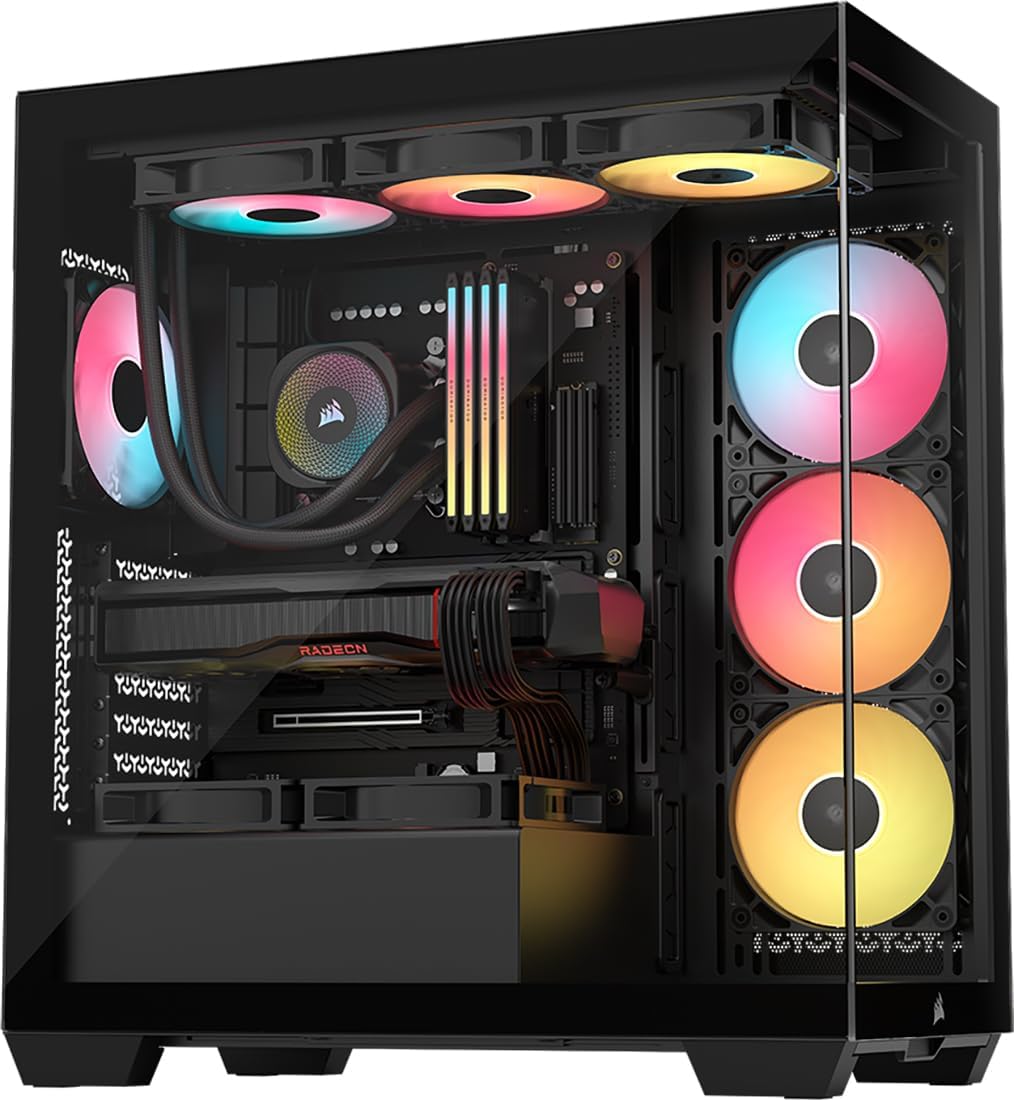
The ASUS A31 is a 4.7-rated ATX mid-tower that combines a frameless, pillar-free glass design with mainstream high-performance compatibility. It is an attractive entry for an AM5 build, particularly for builders using a rear-connect motherboard and a compact AIO liquid cooler.
We may earn a commission when you buy through this link, at no additional cost to you.
Dual-sided tempered-glass panels provide broad views of the internal components, and the pillar-free construction avoids vertical frame elements interrupting the display. The BTF Hidden Connector Design conceals modular cables behind the motherboard and aligns with ASUS BTF-style rear connections, producing a cleaner result than a conventional front-connector layout.
The case is optimized for AIO coolers with up to 80mm of clearance and supports 360mm AIO configurations. Its listed compatibility also includes mainstream RTX 5090 and RTX 4090-class builds, although the exact motherboard, graphics card, and cooler dimensions should be verified before assembly. The angled eight-degree base is designed to improve airflow and extend the visible angle.
The A31 is our top budget recommendation for a stylish AM5 build where glass presentation and clean rear-connected cabling matter. A key consideration is that no pre-installed fans are listed in the supplied specifications, so a complete build should budget for the cooling hardware required by the chosen CPU cooler and graphics card.
The hidden-connector design accommodates cables behind the motherboard rather than allowing them to cross the visible chamber. Pairing the A31 with an ASUS BTF-compatible AM5 motherboard can create one of the cleanest cable-managed layouts in the guide.
Dual frameless tempered-glass panels maximize the view of the system, while the angled base adds visual character and is intended to aid airflow. The result is a case that suits a showcase build without overlooking mainstream hardware compatibility.
We may earn a commission when you buy through this link, at no additional cost to you.
The HYTE Y50 RGB is a 4.7-rated white dual-chamber case that offers a distinctive alternative to the many black gaming enclosures in this guide. Its three-piece panoramic glass design is intended to present the AM5 components as the visual focus of the build.
We may earn a commission when you buy through this link, at no additional cost to you.
The listed fan package includes a 120mm FE12RS aRGB fan and a 360mm FE12RTR aRGB reverse-blade unibody fan, amounting to four physical fans. The large reverse-blade unit can serve as an impressive central visual element while helping move air across the main chamber. Standard aRGB and PWM connectors provide straightforward control through a compatible motherboard.
The dual-chamber architecture is compatible with ASUS BTF, Gigabyte Stealth, and MSI Project Zero motherboards, allowing the cable-management benefits of rear-connect designs. Full-size slots for horizontally mounted graphics cards provide additional placement and drive-space options. Buyers should still check the exact dimensions of a large GPU and the arrangement of the included fans.
The Y50 RGB is recommended for an AM5 builder creating a white or pastel-themed system and willing to plan the lighting and fan placement. It offers both aesthetic differentiation and a capable included fan package. Those who prefer a neutral black chassis or want a conventional motherboard layout may find other options more straightforward.
The panoramic three-piece glass layout and snow-white finish create a bright, distinctive presentation. The large reverse-blade fan provides a central lighting element that complements a coordinated white or pastel component theme.
Support for popular rear-connect motherboard standards keeps cables behind the board, while the dual-chamber structure separates power and storage areas from the main components. These features support both presentation and organized installation.
We may earn a commission when you buy through this link, at no additional cost to you.
The ASUS TUF Gaming GT502 Horizon is a 4.6-rated premium ATX mid-tower built around visual openness, independent cooling zones, and modular construction. It is a fitting enclosure for a high-end AM5 system where the motherboard, Ryzen cooler, and graphics card are intended to become the centerpiece.
We may earn a commission when you buy through this link, at no additional cost to you.
Tinted tempered-glass panels at the front and side offer an unobstructed view of the main chamber. Inside, a dual-chamber chassis divides the CPU and graphics-card cooling areas, creating separate zones that can be managed according to the heat generated by each component. The front panel includes a ten-gigabit USB Type-C connection for compatible accessories.
Tool-free side panels release by pressing a hidden button at the rear, making it easier to reach the interior during installation or maintenance. Most panels and mounting components are detachable, extending the modular concept beyond appearance. The supplied specifications do not detail the included fan count or full radiator range, so a buyer should verify the exact configuration and cooling hardware for a high-power Ryzen build.
The GT502 Horizon is the premium recommendation for someone willing to invest in a refined, expandable enclosure. Its dual zones, panoramic glass, and convenient access make it especially suitable for a polished custom build. It is less compelling for a compact or strictly budget-oriented system where those premium design elements are not central to the goal.
Dividing the chassis into two chambers allows the processor and graphics card to occupy distinct thermal zones. This focused layout can help builders direct intake and exhaust more deliberately in a system containing several heat-producing components.
Tool-free side access and detachable panels reduce the effort involved in installation and later upgrades. The modular design makes the enclosure more adaptable than a fixed-layout mid-tower while preserving its polished exterior.
We may earn a commission when you buy through this link, at no additional cost to you.
The best enclosure for an AM5 build is one that fits the selected components, supports the intended cooling strategy, and remains comfortable to assemble. Motherboard format, graphics-card length, power-supply dimensions, radiator placement, and rear connector arrangement deserve attention before choosing a color or fan style.
An AM5 build can use ATX, micro-ATX, or Mini-ITX motherboards, but the enclosure must support the chosen board and provide a sensible mounting pattern. ATX mid-towers are the broadest option in this guide, while several models also support E-ATX. A micro-ATX board will usually fit an ATX case, whereas a Mini-ITX board can create extra room for cooling or cable management in a larger enclosure.
Choose a case that explicitly supports your motherboard size and check the board's rear-panel layout. This also helps when planning a rear-connect model, whose connectors occupy the board's rear edge rather than its front surface.
Modern graphics cards can be long, thick, and power hungry, so the case's stated maximum GPU length is one of the most important compatibility checks. The guide includes limits ranging from 400mm to 460mm, along with the Cooler Master bundle's 410mm allowance. Measure the actual card rather than relying only on the product category, and also account for power-cable bend radius.
Prioritize a case with enough room for your selected GPU and front fans or radiator. Avoid ordering a large GPU for a case whose limit is close to the card's length.
An AM5 system's CPU-cooler choice directly affects the case selection. Air coolers need adequate clearance from the side panel and graphics card, while AIO units require radiator space and compatible tubing or pump placement. The Geometric Future M5 supports 420mm radiators, the FOIFKIN F600 supports three 360mm units, and the NZXT H5 Flow supports a 360mm front and 240mm top arrangement.
Match the radiator to the case's documented mounting positions and verify the cooler thickness. A simple 360mm AIO is a common choice, but the case must actually provide that mounting option.
Included fans can determine how much additional cooling hardware a build needs. Cases in this guide ship with anywhere from two to seven fans, and their orientation affects whether air enters or exhausts the main chamber. A balanced setup usually uses intake fans at the front or bottom and an exhaust fan at the rear, while a top exhaust can release rising heat.
Check whether the included fans are forward- or reverse-blade models, and consider adding a graphics-card intake fan if the case provides a side or shroud mounting point. More fans are not automatically better if their directions create conflicting airflow.
The power supply must fit both the case's PSU compartment and the selected modular unit's physical dimensions. Reported maximum lengths range from 160mm in the Geometric Future M5 to 200mm in the FOIFKIN F600, while the Cooler Master bundle includes a 650W Gold unit. Always check the power requirements of the final graphics card and processor before relying on a bundled supply.
A modular PSU can reduce clutter, but the case also needs adequate space for cable bends. Premium and modular systems make routing easier, while simpler mid-towers may require more careful cable placement behind the motherboard tray.
Rear-connect motherboards move headers and ports to the back, producing a cleaner view through glass side panels. The ASUS A31, CORSAIR 3500X RS ARGB, and HYTE Y50 RGB are explicitly described as compatible with relevant rear-connect platforms. Compatibility may require a specific board model and a suitable panel configuration, so confirm the exact motherboard before ordering.
Use a rear-connect board if cable visibility is a major concern. Otherwise, verify that the case's conventional cable channels and routing space are sufficient for the connectors on your chosen AM5 motherboard.
Tempered-glass panels improve the appearance of a visible component set, but they can add weight and make removal worthwhile during installation. Tool-free panels on the Geometric Future M5, CORSAIR 3500X RS ARGB, and ASUS TUF GT502 Horizon improve service access. ARGB fans may also require a compatible five-volt ARGB header and software support on the motherboard.
Choose removable panels if you expect frequent upgrades. Coordinate lighting effects in advance, especially when a case includes several pre-installed ARGB fans.
Storage requirements depend on the AM5 build, but a case should not force awkward compromises if drives or a boot drive are added later. The FOIFKIN F600 lists support for one hard drive and two solid-state drives, while the HYTE Y50 RGB mentions full-size slots and additional drive space for horizontally mounted graphics cards. Other cases focus more heavily on modular panels and cooling flexibility.
Inventory your current drives and likely additions before choosing. If the motherboard has limited storage connectors, make sure the enclosure also offers a practical mounting location for every drive.
Begin by installing the AM5 motherboard and CPU before finalizing the case's internal layout. Connect the power supply, storage, front-panel wires, and any rear-connect motherboard headers while the relevant components remain accessible. Confirm the CPU cooler, graphics-card thickness, and radiator position against the case specifications before tightening everything into place.
Install fans in a deliberate direction: use front or bottom positions for intake and rear or upper positions for exhaust, unless the included product instructions or reverse-blade design requires a different arrangement. Connect four-pin PWM fan headers to a suitable motherboard header or powered hub, and connect five-volt ARGB lighting to the correct header so software control works properly.
During maintenance, power down and disconnect the system before removing panels or changing hardware. Use a soft microfiber cloth to clean tempered glass and exterior surfaces, and avoid liquid cleaners that could streak the glass or affect coatings. Keep dust filters and mesh panels clear, route cables without excessive bending, and check that tool-free latches remain secure after each panel is replaced.
An ATX mid-tower is the most broadly practical option for an AM5 gaming build. It generally supports full-size ATX boards, long graphics cards, multiple fans, and large radiators without becoming difficult to manage. A compact case can work for smaller components, while a large dual-chamber enclosure benefits builders using rear-connect boards, custom cooling, or a showcase aesthetic.
A glass panel is useful for displaying the CPU cooler, graphics card, motherboard, and ARGB lighting. It is not essential for thermal performance, and some airflow-focused designs use mesh instead. If appearance is a priority, look for removable tempered glass and a pillar-free view; if serviceability is more important, prioritize easy panel access and adequate ventilation.
Most full-size ATX motherboards fit cases labeled for ATX support, but you should verify the case's specification and any size annotations. Some ATX cases have restrictions on E-ATX, graphics-card length, or power supply dimensions. Also check whether the motherboard uses rear-mounted connectors and whether those connectors align with the case's rear panel.
Pre-installed ARGB fans can save assembly time and ensure a coordinated lighting arrangement from the start. However, verify fan count, direction, connector type, and whether reverse-blade models are included. You will still need a compatible five-volt ARGB header and may need extra PWM connectors, hubs, or software support for a complete setup.
The case should provide more clearance than the graphics card's listed length, with extra space for power connectors and cable bends. The cases here support maximum lengths from 400mm to 460mm, plus the Cooler Master bundle's stated 410mm allowance. Large modern GPUs can approach these limits, so compare the exact card against the case specification before buying.
Many of the cases support 360mm radiators, but the exact mounting position and included fan arrangement matter. The Geometric Future M5 supports radiators up to 420mm, the FOIFKIN F600 can accommodate three 360mm units, and the NZXT H5 Flow supports a front 360mm radiator. Check whether the included fans occupy that mounting area and confirm AIO pump clearance.
Rear-connect motherboards can produce a cleaner interior because cables connect at the back of the board instead of crossing the visible chamber. Compatibility is specific, so the motherboard and case must both support the same arrangement. Several cases in this guide are validated for ASUS BTF, MSI Project Zero, or Gigabyte Project Stealth platforms.
It depends on the selected case and cooling plan. The NZXT H5 Flow, CORSAIR 4000D RS ARGB Frame, and CORSAIR 3500X RS ARGB include three fans, the ASUS A31 specification does not list included fans, and the FOIFKIN F600 includes seven. Additional fans may still be useful for a dedicated graphics-card intake or a more complete liquid-cooling arrangement.
The Geometric Future M5 is the strongest all-around choice for a high-performance system that values cooling capacity, substantial hardware clearance, and a complete fan package. The CORSAIR 4000D RS ARGB Frame is equally compelling for builders who prioritize modularity and adaptable fan placement, while the ASUS TUF GT502 Horizon leads the premium selection with independent cooling chambers and a refined panoramic design.
For value-focused builders, the ASUS A31 stands out through its dual glass panels, rear-connect support, and 360mm AIO capability. Other useful alternatives include the Fan-Ready FOIFKIN F600, the panoramic CORSAIR 3500X RS ARGB, the complete Cooler Master HAF 500 Pro Bundle, the compact NZXT H5 Flow, the white HYTE Y50 RGB, and the green-accented Geometric Future M5.
Before purchasing, confirm the motherboard format, graphics-card length, power-supply dimensions, CPU-cooler height, radiator position, and connector layout against the manufacturer's specifications. Product ratings, availability, and prices can change over time, so check the current listing and recent customer feedback before completing your AM5 build.