
TPA3116D2 Dual Channel Class D Amplifier
4.3Editor score
Efficient digital amplification
Dual-channel module design
Comprehensive fault protection
Class D audio amplifier board guide comparing output power, channel layouts, protection features, connectivity, cooling, and ideal uses for DIY audio projects.
A Class D audio amplifier board converts low-voltage DC power into a powerful, efficient audio signal for speakers. Because these compact modules can suit multichannel, home-theater, car-audio, and DIY projects, the right choice depends on output needs, speaker impedance, cooling, input options, and available enclosure space.
This guide compares ten amplifier boards using their published specifications, including rated output, channel configuration, protection circuitry, cooling, input methods, dimensions, and intended applications. The list ranges from compact dual-channel modules to high-output units designed for demanding speaker loads, allowing buyers to compare practical features rather than relying on wattage alone.
Each review explains the strongest reason to consider a particular board, along with the limitations revealed by its specifications. The top three selections represent the strongest all-around, value-oriented, and premium options in this group. Product listings and prices can change, so readers should verify current details and compatibility before purchasing.
4.3Editor score

5.0Editor score

5.0Editor score
The table below compares all ten boards by channel count, headline output, cooling approach, and key capability, making it easier to narrow the field before checking enclosure space, speaker impedance, and power-supply requirements.

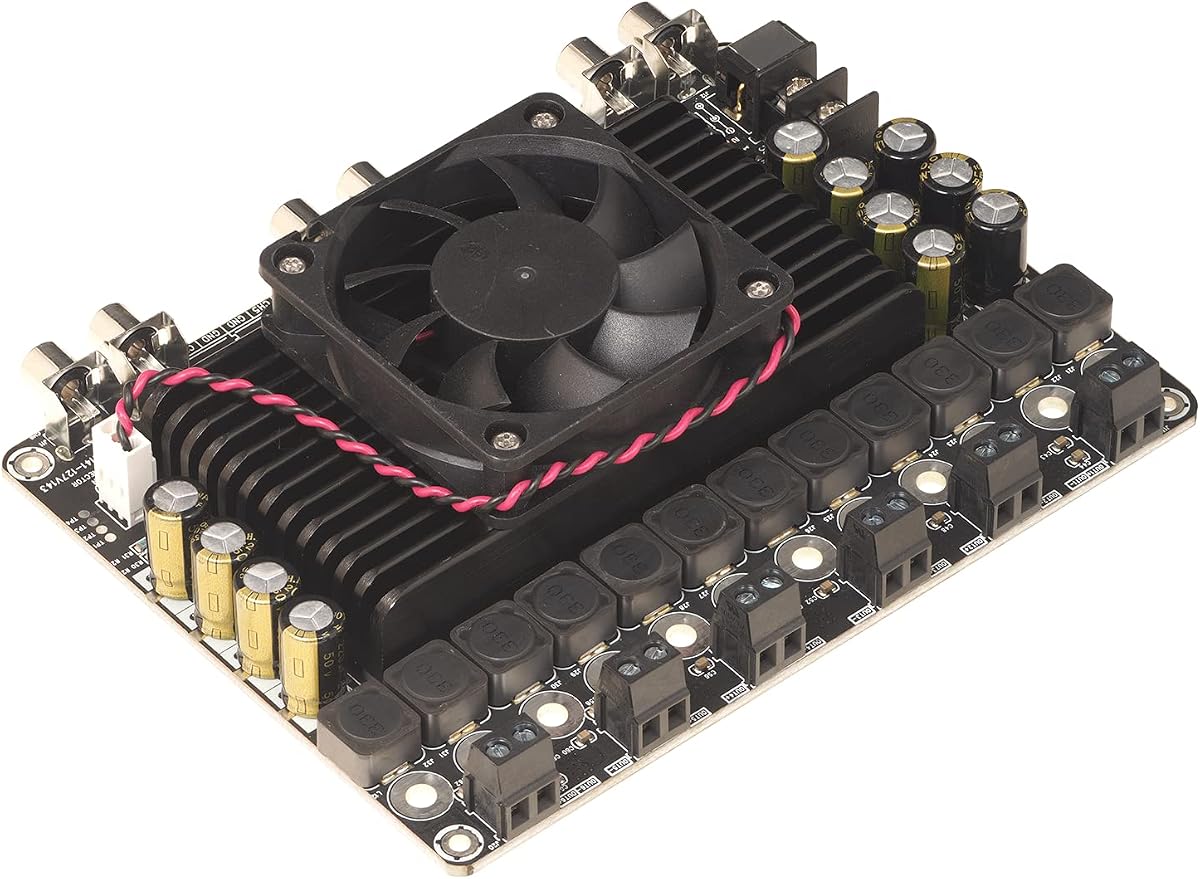

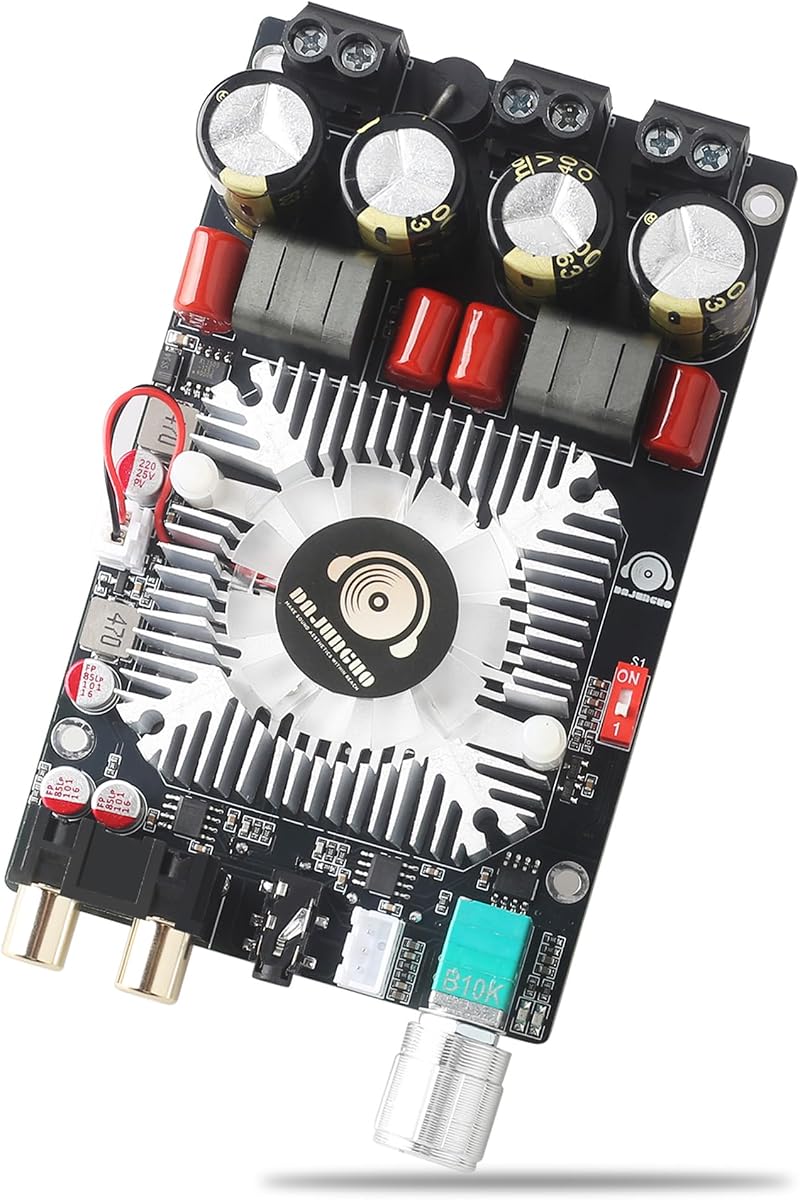


The 4 x 100Watt Class D Audio Amplifier Board is a strong all-around selection for builders who need several amplified channels from one module. It carries a 5.0 rating, and its most immediately useful feature is the four-channel balanced architecture, which can support surround-style speaker layouts without requiring four separate amplifier boards.
We may earn a commission when you buy through this link, at no additional cost to you.
Its published output is 100 watts at 4 ohms with 27V DC when measured at 10 percent THD+N, while output falls to 69 watts under the stricter 1 percent THD+N condition. That distinction matters for buyers who want realistic power expectations. The board also includes a working indicator, BTL architecture, overcurrent protection, and overtemperature protection, giving it a well-rounded feature set for a permanent installation.
The main trade-off is its specified 27V operating requirement. A builder accustomed to low-voltage modules may need a more capable supply, and the listing does not identify the available input connectors, which could complicate integration with an existing preamp. Even so, the combination of four channels, a 100-watt headline rating, protective circuitry, and a 6.00 by 4.50 by 1.30-inch enclosure makes this a versatile choice.
This is the most practical recommendation for a multichannel DIY speaker system, home-theater expansion, or compact installation that needs more than stereo. It is less suitable for someone seeking plug-and-play input flexibility or operation from a basic 12V source. Buyers should confirm the power supply, wiring arrangement, and enclosure ventilation before committing.
The four-channel configuration reduces the number of modules needed for a surround or multi-zone installation. Its 100-watt headline output is suitable for many powered-speaker applications when paired with compatible 4-ohm loads and an appropriate 27V supply.
Overcurrent and overtemperature protection are valuable for boards installed in furniture, cabinets, or other enclosed spaces. The working indicator also makes basic system-status checks more convenient.
We may earn a commission when you buy through this link, at no additional cost to you.
The 1 x 200Watt Class D Audio Amplifier Board is designed for builders who need substantial power in one channel rather than a balanced stereo or surround configuration. Its 5.0 rating reflects a broadly positive customer response, while the headline 200-watt output makes it appealing for a subwoofer, high-output monitor, or dedicated mono speaker.
We may earn a commission when you buy through this link, at no additional cost to you.
The board is rated at 200 watts into a 3-ohm load with 34V DC and 10 percent THD+N. At the more demanding 1 percent THD+N level, it still produces 150 watts, which is a useful figure for judging sustained output. A power and clip indicator, temperature-control fan, and support for the VC01 volume-control board make it easier to integrate into a purpose-built amplifier enclosure.
Its chief limitation is the single-channel architecture. It may be less convenient than a two- or four-channel module for ordinary stereo listening, and the listed 3-ohm load should be treated as a specific compatibility point rather than a universal invitation to connect any speaker. The 34V supply requirement also places it beyond basic automotive-style power systems.
Choose this board for a dedicated high-output mono application where its 200-watt ceiling and lower-distortion 150-watt figure are more useful than multi-channel flexibility. It is best suited to experienced builders comfortable selecting a suitable power supply and respecting the stated 3-ohm configuration.
The 200-watt headline specification gives the module useful headroom for a subwoofer or other power-hungry mono driver. More importantly, the listed 150-watt result at 1 percent THD+N provides a more conservative basis for system planning.
Compatibility with the VC01 volume board gives users an optional way to add level control. The power and clip indicators and automatic temperature-control fan simplify monitoring and thermal management.
We may earn a commission when you buy through this link, at no additional cost to you.
The 6 x 100Watt Class D Audio Amplifier Board is built for projects that require more channels than a conventional stereo amplifier can provide. It earns a 5.0 rating and uses the TDA7498 platform, offering six balanced channels with a 100-watt headline output for each one.
We may earn a commission when you buy through this link, at no additional cost to you.
The specification lists 100 watts at 6 ohms with 36V DC and 10 percent THD+N, plus 70 watts at the same load and voltage with 1 percent THD+N. Its 6-ohm compatibility makes it relevant for common home-theater and multi-room speaker systems where many passive speakers are designed around 6-ohm nominal loads. A working indicator and temperature-control fan support routine installation and operation.
This board requires a 36V DC source, the highest stated operating voltage in the group, and that must be considered before installation. The listing also does not specify input connectors or a separate volume-control function. Its relatively tall 1.53-inch depth and greater channel count may also require careful enclosure planning.
For a large surround system, distributed audio installation, or any project with five or six passive speaker zones, this is a compelling consolidated solution. It is less appropriate for a small stereo setup where a two-channel module would be simpler. The key question is whether the required supply, channel count, and 6-ohm target align with the rest of the system.
Consolidating six amplified channels can simplify large surround or multi-zone installations by reducing the number of separate amplifier units. The 6-inch by 4.5-inch footprint remains compact despite the higher channel count.
The listed 6-ohm specification is particularly relevant for conventional passive home-theater speakers. Buyers should still verify each speaker's impedance and ensure the wiring does not create loads outside the board's intended operating conditions.
We may earn a commission when you buy through this link, at no additional cost to you.
The Clyxgs TPA3116D2 is an efficient and versatile dual-channel module for entry-level stereo builds, car audio experiments, computer-speaker projects, and compact home-theater systems. Its 4.3 rating is lower than the 5.0 scores assigned to several larger T-AMP boards, but the module offers a practical combination of efficiency, protection, and broad voltage support.
We may earn a commission when you buy through this link, at no additional cost to you.
Its TPA3116D2 power stage is described as delivering more than 90 percent efficiency with low idle loss. The integrated protection system covers overvoltage, undervoltage, overheating, DC detection, and short circuits, making it especially appealing for experimental installations. European-style three-pin wiring terminals and surface-mounted capacitors add construction convenience, while the large heatsink uses convection for heat dissipation.
One notable drawback is that the supplied information does not state a clear per-channel wattage figure. That makes it harder to compare the board directly with products listing 50, 100, 200, or 500 watts. The rating of 4.3 also suggests the customer experience has been somewhat less uniformly positive than that of the leading five-rated products, although the board remains highly practical.
This is the best value-oriented pick for a builder who prioritizes efficiency, fault protection, and a manageable 12–26V supply range over a headline wattage claim. It is especially well matched to car, computer-speaker, and small home-theater projects. Confirm the module's input connections and load requirements in the current listing before finalizing a build.
The stated efficiency above 90 percent reduces waste heat compared with many less-efficient amplifier approaches. That makes the module well suited to compact enclosures where cooling space is limited.
Integrated detection for overvoltage, undervoltage, overheating, DC offset, and short circuits gives DIY builders several layers of system safeguards. Protection supports reliability but does not remove the need to observe polarity and wiring limits.
We may earn a commission when you buy through this link, at no additional cost to you.
The 2 X 500Watt Class D Audio Amplifier Board is a high-output stereo option for serious DIY speaker projects, subwoofers, and efficiently driven passive speakers. It carries a 5.0 rating and reaches 500 watts per channel into 3 ohms with a 48V DC supply at 10 percent THD+N.
We may earn a commission when you buy through this link, at no additional cost to you.
The stricter measurement is also impressive: the board produces 260 watts per channel at 1 percent THD+N under the same stated conditions. It includes a temperature-control fan, power and clip indicators, and compatibility with the VC01 volume-control board. Its 4.80 by 3.60 by 1.53-inch size is also relatively compact for a module offering this much headline power.
The trade-off is system complexity. A 48V DC supply is outside the range of many common project supplies, and 3-ohm loading may not match the impedance of ordinary home speakers. Users must account for the substantial current and thermal demands associated with operation near the headline rating. The board is powerful, but it is not automatically suitable for every speaker.
This is a strong recommendation for experienced builders who need true high-power stereo amplification and can design a suitable 48V power stage. It may also serve a dual-subwoofer arrangement when used in mono configuration. Buyers should prioritize correct load compatibility and professional-grade wiring over being impressed by the headline figure alone.
The 500-watt headline output is most relevant to high-efficiency speakers or subwoofers designed for substantial amplifier power. The listed 260-watt result at 1 percent THD+N gives users a more realistic figure for cleaner, sustained output.
At 4.80 by 3.60 inches, the board maintains a relatively small footprint despite its high-output specification. A fan and indicators make it easier to manage in a custom enclosure, although adequate airflow remains essential.
We may earn a commission when you buy through this link, at no additional cost to you.
The DAJUNGUO ZK-2202 stands out for its unusually flexible set of analog inputs and configurable output modes. It has a 4.6 rating, uses dual TPA3251 chips, and is specified to deliver 220 watts per channel in stereo or 350 watts in bridged mono operation.
We may earn a commission when you buy through this link, at no additional cost to you.
The board accepts RCA, AUX, and XH2.54-3P inputs while retaining an analog signal path. A DIP switch activates bridged mode, and the product data clearly warns that power must be switched off before changing modes. The 12–36V DC input range is broad enough for car, home-theater, and portable-system concepts, while the cooling fan is intended to support stable operation at high output.
The main integration rule is that only one input can be active at a time. Connecting several sources simultaneously may produce interference, so the board is more flexible in its connection formats than in simultaneous source switching. Its stated 0.03 percent THD figure is another reason to examine the product carefully against less ambitious competitors.
This is a compelling choice for a builder who wants stereo and mono flexibility without replacing the amplifier module. It suits experienced users comfortable changing configuration safely. For plug-and-play users, the requirement to deactivate the board before changing modes and avoiding multiple simultaneous inputs adds a small amount of setup discipline.
RCA, AUX, and XH2.54-3P connections make it easier to adapt the module to different preamps, adapters, and custom signal sources. Only one input should be active at a time to prevent signal interference.
The DIP-controlled bridged mode turns the board into a higher-output mono amplifier for a subwoofer or other single driver. Always power the board off before changing the switch position to avoid damaging the circuitry.
We may earn a commission when you buy through this link, at no additional cost to you.
The 1000W Digital Amplifier Board is the feature-rich premium selection in this group, with a 5.0 rating and a strong emphasis on thermal control and component selection. Its headline 1000-watt figure immediately attracts attention, although the supplied information does not break that number down by channel, load, voltage, or distortion.
We may earn a commission when you buy through this link, at no additional cost to you.
Its standout feature is the adjustable temperature threshold located at the base of the heat sink. A strategically positioned top-mounted fan dissipates heat while reducing overall board height, which can make enclosure planning easier. The board uses tantalum capacitors, bipolar sound capacitors, and other carefully selected components, and the manufacturer describes the design as extensively debugged and refined by experienced engineers.
The limitation is measurement detail. Without a channel count, specified load impedance, supply-voltage range, or THD+N figures, it is difficult to compare the board's real output with the precisely stated products in the list. Buyers should therefore treat 1000 watts as a headline feature rather than a complete engineering specification.
The board is best suited to an enthusiast who values cooling customization and premium component construction, particularly when designing a custom power-amplifier enclosure. It may be an attractive centerpiece for a music system, but careful review of the current technical listing is essential before connecting expensive speakers or building a fixed power supply.
The adjustable temperature trigger lets an installer align fan operation with the enclosure, ambient conditions, and system workload. This is useful in compact builds where noise, airflow, and thermal margins need careful balance.
Tantalum capacitors and bipolar sound capacitors form part of the board's component-selection strategy. The manufacturer also emphasizes engineering refinement, although buyers should request or verify complete output conditions before relying on the headline wattage.
We may earn a commission when you buy through this link, at no additional cost to you.
The TPA3116D2 Stereo Amplifier Boards 2-Pack is a practical way to assemble a stereo system because it includes two modules rather than one. Each board is a dual-channel amplifier rated at 50 watts per channel, and the pair can therefore be used for separate stereo zones or combined to create a four-channel arrangement.
We may earn a commission when you buy through this link, at no additional cost to you.
The boards use the original TDA3116D2 device and incorporate high-performance inductors and capacitors. They operate from 4.5–26V DC, with 24V recommended, making them adaptable to many power arrangements. Reverse-connection protection helps reduce installation errors, while short-circuit, thermal, overvoltage, undervoltage, and DC protection cover several common failure conditions.
The 4.3 rating is the primary reason this pair does not rank above similarly compact dual-channel alternatives in the list. It also does not list the amount of usable output at lower distortion, so the 50-watt figure should not be mistaken for guaranteed clean output under every operating condition. Users still need to provide a suitable supply and connect each board correctly.
Choose this two-pack when you want a matched pair of stereo boards or a way to build a four-channel amplifier from compact modules. It is well suited to home-theater, store-display, and square-speaker projects mentioned in the product information. The broad voltage range and extensive protection make it flexible for knowledgeable DIY installers.
Two included modules simplify a matched stereo build and make it easy to create four channels from a single product purchase. The setup is useful for home-theater, demonstration, and multi-room speaker projects.
Reverse-polarity, short-circuit, thermal, voltage, and DC protection provide useful safeguards during assembly. These features reduce risk, but correct wiring and a properly sized supply remain the buyer's responsibility.
We may earn a commission when you buy through this link, at no additional cost to you.
The IRS2092S 500W Class D board is the smallest-footprint high-output option in the comparison, measuring 3.94 by 1.65 by 1.38 inches. That dimensional advantage makes it appealing for custom home-theater or compact portable enclosures where every inch matters. Its 500-watt output is specified for a 4-ohm load.
We may earn a commission when you buy through this link, at no additional cost to you.
The module is described as achieving more than 90 percent efficiency with minimal heat generation and low distortion. Its stated frequency response covers 20Hz to 20kHz, which encompasses the conventional full-range audio spectrum. Protection against output short circuits, DC bias, and overheating helps safeguard the board and connected equipment.
The principal drawback is the absence of a customer rating, so there is no visible star-score history to support the product's value. The specifications also do not state the required supply voltage, channel arrangement, or output at a defined THD+N level. Those omissions make direct technical comparison less precise than with the better-documented boards.
This module makes sense for an experienced builder who prioritizes compact size, efficiency, and a stated 500-watt capability for a 4-ohm speaker. It may work particularly well in a tightly constrained custom enclosure. Because independent customer feedback is unavailable, buyers should confirm pinout, supply requirements, cooling needs, and input connections directly from the current documentation.
At 3.94 by 1.65 inches, the module leaves more room for speakers, ventilation, and wiring in a compact enclosure. Its size is especially notable alongside the board's 500-watt headline rating.
The stated efficiency above 90 percent supports lower heat production, while the 20Hz–20kHz response covers the standard audible range. The listed short-circuit, DC-bias, and overtemperature safeguards add practical protection for a DIY installation.
We may earn a commission when you buy through this link, at no additional cost to you.
The 3 X 500Watt Class D Audio Amplifier Board is the premium high-power choice because it combines three channels with a 500-watt headline rating for each. It holds a 5.0 rating and reaches 312 watts per channel at the more stringent 1 percent THD+N level when operated at 50V DC into 3 ohms.
We may earn a commission when you buy through this link, at no additional cost to you.
This level of output makes the board relevant to serious high-efficiency speaker systems, large subwoofers, and professional-style passive installations. A temperature-control fan manages heat, while overcurrent and overtemperature protection reduce the risk of operating the module beyond its intended limits. A power indicator provides a simple way to check system status.
The trade-offs are significant. It requires a 50V DC supply, the highest operating voltage among the products listed here, and its published output assumes a 3-ohm load. The 6.00 by 4.50 by 1.48-inch size is manageable, but the electrical and thermal demands are not appropriate for every hobby project or entry-level enclosure.
For an experienced builder creating a three-channel high-output system, this is the most capable option in the group. It is particularly compelling for a cinema amplifier with two surround channels and a subwoofer, provided the speakers and supply are designed for the stated conditions. Buyers should treat the 312-watt cleaner-output figure as a more useful planning target than the 500-watt headline claim.
Three balanced output channels support a cinema-style two-surround-plus-subwoofer arrangement or another three-zone passive system. Combining the channels in one module can simplify wiring and reduce the number of separate amplifiers needed.
The 312-watt figure at 1 percent THD+N is more informative than the 500-watt headline rating alone. It indicates a substantial clean-power ceiling under the stated 50V and 3-ohm test conditions.
We may earn a commission when you buy through this link, at no additional cost to you.
Choosing a Class D audio amplifier board requires balancing channel count, usable clean power, speaker impedance, supply requirements, protection, and thermal design. The headline wattage is only one part of a board's suitability, and the best option for a compact stereo project may be very different from one intended for a high-output cinema amplifier.
A wattage figure is meaningful only when it is paired with its test conditions. In this comparison, some products state 500 watts at 10 percent THD+N, while others publish a lower figure at 1 percent THD+N. The stricter 1 percent figure is generally more useful for estimating output that should remain reasonably clean, although frequency, test method, and channel loading can still affect comparisons.
Also check whether the rating is per channel, total output, stereo, or bridged mono. The 2 X 500Watt board reports 500 watts per channel at 3 ohms, whereas the DAJUNGUO ZK-2202 reports 220 watts per channel in stereo and 350 watts in bridged mode. Compare like configurations rather than selecting solely by the largest number.
Prioritize the complete output specification. Treat headline wattage as a maximum or marketing shorthand unless it includes a defined load, supply voltage, and distortion target.
Start by counting the passive speaker channels that actually need amplification. A two-channel module suits conventional stereo, while four- and six-channel boards serve surround and multi-zone installations. The TPA3116D2 two-pack offers a different route: two dual-channel modules can create four channels or serve two separate stereo systems.
The 3 X 500Watt board is particularly relevant to a three-channel cinema arrangement. The four-channel T-AMP may be more natural for a four-speaker surround layout, while the six-channel TDA7498 board can cover larger or more distributed systems. Consider whether every channel needs the same output level or whether a subwoofer deserves a more powerful mono channel.
Choose the channel count that matches the project without adding unnecessary bulk, complexity, or idle power consumption. A more elaborate board is not automatically better for a small installation.
Impedance is the electrical load presented by each speaker, and it directly affects amplifier output, current draw, and thermal stress. Several of the T-AMP boards are published around 3-ohm loads: the single-channel 200-watt board, the dual-channel 500-watt board, and the three-channel 500-watt board all specify 3-ohm operation.
Other options target different loads. The 4 x 100Watt and 6 x 100Watt boards are listed at 4 and 6 ohms respectively, while the 4–8-ohm recommendation on the TPA3116D2 two-pack is broad. The IRS2092S board is specified at 4 ohms. Never assume a board will drive an impedance below its published load.
Read the manual and confirm whether multiple speakers may be wired in parallel. A nominally compatible speaker can still create a load the board was not designed to handle, so the full wiring plan should be checked before assembly.
Class D boards convert DC power into audio output, so the supply must provide adequate voltage and current. The listed boards range from a broad 4.5–26V operating range on the TPA3116D2 two-pack to a 50V input on the 3 X 500Watt board. The 27V, 34V, 36V, and 48V models fall between those extremes.
A higher voltage can unlock the board's stated output, but it also places greater demands on the supply, wiring, connectors, and enclosure. Builders should use a supply with suitable current capacity and stable output rather than assuming any adapter with the correct voltage will do.
Check polarity, grounding method, and any manufacturer recommendations before connection. For automotive, portable, or home-theater use, the entire power path should be designed for continuous current draw and appropriate safety.
Class D efficiency helps control waste heat, but high-output boards still need thermal management. Several products include temperature-controlled fans, and the 1000W board adds an adjustable trigger at the base of its heatsink. The DAJUNGUO ZK-2202 also uses a cooling fan, while the TPA3116D2 boards use a large heatsink and convection-oriented dissipation.
Measure both the board and any required clearance around its heatsink or fan. A fan needs unobstructed airflow, and an enclosure should not trap heat around the amplifier. Fans may also introduce audible noise in a quiet listening room, so placement matters.
Consider actual output needs rather than maximum capacity. A compact 50-watt module may run cool and quiet in a small project, while a 500-watt design may need a substantial enclosure and deliberate airflow.
Protection circuitry helps guard against mistakes, overheating, and electrical faults. The options in this guide variously mention overcurrent, overtemperature, undervoltage, overvoltage, DC detection, reverse-connection, and short-circuit protection. These safeguards are especially useful in DIY systems where wiring errors are more likely.
Indicators provide additional convenience. Working, power, and clip lights can reveal whether a board is receiving power or entering clipping, although indicator behavior is not a substitute for accurate metering. The ZK-2202's DIP-switched bridged mode also comes with an explicit instruction to power off before switching.
Choose a board with safeguards appropriate to the environment, but continue to observe polarity, load, and voltage limits. Protection is a safety net rather than permission to operate outside the manufacturer's specifications.
Input connections determine how easily a board can accept audio from an existing system. The DAJUNGUO ZK-2202 is the clearest choice here because it offers RCA, AUX, and XH2.54-3P analog inputs. The TPA3116D2 module uses European-style three-pin wiring terminals, while several T-AMP listings do not specify their input format in the supplied information.
Analog inputs avoid digital compression and can be flexible for DIY projects, but they still require a preamplifier or other source capable of producing a suitable line-level signal. The ZK-2202 also allows only one input to be active at a time, so multiple formats do not equal simultaneous source selection.
Confirm the connector layout, signal level, and whether a volume-control board is required. A dedicated volume board, such as the supported VC01 accessory, can improve usability in a custom amplifier.
An amplifier board is only one component of a functioning audio system. Include the speaker sensitivity and impedance, source quality, enclosure acoustics, power supply, wiring, preamplification, and ventilation in the design. A powerful board paired with low-sensitivity speakers may not create the perceived volume or sound quality that its wattage suggests.
The broad use cases in the product data range from car audio and computer speakers to home theaters, square speakers, and high-power music systems. The best choice should fit the actual environment rather than the most ambitious specification available.
Build a complete parts list and verify that every component is compatible before purchasing. This reduces the likelihood of discovering an unsuitable speaker impedance, insufficient supply, or missing input connection after the amplifier has arrived.
Before connecting any board, disconnect the DC power and read the available documentation. Identify the input, speaker outputs, power terminals, ground connection, and any configuration switches. Check speaker impedance against the published load, verify the required supply voltage, and plan the wiring before placing the amplifier inside its enclosure.
Connect the audio source first with the amplifier powered down, then wire the speakers with correct polarity. Make the DC connection last, observe all voltage and current requirements, and power the system in stages so that a wiring error is easier to isolate. If a board offers stereo and bridged modes, switch it off completely before changing configuration.
For long-term use, provide unobstructed airflow, secure every connection, and monitor the indicators for overheating or clipping. Keep the board away from moisture and conductive debris, avoid exceeding the specified load, and periodically inspect the heatsink, fan, terminals, and wiring. If distortion, unusual noise, or excessive heat appears, disconnect power and investigate before reconnecting the system.
It is a module containing a digital power-amplification stage that converts DC power into an audio signal for passive speakers. Class D designs are known for high efficiency, compact construction, and low heat generation compared with many older amplifier topologies. Actual performance still depends on the power supply, speaker load, cooling, and signal quality.
The right amount depends on speaker sensitivity, impedance, room size, and how loudly you listen. High-efficiency speakers may sound powerful with considerably less amplifier power than low-efficiency models. Use the board's output at its specified 1 percent THD+N condition as a conservative target, and avoid selecting a module only by its largest headline wattage.
Yes, as long as the board has enough channels and the resulting wiring remains within its impedance and power specifications. Connecting speakers in parallel lowers the load seen by the amplifier, so buyers should verify the manual and avoid presenting an impedance below the published limit.
The required voltage depends on the module, and current capacity must match the expected load. In this group, listed operating voltages range from 4.5–26V on the TPA3116D2 two-pack to 50V on the 3 X 500Watt board. Use a stable DC source with adequate continuous current rather than a generic supply selected only by voltage.
A line-level source is generally required, and many bare amplifier modules do not include convenient user-facing volume control. The 1 x 200Watt and 2 X 500Watt boards are listed as supporting the VC01 volume-control board, while other systems may need an external preamp or attenuator.
Bridging can be safe when the board explicitly supports the configuration and the correct terminals are used. On the DAJUNGUO ZK-2202, the DIP switch activates bridged operation, but the board must be powered off before changing modes. Improper bridging can damage the module, speakers, or connected equipment.
Cooling is essential, particularly for high-output boards or installations in enclosed furniture. Active fan cooling appears on several high-power models, while other boards rely on a large heatsink and convection. Keep all vents and fans unobstructed and leave adequate clearance around the board.
Not always. Some figures specify 10 percent THD+N, while others provide a lower output at 1 percent THD+N. Load impedance, supply voltage, channel count, and test method also differ. Compare the full conditions and use the cleaner-output figure when planning a system.
The 4 x 100Watt Class D Audio Amplifier Board is the strongest overall choice for multichannel projects, combining four balanced outputs, a 5.0 rating, protection, and useful indicators. The TPA3116D2 Dual Channel Class D Amplifier is the best value pick for efficient DIY stereo, while the 3 X 500Watt Class D Audio Amplifier Board represents the premium high-power choice for experienced three-channel installations.
Prioritize the specification that matches the actual project rather than the biggest number available. Confirm speaker impedance, supply voltage, channel requirements, input connections, and enclosure cooling before purchasing. A lower-output board that suits the speakers and installation is more likely to produce a reliable result than an oversized module operated outside its intended conditions.
Product listings, ratings, and prices can change, so check the current details and seller information before ordering. Review the manufacturer's instructions, especially for power-off mode switching and load restrictions, and ensure the full system has been designed around safe electrical and thermal limits.